

The DOI matches its Crossref record; 42 of the 42 references it cites were found in a registry or an index.
Sarcopenia and physical independence in older adults: the independent and synergic role of muscle mass and muscle function
Open accessAbstract
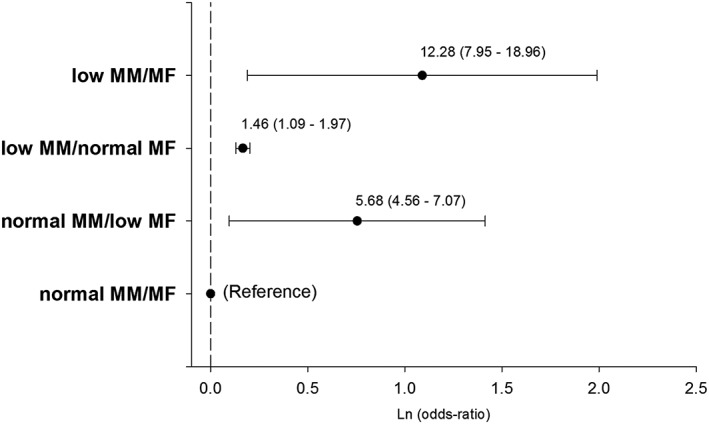
Background: The loss of skeletal muscle mass (MM) or muscle function (MF) alone increases the risk for losing physical independence in older adults. We aimed to examine the independent and synergic associations of low MM and low MF, both criteria of sarcopenia, with the risk for losing projected physical independence in later life (+90 years old). Methods: Cross‐sectional analyses were conducted in 3493 non‐institutionalized older adults (1166 males). Physical independence was assessed with a 12‐item composite physical function scale. Logistic regression was used to estimate the odds‐ratio (OR) for being at risk for losing physical independence. Results: Approximately 30% of the participants were at risk for losing physical independence at 90 years of age. Independent analysis demonstrated that participants with low MM had 1.65 (95%CI: 1.27–2.31) increased odds for being at risk for losing physical independence and participants with low MF had 6.19 (95%CI 5.08–7.53) increased odds for being at risk. Jointly, having a low MM and a low MF increased the risk for losing physical independence to 12.28 (95%CI 7.95 to 18.96). Conclusions: Although low MM represents a risk factor for losing physical independence, low MF seems to play a more dominant role in this relationship, with the presence of both sarcopenia criteria representing a substantial risk for losing physical independence in later life.
Overview
The claims and statistics of this paper haven’t been checked yet.
Run the check — free, no account needed. It reads the open-access text and checks the sources it cites.
Integrity signals
Registry
Cites
Statistics
Figures
Verification
Claims the paper makes
The claims and statistics of this paper haven’t been checked yet.
Run the check — free, no account needed. It reads the open-access text and checks the sources it cites.
Claims other papers make about this one
Each is checked against this paper’s own text: does it say what the citing paper says it does?
The cited source says what the claim attributes to it.
In the citing paper
“Muscular strength, de fi ned as the ability to apply force to an external resistance or object, 11 is a predictor of functional decline, 12 -14 deteriorating by w 15% every decade beyond 50 years of age 15 and by 3.4% annually in people aged . 75 years. 16”
From High-velocity power training has similar effects to traditional resistance training for functional performance in older adults: a systematic review (2023) · cites this paper as [12]
Self-check
Percentages, sums and reported differences re-computed from the paper’s own numbers.
The self-check needs the paper’s full text.
Citations
Cites
Sarcopenia: European consensus on definition and diagnosis
Cruz-Jentoft, A. J., Baeyens, J. P., Bauer, J. M., Boirie, Y., Cederholm, T., Landi, F., Martin, F. C., Michel, J.-P., Rolland, Y., Schneider, S. M., et al. (2010) · Age and Ageing · doi:10.1093/ageing/afq034 · Cited by 11,601
Fried, L. P., Ferrucci, L., Darer, J., Williamson, J. D., & Anderson, G. (2004) · The Journals of Gerontology Series A: Biological Sciences and Medical Sciences · doi:10.1093/gerona/59.3.m255 · Cited by 4,032
Epidemiology of Sarcopenia among the Elderly in New Mexico
Baumgartner, R. N., Koehler, K. M., Gallagher, D., Romero, L., Heymsfield, S. B., Ross, R. R., Garry, P. J., & Lindeman, R. D. (1998) · American Journal of Epidemiology · doi:10.1093/oxfordjournals.aje.a009520 · Cited by 4,004
Fielding, R. A., Vellas, B., Evans, W. J., Bhasin, S., Morley, J. E., Newman, A. B., Abellan van Kan, G., Andrieu, S., Bauer, J., Breuille, D., et al. (2011) · Journal of the American Medical Directors Association · doi:10.1016/j.jamda.2011.01.003 · Cited by 3,256
Goodpaster, B. H., Park, S. W., Harris, T. B., Kritchevsky, S. B., Nevitt, M., Schwartz, A. V., Simonsick, E. M., Tylavsky, F. A., Visser, M., Newman, A. B., et al. (2006) · The Journals of Gerontology Series A: Biological Sciences and Medical Sciences · doi:10.1093/gerona/61.10.1059 · Cited by 3,083
A 30-s chair-stand test as a measure of lower body strength in community-residing older adults.
Jones, C. J., Rikli, R. E., & Beam, W. C. (1999) · Research Quarterly for Exercise and Sport · doi:10.1080/02701367.1999.10608028 · Cited by 2,921
Anthropometric Standardization Reference Manual
Lohman, T. J., Roache, A. F., & Martorell, R. (1992) · Medicine & Science in Sports & Exercise · doi:10.1249/00005768-199208000-00020 · Cited by 2,764
Studenski, S. A., Peters, K. W., Alley, D. E., Cawthon, P. M., McLean, R. R., Harris, T. B., Ferrucci, L., Guralnik, J. M., Fragala, M. S., Kenny, A. M., et al. (2014) · The Journals of Gerontology: Series A · doi:10.1093/gerona/glu010 · Cited by 2,545
Newman, A. B., Kupelian, V., Visser, M., Simonsick, E. M., Goodpaster, B. H., Kritchevsky, S. B., Tylavsky, F. A., Rubin, S. M., Harris, T. B., & on Behalf of the Health, A. A. B. C. S. I. (2006) · The Journals of Gerontology Series A: Biological Sciences and Medical Sciences · doi:10.1093/gerona/61.1.72 · Cited by 1,692
Mitchell, W. K., Williams, J., Atherton, P., Larvin, M., Lund, J., & Narici, M. (2012) · Frontiers in Physiology · doi:10.3389/fphys.2012.00260 · Cited by 1,377
Rikli, R. E., & Jones, C. J. (2012) · The Gerontologist · doi:10.1093/geront/gns071 · Cited by 1,107
Clark, B. C., & Manini, T. M. (2008) · The Journals of Gerontology Series A · doi:10.1093/gerona/63.8.829 · Cited by 876
Dynapenia and aging: an update
Manini, T. M., & Clark, B. C. (2012) · The Journals of Gerontology: Series A · doi:10.1093/gerona/glr010 · Cited by 875
Lee, R. C., Wang, Z., Heo, M., Ross, R., Janssen, I., & Heymsfield, S. B. (2000) · The American Journal of Clinical Nutrition · doi:10.1093/ajcn/72.3.796 · Cited by 854
Sarcopenia: characteristics, mechanisms and functional significance
Narici, M. V., & Maffulli, N. (2010) · British Medical Bulletin · doi:10.1093/bmb/ldq008 · Cited by 827
Delmonico, M. J., Harris, T. B., Lee, J., Visser, M., Nevitt, M., Kritchevsky, S. B., Tylavsky, F. A., Newman, A. B., & for the Health, A. A. B. C. S. (2007) · Journal of the American Geriatrics Society · doi:10.1111/j.1532-5415.2007.01140.x · Cited by 819
Morley, J. E., Anker, S. D., & von Haehling, S. (2014) · Journal of Cachexia Sarcopenia and Muscle · doi:10.1007/s13539-014-0161-y · Cited by 633
Lenk, K., Schuler, G. C., & Adams, V. (2010) · Journal of Cachexia Sarcopenia and Muscle · doi:10.1007/s13539-010-0007-1 · Cited by 498
Rikli, R. E., & Jones, C. J. (1998) · Journal of Aging and Physical Activity · doi:10.1123/japa.6.4.363 · Cited by 455
An evidence-based comparison of operational criteria for the presence of sarcopenia
Dam, T.-T., Peters, K. W., Fragala, M., Cawthon, P. M., Harris, T. B., McLean, R., Shardell, M., Alley, D. E., Kenny, A., Ferrucci, L., et al. (2014) · The Journals of Gerontology Series A: Biological Sciences and Medical Sciences · doi:10.1093/gerona/glu013 · Cited by 363
Predictors of Functional Change: A Longitudinal Study of Nondemented People Aged 65 and Older
Wang, L., van Belle, G., Kukull, W. A., & Larson, E. B. (2002) · Journal of the American Geriatrics Society · doi:10.1046/j.1532-5415.2002.50408.x · Cited by 333
Visser, M., Deeg, D. J. H., Lips, P., Harris, T. B., & Bouter, L. M. (2000) · Journal of the American Geriatrics Society · doi:10.1111/j.1532-5415.2000.tb04694.x · Cited by 323
Lee, W., Liu, L.-K., Peng, L., Lin, M.-H., & Chen, L. (2013) · Journal of the American Medical Directors Association · doi:10.1016/j.jamda.2013.03.019 · Cited by 276
Dufour, A. B., Hannan, M. T., Murabito, J. M., Kiel, D. P., & McLean, R. R. (2012) · The Journals of Gerontology Series A · doi:10.1093/gerona/gls109 · Cited by 251
Lower extremity muscle mass predicts functional performance in mobility-limited elders
Reid, K. F., Naumova, E. N., Carabello, R. J., Phillips, E. M., & Fielding, R. A. (2008) · The journal of nutrition health & aging · doi:10.1007/bf02982711 · Cited by 250
Alexandre, T. D. S., Duarte, Y. A. D. O., Santos, J. L. F., Wong, R., & Lebrão, M. L. (2014) · The journal of nutrition health & aging · doi:10.1007/s12603-014-0540-2 · Cited by 234
Ethical guidelines for publishing in the Journal of Cachexia, Sarcopenia and Muscle: update 2015
von Haehling, S., Morley, J. E., Coats, A. J. S., & Anker, S. D. (2015) · Journal of Cachexia Sarcopenia and Muscle · doi:10.1002/jcsm.12089 · Cited by 199
Dynapenic-Obesity and Physical Function in Older Adults
B̀ouchard, D. R., & Janssen, I. (2009) · The Journals of Gerontology Series A · doi:10.1093/gerona/glp159 · Cited by 180
Huang, C., Hwang, A., Liu, L.-K., Lee, W., Chen, L.-Y., Peng, L.-N., Lin, M.-H., & Chen, L.-K. (2015) · Rejuvenation Research · doi:10.1089/rej.2015.1710 · Cited by 142
Scott, D., Sanders, K. M., Aitken, D., Hayes, A., Ebeling, P. R., & Jones, G. (2014) · Obesity · doi:10.1002/oby.20734 · Cited by 141
Muscle quality index improves with resistance exercise training in older adults
Fragala, M. S., Fukuda, D. H., Stout, J. R., Townsend, J. R., Emerson, N. S., Boone, C. H., Beyer, K. S., Oliveira, L., & Hoffman, J. R. (2014) · Experimental Gerontology · doi:10.1016/j.exger.2014.01.027 · Cited by 125
Sarcopenia and impairment in cognitive and physical performance
Tolea, M. I., & Galvin, J. E. (2015) · Clinical Interventions in Aging · doi:10.2147/cia.s76275 · Cited by 120
Iolascon, G. (2014) · Clinical cases in mineral and bone metabolism · doi:10.11138/ccmbm/2014.11.3.215 · Cited by 80
Venturelli, M., Saggin, P., Muti, E., Naro, F., Cancellara, L., Toniolo, L., Tarperi, C., Calabria, E., Richardson, R. S., Reggiani, C., et al. (2015) · Acta Physiologica · doi:10.1111/apha.12524 · Cited by 75
Dynapenic Abdominal Obesity and Metabolic Risk Factors in Adults 50 Years of Age and Older
Sénéchal, M., Dionne, I. J., & Brochu, M. (2012) · Journal of Aging and Health · doi:10.1177/0898264312440324 · Cited by 74
Cesari, M., Rolland, Y., van Kan, G. A., Bandinelli, S., Vellas, B. J., Ferrucci, L., & Kritchevsky, S. B. (2014) · The Journals of Gerontology Series A · doi:10.1093/gerona/glu181 · Cited by 68
Dynapenic Obesity and Lower Extremity Function in Elderly Adults
Yang, M., Jiang, J., Hao, Q., Luo, L., & Dong, B. (2015) · Journal of the American Medical Directors Association · doi:10.1016/j.jamda.2014.06.019 · Cited by 61
Flynn, C. A., & Saunders, V. (2015) · Research Bank (Australian Catholic University) · Cited by 59
Li, C., Li, T., Lin, W., Liu, C.-S., Hsu, C., Hsiung, C. A., Chen, C., Huang, K., Wu, C., Wang, C., et al. (2015) · BMC Geriatrics · doi:10.1186/s12877-015-0011-6 · Cited by 46
Criterion-referenced fitness standards for predicting physical independence into later life
Sardinha, L. B., Santos, D. A., Marques, E. A., & Mota, J. A. P. S. (2014) · Experimental Gerontology · doi:10.1016/j.exger.2014.12.012 · Cited by 35
Self-citationSkoffer, B., Dalgas, U., Mechlenburg, I., Søballe, K., & Maribo, T. (2015) · Journal of Rehabilitation Medicine · doi:10.2340/16501977-1940 · Cited by 32
What is the mechanism for in vivo loss of skeletal muscle function in elderly women?
Grounds, M. D., & Pinniger, G. J. (2015) · Acta Physiologica · doi:10.1111/apha.12547 · Cited by 9
Cited by
Sorted by citations
Sarcopenia: revised European consensus on definition and diagnosis
Cruz-Jentoft, A. J., Bahat, G., Bauer, J., Boirie, Y., Bruyère, O., Cederholm, T., Cooper, C., Landi, F., Rolland, Y., Sayer, A. A., et al. (2019) · Age and Ageing · doi:10.1093/ageing/afy169 · Cited by 13,818
Yeung, S. S. Y., Reijnierse, E. M., Pham, V. K., Trappenburg, M. C., Lim, W. K., Meskers, C. G. M., & Maier, A. B. (2019) · Journal of Cachexia Sarcopenia and Muscle · doi:10.1002/jcsm.12411 · Cited by 1,115
Sarcopenia during COVID-19 lockdown restrictions: long-term health effects of short-term muscle loss
Kirwan, R., McCullough, D., Butler, T., de Heredia, F. P., Davies, I. G., & Stewart, C. E. (2020) · GeroScience · doi:10.1007/s11357-020-00272-3 · Cited by 344
Grevendonk, L., Connell, N. J., McCrum, C., Fealy, C. E., Bilet, L., Bruls, Y. M. H., Mevenkamp, J., Schrauwen-Hinderling, V. B., Jörgensen, J. A., Moonen-Kornips, E., et al. (2021) · Nature Communications · doi:10.1038/s41467-021-24956-2 · Cited by 298
Mitochondrial Dynamics and Mitophagy in Skeletal Muscle Health and Aging
Leduc-Gaudet, J.-P., Hussain, S. N. A., Barreiro, E., & Gouspillou, G. (2021) · International Journal of Molecular Sciences · doi:10.3390/ijms22158179 · Cited by 268
“For instance, lower muscle mass and strength has been associated with functional impairment, falls, and physical disability [2,3].”
Background
Metadata
- Authors
- dos Santos, L., Cyrino, E. S., Antunes, M., Santos, D. A., & Sardinha, L. B.
- Affiliations
- Universidade Estadual de Londrina (BR)
- Study and Research Group in Metabolism, Nutrition, and Exercise GEPEMENE State University of Londrina ‐ UEL Londrina Brazil
- University of Lisbon (PT)
- Corresponding author
- Sardinha, Luís B.
- Venue
- Journal of Cachexia, Sarcopenia and Muscle
- Publisher
- Wiley
- Published
- 2016-11-08
- Volume
- 8
- Issue
- 2
- Pages
- 245-250
- ISSN
- 2190-5991 (ISSN-L)
- 2190-6009
- PMC
- PMC5377449
- OpenAlex
- W2559775223
- Cited by
- 302
- References
- 42
- Citations by year
- 2026: 37 · 2025: 36 · 2024: 47 · 2023: 31 · 2022: 31 · 2021: 47 · 2020: 24 · 2019: 23 · 2018: 18 · 2017: 8
- FWCI
- 13.15
- Type
- journal article
- Language
- en
- Open access
- gold
- doi.org
- Licence
- Locations
- Journal of Cachexia Sarcopenia and Muscle (publishedVersion, cc-by-nc-nd)
- PubMed Central (publishedVersion, cc-by-nc-nd)
- PubMed (publishedVersion)
- Funders
- Fundação para a Ciência e a Tecnologia (SFRH/BPD/92462/2013)
- Topics
- Health Sciences › Medicine › Physiology (medical) › Nutrition and Health in Aging
- Health Sciences › Medicine › Geriatrics and Gerontology › Frailty in Older Adults
- Life Sciences › Biochemistry, Genetics and Molecular Biology › Molecular Biology › Muscle Physiology and Disorders
- Keywords
- sarcopenia, physical independence, older adults, muscle mass, muscle function, physical function, aging, frailty, risk factors
- MeSH terms
- Activities of Daily Living, Aged, Aged, 80 and over, Aging, Body Composition, Female, Humans, Male, Risk Factors, Geriatric Assessment, Odds Ratio, Muscle, Skeletal, Sarcopenia
About these checks
Registry, retraction, Cites and statistics results are computed, not judged, with one exception: a printed reference that no index lists is read once by a model before it counts as a citation error. Claims are extracted by a model and kept only when their quote appears verbatim in the text; each cited source is then checked, with a model’s help, for whether it says what the claim relies on. Those verdicts can be wrong — read the claim’s quote and the cited source before relying on one.
Statistics and arithmetic are recomputed, not judged.
Confidence bands are shown only for fields calibrated on our annotated test set. None is calibrated yet, so no band is shown.
What counts as a claim ›How we measure confidence ›How we check this ›
Are you an author, or do you see a problem with this page? Request a review
