

The DOI matches its Crossref record; 40 of the 41 references it cites were found in a registry or an index; 8 of the 39 sources its claims cite were checked for support.
Person‐Centered Case Formulation: A Culturally Responsive and Trauma Informed Reconceptualization for Psychotraumatology Practice
Open accessAbstract
This is a conceptual‐practice paper proposing a person‐centered formulation, illustrated with a clinical case study derived from qualitative research data. This paper aims to update and promote the use of a culturally responsive and trauma‐informed model of a person‐centered formulation for individuals seeking refuge and asylum, utilizing accessible language and a holistic approach. It adopts two methods, namely, (i) a qualitative case study approach to collaboratively explore a client's narrative of trauma and displacement, (ii) it develops a new person‐centered formulation based on a culturally responsive and trauma‐informed model. This paper demonstrates how a person‐centered approach may facilitate a more holistic conceptualization of trauma, relational distress, and systemic adversity amongst refugee and asylum‐seeking populations, enabling a more effective, nonpathologizing therapeutic exploration and process. It advocates for the inclusion of a person‐centered formulation in psychotraumatology practice with individuals seeking refuge and asylum as part of a culturally responsive and trauma informed approach to psychotherapy. Finally, it highlights the potential clinical implications for working with clients from various cultural contexts, and the importance of language considerations and a holistic therapeutic approach.
Overview
AI snapshot
Written from the paper’s full text.
TL;DR
This conceptual-practice paper proposes a culturally responsive, trauma-informed person-centered case formulation model for psychotraumatology practice with refugees and asylum seekers, illustrated by an anonymized case, “Ade.” It argues for an eight-stage, holistic, nonpathologizing formulation process that integrates culture, language, spirituality, embodiment, and systemic adversity.
Key findings
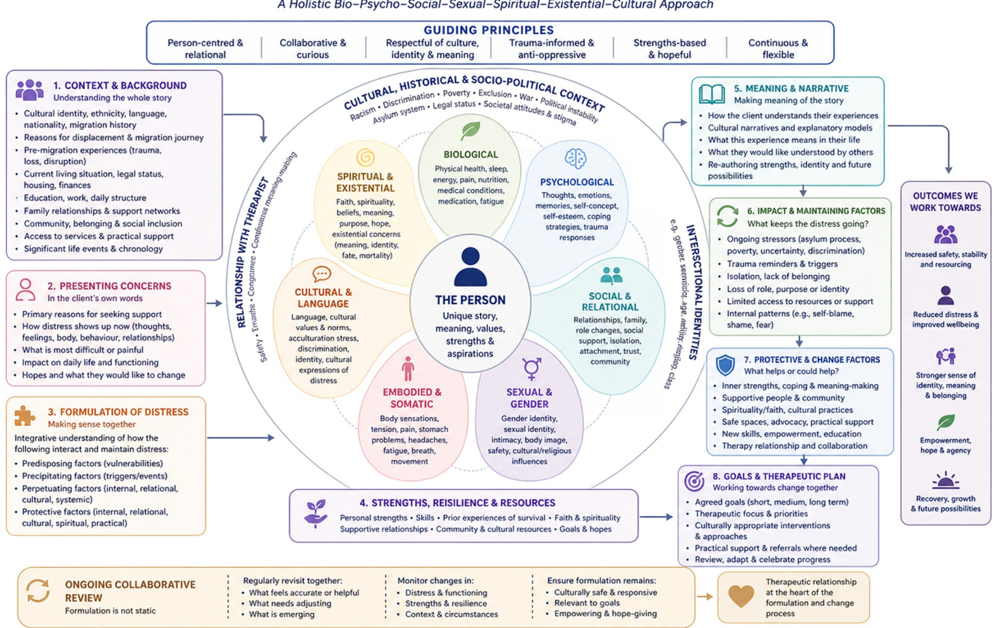
- The paper proposes an interconnected eight-stage person-centered formulation model, centered on the person within a bio-psycho-social-sexual-spiritual-existential-cultural framework, rather than a rigid linear or diagnostic tool.
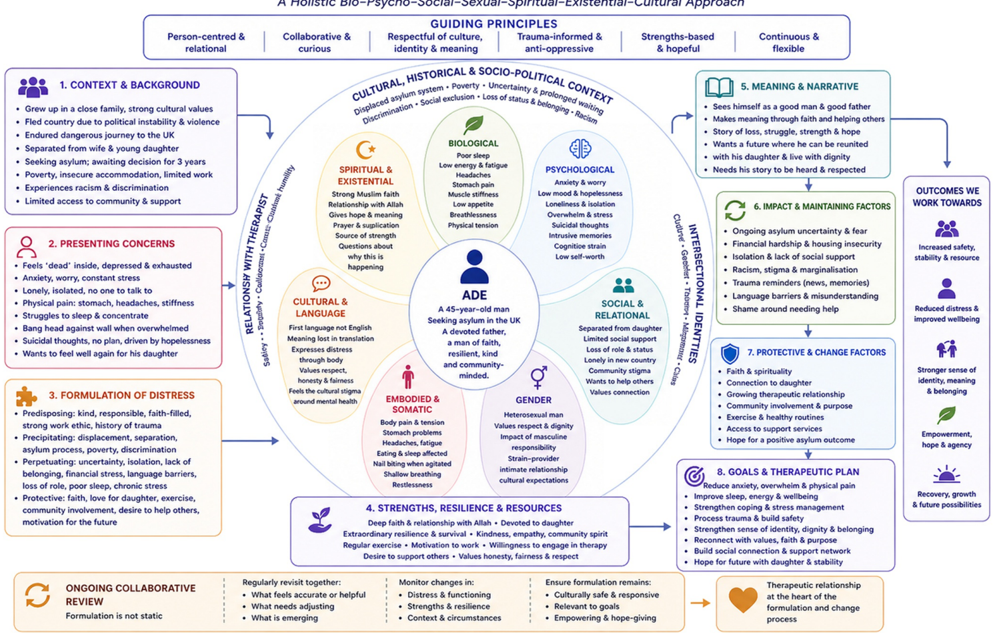
- The illustrative case, Ade, was a man of Pakistani heritage aged 45–54, unemployed, divorced, and seeking refuge in Northern England with his daughter; he scored 10 out of 10 on the Trauma Screening Questionnaire (TSQ), signifying likely PTSD.
- Ade’s distress included anxiety, exhaustion, loneliness, hopelessness, bodily pain, and suicidal thoughts, with maintaining factors including asylum uncertainty, financial hardship, social isolation, language barriers, and discrimination; protective factors included his daughter, religious faith and spiritual community, helping others, exercise, and willingness to engage in therapy.
- Language and interpretation were central: Ade struggled to understand questions even with an interpreter, and his culturally embedded expression of “banging one’s head against the wall” illustrated distress communicated through culturally specific metaphors not readily accommodated in conventional formulation.
Methods
- Conceptual-practice paper using a qualitative case study methodology, drawing on McLeod’s (2010) articulation of case study research; the case is drawn from a doctoral thesis study on embodied trauma among refugee and asylum-seeking populations and is used illustratively rather than representationally.
- The case data came from a qualitative semi-structured interview with a structured TSQ section and seven open questions covering embodied trauma, body/self-concept, and refuge/asylum dislocation, followed by a body mapping exercise; reflexive thematic analysis was used with a sample of 13 participants, and Ade’s raw data appear in Appendix A.
- The new model integrates a scoping review on embodied trauma and culturally re-envisions Simms’ (2011) person-centered formulation; ethical approval was gained from York St John University’s School of Education, Language and Psychology Ethics Committee (Approval Code: RECCOUN00025).
Limitations
- Stated: the paper uses a qualitative in-depth case study of one participant, and the conceptualized domains are specific to that participant and not generalizable to all clients; further exploration and evidencing of the model in practice are recommended.
- Stated: although the model attempts to move beyond westernized assumptions, it remains situated within counseling psychology discourse and may still reflect western epistemological foundations; empirical research on clinical utility, acceptability, and therapeutic outcomes is needed.
- Stated: broadening the approach beyond classical client-centered psychotherapy to “person-centered” may dilute the potency of a puristic approach. Evident from the text: no clinical outcome or effectiveness data are reported, and the formulation is presented as conceptual and illustrative only.
Model-written summary. Check it against the paper before relying on it.
Integrity signals
Registry
Cites
Statistics
Figures

Verification
Claims the paper makes
39 Own interpretation · 16 No basis given · 10 Own result · 9 Sources not found · 8 Own method · 4 Partly supported · 4 Not checked yet · 3 Supported · 2 No full text of the sources · 1 Supported so far · accuracy not yet measured
The cited sources support only part of this claim — read each source’s verdict below.
In the paper
“we have proposed in our own research on conceptualizing trauma that it can be experienced by and impact any individual across any one or combination of their bio-psycho-social-sexual-spiritual-existential and cultural or holistic realms of existence.”
§ Person-Centered Case Formulation: A Culturally Responsive and Trauma Informed Reconceptualization for Psychotraumatology Practice > 1 | Introduction
What the sources say
- Partly supportedcites O'Brien and Charura 2023 sourceExperimental — accuracy not yet measured
The ‘Suitability of definition of embodied trauma’ section proposes bio-psycho-social-sexual-spiritual-existential manifestations, and the Abstract includes cultural reactions in its definition of embodied trauma. The paper presents these manifestations through a study of displaced participants; the passages do not explicitly extend the full formulation to any individual or describe ‘any one or combination’ of the realms. (LLM, conf=0.83)
plaindirect- Asserted: passes — The authors put it forward as true.
- Checkable: unclear — It is unclear whether it could be checked against evidence.
- Load-bearing: passes — The paper’s conclusions depend on it.
- Based: passes — The paper gives a reason why it holds.
- Partly supported
Every source the paper cites for this claim was checked and supports it.
In the paper
“Likewise, Miller and Rasmussen (2017) suggest that ongoing postmigration stressors, such as poverty, insecure immigration status, and social isolation, are often more predictive of psychological distress amongst refugees than premigration trauma exposure alone.”
§ Person-Centered Case Formulation: A Culturally Responsive and Trauma Informed Reconceptualization for Psychotraumatology Practice > 4 | Discussion
What the sources say
- Supportedcites Miller and Rasmussen (2017) source
The Abstract says post-migration stressors have accounted for greater variance in depression and anxiety than war-related trauma and loss in numerous studies. It identifies poverty, social isolation, and uncertainty about legal status for asylum seekers as relevant stressors; the section on early refugee research likewise reports improved prediction when post-migration stressors were included. (LLM, conf=0.93)
hedgedcorrelational- Asserted: passes — The authors put it forward as true.
- Checkable: passes — It can be checked against evidence.
- Load-bearing: passes — The paper’s conclusions depend on it.
- Based: passes — The paper gives a reason why it holds.
- Supported
The cited sources support only part of this claim — read each source’s verdict below.
In the paper
“A central issue regarding the formulation of psychological distress with individuals who are seeking refuge and asylum is language, especially what is lost in translation (Uphoff and Charura 2016;O'Brien and Charura 2023).”
§ Person-Centered Case Formulation: A Culturally Responsive and Trauma Informed Reconceptualization for Psychotraumatology Practice > 1.3 | Formulation and Language
What the sources say
- Not matchedcites Uphoff and Charura 2016
Couldn’t be matched to a paper in Crossref, so it can’t be checked.
- Supportedcites O'Brien and Charura 2023 source
In “Bridging the cultural distance gap” (page unavailable), the authors describe checking translated trauma-screening questions with participants and interpreters to ensure mutual understanding. They also stress clarifying the language of emotions rather than assuming that emotion words are understood universally. These passages support the claim that language and what may be lost in translation matter when understanding distress among people seeking refuge or asylum. (LLM, conf=0.86)
plaincorrelational- Asserted: passes — The authors put it forward as true.
- Checkable: passes — It can be checked against evidence.
- Load-bearing: passes — The paper’s conclusions depend on it.
- Based: passes — The paper gives a reason why it holds.
- Not matched
The sources with a verdict support this claim; the rest weren’t checked yet, have no full text we could read, or their verdicts aren’t rated yet.
In the paper
“Contemporary or traditional models of formulation such as CBT (Beck 2019), Psychodynamic (Malan 1979) or Compassion Focussed Therapy (CFT) (Gilbert 2009) have historically underemphasized cultural identity, value systems, expressions of distress, aspects of intersectionality or language considerations which resoundingly echo the profound absence of multicultural training and competencies and colon”
§ Person-Centered Case Formulation: A Culturally Responsive and Trauma Informed Reconceptualization for Psychotraumatology Practice > 1.2 | Formulation and Culture
What the sources say
- Not checked — no full text of the sourcecites Beck 2019 source
- Not checked — no full text of the sourcecites Malan 1979 source
- Supportedcites Gilbert 2009 source
The citation immediately follows “Compassion Focussed Therapy (CFT),” identifying Gilbert’s paper as a source for that model. The paper’s Conclusions describe compassion-focused therapy as an integrated therapy, and “Balancing the systems” describes its approach to formulation. The statement about historical underemphasis is the citing authors’ broader critique, not a finding specifically attributed to Gilbert. (LLM, conf=0.88)
plain- Asserted: passes — The authors put it forward as true.
- Checkable: passes — It can be checked against evidence.
- Load-bearing: passes — The paper’s conclusions depend on it.
- Based: passes — The paper gives a reason why it holds.
The paper states this without a source or data behind it here, so there is nothing to check it against. The quote shows it is in the paper.
In the paper
“In the case of Ade, for example, distress could not be meaningfully understood without considering the intersection of displacement, loss of cultural belonging, separation from family, poverty, exclusion from community networks, and prolonged uncertainty associated with the asylum process.”
§ Person-Centered Case Formulation: A Culturally Responsive and Trauma Informed Reconceptualization for Psychotraumatology Practice > 4 | Discussion
hedgedcorrelationalSingle case- Asserted: passes — The authors put it forward as true.
- Checkable: passes — It can be checked against evidence.
- Load-bearing: passes — The paper’s conclusions depend on it.
- Based: passes — The paper gives a reason why it holds.
The paper states this without a source or data behind it here, so there is nothing to check it against. The quote shows it is in the paper.
In the paper
“Ade's difficulties were closely linked to structural experiences including the asylum system, poverty, housing instability, social exclusion, and community stigma.”
§ Person-Centered Case Formulation: A Culturally Responsive and Trauma Informed Reconceptualization for Psychotraumatology Practice > 4 | Discussion
plaincorrelationalSingle case- Asserted: passes — The authors put it forward as true.
- Checkable: passes — It can be checked against evidence.
- Load-bearing: passes — The paper’s conclusions depend on it.
- Based: passes — The paper gives a reason why it holds.
The paper states this without a source or data behind it here, so there is nothing to check it against. The quote shows it is in the paper.
In the paper
“For Ade, distress appeared to emerge from the interaction between previous trauma exposure, ongoing asylum uncertainty, social exclusion, poverty, family separation, and reduced access to meaningful social roles.”
§ Person-Centered Case Formulation: A Culturally Responsive and Trauma Informed Reconceptualization for Psychotraumatology Practice > 3 | Results
hedgedconditionalSingle case- Asserted: passes — The authors put it forward as true.
- Checkable: passes — It can be checked against evidence.
- Load-bearing: passes — The paper’s conclusions depend on it.
- Based: passes — The paper gives a reason why it holds.
A result the paper reports from its own data — it cites no other source for it, so there is none to check. The quote shows it is in the paper.
In the paper
“Ade understood his self-concept as a caring father and a person of faith, despite adversity.”
§ Person-Centered Case Formulation: A Culturally Responsive and Trauma Informed Reconceptualization for Psychotraumatology Practice > 3 | Results
plainSingle case- Asserted: passes — The authors put it forward as true.
- Checkable: passes — It can be checked against evidence.
- Load-bearing: unclear — It is unclear whether the paper’s conclusions depend on it.
- Based: passes — The paper gives a reason why it holds.
A result the paper reports from its own data — it cites no other source for it, so there is none to check. The quote shows it is in the paper.
In the paper
“Language emerged as another critical component of culturally informed formulation.”
§ Person-Centered Case Formulation: A Culturally Responsive and Trauma Informed Reconceptualization for Psychotraumatology Practice > 4 | Discussion
plainSingle case- Asserted: passes — The authors put it forward as true.
- Checkable: passes — It can be checked against evidence.
- Load-bearing: passes — The paper’s conclusions depend on it.
- Based: passes — The paper gives a reason why it holds.
The paper states this without a source or data behind it here, so there is nothing to check it against. The quote shows it is in the paper.
In the paper
“His embodied symptoms, psychological distress, spiritual beliefs, cultural values, family relationships, social exclusion, and experiences of displacement formed an interconnected network of experiences that could not be adequately understood through symptomfocused or diagnostic approaches alone.”
§ Person-Centered Case Formulation: A Culturally Responsive and Trauma Informed Reconceptualization for Psychotraumatology Practice > 6 of 17
hedgedcorrelationalSingle case- Asserted: passes — The authors put it forward as true.
- Checkable: passes — It can be checked against evidence.
- Load-bearing: passes — The paper’s conclusions depend on it.
- Based: passes — The paper gives a reason why it holds.
- Rests on an assumption: The single case of Ade is sufficient to illustrate the proposed model's domains and dynamics.
The paper states this without a source or data behind it here, so there is nothing to check it against. The quote shows it is in the paper.
In the paper
“Ade's narratives of uncertainty, exclusion, and fear illustrate how psychological distress may persist or intensify long after the initial traumatic events due to hostile systemic environments and prolonged instability.”
§ Person-Centered Case Formulation: A Culturally Responsive and Trauma Informed Reconceptualization for Psychotraumatology Practice > 4 | Discussion
hedgedconditionalSingle case- Asserted: passes — The authors put it forward as true.
- Checkable: passes — It can be checked against evidence.
- Load-bearing: passes — The paper’s conclusions depend on it.
- Based: passes — The paper gives a reason why it holds.
The paper states this without a source or data behind it here, so there is nothing to check it against. The quote shows it is in the paper.
In the paper
“Importantly, these experiences were expressed through culturally meaningful narratives and embodied descriptions rather than solely through psychological language.”
§ Person-Centered Case Formulation: A Culturally Responsive and Trauma Informed Reconceptualization for Psychotraumatology Practice > 3 | Results
plainSingle case- Asserted: passes — The authors put it forward as true.
- Checkable: passes — It can be checked against evidence.
- Load-bearing: passes — The paper’s conclusions depend on it.
- Based: passes — The paper gives a reason why it holds.
A result the paper reports from its own data — it cites no other source for it, so there is none to check. The quote shows it is in the paper.
In the paper
“Ade repeatedly described distress through physical and embodied experiences, including stomach pain, headaches, low energy, stiffness, disturbed sleep and feelings of being “dead.””
§ Person-Centered Case Formulation: A Culturally Responsive and Trauma Informed Reconceptualization for Psychotraumatology Practice > 4 | Discussion
plainSingle case- Asserted: passes — The authors put it forward as true.
- Checkable: passes — It can be checked against evidence.
- Load-bearing: passes — The paper’s conclusions depend on it.
- Based: passes — The paper gives a reason why it holds.
A result the paper reports from its own data — it cites no other source for it, so there is none to check. The quote shows it is in the paper.
In the paper
“The formulation of Ade's experiences also demonstrates the importance of recognizing strengths, resilience, and protective factors alongside distress.”
§ Person-Centered Case Formulation: A Culturally Responsive and Trauma Informed Reconceptualization for Psychotraumatology Practice > 4 | Discussion
boostedcorrelationalSingle case- Asserted: passes — The authors put it forward as true.
- Checkable: passes — It can be checked against evidence.
- Load-bearing: passes — The paper’s conclusions depend on it.
- Based: passes — The paper gives a reason why it holds.
The paper states this without a source or data behind it here, so there is nothing to check it against. The quote shows it is in the paper.
In the paper
“In Ade's formulation, psychological distress was inseparable from embodied symptoms, spiritual beliefs, social relationships, cultural identity, language experiences, and existential concerns regarding meaning, belonging, and future hope.”
§ Person-Centered Case Formulation: A Culturally Responsive and Trauma Informed Reconceptualization for Psychotraumatology Practice > 3 | Results
plaincorrelationalSingle case- Asserted: passes — The authors put it forward as true.
- Checkable: passes — It can be checked against evidence.
- Load-bearing: passes — The paper’s conclusions depend on it.
- Based: passes — The paper gives a reason why it holds.
The paper states this without a source or data behind it here, so there is nothing to check it against. The quote shows it is in the paper.
In the paper
“In Ade's case, ongoing uncertainty surrounding his asylum claim, financial hardship, social isolation, language barriers, and experiences of discrimination appeared to maintain psychological suffering long after the original traumatic events had occurred.”
§ Person-Centered Case Formulation: A Culturally Responsive and Trauma Informed Reconceptualization for Psychotraumatology Practice > 3 | Results
hedgedconditionalSingle case- Asserted: passes — The authors put it forward as true.
- Checkable: passes — It can be checked against evidence.
- Load-bearing: unclear — It is unclear whether the paper’s conclusions depend on it.
- Based: passes — The paper gives a reason why it holds.
None of the sources cited for this claim have been checked yet.
In the paper
“Importantly, Ade's culturally embedded expression of “banging one's head against the wall” when overwhelmed illustrates how emotional distress may be communicated through culturally specific metaphors that are not readily accommodated within conventional formulation approaches.”
§ Person-Centered Case Formulation: A Culturally Responsive and Trauma Informed Reconceptualization for Psychotraumatology Practice > 4 | Discussion
hedgedconditionalSingle case- Asserted: passes — The authors put it forward as true.
- Checkable: passes — It can be checked against evidence.
- Load-bearing: passes — The paper’s conclusions depend on it.
- Based: passes — The paper gives a reason why it holds.
A result the paper reports from its own data — it cites no other source for it, so there is none to check. The quote shows it is in the paper.
In the paper
“His spirituality and connection with God appeared to provide continuity, meaning, and hope amidst prolonged uncertainty and exclusion.”
§ Person-Centered Case Formulation: A Culturally Responsive and Trauma Informed Reconceptualization for Psychotraumatology Practice > 4 | Discussion
hedgedconditionalSingle case- Asserted: passes — The authors put it forward as true.
- Checkable: passes — It can be checked against evidence.
- Load-bearing: unclear — It is unclear whether the paper’s conclusions depend on it.
- Based: passes — The paper gives a reason why it holds.
A conclusion the paper draws from its own results — it cites no other source for it, so there is none to check. The quote shows it is in the paper.
In the paper
“Drawing on person-centered theory, contemporary literature on embodied trauma, and the illustrative case formulation of “Ade,” the paper demonstrates how psychological distress cannot be adequately understood through reductionist or exclusively symptom-focused frameworks alone.”
§ Person-Centered Case Formulation: A Culturally Responsive and Trauma Informed Reconceptualization for Psychotraumatology Practice > 4 | Discussion
boostedSingle case- Asserted: passes — The authors put it forward as true.
- Checkable: unclear — It is unclear whether it could be checked against evidence.
- Load-bearing: passes — The paper’s conclusions depend on it.
- Based: passes — The paper gives a reason why it holds.
A conclusion the paper draws from its own results — it cites no other source for it, so there is none to check. The quote shows it is in the paper.
In the paper
“The formulation therefore prioritizes the client's own explanatory framework and cultural narratives rather than relying exclusively on professional interpretations.”
§ Person-Centered Case Formulation: A Culturally Responsive and Trauma Informed Reconceptualization for Psychotraumatology Practice > 3 | Results
plainSingle case- Asserted: passes — The authors put it forward as true.
- Checkable: passes — It can be checked against evidence.
- Load-bearing: passes — The paper’s conclusions depend on it.
- Based: passes — The paper gives a reason why it holds.
- The authors state this as an assumption: The person-centered approach is best positioned to support the individualized model required for displaced individuals.
A conclusion the paper draws from its own results — it cites no other source for it, so there is none to check. The quote shows it is in the paper.
In the paper
“This proposed model, in contrast, extends existing personcentered formulations by explicitly integrating cultural identity, language, spirituality, community belonging, and culturally specific expressions of distress into the formulation process.”
§ Person-Centered Case Formulation: A Culturally Responsive and Trauma Informed Reconceptualization for Psychotraumatology Practice > 4 | Discussion
plain- Asserted: passes — The authors put it forward as true.
- Checkable: passes — It can be checked against evidence.
- Load-bearing: passes — The paper’s conclusions depend on it.
- Based: passes — The paper gives a reason why it holds.
None of the sources cited for this claim have been checked yet.
In the paper
“Importantly, the model differs from traditional person-centered formulations in several ways (Simms 2011;Uphoff and Charura 2016).”
§ Person-Centered Case Formulation: A Culturally Responsive and Trauma Informed Reconceptualization for Psychotraumatology Practice > 3 | Results
What the sources say
- Not checked — no full text of the sourcecites Simms 2011 source
- Not matchedcites Uphoff and Charura 2016
Couldn’t be matched to a paper in Crossref, so it can’t be checked.
plain- Asserted: passes — The authors put it forward as true.
- Checkable: passes — It can be checked against evidence.
- Load-bearing: passes — The paper’s conclusions depend on it.
- Based: passes — The paper gives a reason why it holds.
- The authors state this as an assumption: The person-centered approach is best positioned to support the individualized model required for displaced individuals.
A conclusion the paper draws from its own results — it cites no other source for it, so there is none to check. The quote shows it is in the paper.
In the paper
“Such experiences highlight the limitations of traditional western diagnostic frameworks which may privilege cognitive or behavioral symptoms over embodied and culturally situated expressions of suffering.”
§ Person-Centered Case Formulation: A Culturally Responsive and Trauma Informed Reconceptualization for Psychotraumatology Practice > 4 | Discussion
hedgedconditionalSingle case- Asserted: passes — The authors put it forward as true.
- Checkable: passes — It can be checked against evidence.
- Load-bearing: passes — The paper’s conclusions depend on it.
- Based: passes — The paper gives a reason why it holds.
None of the sources cited for this claim have been checked yet.
In the paper
“When formulation is reconceptualized as a tentative, collaborative, and phenomenological process, it can function in ways that remain faithful to person-centered principles of nonpathologization, relational depth, and respect for the client's subjective frame of reference (Gillon 2012;Uphoff and Charura 2016).”
§ Person-Centered Case Formulation: A Culturally Responsive and Trauma Informed Reconceptualization for Psychotraumatology Practice > 5 | Conclusion
What the sources say
- Not checked — no full text of the sourcecites Gillon 2012 source
- Not matchedcites Uphoff and Charura 2016
Couldn’t be matched to a paper in Crossref, so it can’t be checked.
plainconditional- Asserted: passes — The authors put it forward as true.
- Checkable: passes — It can be checked against evidence.
- Load-bearing: passes — The paper’s conclusions depend on it.
- Based: passes — The paper gives a reason why it holds.
In the paper
“However, it is equally important to critically acknowledge that discourses of “resilience” can sometimes obscure the structural injustices and systemic harms experienced by displaced individuals if interpreted uncritically (Ecclestone and Lewis 2014).”
§ Person-Centered Case Formulation: A Culturally Responsive and Trauma Informed Reconceptualization for Psychotraumatology Practice > 4 | Discussion
What the sources say
- Not checked — no full text of the sourcecites Ecclestone and Lewis 2014 source
hedgedconditional- Asserted: passes — The authors put it forward as true.
- Checkable: passes — It can be checked against evidence.
- Load-bearing: passes — The paper’s conclusions depend on it.
- Based: passes — The paper gives a reason why it holds.
A conclusion the paper draws from its own results — it cites no other source for it, so there is none to check. The quote shows it is in the paper.
In the paper
“Rather than focusing exclusively on cognitive, emotional, or relational processes, the model explicitly recognizes that trauma and distress may be experienced across multiple interconnected domains of human experience.”
§ Person-Centered Case Formulation: A Culturally Responsive and Trauma Informed Reconceptualization for Psychotraumatology Practice > 3 | Results
hedgedSingle case- Asserted: passes — The authors put it forward as true.
- Checkable: passes — It can be checked against evidence.
- Load-bearing: passes — The paper’s conclusions depend on it.
- Based: passes — The paper gives a reason why it holds.
- The authors state this as an assumption: The person-centered approach is best positioned to support the individualized model required for displaced individuals.
In the paper
“Consistent with Rogers' emphasis on subjective experience, distress is understood through the client's lived reality rather than through diagnostic categorization.”
§ Person-Centered Case Formulation: A Culturally Responsive and Trauma Informed Reconceptualization for Psychotraumatology Practice > 3 | Results
What the sources say
- Not matchedcites Rogers
Couldn’t be matched to a paper in Crossref, so it can’t be checked.
plainSingle case- Asserted: passes — The authors put it forward as true.
- Checkable: passes — It can be checked against evidence.
- Load-bearing: passes — The paper’s conclusions depend on it.
- Based: passes — The paper gives a reason why it holds.
- The authors state this as an assumption: The person-centered approach is best positioned to support the individualized model required for displaced individuals.
- Not matched
In the paper
“Kirmayer and Young (1998) note that cultural variations in the expression of distress challenge the universality of western psychiatric categories, particularly in trauma-related presentations.”
§ Person-Centered Case Formulation: A Culturally Responsive and Trauma Informed Reconceptualization for Psychotraumatology Practice > 4 | Discussion
What the sources say
- Not checked — no full text of the sourcecites Kirmayer and Young (1998) source
plaindirect- Asserted: passes — The authors put it forward as true.
- Checkable: passes — It can be checked against evidence.
- Load-bearing: passes — The paper’s conclusions depend on it.
- Based: passes — The paper gives a reason why it holds.
The paper states this without a source or data behind it here, so there is nothing to check it against. The quote shows it is in the paper.
In the paper
“This broader understanding reflects a trauma-informed recognition that psychological distress often develops within adverse relational and environmental conditions.”
§ Person-Centered Case Formulation: A Culturally Responsive and Trauma Informed Reconceptualization for Psychotraumatology Practice > 3 | Results
plainconditionalSingle case- Asserted: passes — The authors put it forward as true.
- Checkable: passes — It can be checked against evidence.
- Load-bearing: passes — The paper’s conclusions depend on it.
- Based: passes — The paper gives a reason why it holds.
None of the sources cited for this claim could be matched to a paper in Crossref, so there is nothing to check it against.
In the paper
“In fact, taking this one step further, we would suggest that these aspects are seemingly entirely absent from most globally westernized conceptualizations of formulation, where formulation has arisen, and is inherently imbedded in, a globally westernized model of individuals and psychological care.”
§ Person-Centered Case Formulation: A Culturally Responsive and Trauma Informed Reconceptualization for Psychotraumatology Practice > 1.2 | Formulation and Culture
What the sources say
- Not matchedcites Johnstone and Dallos 2014
Couldn’t be matched to a paper in Crossref, so it can’t be checked.
- Not matchedcites Charura and Lago 2021
Couldn’t be matched to a paper in Crossref, so it can’t be checked.
hedged- Asserted: passes — The authors put it forward as true.
- Checkable: passes — It can be checked against evidence.
- Load-bearing: passes — The paper’s conclusions depend on it.
- Based: passes — The paper gives a reason why it holds.
- Not matched
None of the sources cited for this claim could be matched to a paper in Crossref, so there is nothing to check it against.
In the paper
“We also assert that trauma happens in the context of relationship and therefore any approaches to therapeutic support or healing need to be considered in the context of relationships.”
§ Person-Centered Case Formulation: A Culturally Responsive and Trauma Informed Reconceptualization for Psychotraumatology Practice > 1 | Introduction
What the sources say
- Not matchedcites Charura et al. 2024
Couldn’t be matched to a paper in Crossref, so it can’t be checked.
- Not matchedcites Rogers 1957a
Couldn’t be matched to a paper in Crossref, so it can’t be checked.
- Not matchedcites Rogers 1957b
Couldn’t be matched to a paper in Crossref, so it can’t be checked.
plaincorrelational- Asserted: passes — The authors put it forward as true.
- Checkable: unclear — It is unclear whether it could be checked against evidence.
- Load-bearing: passes — The paper’s conclusions depend on it.
- Based: passes — The paper gives a reason why it holds.
- Not matched
In the paper
“This addresses an important gap identified within existing formulation literature, where dominant westernized models often fail to adequately conceptualize the lived experiences of individuals from diverse cultural backgrounds (Johnstone and Dallos 2014).”
§ Person-Centered Case Formulation: A Culturally Responsive and Trauma Informed Reconceptualization for Psychotraumatology Practice > 4 | Discussion
What the sources say
- Not matchedcites Johnstone and Dallos 2014
Couldn’t be matched to a paper in Crossref, so it can’t be checked.
plain- Asserted: passes — The authors put it forward as true.
- Checkable: passes — It can be checked against evidence.
- Load-bearing: passes — The paper’s conclusions depend on it.
- Based: passes — The paper gives a reason why it holds.
- Not matched
A conclusion the paper draws from its own results — it cites no other source for it, so there is none to check. The quote shows it is in the paper.
In the paper
“The case of Ade illustrates how these domains interact dynamically rather than operating independently.”
§ Person-Centered Case Formulation: A Culturally Responsive and Trauma Informed Reconceptualization for Psychotraumatology Practice > 6 of 17
plaincorrelationalSingle case- Asserted: passes — The authors put it forward as true.
- Checkable: passes — It can be checked against evidence.
- Load-bearing: passes — The paper’s conclusions depend on it.
- Based: passes — The paper gives a reason why it holds.
- Rests on an assumption: The single case of Ade is sufficient to illustrate the proposed model's domains and dynamics.
None of the sources cited for this claim could be matched to a paper in Crossref, so there is nothing to check it against.
In the paper
“Whatever the practitioner's stance, there cannot be any doubt that the competency of formulation is required by professional bodies across the United Kingdom (UK) and that it needs to be ethically included as part of psychological assessment and treatment planning with the client.”
§ Person-Centered Case Formulation: A Culturally Responsive and Trauma Informed Reconceptualization for Psychotraumatology Practice > 1 | Introduction
What the sources say
- Not matchedcites BPS 2011
Couldn’t be matched to a paper in Crossref, so it can’t be checked.
- Not matchedcites HCPC 2023
Couldn’t be matched to a paper in Crossref, so it can’t be checked.
- Not matchedcites Lane and Corrie 2026
Couldn’t be matched to a paper in Crossref, so it can’t be checked.
boosted- Asserted: passes — The authors put it forward as true.
- Checkable: passes — It can be checked against evidence.
- Load-bearing: unclear — It is unclear whether the paper’s conclusions depend on it.
- Based: passes — The paper gives a reason why it holds.
- Not matched
A conclusion the paper draws from its own results — it cites no other source for it, so there is none to check. The quote shows it is in the paper.
In the paper
“In this sense, formulation may function as an antipathologizing and socially contextualized clinical tool that positions distress as understandable within the context of forced migration and ongoing adversity rather than solely as individual dysfunction.”
§ Person-Centered Case Formulation: A Culturally Responsive and Trauma Informed Reconceptualization for Psychotraumatology Practice > 4 | Discussion
hedgedconditional- Asserted: passes — The authors put it forward as true.
- Checkable: unclear — It is unclear whether it could be checked against evidence.
- Load-bearing: passes — The paper’s conclusions depend on it.
- Based: passes — The paper gives a reason why it holds.
A conclusion the paper draws from its own results — it cites no other source for it, so there is none to check. The quote shows it is in the paper.
In the paper
“His presentation of anxiety, exhaustion, loneliness, embodied pain, and suicidal ideation emerged not as isolated psychopathology, but as understandable responses to prolonged relational, social and systemic adversity.”
§ Person-Centered Case Formulation: A Culturally Responsive and Trauma Informed Reconceptualization for Psychotraumatology Practice > 4 | Discussion
plaindirectSingle case- Asserted: passes — The authors put it forward as true.
- Checkable: passes — It can be checked against evidence.
- Load-bearing: passes — The paper’s conclusions depend on it.
- Based: passes — The paper gives a reason why it holds.
A conclusion the paper draws from its own results — it cites no other source for it, so there is none to check. The quote shows it is in the paper.
In the paper
“At the same time, there are important tensions in attempting to integrate person-centered philosophy with formalized formulation practices.”
§ Person-Centered Case Formulation: A Culturally Responsive and Trauma Informed Reconceptualization for Psychotraumatology Practice > 4 | Discussion
plain- Asserted: passes — The authors put it forward as true.
- Checkable: passes — It can be checked against evidence.
- Load-bearing: passes — The paper’s conclusions depend on it.
- Based: passes — The paper gives a reason why it holds.
In the paper
“Without such consideration, there is a risk that culturally normative expressions may be misunderstood as evidence of psychopathology, further perpetuating experiences of marginalization and epistemic injustice within mental health systems (Hook et al. 2017).”
§ Person-Centered Case Formulation: A Culturally Responsive and Trauma Informed Reconceptualization for Psychotraumatology Practice > 4 | Discussion
What the sources say
- Not matchedcites Hook et al. 2017
Couldn’t be matched to a paper in Crossref, so it can’t be checked.
hedgedconditional- Asserted: passes — The authors put it forward as true.
- Checkable: passes — It can be checked against evidence.
- Load-bearing: passes — The paper’s conclusions depend on it.
- Based: passes — The paper gives a reason why it holds.
- Not matched
A conclusion the paper draws from its own results — it cites no other source for it, so there is none to check. The quote shows it is in the paper.
In the paper
“The formulation presented in Figure 2 demonstrates how the proposed culturally and trauma-informed person-centered model can be applied in practice to collaboratively understand the experiences of individuals seeking refuge and asylum.”
§ Person-Centered Case Formulation: A Culturally Responsive and Trauma Informed Reconceptualization for Psychotraumatology Practice > 3 | Results
boostedSingle case- Asserted: passes — The authors put it forward as true.
- Checkable: passes — It can be checked against evidence.
- Load-bearing: passes — The paper’s conclusions depend on it.
- Based: passes — The paper gives a reason why it holds.
- The authors state this as an assumption: The person-centered approach is best positioned to support the individualized model required for displaced individuals.
A conclusion the paper draws from its own results — it cites no other source for it, so there is none to check. The quote shows it is in the paper.
In the paper
“Unlike prescriptive treatment models, the therapeutic aim(s) emerge moment-bymoment from the collaborative understanding developed throughout the formulation process.”
§ Person-Centered Case Formulation: A Culturally Responsive and Trauma Informed Reconceptualization for Psychotraumatology Practice > 3 | Results
plaindirectSingle case- Asserted: passes — The authors put it forward as true.
- Checkable: passes — It can be checked against evidence.
- Load-bearing: passes — The paper’s conclusions depend on it.
- Based: passes — The paper gives a reason why it holds.
- The authors state this as an assumption: The person-centered approach is best positioned to support the individualized model required for displaced individuals.
None of the sources cited for this claim have been checked yet.
In the paper
“This is particularly significant given evidence suggesting that asylum systems themselves may function as sites of retraumatization (Carswell et al. 2011;Silove et al. 1997).”
§ Person-Centered Case Formulation: A Culturally Responsive and Trauma Informed Reconceptualization for Psychotraumatology Practice > 4 | Discussion
What the sources say
- Not checked — no full text of the sourcecites Carswell et al. 2011 source
- Not matchedcites Silove et al. 1997
Couldn’t be matched to a paper in Crossref, so it can’t be checked.
hedgedconditional- Asserted: passes — The authors put it forward as true.
- Checkable: passes — It can be checked against evidence.
- Load-bearing: passes — The paper’s conclusions depend on it.
- Based: passes — The paper gives a reason why it holds.
In the paper
“Summerfield (1999Summerfield ( , 2008) ) has criticized the global exportation of western trauma frameworks, arguing that concepts such as PTSD may inadequately capture the lived realities of displaced populations whose suffering is inseparable from social rupture, collective violence, and ongoing uncertainty.”
§ Person-Centered Case Formulation: A Culturally Responsive and Trauma Informed Reconceptualization for Psychotraumatology Practice > 4 | Discussion
What the sources say
- Not matchedcites Summerfield (1999, 2008)
Couldn’t be matched to a paper in Crossref, so it can’t be checked.
hedgedconditional- Asserted: passes — The authors put it forward as true.
- Checkable: passes — It can be checked against evidence.
- Load-bearing: passes — The paper’s conclusions depend on it.
- Based: passes — The paper gives a reason why it holds.
- Not matched
- Probably not a substantial claim. 45
- It may state two separate claims as one. 28
The cited sources support only part of this claim — read each source’s verdict below.
In the paper
“The client's consent was given as part of a doctoral thesis research study and the full paper of this study can be read via the subsequent publications (O'Brien and Charura 2023, 2024).”
§ Person-Centered Case Formulation: A Culturally Responsive and Trauma Informed Reconceptualization for Psychotraumatology Practice > 2.2 | A New Approach to Formulation
What the sources say
- Partly supportedcites O'Brien and Charura 2023 sourceExperimental — accuracy not yet measured
The Informed consent section says participants signed consent forms and gave verbal consent before recording. Our copy does not identify the particular client in the citing sentence or state that the study was part of a doctoral thesis (searched: doctoral thesis, PhD, doctorate). (LLM, conf=0.80)
- Not matchedcites O'Brien and Charura 2024
Couldn’t be matched to a paper in Crossref, so it can’t be checked.
plainSingle case- Asserted: passes — The authors put it forward as true.
- Checkable: passes — It can be checked against evidence.
- Load-bearing: fails — The paper’s conclusions may not depend on it.
- Based: passes — The paper gives a reason why it holds.
Probably not a substantial claim. The paper’s conclusions may not depend on it.
- Partly supported
The cited sources support only part of this claim — read each source’s verdict below.
In the paper
“The findings further reinforce recent literature which conceptualizes trauma amongst refugee and asylum-seeking populations as embodied and culturally mediated (Murphy et al. 2021;O'Brien and Charura 2023).”
§ Person-Centered Case Formulation: A Culturally Responsive and Trauma Informed Reconceptualization for Psychotraumatology Practice > 4 | Discussion
What the sources say
- Not matchedcites Murphy et al. 2021
Couldn’t be matched to a paper in Crossref, so it can’t be checked.
- Supportedcites O'Brien and Charura 2023 source
In “Limitations of existing trauma screening tools” (page unavailable), the paper reports bodily reactions to trauma reminders among all study participants and discusses culturally specific expressions of distress. Its findings support the characterization of trauma in the studied refugees and asylum seekers as embodied and culturally mediated. (LLM, conf=0.92)
plaincorrelationalSingle case- Asserted: passes — The authors put it forward as true.
- Checkable: passes — It can be checked against evidence.
- Load-bearing: passes — The paper’s conclusions depend on it.
- Based: passes — The paper gives a reason why it holds.
It may state two separate claims as one.
- Not matched
Every source the paper cites for this claim was checked and supports it.
In the paper
“The research method employed in this study asked Ade to take part in a qualitative semistructured interview where the structured section was made up of the TSQ (Brewin et al. 2002).”
§ Person-Centered Case Formulation: A Culturally Responsive and Trauma Informed Reconceptualization for Psychotraumatology Practice > 2.4 | Research Method
What the sources say
- Supportedcites Brewin et al. 2002 source
The Measures section identifies the final 10-item Trauma Screening Questionnaire (TSQ) and says it is provided in the Appendix. This supports the citation identifying the instrument used in the citing authors’ interview; the interview design itself is their own description. (LLM, conf=0.92)
plainSingle case- Asserted: passes — The authors put it forward as true.
- Checkable: passes — It can be checked against evidence.
- Load-bearing: fails — The paper’s conclusions may not depend on it.
- Based: passes — The paper gives a reason why it holds.
Probably not a substantial claim. The paper’s conclusions may not depend on it.
- Supported
Every source the paper cites for this claim was checked and supports it.
In the paper
“Ade scored 10 out of a possible 10 on the Trauma Screening Questionnaire (TSQ) (Brewin et al. 2002) signifying likely Post Traumatic Stress Disorder (PTSD).”
§ Person-Centered Case Formulation: A Culturally Responsive and Trauma Informed Reconceptualization for Psychotraumatology Practice > 2.3 | Participant Information
What the sources say
- Supportedcites Brewin et al. 2002 source
The paper describes a ten-symptom screening instrument (p. 1) and reports that endorsing six or more symptoms was the optimal cut-off for screening for PTSD (Performance of the Trauma Screening Questionnaire, p. 2). A score of 10 out of 10 therefore supports the citing sentence’s interpretation of likely PTSD. Ade’s individual score is the citing authors’ observation, not a finding attributed to this paper. (LLM, conf=0.91)
hedgedcorrelationalSingle case- Asserted: passes — The authors put it forward as true.
- Checkable: passes — It can be checked against evidence.
- Load-bearing: fails — The paper’s conclusions may not depend on it.
- Based: passes — The paper gives a reason why it holds.
Probably not a substantial claim. The paper’s conclusions may not depend on it. It may state two separate claims as one.
- Supported
A result the paper reports from its own data — it cites no other source for it, so there is none to check. The quote shows it is in the paper.
In the paper
“Ade's relationship with his daughter, religious faith and engagement with a spiritual community and practice, commitment to helping others, engagement with exercise, and willingness to engage in therapy all represented important sources of resilience that could be incorporated into therapeutic work.”
§ Person-Centered Case Formulation: A Culturally Responsive and Trauma Informed Reconceptualization for Psychotraumatology Practice > 3 | Results
hedgedcorrelationalSingle case- Asserted: passes — The authors put it forward as true.
- Checkable: passes — It can be checked against evidence.
- Load-bearing: fails — The paper’s conclusions may not depend on it.
- Based: passes — The paper gives a reason why it holds.
Probably not a substantial claim. The paper’s conclusions may not depend on it. It may state two separate claims as one.
A result the paper reports from its own data — it cites no other source for it, so there is none to check. The quote shows it is in the paper.
In the paper
“In Ade's case, experiences of anxiety, exhaustion, loneliness, hopelessness, bodily pain, and suicidal thoughts emerged as central concerns.”
§ Person-Centered Case Formulation: A Culturally Responsive and Trauma Informed Reconceptualization for Psychotraumatology Practice > 3 | Results
plainSingle case- Asserted: passes — The authors put it forward as true.
- Checkable: passes — It can be checked against evidence.
- Load-bearing: unclear — It is unclear whether the paper’s conclusions depend on it.
- Based: passes — The paper gives a reason why it holds.
It may state two separate claims as one.
The paper states this without a source or data behind it here, so there is nothing to check it against. The quote shows it is in the paper.
In the paper
“His story was not solely one of trauma and loss but also one of perseverance, responsibility, and hope.”
§ Person-Centered Case Formulation: A Culturally Responsive and Trauma Informed Reconceptualization for Psychotraumatology Practice > 3 | Results
plainSingle case- Asserted: passes — The authors put it forward as true.
- Checkable: passes — It can be checked against evidence.
- Load-bearing: fails — The paper’s conclusions may not depend on it.
- Based: passes — The paper gives a reason why it holds.
Probably not a substantial claim. The paper’s conclusions may not depend on it. It may state two separate claims as one.
The paper states this without a source or data behind it here, so there is nothing to check it against. The quote shows it is in the paper.
In the paper
“Using the case formulation of “Ade,” this paper has demonstrated how distress amongst displaced individuals may be more accurately understood as relational, embodied, existential, cultural, and socio-political in nature, rather than solely as intrapsychic dysfunction or symptomatology.”
§ Person-Centered Case Formulation: A Culturally Responsive and Trauma Informed Reconceptualization for Psychotraumatology Practice > 5 | Conclusion
boostedconditionalSingle case- Asserted: passes — The authors put it forward as true.
- Checkable: passes — It can be checked against evidence.
- Load-bearing: passes — The paper’s conclusions depend on it.
- Based: passes — The paper gives a reason why it holds.
Probably not a substantial claim.
- Rests on an assumption: The single case of Ade is sufficient to illustrate the proposed model's domains and dynamics.
A result the paper reports from its own data — it cites no other source for it, so there is none to check. The quote shows it is in the paper.
In the paper
“Ade frequently struggled to understand questions even when supported by an interpreter, suggesting that translation alone may not sufficiently bridge differences in meaning-making, cultural assumptions, and conceptualizations of distress.”
§ Person-Centered Case Formulation: A Culturally Responsive and Trauma Informed Reconceptualization for Psychotraumatology Practice > 4 | Discussion
hedgedconditionalSingle case- Asserted: passes — The authors put it forward as true.
- Checkable: passes — It can be checked against evidence.
- Load-bearing: passes — The paper’s conclusions depend on it.
- Based: passes — The paper gives a reason why it holds.
It may state two separate claims as one.
The paper states this without a source or data behind it here, so there is nothing to check it against. The quote shows it is in the paper.
In the paper
“For Ade, this included reducing distress, strengthening social connections, processing traumatic experiences safely, rebuilding a sense of dignity and belonging, and supporting hope for the future.”
§ Person-Centered Case Formulation: A Culturally Responsive and Trauma Informed Reconceptualization for Psychotraumatology Practice > 3 | Results
plainSingle case- Asserted: passes — The authors put it forward as true.
- Checkable: passes — It can be checked against evidence.
- Load-bearing: fails — The paper’s conclusions may not depend on it.
- Based: passes — The paper gives a reason why it holds.
Probably not a substantial claim. The paper’s conclusions may not depend on it. It may state two separate claims as one.
A result the paper reports from its own data — it cites no other source for it, so there is none to check. The quote shows it is in the paper.
In the paper
“Ade was a man of Pakistani heritage, aged between 45 and 54 years-old, unemployed and divorced, and seeking refuge in Northern England with his daughter.”
§ Person-Centered Case Formulation: A Culturally Responsive and Trauma Informed Reconceptualization for Psychotraumatology Practice > 2.3 | Participant Information
plainSingle case- Asserted: passes — The authors put it forward as true.
- Checkable: passes — It can be checked against evidence.
- Load-bearing: fails — The paper’s conclusions may not depend on it.
- Based: passes — The paper gives a reason why it holds.
Probably not a substantial claim. The paper’s conclusions may not depend on it. It may state two separate claims as one.
A result the paper reports from its own data — it cites no other source for it, so there is none to check. The quote shows it is in the paper.
In the paper
“Ade's relationship with his daughter, his faith, his engagement with exercise, and his efforts to support others within the refugee community all emerged as significant protective resources.”
§ Person-Centered Case Formulation: A Culturally Responsive and Trauma Informed Reconceptualization for Psychotraumatology Practice > 4 | Discussion
plaincorrelationalSingle case- Asserted: passes — The authors put it forward as true.
- Checkable: passes — It can be checked against evidence.
- Load-bearing: passes — The paper’s conclusions depend on it.
- Based: passes — The paper gives a reason why it holds.
It may state two separate claims as one.
The paper states this without a source or data behind it here, so there is nothing to check it against. The quote shows it is in the paper.
In the paper
“Instead, the findings presented here suggest that distress experienced by displaced individuals is relational, embodied, cultural, spiritual, existential, and systemic in nature, requiring a holistic and collaborative approach to formulation.”
§ Person-Centered Case Formulation: A Culturally Responsive and Trauma Informed Reconceptualization for Psychotraumatology Practice > 4 | Discussion
hedgedSingle case- Asserted: passes — The authors put it forward as true.
- Checkable: unclear — It is unclear whether it could be checked against evidence.
- Load-bearing: passes — The paper’s conclusions depend on it.
- Based: passes — The paper gives a reason why it holds.
It may state two separate claims as one.
A conclusion the paper draws from its own results — it cites no other source for it, so there is none to check. The quote shows it is in the paper.
In the paper
“We recognize that formulation is never a neutral process and is inevitably influenced by the practitioner's own theoretical orientation, cultural positioning, assumptions, and lived experiences.”
§ Person-Centered Case Formulation: A Culturally Responsive and Trauma Informed Reconceptualization for Psychotraumatology Practice > 5.2 | Reflexivity Statement
plaindirect- Asserted: passes — The authors put it forward as true.
- Checkable: fails — It may be too vague to check against evidence.
- Load-bearing: passes — The paper’s conclusions depend on it.
- Based: fails — The paper may give no reason why it holds.
Probably not a substantial claim. It may be too vague to check against evidence. The paper may give no reason why it holds.
The paper states this without a source or data behind it here, so there is nothing to check it against. The quote shows it is in the paper.
In the paper
“There is arguably not space in the existing models of formulation to conceptualize and document these culturally specific expressions of distress or to consider language requirements of each individual.”
§ Person-Centered Case Formulation: A Culturally Responsive and Trauma Informed Reconceptualization for Psychotraumatology Practice > 1.3 | Formulation and Language
hedged- Asserted: passes — The authors put it forward as true.
- Checkable: unclear — It is unclear whether it could be checked against evidence.
- Load-bearing: passes — The paper’s conclusions depend on it.
- Based: passes — The paper gives a reason why it holds.
It may state two separate claims as one.
A conclusion the paper draws from its own results — it cites no other source for it, so there is none to check. The quote shows it is in the paper.
In the paper
“The proposed model therefore positions formulation not as a static diagnostic exercise, but as a collaborative, culturally responsive and meaningmaking process grounded in the client's lived experience, identity, values, relationships, and context.”
§ Person-Centered Case Formulation: A Culturally Responsive and Trauma Informed Reconceptualization for Psychotraumatology Practice > 5 | Conclusion
plainSingle case- Asserted: passes — The authors put it forward as true.
- Checkable: passes — It can be checked against evidence.
- Load-bearing: passes — The paper’s conclusions depend on it.
- Based: passes — The paper gives a reason why it holds.
Probably not a substantial claim.
A conclusion the paper draws from its own results — it cites no other source for it, so there is none to check. The quote shows it is in the paper.
In the paper
“While maintaining the core person-centered principles of empathy, collaboration, phenomenological understanding, and nonpathologisation, it explicitly incorporates cultural identity, language considerations, spirituality, community belonging, embodied expressions of distress, and sociopolitical context.”
§ Person-Centered Case Formulation: A Culturally Responsive and Trauma Informed Reconceptualization for Psychotraumatology Practice > 3 | Results
plain- Asserted: passes — The authors put it forward as true.
- Checkable: passes — It can be checked against evidence.
- Load-bearing: passes — The paper’s conclusions depend on it.
- Based: passes — The paper gives a reason why it holds.
It may state two separate claims as one.
- The authors state this as an assumption: The person-centered approach is best positioned to support the individualized model required for displaced individuals.
What the paper did — it cites no source for this, so there is none to check. The quote shows it is in the paper.
In the paper
“Informed consent was sought from each participant in the study via a paper consent form and through verbal consent.This included consent for anonymized data sharing for research, publication and dissemination purposes.”
§ Person-Centered Case Formulation: A Culturally Responsive and Trauma Informed Reconceptualization for Psychotraumatology Practice > 2.1 | Ethical Approval
plain- Asserted: passes — The authors put it forward as true.
- Checkable: passes — It can be checked against evidence.
- Load-bearing: fails — The paper’s conclusions may not depend on it.
- Based: passes — The paper gives a reason why it holds.
Probably not a substantial claim. The paper’s conclusions may not depend on it. It may state two separate claims as one.
A conclusion the paper draws from its own results — it cites no other source for it, so there is none to check. The quote shows it is in the paper.
In the paper
“We remain mindful that all interpretation is partial and situated, and that alternative understandings may emerge from various cultural, relational, or theoretical perspectives.”
§ Person-Centered Case Formulation: A Culturally Responsive and Trauma Informed Reconceptualization for Psychotraumatology Practice > 5.2 | Reflexivity Statement
hedged- Asserted: passes — The authors put it forward as true.
- Checkable: fails — It may be too vague to check against evidence.
- Load-bearing: passes — The paper’s conclusions depend on it.
- Based: fails — The paper may give no reason why it holds.
Probably not a substantial claim. It may be too vague to check against evidence. The paper may give no reason why it holds. It may state two separate claims as one.
A conclusion the paper draws from its own results — it cites no other source for it, so there is none to check. The quote shows it is in the paper.
In the paper
“The formulation begins with an exploration of the client's context and background, recognizing that experiences of migration, displacement, family relationships, culture, language, faith, social position, and exposure to trauma shape the individual's current experiences.”
§ Person-Centered Case Formulation: A Culturally Responsive and Trauma Informed Reconceptualization for Psychotraumatology Practice > 3 | Results
plaindirect- Asserted: passes — The authors put it forward as true.
- Checkable: passes — It can be checked against evidence.
- Load-bearing: passes — The paper’s conclusions depend on it.
- Based: passes — The paper gives a reason why it holds.
Probably not a substantial claim.
- The authors state this as an assumption: The person-centered approach is best positioned to support the individualized model required for displaced individuals.
What the paper did — it cites no source for this, so there is none to check. The quote shows it is in the paper.
In the paper
“Second, although the model attempts to move beyond westernized assumptions, it remains situated within counseling psychology discourse and may still reflect certain western epistemological foundations.”
§ Person-Centered Case Formulation: A Culturally Responsive and Trauma Informed Reconceptualization for Psychotraumatology Practice > 4 | Discussion
hedgedconditional- Asserted: passes — The authors put it forward as true.
- Checkable: passes — It can be checked against evidence.
- Load-bearing: fails — The paper’s conclusions may not depend on it.
- Based: passes — The paper gives a reason why it holds.
Probably not a substantial claim. The paper’s conclusions may not depend on it. It may state two separate claims as one.
A conclusion the paper draws from its own results — it cites no other source for it, so there is none to check. The quote shows it is in the paper.
In the paper
“The paper further highlights the crucial importance of language, interpretation, spirituality, community belonging, and systemic context when working therapeutically with refugee and asylumseeking populations.”
§ Person-Centered Case Formulation: A Culturally Responsive and Trauma Informed Reconceptualization for Psychotraumatology Practice > 5 | Conclusion
boosted- Asserted: passes — The authors put it forward as true.
- Checkable: fails — It may be too vague to check against evidence.
- Load-bearing: passes — The paper’s conclusions depend on it.
- Based: passes — The paper gives a reason why it holds.
Probably not a substantial claim. It may be too vague to check against evidence. It may state two separate claims as one.
What the paper did — it cites no source for this, so there is none to check. The quote shows it is in the paper.
In the paper
“First, the paper presents a theoretical and practice-oriented framework illustrated through a single case example, limiting generalizability.”
§ Person-Centered Case Formulation: A Culturally Responsive and Trauma Informed Reconceptualization for Psychotraumatology Practice > 4 | Discussion
plaindirectSingle case- Asserted: passes — The authors put it forward as true.
- Checkable: passes — It can be checked against evidence.
- Load-bearing: fails — The paper’s conclusions may not depend on it.
- Based: passes — The paper gives a reason why it holds.
Probably not a substantial claim. The paper’s conclusions may not depend on it. It may state two separate claims as one.
The paper states this without a source or data behind it here, so there is nothing to check it against. The quote shows it is in the paper.
In the paper
“This highlights trauma-informed principles which suggest that current environments may continue to perpetuate distress and systemic retraumatization.”
§ Person-Centered Case Formulation: A Culturally Responsive and Trauma Informed Reconceptualization for Psychotraumatology Practice > 3 | Results
hedgedconditionalSingle case- Asserted: passes — The authors put it forward as true.
- Checkable: passes — It can be checked against evidence.
- Load-bearing: passes — The paper’s conclusions depend on it.
- Based: passes — The paper gives a reason why it holds.
Probably not a substantial claim.
A conclusion the paper draws from its own results — it cites no other source for it, so there is none to check. The quote shows it is in the paper.
In the paper
“Within the current formulation, these factors emerge from the client's own strengths, values, relationships, cultural resources, spirituality, and community connections.”
§ Person-Centered Case Formulation: A Culturally Responsive and Trauma Informed Reconceptualization for Psychotraumatology Practice > 3 | Results
plaindirect- Asserted: passes — The authors put it forward as true.
- Checkable: passes — It can be checked against evidence.
- Load-bearing: passes — The paper’s conclusions depend on it.
- Based: passes — The paper gives a reason why it holds.
Probably not a substantial claim.
- The authors state this as an assumption: The person-centered approach is best positioned to support the individualized model required for displaced individuals.
A conclusion the paper draws from its own results — it cites no other source for it, so there is none to check. The quote shows it is in the paper.
In the paper
“Unlike many traditional formulations that focus primarily on intrapsychic processes, the current model incorporates cultural, relational, systemic, and sociopolitical influences.”
§ Person-Centered Case Formulation: A Culturally Responsive and Trauma Informed Reconceptualization for Psychotraumatology Practice > 3 | Results
plainSingle case- Asserted: passes — The authors put it forward as true.
- Checkable: passes — It can be checked against evidence.
- Load-bearing: passes — The paper’s conclusions depend on it.
- Based: passes — The paper gives a reason why it holds.
It may state two separate claims as one.
- The authors state this as an assumption: The person-centered approach is best positioned to support the individualized model required for displaced individuals.
A conclusion the paper draws from its own results — it cites no other source for it, so there is none to check. The quote shows it is in the paper.
In the paper
“The formulation presented does not claim to represent the participant's definitive experience, but rather demonstrates one possible culturally and trauma-informed understanding developed through phenomenological and relational interpretation.”
§ Person-Centered Case Formulation: A Culturally Responsive and Trauma Informed Reconceptualization for Psychotraumatology Practice > 5.2 | Reflexivity Statement
hedgedSingle case- Asserted: passes — The authors put it forward as true.
- Checkable: passes — It can be checked against evidence.
- Load-bearing: fails — The paper’s conclusions may not depend on it.
- Based: passes — The paper gives a reason why it holds.
Probably not a substantial claim. The paper’s conclusions may not depend on it. It may state two separate claims as one.
- Rests on an assumption: The participant's interview narratives provide a valid basis for formulating his distress.
What the paper did — it cites no source for this, so there is none to check. The quote shows it is in the paper.
In the paper
“The case which we draw our formulation ideas from, involves a research participant, a man seeking sanctuary in the United Kingdom and is used illustratively rather than representationally.The focus is not on generalization, but on theoretical and experiential resonance, enabling a nuanced exploration of how cultural location, trauma, and power shape the formulation processes.”
§ Person-Centered Case Formulation: A Culturally Responsive and Trauma Informed Reconceptualization for Psychotraumatology Practice > 2 | Method
plainSingle case- Asserted: passes — The authors put it forward as true.
- Checkable: passes — It can be checked against evidence.
- Load-bearing: passes — The paper’s conclusions depend on it.
- Based: passes — The paper gives a reason why it holds.
Probably not a substantial claim. It may state two separate claims as one.
A conclusion the paper draws from its own results — it cites no other source for it, so there is none to check. The quote shows it is in the paper.
In the paper
“Overall, this paper argues that culturally informed personcentered formulation offers a meaningful and ethically responsive framework for psychotraumatology practice with individuals seeking refuge and asylum.”
§ Person-Centered Case Formulation: A Culturally Responsive and Trauma Informed Reconceptualization for Psychotraumatology Practice > 4 | Discussion
plainconditional- Asserted: passes — The authors put it forward as true.
- Checkable: fails — It may be too vague to check against evidence.
- Load-bearing: passes — The paper’s conclusions depend on it.
- Based: passes — The paper gives a reason why it holds.
Probably not a substantial claim. It may be too vague to check against evidence.
A conclusion the paper draws from its own results — it cites no other source for it, so there is none to check. The quote shows it is in the paper.
In the paper
“The model also extends contemporary personcentered thinking by integrating trauma informed and culturally responsive principles, recognizing the impact of trauma on embodiment, relationships, identity, safety, and meaningmaking.”
§ Person-Centered Case Formulation: A Culturally Responsive and Trauma Informed Reconceptualization for Psychotraumatology Practice > 3 | Results
plaincorrelational- Asserted: passes — The authors put it forward as true.
- Checkable: passes — It can be checked against evidence.
- Load-bearing: passes — The paper’s conclusions depend on it.
- Based: passes — The paper gives a reason why it holds.
It may state two separate claims as one.
- The authors state this as an assumption: The person-centered approach is best positioned to support the individualized model required for displaced individuals.
What the paper did — it cites no source for this, so there is none to check. The quote shows it is in the paper.
In the paper
“Both authors engaged in ongoing dialogue, critical reflection, and collaborative discussion throughout the writing process in order to challenge assumptions, deepen reflexive awareness, and ensure that the proposed formulation framework remained aligned with person-centered, antipathologizing, and culturally responsive values.”
§ Person-Centered Case Formulation: A Culturally Responsive and Trauma Informed Reconceptualization for Psychotraumatology Practice > 5.2 | Reflexivity Statement
plaindirect- Asserted: passes — The authors put it forward as true.
- Checkable: passes — It can be checked against evidence.
- Load-bearing: fails — The paper’s conclusions may not depend on it.
- Based: passes — The paper gives a reason why it holds.
Probably not a substantial claim. The paper’s conclusions may not depend on it.
A conclusion the paper draws from its own results — it cites no other source for it, so there is none to check. The quote shows it is in the paper.
In the paper
“The logic of the model follows an interconnected eight-stage process.”
§ Person-Centered Case Formulation: A Culturally Responsive and Trauma Informed Reconceptualization for Psychotraumatology Practice > 3 | Results
plain- Asserted: passes — The authors put it forward as true.
- Checkable: passes — It can be checked against evidence.
- Load-bearing: fails — The paper’s conclusions may not depend on it.
- Based: passes — The paper gives a reason why it holds.
Probably not a substantial claim. The paper’s conclusions may not depend on it.
- The authors state this as an assumption: The person-centered approach is best positioned to support the individualized model required for displaced individuals.
A conclusion the paper draws from its own results — it cites no other source for it, so there is none to check. The quote shows it is in the paper.
In the paper
“There remains a risk that formulation could inadvertently impose professional interpretations onto clients' lived experiences, particularly when shaped by institutional requirements or dominant psychological discourses.”
§ Person-Centered Case Formulation: A Culturally Responsive and Trauma Informed Reconceptualization for Psychotraumatology Practice > 4 | Discussion
hedgedconditional- Asserted: passes — The authors put it forward as true.
- Checkable: fails — It may be too vague to check against evidence.
- Load-bearing: passes — The paper’s conclusions depend on it.
- Based: passes — The paper gives a reason why it holds.
Probably not a substantial claim. It may be too vague to check against evidence.
A conclusion the paper draws from its own results — it cites no other source for it, so there is none to check. The quote shows it is in the paper.
In the paper
“However, we argue that these revision have not yet gone far enough to incorporate a holistic, culturally and trauma-informed approach to formulating therapeutic work with clients in the field of psychotraumatology.”
§ Person-Centered Case Formulation: A Culturally Responsive and Trauma Informed Reconceptualization for Psychotraumatology Practice > 1.2 | Formulation and Culture
plain- Asserted: passes — The authors put it forward as true.
- Checkable: fails — It may be too vague to check against evidence.
- Load-bearing: passes — The paper’s conclusions depend on it.
- Based: fails — The paper may give no reason why it holds.
Probably not a substantial claim. It may be too vague to check against evidence. The paper may give no reason why it holds.
- Rests on an assumption: No comprehensive model has yet been proposed considering the holistic aspects of an individual.
A conclusion the paper draws from its own results — it cites no other source for it, so there is none to check. The quote shows it is in the paper.
In the paper
“The formulation therefore functions as a bridge between understanding the client's experiences and identifying meaningful therapeutic priorities.”
§ Person-Centered Case Formulation: A Culturally Responsive and Trauma Informed Reconceptualization for Psychotraumatology Practice > 3 | Results
plaindirectSingle case- Asserted: passes — The authors put it forward as true.
- Checkable: passes — It can be checked against evidence.
- Load-bearing: passes — The paper’s conclusions depend on it.
- Based: passes — The paper gives a reason why it holds.
Probably not a substantial claim.
- The authors state this as an assumption: The person-centered approach is best positioned to support the individualized model required for displaced individuals.
None of the sources cited for this claim could be matched to a paper in Crossref, so there is nothing to check it against.
In the paper
“The eighth stage translates the formulation into an articulation of the incongruence (or psychological maladjustment) that the client experiences, thwarting of their actualizing tendency, as well as identifying what they need to move toward growth and healing (Rogers 1957a(Rogers , 1957b(Rogers , 1959)).”
§ Person-Centered Case Formulation: A Culturally Responsive and Trauma Informed Reconceptualization for Psychotraumatology Practice > 3 | Results
What the sources say
- Not matchedcites Rogers 1957a
Couldn’t be matched to a paper in Crossref, so it can’t be checked.
- Not matchedcites Rogers 1957b
Couldn’t be matched to a paper in Crossref, so it can’t be checked.
- Not matchedcites Rogers 1959
Couldn’t be matched to a paper in Crossref, so it can’t be checked.
plain- Asserted: passes — The authors put it forward as true.
- Checkable: passes — It can be checked against evidence.
- Load-bearing: passes — The paper’s conclusions depend on it.
- Based: passes — The paper gives a reason why it holds.
Probably not a substantial claim. It may state two separate claims as one.
- The authors state this as an assumption: The person-centered approach is best positioned to support the individualized model required for displaced individuals.
- Not matched
A conclusion the paper draws from its own results — it cites no other source for it, so there is none to check. The quote shows it is in the paper.
In the paper
“Offering a space to collaboratively explore the client's context and background utilizing this formulation allows for a process and relational orientated approach.”
§ Person-Centered Case Formulation: A Culturally Responsive and Trauma Informed Reconceptualization for Psychotraumatology Practice > 3 | Results
plaindirect- Asserted: passes — The authors put it forward as true.
- Checkable: fails — It may be too vague to check against evidence.
- Load-bearing: passes — The paper’s conclusions depend on it.
- Based: passes — The paper gives a reason why it holds.
Probably not a substantial claim. It may be too vague to check against evidence.
- The authors state this as an assumption: The person-centered approach is best positioned to support the individualized model required for displaced individuals.
What the paper did — it cites no source for this, so there is none to check. The quote shows it is in the paper.
In the paper
“The participant has been pseudonymized “Ade,” which is not their real name, and some details have been changed to uphold confidentiality.”
§ Person-Centered Case Formulation: A Culturally Responsive and Trauma Informed Reconceptualization for Psychotraumatology Practice > 2.2 | A New Approach to Formulation
plainSingle case- Asserted: passes — The authors put it forward as true.
- Checkable: passes — It can be checked against evidence.
- Load-bearing: fails — The paper’s conclusions may not depend on it.
- Based: passes — The paper gives a reason why it holds.
Probably not a substantial claim. The paper’s conclusions may not depend on it. It may state two separate claims as one.
None of the sources cited for this claim could be matched to a paper in Crossref, so there is nothing to check it against.
In the paper
“These understandings collectively inform an articulation of what the client experiences as hurting, as well as the direction they feel they need to move toward growth, healing, and self-actualization (Rogers 1957a(Rogers , 1957b(Rogers , 1959)).”
§ Person-Centered Case Formulation: A Culturally Responsive and Trauma Informed Reconceptualization for Psychotraumatology Practice > 3 | Results
What the sources say
- Not matchedcites Rogers 1957a
Couldn’t be matched to a paper in Crossref, so it can’t be checked.
- Not matchedcites Rogers 1957b
Couldn’t be matched to a paper in Crossref, so it can’t be checked.
- Not matchedcites Rogers 1959
Couldn’t be matched to a paper in Crossref, so it can’t be checked.
plaindirect- Asserted: passes — The authors put it forward as true.
- Checkable: fails — It may be too vague to check against evidence.
- Load-bearing: passes — The paper’s conclusions depend on it.
- Based: passes — The paper gives a reason why it holds.
Probably not a substantial claim. It may be too vague to check against evidence.
- The authors state this as an assumption: The person-centered approach is best positioned to support the individualized model required for displaced individuals.
- Not matched
A conclusion the paper draws from its own results — it cites no other source for it, so there is none to check. The quote shows it is in the paper.
In the paper
“This facilitates a depth of moment-by-moment meaning making and contextualized formulation of distress, which also identifies and prizes strengths and resources alongside the client's challenges or difficulties.”
§ Person-Centered Case Formulation: A Culturally Responsive and Trauma Informed Reconceptualization for Psychotraumatology Practice > 3 | Results
plaindirect- Asserted: passes — The authors put it forward as true.
- Checkable: passes — It can be checked against evidence.
- Load-bearing: passes — The paper’s conclusions depend on it.
- Based: passes — The paper gives a reason why it holds.
Probably not a substantial claim. It may state two separate claims as one.
- The authors state this as an assumption: The person-centered approach is best positioned to support the individualized model required for displaced individuals.
A conclusion the paper draws from its own results — it cites no other source for it, so there is none to check. The quote shows it is in the paper.
In the paper
“The seventh stage identifies protective and facilitative factors of change.”
§ Person-Centered Case Formulation: A Culturally Responsive and Trauma Informed Reconceptualization for Psychotraumatology Practice > 3 | Results
plain- Asserted: passes — The authors put it forward as true.
- Checkable: passes — It can be checked against evidence.
- Load-bearing: fails — The paper’s conclusions may not depend on it.
- Based: passes — The paper gives a reason why it holds.
Probably not a substantial claim. The paper’s conclusions may not depend on it.
- The authors state this as an assumption: The person-centered approach is best positioned to support the individualized model required for displaced individuals.
A conclusion the paper draws from its own results — it cites no other source for it, so there is none to check. The quote shows it is in the paper.
In the paper
“Without such considerations, there remains a risk that practitioners may inadvertently misunderstand, pathologize or decontextualize culturally situated experiences of distress.”
§ Person-Centered Case Formulation: A Culturally Responsive and Trauma Informed Reconceptualization for Psychotraumatology Practice > 5 | Conclusion
hedgedconditional- Asserted: passes — The authors put it forward as true.
- Checkable: fails — It may be too vague to check against evidence.
- Load-bearing: passes — The paper’s conclusions depend on it.
- Based: passes — The paper gives a reason why it holds.
Probably not a substantial claim. It may be too vague to check against evidence.
What the paper did — it cites no source for this, so there is none to check. The quote shows it is in the paper.
In the paper
“Ethical approval was gained from York St John University's School of Education, Language and Psychology Ethics Committee.Approval Code: RECCOUN00025.”
- Also stated in: § Additional information · plain
“Ethical approval was gained from York St John University's School of Education, Language and Psychology Ethics Committee.Approval Code: RECCOUN00025.”
§ Person-Centered Case Formulation: A Culturally Responsive and Trauma Informed Reconceptualization for Psychotraumatology Practice > 2.1 | Ethical Approval
plain- Asserted: passes — The authors put it forward as true.
- Checkable: passes — It can be checked against evidence.
- Load-bearing: fails — The paper’s conclusions may not depend on it.
- Based: passes — The paper gives a reason why it holds.
Probably not a substantial claim. The paper’s conclusions may not depend on it.
- Also stated in: § Additional information · plain
A conclusion the paper draws from its own results — it cites no other source for it, so there is none to check. The quote shows it is in the paper.
In the paper
“Formulation therefore becomes not merely an assessment task, but a collaborative and dialogical process of meaning-making between practitioner, client and, where relevant, interpreter.”
§ Person-Centered Case Formulation: A Culturally Responsive and Trauma Informed Reconceptualization for Psychotraumatology Practice > 4 | Discussion
plain- Asserted: passes — The authors put it forward as true.
- Checkable: fails — It may be too vague to check against evidence.
- Load-bearing: passes — The paper’s conclusions depend on it.
- Based: passes — The paper gives a reason why it holds.
Probably not a substantial claim. It may be too vague to check against evidence.
The paper states this without a source or data behind it here, so there is nothing to check it against. The quote shows it is in the paper.
In the paper
“In doing so, the paper responds to a significant gap within existing formulation practices, where culture, spirituality, language, systemic oppression, displacement, and embodied expressions of distress have often remained peripheral or insufficiently conceptualized.”
§ Person-Centered Case Formulation: A Culturally Responsive and Trauma Informed Reconceptualization for Psychotraumatology Practice > 5 | Conclusion
plain- Asserted: passes — The authors put it forward as true.
- Checkable: passes — It can be checked against evidence.
- Load-bearing: passes — The paper’s conclusions depend on it.
- Based: fails — The paper may give no reason why it holds.
Probably not a substantial claim. The paper may give no reason why it holds.
A conclusion the paper draws from its own results — it cites no other source for it, so there is none to check. The quote shows it is in the paper.
In the paper
“Drawing together person-centered philosophy, contemporary trauma literature, cultural psychiatry, and embodied understandings of distress, we have proposed a holistic formulation model that moves beyond reductionist and westernized conceptualizations of psychological suffering.”
§ Person-Centered Case Formulation: A Culturally Responsive and Trauma Informed Reconceptualization for Psychotraumatology Practice > 5 | Conclusion
plain- Asserted: passes — The authors put it forward as true.
- Checkable: passes — It can be checked against evidence.
- Load-bearing: passes — The paper’s conclusions depend on it.
- Based: passes — The paper gives a reason why it holds.
Probably not a substantial claim.
A conclusion the paper draws from its own results — it cites no other source for it, so there is none to check. The quote shows it is in the paper.
In the paper
“Throughout the process, the formulation remains open to revision as new experiences, insights, and meanings emerge within the therapeutic relationship.”
§ Person-Centered Case Formulation: A Culturally Responsive and Trauma Informed Reconceptualization for Psychotraumatology Practice > 3 | Results
plain- Asserted: passes — The authors put it forward as true.
- Checkable: passes — It can be checked against evidence.
- Load-bearing: passes — The paper’s conclusions depend on it.
- Based: passes — The paper gives a reason why it holds.
Probably not a substantial claim.
- The authors state this as an assumption: The person-centered approach is best positioned to support the individualized model required for displaced individuals.
A conclusion the paper draws from its own results — it cites no other source for it, so there is none to check. The quote shows it is in the paper.
In the paper
“Exploration of meaning and narrative helps clarify how the client understands their experiences, which in turn illuminates the factors maintaining distress and those supporting change.”
§ Person-Centered Case Formulation: A Culturally Responsive and Trauma Informed Reconceptualization for Psychotraumatology Practice > 3 | Results
plaindirect- Asserted: passes — The authors put it forward as true.
- Checkable: passes — It can be checked against evidence.
- Load-bearing: passes — The paper’s conclusions depend on it.
- Based: passes — The paper gives a reason why it holds.
Probably not a substantial claim. It may state two separate claims as one.
- The authors state this as an assumption: The person-centered approach is best positioned to support the individualized model required for displaced individuals.
A conclusion the paper draws from its own results — it cites no other source for it, so there is none to check. The quote shows it is in the paper.
In the paper
“The formulation remains provisional and open to reflexive revisions as new meaning and experiences emerge.”
§ Person-Centered Case Formulation: A Culturally Responsive and Trauma Informed Reconceptualization for Psychotraumatology Practice > 6 of 17
plain- Asserted: passes — The authors put it forward as true.
- Checkable: passes — It can be checked against evidence.
- Load-bearing: passes — The paper’s conclusions depend on it.
- Based: passes — The paper gives a reason why it holds.
Probably not a substantial claim.
A conclusion the paper draws from its own results — it cites no other source for it, so there is none to check. The quote shows it is in the paper.
In the paper
“The eight stages are not intended to be followed as a rigid linear sequence.Rather, they operate as an interconnected and re- MultiPsych, 2026 5 of 17 flexive process.”
§ Person-Centered Case Formulation: A Culturally Responsive and Trauma Informed Reconceptualization for Psychotraumatology Practice > 3 | Results
plain- Asserted: passes — The authors put it forward as true.
- Checkable: passes — It can be checked against evidence.
- Load-bearing: passes — The paper’s conclusions depend on it.
- Based: passes — The paper gives a reason why it holds.
Probably not a substantial claim. It may state two separate claims as one.
- The authors state this as an assumption: The person-centered approach is best positioned to support the individualized model required for displaced individuals.
What the paper did — it cites no source for this, so there is none to check. The quote shows it is in the paper.
In the paper
“The illustrative case material presented within this paper derives from previous qualitative research conducted by the first author as part of doctoral research exploring embodied trauma amongst refugee and asylum-seeking populations.”
§ Person-Centered Case Formulation: A Culturally Responsive and Trauma Informed Reconceptualization for Psychotraumatology Practice > 5.2 | Reflexivity Statement
plain- Asserted: passes — The authors put it forward as true.
- Checkable: passes — It can be checked against evidence.
- Load-bearing: fails — The paper’s conclusions may not depend on it.
- Based: passes — The paper gives a reason why it holds.
Probably not a substantial claim. The paper’s conclusions may not depend on it.
- Rests on an assumption: The participant's interview narratives provide a valid basis for formulating his distress.
A conclusion the paper draws from its own results — it cites no other source for it, so there is none to check. The quote shows it is in the paper.
In the paper
“The formulation therefore provides a holistic map of distress, resilience, and strengths that support recovery which can guide therapeutic engagement while remaining responsive to the client's evolving experiences.”
§ Person-Centered Case Formulation: A Culturally Responsive and Trauma Informed Reconceptualization for Psychotraumatology Practice > 6 of 17
plaindirectSingle case- Asserted: passes — The authors put it forward as true.
- Checkable: passes — It can be checked against evidence.
- Load-bearing: passes — The paper’s conclusions depend on it.
- Based: passes — The paper gives a reason why it holds.
Probably not a substantial claim. It may state two separate claims as one.
- Rests on an assumption: The proposed formulation domains are sufficient to capture the complexity of displaced individuals' distress.
A conclusion the paper draws from its own results — it cites no other source for it, so there is none to check. The quote shows it is in the paper.
In the paper
“In practice, the model can be used collaboratively during assessment, ongoing therapy, multidisciplinary discussions, supervision and care planning (see Appendix B for an example formulation worksheet that could be used in practice).”
§ Person-Centered Case Formulation: A Culturally Responsive and Trauma Informed Reconceptualization for Psychotraumatology Practice > 6 of 17
plain- Asserted: passes — The authors put it forward as true.
- Checkable: passes — It can be checked against evidence.
- Load-bearing: fails — The paper’s conclusions may not depend on it.
- Based: fails — The paper may give no reason why it holds.
Probably not a substantial claim. The paper’s conclusions may not depend on it. The paper may give no reason why it holds.
A conclusion the paper draws from its own results — it cites no other source for it, so there is none to check. The quote shows it is in the paper.
In the paper
“Experiences of displacement, trauma, and cultural identity are highly heterogeneous, and no single formulation framework can fully encompass the complexity of all refugee and asylum-seeking populations.”
§ Person-Centered Case Formulation: A Culturally Responsive and Trauma Informed Reconceptualization for Psychotraumatology Practice > 4 | Discussion
plain- Asserted: passes — The authors put it forward as true.
- Checkable: fails — It may be too vague to check against evidence.
- Load-bearing: passes — The paper’s conclusions depend on it.
- Based: fails — The paper may give no reason why it holds.
Probably not a substantial claim. It may be too vague to check against evidence. The paper may give no reason why it holds. It may state two separate claims as one.
The paper relies on this without support.
No comprehensive model has yet been proposed considering the holistic aspects of an individual.
“However, no comprehensive model has yet been proposed considering these holistic aspects of an individual, despite its urgent requirement in order to provide specific, targeted, relevant, and expedient access to appropriate therapeutic care services in the United Kingdom.”
The authors state this as an assumption.
The person-centered approach is best positioned to support the individualized model required for displaced individuals.
“We, as researchers and therapeutic practitioners, believe that the person-centered approach is best positioned to support the individualized model required for displaced individuals, and have culturally re-envisioned Simms' (2011) model of person-centered formulation specifically for this client group.”
The paper relies on this without support.
The single case of Ade is sufficient to illustrate the proposed model's domains and dynamics.
“The case of Ade illustrates how these domains interact dynamically rather than operating independently.”
“Using the case formulation of “Ade,” this paper has demonstrated how distress amongst displaced individuals may be more accurately understood as relational, embodied, existential, cultural, and socio-political in nature, rather than solely as intrapsychic dysfunction or symptomatology.”
The paper relies on this without support.
The proposed formulation domains are sufficient to capture the complexity of displaced individuals' distress.
“The formulation therefore provides a holistic map of distress, resilience, and strengths that support recovery which can guide therapeutic engagement while remaining responsive to the client's evolving experiences.”
The paper relies on this without support.
The participant's interview narratives provide a valid basis for formulating his distress.
“The illustrative case material presented within this paper derives from previous qualitative research conducted by the first author as part of doctoral research exploring embodied trauma amongst refugee and asylum-seeking populations.”
Citations
Cites
Braun, V., & Clarke, V. (2022) · Encyclopedia of Quality of Life and Well-Being Research · doi:10.1007/978-3-319-69909-7_3470-2 · Cited by 5,890
Thematic Analysis: A Practical Guide
Braun, V., & Clarke, V. (2022) · QMiP Bulletin · doi:10.53841/bpsqmip.2022.1.33.46 · Cited by 5,438
The Lancet Commission on global mental health and sustainable development
Patel, V., Saxena, S., Lund, C., Thornicroft, G., Baingana, F., Bolton, P., Chisholm, D., Collins, P. Y., Cooper, J. L., Eaton, J., et al. (2018) · The Lancet · doi:10.1016/s0140-6736(18)31612-x · Cited by 3,692
Introducing compassion-focused therapy
Gilbert, P. (2009) · Advances in Psychiatric Treatment · doi:10.1192/apt.bp.107.005264 · Cited by 1,435
Cultural humility: Measuring openness to culturally diverse clients.
Hook, J. N., Davis, D. E., Owen, J., Worthington, E. L., & Utsey, S. O. (2013) · Journal of Counseling Psychology · doi:10.1037/a0032595 · Cited by 1,317
A critique of seven assumptions behind psychological trauma programmes in war-affected areas
Summerfield, D. (1999) · Social Science & Medicine · doi:10.1016/s0277-9536(98)00450-x · Cited by 987
Jacob, S. A., & Furgerson, S. P. (2015) · The Qualitative Report · doi:10.46743/2160-3715/2012.1718 · Cited by 772
The invention of post-traumatic stress disorder and the social usefulness of a psychiatric category
Summerfield, D. A. (2001) · BMJ · doi:10.1136/bmj.322.7278.95 · Cited by 689
The mental health of civilians displaced by armed conflict: an ecological model of refugee distress
Miller, K. E., & Rasmussen, A. (2017) · Epidemiology and Psychiatric Sciences · doi:10.1017/s2045796016000172 · Cited by 653
Brief screening instrument for post-traumatic stress disorder
Brewin, C. R., Rose, S., Andrews, B., Green, J., Tata, P., McEvedy, C., Turner, S., & Foa, E. B. (2002) · British Journal of Psychiatry · doi:10.1192/bjp.181.2.158 · Cited by 623
Research works printed but not linked: 28
- Berghofer G., 1996, Client‐Centred and Experiential Psychotherapy: A Paradigm in Motion, 481
- Charura D., 2021, Black Identities and White Therapies: Race, Respect and Diversity
- Charura D., 2024, Trauma Demystified: A Guide for Students and Practitioners
- Charura D., 2015, The Therapeutic Relationship Handbook
- Cooper M., 2008, Essential Research Findings in Counselling and Psychotherapy: The Facts Are Friendly
- Dudley R., 2006, Formulation in Psychology and Psychotherapy: Making Sense of People’s Problems, 17
- Grisaru N., 2016, Functional Somatic Syndromes Among Ethiopian Immigrants in Israel, Harefuah, 155, 741
- Hipolito J., 2019, Self Organisation and Complexity: Evolution and Development of Rogerian Thinking Organised by Odete Nunes, Universidade Autonoma De Lisboa
- Joseph S., 2015, A person‐centred Perspective on Psychological Theory and Practice
- Kleinman A., 1988, Rethinking Psychiatry: From Cultural Category to Personal Experience
- Lane D., 2026, The Handbook of Counselling Psychology and Psychotherapy: A Training Companion, 99
- Maslow A. H., 2013, A Theory of Human Motivation
- Mearns D., 2013, Person‐Centred Counselling in Action
- National Institute for Health and Care Excellence [NICE], 2026, Psychosis and Schizophrenia
- O’Brien C. V., 2026, The Handbook of Counselling Psychology and Psychotherapy: A Training Companion
- Orlinsky D. E., 2004, Handbook of Psychotherapy and Behaviour Change, 307
- Paul S., 1996, A Relational Model of Counselling, Counselling Journal of the British Association of Counselling, 7, 229
- Rogers C. R., 1951, Client‐Centred Therapy: Its Current Practice, Implication and Theory
- Rogers C. R., 1959, Psychology: A Study of a Science, Formulations of the Person, and Social Context, 184
- Rogers C. R., 1961, On Becoming a Person
- Rogers C. R., 1963, Nebraska Symposium on Motivation, 1
- Rogers C. R., 1970, On Encounter Groups
- Rogers C. R., 1980, A Way of Being
- Schmid P. F., 2007, The Handbook of Person‐Centred Psychotherapy and Counselling, 213
- Schmid P. F., 2007, The Handbook of Person‐Centred Psychotherapy and Counselling, 38
- Tribe R., 2008, Working With Interpreters in Health Settings: Guidelines for Psychologists
- Uphoff A., 2016, The person‐centred Counselling and Psychotherapy Handbook: Origins, Developments and Current Applications, 313
- Watters E., 2010, Crazy Like Us: The Globalization of the American Psyche
Cited by
Still being checked.
Metadata
- Authors
- O'Brien, C., & Charura, D.
- Affiliations
- John Wiley & Sons London UK
- York St John University (GB)
- Venue
- MultiPsych
- Publisher
- Wiley
- Published
- 2026-07-13
- Volume
- 1
- Issue
- 3
- ISSN
- 3069-9711 (ISSN-L)
- OpenAlex
- W7168145029
- Cited by
- 0
- References
- 30
- FWCI
- 0.00
- Type
- journal article
- Language
- en
- Open access
- hybrid
- doi.org
- Locations
- MultiPsych (publishedVersion, cc-by)
- Research at York St John (York St John University) (acceptedVersion)
- Topics
- Social Sciences › Psychology › Clinical Psychology › Migration, Health and Trauma
- Social Sciences › Psychology › Clinical Psychology › Counseling Practices and Supervision
- Social Sciences › Psychology › Clinical Psychology › Psychoanalysis and Psychopathology Research
- Keywords
- trauma-informed practice, psychotraumatology, refugees, asylum seekers, displacement, trauma narratives, relational distress, language access
About these checks
Registry, retraction, Cites and statistics results are computed, not judged, with one exception: a printed reference that no index lists is read once by a model before it counts as a citation error. Claims are extracted by a model and kept only when their quote appears verbatim in the text; each cited source is then checked, with a model’s help, for whether it says what the claim relies on. Those verdicts can be wrong — read the claim’s quote and the cited source before relying on one.
A language model drew the claims from the paper on 2026-11-08, under version 3 of the claim definition (model deepseek-v4.1-flash, prompt extract-v3).
A second model labelled each claim on 2026-11-08 (model jev-1.13-20260917, definition revision gold-guideline-v0.2).
Cited sources are checked with a language model’s help (gpt-6-sol).
Statistics and arithmetic are recomputed, not judged.
Confidence bands are shown only for fields calibrated on our annotated test set. None is calibrated yet, so no band is shown.
What counts as a claim ›How we measure confidence ›How we check this ›
Are you an author, or do you see a problem with this page? Request a review
