

Negative feedback regulation of the ERK1/2 MAPK pathway
Open accessThe DOI matches its Crossref record; 133 of the 134 references it cites were found in a registry or an index.
Abstract
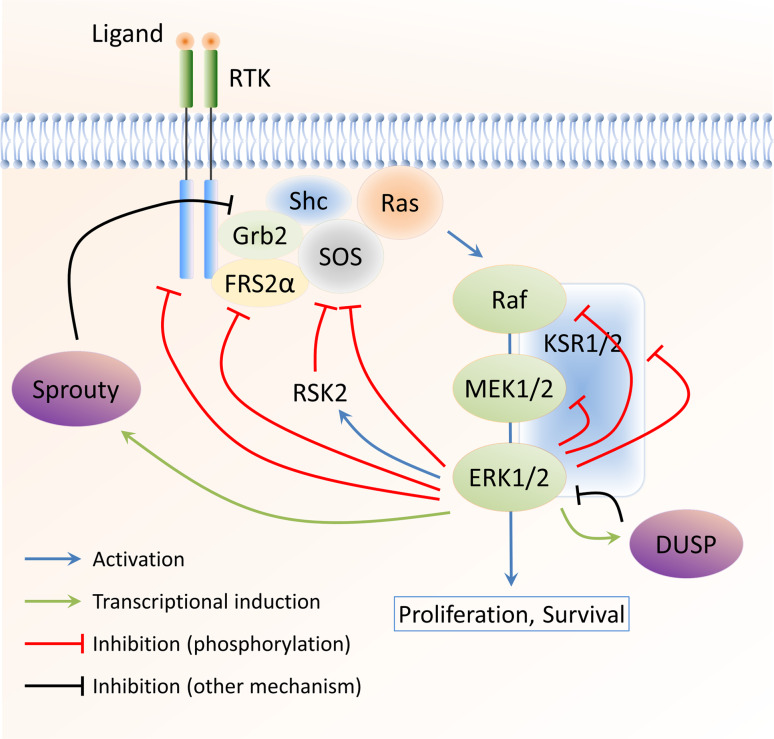
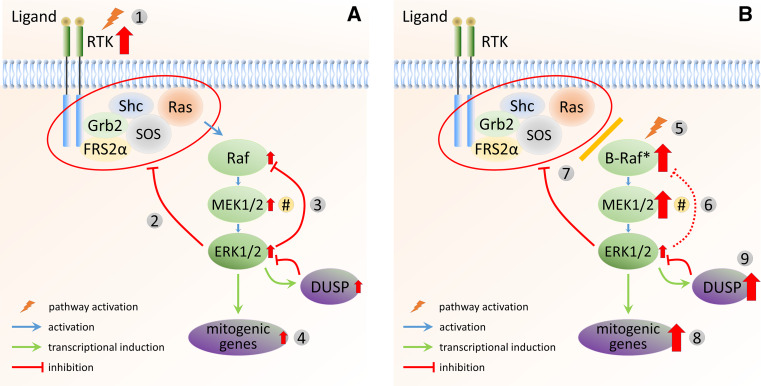
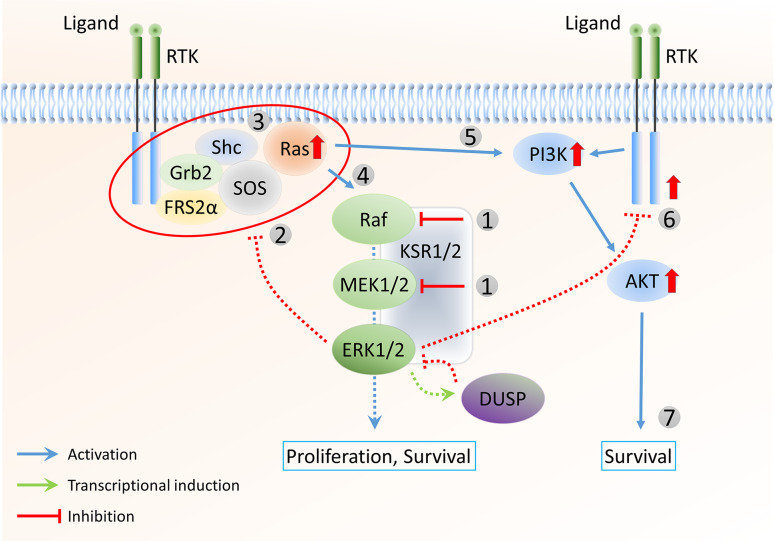
The extracellular signal-regulated kinase 1/2 (ERK1/2) mitogen-activated protein kinase (MAPK) signalling pathway regulates many cellular functions, including proliferation, differentiation, and transformation. To reliably convert external stimuli into specific cellular responses and to adapt to environmental circumstances, the pathway must be integrated into the overall signalling activity of the cell. Multiple mechanisms have evolved to perform this role. In this review, we will focus on negative feedback mechanisms and examine how they shape ERK1/2 MAPK signalling. We will first discuss the extensive number of negative feedback loops targeting the different components of the ERK1/2 MAPK cascade, specifically the direct posttranslational modification of pathway components by downstream protein kinases and the induction of de novo gene synthesis of specific pathway inhibitors. We will then evaluate how negative feedback modulates the spatiotemporal signalling dynamics of the ERK1/2 pathway regarding signalling amplitude and duration as well as subcellular localisation. Aberrant ERK1/2 activation results in deregulated proliferation and malignant transformation in model systems and is commonly observed in human tumours. Inhibition of the ERK1/2 pathway thus represents an attractive target for the treatment of malignant tumours with increased ERK1/2 activity. We will, therefore, discuss the effect of ERK1/2 MAPK feedback regulation on cancer treatment and how it contributes to reduced clinical efficacy of therapeutic agents and the development of drug resistance.
Overview
The claims and statistics of this paper haven’t been checked yet.
Free: it reads the open-access text and checks the first 5 claims that cite a source we can check. Create a free account to check every claim.
Integrity signals
Registry
Cites
Statistics
Figures
Verification
Claims the paper makes
The claims and statistics of this paper haven’t been checked yet.
Free: it reads the open-access text and checks the first 5 claims that cite a source we can check. Create a free account to check every claim.
Claims other papers make about this one
Each is checked against this paper’s own text: does it say what the citing paper says it does?
The source backs part of the claim, not all of it — or backs it for a different population, condition or comparison.
In the citing paper
“Co-inhibiting KRAS and EGFR can shut down feedback loops activated by KRAS monotherapy [96,101,124].”
From KRAS: Biology, Inhibition, and Mechanisms of Inhibitor Resistance (2024) · cites this paper as [124]
Experimental — accuracy not yet measuredThe cited source says what the claim attributes to it.
In the citing paper
“The limited ef fi cacy observed for MEK inhibitors may involve adaptive feedback mechanisms through the reactivation of MAPK signalling caused by the blockade of ERK signalling [11 -13].”
In the citing paper
“inhibitors of SOS1 reduce the activity of this key RAS-GEF and have demonstrated preclinical efficacy in combination with trametinib in KRASG12C-mutant and KRASG13D-mutant cell lines75, suggesting the potential for synergy when combined with KRAS-off inhibitors.”
From The current state of the art and future trends in RAS-targeted cancer therapies (2022) · cites this paper as [75]
In the citing paper
“SOS1 activation has been shown to be a key mechanism of adaptive resistance to MEK inhibitors; therefore, BI-3406 has been evaluated in combination with trametinib in KRASG12C-mutant and KRASG13D-mutant cell lines and found to synergistically inhibit their growth75.”
From The current state of the art and future trends in RAS-targeted cancer therapies (2022) · cites this paper as [75]
Self-check
Percentages, sums and reported differences re-computed from the paper’s own numbers.
The self-check needs the paper’s full text.
Citations
Cites
Mutations of the BRAF gene in human cancer
Davies, H., Bignell, G. R., Cox, C., Stephens, P., Edkins, S., Clegg, S., Teague, J., Woffendin, H., Garnett, M. J., Bottomley, W., et al. (2002) · Nature · doi:10.1038/nature00766 · Cited by 10,674
Pao, W., Miller, V., Zakowski, M., Doherty, J., Politi, K., Sarkaria, I., Singh, B., Heelan, R., Rusch, V., Fulton, L., et al. (2004) · Proceedings of the National Academy of Sciences · doi:10.1073/pnas.0405220101 · Cited by 4,338
Alessi, D. R., Cuenda, A., Cohen, P., Dudley, D. T., & Saltiel, A. R. (1995) · Journal of Biological Chemistry · doi:10.1074/jbc.270.46.27489 · Cited by 3,393
Inhibition of Mutated, Activated BRAF in Metastatic Melanoma
Flaherty, K. T., Puzanov, I., Kim, K. B., Ribas, A., McArthur, G. A., Sosman, J. A., O'Dwyer, P. J., Lee, R. J., Grippo, J. F., Nolop, K., et al. (2010) · New England Journal of Medicine · doi:10.1056/nejmoa1002011 · Cited by 3,103
Combined BRAF and MEK inhibition in melanoma with BRAF V600 mutations
Flaherty, K. T., Infante, J. R., Daud, A., Gonzalez, R., Kefford, R. F., Sosman, J., Hamid, O., Schuchter, L., Cebon, J., Ibrahim, N., et al. (2012) · New England Journal of Medicine · doi:10.1056/nejmoa1210093 · Cited by 2,810
Melanomas acquire resistance to B-RAF(V600E) inhibition by RTK or N-RAS upregulation
Nazarian, R., Shi, H., Wang, Q., Kong, X., Koya, R. C., Lee, H., Chen, Z., Lee, M.-K., Attar, N., Sazegar, H., et al. (2010) · Nature · doi:10.1038/nature09626 · Cited by 2,192
Unresponsiveness of colon cancer to BRAF(V600E) inhibition through feedback activation of EGFR
Prahallad, A., Sun, C., Huang, S., Di Nicolantonio, F., Salazar, R., Zecchin, D., Beijersbergen, R. L., Bardelli, A., & Bernards, R. (2012) · Nature · doi:10.1038/nature10868 · Cited by 2,051
Clinical efficacy of a RAF inhibitor needs broad target blockade in BRAF-mutant melanoma
Bollag, G., Hirth, P., Tsai, J., Zhang, J., Ibrahim, P. N., Cho, H., Spevak, W., Zhang, C., Zhang, Y., Habets, G., et al. (2010) · Nature · doi:10.1038/nature09454 · Cited by 1,831
RAF inhibitors transactivate RAF dimers and ERK signalling in cells with wild-type BRAF
Poulikakos, P. I., Zhang, C., Bollag, G., Shokat, K. M., & Rosen, N. (2010) · Nature · doi:10.1038/nature08902 · Cited by 1,811
Kinase-Dead BRAF and Oncogenic RAS Cooperate to Drive Tumor Progression through CRAF
Heidorn, S. J., Milagre, C., Whittaker, S., Nourry, A., Niculescu-Duvas, I., Dhomen, N., Hussain, J., Reis-Filho, J. S., Springer, C. J., Pritchard, C., et al. (2010) · Cell · doi:10.1016/j.cell.2009.12.040 · Cited by 1,465
Cited by
Items 201–300 of 645
Wang, X., Meng, K., Wang, H., Wang, Y., Zhao, Y., Kang, J., Zhang, Y., & Quan, F. (2021) · Journal of Cellular Physiology · doi:10.1002/jcp.30251 · Cited by 22
Kramer, E. R., & Conway, J. A. (2021) · Neural Regeneration Research · doi:10.4103/1673-5374.327330 · Cited by 22
Endothelial cell expression of mutant Map2k1 causes vascular malformations in mice
Smits, P. J., Sudduth, C. L., Konczyk, D. J., Cheng, Y. S., Vivero, M. P., Kozakewich, H. P., Warman, M. L., & Greene, A. K. (2022) · Angiogenesis · doi:10.1007/s10456-022-09853-6 · Cited by 21
Yu, H., Kan, J., Tang, M., Zhu, Y., & Hu, B. (2023) · Brain Sciences · doi:10.3390/brainsci13040549 · Cited by 21
Arekatla, G., Trenzinger, C., Reimann, A., Loeffler, D., Kull, T., & Schroeder, T. (2023) · Developmental Cell · doi:10.1016/j.devcel.2023.04.013 · Cited by 21
Cai, Y., Xie, K., Wu, H., & Wu, K. (2019) · Journal of Cellular Physiology · doi:10.1002/jcp.28503 · Cited by 21
Li, Y., Zhong, Y., Xiao, X., Li, D.-D., Zhou, Z., & Tian, Y. (2020) · Innate Immunity · doi:10.1177/1753425920918911 · Cited by 21
Chen, J., Song, C., Lei, S., Li, J., Zuo, A., Xu, D., & Guo, Y. L. (2020) · Experimental Cell Research · doi:10.1016/j.yexcr.2020.112194 · Cited by 21
Zhou, Y., Gao, L., Xia, P., Zhao, J., Li, W., Zhou, Y., Wei, Q., Wu, Q., Wu, Q., Sun, D., et al. (2021) · Frontiers in Pharmacology · doi:10.3389/fphar.2021.619567 · Cited by 21
DUSP4 protects BRAF- and NRAS-mutant melanoma from oncogene overdose through modulation of MITF
Gutierrez-Prat, N., Zuberer, H. L., Mangano, L., Karimaddini, Z., Wolf, L., Tyanova, S., Wellinger, L. C., Marbach, D., Griesser, V., Pettazzoni, P., et al. (2022) · Life Science Alliance · doi:10.26508/lsa.202101235 · Cited by 21
Signaling oscillations: Molecular mechanisms and functional roles
Casani-Galdon, P., & García‐Ojalvo, J. (2022) · Current Opinion in Cell Biology · doi:10.1016/j.ceb.2022.102130 · Cited by 21
Recent advances in the development of inhibitors targeting KRAS-G12C and its related pathways
Zhao, D., Liu, Y., Yi, F., Zhao, X., & Lu, K. (2023) · European Journal of Medicinal Chemistry · doi:10.1016/j.ejmech.2023.115698 · Cited by 21
Hu, X., Li, W., Zeng, K., Xu, Z., Li, C., Kang, Z., Li, S., Huang, X., Han, P., Lin, H., et al. (2023) · BMC Medicine · doi:10.1186/s12916-023-02927-2 · Cited by 20
An Overview of miRNAs Involved in PASMC Phenotypic Switching in Pulmonary Hypertension
Zhang, W., Tao, Z., Xu, F., Diao, Q., Li, J., Zhou, L., Miao, Y., Xie, S., Wan, J., & Xu, R. (2021) · BioMed Research International · doi:10.1155/2021/5765029 · Cited by 21
Reconstruction and analysis of a large-scale binary Ras-effector signaling network
Catozzi, S., Ternet, C., Gourrege, A., Wynne, K. J., Oliviero, G., & Kiel, C. (2022) · Cell Communication and Signaling · doi:10.1186/s12964-022-00823-5 · Cited by 20
Molinar‐Inglis, O., Wozniak, J. M., Grimsey, N. J., Orduña-Castillo, L. B., Cheng, N., Lin, Y., Ramirez, M. L. G., Birch, C. A., Lapek, J. D., Gonzalez, D. J., et al. (2022) · Journal of Biological Chemistry · doi:10.1016/j.jbc.2022.101801 · Cited by 20
Tögel, L., Nightingale, R., Wu, R., Chüeh, A. C., Al-Obaidi, S. J., Luk, I. Y., Dávalos-Salas, M., Chionh, F. J. M., Murone, C., Buchanan, D. D., et al. (2018) · Scientific Reports · doi:10.1038/s41598-018-20176-9 · Cited by 21
Effects of hypoxia and ASIC3 on nucleus pulposus cells: From cell behavior to molecular mechanism
Wang, D., Zhu, H., Cheng, W., Lin, S., Shao, R., & Pan, H. (2019) · Biomedicine & Pharmacotherapy · doi:10.1016/j.biopha.2019.109061 · Cited by 20
Georgescu, M.-M., Li, Y., Islam, M. Z., Notarianni, C., Sun, H., Olar, A., & Fuller, G. N. (2019) · Oncotarget · doi:10.18632/oncotarget.27005 · Cited by 20
Cao, Y., Chen, J., Liu, F., Qi, G., Zhao, Y., Xu, S., Wang, J., Zhu, T., Zhang, Y., & Jia, Y. (2023) · Cellular & Molecular Biology Letters · doi:10.1186/s11658-023-00416-1 · Cited by 19
Cordycepin inhibits myogenesis via activating the ERK1/2 MAPK signalling pathway in C2C12 cells
Cheng, C., Zhang, S., Gong, Y., Wang, X., Tang, S., Wan, J., Ding, K., Yuan, C., Sun, W., & Yao, L. (2023) · Biomedicine & Pharmacotherapy · doi:10.1016/j.biopha.2023.115163 · Cited by 19
Wu, Q., Zhou, Y., & Zhou, X. (2019) · Evidence-based Complementary and Alternative Medicine · doi:10.1155/2019/1528586 · Cited by 19
Oncogenic K-Ras4B Dimerization Enhances Downstream Mitogen-activated Protein Kinase Signaling
Muratcioğlu, S., Aydın, C., Odabasi, E., Özdemir, E. S., Firat‐Karalar, E. N., Jang, H., Tsai, C., Nussinov, R., Kavaklı, İ. H., Gürsoy, A., et al. (2020) · Journal of Molecular Biology · doi:10.1016/j.jmb.2020.01.002 · Cited by 19
Giordano, G., Parcesepe, P., Bruno, G., Piscazzi, A., Lizzi, V., Remo, A., Pancione, M., D'Andrea, M. R., Santis, E. D., Coppola, L., et al. (2021) · International Journal of Molecular Sciences · doi:10.3390/ijms22147717 · Cited by 19
Diehl, J. N., Hibshman, P. S., Ozkan‐Dagliyan, I., Goodwin, C. M., Howard, S. V., Cox, A. D., & Der, C. J. (2022) · Advances in cancer research · doi:10.1016/bs.acr.2021.07.008 · Cited by 20
Tong, L., & Wu, W. (2019) · Pathology - Research and Practice · doi:10.1016/j.prp.2019.152522 · Cited by 19
Ko, T., Sharma, R., & Li, S. (2019) · Oncogene · doi:10.1038/s41388-019-1022-0 · Cited by 19
Cancer stem cell generation by silenced MAPK enhancing PI3K/AKT signaling
Hassan, G., Du, J., Afify, S. M., Seno, A., & Seno, M. (2020) · Medical Hypotheses · doi:10.1016/j.mehy.2020.109742 · Cited by 19
Rerouting the drug response: Overcoming metabolic adaptation in KRAS-mutant cancers
Moss, D., McCann, C. K., & Kerr, E. M. (2022) · Science Signaling · doi:10.1126/scisignal.abj3490 · Cited by 19
Piercey, O., Tie, J., Hollande, F., Wong, H., Mariadason, J. M., & Desai, J. (2024) · Clinical Colorectal Cancer · doi:10.1016/j.clcc.2024.04.004 · Cited by 18
Current perspectives of KRAS in non-small cell lung cancer
Harris, E., & Thawani, R. (2024) · Current Problems in Cancer · doi:10.1016/j.currproblcancer.2024.101106 · Cited by 18
Postnatal regulation of B-1a cell development and survival by the CIC-PER2-BHLHE41 axis
Hong, H., Lee, J., Park, G.-Y., Kim, S., Park, J., Park, J. S., Song, Y., Lee, S., Kim, T. J., Lee, Y. J., et al. (2022) · Cell Reports · doi:10.1016/j.celrep.2022.110386 · Cited by 18
ERK1/2-RSK2 Signaling in Regulation of ERα-Mediated Responses
Lannigan, D. A. (2022) · Endocrinology · doi:10.1210/endocr/bqac106 · Cited by 18
Mandl, M., Wagner, S., Hatzmann, F. M., Ejaz, A., Ritthammer, H., Baumgarten, S., Viertler, H. P., Springer, J., Zwierzina, M., Mattesich, M., et al. (2020) · The Journals of Gerontology Series A · doi:10.1093/gerona/glaa098 · Cited by 18
Xu, Y., Qiu, Y. L., Lin, Q., Huang, C., Li, J., Chen, L., Xue, Z., Wu, Q., & Wang, Y. (2022) · Stem Cell Research & Therapy · doi:10.1186/s13287-022-03003-x · Cited by 18
Liu, P., Yang, X., Zhang, H., Pu, J., & Wei, K. (2018) · OncoTargets and Therapy · doi:10.2147/ott.s164276 · Cited by 18
Yang, X., Zeng, T., Liu, Z., He, W., Hu, M., Tang, T., Chen, L., & Xing, L. (2022) · Cancer Medicine · doi:10.1002/cam4.4795 · Cited by 17
Chaput, D., & Andelfinger, G. (2024) · Canadian Journal of Cardiology · doi:10.1016/j.cjca.2024.02.020 · Cited by 17
Sevrin, T., Imoto, H., Robertson, S. A., Rauch, N., Dyn'ko, U., Koubova, K., Wynne, K. J., Kölch, W., Rukhlenko, O. S., & Kholodenko, B. Ν. (2024) · Cell Reports · doi:10.1016/j.celrep.2024.114710 · Cited by 17
Branicky, R. S., Wang, Y., Khaki, A., Liu, J., Kramer‐Drauberg, M., & Hekimi, S. (2022) · Science Advances · doi:10.1126/sciadv.adc9851 · Cited by 17
Dabrafenib protects from cisplatin-induced hearing loss in a clinically relevant mouse model
Ingersoll, M. A., Lutze, R. D., Pushpan, C. K., Kelmann, R. G., Liu, H., May, M. T., Hunter, W. J., He, D. Z. Z., & Teitz, T. (2023) · JCI Insight · doi:10.1172/jci.insight.171140 · Cited by 17
Rao, D. D., Luo, X., Wang, Z., Jay, C. M., Brunicardi, F. C., Maltese, W. A., Manning, L., Senzer, N. N., & Nemunaitis, J. J. (2018) · PLoS ONE · doi:10.1371/journal.pone.0193644 · Cited by 17
Mathematical modeling of Erk activity waves in regenerating zebrafish scales
Hayden, L., Poss, K. D., Simone, A. D., & Talia, S. D. (2021) · Biophysical Journal · doi:10.1016/j.bpj.2021.05.004 · Cited by 16
Niitsu, Y., Sato, Y., Takanashi, K., Hayashi, T., Kubo-Birukawa, N., Shimizu, F., Fujitani, N., Shimoyama, R., Kukitsu, T., Kurata, W., et al. (2020) · Proceedings of the National Academy of Sciences · doi:10.1073/pnas.2000361117 · Cited by 16
Wu, X., Cui, F., Chen, Y., Zhu, Y., & Liu, F. (2020) · OncoTargets and Therapy · doi:10.2147/ott.s258935 · Cited by 16
Kobayashi, T., Miyazaki, M., Sasaki, N., Yamamuro, S., Uchida, E., Kawauchi, D., Takahashi, M., Otsuka, Y., Kumagai, K., Takeuchi, S., et al. (2020) · Cancers · doi:10.3390/cancers12123641 · Cited by 16
Recent Developments in Targeting RAS Downstream Effectors for RAS-Driven Cancer Therapy
Tatlı, Ö., & Doğanay, G. D. (2021) · Molecules · doi:10.3390/molecules26247561 · Cited by 16
Chen, T., Tang, X., Tang, X., Feng, F., Xu, C., Zhao, Q., Wu, Y., Sun, H., & Chen, Y. (2023) · European Journal of Medicinal Chemistry · doi:10.1016/j.ejmech.2023.115828 · Cited by 16
Yang, Z., Xiang, H., Duan, X., Liu, J., He, X., He, Y., Hu, S., & He, L. (2018) · Lasers in Medical Science · doi:10.1007/s10103-018-2683-6 · Cited by 16
Yoshimura, A., Horinaka, M., Yaoi, T., Ono, H., Itoh, K., Yamada, T., Takayama, K., & Sakai, T. (2024) · British Journal of Cancer · doi:10.1038/s41416-024-02727-2 · Cited by 15
Targeting pathological ERK1/2 signaling in cancer and beyond
Schanbacher, C., Goebeler, M.-E., Gerull, B., & Lorenz, K. (2025) · Trends in Molecular Medicine · doi:10.1016/j.molmed.2025.08.001 · Cited by 15
Zhu, Y., Ailane, N., Sala-Valdés, M., Rad, F. H., Billard, M., Nguyen, V., Saffroy, R., Lemoine, A., Rubinstein, E., Boucheix, C., et al. (2017) · Oncotarget · doi:10.18632/oncotarget.16247 · Cited by 15
A multitargeted probe-based strategy to identify signaling vulnerabilities in cancers
Rao, S., Du, G., Hafner, M. A., Subramanian, K., Sorger, P. K., & Gray, N. S. (2019) · Journal of Biological Chemistry · doi:10.1074/jbc.ra118.006805 · Cited by 15
Can Systems Biology Advance Clinical Precision Oncology?
Rocca, A., & Kholodenko, B. Ν. (2021) · Cancers · doi:10.3390/cancers13246312 · Cited by 16
Roux, Ö. L., Pershing, N. L., Kaltenbrun, E., Newman, N. J., Everitt, J. I., Baldelli, E., Pierobon, M., Petricoin, E. F., & Counter, C. M. (2022) · eLife · doi:10.7554/elife.75715 · Cited by 15
A Combined Antitumor Strategy Mediated by a New Targeted Nanosystem to Hepatocellular Carcinoma
Farinha, D., Migawa, M. T., Sarmento‐Ribeiro, A. B., & Faneca, H. (2021) · International Journal of Nanomedicine · doi:10.2147/ijn.s302288 · Cited by 15
Sharma, U., Barwal, T. S., Khandelwal, A., Rana, M. K., Rana, A. P. S., Singh, K., & Jain, A. (2022) · Frontiers in Oncology · doi:10.3389/fonc.2022.823953 · Cited by 15
Neferine mediated TGF-β/ERK signaling to inhibit fibrosis in endometriosis.
Xia, Y., Guo, Y., Zhou, J., Fan, L., Xie, J., Wang, Y., Du, H., & Ni, X. (2023) · PubMed Central · Cited by 14
Electric field modulation of ERK dynamics shows dependency on waveform and timing
Hu, M., Li, H., Zhu, K., Guo, L., Zhao, M., Zhan, H., Devreotes, P. N., & Qing, Q. (2024) · Scientific Reports · doi:10.1038/s41598-024-53018-y · Cited by 14
RASopathies – what they reveal about RAS/MAPK signaling in skeletal muscle development
Rauen, K. A., & Tidyman, W. E. (2024) · Disease Models & Mechanisms · doi:10.1242/dmm.050609 · Cited by 14
Allosteric Kinase Inhibitors Reshape MEK1 Kinase Activity Conformations in Cells and In Silico
Fleischmann, J., Feichtner, A., DeFalco, L., Kugler, V., Schwaighofer, S., Huber, R. G., & Stefan, E. (2021) · Biomolecules · doi:10.3390/biom11040518 · Cited by 15
Regulation of ERK2 activity by dynamic S-acylation
Azizi, S., Qiu, T., Brookes, N., & Dickinson, B. C. (2023) · Cell Reports · doi:10.1016/j.celrep.2023.113135 · Cited by 15
DeKinomics pulse-chases kinase functions in living cells
Weng, Y., Chen, W., Kong, Q., Wang, R., Zeng, R., He, A., Liu, Y., Mao, Y., Qin, Y., Ngai, W. S. C., et al. (2024) · Nature Chemical Biology · doi:10.1038/s41589-023-01497-x · Cited by 14
Pang, X., Cui, D., Lv, B., & Wang, C. (2024) · Journal of Medicinal Chemistry · doi:10.1021/acs.jmedchem.3c02135 · Cited by 14
Han, S. H., & Kim, K. (2020) · Journal of Cell Science · doi:10.1242/jcs.247304 · Cited by 14
Osum, S. H., Coutts, A. W., Duerre, D. J., Tschida, B. R., Kirstein, M. N., Fisher, J. E., Bell, W. R., Delpuech, O., Smith, P. D., Widemann, B. C., et al. (2021) · Neuro-Oncology Advances · doi:10.1093/noajnl/vdab020 · Cited by 14
Yu, X., Wang, Y., Tan, X., & Li, M. (2021) · Acta Histochemica · doi:10.1016/j.acthis.2021.151749 · Cited by 14
Wang, J., Liang, X., Yu, T., Xu, Y., Xu, L., Zhang, X., Ma, J., Wang, Y., & He, S. (2018) · Cell Biology International · doi:10.1002/cbin.11035 · Cited by 14
Predictive power of non-identifiable models
Grabowski, F., Nałęcz‐Jawecki, P., & Lipniacki, T. (2023) · Scientific Reports · doi:10.1038/s41598-023-37939-8 · Cited by 13
Pairawan, S. S., Akçakanat, A., Kopetz, S., Tapia, C., Zheng, X., Chen, H., Ha, M. J., Rizvi, Y. Q., Holla, V. R., Wang, J., et al. (2022) · Scientific Reports · doi:10.1038/s41598-022-05193-z · Cited by 13
Osum, S. H., Oribamise, E. I., Corbiere, S., Taisto, M. E., Jubenville, T. A., Coutts, A., Kirstein, M. N., Fisher, J. E., Moertel, C. L., Du, M., et al. (2023) · Molecular Therapy — Nucleic Acids · doi:10.1016/j.omtn.2023.06.018 · Cited by 13
A pan-respiratory antiviral chemotype targeting a transient host multi-protein complex
Michon, M., Müller‐Schiffmann, A., Lingappa, A. F., Yu, S. F., Du, L., Deiter, F., Broce, S., Mallesh, S., Crabtree, J. M., Lingappa, U. F., et al. (2024) · Open Biology · doi:10.1098/rsob.230363 · Cited by 13
Dochi, T., Akita, A., Kishimoto, N., Takamune, N., & Misumi, S. (2017) · Biochemical and Biophysical Research Communications · doi:10.1016/j.bbrc.2017.11.177 · Cited by 13
Morosin, S. K., Delforce, S. J., Lumbers, E. R., & Pringle, K. G. (2020) · Placenta · doi:10.1016/j.placenta.2020.05.009 · Cited by 13
Neuroblastoma signalling models unveil combination therapies targeting feedback-mediated resistance
Dorel, M., Klinger, B., Mari, T., Toedling, J., Blanc, E., Messerschmidt, C., Nadler-Holly, M., Ziehm, M., Sieber, A., Hertwig, F., et al. (2021) · PLoS Computational Biology · doi:10.1371/journal.pcbi.1009515 · Cited by 13
Li, F., Yang, H., Cao, Y., Li, D., Ma, J., & Liu, P. (2021) · Nanotechnology · doi:10.1088/1361-6528/ac378c · Cited by 13
Zhang, T., Li, S., Li, Y., Cao, J., Xue, H. Y., Wang, C., & Jin, C. (2022) · Molecules · doi:10.3390/molecules27092946 · Cited by 13
Chen, T., Zhu, H., Wang, Y., Zhao, P., Chen, J., Sun, J., Zhang, X., & Zhu, G. (2018) · Europe PMC (PubMed Central) · Cited by 13
MEK Inhibition in Glioblastoma: Current Perspectives and Future Directions
Levy, A. S., Bryant, J.-P., Matichak, D. P., Onishi, S., & Banasavadi‐Siddegowda, Y. (2025) · International Journal of Molecular Sciences · doi:10.3390/ijms26146875 · Cited by 12
Gao, X., Shan, W., Liu, X., Zhang, J., Zheng, J., & Yao, H. (2018) · Future Oncology · doi:10.2217/fon-2018-0171 · Cited by 12
Atyeo, N., Chae, M. Y., Tóth, Z., Sharma, A., & Papp, B. (2023) · Journal of Virology · doi:10.1128/jvi.01696-22 · Cited by 12
Xing, J., Tan, R., Huang, F., & Tian, N. (2024) · Journal of Cellular and Molecular Medicine · doi:10.1111/jcmm.18211 · Cited by 12
Meng, X., Bai, X., Ke, A., Li, K., Lei, Y., Ding, S., & Dai, D. (2024) · Biomolecules · doi:10.3390/biom14060608 · Cited by 12
Biphasic spatiotemporal regulation of GRB2 dynamics by p52SHC for transient RAS activation
Yoshizawa, R., Umeki, N., Yamamoto, A., Murata, M., & Sako, Y. (2021) · Biophysics and Physicobiology · doi:10.2142/biophysico.bppb-v18.001 · Cited by 12
Yuan, P., Qin, H., Wei, J., Chen, G., & Li, X. (2022) · Regenerative Therapy · doi:10.1016/j.reth.2022.11.004 · Cited by 12
Protein Translation and Signaling in Human Eosinophils
Esnault, S. J., Shen, Z.-J., & Malter, J. S. (2017) · Frontiers in Medicine · doi:10.3389/fmed.2017.00150 · Cited by 13
Santra, T. (2018) · Scientific Reports · doi:10.1038/s41598-018-30118-0 · Cited by 12
Yan, X., Yu, X. L., Jiang, C., Cao, Y., Zhu, L., Du, C., & Jia, Y. (2022) · Annals of Translational Medicine · doi:10.21037/atm-22-892 · Cited by 12
Chou, W.-L., Yang, S.-C., Alshetaili, A., Wei, S.-H., Yang, S.-H., & Fang, J. (2024) · International Immunopharmacology · doi:10.1016/j.intimp.2024.113486 · Cited by 11
Niitsu, Y., Sato, Y., & Takayama, T. (2022) · Proceedings of the Japan Academy Series B · doi:10.2183/pjab.98.005 · Cited by 11
Early Combined SHP2 Targeting Reverses the Therapeutic Resistance of Vemurafenib in Thyroid Cancer
Ma, W., Tian, M., Hu, L., Ruan, X., Zhang, W., Zheng, X., & Gao, M. (2023) · Journal of Cancer · doi:10.7150/jca.83853 · Cited by 11
Targeting guanine nucleotide exchange factors for novel cancer drug discovery
Bannoura, S. F., Khan, H. Y., Uddin, M. H., Mohammad, R. M., Pasche, B., & Azmi, A. S. (2024) · Expert Opinion on Drug Discovery · doi:10.1080/17460441.2024.2368242 · Cited by 11
Puranik, N., Jung, H., & Song, M. (2024) · International Journal of Molecular Sciences · doi:10.3390/ijms252011043 · Cited by 11
Truong, A. D., Hong, Y., Rengaraj, D., Lee, J., Lee, K., & Hong, Y. H. (2018) · Developmental & Comparative Immunology · doi:10.1016/j.dci.2018.05.017 · Cited by 11
Haryuni, R. D., Watabe, S., Yamaguchi, A., Fukushi, Y., Tanaka, T., Kawasaki, Y., Zhou, Y., Yokoyama, S., & Sakurai, H. (2019) · Biochemical and Biophysical Research Communications · doi:10.1016/j.bbrc.2019.04.125 · Cited by 11
Raimúndez, E., Keller, S., Zwingenberger, G., Ebert, K., Hug, S., Theis, F. J., Maier, D., Luber, B., & Hasenauer, J. (2020) · PLoS Computational Biology · doi:10.1371/journal.pcbi.1007147 · Cited by 11
Exploiting codon usage identifies intensity-specific modifiers of Ras/MAPK signaling in vivo
Sawyer, J. K., Kabiri, Z., Montague, R. A., Allen, S. R., Stewart, R. K., Paramore, S. V., Cohen, E., Zaribafzadeh, H., Counter, C. M., & Fox, D. T. (2020) · PLoS Genetics · doi:10.1371/journal.pgen.1009228 · Cited by 11
Secondary metabolites in wound healing: a review of their mechanisms of action
Álvarez-Santos, N., García‐Bores, A. M., Barrera‐Oviedo, D., Hernández, T., Estrella-Parra, E. A., & Ávila-Acevedo, J. G. (2023) · Studies in natural products chemistry · doi:10.1016/b978-0-323-91253-2.00012-1 · Cited by 13
Guihu, W., Wei, D., Hailong, Z., Chongyu, Z., Jin, S., Mengchen, Z., Jian, Z., Rui, Z., Song, R., Chen, Z., et al. (2024) · Frontiers in Immunology · doi:10.3389/fimmu.2024.1417521 · Cited by 10
Fan, Y., An, C., Wang, Z., Luo, J., Wang, W., Luo, Q., & Song, G. (2025) · Journal of Physiology and Biochemistry · doi:10.1007/s13105-025-01070-1 · Cited by 10
Metadata
- Authors
- Lake, D., Corrêa, S. A. L., & Müller, J.
- Affiliations
- University of Warwick (GB)
- Aston University (GB)
- Corresponding author
- Müller, Jürgen
- Venue
- Cellular and Molecular Life Sciences
- Published
- 2016-06-24
- Volume
- 73
- Issue
- 23
- Pages
- 4397-4413
- ISSN
- 1420-682X (ISSN-L)
- 1420-9071
- PMC
- PMC5075022
- OpenAlex
- W2465367340
- Cited by
- 565
- References
- 134
- Citations by year
- 2026: 48 · 2025: 45 · 2024: 63 · 2023: 74 · 2022: 73 · 2021: 84 · 2020: 63 · 2019: 50 · 2018: 43 · 2017: 21 · 2016: 1
- FWCI
- 3.46
- Type
- journal article
- Language
- en
- Open access
- hybrid
- doi.org
- Locations
- Cellular and Molecular Life Sciences (publishedVersion, cc-by)
- PubMed Central (publishedVersion, cc-by)
- PubMed (publishedVersion)
- Bradford Scholars (University of Bradford) (publishedVersion, other-oa)
- e-space (Manchester Metropolitan University) (acceptedVersion)
- Warwick Research Archive Portal (University of Warwick) (acceptedVersion)
- Aston Publications Explorer (Aston University) (submittedVersion)
- Topics
- Life Sciences › Biochemistry, Genetics and Molecular Biology › Molecular Biology › Melanoma and MAPK Pathways
- Life Sciences › Biochemistry, Genetics and Molecular Biology › Molecular Biology › Protein Kinase Regulation and GTPase Signaling
- Life Sciences › Biochemistry, Genetics and Molecular Biology › Molecular Biology › Protein Tyrosine Phosphatases
- Keywords
- ERK1/2, MAPK signaling, negative feedback regulation, post-translational modification, pathway inhibitors, subcellular localization, cancer therapy, drug resistance, malignant transformation
- MeSH terms
- Animals, Humans, Phosphorylation, Disease Progression, MAP Kinase Signaling System, Feedback, Physiological, Protein Kinase Inhibitors, Extracellular Signal-Regulated MAP Kinases
About these checks
Registry, retraction, Cites and statistics results are computed, not judged, with one exception: a printed reference that no index lists is read once by a model before it counts as a citation error. Claims are extracted by a model and kept only when their quote appears verbatim in the text; each cited source is then checked, with a model’s help, for whether it says what the claim relies on. Those verdicts can be wrong — read the claim’s quote and the cited source before relying on one.
Statistics and arithmetic are recomputed, not judged.
Confidence bands are shown only for fields calibrated on our annotated test set. None is calibrated yet, so no band is shown.
What counts as a claim ›How we measure confidence ›How we check this ›
Are you an author, or do you see a problem with this page? Request a review
Data sources
Bibliographic data: Semantic Scholar, OpenAlex, Crossref.
Contains information from the Semantic Scholar Academic Graph Datasets, made available under the ODC Attribution License (ODC-BY 1.0).
Semantic Scholar’s data is described in: Kinney, R., et al. (2023). The Semantic Scholar Open Data Platform. arXiv:2301.10140.
