

Negative feedback regulation of the ERK1/2 MAPK pathway
Open accessThe DOI matches its Crossref record; 133 of the 134 references it cites were found in a registry or an index.
Abstract
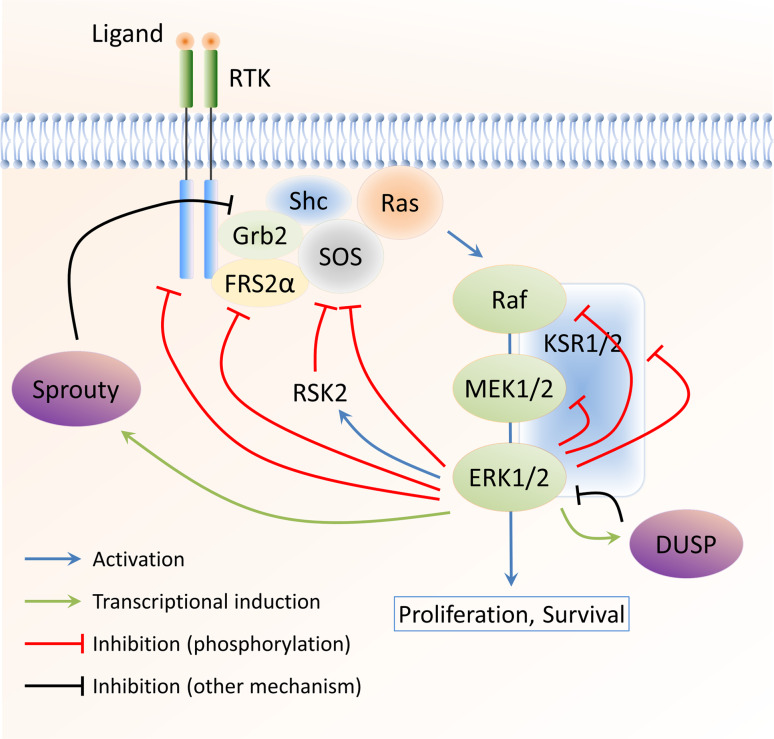
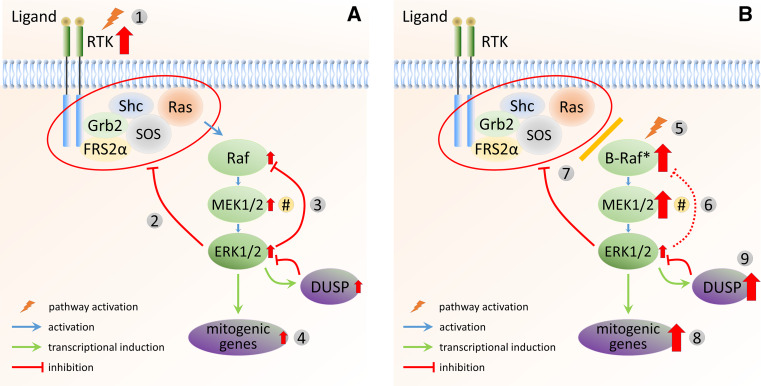
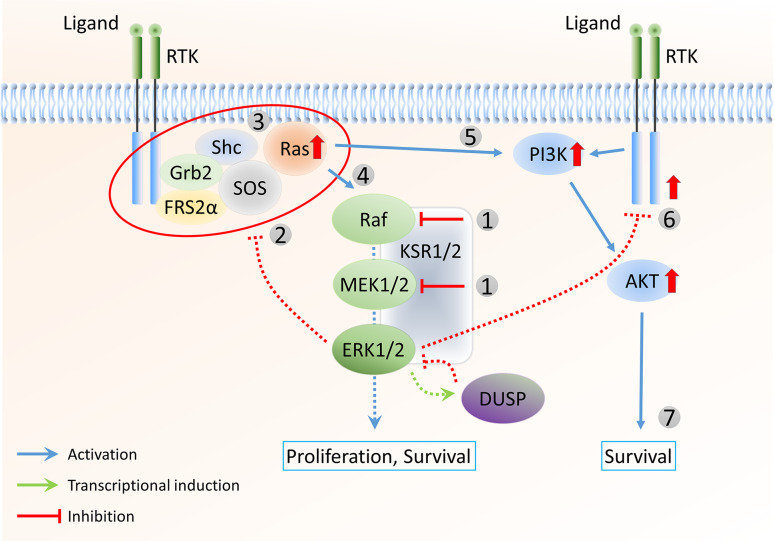
The extracellular signal-regulated kinase 1/2 (ERK1/2) mitogen-activated protein kinase (MAPK) signalling pathway regulates many cellular functions, including proliferation, differentiation, and transformation. To reliably convert external stimuli into specific cellular responses and to adapt to environmental circumstances, the pathway must be integrated into the overall signalling activity of the cell. Multiple mechanisms have evolved to perform this role. In this review, we will focus on negative feedback mechanisms and examine how they shape ERK1/2 MAPK signalling. We will first discuss the extensive number of negative feedback loops targeting the different components of the ERK1/2 MAPK cascade, specifically the direct posttranslational modification of pathway components by downstream protein kinases and the induction of de novo gene synthesis of specific pathway inhibitors. We will then evaluate how negative feedback modulates the spatiotemporal signalling dynamics of the ERK1/2 pathway regarding signalling amplitude and duration as well as subcellular localisation. Aberrant ERK1/2 activation results in deregulated proliferation and malignant transformation in model systems and is commonly observed in human tumours. Inhibition of the ERK1/2 pathway thus represents an attractive target for the treatment of malignant tumours with increased ERK1/2 activity. We will, therefore, discuss the effect of ERK1/2 MAPK feedback regulation on cancer treatment and how it contributes to reduced clinical efficacy of therapeutic agents and the development of drug resistance.
Overview
The claims and statistics of this paper haven’t been checked yet.
Free: it reads the open-access text and checks the first 5 claims that cite a source we can check. Create a free account to check every claim.
Integrity signals
Registry
Cites
Statistics
Figures
Verification
Claims the paper makes
The claims and statistics of this paper haven’t been checked yet.
Free: it reads the open-access text and checks the first 5 claims that cite a source we can check. Create a free account to check every claim.
Claims other papers make about this one
Each is checked against this paper’s own text: does it say what the citing paper says it does?
The source backs part of the claim, not all of it — or backs it for a different population, condition or comparison.
In the citing paper
“Co-inhibiting KRAS and EGFR can shut down feedback loops activated by KRAS monotherapy [96,101,124].”
From KRAS: Biology, Inhibition, and Mechanisms of Inhibitor Resistance (2024) · cites this paper as [124]
Experimental — accuracy not yet measuredThe cited source says what the claim attributes to it.
In the citing paper
“The limited ef fi cacy observed for MEK inhibitors may involve adaptive feedback mechanisms through the reactivation of MAPK signalling caused by the blockade of ERK signalling [11 -13].”
In the citing paper
“inhibitors of SOS1 reduce the activity of this key RAS-GEF and have demonstrated preclinical efficacy in combination with trametinib in KRASG12C-mutant and KRASG13D-mutant cell lines75, suggesting the potential for synergy when combined with KRAS-off inhibitors.”
From The current state of the art and future trends in RAS-targeted cancer therapies (2022) · cites this paper as [75]
In the citing paper
“SOS1 activation has been shown to be a key mechanism of adaptive resistance to MEK inhibitors; therefore, BI-3406 has been evaluated in combination with trametinib in KRASG12C-mutant and KRASG13D-mutant cell lines and found to synergistically inhibit their growth75.”
From The current state of the art and future trends in RAS-targeted cancer therapies (2022) · cites this paper as [75]
Self-check
Percentages, sums and reported differences re-computed from the paper’s own numbers.
The self-check needs the paper’s full text.
Citations
Cites
Mutations of the BRAF gene in human cancer
Davies, H., Bignell, G. R., Cox, C., Stephens, P., Edkins, S., Clegg, S., Teague, J., Woffendin, H., Garnett, M. J., Bottomley, W., et al. (2002) · Nature · doi:10.1038/nature00766 · Cited by 10,674
Pao, W., Miller, V., Zakowski, M., Doherty, J., Politi, K., Sarkaria, I., Singh, B., Heelan, R., Rusch, V., Fulton, L., et al. (2004) · Proceedings of the National Academy of Sciences · doi:10.1073/pnas.0405220101 · Cited by 4,338
Alessi, D. R., Cuenda, A., Cohen, P., Dudley, D. T., & Saltiel, A. R. (1995) · Journal of Biological Chemistry · doi:10.1074/jbc.270.46.27489 · Cited by 3,393
Inhibition of Mutated, Activated BRAF in Metastatic Melanoma
Flaherty, K. T., Puzanov, I., Kim, K. B., Ribas, A., McArthur, G. A., Sosman, J. A., O'Dwyer, P. J., Lee, R. J., Grippo, J. F., Nolop, K., et al. (2010) · New England Journal of Medicine · doi:10.1056/nejmoa1002011 · Cited by 3,103
Combined BRAF and MEK inhibition in melanoma with BRAF V600 mutations
Flaherty, K. T., Infante, J. R., Daud, A., Gonzalez, R., Kefford, R. F., Sosman, J., Hamid, O., Schuchter, L., Cebon, J., Ibrahim, N., et al. (2012) · New England Journal of Medicine · doi:10.1056/nejmoa1210093 · Cited by 2,810
Melanomas acquire resistance to B-RAF(V600E) inhibition by RTK or N-RAS upregulation
Nazarian, R., Shi, H., Wang, Q., Kong, X., Koya, R. C., Lee, H., Chen, Z., Lee, M.-K., Attar, N., Sazegar, H., et al. (2010) · Nature · doi:10.1038/nature09626 · Cited by 2,192
Unresponsiveness of colon cancer to BRAF(V600E) inhibition through feedback activation of EGFR
Prahallad, A., Sun, C., Huang, S., Di Nicolantonio, F., Salazar, R., Zecchin, D., Beijersbergen, R. L., Bardelli, A., & Bernards, R. (2012) · Nature · doi:10.1038/nature10868 · Cited by 2,051
Clinical efficacy of a RAF inhibitor needs broad target blockade in BRAF-mutant melanoma
Bollag, G., Hirth, P., Tsai, J., Zhang, J., Ibrahim, P. N., Cho, H., Spevak, W., Zhang, C., Zhang, Y., Habets, G., et al. (2010) · Nature · doi:10.1038/nature09454 · Cited by 1,831
RAF inhibitors transactivate RAF dimers and ERK signalling in cells with wild-type BRAF
Poulikakos, P. I., Zhang, C., Bollag, G., Shokat, K. M., & Rosen, N. (2010) · Nature · doi:10.1038/nature08902 · Cited by 1,811
Kinase-Dead BRAF and Oncogenic RAS Cooperate to Drive Tumor Progression through CRAF
Heidorn, S. J., Milagre, C., Whittaker, S., Nourry, A., Niculescu-Duvas, I., Dhomen, N., Hussain, J., Reis-Filho, J. S., Springer, C. J., Pritchard, C., et al. (2010) · Cell · doi:10.1016/j.cell.2009.12.040 · Cited by 1,465
Cited by
Items 601–645 of 645
The Biochemical Basis of HormesisPreprint
Cerrillo, G., Vidaković, H., & Míguez, D. G. (2026) · bioRxiv (Cold Spring Harbor Laboratory) · doi:10.64898/2026.04.20.719646
Downstream Survival Pathways in Gastrointestinal Stromal Tumors: Mechanisms and Significance
祁, 邓. (2026) · Advances in Clinical Medicine · doi:10.12677/acm.2026.1641731
Transcriptomic Signatures of Chicken DF-1 Cells Following Toll-Like Receptor 3 Stimulation
Park, J., Jung, J.-W., Bugenyi, A. W., Ndimukaga, M., Truong, A. D., So, J. R., Uyen, N. T., Jang, H. S., & Song, K. (2026) · Journal of Animal Science and Technology · doi:10.5187/jast.2500376
Shamsi, A., Anwar, S., & Dinislam, K. (2026) · Advances in protein chemistry and structural biology · doi:10.1016/bs.apcsb.2026.04.008
Control-guided refinement of partially specified Boolean networks: applications to RTK signaling
Šmijáková, E., Brim, L., Pastva, S., & Šafránek, D. (2026) · Bioinformatics · doi:10.1093/bioinformatics/btag275
Epigenetic silencing of MAFG is a potential prognosis biomarker in lung adenocarcinomasPreprint
García-Guede, Á., Rodríguez‐Antolín, C., Arauzo-Cabrera, A., Moreno-Velasco, R., Pernía, O., Herencia, M. B., Acero-Riaguas, L., Esteban‐Rodríguez, I., Sacristán, S., Torres-Ruiz, R., et al. (2026) · bioRxiv (Cold Spring Harbor Laboratory) · doi:10.64898/2026.05.26.724922
Turner, J. A., D’Antonio, M. A., Montane, H. N., MacBeth, M. L., Katsnelson, E., Robinson, W. A., Tobin, R. P., Couts, K. L., Markovic, S. N., & Torres, R. M. (2026) · Frontiers in Immunology · doi:10.3389/fimmu.2026.1829486
MEK Inhibitors and Toll-like Receptor Signaling: Implications for Infection and Inflammation
Planz, O. (2026) · International Journal of Molecular Sciences · doi:10.3390/ijms27135666
Hu, J., Qiao, Y., Lei, G., 盖祥云, Xia, Q., Hu, Q., Sun, H., Wang, H., Li, Z., Zhao, Y., et al. (2026) · International Journal of Molecular Sciences · doi:10.3390/ijms27135815
Reversible Opto-Chemical activation of KRASG12V signaling with near single-cell precisionPreprint
Muñoz-Nava, L. M., Bespalova, M., Caracci, M. O., Kewagamang, K. A., Soetje, B., Seidler, S., Michel, K., Vogel, H., Maerz, J., & Bastiaens, P. I. H. (2026) · bioRxiv (Cold Spring Harbor Laboratory) · doi:10.64898/2026.06.29.735036
Alnatsha, A., Xu, J., Habshi, T., Li, Q., Riçku, K., Allawadhi, P., Saka, D., Dai, R., Xue, Y., Nguyen, H., et al. (2026) · Gut · doi:10.1136/gutjnl-2025-337363
Darash‐Yahana, M., Soudah, N., Baskin, A., Levy-Saar, I., Levitzki, A., & Engelberg, D. (2026) · iScience · doi:10.1016/j.isci.2026.116629
Wang, M. C., Xu, C., Xie, S., Jin, J., Zhang, P. G., Liu, J., Wu, C., Xi, Y., & Yang, X. Y. (2026) · Cell Communication and Signaling · doi:10.1186/s12964-026-03045-1
Discovery of Cyclic Peptides Targeting the BRAF Dimer Interface as Dual Inhibitors
Zhang, K., Zhang, W., Dong, P., Wang, G., Gai, C., Chai, X., Zhuo, X., Xiao, Y.-Y., Hu, K., Li, J., et al. (2026) · ACS Pharmacology & Translational Science · doi:10.1021/acsptsci.6c00158
Peng, L., Zhou, Y., Yao, L., Yan, S., Li, X., Yin, W., Ni, M., & Chen, J. (2026) · Food and Chemical Toxicology · doi:10.1016/j.fct.2026.116289
Drugging ERK1/2 in Cancer: A Glimpse of Small‐Molecule Inhibitors
Peng, Z., Fu, Y., Chen, Y., Fan, B., & Liu, B. (2026) · Medicinal Research Reviews · doi:10.1002/med.70084
Yin, Q., Ma, J., Jin, X., Liu, L., Gu, B., Wang, J., Zhang, J., Ye, L., Mao, X., Fang, L., et al. (2026) · Phytomedicine · doi:10.1016/j.phymed.2026.158641
Ramos, R. Q., da Silva, C. M. F. P., Evangelista, A. F., Serpeloni, F., Lacerda, N. R., Avanci, J. Q., & de Assis, S. G. (2026) · Developmental Psychobiology · doi:10.1002/dev.70183
Delgado, L. G. (2022) · Knowledge UdeS (Institutional Deposit of the University of Sherbrooke)
Jones-Oliveira, J. B., Oliveira, H.-J. B., & Oliveira, J. S. (2026) · Journal of Computational Biology · doi:10.1177/15578666261469890
Exploring the nuclear translocation of TPL2 and its interaction with MEK1
Shi, X. (2026) · Enlighten: Theses (The University of Glasgow)
Bharti, J., Gogu, P., Sarwan, D. N., Pathak, M. K., Gupta, P. S., Dwivedi, A. R., & Pathak, P. (2026) · Biochemical Pharmacology · doi:10.1016/j.bcp.2026.118379
森谷, 晃. (2026) · Nihon Ika Daigaku Igakkai Zasshi · doi:10.1272/manms.22.233
Ma, J., Du, C., Zhao, X., Liu, Y., Yang, X., Liu, S., Fan, K., Wang, X., Liu, G., Tuerhong, R., et al. (2026) · Research Square · doi:10.21203/rs.3.rs-10607674/v1
The pERKs of temporal order memory in mice
D'hers, S., Ramos, S. O., Robles, A. D., & Feld, M. (2026) · Frontiers in Molecular Neuroscience · doi:10.3389/fnmol.2026.1912931
Kobayashi, T. (2021) · Institutional Repositories DataBase (IRDB) · doi:10.20780/00032817
Slow fluctuations shape cell signaling near a bifurcation in embryonic stem cellsPreprint
Fabris, F., Raina, D., Schröter, C., & Morelli, L. G. (2026) · arXiv (Cornell University) · doi:10.48550/arxiv.2609.05453
Dual targeting of SOS1 and EGFR suppresses growth of KRAS-mutant colorectal cancerPreprint
Tanaka, H., Kitazawa, M., Nakamura, S., Yamamoto, Y., Miyazaki, S., Hondo, N., Kuroiwa, M., Kimura, D., Yamazaki, S., Kataoka, M., et al. (2026) · SSRN Electronic Journal · doi:10.2139/ssrn.7478781
Slotki-Itzchakov, O., Shpungin, S., & Nir, U. (2026) · Frontiers in Oncology · doi:10.3389/fonc.2026.1948976
Dimitrakopoulou, M.-E., Theocharopoulos, C., Katsandri, A., Foteinou, D., Stefanou, D. T., Gkoufa, A., Tsoukalas, K., Bousou, T., Anastasopoulou, A. N., Gogas, H., et al. (2026) · Critical Reviews in Oncology/Hematology · doi:10.1016/j.critrevonc.2026.105630
Grechukhina, A. A., Mishchenko, T. A., Gudkov, S. V., & Vedunova, M. V. (2026) · International Journal of Molecular Sciences · doi:10.3390/ijms27198757
Acquired resistance to targeted therapies in BRAF mutant colorectal cancer
Oddo, D. (n.d.) · Institutional Research Information System University of Turin (University of Turin)
AaMYB17 Regulates the Biosynthesis of Anthocyanins in the Fruit of Actinidia arguta
Chen, X., Li, W., Liu, X., Zhao, C., Guo, Y., Ma, Z., Zhang, L., Liu, W., Han, D., & Li, X. (2026) · Physiologia Plantarum · doi:10.1111/ppl.71111
Hamidi, A. A., Moaven, O., Mahmoudian, R. A., & Abbaszadegan, M. R. (2026) · Experimental Hematology and Oncology · doi:10.1186/s40164-026-00849-2
BindingDB (2023) · UC San Diego · doi:10.7270/q2154mxq
Galiyeva, L., Grušanović, J., Netušil, J., Melichar, V., Klímová, Z., Kolář, M., Plzák, J., Šáchová, J., Kalfeřt, D., & Vomastek, T. (2026) · Biochemical Pharmacology · doi:10.1016/j.bcp.2026.118568
Zhang, J., Cui, Y., Yang, L., & Lv, Y. (2026) · Indian Journal of Pharmaceutical Education and Research · doi:10.5530/ijper.20271514
Cheng, Z., Yue, Y., Wang, Y., An, X., Xu, J., Yamada, T., Cheng, G., Bao, H., 昝林森, & Tong, B. (2026) · International Journal of Biological Macromolecules · doi:10.1016/j.ijbiomac.2026.155124
Sun, T.-K., Li, J., Sun, Y.-W., Huang, J.-W., Wu, Y.-Y., Munir, M., & Liu, H. (2026) · International Journal of Molecular Sciences · doi:10.3390/ijms272110030
Sharma, U., Barwal, T. S., Khandelwal, A., Rana, M. K., Rana, A. P. S., Singh, K., & Jain, A. (2022) · doi:10.3389/fonc.2022.823953.s004
Dorel, M., Klinger, B., Mari, T., Toedling, J., Blanc, E., Messerschmidt, C., Nadler-Holly, M., Ziehm, M., Sieber, A., Hertwig, F., et al. (2021) · doi:10.1371/journal.pcbi.1009515.r001
Fernandes, L. M., Tresemer, J., Zhang, J., Rios, J. J., Scallan, J. P., & Dellinger, M. T. (2023) · doi:10.3389/fcell.2023.1276333.s001
Metadata
- Authors
- Lake, D., Corrêa, S. A. L., & Müller, J.
- Affiliations
- University of Warwick (GB)
- Aston University (GB)
- Corresponding author
- Müller, Jürgen
- Venue
- Cellular and Molecular Life Sciences
- Published
- 2016-06-24
- Volume
- 73
- Issue
- 23
- Pages
- 4397-4413
- ISSN
- 1420-682X (ISSN-L)
- 1420-9071
- PMC
- PMC5075022
- OpenAlex
- W2465367340
- Cited by
- 565
- References
- 134
- Citations by year
- 2026: 48 · 2025: 45 · 2024: 63 · 2023: 74 · 2022: 73 · 2021: 84 · 2020: 63 · 2019: 50 · 2018: 43 · 2017: 21 · 2016: 1
- FWCI
- 3.46
- Type
- journal article
- Language
- en
- Open access
- hybrid
- doi.org
- Locations
- Cellular and Molecular Life Sciences (publishedVersion, cc-by)
- PubMed Central (publishedVersion, cc-by)
- PubMed (publishedVersion)
- Bradford Scholars (University of Bradford) (publishedVersion, other-oa)
- e-space (Manchester Metropolitan University) (acceptedVersion)
- Warwick Research Archive Portal (University of Warwick) (acceptedVersion)
- Aston Publications Explorer (Aston University) (submittedVersion)
- Topics
- Life Sciences › Biochemistry, Genetics and Molecular Biology › Molecular Biology › Melanoma and MAPK Pathways
- Life Sciences › Biochemistry, Genetics and Molecular Biology › Molecular Biology › Protein Kinase Regulation and GTPase Signaling
- Life Sciences › Biochemistry, Genetics and Molecular Biology › Molecular Biology › Protein Tyrosine Phosphatases
- Keywords
- ERK1/2, MAPK signaling, negative feedback regulation, post-translational modification, pathway inhibitors, subcellular localization, cancer therapy, drug resistance, malignant transformation
- MeSH terms
- Animals, Humans, Phosphorylation, Disease Progression, MAP Kinase Signaling System, Feedback, Physiological, Protein Kinase Inhibitors, Extracellular Signal-Regulated MAP Kinases
About these checks
Registry, retraction, Cites and statistics results are computed, not judged, with one exception: a printed reference that no index lists is read once by a model before it counts as a citation error. Claims are extracted by a model and kept only when their quote appears verbatim in the text; each cited source is then checked, with a model’s help, for whether it says what the claim relies on. Those verdicts can be wrong — read the claim’s quote and the cited source before relying on one.
Statistics and arithmetic are recomputed, not judged.
Confidence bands are shown only for fields calibrated on our annotated test set. None is calibrated yet, so no band is shown.
What counts as a claim ›How we measure confidence ›How we check this ›
Are you an author, or do you see a problem with this page? Request a review
Data sources
Bibliographic data: Semantic Scholar, OpenAlex, Crossref.
Contains information from the Semantic Scholar Academic Graph Datasets, made available under the ODC Attribution License (ODC-BY 1.0).
Semantic Scholar’s data is described in: Kinney, R., et al. (2023). The Semantic Scholar Open Data Platform. arXiv:2301.10140.
