

Negative feedback regulation of the ERK1/2 MAPK pathway
Open accessThe DOI matches its Crossref record; 133 of the 134 references it cites were found in a registry or an index.
Abstract
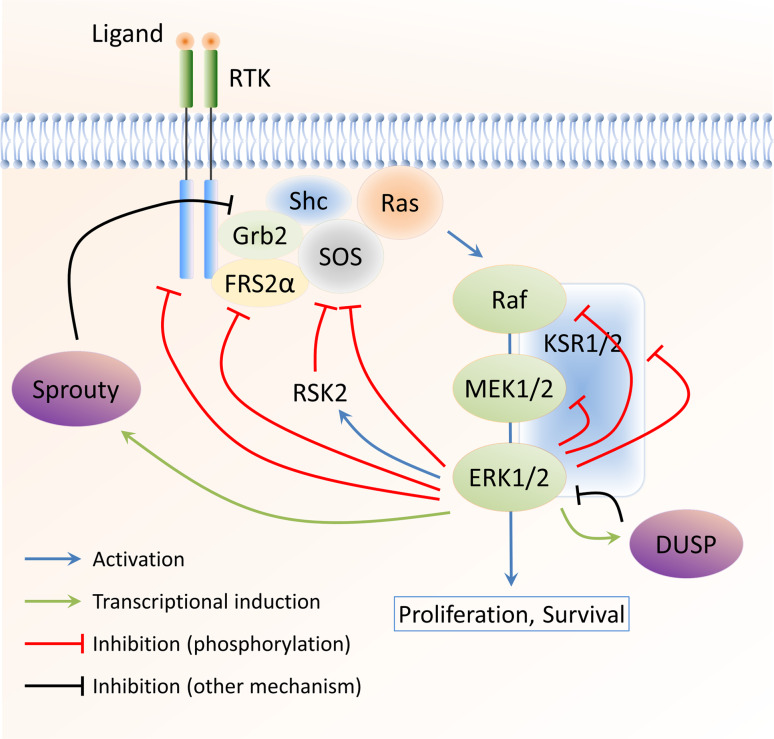
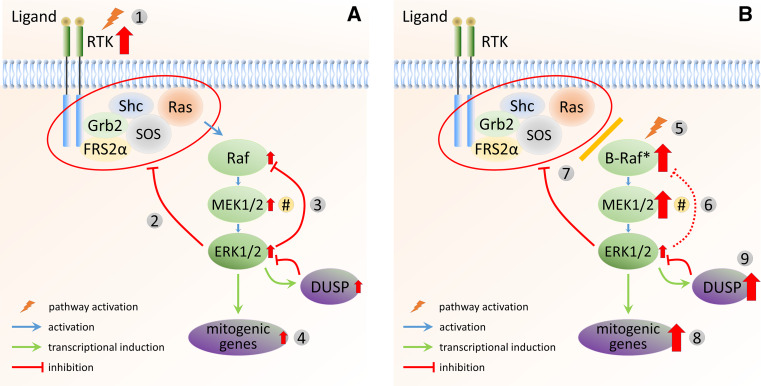
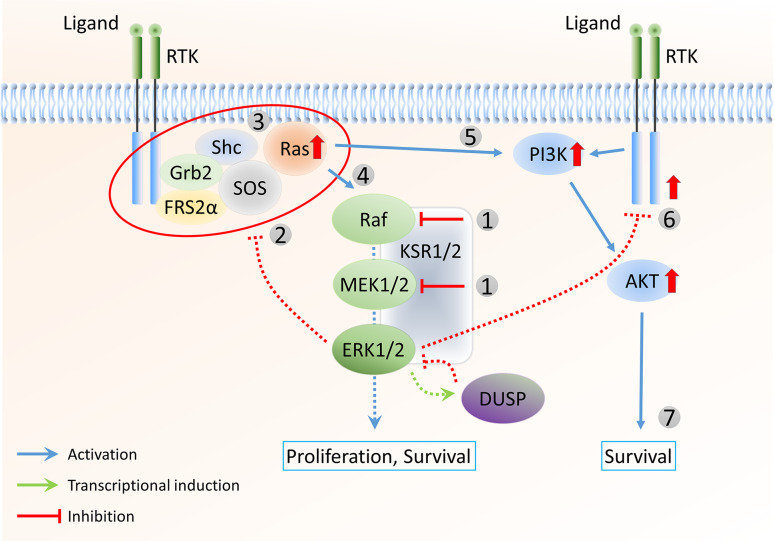
The extracellular signal-regulated kinase 1/2 (ERK1/2) mitogen-activated protein kinase (MAPK) signalling pathway regulates many cellular functions, including proliferation, differentiation, and transformation. To reliably convert external stimuli into specific cellular responses and to adapt to environmental circumstances, the pathway must be integrated into the overall signalling activity of the cell. Multiple mechanisms have evolved to perform this role. In this review, we will focus on negative feedback mechanisms and examine how they shape ERK1/2 MAPK signalling. We will first discuss the extensive number of negative feedback loops targeting the different components of the ERK1/2 MAPK cascade, specifically the direct posttranslational modification of pathway components by downstream protein kinases and the induction of de novo gene synthesis of specific pathway inhibitors. We will then evaluate how negative feedback modulates the spatiotemporal signalling dynamics of the ERK1/2 pathway regarding signalling amplitude and duration as well as subcellular localisation. Aberrant ERK1/2 activation results in deregulated proliferation and malignant transformation in model systems and is commonly observed in human tumours. Inhibition of the ERK1/2 pathway thus represents an attractive target for the treatment of malignant tumours with increased ERK1/2 activity. We will, therefore, discuss the effect of ERK1/2 MAPK feedback regulation on cancer treatment and how it contributes to reduced clinical efficacy of therapeutic agents and the development of drug resistance.
Overview
The claims and statistics of this paper haven’t been checked yet.
Free: it reads the open-access text and checks the first 5 claims that cite a source we can check. Create a free account to check every claim.
Integrity signals
Registry
Cites
Statistics
Figures
Verification
Claims the paper makes
The claims and statistics of this paper haven’t been checked yet.
Free: it reads the open-access text and checks the first 5 claims that cite a source we can check. Create a free account to check every claim.
Claims other papers make about this one
Each is checked against this paper’s own text: does it say what the citing paper says it does?
The source backs part of the claim, not all of it — or backs it for a different population, condition or comparison.
In the citing paper
“Co-inhibiting KRAS and EGFR can shut down feedback loops activated by KRAS monotherapy [96,101,124].”
From KRAS: Biology, Inhibition, and Mechanisms of Inhibitor Resistance (2024) · cites this paper as [124]
Experimental — accuracy not yet measuredThe cited source says what the claim attributes to it.
In the citing paper
“The limited ef fi cacy observed for MEK inhibitors may involve adaptive feedback mechanisms through the reactivation of MAPK signalling caused by the blockade of ERK signalling [11 -13].”
In the citing paper
“inhibitors of SOS1 reduce the activity of this key RAS-GEF and have demonstrated preclinical efficacy in combination with trametinib in KRASG12C-mutant and KRASG13D-mutant cell lines75, suggesting the potential for synergy when combined with KRAS-off inhibitors.”
From The current state of the art and future trends in RAS-targeted cancer therapies (2022) · cites this paper as [75]
In the citing paper
“SOS1 activation has been shown to be a key mechanism of adaptive resistance to MEK inhibitors; therefore, BI-3406 has been evaluated in combination with trametinib in KRASG12C-mutant and KRASG13D-mutant cell lines and found to synergistically inhibit their growth75.”
From The current state of the art and future trends in RAS-targeted cancer therapies (2022) · cites this paper as [75]
Self-check
Percentages, sums and reported differences re-computed from the paper’s own numbers.
The self-check needs the paper’s full text.
Citations
Cites
Mutations of the BRAF gene in human cancer
Davies, H., Bignell, G. R., Cox, C., Stephens, P., Edkins, S., Clegg, S., Teague, J., Woffendin, H., Garnett, M. J., Bottomley, W., et al. (2002) · Nature · doi:10.1038/nature00766 · Cited by 10,674
Pao, W., Miller, V., Zakowski, M., Doherty, J., Politi, K., Sarkaria, I., Singh, B., Heelan, R., Rusch, V., Fulton, L., et al. (2004) · Proceedings of the National Academy of Sciences · doi:10.1073/pnas.0405220101 · Cited by 4,338
Alessi, D. R., Cuenda, A., Cohen, P., Dudley, D. T., & Saltiel, A. R. (1995) · Journal of Biological Chemistry · doi:10.1074/jbc.270.46.27489 · Cited by 3,393
Inhibition of Mutated, Activated BRAF in Metastatic Melanoma
Flaherty, K. T., Puzanov, I., Kim, K. B., Ribas, A., McArthur, G. A., Sosman, J. A., O'Dwyer, P. J., Lee, R. J., Grippo, J. F., Nolop, K., et al. (2010) · New England Journal of Medicine · doi:10.1056/nejmoa1002011 · Cited by 3,103
Combined BRAF and MEK inhibition in melanoma with BRAF V600 mutations
Flaherty, K. T., Infante, J. R., Daud, A., Gonzalez, R., Kefford, R. F., Sosman, J., Hamid, O., Schuchter, L., Cebon, J., Ibrahim, N., et al. (2012) · New England Journal of Medicine · doi:10.1056/nejmoa1210093 · Cited by 2,810
Melanomas acquire resistance to B-RAF(V600E) inhibition by RTK or N-RAS upregulation
Nazarian, R., Shi, H., Wang, Q., Kong, X., Koya, R. C., Lee, H., Chen, Z., Lee, M.-K., Attar, N., Sazegar, H., et al. (2010) · Nature · doi:10.1038/nature09626 · Cited by 2,192
Unresponsiveness of colon cancer to BRAF(V600E) inhibition through feedback activation of EGFR
Prahallad, A., Sun, C., Huang, S., Di Nicolantonio, F., Salazar, R., Zecchin, D., Beijersbergen, R. L., Bardelli, A., & Bernards, R. (2012) · Nature · doi:10.1038/nature10868 · Cited by 2,051
Clinical efficacy of a RAF inhibitor needs broad target blockade in BRAF-mutant melanoma
Bollag, G., Hirth, P., Tsai, J., Zhang, J., Ibrahim, P. N., Cho, H., Spevak, W., Zhang, C., Zhang, Y., Habets, G., et al. (2010) · Nature · doi:10.1038/nature09454 · Cited by 1,831
RAF inhibitors transactivate RAF dimers and ERK signalling in cells with wild-type BRAF
Poulikakos, P. I., Zhang, C., Bollag, G., Shokat, K. M., & Rosen, N. (2010) · Nature · doi:10.1038/nature08902 · Cited by 1,811
Kinase-Dead BRAF and Oncogenic RAS Cooperate to Drive Tumor Progression through CRAF
Heidorn, S. J., Milagre, C., Whittaker, S., Nourry, A., Niculescu-Duvas, I., Dhomen, N., Hussain, J., Reis-Filho, J. S., Springer, C. J., Pritchard, C., et al. (2010) · Cell · doi:10.1016/j.cell.2009.12.040 · Cited by 1,465
Cited by
Items 401–500 of 645
Alternative isoforms and phase separation of Ref1 repress morphogenesis in Cryptococcus
Glueck, N. K., Xie, X., & Lin, X. (2024) · Cell Reports · doi:10.1016/j.celrep.2024.114904 · Cited by 3
Dróżdż, M., Zuvanov, L., Gopika, S., Bose, D., Brüning, F., Robles, M. S., Preußner, M., Wahl, M. C., & Heyd, F. (2025) · The EMBO Journal · doi:10.1038/s44318-025-00374-8 · Cited by 3
Yalikun, Y., Shen, Y., Mao, A., Zhou, Q., Wei, J., Zhu, Y., & Long, M. (2025) · Cancers · doi:10.3390/cancers17213562 · Cited by 3
He, X., Zhang, H., Wang, Y., Yan, H., Chen, Q., Su, M., Shi, Q., Zeng, X., Sheng, W., Wang, Y., et al. (2025) · Science China Life Sciences · doi:10.1007/s11427-025-3041-4 · Cited by 3
Yue, W., Wu, Z., Zhang, K., Long, W., Cui, J., Li, A., & Fang, Y. (2026) · Cell Reports · doi:10.1016/j.celrep.2026.116931 · Cited by 3
Arginase 1 promotes hepatic lipogenesis by regulating ERK2/PPARγ signaling in a non-canonical manner
Shao, M., Cao, X., Chen, Y., Zhu, Z., Shu, Y., Tao, Q., Xu, Q., Ma, T., Wu, Z., Chen, M., et al. (2026) · Nature Communications · doi:10.1038/s41467-026-69731-3 · Cited by 3
Restoring the 14-3-3/CRAF regulatory interaction in Noonan syndrome using molecular glues
Virta, J. M., Vickery, H. R., Konstantinidou, M., Crawford, M. C., Pennings, M. A. M., Ottmann, C., Brunsveld, L., & Arkin, M. R. (2026) · Proceedings of the National Academy of Sciences · doi:10.1073/pnas.2602101123 · Cited by 3
Mi, J., Vajravel, S., Huang, J., Dao, N. H., Cao, J., Chen, K., Zhang, D., & Zhou, W. (2026) · Trends in Food Science & Technology · doi:10.1016/j.tifs.2026.105831 · Cited by 3
Hong, J., Zheng, W., & Cai, X. (2022) · Combinatorial Chemistry & High Throughput Screening · doi:10.2174/1386207325666220830145026 · Cited by 3
Chen, R., Yang, M., Peng, C., Yin, D., Zhang, Y., & Xu, F. (2023) · Current Pharmaceutical Biotechnology · doi:10.2174/0113892010243018231025065109 · Cited by 3
Zeng, Y., Huang, C., Hou, Q., Jiang, W., Cheng, J., & Wu, X. (2024) · Bioorganic Chemistry · doi:10.1016/j.bioorg.2024.107833 · Cited by 3
Molecular Genetics of Noonan Syndrome and Other RASopathies
Motta, M., Flex, E., Martinelli, S., & Tartaglia, M. (2024) · Springer eBooks · doi:10.1007/978-3-031-62945-7_12 · Cited by 3
The network response to Egf is tissue-specific
Awasthi, B. W., Paulo, J. A., Burkhart, D. L., Smith, I. R. L., Collins, R. L., Harper, J. W., Gygi, S. P., & Haigis, K. M. (2025) · iScience · doi:10.1016/j.isci.2025.112146 · Cited by 3
Zhang, Y., Zhou, Y., Zhang, S., Zhang, X., Li, J., & Zhan, X. (2025) · Biochemical Genetics · doi:10.1007/s10528-025-11128-w · Cited by 3
Baghdadi, M., Hinterding, H. M., Gehrmann, T., Putter, P. C., Neuerburg, M., Lakenberg, N., van den Akker, E. B., Slagboom, P. E., Deelen, J., & Partridge, L. (2025) · GeroScience · doi:10.1007/s11357-025-01699-2 · Cited by 3
Research and development prospects of TRIM65
Deng, N.-H., Chen, J.-H., Tian, Z., & Quan, S.-B. (2025) · Journal of Cancer Research and Clinical Oncology · doi:10.1007/s00432-025-06285-9 · Cited by 3
Salimi, A., Schemionek, M., Huber, M., Vieri, M., Patterson, J. B., Alten, J., Brümmendorf, T. H., Masouleh, B. K., & Appelmann, I. (2023) · Journal of Cellular and Molecular Medicine · doi:10.1111/jcmm.17904 · Cited by 3
Ethanol enhances selenoprotein P expression via ERK-FoxO3a axis in HepG2 cells
Chen, J., Mita, Y., & Noguchi, N. (2024) · Journal of Clinical Biochemistry and Nutrition · doi:10.3164/jcbn.23-104 · Cited by 4
Bergel, C. C., Eryılmaz, I. E., Çeçener, G., & Egelí, Ü. (2025) · Scientific Reports · doi:10.1038/s41598-025-86874-3 · Cited by 3
A Toolbox of Structural Biology and Enzyme Kinetics Reveals the Case for ERK Docking Site Inhibition
Sammons, R. M., & Dalby, K. N. (2020) · Springer eBooks · doi:10.1007/978-3-030-48283-1_6 · Cited by 3
Ito, R., Oneyama, C., & Aoki, K. (2021) · PLoS ONE · doi:10.1371/journal.pone.0249388 · Cited by 3
Targeting Oncogenic Driver Mutations in Lung Cancer
Lee, M. H., Rous, F. A., Borczuk, A., Liu, S. V., Gadgeel, S. M., & Halmos, B. (2023) · Cambridge University Press eBooks · doi:10.1017/9781009336123 · Cited by 3
Gao, C., Ge, H., Kuan, S., Cai, C., Lu, X., Esni, F., Schoen, R. E., Wang, J. H., Chu, E., & Hu, J. (2024) · eLife · doi:10.7554/elife.94605 · Cited by 3
Benson, N., van der Graaf, P. H., & Peletier, L. A. (2017) · European Journal of Pharmaceutical Sciences · doi:10.1016/j.ejps.2017.05.049 · Cited by 3
Immune Responses Induced by pVAX/TgERK7 against Toxoplasma gondii Infection in BALB/c Mice
Guo, H.-T., Li, Z.-Y., Wang, J., Geng, Z., & Zhu, X. (2019) · Iranian Journal of Parasitology · doi:10.18502/ijpa.v14i4.2097 · Cited by 3
Davoudi, Z., Dexheimer, T. S., Coussens, N. P., Silvers, T. E., Fox, R. G., Kemp, S. B., Juneja, P., Morris, J., Hollingshead, M. G., Takebe, N., et al. (2025) · Cancer Research Communications · doi:10.1158/2767-9764.crc-24-0582 · Cited by 2
Lasa, M., & Contreras‐Jurado, C. (2026) · Biomedicines · doi:10.3390/biomedicines14050967 · Cited by 2
Wu, Y., Yin, G., Zhang, Q., Qi, L., Zhang, B., Chen, M., Liu, L., Zhou, Y., He, L., Wang, H.-H., et al. (2026) · Journal of the American Chemical Society · doi:10.1021/jacs.6c05492 · Cited by 2
USP22 deubiquitinates and stabilizes ERK1/2 to promote colorectal cancer progression
Ma, G., Yang, H.-T., Xu, G., Wang, Y.-Y., Zhang, S., Huang, Y., Deng, G.-G., Kong, L., & Yan, L. I. (2026) · Acta Pharmacologica Sinica · doi:10.1038/s41401-026-01826-5 · Cited by 2
Kruglova, N. A., & Filatov, A. V. (2019) · Biochemical and Biophysical Research Communications · doi:10.1016/j.bbrc.2019.09.041 · Cited by 2
Lu, C.-P., Wei, C., Zhu, J., Tang, D., Wang, C., & Hou, C.-C. (2021) · Frontiers in Marine Science · doi:10.3389/fmars.2021.658733 · Cited by 2
Liu, Y., Tang, S. C., Li, C. H., To, K. F., Li, B., Chan, S. L., Wong, C. H., & Chen, Y. (2024) · Cancer Science · doi:10.1111/cas.16286 · Cited by 2
Ferreira, H. J., de Almeida, E. M., da Silva, W. M. B., Teixeira, E. H., & Neto, L. G. D. N. (2019) · Current Drug Targets · doi:10.2174/1389450120666191122113850 · Cited by 2
ANTIPROLIFERATIVE EFFECTS OF SOME MEDICINAL PLANTS ON COLORECTAL CANCER: A MINI REVIEW
Borjac, J. (2022) · BAU Journal - Health and Wellbeing · doi:10.54729/bsla1133 · Cited by 2
Sato, J., Nakano, K., & Miyazaki, H. (2023) · Biochemical and Biophysical Research Communications · doi:10.1016/j.bbrc.2023.149170 · Cited by 2
Gong, K.-Q., Brune, J. E., Guo, X., & Manicone, A. M. (2024) · American Journal of Physiology-Lung Cellular and Molecular Physiology · doi:10.1152/ajplung.00080.2024 · Cited by 2
Biancatelli, R. M. L. C., Solopov, P. A., Day, T., Austin, D. E., Murray, L. E., & Catravas, J. D. (2025) · International Journal of Molecular Sciences · doi:10.3390/ijms26020441 · Cited by 2
How the Structure of Signaling Regulation Evolves: Insights From an Evolutionary Model
Asgari, D., & Tate, A. T. (2025) · Molecular Biology and Evolution · doi:10.1093/molbev/msaf104 · Cited by 2
Synthesis of the Dynamical Properties of Feedback Loops in Bio-Pathways
Zhou, J. R., Ramanathan, R., & Wong, W. (2019) · IEEE Transactions on Computational Biology and Bioinformatics · doi:10.1109/tcbb.2019.2936200 · Cited by 2
Iqbal, S., & Omara, T. (2024) · Revista Brasileira de Farmacognosia · doi:10.1007/s43450-024-00531-w · Cited by 2
Signalling pathways drive heterogeneity of ground state pluripotencyPreprint
McEwen, K. R., Linnett, S., Leitch, H. G., Srivastava, P. K., Zouabi, L. A., Huang, T.-C., Rotival, M., Sardini, A., Chan, T. E., Filippi, S., et al. (2018) · bioRxiv (Cold Spring Harbor Laboratory) · doi:10.1101/373373 · Cited by 2
Identification of X-chromosomal genes that drive global X-dosage effects in mammals
Genolet, O. (2021) · Refubium (Universitätsbibliothek der Freien Universität Berlin) · doi:10.17169/refubium-28878 · Cited by 2
Huang, C.-S., Terng, H.-J., & Hwang, Y. (2023) · Biomedicines · doi:10.3390/biomedicines11010145 · Cited by 1
Pharmacological control of angiogenesis by regulating phosphorylation of myosin light chain 2
Tsuji‐Tamura, K., Sato, M. M., & Tamura, M. (2024) · Cellular Signalling · doi:10.1016/j.cellsig.2024.111223 · Cited by 1
Ultradeep Phosphoproteomics for Assessing Protein Kinase Inhibitor Selectivity on a Proteome Scale
Zhang, Y., Han, Y., Li, X., Huang, M., Hao, P., & Kang, J. (2025) · Journal of Medicinal Chemistry · doi:10.1021/acs.jmedchem.4c03170 · Cited by 1
IGFBP7 inhibition relieves LPS induced nucleus pulposus cell injury by regulating the ERK1/2 pathway
Gao, J., Gao, C., Wang, X., & Wu, M. (2025) · Cytotechnology · doi:10.1007/s10616-025-00784-w · Cited by 1
Halofuginone induces ERK phosphorylation and synergizes with trametinib in gastric cancer cells
Sun, Y., Wang, P., Bai, X., Tian, L., & Zhong, Y. (2025) · International Journal of Immunopathology and Pharmacology · doi:10.1177/03946320251359860 · Cited by 1
Kluitmans, D. J. F., Melis, J. J. T. M., van den Bossche, E., Ytsma, J., de Roos, J. A. D. M., van Linden, O. P. J., Grobben, Y., Kooijman, J. J., & Zaman, G. J. R. (2025) · Frontiers in Oncology · doi:10.3389/fonc.2025.1667291 · Cited by 1
Long-term dynamic profiles of cognitive kinases induced by different learning protocols
Zhang, Y., Liu, R.-Y., Smolen, P. D., & Byrne, J. H. (2025) · Learning & Memory · doi:10.1101/lm.054177.125 · Cited by 1
Targeting RAS for Cancer Treatment: What a Long, Strange Trip It's Been
Cox, A. D., & Der, C. J. (2025) · Annual Review of Cancer Biology · doi:10.1146/annurev-cancerbio-071024-082459 · Cited by 1
The MAPK/ERK Signaling Axis in Cancer Development and Pain Modulation: A Comprehensive Review
Jahan, I., Karmakar, P. K., Islam, G. T., & Rahman, M. S. (2026) · TAJ Journal of Teachers Association · doi:10.70818/taj.v39i01.0600 · Cited by 1
Pancreatic cancer: emerging small molecule pharmacotherapies
Pokora, B., Pokora, K., & Fichna, J. (2026) · Expert Opinion on Pharmacotherapy · doi:10.1080/14656566.2026.2657995 · Cited by 1
Nanofiber-based mechanochemical and immunological regulation of bone–tendon interface regeneration
Zhu, Y., 潘勇琨, Zhou, Y., Yi, Q., Yang, X., Zhang, M., Xie, Y., & Chen, P. (2026) · Nanoscale · doi:10.1039/d6nr01106c · Cited by 1
Li, Y. Q., Chen, Y., Huang, A., Zhan, Y., Ni, M., Zhang, F., Xu, S., & Li, Y. (2026) · Frontiers in Oncology · doi:10.3389/fonc.2026.1833649 · Cited by 1
Ye, J., Wen, Y., Zhan, J., Hla, K. W. Y., Li, T., Xiao, Z., & Shu, X. (2026) · Growth Factors · doi:10.1080/08977194.2026.2671736 · Cited by 1
Qiu, Q., Li, B., Ma, P., Wang, S. W., Ma, X., Tang, X., Zhang, S., & Zhang, M. (2026) · PLANT PHYSIOLOGY · doi:10.1093/plphys/kiag458 · Cited by 1
A patent perspective of RSK inhibitors to treat cancer (2020-present)
Preminger, A., & Lannigan, D. A. (2026) · Expert Opinion on Therapeutic Patents · doi:10.1080/13543776.2026.2708736 · Cited by 1
Xue, J., Wang, Z., Zhang, X., Xu, S., Wu, S., Sun, X., Li, M., Wu, X., 陈张铭, & Lu, M.-L. (2026) · Cell Death and Disease · doi:10.1038/s41419-026-09320-w · Cited by 1
HMP19 is a new metastasis suppressor in epithelial ovarian cancer
Liu, Y., Liu, S., Wang, Y., Su, M., Zhang, Y., Liu, X., Yao, F., & Xu, Y. (2018) · Blood and Genomics · doi:10.46701/apjbg.2018032018112 · Cited by 1
Perspectives for the application of interleukin 15 in anti-cancer therapy
Węgierek‐Ciura, K., & Pajtasz‐Piasecka, E. (2019) · Postępy Higieny i Medycyny Doświadczalnej · doi:10.5604/01.3001.0013.7194 · Cited by 1
Okadaic Acid Inhibits Protein Phosphatases to Suppress Spermatogonial Cell Proliferation
Gan, T., Liu, X., Chen, X., Shi, Y., & Wang, W. (2022) · Biology Bulletin · doi:10.1134/s1062359022140060 · Cited by 1
Target Hyperactive ERK Signaling for Cancer Therapy
Yap, J., & Hu, J. (2023) · Springer eBooks · doi:10.1007/978-3-030-80962-1_257-1 · Cited by 1
An updated patent review of SOS1 inhibitors (2022–present)
Zhou, G., Zhou, C., Ma, X., Xu, J., Zhou, Z., Xu, T., Zheng, M., & Zhang, S. (2024) · Expert Opinion on Therapeutic Patents · doi:10.1080/13543776.2024.2419825 · Cited by 1
Biomarker validation: challenges and regulatory perspectives
Chauhan, B., Singh, B. K., Paul, T. J., & Trivedi, N. (2025) · Elsevier eBooks · doi:10.1016/b978-0-443-29279-8.00007-7 · Cited by 1
Linearity in Cell Signaling Pathways
Nunns, H. (2019) · CaltechTHESIS (California Institute of Technology) · doi:10.7907/wp0j-e945 · Cited by 1
Interplays and feedback loops of oncogenic signaling pathways in B cell non-Hodgkin lymphoma
Rausch, I. (2019) · eDiss (Georg-August-Universität Göttingen) · doi:10.53846/goediss-7302 · Cited by 1
Rambur, A. (2018) · theses.fr (ABES) · doi:10.70675/3e0d85cez86d9z4756zacaez72d940763b51 · Cited by 1
Sayed, U. (2019) · WestminsterResearch (University of Westminster) · doi:10.34737/qy0x9 · Cited by 1
Kim, D. H. (2019) · TSpace (University of Toronto) · Cited by 1
Sun, X., Zhang, T., Tang, L., Min, J., & Yu, D. (2022) · Research Square · doi:10.21203/rs.3.rs-1841893/v1 · Cited by 1
The MEK-ERK signaling pathway promotes maintenance of cardiac chamber identity
Yao, Y., & Yelon, D. L. (2020) · eScholarship (California Digital Library) · doi:10.1101/2023.07.17.549343 · Cited by 1
Gao, C., Ge, H., Kuan, S., Cai, C., Lu, X., Esni, F., Schoen, R. E., Wang, J. H., Chu, E., & Hu, J. (2024) · eLife · doi:10.7554/elife.94605.1 · Cited by 1
Einfluss der extrazellulären Matrix auf intrazelluläre Signalwege
Stern, D. (2020) · Dokumentenrepositorium der RUB (Ruhr University Bochum) · doi:10.13154/294-6910 · Cited by 1
Aldehaiman, M. M. (2018) · King Abdullah University of Science and Technology Repository (King Abdullah University of Science and Technology) · doi:10.25781/kaust-1qr9t · Cited by 1
Dicaire-Leduc, C. (2021) · doi:10.71781/11702 · Cited by 2
Nicolini, V. J. (2024) · theses.fr (ABES) · doi:10.70675/859a8db7z2ed8z48ebzb9e8z52ee0a4ba0d4 · Cited by 1
Learning Causal Orderings for In-Context Tabular PredictionPreprint
Xu, S., Mameche, S., & Vreeken, J. (2026) · arXiv (Cornell University) · doi:10.48550/arxiv.2605.22335 · Cited by 1
Ishino, F., Irie, M., Shiura, H., Kohda, T., & Kaneko‐Ishino, T. (2026) · bioRxiv (Cold Spring Harbor Laboratory) · doi:10.64898/2026.07.15.738833 · Cited by 1
Pinnelli, M. (n.d.) · Institutional Research Information System University of Turin (University of Turin) · Cited by 1
(2023) · doi:10.1158/1541-7786.c.6544943
The role of ERK5 signaling in colorectal cancer
(2016) · Cancer Cell & Microenvironment · doi:10.14800/ccm.1437
Dyckhoff-Shen, S. (2017) · Elektronische Hochschulschriften der LMU München (Ludwig-Maximilians-Universität München) · doi:10.5282/edoc.20619
The role of the EGF pathway and sur-2/Med23 in vulval development of nematodes
Mahalak, K. K. (2016) · OhioLink ETD Center (Ohio Library and Information Network)
Graded organisation of fibronectin to tune cell behaviour
Grigoriou, E. (2017) · Enlighten: Theses (The University of Glasgow)
Ciblage de la voie PI3K/mTOR dans les léiomyosarcomes : sensibilité et mécanismes de résistance
Fourneaux, B. (2017) · theses.fr (ABES) · doi:10.70675/3f0ab847z27b0z4e03zad9ez3cb6ed282770
Positive feedback loop of regulating ERK phosphorylation in mESCs mediated by Etv5-Tet2-Fgfr2 axisPreprint
Fan, C., Zhu, K., Liu, Y., Zhang, M., Cao, H., Li, N., Wang, Y., Hua, J., Wang, H., & Zhang, S. (2019) · bioRxiv (Cold Spring Harbor Laboratory) · doi:10.1101/560334
Pan-Cancer Exploration of mRNA Mediated Dysregulated Pathways in the Cancer Genomics CloudPreprint
Linan, M. K., Wang, J., & Dinu, V. (2019) · bioRxiv (Cold Spring Harbor Laboratory) · doi:10.1101/599225
Velichkov, A., Susurkova, R., Mihova, A., Muhtarova, M., Guenova, M. L., Antonova, I., Nikolov, G., & Terzieva, V. I. (2019) · Monoclonal Antibodies in Immunodiagnosis and Immunotherapy · doi:10.1089/mab.2019.0007
Molecular Mechanisms of Chemotherapy Resistance in Oestrogen Receptor Positive Breast Cancer
Baxter, D. E. (2019) · White Rose eTheses Online (University of Leeds, The University of Sheffield, University of York)
Hyperactivation of ERK1/2 by DUSP6 inhibition leads to lethality in lung adenocarcinoma
Oh, M. H. (2019) · cIRcle (University of British Columbia) · doi:10.14288/1.0376231
Neurodevelopmental polybrominated diphenyl ether exposures
Poston, R. G. (2019) · eScholarship (California Digital Library)
Modelling of Protein Complexes Involved in Signalling Pathway for Non-small Cell Lung Cancer
Bapat, S., Momin, S., & Vyas, R. (2020) · Springer eBooks · doi:10.1007/978-981-15-2063-1_1
Investigating mechanisms of acquired resistance to AT13148, an AGC kinase inhibitor
Breeds, N. (2020) · Kent Academic Repository (University of Kent)
Vega, A. M. (2020) · LA Referencia (Red Federada de Repositorios Institucionales de Publicaciones Científicas)
Multiplexed signaling dynamics quantification in single mouse embryonic stem cells
Reimann, A. (2020) · Repository for Publications and Research Data (ETH Zurich) · doi:10.3929/ethz-b-000431933
Investigating mechanisms of acquired resistance to the AKT inhibitor capivasertib (AZD5363)
Jakubowski, J. M. (2019) · Kent Academic Repository (University of Kent)
Serina 284 como regulador de la dimerización y de la localización celular de ERK2
Cappitelli, V. (2020) · LA Referencia (Red Federada de Repositorios Institucionales de Publicaciones Científicas)
Genetic dependencies in hereditary and sporadic melanoma
Christodoulou, E. (2020) · Leiden Repository (Leiden University)
Metadata
- Authors
- Lake, D., Corrêa, S. A. L., & Müller, J.
- Affiliations
- University of Warwick (GB)
- Aston University (GB)
- Corresponding author
- Müller, Jürgen
- Venue
- Cellular and Molecular Life Sciences
- Published
- 2016-06-24
- Volume
- 73
- Issue
- 23
- Pages
- 4397-4413
- ISSN
- 1420-682X (ISSN-L)
- 1420-9071
- PMC
- PMC5075022
- OpenAlex
- W2465367340
- Cited by
- 565
- References
- 134
- Citations by year
- 2026: 48 · 2025: 45 · 2024: 63 · 2023: 74 · 2022: 73 · 2021: 84 · 2020: 63 · 2019: 50 · 2018: 43 · 2017: 21 · 2016: 1
- FWCI
- 3.46
- Type
- journal article
- Language
- en
- Open access
- hybrid
- doi.org
- Locations
- Cellular and Molecular Life Sciences (publishedVersion, cc-by)
- PubMed Central (publishedVersion, cc-by)
- PubMed (publishedVersion)
- Bradford Scholars (University of Bradford) (publishedVersion, other-oa)
- e-space (Manchester Metropolitan University) (acceptedVersion)
- Warwick Research Archive Portal (University of Warwick) (acceptedVersion)
- Aston Publications Explorer (Aston University) (submittedVersion)
- Topics
- Life Sciences › Biochemistry, Genetics and Molecular Biology › Molecular Biology › Melanoma and MAPK Pathways
- Life Sciences › Biochemistry, Genetics and Molecular Biology › Molecular Biology › Protein Kinase Regulation and GTPase Signaling
- Life Sciences › Biochemistry, Genetics and Molecular Biology › Molecular Biology › Protein Tyrosine Phosphatases
- Keywords
- ERK1/2, MAPK signaling, negative feedback regulation, post-translational modification, pathway inhibitors, subcellular localization, cancer therapy, drug resistance, malignant transformation
- MeSH terms
- Animals, Humans, Phosphorylation, Disease Progression, MAP Kinase Signaling System, Feedback, Physiological, Protein Kinase Inhibitors, Extracellular Signal-Regulated MAP Kinases
About these checks
Registry, retraction, Cites and statistics results are computed, not judged, with one exception: a printed reference that no index lists is read once by a model before it counts as a citation error. Claims are extracted by a model and kept only when their quote appears verbatim in the text; each cited source is then checked, with a model’s help, for whether it says what the claim relies on. Those verdicts can be wrong — read the claim’s quote and the cited source before relying on one.
Statistics and arithmetic are recomputed, not judged.
Confidence bands are shown only for fields calibrated on our annotated test set. None is calibrated yet, so no band is shown.
What counts as a claim ›How we measure confidence ›How we check this ›
Are you an author, or do you see a problem with this page? Request a review
Data sources
Bibliographic data: Semantic Scholar, OpenAlex, Crossref.
Contains information from the Semantic Scholar Academic Graph Datasets, made available under the ODC Attribution License (ODC-BY 1.0).
Semantic Scholar’s data is described in: Kinney, R., et al. (2023). The Semantic Scholar Open Data Platform. arXiv:2301.10140.
