

Negative feedback regulation of the ERK1/2 MAPK pathway
Open accessThe DOI matches its Crossref record; 133 of the 134 references it cites were found in a registry or an index.
Abstract
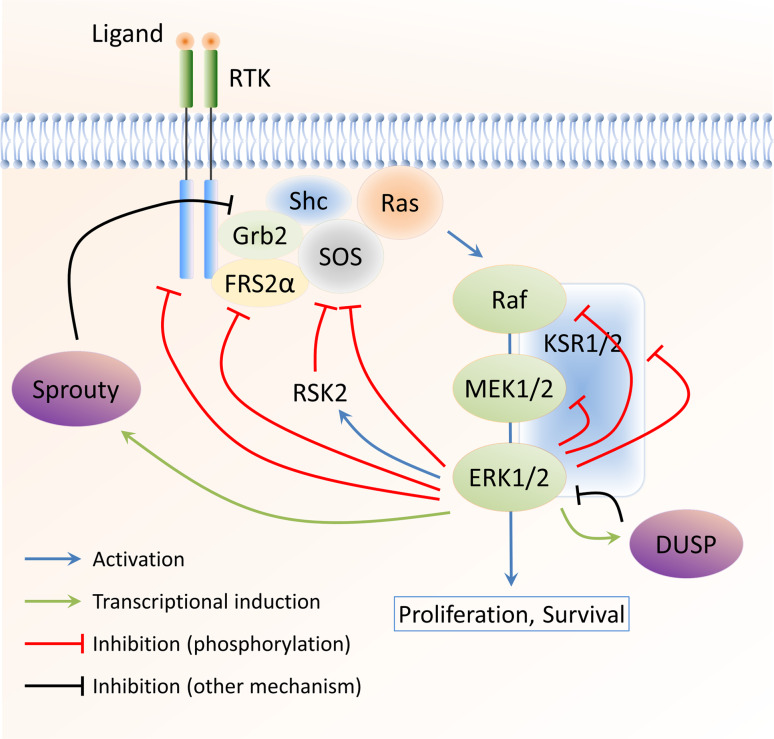
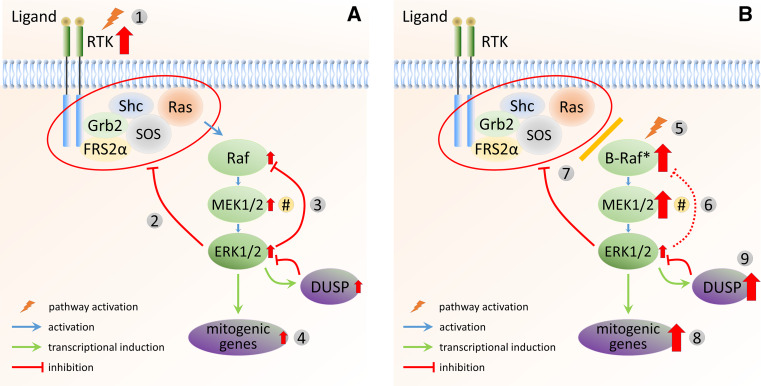
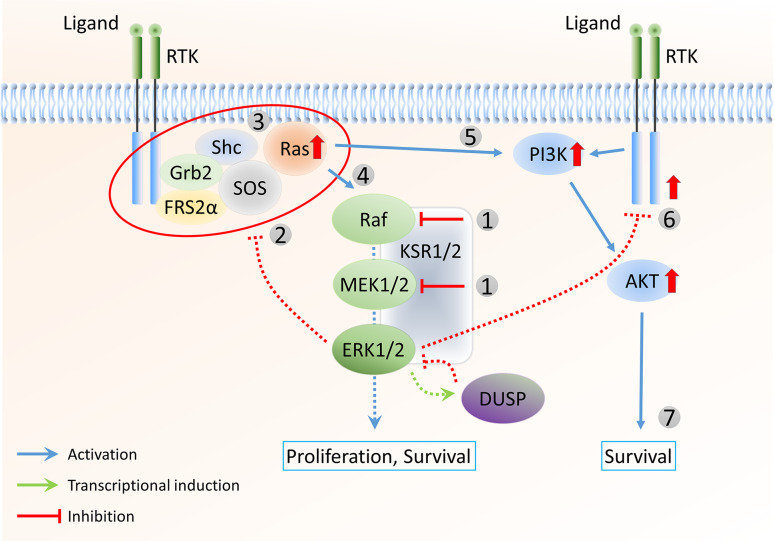
The extracellular signal-regulated kinase 1/2 (ERK1/2) mitogen-activated protein kinase (MAPK) signalling pathway regulates many cellular functions, including proliferation, differentiation, and transformation. To reliably convert external stimuli into specific cellular responses and to adapt to environmental circumstances, the pathway must be integrated into the overall signalling activity of the cell. Multiple mechanisms have evolved to perform this role. In this review, we will focus on negative feedback mechanisms and examine how they shape ERK1/2 MAPK signalling. We will first discuss the extensive number of negative feedback loops targeting the different components of the ERK1/2 MAPK cascade, specifically the direct posttranslational modification of pathway components by downstream protein kinases and the induction of de novo gene synthesis of specific pathway inhibitors. We will then evaluate how negative feedback modulates the spatiotemporal signalling dynamics of the ERK1/2 pathway regarding signalling amplitude and duration as well as subcellular localisation. Aberrant ERK1/2 activation results in deregulated proliferation and malignant transformation in model systems and is commonly observed in human tumours. Inhibition of the ERK1/2 pathway thus represents an attractive target for the treatment of malignant tumours with increased ERK1/2 activity. We will, therefore, discuss the effect of ERK1/2 MAPK feedback regulation on cancer treatment and how it contributes to reduced clinical efficacy of therapeutic agents and the development of drug resistance.
Overview
The claims and statistics of this paper haven’t been checked yet.
Free: it reads the open-access text and checks the first 5 claims that cite a source we can check. Create a free account to check every claim.
Integrity signals
Registry
Cites
Statistics
Figures
Verification
Claims the paper makes
The claims and statistics of this paper haven’t been checked yet.
Free: it reads the open-access text and checks the first 5 claims that cite a source we can check. Create a free account to check every claim.
Claims other papers make about this one
Each is checked against this paper’s own text: does it say what the citing paper says it does?
The source backs part of the claim, not all of it — or backs it for a different population, condition or comparison.
In the citing paper
“Co-inhibiting KRAS and EGFR can shut down feedback loops activated by KRAS monotherapy [96,101,124].”
From KRAS: Biology, Inhibition, and Mechanisms of Inhibitor Resistance (2024) · cites this paper as [124]
Experimental — accuracy not yet measuredThe cited source says what the claim attributes to it.
In the citing paper
“The limited ef fi cacy observed for MEK inhibitors may involve adaptive feedback mechanisms through the reactivation of MAPK signalling caused by the blockade of ERK signalling [11 -13].”
In the citing paper
“inhibitors of SOS1 reduce the activity of this key RAS-GEF and have demonstrated preclinical efficacy in combination with trametinib in KRASG12C-mutant and KRASG13D-mutant cell lines75, suggesting the potential for synergy when combined with KRAS-off inhibitors.”
From The current state of the art and future trends in RAS-targeted cancer therapies (2022) · cites this paper as [75]
In the citing paper
“SOS1 activation has been shown to be a key mechanism of adaptive resistance to MEK inhibitors; therefore, BI-3406 has been evaluated in combination with trametinib in KRASG12C-mutant and KRASG13D-mutant cell lines and found to synergistically inhibit their growth75.”
From The current state of the art and future trends in RAS-targeted cancer therapies (2022) · cites this paper as [75]
Self-check
Percentages, sums and reported differences re-computed from the paper’s own numbers.
The self-check needs the paper’s full text.
Citations
Cites
Mutations of the BRAF gene in human cancer
Davies, H., Bignell, G. R., Cox, C., Stephens, P., Edkins, S., Clegg, S., Teague, J., Woffendin, H., Garnett, M. J., Bottomley, W., et al. (2002) · Nature · doi:10.1038/nature00766 · Cited by 10,674
Pao, W., Miller, V., Zakowski, M., Doherty, J., Politi, K., Sarkaria, I., Singh, B., Heelan, R., Rusch, V., Fulton, L., et al. (2004) · Proceedings of the National Academy of Sciences · doi:10.1073/pnas.0405220101 · Cited by 4,338
Alessi, D. R., Cuenda, A., Cohen, P., Dudley, D. T., & Saltiel, A. R. (1995) · Journal of Biological Chemistry · doi:10.1074/jbc.270.46.27489 · Cited by 3,393
Inhibition of Mutated, Activated BRAF in Metastatic Melanoma
Flaherty, K. T., Puzanov, I., Kim, K. B., Ribas, A., McArthur, G. A., Sosman, J. A., O'Dwyer, P. J., Lee, R. J., Grippo, J. F., Nolop, K., et al. (2010) · New England Journal of Medicine · doi:10.1056/nejmoa1002011 · Cited by 3,103
Combined BRAF and MEK inhibition in melanoma with BRAF V600 mutations
Flaherty, K. T., Infante, J. R., Daud, A., Gonzalez, R., Kefford, R. F., Sosman, J., Hamid, O., Schuchter, L., Cebon, J., Ibrahim, N., et al. (2012) · New England Journal of Medicine · doi:10.1056/nejmoa1210093 · Cited by 2,810
Melanomas acquire resistance to B-RAF(V600E) inhibition by RTK or N-RAS upregulation
Nazarian, R., Shi, H., Wang, Q., Kong, X., Koya, R. C., Lee, H., Chen, Z., Lee, M.-K., Attar, N., Sazegar, H., et al. (2010) · Nature · doi:10.1038/nature09626 · Cited by 2,192
Unresponsiveness of colon cancer to BRAF(V600E) inhibition through feedback activation of EGFR
Prahallad, A., Sun, C., Huang, S., Di Nicolantonio, F., Salazar, R., Zecchin, D., Beijersbergen, R. L., Bardelli, A., & Bernards, R. (2012) · Nature · doi:10.1038/nature10868 · Cited by 2,051
Clinical efficacy of a RAF inhibitor needs broad target blockade in BRAF-mutant melanoma
Bollag, G., Hirth, P., Tsai, J., Zhang, J., Ibrahim, P. N., Cho, H., Spevak, W., Zhang, C., Zhang, Y., Habets, G., et al. (2010) · Nature · doi:10.1038/nature09454 · Cited by 1,831
RAF inhibitors transactivate RAF dimers and ERK signalling in cells with wild-type BRAF
Poulikakos, P. I., Zhang, C., Bollag, G., Shokat, K. M., & Rosen, N. (2010) · Nature · doi:10.1038/nature08902 · Cited by 1,811
Kinase-Dead BRAF and Oncogenic RAS Cooperate to Drive Tumor Progression through CRAF
Heidorn, S. J., Milagre, C., Whittaker, S., Nourry, A., Niculescu-Duvas, I., Dhomen, N., Hussain, J., Reis-Filho, J. S., Springer, C. J., Pritchard, C., et al. (2010) · Cell · doi:10.1016/j.cell.2009.12.040 · Cited by 1,465
Cited by
RAS Proteins and Their Regulators in Human Disease
Simanshu, D. K., Nissley, D. V., & McCormick, F. (2017) · Cell · doi:10.1016/j.cell.2017.06.009 · Cited by 1,943
ERK signalling: A master regulator of cell behaviour, life and fate
Lavoie, H., Gagnon, J., & Therrien, M. (2020) · Nature Reviews Molecular Cell Biology · doi:10.1038/s41580-020-0255-7 · Cited by 1,185
RAS-targeted therapies: is the undruggable drugged?
Moore, A. R., Rosenberg, S. C., McCormick, F., & Malek, S. (2020) · Nature Reviews Drug Discovery · doi:10.1038/s41573-020-0068-6 · Cited by 1,103
Targeting the RAS/RAF/MAPK pathway for cancer therapy: from mechanism to clinical studies
Bahar, M. E., Kim, H. J., & Kim, D. R. (2023) · Signal Transduction and Targeted Therapy · doi:10.1038/s41392-023-01705-z · Cited by 888
The current state of the art and future trends in RAS-targeted cancer therapies
Punekar, S. R., Velcheti, V., Neel, B. G., & Wong, K.-K. (2022) · Nature Reviews Clinical Oncology · doi:10.1038/s41571-022-00671-9 · Cited by 549
Targeting the MAPK pathway in KRAS-driven tumors
Drosten, M., & Barbacid, M. (2020) · Cancer Cell · doi:10.1016/j.ccell.2020.03.013 · Cited by 512
EGFR Blockade Reverts Resistance to KRASG12C Inhibition in Colorectal Cancer.
Amodio, V., Yaeger, R., Arcella, P., Cancelliere, C., Lamba, S., Lorenzato, A., Arena, S., Montone, M., Mussolin, B., Bian, Y., et al. (2020) · Cancer Discovery · doi:10.1158/2159-8290.cd-20-0187 · Cited by 504
Tan, S. Y., Mei Wong, J. L., Sim, Y. J., Wong, S. S., Mohamed Elhassan, S. A., Tan, S. H., Ling Lim, G. P., Rong Tay, N. W., Annan, N. C., Bhattamisra, S. K., et al. (2019) · Diabetes & Metabolic Syndrome: Clinical Research & Reviews · doi:10.1016/j.dsx.2018.10.008 · Cited by 445
Hofmann, M. H., Gmachl, M., Ramharter, J., Savarese, F., Gerlach, D., Marszalek, J. R., Sanderson, M. P., Kessler, D., Trapani, F., Arnhof, H., et al. (2021) · Cancer Discovery · doi:10.1158/2159-8290.cd-20-0142 · Cited by 444
Sugiura, R., Satoh, R., & Takasaki, T. (2021) · Cells · doi:10.3390/cells10102509 · Cited by 369
MAPK/ERK Signaling Pathway in Hepatocellular Carcinoma
Moon, H., & Ro, S. W. (2021) · Cancers · doi:10.3390/cancers13123026 · Cited by 326
The MEK/ERK Network as a Therapeutic Target in Human Cancer
Barbosa, R., Acevedo, L. A., & Marmorstein, R. (2021) · Molecular Cancer Research · doi:10.1158/1541-7786.mcr-20-0687 · Cited by 210
Inhibitory feedback control of NF-κB signalling in health and disease
Prescott, J. A., Mitchell, J. P., & Cook, S. J. (2021) · Biochemical Journal · doi:10.1042/bcj20210139 · Cited by 187
BRAF Mutations in Melanoma: Biological Aspects, Therapeutic Implications, and Circulating Biomarkers
Castellani, G., Buccarelli, M., Arasi, M. B., Rossi, S., Pisanu, M. E., Bellenghi, M., Lintas, C., & Tabolacci, C. (2023) · Cancers · doi:10.3390/cancers15164026 · Cited by 186
Control of osteoblast regeneration by a train of Erk activity waves
De Simone, A., Evanitsky, M. N., Hayden, L., Cox, B. D., Wang, J., Tornini, V. A., Ou, J., Chao, A., Poss, K. D., & Di Talia, S. (2021) · Nature · doi:10.1038/s41586-020-03085-8 · Cited by 178
Adaptive responses to low doses of radiation or chemicals: their cellular and molecular mechanisms
Guéguen, Y., Bontemps, A., & Ebrahimian, T. G. (2018) · Cellular and Molecular Life Sciences · doi:10.1007/s00018-018-2987-5 · Cited by 171
Drugging KRAS: Current perspectives and state-of-art review
Parikh, K., Banna, G., Liu, S. V., Friedlaender, A., Desai, A., Subbiah, V., & Addeo, A. (2022) · Journal of Hematology & Oncology · doi:10.1186/s13045-022-01375-4 · Cited by 164
Mitochondrial‐Endoplasmic Reticulum Communication‐Mediated Oxidative Stress and Autophagy
Liu, X., Hussain, R., Mehmood, K., Tang, Z., Zhang, H., & Li, Y. (2022) · BioMed Research International · doi:10.1155/2022/6459585 · Cited by 161
Advances in dietary polysaccharides as anticancer agents: Structure-activity relationship
Li, N., Wang, C., Georgiev, M. I., Bajpai, V. K., Tundis, R., Simal-Gandara, J., Lu, X., Xiao, J., Tang, X., & Qiao, X. (2021) · Trends in Food Science & Technology · doi:10.1016/j.tifs.2021.03.008 · Cited by 161
Progress on Ras/MAPK Signaling Research and Targeting in Blood and Solid Cancers
Dillon, M., Lopez, A., Lin, E., Sales, D., Perets, R., & Jain, P. (2021) · Cancers · doi:10.3390/cancers13205059 · Cited by 158
Multi-omic Profiling Reveals Dynamics of the Phased Progression of Pluripotency
Yang, P., Humphrey, S. J., Cinghu, S., Pathania, R., Oldfield, A. J., Kumar, D., Perera, D., Yang, J. Y. H., James, D. E., Mann, M., et al. (2019) · Cell Systems · doi:10.1016/j.cels.2019.03.012 · Cited by 146
Schwann cells apoptosis is induced by high glucose in diabetic peripheral neuropathy
Liu, Y.-P., Shao, S.-J., & Guo, H.-D. (2020) · Life Sciences · doi:10.1016/j.lfs.2020.117459 · Cited by 145
Navigating the ERK1/2 MAPK Cascade
Martín-Vega, A., & Cobb, M. H. (2023) · Biomolecules · doi:10.3390/biom13101555 · Cited by 144
Scarless wound healing: Current insights from the perspectives of TGF-β, KGF-1, and KGF-2
Wang, X., Banda, J., Qi, H., Chang, A. K., Bwalya, C., Chao, L., & Li, X. (2022) · Cytokine & Growth Factor Reviews · doi:10.1016/j.cytogfr.2022.03.001 · Cited by 142
The Role of PI3K/AKT and MAPK Signaling Pathways in Erythropoietin Signalization
Tóthová, Z., Šemeláková, M., Solárová, Z., Tomc, J., Debeljak, N., & Solár, P. (2021) · International Journal of Molecular Sciences · doi:10.3390/ijms22147682 · Cited by 138
Mechanisms shaping the role of ERK1/2 in cellular sene scence (Review)
Zou, J., Lei, T., Guo, P., Yu, J., Xu, Q., Luo, Y., Ke, R., & Huang, D. (2018) · Molecular Medicine Reports · doi:10.3892/mmr.2018.9712 · Cited by 136
Pan-cancer proteogenomics connects oncogenic drivers to functional states
Li, Y., Porta‐Pardo, E., Tokheim, C. J., Bailey, M. H., Yaron, T. M., Stathias, V., Geffen, Y., Imbach, K. J., Cao, S., Anand, S. K., et al. (2023) · Cell · doi:10.1016/j.cell.2023.07.014 · Cited by 136
Unni, A. M., Harbourne, B., Oh, M. H., Wild, S. A., Ferrarone, J. R., Lockwood, W. W., & VARMUS, H. E. (2018) · eLife · doi:10.7554/elife.33718 · Cited by 123
Wang, S. Y., Kim, H., Kwak, G., Yoon, H. Y., Jo, S. D., Lee, J. E., Cho, D., Kwon, I. C., & Kim, S. H. (2018) · Advanced Science · doi:10.1002/advs.201800852 · Cited by 118
Bhagwat, S. V., McMillen, W. T., Cai, S., Zhao, B., Whitesell, M., Shen, W., Kindler, L., Flack, R. S., Wu, W., Anderson, B., et al. (2020) · Molecular Cancer Therapeutics · doi:10.1158/1535-7163.mct-19-0183 · Cited by 107
Weiss, A., Adler, F., Buhles, A., Stamm, C., Fairhurst, R. A., Kiffe, M., Sterker, D., Centeleghe, M., Wartmann, M., Kinyamu-Akunda, J., et al. (2019) · Molecular Cancer Therapeutics · doi:10.1158/1535-7163.mct-18-1291 · Cited by 117
The molecular genetics of RASopathies : An update on novel disease genes and new disorders
Tartaglia, M., Aoki, Y., & Gelb, B. D. (2022) · American Journal of Medical Genetics Part C Seminars in Medical Genetics · doi:10.1002/ajmg.c.32012 · Cited by 116
Ozkan-Dagliyan, I., Diehl, J. N., George, S. D., Schaefer, A., Papke, B., Klotz-Noack, K., Waters, A. M., Goodwin, C. M., Gautam, P., Pierobon, M., et al. (2020) · Cell Reports · doi:10.1016/j.celrep.2020.107764 · Cited by 106
Periostin: an emerging activator of multiple signaling pathways
Wang, Z., An, J., Zhu, D., Chen, H., Lin, A., Kang, J., Liu, W., & Kang, X. (2022) · Journal of Cell Communication and Signaling · doi:10.1007/s12079-022-00674-2 · Cited by 111
Multiple low dose therapy as an effective strategy to treat EGFR inhibitor-resistant NSCLC tumours
Fernandes Neto, J. M., Nadal, E., Bosdriesz, E., Ooft, S. N., Farre, L., McLean, C., Klarenbeek, S., Jurgens, A., Hagen, H., Wang, L., et al. (2020) · Nature Communications · doi:10.1038/s41467-020-16952-9 · Cited by 92
Signaling pathways in liver cancer: pathogenesis and targeted therapy
Xue, Y., Ruan, Y., Wang, Y., Xiao, P., & Xu, J. (2024) · Molecular Biomedicine · doi:10.1186/s43556-024-00184-0 · Cited by 97
Monaco, K.-A., Delach, S., Yuan, J., Mishina, Y., Fordjour, P., Labrot, E., McKay, D., Guo, R., Higgins, S., Wang, H. Q., et al. (2021) · Clinical Cancer Research · doi:10.1158/1078-0432.ccr-20-2563 · Cited by 86
Emerging therapeutic targets for neurofibromatosis type 1
Walker, J. A., & Upadhyaya, M. (2018) · Expert Opinion on Therapeutic Targets · doi:10.1080/14728222.2018.1465931 · Cited by 94
Inhibition of RAF dimers: it takes two to tango
Cook, F. A., & Cook, S. J. (2020) · Biochemical Society Transactions · doi:10.1042/bst20200485 · Cited by 91
Klomp, J. E., Klomp, J. A., & Der, C. J. (2021) · Biochemical Society Transactions · doi:10.1042/bst20200507 · Cited by 91
Lu, H., Liu, C., Velazquez, R., Wang, H., Dunkl, L. M., Kazic-Legueux, M., Haberkorn, A., Billy, E., Manchado, E., Brachmann, S. M., et al. (2019) · Molecular Cancer Therapeutics · doi:10.1158/1535-7163.mct-18-0852 · Cited by 90
Targeting EGFR in melanoma – The sea of possibilities to overcome drug resistance
Pastwińska, J., Karaś, K., Karwaciak, I., & Ratajewski, M. (2022) · Biochimica et Biophysica Acta (BBA) - Reviews on Cancer · doi:10.1016/j.bbcan.2022.188754 · Cited by 86
The Multiple Roles of FGF Signaling in the Developing Spinal Cord
del Corral, R. D., & Morales, A. V. (2017) · Frontiers in Cell and Developmental Biology · doi:10.3389/fcell.2017.00058 · Cited by 86
Comprehensive Analysis of ERK1/2 Substrates for Potential Combination Immunotherapies
Yang, L., Zheng, L., Chng, W. J., & Ding, J. L. (2019) · Trends in Pharmacological Sciences · doi:10.1016/j.tips.2019.09.005 · Cited by 84
Jones, G. G., del Río, I. B., Sari, S., Sekerim, A., Young, L. C., Hartig, N., Areso Zubiaur, I., El-Bahrawy, M. A., Hynds, R. E., Lei, W., et al. (2019) · Nature Communications · doi:10.1038/s41467-019-10367-x · Cited by 80
RET Receptor Tyrosine Kinase: Role in Neurodegeneration, Obesity, and Cancer
Mahato, A. K., & Sidorova, Y. A. (2020) · International Journal of Molecular Sciences · doi:10.3390/ijms21197108 · Cited by 79
Hyperactivation of MAPK Signaling Is Deleterious to RAS/RAF-mutant Melanoma
Leung, G. P., Feng, T., Sigoillot, F. D., Geyer, F. C., Shirley, M. D., Ruddy, D. A., Rakiec, D. P., Freeman, A. K., Engelman, J. A., Jaskelioff, M., et al. (2019) · Molecular Cancer Research · doi:10.1158/1541-7786.mcr-18-0327 · Cited by 73
Mlakar, V., Morel, E., Mlakar, S. J., Ansari, M., & Gumy‐Pause, F. (2021) · Journal of Experimental & Clinical Cancer Research · doi:10.1186/s13046-021-01967-x · Cited by 76
Garza, K. M., Zhang, L., Borron, B. M., Wood, L. B., & Singer, A. C. (2019) · Journal of Neuroscience · doi:10.1523/jneurosci.1511-19.2019 · Cited by 76
Khan, S. A., Park, K., Fischer, L. A., Dong, C., Lungjangwa, T., Jiménez, M., Casalena, D. E., Chew, B., Dietmann, S., Auld, D. S., et al. (2021) · Cell Reports · doi:10.1016/j.celrep.2021.109233 · Cited by 75
İmani, S., Roozitalab, G., Emadi, M., Moradi, A., Behzadi, P., & Kaboli, P. J. (2024) · Frontiers in Oncology · doi:10.3389/fonc.2024.1504142 · Cited by 76
One Atom Makes All the Difference: Getting a Foot in the Door between SOS1 and KRAS
Ramharter, J., Kessler, D., Ettmayer, P., Hofmann, M. H., Gerstberger, T., Gmachl, M., Wunberg, T., Kofink, C., Sanderson, M., Arnhof, H., et al. (2021) · Journal of Medicinal Chemistry · doi:10.1021/acs.jmedchem.0c01949 · Cited by 62
FGFR2 Inhibition in Cholangiocarcinoma
Vogel, A., Segatto, O., Stenzinger, A., & Saborowski, A. L. (2022) · Annual Review of Medicine · doi:10.1146/annurev-med-042921-024707 · Cited by 72
Toska, E., Castel, P., Chhangawala, S., Arruabarrena-Aristorena, A., Chan, C., Hristidis, V. C., Cocco, E., Sallaku, M., Xu, G., Park, J., et al. (2019) · Cell Reports · doi:10.1016/j.celrep.2019.02.111 · Cited by 67
Biological Significance and Targeting of the FGFR Axis in Cancer
Chioni, A., & Grose, R. P. (2021) · Cancers · doi:10.3390/cancers13225681 · Cited by 70
KRAS: Biology, Inhibition, and Mechanisms of Inhibitor Resistance
Ash, L. J., Busia-Bourdain, O., Okpattah, D., Kamel, A., Liberchuk, A., & Wolfe, A. L. (2024) · Current Oncology · doi:10.3390/curroncol31040150 · Cited by 68
Gomes, L. C., Hänzelmann, S., Hausmann, F., Khatri, R., Moreno, S. O., Parvaz, M., Tzeplaeff, L., Pasetto, L., Gébelin, M., Ebbing, M., et al. (2024) · Nature Communications · doi:10.1038/s41467-024-49196-y · Cited by 68
Adderley, J., von Freyend, S. J., Jackson, S. A., Bird, M. J., Burns, A. L., Anar, B., Metcalf, T., Semblat, J., Billker, O., Wilson, D. W., et al. (2020) · Nature Communications · doi:10.1038/s41467-020-17829-7 · Cited by 69
Tripathi, K., & Garg, M. (2018) · Journal of Cell Communication and Signaling · doi:10.1007/s12079-017-0441-3 · Cited by 66
Negative Regulation of FGFR (Fibroblast Growth Factor Receptor) Signaling
Szybowska, P., Kostas, M., Wesche, J., Haugsten, E. M., & Więdłocha, A. (2021) · Cells · doi:10.3390/cells10061342 · Cited by 66
Eleveld, T. F., Schild, L. G., Köster, J., Zwijnenburg, D. A., Alles, L. K., Ebus, M. E., Volckmann, R., Tijtgat, G. A., Sluis, P. V., Versteeg, R., et al. (2018) · Cancer Research · doi:10.1158/0008-5472.can-18-1045 · Cited by 65
BRAF Mutation in Colorectal Cancers: From Prognostic Marker to Targetable Mutation
Nakayama, I., Hirota, T., & Shinozaki, E. (2020) · Cancers · doi:10.3390/cancers12113236 · Cited by 65
Huang, Y., Zhen, Y., Chen, Y., Sui, S., & Zhang, L. (2023) · Biochemical Pharmacology · doi:10.1016/j.bcp.2023.115842 · Cited by 64
ERK1 and ERK2 activation modulates diet-induced obesity in mice
Khan, A. S., Selvakumar, S., Dramane, G., Khelifi, D., & Khan, N. A. (2017) · Biochimie · doi:10.1016/j.biochi.2017.03.004 · Cited by 64
The roles of GRP81 as a metabolic sensor and inflammatory mediator
Hu, J., Cai, M., Liu, Y., Liu, B., Xue, X., Ji, R.-F., Bian, X., & Lou, S. (2020) · Journal of Cellular Physiology · doi:10.1002/jcp.29739 · Cited by 63
Combination of HGF/MET-targeting agents and other therapeutic strategies in cancer
Moosavi, F., Giovannetti, E., Peters, G. J., & Firuzi, O. (2021) · Critical Reviews in Oncology/Hematology · doi:10.1016/j.critrevonc.2021.103234 · Cited by 62
Genolet, O., Monaco, A. A., Dunkel, I., Boettcher, M., & Schulz, E. G. (2021) · Genome biology · doi:10.1186/s13059-021-02321-2 · Cited by 62
“Undruggable KRAS”: druggable after all
Cox, A. D., & Der, C. J. (2024) · Genes & Development · doi:10.1101/gad.352081.124 · Cited by 61
The road to ERK activation: Do neurons take alternate routes?
Zobon, N. T. M., & Blackwell, K. T. (2020) · Cellular Signalling · doi:10.1016/j.cellsig.2020.109541 · Cited by 61
Wang, X., Xiao, T., Chen, P., Jiang, P., Li, W., Chang, H., Wei, C., Lai, X., Zhang, H., Pan, Y., et al. (2024) · Signal Transduction and Targeted Therapy · doi:10.1038/s41392-024-01986-y · Cited by 58
Mathien, S., Tesnière, C., & Meloche, S. (2021) · Pharmacological Reviews · doi:10.1124/pharmrev.120.000170 · Cited by 58
A Sprouty4 reporter to monitor FGF/ERK signaling activity in ESCs and mice
Morgani, S. M., Saiz, N., Garg, V., Raina, D., Simon, C. S., Kang, M., Arias, A. M., Nichols, J., Schröter, C., & Hadjantonakis, A.-K. (2018) · Developmental Biology · doi:10.1016/j.ydbio.2018.06.017 · Cited by 55
Béal, J., Pantolini, L., Noël, V., Barillot, E., & Calzone, L. (2021) · PLoS Computational Biology · doi:10.1371/journal.pcbi.1007900 · Cited by 53
New Approaches to Targeted Therapy in Melanoma
Fernandez, M. F., Choi, J. S., & Sosman, J. A. (2023) · Cancers · doi:10.3390/cancers15123224 · Cited by 52
Drug resistance in targeted cancer therapies with RAF inhibitors
Degirmenci, U., Yap, J., Sim, Y. R. M., Qin, S., & Hu, J. (2021) · Cancer Drug Resistance · doi:10.20517/cdr.2021.36 · Cited by 52
Huang, C., Teng, Y., Lu, F., Hsu, W., Lin, C., Hung, C. ‐., Tung, J., Hsieh, Y., & Liu, C. (2017) · Environmental Toxicology · doi:10.1002/tox.22449 · Cited by 51
LncRNA BANCR facilitates vascular smooth muscle cell proliferation and migration through JNK pathway
Li, H., Liu, X., Zhang, L., & Li, X. (2017) · Oncotarget · doi:10.18632/oncotarget.21603 · Cited by 51
CRAF dimerization with ARAF regulates KRAS-driven tumor growth
Venkatanarayan, A., Liang, J., Yen, I., Shanahan, F., Haley, B., Phu, L., Verschueren, E., Hinkle, T. B., Kan, D., Segal, E., et al. (2022) · Cell Reports · doi:10.1016/j.celrep.2022.110351 · Cited by 50
Bisperoxovandium (pyridin‐2‐squaramide) targets both PTEN and ERK1/2 to confer neuroprotection
Zhang, Z., Chen, J., Han, X., Zhang, Y., Liao, H., Lei, R., Zhuang, Y., Wang, Z., Li, Z., Chen, J., et al. (2017) · British Journal of Pharmacology · doi:10.1111/bph.13727 · Cited by 50
Yan, S., Chen, R., Wang, M., & Zha, J. (2020) · Environmental Pollution · doi:10.1016/j.envpol.2020.116245 · Cited by 49
Klomp, J. E., Lee, Y. S., Goodwin, C. M., Papke, B., Klomp, J. A., Waters, A. M., Stalnecker, C. A., DeLiberty, J. M., Drizyte‐Miller, K., Yang, R. Y., et al. (2021) · Cell Reports · doi:10.1016/j.celrep.2021.110060 · Cited by 49
Optogenetic actuator – ERK biosensor circuits identify MAPK network nodes that shape ERK dynamics
Dessauges, C., Mikelson, J., Dobrzyński, M., Jacques, M., Frismantiene, A., Gagliardi, P. A., Khammash, M., & Pertz, O. (2022) · Molecular Systems Biology · doi:10.15252/msb.202110670 · Cited by 48
NIK links inflammation to hepatic steatosis by suppressing PPARα in alcoholic liver disease
Li, Y., Chen, M., Zhou, Y., Tang, C., Zhang, W., Zhong, Y., Chen, Y., Zhou, H. Y., & Sheng, L. (2020) · Theranostics · doi:10.7150/thno.40149 · Cited by 48
Mahmoudvand, S., & Shokri, S. (2021) · Scandinavian Journal of Immunology · doi:10.1111/sji.13044 · Cited by 48
USP19 exacerbates lipogenesis and colorectal carcinogenesis by stabilizing ME1
Zhu, Y., Gu, L., Lin, X., Zhou, X., Lu, B., Liu, C., Lei, C., Zhou, F., Zhao, Q., Prochownik, E. V., et al. (2021) · Cell Reports · doi:10.1016/j.celrep.2021.110174 · Cited by 48
Gavert, N. S., Zwang, Y., Weiser, R., Greenberg, O., Halperin, S., Jacobi, O., Mallel, G., Sandler, O., Berger, A. J., Stossel, E., et al. (2022) · Nature Cancer · doi:10.1038/s43018-021-00325-2 · Cited by 48
The insulin signalling network
Burchfield, J. G., Díaz‐Vegas, A., & James, D. E. (2025) · Nature Metabolism · doi:10.1038/s42255-025-01349-z · Cited by 49
PI3K pathway in prostate cancer: All resistant roads lead to PI3K
Park, S., Kim, Y. S., Kim, D. Y., So, I., & Jeon, J. (2018) · Biochimica et Biophysica Acta (BBA) - Reviews on Cancer · doi:10.1016/j.bbcan.2018.09.001 · Cited by 47
Lu, H., Liu, C., Huynh, H., Le, T. B. U., LaMarche, M. J., Mohseni, M., Engelman, J. A., Hammerman, P. S., Caponigro, G., & Hao, H.-X. (2020) · Oncotarget · doi:10.18632/oncotarget.27435 · Cited by 43
Regulation of Renal Differentiation by Trophic Factors
Kurtzeborn, K., Cebrián, C., & Kuure, S. (2018) · Frontiers in Physiology · doi:10.3389/fphys.2018.01588 · Cited by 46
ETS‐targeted therapy: can it substitute for MEK inhibitors?
Tetsu, O., & McCormick, F. P. (2017) · Clinical and Translational Medicine · doi:10.1186/s40169-017-0147-4 · Cited by 45
Liao, J., Tao, X., Ding, Q., Liu, J., Yang, X., Yuan, F., Yang, J., Liu, B., Xiang, G., & Chen, Q. (2017) · Oncology Reports · doi:10.3892/or.2017.5982 · Cited by 45
Can Growth Factors Cure Parkinson’s Disease?
Sidorova, Y. A., & Saarma, M. (2020) · Trends in Pharmacological Sciences · doi:10.1016/j.tips.2020.09.010 · Cited by 45
Shrestha, R., Llauradó, M., Dawson, A., Hoenisch, J., Volik, S. V., Lin, Y., Anderson, S. A., Kim, H. H., Haegert, A. M., Colborne, S., et al. (2021) · Cancer Research · doi:10.1158/0008-5472.can-20-2222 · Cited by 45
Robust and tunable signal processing in mammalian cells via engineered covalent modification cycles
Jones, R. D., Qian, Y., Ilia, K., Wang, B. X., Laub, M. T., Vecchio, D. D., & Weiss, R. (2022) · Nature Communications · doi:10.1038/s41467-022-29338-w · Cited by 45
A systematic analysis of signaling reactivation and drug resistance
Kholodenko, B. Ν., Rauch, N., Kölch, W., & Rukhlenko, O. S. (2021) · Cell Reports · doi:10.1016/j.celrep.2021.109157 · Cited by 44
Bhalla, U. S. (2017) · eLife · doi:10.7554/elife.25827 · Cited by 44
MYC and RAF: Key Effectors in Cellular Signaling and Major Drivers in Human Cancer
Stefan, E., & Bister, K. (2017) · Current topics in microbiology and immunology · doi:10.1007/82_2017_4 · Cited by 46
Regulatory role of heme oxygenase-1 in silica-induced lung injury
Nakashima, K., Sato, T., Shigemori, S., Shimosato, T., Shinkai, M., & Kaneko, T. (2018) · Respiratory Research · doi:10.1186/s12931-018-0852-6 · Cited by 44
EGFR-RAS-MAPK signaling is confined to the plasma membrane and associated endorecycling protrusions
Surve, S., Watkins, S. C., & Sorkin, A. D. (2021) · The Journal of Cell Biology · doi:10.1083/jcb.202107103 · Cited by 44
Metadata
- Authors
- Lake, D., Corrêa, S. A. L., & Müller, J.
- Affiliations
- University of Warwick (GB)
- Aston University (GB)
- Corresponding author
- Müller, Jürgen
- Venue
- Cellular and Molecular Life Sciences
- Published
- 2016-06-24
- Volume
- 73
- Issue
- 23
- Pages
- 4397-4413
- ISSN
- 1420-682X (ISSN-L)
- 1420-9071
- PMC
- PMC5075022
- OpenAlex
- W2465367340
- Cited by
- 565
- References
- 134
- Citations by year
- 2026: 48 · 2025: 45 · 2024: 63 · 2023: 74 · 2022: 73 · 2021: 84 · 2020: 63 · 2019: 50 · 2018: 43 · 2017: 21 · 2016: 1
- FWCI
- 3.46
- Type
- journal article
- Language
- en
- Open access
- hybrid
- doi.org
- Locations
- Cellular and Molecular Life Sciences (publishedVersion, cc-by)
- PubMed Central (publishedVersion, cc-by)
- PubMed (publishedVersion)
- Bradford Scholars (University of Bradford) (publishedVersion, other-oa)
- e-space (Manchester Metropolitan University) (acceptedVersion)
- Warwick Research Archive Portal (University of Warwick) (acceptedVersion)
- Aston Publications Explorer (Aston University) (submittedVersion)
- Topics
- Life Sciences › Biochemistry, Genetics and Molecular Biology › Molecular Biology › Melanoma and MAPK Pathways
- Life Sciences › Biochemistry, Genetics and Molecular Biology › Molecular Biology › Protein Kinase Regulation and GTPase Signaling
- Life Sciences › Biochemistry, Genetics and Molecular Biology › Molecular Biology › Protein Tyrosine Phosphatases
- Keywords
- ERK1/2, MAPK signaling, negative feedback regulation, post-translational modification, pathway inhibitors, subcellular localization, cancer therapy, drug resistance, malignant transformation
- MeSH terms
- Animals, Humans, Phosphorylation, Disease Progression, MAP Kinase Signaling System, Feedback, Physiological, Protein Kinase Inhibitors, Extracellular Signal-Regulated MAP Kinases
About these checks
Registry, retraction, Cites and statistics results are computed, not judged, with one exception: a printed reference that no index lists is read once by a model before it counts as a citation error. Claims are extracted by a model and kept only when their quote appears verbatim in the text; each cited source is then checked, with a model’s help, for whether it says what the claim relies on. Those verdicts can be wrong — read the claim’s quote and the cited source before relying on one.
Statistics and arithmetic are recomputed, not judged.
Confidence bands are shown only for fields calibrated on our annotated test set. None is calibrated yet, so no band is shown.
What counts as a claim ›How we measure confidence ›How we check this ›
Are you an author, or do you see a problem with this page? Request a review
Data sources
Bibliographic data: Semantic Scholar, OpenAlex, Crossref.
Contains information from the Semantic Scholar Academic Graph Datasets, made available under the ODC Attribution License (ODC-BY 1.0).
Semantic Scholar’s data is described in: Kinney, R., et al. (2023). The Semantic Scholar Open Data Platform. arXiv:2301.10140.
