

Negative feedback regulation of the ERK1/2 MAPK pathway
Open accessThe DOI matches its Crossref record; 133 of the 134 references it cites were found in a registry or an index.
Abstract
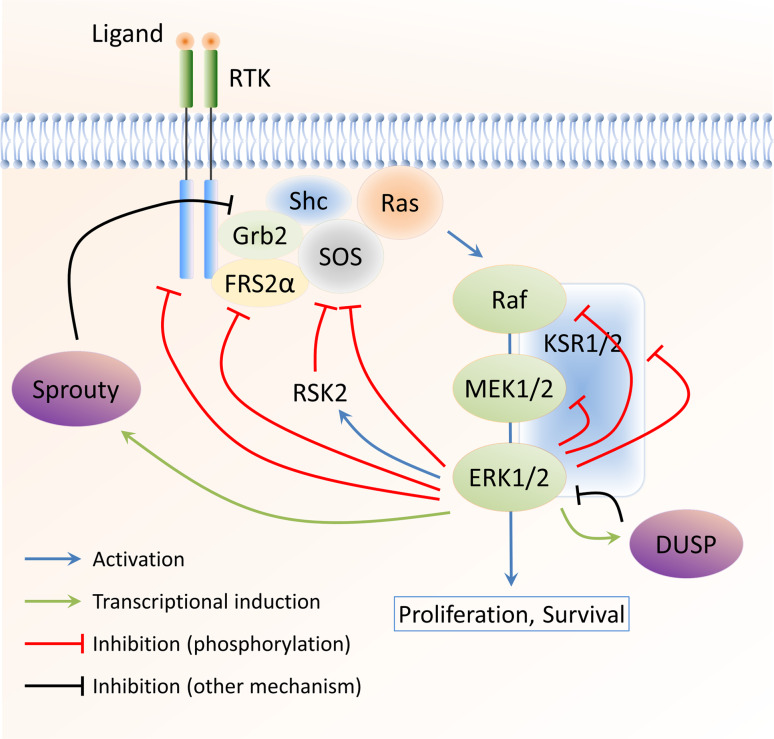
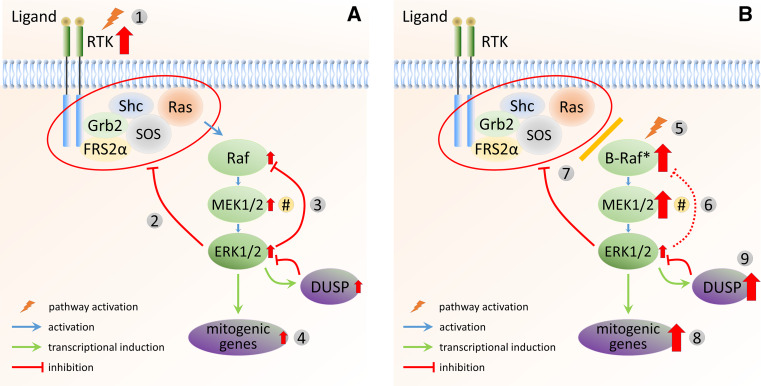
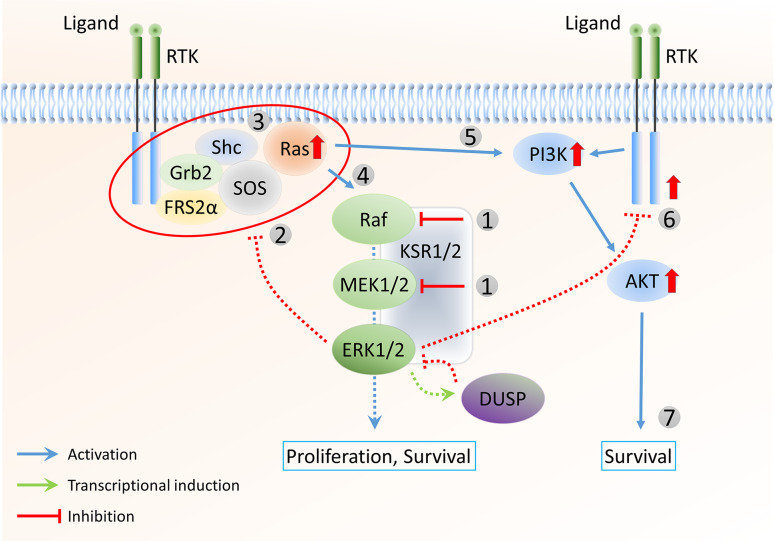
The extracellular signal-regulated kinase 1/2 (ERK1/2) mitogen-activated protein kinase (MAPK) signalling pathway regulates many cellular functions, including proliferation, differentiation, and transformation. To reliably convert external stimuli into specific cellular responses and to adapt to environmental circumstances, the pathway must be integrated into the overall signalling activity of the cell. Multiple mechanisms have evolved to perform this role. In this review, we will focus on negative feedback mechanisms and examine how they shape ERK1/2 MAPK signalling. We will first discuss the extensive number of negative feedback loops targeting the different components of the ERK1/2 MAPK cascade, specifically the direct posttranslational modification of pathway components by downstream protein kinases and the induction of de novo gene synthesis of specific pathway inhibitors. We will then evaluate how negative feedback modulates the spatiotemporal signalling dynamics of the ERK1/2 pathway regarding signalling amplitude and duration as well as subcellular localisation. Aberrant ERK1/2 activation results in deregulated proliferation and malignant transformation in model systems and is commonly observed in human tumours. Inhibition of the ERK1/2 pathway thus represents an attractive target for the treatment of malignant tumours with increased ERK1/2 activity. We will, therefore, discuss the effect of ERK1/2 MAPK feedback regulation on cancer treatment and how it contributes to reduced clinical efficacy of therapeutic agents and the development of drug resistance.
Overview
The claims and statistics of this paper haven’t been checked yet.
Free: it reads the open-access text and checks the first 5 claims that cite a source we can check. Create a free account to check every claim.
Integrity signals
Registry
Cites
Statistics
Figures
Verification
Claims the paper makes
The claims and statistics of this paper haven’t been checked yet.
Free: it reads the open-access text and checks the first 5 claims that cite a source we can check. Create a free account to check every claim.
Claims other papers make about this one
Each is checked against this paper’s own text: does it say what the citing paper says it does?
The source backs part of the claim, not all of it — or backs it for a different population, condition or comparison.
In the citing paper
“Co-inhibiting KRAS and EGFR can shut down feedback loops activated by KRAS monotherapy [96,101,124].”
From KRAS: Biology, Inhibition, and Mechanisms of Inhibitor Resistance (2024) · cites this paper as [124]
Experimental — accuracy not yet measuredThe cited source says what the claim attributes to it.
In the citing paper
“The limited ef fi cacy observed for MEK inhibitors may involve adaptive feedback mechanisms through the reactivation of MAPK signalling caused by the blockade of ERK signalling [11 -13].”
In the citing paper
“inhibitors of SOS1 reduce the activity of this key RAS-GEF and have demonstrated preclinical efficacy in combination with trametinib in KRASG12C-mutant and KRASG13D-mutant cell lines75, suggesting the potential for synergy when combined with KRAS-off inhibitors.”
From The current state of the art and future trends in RAS-targeted cancer therapies (2022) · cites this paper as [75]
In the citing paper
“SOS1 activation has been shown to be a key mechanism of adaptive resistance to MEK inhibitors; therefore, BI-3406 has been evaluated in combination with trametinib in KRASG12C-mutant and KRASG13D-mutant cell lines and found to synergistically inhibit their growth75.”
From The current state of the art and future trends in RAS-targeted cancer therapies (2022) · cites this paper as [75]
Self-check
Percentages, sums and reported differences re-computed from the paper’s own numbers.
The self-check needs the paper’s full text.
Citations
Cites
Mutations of the BRAF gene in human cancer
Davies, H., Bignell, G. R., Cox, C., Stephens, P., Edkins, S., Clegg, S., Teague, J., Woffendin, H., Garnett, M. J., Bottomley, W., et al. (2002) · Nature · doi:10.1038/nature00766 · Cited by 10,674
Pao, W., Miller, V., Zakowski, M., Doherty, J., Politi, K., Sarkaria, I., Singh, B., Heelan, R., Rusch, V., Fulton, L., et al. (2004) · Proceedings of the National Academy of Sciences · doi:10.1073/pnas.0405220101 · Cited by 4,338
Alessi, D. R., Cuenda, A., Cohen, P., Dudley, D. T., & Saltiel, A. R. (1995) · Journal of Biological Chemistry · doi:10.1074/jbc.270.46.27489 · Cited by 3,393
Inhibition of Mutated, Activated BRAF in Metastatic Melanoma
Flaherty, K. T., Puzanov, I., Kim, K. B., Ribas, A., McArthur, G. A., Sosman, J. A., O'Dwyer, P. J., Lee, R. J., Grippo, J. F., Nolop, K., et al. (2010) · New England Journal of Medicine · doi:10.1056/nejmoa1002011 · Cited by 3,103
Combined BRAF and MEK inhibition in melanoma with BRAF V600 mutations
Flaherty, K. T., Infante, J. R., Daud, A., Gonzalez, R., Kefford, R. F., Sosman, J., Hamid, O., Schuchter, L., Cebon, J., Ibrahim, N., et al. (2012) · New England Journal of Medicine · doi:10.1056/nejmoa1210093 · Cited by 2,810
Melanomas acquire resistance to B-RAF(V600E) inhibition by RTK or N-RAS upregulation
Nazarian, R., Shi, H., Wang, Q., Kong, X., Koya, R. C., Lee, H., Chen, Z., Lee, M.-K., Attar, N., Sazegar, H., et al. (2010) · Nature · doi:10.1038/nature09626 · Cited by 2,192
Unresponsiveness of colon cancer to BRAF(V600E) inhibition through feedback activation of EGFR
Prahallad, A., Sun, C., Huang, S., Di Nicolantonio, F., Salazar, R., Zecchin, D., Beijersbergen, R. L., Bardelli, A., & Bernards, R. (2012) · Nature · doi:10.1038/nature10868 · Cited by 2,051
Clinical efficacy of a RAF inhibitor needs broad target blockade in BRAF-mutant melanoma
Bollag, G., Hirth, P., Tsai, J., Zhang, J., Ibrahim, P. N., Cho, H., Spevak, W., Zhang, C., Zhang, Y., Habets, G., et al. (2010) · Nature · doi:10.1038/nature09454 · Cited by 1,831
RAF inhibitors transactivate RAF dimers and ERK signalling in cells with wild-type BRAF
Poulikakos, P. I., Zhang, C., Bollag, G., Shokat, K. M., & Rosen, N. (2010) · Nature · doi:10.1038/nature08902 · Cited by 1,811
Kinase-Dead BRAF and Oncogenic RAS Cooperate to Drive Tumor Progression through CRAF
Heidorn, S. J., Milagre, C., Whittaker, S., Nourry, A., Niculescu-Duvas, I., Dhomen, N., Hussain, J., Reis-Filho, J. S., Springer, C. J., Pritchard, C., et al. (2010) · Cell · doi:10.1016/j.cell.2009.12.040 · Cited by 1,465
Cited by
Items 501–600 of 645
Personalized medicine for patients with advanced cancer: Towards tailored anti-cancer treatment
Ooft, S. (2020) · Utrecht University Repository (Utrecht University) · doi:10.33540/208
Lücker, P. B. (2018) · TSpace (University of Toronto)
Xue, L., Wang, Q., Ding, Z., Miao, Q., Li, Y., Song, L., Li, Y., Yu, J., Wang, Y., & Ma, C. (2021) · Research Square · doi:10.21203/rs.3.rs-287199/v1
Phenotypic characterization of SHOC2 inactivation in adult mice
Sarı, S. (2021) · UCL Discovery (University College London)
Combination Strategies for the Treatment of KRAS Mutant Colorectal and Pancreatic Cancer
Maust, J. D. (2018) · Deep Blue (University of Michigan)
Improving cancer therapy through unconventional strategies
Neto, J. M. F. (2021) · Utrecht University Repository (Utrecht University) · doi:10.33540/1009
Transcriptome Analysis of EnJSRV-Env on the Inhibition of Cell ProliferationPreprint
Wang, X., Zhang, L., & Liu, S. (2021) · Research Square · doi:10.21203/rs.3.rs-1050266/v1
Guan, Y., Chen, B., Wu, Y., Han, Z., Xu, J., Zhang, C., Hao, W., Gao, W., & Guo, Z. (2022) · bioRxiv (Cold Spring Harbor Laboratory) · doi:10.1101/2022.01.11.475954
Strash, N., DeLuca, S., Carattini, G. L. J., Chen, Y., Scherba, J. C., Jain, M., Naseri, R., Wu, T., & Bursac, N. (2022) · bioRxiv (Cold Spring Harbor Laboratory) · doi:10.1101/2022.02.28.482357
Faculty Opinions recommendation of Regulation of renal differentiation by trophic factors.
Schedl, A. (2019) · Faculty Opinions – Post-Publication Peer Review of the Biomedical Literature · doi:10.3410/f.734522891.793568760
Zhi, J., Yi, J., Hou, X., Wang, W., Yang, W., Hu, L., Huang, J., Guo, S., Ruan, X., Zheng, X., et al. (2020) · Research Square · doi:10.21203/rs.3.rs-86062/v1
Gao, C., Ge, H., Kuan, S., Cai, C., Lu, X., Esni, F., Schoen, R. E., Wang, J. H., Chu, E., & Hu, J. (2023) · Research Square · doi:10.21203/rs.3.rs-2531119/v1
Shrestha, R., Llauradó, M., Dawson, A., Hoenisch, J., Volik, S. V., Lin, Y., Anderson, S. A., Kim, H. H., Haegert, A. M., Colborne, S., et al. (2023) · doi:10.1158/0008-5472.c.6513021.v1
Shrestha, R., Llauradó, M., Dawson, A., Hoenisch, J., Volik, S. V., Lin, Y., Anderson, S. A., Kim, H. H., Haegert, A. M., Colborne, S., et al. (2023) · doi:10.1158/0008-5472.c.6513021
Monaco, K., Delach, S. M., Yuan, J., Mishina, Y. M., Fordjour, P., Labrot, E., McKay, D., Guo, R., Higgins, S. E., Wang, H. Q., et al. (2023) · doi:10.1158/1078-0432.22480650
Monaco, K., Delach, S. M., Yuan, J., Mishina, Y. M., Fordjour, P., Labrot, E., McKay, D., Guo, R., Higgins, S., Wang, H. Q., et al. (2023) · doi:10.1158/1078-0432.c.6530499
Sasame, J., Ikegaya, N., Kawazu, M., Natsumeda, M., Hayashi, T., Isoda, M., Satomi, K., Tomiyama, A., Oshima, A., Honma, H., et al. (2023) · doi:10.1158/1078-0432.c.6532446
García, N., Pozo, V. D., Yohe, M. E., Goodwin, C. M., Shackleford, T. J., Wang, L., Baxi, K., Chen, Y., Rogojina, A. T., Zimmerman, S. M., et al. (2023) · doi:10.1158/1535-7163.c.6543340.v1
Die Rolle von ERK1/2 im Prozess des kardialen Remodelings während chronischer Volumenbelastung
Jochmann, S. L. (2023) · eDiss (Georg-August-Universität Göttingen) · doi:10.53846/goediss-10201
Gao, C., Ge, H., Kuan, S., Cai, C., Lu, X., Esni, F., Schoen, R. E., Wang, J. H., Chu, E., & Hu, J. (2024) · Research Square · doi:10.21203/rs.3.rs-2531119/v2
ERK-MyD88 interaction inhibition : a novel therapeutic approach in resistant melanoma
Frem, R. (2023) · theses.fr (ABES) · doi:10.70675/539b64edz229cz4d72z911ez81df56ecd401
Terzi, E., & BEDİR, B. E. Ö. (2024) · Experimed · doi:10.26650/experimed.1378000
Klemm, S., Evert, K., Utpatel, K., Muggli, A., Simile, M. M., Chen, X., Evert, M., Calvisi, D. F., & Scheiter, A. (2023) · Figshare · doi:10.6084/m9.figshare.24540668
Study of Interleukin 33 Gene Polymorphism in Egyptian Patients with Allergic Rhinitis
(2024) · The Egyptian Journal of Hospital Medicine · doi:10.21608/ejhm.2024.348395
Ma, L., Yang, X., Luo, X., Hai, L., Ma, Z.-M., & Ding, X. (2024) · Research Square · doi:10.21203/rs.3.rs-4224279/v1
Decroocq, J. (2019) · theses.fr (ABES) · doi:10.70675/6e933875z3629z4e49z9d73z698f1f919e4c
Gao, C., Ge, H., Kuan, S., Cai, C., Lu, X., Esni, F., Schoen, R. E., Wang, J. H., Chu, E., & Hu, J. (2024) · eLife · doi:10.7554/elife.94605.2.sa4
Recent Advances of Drug Design Strategies for Classical KRAS Mutations
Huang, X. (2024) · Transactions on Materials Biotechnology and Life Sciences · doi:10.62051/yc6p5d86
New Treatment Strategies of Type 1 Diabetes Mellitus
Nazari, Q. A. (2024) · Journal of Natural Sciences – Kabul University · doi:10.62810/jns.v7i3.63
Yeakle, K., Nonnemacher, M. R., & Bouchard, M. J. (2025) · iDEA - Drexel University Institutional Repository · doi:10.17918/00010807
颜, 雍. (2025) · Advances in Clinical Medicine · doi:10.12677/acm.2025.1541204
Gao, C., Ge, H., Kuan, S., Cai, C., Lu, X., Esni, F., Schoen, R. E., Wang, J. H., Chu, E., & Hu, J. (2024) · eLife · doi:10.7554/elife.94605.1.sa4
Pan-RAS inhibitor after KRASG12C treatment in pancreatic cancer?
Swales, L., Mathieu, J. R. R., Ducreux, M. P., Jaulin, F., & Boilève, A. (2025) · European Journal of Cancer · doi:10.1016/j.ejca.2025.115588
Hunkins, J., Bedrosian, Z. K., Chaudhury, U., Rosales, A., Michaels, M. J., Lab), M. O. (., Singh, A., & Berg, L. J. (2025) · bioRxiv (Cold Spring Harbor Laboratory) · doi:10.1101/2025.09.22.677398
Singh, A. K., Chauhan, A., Prajapati, V., Kumar, A., Singh, H., Verma, A., & Kumar, P. (2025) · Expert Opinion on Therapeutic Patents · doi:10.1080/13543776.2025.2575028
Bouley, S. J., Housden, B. E., & Walker, J. A. (2025) · Current Oncology · doi:10.3390/curroncol32110649
Network modeling and analysis of MAP kinase pathway to assess role of genes in tumor development
Koundal, A., & Sharma, D. (2025) · Physical Biology · doi:10.1088/1478-3975/ae25af
Controlling Ras activity by manipulating its localization
Vogel, H. (2018) · Technische Universität Dortmund Eldorado (Technische Universität Dortmund) · doi:10.17877/de290r-19874
Genolet, O., Monaco, A. A., Dunkel, I., Boettcher, M., & Schulz, E. G. (2021) · Figshare · doi:10.6084/m9.figshare.14442922
Xu, Y., Qiu, Y., Lin, Q., Huang, C., Li, J., Chen, L., Xue, Z., Wu, Q., & Wang, Y. (2022) · Figshare · doi:10.6084/m9.figshare.20367167
Klemm, S., Evert, K., Utpatel, K., Muggli, A., Simile, M. M., Chen, X., Evert, M., Calvisi, D. F., & Scheiter, A. (2024) · Figshare · doi:10.6084/m9.figshare.26638113
Hsiao, K.-C., Ruan, S.-Y., Chen, S.-M., Lai, T.-Y., Chan, R.-H., Zhang, Y.-M., Chu, C.-A., Cheng, H.-C., Tsai, H.-W., Tu, Y.-F., et al. (2023) · Figshare · doi:10.6084/m9.figshare.23658369
INVESTIGATION OF THE KINOME IN PANCREATIC DUCTAL ADENOCARCINOMA
Diehl, J. N. (2021) · Carolina Digital Repository (University of North Carolina at Chapel Hill) · doi:10.17615/63ms-vz51
Mlakar, V., Morel, E., Mlakar, S. J., Ansari, M., & Gumy‐Pause, F. (2021) · Figshare · doi:10.6084/m9.figshare.14752291
Hsiao, K.-C., Ruan, S.-Y., Chen, S.-M., Lai, T.-Y., Chan, R.-H., Zhang, Y.-M., Chu, C.-A., Cheng, H.-C., Tsai, H.-W., Tu, Y.-F., et al. (2023) · Figshare · doi:10.6084/m9.figshare.23658372
Optimization of logical networks for the modeling of cancer signaling pathways
Landtsheer, S. D. (2019) · Open Repository and Bibliography (University of Luxembourg) · doi:10.6084/m9.figshare.8191262
Genolet, O., Monaco, A. A., Dunkel, I., Boettcher, M., & Schulz, E. G. (2021) · Figshare · doi:10.6084/m9.figshare.14442925
Xu, Y., Qiu, Y., Lin, Q., Huang, C., Li, J., Chen, L., Xue, Z., Wu, Q., & Wang, Y. (2022) · Figshare · doi:10.6084/m9.figshare.20367170
Cao, Y., Chen, J., Liu, F., Qi, G., Zhao, Y., Xu, S., Wang, J., Zhu, T., Zhang, Y., & Jia, Y. (2023) · Figshare · doi:10.6084/m9.figshare.22598959
Klemm, S., Evert, K., Utpatel, K., Muggli, A., Simile, M. M., Chen, X., Evert, M., Calvisi, D. F., & Scheiter, A. (2024) · Figshare · doi:10.6084/m9.figshare.26638116
Hu, X., Li, W., Zeng, K., Xu, Z., Li, C., Kang, Z., Li, S., Huang, X., Han, P., Lin, H., et al. (2023) · Figshare · doi:10.6084/m9.figshare.23621322
FGF4 drives intermittent oscillations of ERK activity in mouse embryonic stem cells
Raina, D. (2021) · Technische Universität Dortmund Eldorado (Technische Universität Dortmund) · doi:10.17877/de290r-22356
Cao, Y., Chen, J., Liu, F., Qi, G., Zhao, Y., Xu, S., Wang, J., Zhu, T., Zhang, Y., & Jia, Y. (2023) · Figshare · doi:10.6084/m9.figshare.22598962
Coudert, L., Osseni, A., Gangloff, Y., Schaeffer, L., & Leblanc, P. (2021) · Figshare · doi:10.6084/m9.figshare.15085850
Klemm, S., Evert, K., Utpatel, K., Muggli, A., Simile, M. M., Chen, X., Evert, M., Calvisi, D. F., & Scheiter, A. (2024) · Figshare · doi:10.6084/m9.figshare.24540911
Papel de CIC (Capicua) en el cáncer de pulmón y validación de dianas moleculares para su tratamiento
Fuentes Cantos, L. (2021) · Rovira & Virgili repository
Determining the mechanism of C-Raf driven metastasis
Ta, L. H. (2023) · eScholarship (California Digital Library)
Benito-Jardón, L. (2020) · Docta Complutense (Universidad Complutense de Madrid)
Endothelial cell-specific phosphatase VE-PTP in regulation of endothelial biology
Oliveira, F. V. R. M. (2022) · Portuguese National Funding Agency for Science, Research and Technology (RCAAP Project by FCT)
MODELING ANTI-CANCER DRUG RESISTANCE USING TUMOR SPHEROIDS
Shahi Thakuri, P. (2019) · OhioLink ETD Center (Ohio Library and Information Network)
Computational modeling of KRAS mutant resistance mechanisms to targeted therapy
van der Ent, H. (. (2023) · Research Repository (Delft University of Technology)
IncRNAs como reguladores de la señalización a través de la cascada de ERK
Molina Carreño, D. (2024) · UCrea (University of Cantabria)
Tsai, Y.-T. (2017) · OhioLink ETD Center (Ohio Library and Information Network)
Jiménez‐Gutiérrez, E. (2021) · Docta Complutense (Universidad Complutense de Madrid)
La ruta de ERK5 es determinante para la sarcomagénesis mediada por 3-metilcolantreno
Arconada‐Luque, E. (2023) · RUIdeRA - Institutional University Repository (University of Castilla-La Mancha)
A PKCα-Mediated Growth Suppressive MEK-ERK Signaling Axis in Intestinal Epithelial Cells
Kaur, N. (2021) · DigitalCommons@UNMC
The Role of FRA1 and SUMOylation in Pancreatic Cancer
Schneeweis, C., Schneider, G., & München, T. U. (2022) · mediaTUM (Technical University of Munich)
Papp, T. (2025) · eScholarship@McGill (McGill) · doi:10.82308/17093
Springer, J. (2021) · Digital Library of the University of Innsbruck (University of Innsbruck)
Role of Tumor Oxygen Tension in Signaling and Response to Targeted Therapies
Adebayo, A. K. (2024) · IUScholarWorks (Indiana University) · doi:10.7912/a8xv-5g73
Anders, M. (2025) · Electronic Theses of LMU Munich (Ludwig-Maximilians-Universität München) · doi:10.5282/edoc.35737
Target Hyperactive ERK Signaling for Cancer Therapy
Yap, J., & Hu, J. (2025) · Springer eBooks · doi:10.1007/978-3-032-00771-1_257
Phenotypic models of perfect adaptation by CD8+ T cells
Gaglione, S. A. (2019) · Oxford University Research Archive (ORA) (University of Oxford) · doi:10.5287/ora-y09b5mg4g
Alqosaibi, A. I. (2025) · Advancements in Life Sciences · doi:10.62940/als.v12i4.3765 · Cited by 1
van Reijmersdal, B., de Wit, M., Prins, K., Govers, Z. A., Schreurs, P., Boon, M., Been, M., Jones, S. G., & Schenck, A. (2026) · Disease Models & Mechanisms · doi:10.64898/2026.01.23.701032
ERK activity as a key player in determining cardiac cell fate choicesPreprint
Farkas, K., & Ferretti, E. (2026) · bioRxiv (Cold Spring Harbor Laboratory) · doi:10.64898/2026.02.18.706664
BEDİR, B. E. Ö. (2021) · AYBU AVESIS
Arenarine D Promotes Pancreatic β Cell Proliferation Via DYRK1A Inhibition for T1DM Therapy
Wang, C., Huang, Q., Gao, S., Zhu, Q., & Lin, T. (2026) · Chemistry & Biodiversity · doi:10.1002/cbdv.71132
Vitamin D Deficiency Activates Gdnf-Ret-pErk1/2 Signal and Induces Kidney Malformations in Mice
Yu, M., Ye, N., Ju, H., Miao, Q., Wang, C. N., Dai, R., Chen, J., Zhai, Y., Sun, L., Wu, X., et al. (2026) · International Journal of Molecular Sciences · doi:10.3390/ijms27073042
一細胞ダイナミクス計測によるシグナル伝達タンパク質の時空間的機能の解明
Yoshizawa, R. (2021) · Institutional Repositories DataBase (IRDB) · doi:10.15083/0002006611
Lighting up Invasion with Optogenetics : RalB Mobilizes the WRC Complex Downstream Ras
Zago, G. (2018) · theses.fr (ABES) · doi:10.70675/5530038ez9f6bz4870zb51ezdb058f3e56c0
Rôle de la kinase ARAF dans le mélanome cutané muté NRAS
Estrada, C. (2020) · theses.fr (ABES) · doi:10.70675/e84b4f6az1676z4c2dz80e4zd8668460d3c5
Stochastic Gene Expression Model with State-Dependent Protein Activation DelayPreprint
Chatterjee, P., & Singh, A. (2026) · bioRxiv (Cold Spring Harbor Laboratory) · doi:10.64898/2026.03.31.715756
MAPK pathway modulation and its implications in KRAS mutant lung adenocarcinoma
Román, S. D. H. (2023) · theses.fr (ABES) · doi:10.70675/8eaccae1ze96bz4279zb69fzaafa5e50c341
Wu, S., Xia, M., Wang, Z., Liu, D., Wang, W., Zhang, C., Jia, J., Tian, F., & Qi, D. (2026) · Comparative Biochemistry and Physiology Part D Genomics and Proteomics · doi:10.1016/j.cbd.2026.101832
Jarisarapurin, W., Kunchana, K., Srisopar, O., Bunsoong, K., Roytrakul, S., & Kumphune, S. (2026) · Scientific Reports · doi:10.1038/s41598-026-45716-6
Metadata
- Authors
- Lake, D., Corrêa, S. A. L., & Müller, J.
- Affiliations
- University of Warwick (GB)
- Aston University (GB)
- Corresponding author
- Müller, Jürgen
- Venue
- Cellular and Molecular Life Sciences
- Published
- 2016-06-24
- Volume
- 73
- Issue
- 23
- Pages
- 4397-4413
- ISSN
- 1420-682X (ISSN-L)
- 1420-9071
- PMC
- PMC5075022
- OpenAlex
- W2465367340
- Cited by
- 565
- References
- 134
- Citations by year
- 2026: 48 · 2025: 45 · 2024: 63 · 2023: 74 · 2022: 73 · 2021: 84 · 2020: 63 · 2019: 50 · 2018: 43 · 2017: 21 · 2016: 1
- FWCI
- 3.46
- Type
- journal article
- Language
- en
- Open access
- hybrid
- doi.org
- Locations
- Cellular and Molecular Life Sciences (publishedVersion, cc-by)
- PubMed Central (publishedVersion, cc-by)
- PubMed (publishedVersion)
- Bradford Scholars (University of Bradford) (publishedVersion, other-oa)
- e-space (Manchester Metropolitan University) (acceptedVersion)
- Warwick Research Archive Portal (University of Warwick) (acceptedVersion)
- Aston Publications Explorer (Aston University) (submittedVersion)
- Topics
- Life Sciences › Biochemistry, Genetics and Molecular Biology › Molecular Biology › Melanoma and MAPK Pathways
- Life Sciences › Biochemistry, Genetics and Molecular Biology › Molecular Biology › Protein Kinase Regulation and GTPase Signaling
- Life Sciences › Biochemistry, Genetics and Molecular Biology › Molecular Biology › Protein Tyrosine Phosphatases
- Keywords
- ERK1/2, MAPK signaling, negative feedback regulation, post-translational modification, pathway inhibitors, subcellular localization, cancer therapy, drug resistance, malignant transformation
- MeSH terms
- Animals, Humans, Phosphorylation, Disease Progression, MAP Kinase Signaling System, Feedback, Physiological, Protein Kinase Inhibitors, Extracellular Signal-Regulated MAP Kinases
About these checks
Registry, retraction, Cites and statistics results are computed, not judged, with one exception: a printed reference that no index lists is read once by a model before it counts as a citation error. Claims are extracted by a model and kept only when their quote appears verbatim in the text; each cited source is then checked, with a model’s help, for whether it says what the claim relies on. Those verdicts can be wrong — read the claim’s quote and the cited source before relying on one.
Statistics and arithmetic are recomputed, not judged.
Confidence bands are shown only for fields calibrated on our annotated test set. None is calibrated yet, so no band is shown.
What counts as a claim ›How we measure confidence ›How we check this ›
Are you an author, or do you see a problem with this page? Request a review
Data sources
Bibliographic data: Semantic Scholar, OpenAlex, Crossref.
Contains information from the Semantic Scholar Academic Graph Datasets, made available under the ODC Attribution License (ODC-BY 1.0).
Semantic Scholar’s data is described in: Kinney, R., et al. (2023). The Semantic Scholar Open Data Platform. arXiv:2301.10140.
