

Negative feedback regulation of the ERK1/2 MAPK pathway
Open accessThe DOI matches its Crossref record; 133 of the 134 references it cites were found in a registry or an index.
Abstract
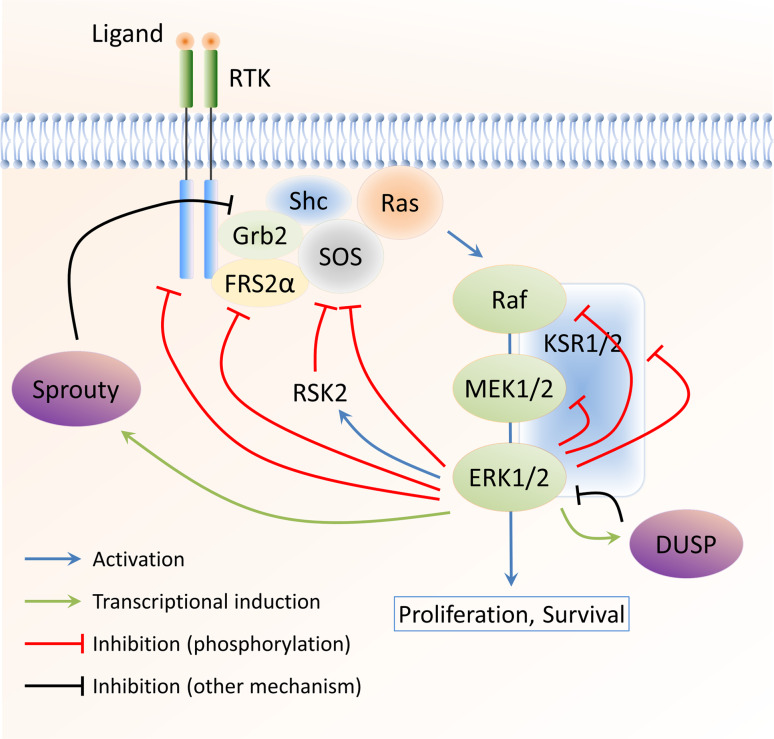
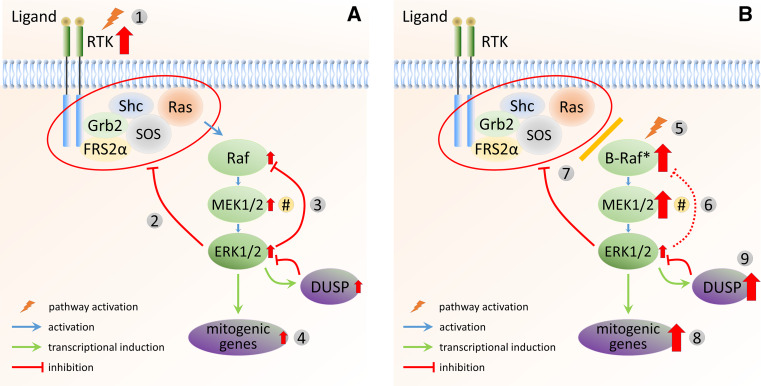
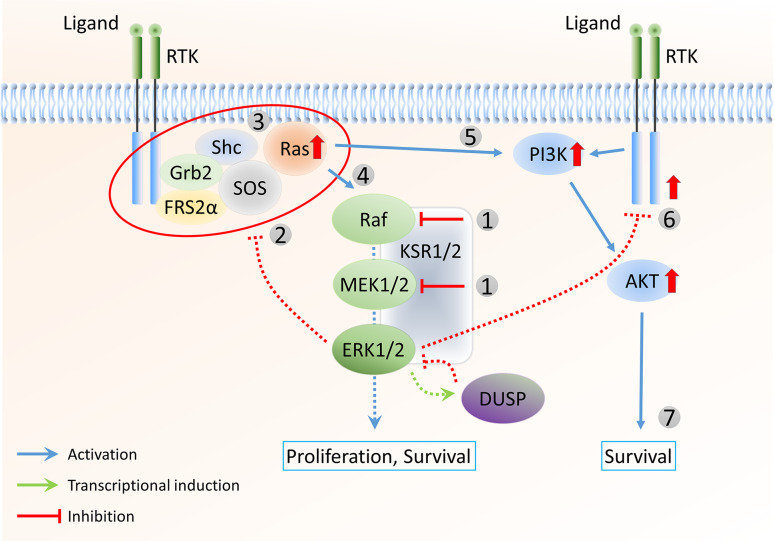
The extracellular signal-regulated kinase 1/2 (ERK1/2) mitogen-activated protein kinase (MAPK) signalling pathway regulates many cellular functions, including proliferation, differentiation, and transformation. To reliably convert external stimuli into specific cellular responses and to adapt to environmental circumstances, the pathway must be integrated into the overall signalling activity of the cell. Multiple mechanisms have evolved to perform this role. In this review, we will focus on negative feedback mechanisms and examine how they shape ERK1/2 MAPK signalling. We will first discuss the extensive number of negative feedback loops targeting the different components of the ERK1/2 MAPK cascade, specifically the direct posttranslational modification of pathway components by downstream protein kinases and the induction of de novo gene synthesis of specific pathway inhibitors. We will then evaluate how negative feedback modulates the spatiotemporal signalling dynamics of the ERK1/2 pathway regarding signalling amplitude and duration as well as subcellular localisation. Aberrant ERK1/2 activation results in deregulated proliferation and malignant transformation in model systems and is commonly observed in human tumours. Inhibition of the ERK1/2 pathway thus represents an attractive target for the treatment of malignant tumours with increased ERK1/2 activity. We will, therefore, discuss the effect of ERK1/2 MAPK feedback regulation on cancer treatment and how it contributes to reduced clinical efficacy of therapeutic agents and the development of drug resistance.
Overview
The claims and statistics of this paper haven’t been checked yet.
Free: it reads the open-access text and checks the first 5 claims that cite a source we can check. Create a free account to check every claim.
Integrity signals
Registry
Cites
Statistics
Figures
Verification
Claims the paper makes
The claims and statistics of this paper haven’t been checked yet.
Free: it reads the open-access text and checks the first 5 claims that cite a source we can check. Create a free account to check every claim.
Claims other papers make about this one
Each is checked against this paper’s own text: does it say what the citing paper says it does?
The source backs part of the claim, not all of it — or backs it for a different population, condition or comparison.
In the citing paper
“Co-inhibiting KRAS and EGFR can shut down feedback loops activated by KRAS monotherapy [96,101,124].”
From KRAS: Biology, Inhibition, and Mechanisms of Inhibitor Resistance (2024) · cites this paper as [124]
Experimental — accuracy not yet measuredThe cited source says what the claim attributes to it.
In the citing paper
“The limited ef fi cacy observed for MEK inhibitors may involve adaptive feedback mechanisms through the reactivation of MAPK signalling caused by the blockade of ERK signalling [11 -13].”
In the citing paper
“inhibitors of SOS1 reduce the activity of this key RAS-GEF and have demonstrated preclinical efficacy in combination with trametinib in KRASG12C-mutant and KRASG13D-mutant cell lines75, suggesting the potential for synergy when combined with KRAS-off inhibitors.”
From The current state of the art and future trends in RAS-targeted cancer therapies (2022) · cites this paper as [75]
In the citing paper
“SOS1 activation has been shown to be a key mechanism of adaptive resistance to MEK inhibitors; therefore, BI-3406 has been evaluated in combination with trametinib in KRASG12C-mutant and KRASG13D-mutant cell lines and found to synergistically inhibit their growth75.”
From The current state of the art and future trends in RAS-targeted cancer therapies (2022) · cites this paper as [75]
Self-check
Percentages, sums and reported differences re-computed from the paper’s own numbers.
The self-check needs the paper’s full text.
Citations
Cites
Mutations of the BRAF gene in human cancer
Davies, H., Bignell, G. R., Cox, C., Stephens, P., Edkins, S., Clegg, S., Teague, J., Woffendin, H., Garnett, M. J., Bottomley, W., et al. (2002) · Nature · doi:10.1038/nature00766 · Cited by 10,674
Pao, W., Miller, V., Zakowski, M., Doherty, J., Politi, K., Sarkaria, I., Singh, B., Heelan, R., Rusch, V., Fulton, L., et al. (2004) · Proceedings of the National Academy of Sciences · doi:10.1073/pnas.0405220101 · Cited by 4,338
Alessi, D. R., Cuenda, A., Cohen, P., Dudley, D. T., & Saltiel, A. R. (1995) · Journal of Biological Chemistry · doi:10.1074/jbc.270.46.27489 · Cited by 3,393
Inhibition of Mutated, Activated BRAF in Metastatic Melanoma
Flaherty, K. T., Puzanov, I., Kim, K. B., Ribas, A., McArthur, G. A., Sosman, J. A., O'Dwyer, P. J., Lee, R. J., Grippo, J. F., Nolop, K., et al. (2010) · New England Journal of Medicine · doi:10.1056/nejmoa1002011 · Cited by 3,103
Combined BRAF and MEK inhibition in melanoma with BRAF V600 mutations
Flaherty, K. T., Infante, J. R., Daud, A., Gonzalez, R., Kefford, R. F., Sosman, J., Hamid, O., Schuchter, L., Cebon, J., Ibrahim, N., et al. (2012) · New England Journal of Medicine · doi:10.1056/nejmoa1210093 · Cited by 2,810
Melanomas acquire resistance to B-RAF(V600E) inhibition by RTK or N-RAS upregulation
Nazarian, R., Shi, H., Wang, Q., Kong, X., Koya, R. C., Lee, H., Chen, Z., Lee, M.-K., Attar, N., Sazegar, H., et al. (2010) · Nature · doi:10.1038/nature09626 · Cited by 2,192
Unresponsiveness of colon cancer to BRAF(V600E) inhibition through feedback activation of EGFR
Prahallad, A., Sun, C., Huang, S., Di Nicolantonio, F., Salazar, R., Zecchin, D., Beijersbergen, R. L., Bardelli, A., & Bernards, R. (2012) · Nature · doi:10.1038/nature10868 · Cited by 2,051
Clinical efficacy of a RAF inhibitor needs broad target blockade in BRAF-mutant melanoma
Bollag, G., Hirth, P., Tsai, J., Zhang, J., Ibrahim, P. N., Cho, H., Spevak, W., Zhang, C., Zhang, Y., Habets, G., et al. (2010) · Nature · doi:10.1038/nature09454 · Cited by 1,831
RAF inhibitors transactivate RAF dimers and ERK signalling in cells with wild-type BRAF
Poulikakos, P. I., Zhang, C., Bollag, G., Shokat, K. M., & Rosen, N. (2010) · Nature · doi:10.1038/nature08902 · Cited by 1,811
Kinase-Dead BRAF and Oncogenic RAS Cooperate to Drive Tumor Progression through CRAF
Heidorn, S. J., Milagre, C., Whittaker, S., Nourry, A., Niculescu-Duvas, I., Dhomen, N., Hussain, J., Reis-Filho, J. S., Springer, C. J., Pritchard, C., et al. (2010) · Cell · doi:10.1016/j.cell.2009.12.040 · Cited by 1,465
Cited by
Items 301–400 of 645
Molecular insights into immune evasion and therapeutic paradigms in pancreatic cancer
Li, M., Zhou, R., Qiu, Y., Peng, Y., Liu, M., & Zhang, X. (2025) · Chinese Journal of Cancer Research · doi:10.21147/j.issn.1000-9604.2025.03.13 · Cited by 10
Corrales, E., Levit‐Zerdoun, E., Metzger, P., Kowar, S., Ku, M., Brummer, T., & Boerries, M. (2021) · Cell Communication and Signaling · doi:10.1186/s12964-021-00801-3 · Cited by 10
Zhang, X., Zhang, X., Han, R., Wang, Z., Yang, Q., Huang, Y., & Yan, Y. (2022) · Biochemical and Biophysical Research Communications · doi:10.1016/j.bbrc.2022.01.067 · Cited by 11
Xiao, F., Wang, K., Wang, X., Li, H., Hu, Z., Ren, X., Huang, W., Feng, T., Yao, L., Lin, J., et al. (2024) · Molecular Cancer Therapeutics · doi:10.1158/1535-7163.mct-24-0049 · Cited by 10
Kuppusamy, S., Bhattacharjee, B., Rynjah, D., Kalita, P., Sen, S., & Chakraborty, R. (2024) · Current Diabetes Reviews · doi:10.2174/0115733998335873241012161428 · Cited by 10
Shi, G., Wang, Y., Yang, J., Liu, T., Luo, F., Jin, G., Ma, Y., & Zhang, Y. (2020) · Cardiorenal Medicine · doi:10.1159/000507184 · Cited by 10
New mechanistic insights into the RAS-SIN1 interaction at the membrane
Pudewell, S., Lissy, J., Nakhaeizadeh, H., Mosaddeghzadeh, N., Nakhaei‐Rad, S., Dvorský, R., & Ahmadian, M. R. (2022) · Frontiers in Cell and Developmental Biology · doi:10.3389/fcell.2022.987754 · Cited by 10
The Role of MicroRNAs in Cancer Biology and Therapy from a Systems Biology Perspective
Lai, X., Schmitz, U., & Vera, J. (2022) · Advances in experimental medicine and biology · doi:10.1007/978-3-031-08356-3_1 · Cited by 10
Strash, N., DeLuca, S., Carattini, G. L. J., Chen, Y., Wu, T., Helfer, A., Scherba, J. C., Wang, I., Jain, M., Naseri, R., et al. (2024) · Science Advances · doi:10.1126/sciadv.adh2598 · Cited by 10
Merlin cooperates with neurofibromin and Spred1 to suppress the Ras–Erk pathway
Cui, Y., Ma, L., Schacke, S., Yin, J. C., Hsueh, Y., Jin, H., & Morrison, H. (2020) · Human Molecular Genetics · doi:10.1093/hmg/ddaa263 · Cited by 10
Myers, P. J., Lee, S. H., & Lazzara, M. J. (2023) · bioRxiv (Cold Spring Harbor Laboratory) · doi:10.1101/2023.06.25.543329 · Cited by 10
Optogenetic actuator/ERK biosensor circuits identify MAPK network nodes that shape ERK dynamics
Dessauges, C., Mikelson, J., Dobrzyński, M., Jacques, M.-A., Frismantiene, A., Gagliardi, P. A., Khammash, M., & Pertz, O. (2021) · doi:10.1101/2021.07.27.453955 · Cited by 9
From bench to bedside: murine models of inherited and sporadic brain arteriovenous malformations
Ricciardelli, A., Genet, G., Genet, N., McClugage, S. T., Kan, P., Hirschi, K. K., Fish, J. E., & Wythe, J. D. (2025) · Angiogenesis · doi:10.1007/s10456-024-09953-5 · Cited by 9
Counter-Therapeutic Strategies for Resistance of FLT3 Inhibitors in Acute Myeloid Leukemia
Song, M.-K. (2025) · Cells · doi:10.3390/cells14191526 · Cited by 9
Guda, B. B., Pushkarev, V. M., Ae, K., Kovzun, О. I., & Tronko, M. D. (2019) · Endokrynologia · doi:10.31793/1680-1466.2019.24-1.53 · Cited by 9
Suzuki, C., Nishiyama, A., Arai, S., Tange, S., Tajima, A., Tanimoto, A., Fukuda, K., Takumi, Y., Kotani, H., Takeuchi, S., et al. (2022) · Cancer Science · doi:10.1111/cas.15354 · Cited by 9
Liu, Z., Song, Y., Hu, R., Geng, Y., Huang, Y., Li, F., Ma, W., Dong, H., Song, K., Ding, J., et al. (2023) · Journal of Ethnopharmacology · doi:10.1016/j.jep.2023.116889 · Cited by 9
Hsiao, K.-C., Ruan, S.-Y., Chen, S.-M., Lai, T.-Y., Chan, R., Zhang, Y., Chu, C., Cheng, H., Tsai, H., Tu, Y., et al. (2023) · Cell Communication and Signaling · doi:10.1186/s12964-023-01182-5 · Cited by 9
MAPK-negative feedback regulation confers dependence to JAK2V617F signaling
Kesarwani, M., Kincaid, Z., Azhar, M., Menke, J., Schwieterman, J., Ansari, S., Reaves, A., Deininger, M. W., Levine, R. L., Grimes, H. L., et al. (2023) · Leukemia · doi:10.1038/s41375-023-01959-0 · Cited by 9
Klemm, S., Evert, K., Utpatel, K., Muggli, A., Simile, M. M., Chen, X., Evert, M., Calvisi, D. F., & Scheiter, A. (2023) · BMC Cancer · doi:10.1186/s12885-023-11577-9 · Cited by 9
ASCL1 Restrains ERK1/2 to Promote Survival of a Subset of Neuroendocrine Lung Cancers
Martín-Vega, A., Earnest, S. A., Augustyn, A., Wichaidit, C., Gazdar, A. F., Girard, L., Peyton, M., Kollipara, R. K., Minna, J. D., Johnson, J. E. B., et al. (2024) · Molecular Cancer Therapeutics · doi:10.1158/1535-7163.mct-24-0355 · Cited by 9
Reusability and composability in process description maps: RAS–RAF–MEK–ERK signalling
Mazein, A., Rougny, A., Karr, J. R., Sáez-Rodríguez, J., Ostaszewski, M., & Schneider, R. (2021) · Briefings in Bioinformatics · doi:10.1093/bib/bbab103 · Cited by 9
Using Dictyostelium to Develop Therapeutics for Acute Respiratory Distress Syndrome
Kirolos, S. A., Rijal, R., Consalvo, K. M., & Gomer, R. H. (2021) · Frontiers in Cell and Developmental Biology · doi:10.3389/fcell.2021.710005 · Cited by 9
Dougherty, L. L., Dutta, S., & Avasthi, P. P. (2023) · Life Science Alliance · doi:10.26508/lsa.202301899 · Cited by 9
Lake, D., Corrêa, S. A. L., & Müller, J. (2019) · Brain Research · doi:10.1016/j.brainres.2019.146357 · Cited by 9
Self-citationFinn, K. J., Martin, S. E., & Settleman, J. (2020) · Cancer Research · doi:10.1158/0008-5472.can-19-0729 · Cited by 9
Relav, L., Estienne, A., & Price, C. A. (2021) · Molecular and Cellular Endocrinology · doi:10.1016/j.mce.2021.111297 · Cited by 9
Kirolos, S. A., & Gomer, R. H. (2021) · Molecular Biology of the Cell · doi:10.1091/mbc.e20-10-0656 · Cited by 10
Direct Targeting of the Raf-MEK-ERK Signaling Cascade Inhibits Neuroblastoma Growth
Chilamakuri, R., & Agarwal, S. (2022) · Current Oncology · doi:10.3390/curroncol29090512 · Cited by 9
Zhang, D., Zhou, C., Li, Y., Gao, L., Pang, Z., Yin, G., & Shi, B. (2018) · International Journal of Urology · doi:10.1111/iju.13726 · Cited by 9
Rowswell-Turner, R. B., Rutishauser, J., Kim, K., Khazan, N., Sivagnanalingam, U., Jones, A. M., Singh, R. K., & Moore, R. G. (2019) · Translational Oncology · doi:10.1016/j.tranon.2019.04.009 · Cited by 9
Poston, R. G., Murphy, L., Rejepova, A., Ghaninejad-Esfahani, M., Segales, J. S., Mulligan, K. A., & Saha, R. N. (2020) · Journal of Biological Chemistry · doi:10.1074/jbc.ra119.011138 · Cited by 9
Proteomic analyses identify targets, pathways, and cellular consequences of oncogenic KRAS signaling
Kabella, N., Bayer, F. P., Stamatiou, K., Abele, M., Sakhteman, A., Chang, Y.-C., Wagner, V., Gabriel, A., Krumm, J., Reinecke, M., et al. (2025) · Science Signaling · doi:10.1126/scisignal.adt6552 · Cited by 8
Interactions between LncRNAs and MAPK signaling pathways in the pathogenesis of breast cancer
Ding, B., Wang, X., Zhang, Z., Wang, Y., Bo, W., Zhang, M., Tian, Z., Wang, Y., Xue, X., & Zhang, M. (2025) · Cancer Cell International · doi:10.1186/s12935-025-03943-3 · Cited by 8
Li, J., Zhang, H., Song, K., Wu, J., Li, L., Liu, Z., Xu, B., & Song, Q. (2023) · Cancer Biomarkers · doi:10.3233/cbm-230036 · Cited by 9
Hicks, H. M., Nassar, V. L., Lund, J., Rose, M. M., & Schweppe, R. E. (2024) · Cancer Biology & Therapy · doi:10.1080/15384047.2024.2332000 · Cited by 8
The role of the master cancer regulator Pin1 in the development and treatment of cancer
Stewart, R., Sharma, S., Wu, T., Okuda, S., Xie, G., Zhou, X. Z., Shilton, B. H., & Lu, K. P. (2024) · Frontiers in Cell and Developmental Biology · doi:10.3389/fcell.2024.1343938 · Cited by 8
Mustafa, M., Abbas, K., Ahmad, W., Ahmad, R., Islam, S., Khan, H., Moinuddin, M., Hassan, M. I., Parveen, S., & Habib, S. (2025) · Current Medicinal Chemistry · doi:10.2174/0109298673331849240930140120 · Cited by 8
Evaluation of information flows in the RAS-MAPK system using transfer entropy measurements
Umeki, N., Kabashima, Y., & Sako, Y. (2025) · eLife · doi:10.7554/elife.104432 · Cited by 8
Tie, F., Hu, N., Dong, Q. Z., & Wang, H. (2023) · European Journal of Pharmacology · doi:10.1016/j.ejphar.2023.176154 · Cited by 8
Oliveira, L. G., Testasicca, M. C. D. S., Ricotta, T. Q. N., Vago, J. P., dos Santos, L. M., Nascimento, F. C., Lima, K. M., Queiroz‐Junior, C. M., Sousa, L. P., & Fernandes, A. P. (2022) · Frontiers in Immunology · doi:10.3389/fimmu.2022.762080 · Cited by 8
Illuminating oncogenic KRAS signaling by multi-dimensional chemical proteomics
Kabella, N., Bayer, F. P., Stamatiou, K., Abele, M., Sakhteman, A., Chang, Y.-C., Wagner, V., Gabriel, A., Krumm, J., Reinecke, M., et al. (2025) · doi:10.1101/2025.01.30.635627 · Cited by 8
Robust network inference using response logic
Gross, T., Wongchenko, M. J., Yan, Y., & Blüthgen, N. (2019) · Bioinformatics · doi:10.1093/bioinformatics/btz326 · Cited by 7
Guo, D., Zhao, Y., Sun, X., Zheng, Y., & Huang, B. (2025) · International Journal of Biological Macromolecules · doi:10.1016/j.ijbiomac.2025.146564 · Cited by 7
Sprouty and Spred temporally regulate ERK1/2-signaling to suppress TGFβ-induced lens EMT
Zhao, G., Pan, A. Y., Feng, Y., Rasko, J. E. J., Bailey, C. G., & Lovicu, F. J. (2022) · Experimental Eye Research · doi:10.1016/j.exer.2022.109070 · Cited by 7
Wang, T., Li, K., Liu, H., & Luo, E. (2022) · Organogenesis · doi:10.1080/15476278.2022.2082236 · Cited by 7
Kollara, A., Burt, B. D., Ringuette, M. J., & Brown, T. J. (2023) · Cellular Signalling · doi:10.1016/j.cellsig.2023.110634 · Cited by 7
Advances in KRAS mutation inhibition in metastatic colorectal cancer
Wu, C., Li, W., Chen, M., Zhang, Q., Xu, T., Ma, Y., Liu, W., Wang, Z., Wang, X., Li, J., et al. (2023) · Holistic Integrative Oncology · doi:10.1007/s44178-023-00032-1 · Cited by 7
Lehman, S. S., Williamson, C. D., Tucholski, T., Ellis, N. A., Bouchard, S., Jarník, M., Allen, M., Nita‐Lazar, A., & Machner, M. P. (2024) · Cell Reports · doi:10.1016/j.celrep.2024.114033 · Cited by 7
Cytotoxic activity of KRAS inhibitors in combination with chemotherapeutics
Hamilton, G., & Plangger, A. (2021) · Expert Opinion on Drug Metabolism & Toxicology · doi:10.1080/17425255.2021.1965123 · Cited by 7
The MEK-ERK signaling pathway promotes maintenance of cardiac chamber identity
Yao, Y., Gupta, D., & Yelon, D. L. (2024) · Development · doi:10.1242/dev.202183 · Cited by 7
Peptidomimetics designed to bind to RAS effector domain are promising cancer therapeutic compounds
Pallara, C., Cabot, D., Rivas, J., Brun, S., Seco, J., Abuasaker, B., Tarragó, T., Jaumot, M., Prades, R., & Agell, N. (2022) · Scientific Reports · doi:10.1038/s41598-022-19703-6 · Cited by 7
A semantics, energy-based approach to automate biomodel composition
Shahidi, N., Pan, M., Tran, K., Crampin, E. J., & Nickerson, D. P. (2022) · PLoS ONE · doi:10.1371/journal.pone.0269497 · Cited by 7
Crowe, M. S., Zavorotinskaya, T., Voliva, C. F., Shirley, M. D., Wang, Y., Ruddy, D. A., Rakiec, D. P., Engelman, J. A., Stuart, D. D., & Freeman, A. K. (2021) · Molecular Cancer Research · doi:10.1158/1541-7786.mcr-20-1022 · Cited by 6
Yang, J., Yu, Z., Li, S., Zhang, W., He, J., Qu, X., Qi, Y., Yin, Y., Wu, J., Chen, L., et al. (2024) · Phytochemical Analysis · doi:10.1002/pca.3456 · Cited by 6
Mao, X., Quan, J., Niu, T., Zhang, Z., Zhao, J., He, H., & Yin, Q. (2026) · Bioorganic Chemistry · doi:10.1016/j.bioorg.2026.109775 · Cited by 6
Bandegi, M., Biltekin, E., Akay, Y. M., Ozpolat, B., & Akay, M. (2026) · IEEE Open Journal of Engineering in Medicine and Biology · doi:10.1109/ojemb.2026.3678868 · Cited by 6
Targeting MEK in cancer and beyond: mechanistic insights and therapeutic opportunities
Chan, W. Y., da Silva, I. P., Long, G. V., & Rizos, H. (2026) · The Lancet · doi:10.1016/s0140-6736(26)00199-6 · Cited by 6
Lindenberg, M., Almeida, L., Dhillon-LaBrooy, A., Siegel, E., Henriques‐Normark, B., & Sparwasser, T. D. (2021) · Journal of Molecular Medicine · doi:10.1007/s00109-021-02039-5 · Cited by 6
Stücheli, S., Araya, S., Ercan, C., Moser, S. O., Gallon, J., Jenö, P., Piscuoglio, S., Terracciano, L., & Odermatt, A. (2022) · Cancers · doi:10.3390/cancers14133074 · Cited by 6
Hamdin, C. D., Wu, M., Chen, C., Ho, Y., Jiang, W., Gung, P., Ho, H., Chuang, H., Tan, T., & Yet, S. (2023) · International Journal of Molecular Sciences · doi:10.3390/ijms242417136 · Cited by 6
Yang, K., Zeng, L., Li, Y., Wu, L., Xiang, W., Wu, X., Wang, G., Bao, T., Huang, S., Yu, R., et al. (2023) · Journal of Ethnopharmacology · doi:10.1016/j.jep.2023.117589 · Cited by 6
ERK2 Is a Promoter of Cancer Cell Growth and Migration in Colon Adenocarcinoma
Parascandolo, A., Benincasa, G., Corcione, F., & Laukkanen, M. O. (2024) · Antioxidants · doi:10.3390/antiox13010119 · Cited by 6
STIM proteins at the intersection of signaling pathways
Poth, V., Knapp, M. L., & Niemeyer, B. A. (2020) · Current Opinion in Physiology · doi:10.1016/j.cophys.2020.07.007 · Cited by 6
Riemann, S., Kolibabka, M., Busch, S., Lin, J., Hoffmann, S., Gretz, N., Feng, Y., Wohlfart, P., & Hammes, H. (2021) · Frontiers in Physiology · doi:10.3389/fphys.2021.660164 · Cited by 6
Yao, K., Zhou, E., & Cheng, C. (2022) · Cancer Medicine · doi:10.1002/cam4.4491 · Cited by 6
VanSlyke, J. K., Boswell, B. A., & Musil, L. S. (2024) · Molecular Biology of the Cell · doi:10.1091/mbc.e23-07-0294 · Cited by 6
Restore the brake on tumor progression
Gordon, R. E., Zhang, L., & Yang, Z.-J. (2017) · Biochemical Pharmacology · doi:10.1016/j.bcp.2017.04.003 · Cited by 6
Kumar, R., & Evans, T. (2019) · Stem Cells · doi:10.1002/stem.3023 · Cited by 6
Guda, B. B., PUSHKAREV, V. V., Ковзун, О. І., Pushkarev, V. P., & Tronko, M. D. (2019) · Шпитальна хірургія Журнал імені Л Я Ковальчука · doi:10.11603/2414-4533.2019.3.10551 · Cited by 6
Collins, H. E., Anderson, J. C., Wende, A. R., & Chatham, J. C. (2022) · Physiological Reports · doi:10.14814/phy2.15177 · Cited by 6
Computational modeling of cell signaling and mutations in pancreatic cancerPreprint
Telmer, C. A., Sayed, K., Butchy, A., Bocan, K. N., Kaltenmeier, C., Lotze, M. T., & Miškov-Živanov, N. (2021) · bioRxiv (Cold Spring Harbor Laboratory) · doi:10.1101/2021.06.08.447557 · Cited by 6
Targeting SHP2 Sensitizes Papillary Thyroid Cancer Cells to MEK InhibitorsPreprint
Zhi, J., Yi, J., Xiukun, H., Wang, W., Yang, W., Hu, L., Huang, J., Guo, S., Ruan, X., Zheng, X., et al. (2021) · SSRN Electronic Journal · doi:10.2139/ssrn.3771278 · Cited by 6
Feng, J., Zhang, X., & Tian, T. (2024) · International Journal of Molecular Sciences · doi:10.3390/ijms251810204 · Cited by 5
Lin, H., Zhang, J., Nie, Q., & Sun, X. (2025) · Multiscale Modeling and Simulation · doi:10.1137/24m1663077 · Cited by 6
Soudah, N., Baskin, A., Darash‐Yahana, M., Darlyuk‐Saadon, I., Smorodinsky-Atias, K., Shalit, T., Yu, W., Savidor, A., Pikarsky, E., & Engelberg, D. (2025) · Oncogene · doi:10.1038/s41388-025-03437-6 · Cited by 5
Waldron, N., Silva, D. J., Westaby, D., Jiménez-Vacas, J., Taylor, J., & Sharp, A. (2026) · British Journal of Cancer · doi:10.1038/s41416-026-03441-x · Cited by 5
Shneider, B. L., Cortes‐Santiago, N., Schady, D. A., Krishnamoorthy, S., Thevananther, S., Rajapakshe, K., Perera, D. N., Huang, S., & Coarfa, C. (2021) · American Journal of Physiology-Gastrointestinal and Liver Physiology · doi:10.1152/ajpgi.00065.2020 · Cited by 5
Shen, P., Yu, J., Yan, C., Yang, D., Tong, C., & Wang, X. (2022) · Journal of Animal Physiology and Animal Nutrition · doi:10.1111/jpn.13760 · Cited by 5
Kesarwani, M., Kincaid, Z., Azhar, M., & Azam, M. (2024) · Blood Advances · doi:10.1182/bloodadvances.2023010830 · Cited by 5
Dezashibi, H. M., & Shabani, A. (2023) · Advanced Biomedical Research · doi:10.4103/abr.abr_201_23 · Cited by 5
CRISPRing KRAS: A Winding Road with a Bright Future in Basic and Translational Cancer Research
Gong, X., Du, J., Peng, R., Chen, C., & Zhang, Y. (2024) · Cancers · doi:10.3390/cancers16020460 · Cited by 6
The RAS-Regulated RAF-MEK1/2-ERK1/2 Protein Kinase Pathway: The Path Most Traveled in RASopathies
Dutkiewicz, R., Sharpe, H. J., & Cook, S. J. (2024) · Springer eBooks · doi:10.1007/978-3-031-62945-7_18 · Cited by 5
Potential roles of MEK1 on aging in Argopecten scallops
Yuan, K., Lu, X., Ning, J., Chen, M., Wang, Q., Liu, G., Xu, X. S., He, X., & Wang, C. (2022) · Frontiers in Marine Science · doi:10.3389/fmars.2022.1057814 · Cited by 5
Abuasaker, B., Garrido, E., Vilaplana, M., Gómez-Zepeda, J. D., Brun, S., Garcia‐Cajide, M., Mauvezin, C., Jaumot, M., Pujol, M. D., Rubio, J., et al. (2023) · International Journal of Molecular Sciences · doi:10.3390/ijms24010748 · Cited by 5
A proteomic signature for CNS adaptations to the valence of environmental stimulation
Shaw, A., Arnold, L. D., Privitera, L., Whitfield, P. D., Doherty, M. K., & Morè, L. (2020) · Behavioural Brain Research · doi:10.1016/j.bbr.2020.112515 · Cited by 5
Transcriptomic Changes in Hot Spring Frog Tadpoles (Buergeria otai) in Response to Heat Stress
Komaki, S., Matsunami, M., Lin, J.-W., Lee, K., Lin, Y.-P., Lee, Y. Z., Lin, S., & Igawa, T. (2021) · Frontiers in Ecology and Evolution · doi:10.3389/fevo.2021.706887 · Cited by 5
Engineering SHP2 Phosphatase for Optical Control
Ryan, A., Janosko, C. P., Courtney, T. M., & Deiters, A. (2022) · Biochemistry · doi:10.1021/acs.biochem.2c00387 · Cited by 5
Sun, H., Ma, Y., Yang, Y., Sun, C., & Li, H. (2022) · Avian Pathology · doi:10.1080/03079457.2022.2144132 · Cited by 5
Marois, A. L., Bailey, S. N. L., Hooper, S., Kumar, S., Sparks, H., Alexandrov, Y., Caswell, D. R., Fröhlich, F., Schlegelmilch, K., Valand, K., et al. (2024) · bioRxiv (Cold Spring Harbor Laboratory) · doi:10.1101/2024.05.14.594112 · Cited by 5
The RAS Signaling Network and Cancer
Hibshman, P. S., & Der, C. J. (2024) · Springer eBooks · doi:10.1007/978-3-031-62945-7_17 · Cited by 4
Morphological control of merlin-Rac antagonism in proliferation-promoting signaling
Weiss, B. G., Keth, J. M., Bhatt, K., Doyal, M., Hahn, K. M., Noh, J., Isogai, T., & Danuser, G. M. (2025) · Science Signaling · doi:10.1126/scisignal.adk0922 · Cited by 4
Du, K., Liu, Y., Zhang, L., Peng, L., Dong, W., Jiang, Y., Niu, M., Sun, Y., Wu, C., Niu, Y., et al. (2024) · Biomedicine & Pharmacotherapy · doi:10.1016/j.biopha.2024.116637 · Cited by 4
Gong, Z., Zhang, X., Cui, J., Chen, W., Huang, X., Yang, Q., Li, T., & Zhang, W. (2024) · Journal of Muscle Research and Cell Motility · doi:10.1007/s10974-024-09677-5 · Cited by 4
Recent advances in the therapeutic development of ERK inhibitors
Kumar, D., & Hassan, M. I. (2022) · Elsevier eBooks · doi:10.1016/b978-0-323-91287-7.00023-5 · Cited by 4
Алексеева, Л. И., Byalovsky, Y., Zagorodny, N. V., Ivanova, G. Е., Karateev, D. E., Konchugova, T. V., Rakitina, I. S., & Strakhov, M. A. (2021) · Problems of Balneology Physiotherapy and Exercise Therapy · doi:10.17116/kurort20219803180 · Cited by 4
Using Regularization to Infer Cell Line Specificity in Logical Network Models of Signaling Pathways
Landtsheer, S. D., Lucarelli, P., & Sauter, T. (2018) · Frontiers in Physiology · doi:10.3389/fphys.2018.00550 · Cited by 4
Genolet, O., Monaco, A. A., Dunkel, I., Boettcher, M., & Schulz, E. G. (2020) · bioRxiv (Cold Spring Harbor Laboratory) · doi:10.1101/2020.03.09.983544 · Cited by 4
Optogenetic actuator/biosensor circuits for large-scale interrogation of MAPK signaling dynamicsPreprint
Dessauges, C. (2021) · bioRxiv (Cold Spring Harbor Laboratory) · doi:10.17632/2p9m5jzpzj · Cited by 4
Advances in Small Molecules of Flavonoids for the Regulation of Gluconeogenesis
Wu, X., Wang, A., Ning, C., Wu, Y., & Chen, S. (2023) · Current Topics in Medicinal Chemistry · doi:10.2174/1568026623666230726145514 · Cited by 3
Metadata
- Authors
- Lake, D., Corrêa, S. A. L., & Müller, J.
- Affiliations
- University of Warwick (GB)
- Aston University (GB)
- Corresponding author
- Müller, Jürgen
- Venue
- Cellular and Molecular Life Sciences
- Published
- 2016-06-24
- Volume
- 73
- Issue
- 23
- Pages
- 4397-4413
- ISSN
- 1420-682X (ISSN-L)
- 1420-9071
- PMC
- PMC5075022
- OpenAlex
- W2465367340
- Cited by
- 565
- References
- 134
- Citations by year
- 2026: 48 · 2025: 45 · 2024: 63 · 2023: 74 · 2022: 73 · 2021: 84 · 2020: 63 · 2019: 50 · 2018: 43 · 2017: 21 · 2016: 1
- FWCI
- 3.46
- Type
- journal article
- Language
- en
- Open access
- hybrid
- doi.org
- Locations
- Cellular and Molecular Life Sciences (publishedVersion, cc-by)
- PubMed Central (publishedVersion, cc-by)
- PubMed (publishedVersion)
- Bradford Scholars (University of Bradford) (publishedVersion, other-oa)
- e-space (Manchester Metropolitan University) (acceptedVersion)
- Warwick Research Archive Portal (University of Warwick) (acceptedVersion)
- Aston Publications Explorer (Aston University) (submittedVersion)
- Topics
- Life Sciences › Biochemistry, Genetics and Molecular Biology › Molecular Biology › Melanoma and MAPK Pathways
- Life Sciences › Biochemistry, Genetics and Molecular Biology › Molecular Biology › Protein Kinase Regulation and GTPase Signaling
- Life Sciences › Biochemistry, Genetics and Molecular Biology › Molecular Biology › Protein Tyrosine Phosphatases
- Keywords
- ERK1/2, MAPK signaling, negative feedback regulation, post-translational modification, pathway inhibitors, subcellular localization, cancer therapy, drug resistance, malignant transformation
- MeSH terms
- Animals, Humans, Phosphorylation, Disease Progression, MAP Kinase Signaling System, Feedback, Physiological, Protein Kinase Inhibitors, Extracellular Signal-Regulated MAP Kinases
About these checks
Registry, retraction, Cites and statistics results are computed, not judged, with one exception: a printed reference that no index lists is read once by a model before it counts as a citation error. Claims are extracted by a model and kept only when their quote appears verbatim in the text; each cited source is then checked, with a model’s help, for whether it says what the claim relies on. Those verdicts can be wrong — read the claim’s quote and the cited source before relying on one.
Statistics and arithmetic are recomputed, not judged.
Confidence bands are shown only for fields calibrated on our annotated test set. None is calibrated yet, so no band is shown.
What counts as a claim ›How we measure confidence ›How we check this ›
Are you an author, or do you see a problem with this page? Request a review
Data sources
Bibliographic data: Semantic Scholar, OpenAlex, Crossref.
Contains information from the Semantic Scholar Academic Graph Datasets, made available under the ODC Attribution License (ODC-BY 1.0).
Semantic Scholar’s data is described in: Kinney, R., et al. (2023). The Semantic Scholar Open Data Platform. arXiv:2301.10140.
