

Negative feedback regulation of the ERK1/2 MAPK pathway
Open accessThe DOI matches its Crossref record; 133 of the 134 references it cites were found in a registry or an index.
Abstract
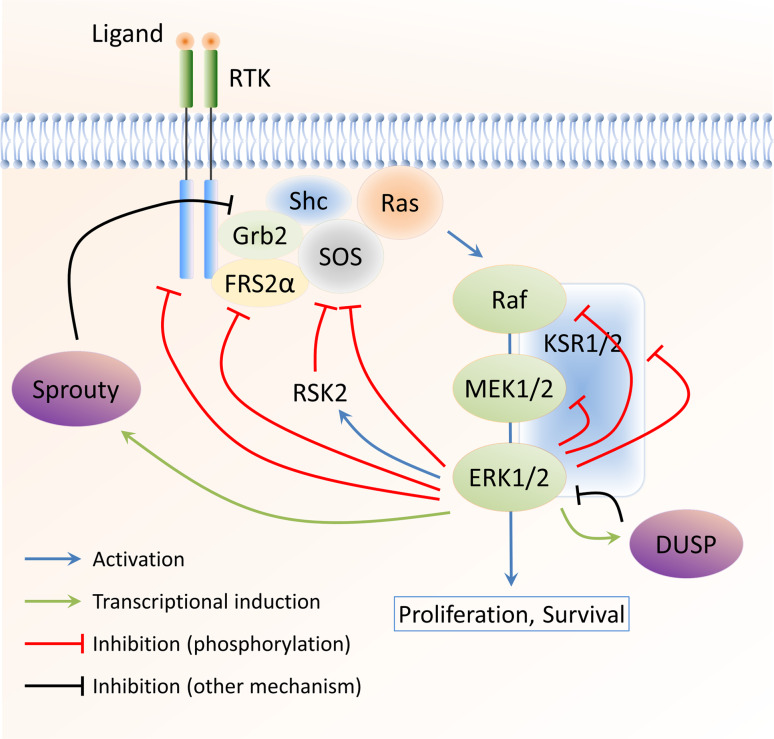
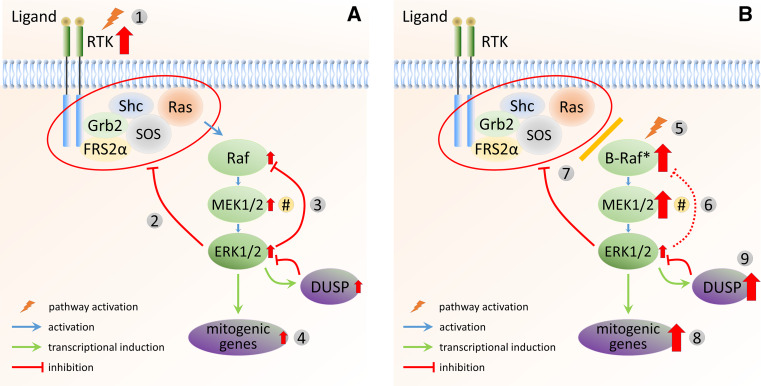
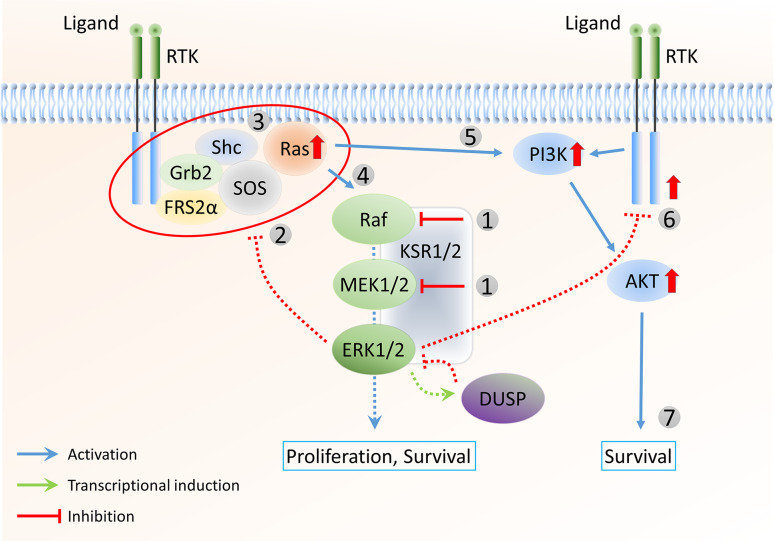
The extracellular signal-regulated kinase 1/2 (ERK1/2) mitogen-activated protein kinase (MAPK) signalling pathway regulates many cellular functions, including proliferation, differentiation, and transformation. To reliably convert external stimuli into specific cellular responses and to adapt to environmental circumstances, the pathway must be integrated into the overall signalling activity of the cell. Multiple mechanisms have evolved to perform this role. In this review, we will focus on negative feedback mechanisms and examine how they shape ERK1/2 MAPK signalling. We will first discuss the extensive number of negative feedback loops targeting the different components of the ERK1/2 MAPK cascade, specifically the direct posttranslational modification of pathway components by downstream protein kinases and the induction of de novo gene synthesis of specific pathway inhibitors. We will then evaluate how negative feedback modulates the spatiotemporal signalling dynamics of the ERK1/2 pathway regarding signalling amplitude and duration as well as subcellular localisation. Aberrant ERK1/2 activation results in deregulated proliferation and malignant transformation in model systems and is commonly observed in human tumours. Inhibition of the ERK1/2 pathway thus represents an attractive target for the treatment of malignant tumours with increased ERK1/2 activity. We will, therefore, discuss the effect of ERK1/2 MAPK feedback regulation on cancer treatment and how it contributes to reduced clinical efficacy of therapeutic agents and the development of drug resistance.
Overview
The claims and statistics of this paper haven’t been checked yet.
Free: it reads the open-access text and checks the first 5 claims that cite a source we can check. Create a free account to check every claim.
Integrity signals
Registry
Cites
Statistics
Figures
Verification
Claims the paper makes
The claims and statistics of this paper haven’t been checked yet.
Free: it reads the open-access text and checks the first 5 claims that cite a source we can check. Create a free account to check every claim.
Claims other papers make about this one
Each is checked against this paper’s own text: does it say what the citing paper says it does?
The source backs part of the claim, not all of it — or backs it for a different population, condition or comparison.
In the citing paper
“Co-inhibiting KRAS and EGFR can shut down feedback loops activated by KRAS monotherapy [96,101,124].”
From KRAS: Biology, Inhibition, and Mechanisms of Inhibitor Resistance (2024) · cites this paper as [124]
Experimental — accuracy not yet measuredThe cited source says what the claim attributes to it.
In the citing paper
“The limited ef fi cacy observed for MEK inhibitors may involve adaptive feedback mechanisms through the reactivation of MAPK signalling caused by the blockade of ERK signalling [11 -13].”
In the citing paper
“inhibitors of SOS1 reduce the activity of this key RAS-GEF and have demonstrated preclinical efficacy in combination with trametinib in KRASG12C-mutant and KRASG13D-mutant cell lines75, suggesting the potential for synergy when combined with KRAS-off inhibitors.”
From The current state of the art and future trends in RAS-targeted cancer therapies (2022) · cites this paper as [75]
In the citing paper
“SOS1 activation has been shown to be a key mechanism of adaptive resistance to MEK inhibitors; therefore, BI-3406 has been evaluated in combination with trametinib in KRASG12C-mutant and KRASG13D-mutant cell lines and found to synergistically inhibit their growth75.”
From The current state of the art and future trends in RAS-targeted cancer therapies (2022) · cites this paper as [75]
Self-check
Percentages, sums and reported differences re-computed from the paper’s own numbers.
The self-check needs the paper’s full text.
Citations
Cites
Mutations of the BRAF gene in human cancer
Davies, H., Bignell, G. R., Cox, C., Stephens, P., Edkins, S., Clegg, S., Teague, J., Woffendin, H., Garnett, M. J., Bottomley, W., et al. (2002) · Nature · doi:10.1038/nature00766 · Cited by 10,674
Pao, W., Miller, V., Zakowski, M., Doherty, J., Politi, K., Sarkaria, I., Singh, B., Heelan, R., Rusch, V., Fulton, L., et al. (2004) · Proceedings of the National Academy of Sciences · doi:10.1073/pnas.0405220101 · Cited by 4,338
Alessi, D. R., Cuenda, A., Cohen, P., Dudley, D. T., & Saltiel, A. R. (1995) · Journal of Biological Chemistry · doi:10.1074/jbc.270.46.27489 · Cited by 3,393
Inhibition of Mutated, Activated BRAF in Metastatic Melanoma
Flaherty, K. T., Puzanov, I., Kim, K. B., Ribas, A., McArthur, G. A., Sosman, J. A., O'Dwyer, P. J., Lee, R. J., Grippo, J. F., Nolop, K., et al. (2010) · New England Journal of Medicine · doi:10.1056/nejmoa1002011 · Cited by 3,103
Combined BRAF and MEK inhibition in melanoma with BRAF V600 mutations
Flaherty, K. T., Infante, J. R., Daud, A., Gonzalez, R., Kefford, R. F., Sosman, J., Hamid, O., Schuchter, L., Cebon, J., Ibrahim, N., et al. (2012) · New England Journal of Medicine · doi:10.1056/nejmoa1210093 · Cited by 2,810
Melanomas acquire resistance to B-RAF(V600E) inhibition by RTK or N-RAS upregulation
Nazarian, R., Shi, H., Wang, Q., Kong, X., Koya, R. C., Lee, H., Chen, Z., Lee, M.-K., Attar, N., Sazegar, H., et al. (2010) · Nature · doi:10.1038/nature09626 · Cited by 2,192
Unresponsiveness of colon cancer to BRAF(V600E) inhibition through feedback activation of EGFR
Prahallad, A., Sun, C., Huang, S., Di Nicolantonio, F., Salazar, R., Zecchin, D., Beijersbergen, R. L., Bardelli, A., & Bernards, R. (2012) · Nature · doi:10.1038/nature10868 · Cited by 2,051
Clinical efficacy of a RAF inhibitor needs broad target blockade in BRAF-mutant melanoma
Bollag, G., Hirth, P., Tsai, J., Zhang, J., Ibrahim, P. N., Cho, H., Spevak, W., Zhang, C., Zhang, Y., Habets, G., et al. (2010) · Nature · doi:10.1038/nature09454 · Cited by 1,831
RAF inhibitors transactivate RAF dimers and ERK signalling in cells with wild-type BRAF
Poulikakos, P. I., Zhang, C., Bollag, G., Shokat, K. M., & Rosen, N. (2010) · Nature · doi:10.1038/nature08902 · Cited by 1,811
Kinase-Dead BRAF and Oncogenic RAS Cooperate to Drive Tumor Progression through CRAF
Heidorn, S. J., Milagre, C., Whittaker, S., Nourry, A., Niculescu-Duvas, I., Dhomen, N., Hussain, J., Reis-Filho, J. S., Springer, C. J., Pritchard, C., et al. (2010) · Cell · doi:10.1016/j.cell.2009.12.040 · Cited by 1,465
Cited by
Items 101–200 of 645
EGFR-RAS-MAPK signaling is confined to the plasma membrane and associated endorecycling protrusions
Surve, S., Watkins, S. C., & Sorkin, A. D. (2021) · The Journal of Cell Biology · doi:10.1083/jcb.202107103 · Cited by 44
The role of polyphenols in modulating mitophagy: Implications for therapeutic interventions
Lin, X., Liu, W., Hu, X., Liu, Z., Wang, F., & Wang, J. (2024) · Pharmacological Research · doi:10.1016/j.phrs.2024.107324 · Cited by 43
Jiang, H., Xu, M., Li, L., Grierson, P., Dodhiawala, P., Highkin, M., Zhang, D., Li, Q., Wang-Gillam, A., & Lim, K.-H. (2018) · Molecular Cancer Therapeutics · doi:10.1158/1535-7163.mct-17-1142 · Cited by 40
Shen, X., Cui, X., Cui, H., Jin, Y., Jin, W., & Sun, H. (2018) · Journal of Cellular Biochemistry · doi:10.1002/jcb.27779 · Cited by 42
FGF2: a novel druggable target for glioblastoma?
Jimenez‐Pascual, A., Mitchell, K., Siebzehnrübl, F. A., & Lathia, J. D. (2020) · Expert Opinion on Therapeutic Targets · doi:10.1080/14728222.2020.1736558 · Cited by 42
Feng, W., Liu, Y., Ding, Y., Mao, G., Zhao, T., Chen, K., Qiu, X., Xu, T., Zhao, X., Wu, X., et al. (2020) · Archives of Toxicology · doi:10.1007/s00204-020-02683-9 · Cited by 42
RNA polymerase II pausing in development: orchestrating transcription
Abuhashem, A., Garg, V., & Hadjantonakis, A. (2022) · Open Biology · doi:10.1098/rsob.210220 · Cited by 42
Howes, J. E., Akan, D. T., Burns, M. C., Rossanese, O. W., Waterson, A. G., & Fesik, S. W. (2018) · Molecular Cancer Therapeutics · doi:10.1158/1535-7163.mct-17-0666 · Cited by 42
Ji, Q., Wang, Y. L., Li, X., Yang, Y., Wang, C. S., & Mei, Y. (2019) · Journal of Cardiothoracic Surgery · doi:10.1186/s13019-019-1025-5 · Cited by 41
Liu, Y., Yang, H., Guo, Q., Liu, T., Jiang, Y., Zhao, M., Zeng, K., & Tu, P. (2020) · Molecules · doi:10.3390/molecules25030560 · Cited by 41
Duan, S., Moro, L., Qu, R., Simoneschi, D., Cho, H., Jiang, S., Zhao, H., Chang, Q., de Stanchina, E., Arbini, A., et al. (2021) · Cell Reports · doi:10.1016/j.celrep.2021.109870 · Cited by 41
Copper-Dependent Kinases and Their Role in Cancer Inception, Progression and Metastasis
Vitaliti, A., Luca, A. D., & Rossi, L. C. (2022) · Biomolecules · doi:10.3390/biom12101520 · Cited by 41
Muta, Y., Matsuda, M., & Imajo, M. (2019) · Cancers · doi:10.3390/cancers11040513 · Cited by 37
Targeted Quantification of Phosphorylation Dynamics in the Context of EGFR-MAPK Pathway
Yi, L., Shi, T., Gritsenko, M. A., Chan, C.-Y. X., Fillmore, T., Hess, B., Swensen, A., Liu, T., Smith, R. D., Wiley, H. S., et al. (2018) · Analytical Chemistry · doi:10.1021/acs.analchem.8b00071 · Cited by 42
Rana, A., Singh, S., Sharma, R., & Kumar, A. (2018) · Current Neuropharmacology · doi:10.2174/1570159x16666180911121847 · Cited by 41
Paeonol alleviates primary dysmenorrhea in mice via activating CB2R in the uterus
Peng, Y., Zheng, X., Fan, Z., Zhou, H., Zhu, X., Wang, G., & Liu, Z. (2019) · Phytomedicine · doi:10.1016/j.phymed.2019.153151 · Cited by 40
Mechanotransduction for therapeutic approaches: Cellular aging and rejuvenation
Han, H.-M., Kim, S.-Y., & Kim, D. (2025) · APL Bioengineering · doi:10.1063/5.0263236 · Cited by 39
Modulation of Mutant KrasG12D -Driven Lung Tumorigenesis In Vivo by Gain or Loss of PCDH7 Function
Zhou, X., Padanad, M. S., Evers, B. M., Smith, B., Novaresi, N., Suresh, S., Richardson, J. A., Stein, E., Zhu, J., Hammer, R. E., et al. (2019) · Molecular Cancer Research · doi:10.1158/1541-7786.mcr-18-0739 · Cited by 40
Identifying the ErbB/MAPK Signaling Cascade as a Therapeutic Target in Canine Bladder Cancer
Cronise, K. E., Hernandez, B. G., Gustafson, D. L., & Duval, D. L. (2019) · Molecular Pharmacology · doi:10.1124/mol.119.115808 · Cited by 39
Jiménez‐Gutiérrez, E., Alegría‐Carrasco, E., Alonso‐Rodríguez, E., Fernández‐Acero, T., Molina, M., & Martín, H. (2020) · FEBS Journal · doi:10.1111/febs.15288 · Cited by 39
ERK/MAPK signaling is essential for intestinal development through Wnt pathway modulation
Wei, G., Gao, N., Chen, J., Fan, L., Zeng, Z., Gao, G., Li, L., Fang, G., Hu, K., Pang, X., et al. (2020) · Development · doi:10.1242/dev.185678 · Cited by 39
Targeting RAS oncogenesis with SOS1 inhibitors
Hillig, R. C., & Bader, B. (2022) · Advances in cancer research · doi:10.1016/bs.acr.2021.07.001 · Cited by 39
Targeting ERK beyond the boundaries of the kinase active site in melanoma
Sammons, R. M., Ghose, R., Tsai, K. Y., & Dalby, K. N. (2019) · Molecular Carcinogenesis · doi:10.1002/mc.23047 · Cited by 38
CIC Is a Mediator of the ERK1/2-DUSP6 Negative Feedback Loop
Ren, Y., Ouyang, Z., Hou, Z., Yan, Y., Zhi, Z., Shi, M., Du, M., Liu, H., Wen, Y., & Shao, Y. (2020) · iScience · doi:10.1016/j.isci.2020.101635 · Cited by 40
Sasame, J., Ikegaya, N., Kawazu, M., Natsumeda, M., Hayashi, T., Isoda, M., Satomi, K., Tomiyama, A., Oshima, A., Honma, H., et al. (2022) · Clinical Cancer Research · doi:10.1158/1078-0432.ccr-21-3622 · Cited by 38
Nagai, N., Fukuoka, Y., Ishii, M., Otake, H., Yamamoto, T., Taga, A., Okamoto, N., & Shimomura, Y. (2018) · International Journal of Molecular Sciences · doi:10.3390/ijms19041123 · Cited by 37
Cancer Mutations in FGFR2 Prevent a Negative Feedback Loop Mediated by the ERK1/2 Pathway
Szybowska, P., Kostas, M., Wesche, J., Więdłocha, A., & Haugsten, E. M. (2019) · Cells · doi:10.3390/cells8060518 · Cited by 37
Modulating multi-functional ERK complexes by covalent targeting of a recruitment site in vivo
Kaoud, T. S., Johnson, W. H., Ebelt, N. D., Piserchio, A., Zamora‐Olivares, D., Ravenstein, S. X. V., Pridgen, J. R., Edupuganti, R., Sammons, R. M., Cano, M., et al. (2019) · Nature Communications · doi:10.1038/s41467-019-12996-8 · Cited by 37
Zhang, Y., Chen, Y., Shi, L., Li, J., Wan, W., Li, B., Liu, D., Li, X., Chen, Y., Xiang, M., et al. (2022) · Cell Death Discovery · doi:10.1038/s41420-022-01221-z · Cited by 37
Signaling pathways as linear transmitters
Nunns, H., & Goentoro, L. A. (2018) · eLife · doi:10.7554/elife.33617 · Cited by 36
Mandl, M., Wagner, S., Hatzmann, F. M., Mitterberger, M. C., Zwierzina, M., Mattesich, M., & Zwerschke, W. (2019) · Cell Death and Disease · doi:10.1038/s41419-019-1657-3 · Cited by 36
Kavran, A. J., Stuart, S. A., Hayashi, K. R., Basken, J., Brandhuber, B. J., & Ahn, N. G. (2022) · Proceedings of the National Academy of Sciences · doi:10.1073/pnas.2113535119 · Cited by 38
Intermittent ERK oscillations downstream of FGF in mouse embryonic stem cells
Raina, D., Fabris, F., Morelli, L. G., & Schröter, C. (2022) · Development · doi:10.1242/dev.199710 · Cited by 36
Zhao, X., Hou, P., Xin, H., Zhang, Y., Zhou, A., Lai, C., & Xie, J. (2019) · International Journal of Biological Macromolecules · doi:10.1016/j.ijbiomac.2019.10.148 · Cited by 36
NKX2-1 controls lung cancer progression by inducing DUSP6 to dampen ERK activity
Ingram, K., Samson, S. C., Zewdu, R., Zitnay, R. G., Snyder, E. L., & Mendoza, M. C. (2021) · Oncogene · doi:10.1038/s41388-021-02076-x · Cited by 35
Small molecule Son of Sevenless 1 (SOS1) inhibitors: a review of the patent literature
Thompson, S. K., Buckl, A. K., Dossetter, A. G., Griffen, E., & Gill, A. L. (2021) · Expert Opinion on Therapeutic Patents · doi:10.1080/13543776.2021.1952984 · Cited by 35
Yeh, L., Lin, C., Lu, K., Hsieh, Y., Yeh, C., Yang, S., & Yang, J. (2022) · International Journal of Molecular Sciences · doi:10.3390/ijms23010484 · Cited by 35
Jia, L., Li, F., Shao, M., Zhang, W., Zhang, C., Zhao, X., Luan, H., Qi, Y., Zhang, P., Liang, L., et al. (2017) · Oncology Letters · doi:10.3892/ol.2017.7391 · Cited by 35
Hen collagen hydrolysate alleviates UVA-induced damage in human dermal fibroblasts
Wang, X., Hong, H., & Wu, J. (2019) · Journal of Functional Foods · doi:10.1016/j.jff.2019.103574 · Cited by 35
Ryan, A., Liu, J., & Deiters, A. (2021) · Journal of the American Chemical Society · doi:10.1021/jacs.1c04324 · Cited by 34
ERK5 Signalling and Resistance to ERK1/2 Pathway Therapeutics: The Path Less Travelled?
Cook, S. J., & Lochhead, P. A. (2022) · Frontiers in Cell and Developmental Biology · doi:10.3389/fcell.2022.839997 · Cited by 34
Zhang, Y., Liu, D., Fang, L., Zhao, X., Zhou, A., & Xie, J. (2017) · Food Chemistry · doi:10.1016/j.foodchem.2017.06.152 · Cited by 34
MEK1 regulates pulmonary macrophage inflammatory responses and resolution of acute lung injury
Long, M. E., Gong, K.-Q., Eddy, W. E., Volk, J. S., Morrell, E. D., Mikacenic, C. R., West, T. E., Skerrett, S. J., Charron, J., Liles, W. C., et al. (2019) · JCI Insight · doi:10.1172/jci.insight.132377 · Cited by 34
Yoshitake, R., Saeki, K., Eto, S., Shinada, M., Nakano, R., Sugiya, H., Endo, Y., Fujita, N., Nishimura, R., & Nakagawa, T. (2020) · Scientific Reports · doi:10.1038/s41598-020-64832-5 · Cited by 33
Keeping track of time: The fundamentals of cellular clocks
Gliech, C. R., & Holland, A. J. (2020) · The Journal of Cell Biology · doi:10.1083/jcb.202005136 · Cited by 33
Myofibroblast‐Specific Msi2 Knockout Inhibits HCC Progression in a Mouse Model
Qu, C., He, L., Yao, N., Li, J., Jiang, Y., Li, B., Peng, S., Hu, K., Chen, D., Chen, G., et al. (2021) · Hepatology · doi:10.1002/hep.31754 · Cited by 33
Drosophila RASopathy models identify disease subtype differences and biomarkers of drug efficacy
Das, T. K., Gatto, J., Mirmira, R., Hourizadeh, E., Kaufman, D. S., Gelb, B. D., & Cagan, R. L. (2021) · iScience · doi:10.1016/j.isci.2021.102306 · Cited by 33
Interplay between K-RAS and miRNAs
Shui, B., Rocca, G. L., Ventura, A., & Haigis, K. M. (2022) · Trends in cancer · doi:10.1016/j.trecan.2022.01.002 · Cited by 33
Cucurbitacin II a: A review of phytochemistry and pharmacology
Zeng, Y., Wang, J., Huang, Q., Ren, Y., Li, T., Zhang, X., Yao, R., & Sun, J. (2021) · Phytotherapy Research · doi:10.1002/ptr.7077 · Cited by 32
Diehl, J. N., Klomp, J. E., Snare, K. R., Hibshman, P. S., Blake, D. R., Kaiser, Z. D., Gilbert, T. S. K., Baldelli, E., Pierobon, M., Papke, B., et al. (2021) · Journal of Biological Chemistry · doi:10.1016/j.jbc.2021.101335 · Cited by 29
Wajapeyee, N., Parajuli, K. R., Chava, S., Pattanayak, R., Manna, D. L. D., Shrestha, D., Yang, E. S.-H., Cai, G., Johnson, D. B., & Gupta, R. (2020) · Oncogenesis · doi:10.1038/s41389-020-0228-x · Cited by 31
Du, J., Dong, Z., Tan, L., Tan, M., Zhang, F., Zhang, K., Pan, G., Li, C., Shi, S., Zhang, Y., et al. (2020) · Frontiers in Cell and Developmental Biology · doi:10.3389/fcell.2020.607757 · Cited by 33
Tubita, A., Tusa, I., & Rovida, E. (2021) · Frontiers in Cell and Developmental Biology · doi:10.3389/fcell.2021.647311 · Cited by 31
Newell, S., van der Watt, P. J., & Leaner, V. D. (2023) · IUBMB Life · doi:10.1002/iub.2773 · Cited by 31
Mustafa, M., Abbas, K., Alam, M., Habib, S., Zulfareen, Hasan, G. M., Islam, S., Shamsi, A., & Hassan, M. I. (2024) · Frontiers in Oncology · doi:10.3389/fonc.2024.1427802 · Cited by 32
Zohrap, N., Saatci, Ö., Özeş, B., Çoban, İ., Atay, H. M., Battaloğlu, E., Şahin, Ö., & Buğra, K. (2018) · Oncotarget · doi:10.18632/oncotarget.25082 · Cited by 31
Procyanidin B2 Reduces Vascular Calcification through Inactivation of ERK1/2-RUNX2 Pathway
Liang, Y., Chen, G., Zhang, F., Yang, X., Chen, Y., Duan, Y., Yu, M., Zhang, S., & Han, J. (2021) · Antioxidants · doi:10.3390/antiox10060916 · Cited by 31
Unlocking the multifaceted roles of GLP-1: Physiological functions and therapeutic potential
AL-Noshokaty, T. M., Abdelhamid, R., Abdelmaksoud, N. M., Khaled, A., Hossam, M., Ahmed, R., Saber, T., Khaled, S., Elshaer, S. S., & Abulsoud, A. I. (2025) · Toxicology Reports · doi:10.1016/j.toxrep.2025.101895 · Cited by 30
Green, Y. S., Sargis, T., Reichert, E. C., Rudasi, E., Fuja, D. G., Jonasch, E. W., & Koh, M. Y. (2019) · Molecular Cancer Research · doi:10.1158/1541-7786.mcr-18-1080 · Cited by 30
PPP6C negatively regulates oncogenic ERK signaling through dephosphorylation of MEK
Cho, E., Lou, H. J., Kuruvilla, L., Calderwood, D., & Turk, B. E. (2021) · Cell Reports · doi:10.1016/j.celrep.2021.108928 · Cited by 30
Qi, R., Liu, H., Wang, Q., Wang, J., Yang, F., Long, D., & Huang, J. (2017) · Cellular Physiology and Biochemistry · doi:10.1159/000486169 · Cited by 30
Zhou, Y., Ji, J., Chen, C., & Hong, F. (2019) · Journal of Agricultural and Food Chemistry · doi:10.1021/acs.jafc.8b06992 · Cited by 30
Protein Kinase D3 promotes the cell proliferation by activating the ERK1/c‐MYC axis in breast cancer
Liu, Y., Song, H., Yu, S., Huang, K., Ma, X., Zhou, Y., Yu, S., Zhang, J., & Chen, L. (2020) · Journal of Cellular and Molecular Medicine · doi:10.1111/jcmm.14772 · Cited by 31
Chaperone regulation of biomolecular condensates
Bard, J. A. M., & Drummond, D. A. (2024) · Frontiers in Biophysics · doi:10.3389/frbis.2024.1342506 · Cited by 29
Bai, Z., Zhang, J., Ning, X., Guo, H., Xu, X., Huang, X., Wang, Y., Hu, Z., Lu, C., Zhang, L., et al. (2020) · Molecular Plant · doi:10.1016/j.molp.2020.06.002 · Cited by 29
Theodorou, J., Nowak, E., Böck, A., Salvermoser, M., Beerweiler, C., Zeber, K., Kulig, P., Tsang, M. S., Wong, C., Wong, G., et al. (2021) · Pediatric Allergy and Immunology · doi:10.1111/pai.13657 · Cited by 29
Salama, A., Elgohary, R., & Fahmy, M. I. (2023) · Journal of Applied Toxicology · doi:10.1002/jat.4447 · Cited by 29
Peng, S., Hsiao, C., Lan, T., Yen, C., Farooqi, A. A., Cheng, C., Tang, J., Yu, T., Yeh, Y., Chuang, Y., et al. (2020) · Environmental Toxicology · doi:10.1002/tox.22903 · Cited by 29
Zhang, J., Deng, Y., Cheng, B., Huang, Y., Meng, Y., Zhong, K., Xiong, G., Guo, J., Liu, Y., & Lu, H. (2020) · Chemosphere · doi:10.1016/j.chemosphere.2020.127038 · Cited by 29
Wang, X., Chen, S. R. W., Zhao, L., & Shi, X. (2021) · International Immunopharmacology · doi:10.1016/j.intimp.2021.107506 · Cited by 28
Garcia, N., Pozo, V. D., Yohe, M. E., Goodwin, C. M., Shackleford, T. J., Wang, L., Baxi, K., Chen, Y., Rogojina, A. T., Zimmerman, S. M., et al. (2022) · Molecular Cancer Therapeutics · doi:10.1158/1535-7163.mct-21-0194 · Cited by 28
Wisinski, K. B., Flamand, Y., Wilson, M. A., Luke, J. J., Tawbi, H. A., Hong, F., Mitchell, E. P., Zwiebel, J. A., Chen, H., Gray, R. J., et al. (2023) · JCO Precision Oncology · doi:10.1200/po.22.00421 · Cited by 28
Scieuzo, C., Nardiello, M., Salvia, R., Pezzi, M., Chicca, M. C., Leis, M., Bufo, S. A., Vinson, S. B., Rao, A., Vogel, H., et al. (2018) · Journal of Insect Physiology · doi:10.1016/j.jinsphys.2018.02.008 · Cited by 28
Davis, T. B., Yang, M., Schell, M. J., Wang, H., Ma, L., Pledger, W. J., & Yeatman, T. J. (2018) · Scientific Reports · doi:10.1038/s41598-018-27584-x · Cited by 27
Coudert, L., Osseni, A., Gangloff, Y., Schaeffer, L., & Leblanc, P. (2021) · BMC Biology · doi:10.1186/s12915-021-01091-4 · Cited by 27
BRAF/MEK inhibition in NSCLC: mechanisms of resistance and how to overcome it
Tsamis, I., Gomatou, G., Chachali, S.-P., Trontzas, I. P., Patriarcheas, V., Panagiotou, Ε., & Kotteas, E. A. (2022) · Clinical & Translational Oncology · doi:10.1007/s12094-022-02849-0 · Cited by 27
Liang, L., Li, Y., Ying, B., Huang, X., Liao, S., Yang, J., & Liao, G. (2023) · International Journal of Oral Science · doi:10.1038/s41368-022-00210-3 · Cited by 27
Zhao, X., Zhao, G.-S., Shi, Z., Zhou, C., Chen, Y., Hu, B., & Yan, S. (2017) · Scientific Reports · doi:10.1038/srep45779 · Cited by 27
An essential signaling cascade for avian auditory hair cell regeneration
Benkafadar, N., Satõ, M., Ling, A. H., Janesick, A., Scheibinger, M., Jan, T. A., & Heller, S. (2023) · Developmental Cell · doi:10.1016/j.devcel.2023.11.028 · Cited by 26
ETV5 links the FGFR3 and Hippo signalling pathways in bladder cancer
di Martino, E., Alder, O., Hurst, C. D., & Knowles, M. A. (2019) · Scientific Reports · doi:10.1038/s41598-018-36456-3 · Cited by 26
Yuan, J., Huang, B., Chen, Y., Cui, G., Mer, G., & Zhong, C. (2024) · doi:10.21203/rs.3.rs-3944681/v1 · Cited by 26
The factors affecting neurogenesis after stroke and the role of acupuncture
Mu, J.-D., Ma, L., Zhang, Z., Xu, Q., Zhang, Q., Ma, L.-H., & Sun, T. (2023) · Frontiers in Neurology · doi:10.3389/fneur.2023.1082625 · Cited by 25
Regulation of MAPK signaling and implications in chronic lymphocytic leukemia
Shukla, A., Shukla, V., & Joshi, S. S. (2017) · Leukemia & lymphoma/Leukemia and lymphoma · doi:10.1080/10428194.2017.1370548 · Cited by 25
Small-Molecule NSC59984 Induces Mutant p53 Degradation through a ROS-ERK2-MDM2 Axis in Cancer Cells
Zhang, S., Zhou, L., & El‐Deiry, W. S. (2022) · Molecular Cancer Research · doi:10.1158/1541-7786.mcr-21-0149 · Cited by 25
MAPK and β-Catenin signaling: implication and interplay in orthodontic tooth movement
Yong, J., Groeger, S. E., Meyle, J., & Ruf, S. (2022) · Frontiers in Bioscience-Landmark · doi:10.31083/j.fbl2702054 · Cited by 25
GCN5–ERK lactylation–phosphorylation loop amplifies lactate-driven cancer progression
Huang, B., Jin, M., Cui, G., Wang, Z., Wang, F., Chen, M., Zhu, L., Li, Y., Yang, X., Li, R., et al. (2026) · Nature Chemical Biology · doi:10.1038/s41589-025-02107-8 · Cited by 24
Capillary constrictions prime cancer cell tumorigenicity through PIEZO1
Silvani, G., Kopecky, C., Romanazzo, S., Rodríguez, V., Das, A., Pandžić, E., Lock, J. G., Chaffer, C. L., Poole, K., & Kilian, K. A. (2025) · Nature Communications · doi:10.1038/s41467-025-63374-6 · Cited by 24
Localization dynamics of endogenous fluorescently labeled RAF1 in EGF-stimulated cells
Surve, S., Myers, P. J., Clayton, S. A., Watkins, S. C., Lazzara, M. J., & Sorkin, A. D. (2018) · Molecular Biology of the Cell · doi:10.1091/mbc.e18-08-0512 · Cited by 24
Alam, M. A., Bertolini, M., Gherardini, J., Keren, A., Ponce, L., Chéret, J., Alenfall, J., Dunér, P., Nilsson, A. H., Gilhar, A., et al. (2019) · British Journal of Dermatology · doi:10.1111/bjd.18479 · Cited by 24
Iwasaki, T., Hayashi, K., Matsushita, M., Nonaka, D., Kohashi, K., Kuwamoto, S., Umekita, Y., & Oda, Y. (2021) · Cancer Science · doi:10.1111/cas.15187 · Cited by 24
Liu, Y., Liu, F., Li, C., Zhang, T., Han, T., Dai, Y., Huang, N., Tang, H., Wang, X., Lin, S., et al. (2024) · Neuro-Oncology · doi:10.1093/neuonc/noae241 · Cited by 23
Hyperactive KRAS/MAPK signaling disrupts normal lymphatic vessel architecture and function
Fernandes, L. M., Tresemer, J. D., Zhang, J., Rios, J. J., Scallan, J. P., & Dellinger, M. T. (2023) · Frontiers in Cell and Developmental Biology · doi:10.3389/fcell.2023.1276333 · Cited by 23
Leopold, A. V., Pletnev, S. V., & Verkhusha, V. V. (2020) · Journal of Molecular Biology · doi:10.1016/j.jmb.2020.04.005 · Cited by 23
Montico, B., Colizzi, F., Giurato, G., Rizzo, A., Salvati, A., Baboçi, L., Benedetti, D., Pivetta, E., Covre, A., Bo, M. D., et al. (2020) · Cell Death and Disease · doi:10.1038/s41419-020-2585-y · Cited by 23
Targeting KRAS in pancreatic cancer: Emerging therapeutic strategies
Khan, S. U., Budamagunta, V., & Zhou, D. (2023) · Advances in cancer research · doi:10.1016/bs.acr.2023.02.004 · Cited by 23
Truong, A. D., Hong, Y., Lee, J., Lee, K., Kil, D. Y., Lillehoj, H. S., & Hong, Y. H. (2018) · International Journal of Molecular Sciences · doi:10.3390/ijms19061665 · Cited by 22
Bioorthogonal Engineering of Bacterial Effectors for Spatial–Temporal Modulation of Cell Signaling
Zhao, J., Liu, Y., Lin, F., Wang, W., Yang, S., Ge, Y., & Chen, P. R. (2018) · ACS Central Science · doi:10.1021/acscentsci.8b00751 · Cited by 23
Liu, X., Wang, G., Yan, X., Qiu, H., Min, P., Wu, M., Tang, C., Zhang, F., Tang, Q., Zhu, S., et al. (2019) · Cell & Bioscience · doi:10.1186/s13578-019-0351-6 · Cited by 22
Zhang, H., Zhang, C., Liu, Y., Gao, W., Wang, S., Fang, X., Guo, Y., Li, M., Liu, R., Roman, R. J., et al. (2020) · Physiological Reports · doi:10.14814/phy2.14345 · Cited by 22
Endosulfan promotes cell migration via PTP4A3-mediated signaling pathways in HUVECs
Li, H., Liu, S., Hu, Y., Zhao, B., Sun, Y., & Xu, D. (2020) · Ecotoxicology and Environmental Safety · doi:10.1016/j.ecoenv.2020.110267 · Cited by 22
Metadata
- Authors
- Lake, D., Corrêa, S. A. L., & Müller, J.
- Affiliations
- University of Warwick (GB)
- Aston University (GB)
- Corresponding author
- Müller, Jürgen
- Venue
- Cellular and Molecular Life Sciences
- Published
- 2016-06-24
- Volume
- 73
- Issue
- 23
- Pages
- 4397-4413
- ISSN
- 1420-682X (ISSN-L)
- 1420-9071
- PMC
- PMC5075022
- OpenAlex
- W2465367340
- Cited by
- 565
- References
- 134
- Citations by year
- 2026: 48 · 2025: 45 · 2024: 63 · 2023: 74 · 2022: 73 · 2021: 84 · 2020: 63 · 2019: 50 · 2018: 43 · 2017: 21 · 2016: 1
- FWCI
- 3.46
- Type
- journal article
- Language
- en
- Open access
- hybrid
- doi.org
- Locations
- Cellular and Molecular Life Sciences (publishedVersion, cc-by)
- PubMed Central (publishedVersion, cc-by)
- PubMed (publishedVersion)
- Bradford Scholars (University of Bradford) (publishedVersion, other-oa)
- e-space (Manchester Metropolitan University) (acceptedVersion)
- Warwick Research Archive Portal (University of Warwick) (acceptedVersion)
- Aston Publications Explorer (Aston University) (submittedVersion)
- Topics
- Life Sciences › Biochemistry, Genetics and Molecular Biology › Molecular Biology › Melanoma and MAPK Pathways
- Life Sciences › Biochemistry, Genetics and Molecular Biology › Molecular Biology › Protein Kinase Regulation and GTPase Signaling
- Life Sciences › Biochemistry, Genetics and Molecular Biology › Molecular Biology › Protein Tyrosine Phosphatases
- Keywords
- ERK1/2, MAPK signaling, negative feedback regulation, post-translational modification, pathway inhibitors, subcellular localization, cancer therapy, drug resistance, malignant transformation
- MeSH terms
- Animals, Humans, Phosphorylation, Disease Progression, MAP Kinase Signaling System, Feedback, Physiological, Protein Kinase Inhibitors, Extracellular Signal-Regulated MAP Kinases
About these checks
Registry, retraction, Cites and statistics results are computed, not judged, with one exception: a printed reference that no index lists is read once by a model before it counts as a citation error. Claims are extracted by a model and kept only when their quote appears verbatim in the text; each cited source is then checked, with a model’s help, for whether it says what the claim relies on. Those verdicts can be wrong — read the claim’s quote and the cited source before relying on one.
Statistics and arithmetic are recomputed, not judged.
Confidence bands are shown only for fields calibrated on our annotated test set. None is calibrated yet, so no band is shown.
What counts as a claim ›How we measure confidence ›How we check this ›
Are you an author, or do you see a problem with this page? Request a review
Data sources
Bibliographic data: Semantic Scholar, OpenAlex, Crossref.
Contains information from the Semantic Scholar Academic Graph Datasets, made available under the ODC Attribution License (ODC-BY 1.0).
Semantic Scholar’s data is described in: Kinney, R., et al. (2023). The Semantic Scholar Open Data Platform. arXiv:2301.10140.
