

The DOI matches its Crossref record; 45 of the 45 references it cites were found in a registry or an index.
Seelische Gesundheit und psychische Belastungen von Kindern und Jugendlichen in der ersten Welle der COVID-19-Pandemie – Ergebnisse der COPSY-Studie
Open accessAbstract
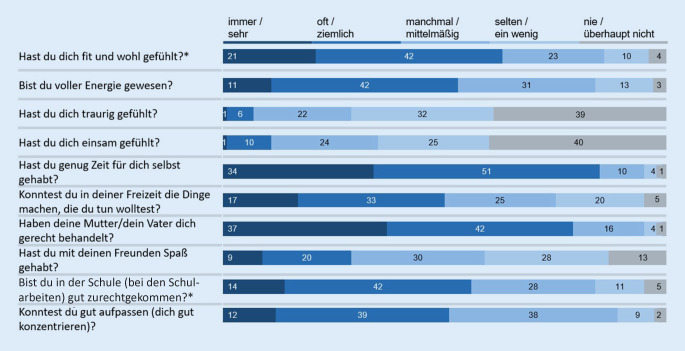
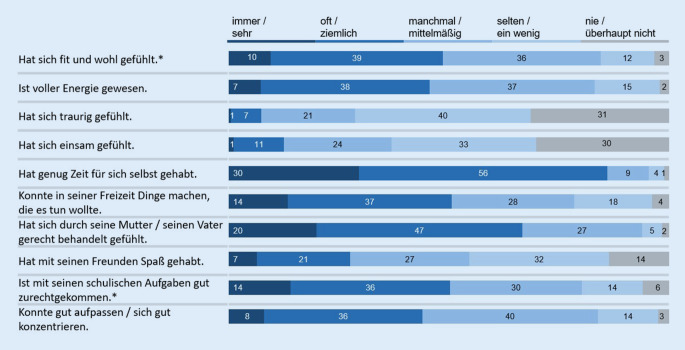
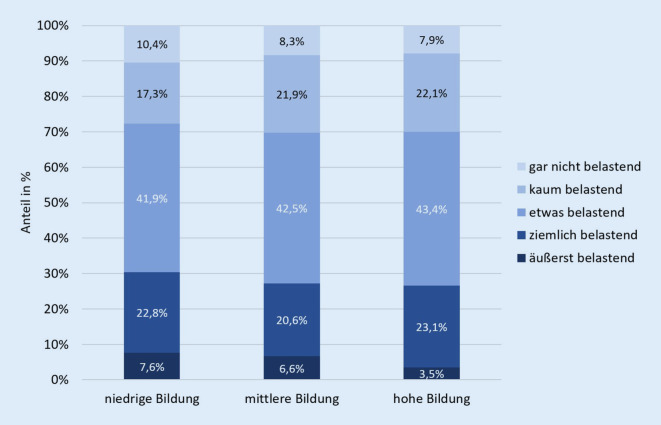
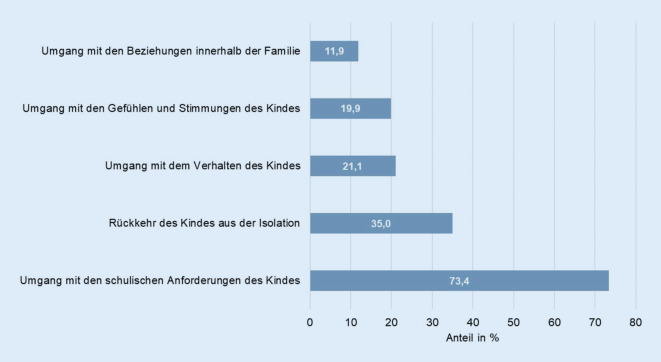
Zusammenfassung: Hintergrund: Die mit der COVID-19-Pandemie einhergehenden Veränderungen und Kontaktbeschränkungen können das psychische Wohlbefinden von Kindern und Jugendlichen beeinflussen. Ziel der Arbeit: COPSY ist die erste deutschlandweite repräsentative Studie, welche die psychische Gesundheit und Lebensqualität von Kindern und Jugendlichen während der Pandemie untersucht. Die Ergebnisse werden mit denen der repräsentativen longitudinalen BELLA-Studie aus der Zeit vor der Pandemie verglichen. Material und Methoden: Vom 26.05. bis zum 10.06.2020 wurden n = 1586 Eltern mit 7‑ bis 17-jährigen Kindern und Jugendlichen, von denen n = 1040 11- bis 17-Jährige auch Selbstangaben machten, befragt. Dabei wurden international etablierte Instrumente zur Erfassung von gesundheitsbezogener Lebensqualität, psychischen Auffälligkeiten, Ängstlichkeit und depressiven Symptomen eingesetzt. Die Daten wurden mittels deskriptiver Statistiken und bivariater Tests ausgewertet. Ergebnisse: 71 % der Kinder und Jugendlichen und 75 % der Eltern fühlten sich durch die erste Welle der Pandemie belastet. Im Vergleich zu der Zeit vor der Pandemie gaben die Kinder und Jugendlichen eine geminderte Lebensqualität an, der Anteil von Kindern und Jugendlichen mit psychischen Auffälligkeiten hat sich in etwa verdoppelt und ihr Gesundheitsverhalten hat sich verschlechtert. Sozial benachteiligte Kinder erlebten die Belastungen durch die Pandemie besonders stark. Zwei Drittel der Eltern wünschten sich Unterstützung im Umgang mit ihrem Kind. Diskussion: Die COVID-19-Pandemie führt zu einer psychischen Gesundheitsgefährdung der Kinder und Jugendlichen, auf die präventiv mit niedrigschwelligen und zielgruppenspezifischen Angeboten in der Schule, in der ärztlichen Praxis und in der Gesellschaft im Sinne des Kinderschutzes reagiert werden sollte.
Overview
The claims and statistics of this paper haven’t been checked yet.
Run the check — free, no account needed. It reads the open-access text and checks the sources it cites.
Integrity signals
Registry
Cites
Statistics
Figures
Verification
Claims the paper makes
The claims and statistics of this paper haven’t been checked yet.
Run the check — free, no account needed. It reads the open-access text and checks the sources it cites.
Claims other papers make about this one
Each is checked against this paper’s own text: does it say what the citing paper says it does?
The source backs part of the claim, not all of it — or backs it for a different population, condition or comparison.
In the citing paper
“Socially restrictive measures, quarantines and lockdowns have been associated with reduced social interaction and increased loneliness that may lead to a rise in mental health problems such as symptoms of depression and anxiety.”
From A Longitudinal Study of Loneliness Before the End of the COVID-19 Pandemic: Trajectories, Predictors, and Impact on Chinese Adolescent Mental Health (2024) · cites this paper as [9]
Experimental — accuracy not yet measuredThe source backs part of the claim, not all of it — or backs it for a different population, condition or comparison.
In the citing paper
“In Germany, the number of mental health problems has demonstrably increased”
From “So That You Can Feel Well”: Perspectives of Students with Social, Emotional and Behavioral Difficulties on Factors that Support School Attendance (2025) · cites this paper as Ravens-Sieberer et al., 2021
Experimental — accuracy not yet measured
Self-check
Percentages, sums and reported differences re-computed from the paper’s own numbers.
The self-check needs the paper’s full text.
Citations
Cites
The Psychological Impact of Quarantine and How to Reduce It: Rapid Review of the Evidence
Brooks, S. K., Webster, R. K., Smith, L. E., Woodland, L., Wessely, S., Greenberg, N., & Rubin, G. J. (2020) · doi:10.2139/ssrn.3532534 · Cited by 16,394
The psychological impact of quarantine and how to reduce it: Rapid review of the evidence
Brooks, S. K., Webster, R. K., Smith, L. E., Woodland, L., Wessely, S., Greenberg, N., & Rubin, G. J. (2020) · The Lancet · doi:10.1016/s0140-6736(20)30460-8 · Cited by 16,378
The Strengths and Difficulties Questionnaire: A research note
Goodman, R. (1997) · Journal of Child Psychology and Psychiatry · doi:10.1111/j.1469-7610.1997.tb01545.x · Cited by 14,908
Cicchetti, D. V. (1994) · Psychological Assessment · doi:10.1037/1040-3590.6.4.284 · Cited by 9,349 · cited 2×
“Cicchetti DV (1994) Guidelines, criteria, and rules of thumbfor evaluatingnormedandstandardized assessment instruments in psychology.”
BackgroundBIRMAHER, B., BRENT, D. A., CHIAPPETTA, L., BRIDGE, J., MONGA, S., & BAUGHER, M. (1999) · Journal of the American Academy of Child & Adolescent Psychiatry · doi:10.1097/00004583-199910000-00011 · Cited by 2,252
Reiss, F. (2013) · Social Science & Medicine · doi:10.1016/j.socscimed.2013.04.026 · Cited by 2,062
Behavioral and emotional disorders in children during the COVID-19 epidemic
Jiao, W. Y., Wang, L. N., Liu, J., Fang, S. F., Jiao, F. Y., Pettoello-Mantovani, M., & Somekh, E. (2020) · The Journal of Pediatrics · doi:10.1016/j.jpeds.2020.03.013 · Cited by 1,468
Zhou, S.-J., Zhang, L.-G., Wang, L.-L., Guo, Z.-C., Wang, J.-Q., Chen, J.-C., Liu, M., Chen, X., & Chen, J.-X. (2020) · European Child & Adolescent Psychiatry · doi:10.1007/s00787-020-01541-4 · Cited by 1,464
Well-being of parents and children during the COVID-19 pandemic: A national survey
Patrick, S. W., Henkhaus, L. E., Zickafoose, J. S., Lovell, K., Halvorson, A., Loch, S., Letterie, M., & Davis, M. M. (2020) · Pediatrics · doi:10.1542/peds.2020-016824 · Cited by 1,200
Impact of the COVID-19 Pandemic on Quality of Life and Mental Health in Children and Adolescents
Ravens‐Sieberer, U., Kaman, A., Erhart, M., Devine, J., Schlack, R., & Otto, C. (2020) · European Child & Adolescent Psychiatry · doi:10.1007/s00787-021-01726-5 · Cited by 1,189
Self-citation
Research works printed but not linked: 7
- Langmeyer A, Guglhör-Rudan A, Naab T et al (2020) Kindsein in Zeiten von Corona. Erste Ergebnisse zum veränderten Alltag und zum Wohlbefinden von Kindern. Deutsches Jugendinstitut, München
- Ravens-Sieberer U, The European KIDSCREEN Group (2006) The KIDSCREEN Questionnaires—Quality of life questionnaires for children and adolescents—Handbook. Pabst Science, Lengerich
- Löwe B, Spitzer R, Zipfel S et al (2002) Gesundheitsfragebogen für Patienten (PHQ-D). Manual-Komplettversion und Kurzform. Autorisierte deutsche Version des “Prime MD Patient Health Questionnaire (PHQ). Pfizer, Heidelberg
- UNICEF (2020) COVID-19: children at heightened risk of abuse, neglect, exploitation and violence amidst intensifying containment measures
- Deutscher Kinderschutzbund (2020) Stellungnahme des Deutschen Kinderschutzbundes Bundesverband e. V. zur „Situation von Kindern und Jugendlichen in der Corona-Krise“
- Bundeszentrale für gesundheitliche Aufklärung (2020) BZgA: Unterstützung für Familien in Corona-Zeiten
- Bundesamt für Bevölkerungsschutz und Katastrophenhilfe (2020) COVID-19: Tipps für Eltern
Cited by
Sorted by citations
Long-COVID in children and adolescents: a systematic review and meta-analyses
Lopez-Leon, S., Wegman-Ostrosky, T., Ayuzo del Valle, N. C., Perelman, C., Sepulveda, R., Rebolledo, P. A., Cuapio, A., & Villapol, S. (2022) · Scientific Reports · doi:10.1038/s41598-022-13495-5 · Cited by 528
Lewalter, D. (2023) · Waxmann Verlag GmbH eBooks · doi:10.31244/9783830998488 · Cited by 188
Śniadach, J., Szymkowiak, S., Osip, P., & Waszkiewicz, N. (2021) · Life · doi:10.3390/life11111188 · Cited by 74
Alt, P., Reim, J., & Walper, S. (2021) · Journal of Research on Adolescence · doi:10.1111/jora.12648 · Cited by 63
Geweniger, A., Barth, M., Haddad, A. D. M., Högl, H., Insan, S., Mund, A., & Langer, T. (2022) · Frontiers in Pediatrics · doi:10.3389/fped.2022.759066 · Cited by 61
Kostev, K., Weber, K., Riedel-Heller, S. G., von Vultée, C., & Bohlken, J. (2021) · European Child & Adolescent Psychiatry · doi:10.1007/s00787-021-01924-1 · Cited by 44
The youth mental health crisis: Quasi-experimental evidence on the role of school closures
Felfe, C., Saurer, J., Schneider, P., Vornberger, J., Erhart, M., Kaman, A., & Ravens‐Sieberer, U. (2023) · Science Advances · doi:10.1126/sciadv.adh4030 · Cited by 45
Self-citationTeachers’ emotional exhaustion and job satisfaction: How much does the school context matter?
Schulze-Hagenest, T., Carstensen, B., Weber, K. E., Jansen, T., Meyer, J., Köller, O., & Klusmann, U. (2023) · Teaching and Teacher Education · doi:10.1016/j.tate.2023.104360 · Cited by 50
Blüher, S., Huizinga, O., Joisten, C., Pflanz, J., Torbahn, G., Wiegand, S., Holzapfel, C., & Hauner, H. (2023) · Obesity Facts · doi:10.1159/000529116 · Cited by 35
Impact of COVID-19 pandemic on families living with autism: An online survey
Isensee, C., Schmid, B., Marschik, P. B., Zhang, D., & Poustka, L. (2022) · Research in Developmental Disabilities · doi:10.1016/j.ridd.2022.104307 · Cited by 41
Impact of the COVID-19 pandemic on young people with and without pre-existing mental health problems
Kleine, R., Galimov, A., Hanewinkel, R., Unger, J. B., Sussman, S. Y., & Hansen, J. (2023) · Scientific Reports · doi:10.1038/s41598-023-32918-5 · Cited by 31
Schlack, R., Neuperd, L., Junker, S., Eicher, S., Hölling, H., Thom, J., Ravens-Sieberer, U., & Beyer, A.-K. (2022) · Robert Koch-Institut · doi:10.25646/10761 · Cited by 30
Self-citationEffects of the COVID-19 Pandemic on Children and Adolescents from the Perspective of Teachers
Senft, B., Liebhauser, A., Tremschnig, I., Ferijanz, E., & Wladika, W. (2022) · Frontiers in Education · doi:10.3389/feduc.2022.808015 · Cited by 25
Next generation Europe: a recovery plan for children, adolescents and their families
Fegert, J. M., Kehoe, L. A., Çetin, F. Ç., Doyle, M., D, S. E. M., Hebebrand, J., Hillegers, M. H. J., Karwautz, A. F. K., Kotsis, K. T., Kiss, E., et al. (2021) · European Child & Adolescent Psychiatry · doi:10.1007/s00787-021-01767-w · Cited by 25
Perez, A., Göbel, A., Stuhrmann, L. Y., Schepanski, S. N., Singer, D., Bindt, C., & Mudra, S. (2022) · Frontiers in Psychology · doi:10.3389/fpsyg.2021.805543 · Cited by 26
Einheitliche Basisversorgung von Kindern und Jugendlichen mit Long COVID
Töpfner, N., (DGPI), D. G. F. P. I. E. V., Alberer, M., Ankermann, T., (GPP), G. F. P. P. E. V., Bender, S., Deutsche Gesellschaft für Kinder- und Jugendpsychiatrie, P. U. P. E. V. (., Berner, R., de Laffolie, J., (GPGE), G. F. P. G. U. E. E. V., et al. (2022) · Monatsschrift Kinderheilkunde · doi:10.1007/s00112-021-01408-1 · Cited by 24
Döpfner, M., Adam, J., Habbel, C., Schulte, B., Schulze-Husmann, K., Simons, M., Heuer, F. H., Wegner, C., Bender, S., TEMPO-Studiengruppe, et al. (2021) · Bundesgesundheitsblatt - Gesundheitsforschung - Gesundheitsschutz · doi:10.1007/s00103-021-03455-1 · Cited by 23
Treier, A., Holas, V., Görtz‐Dorten, A., Frenk, F., Goldbeck, C., Mücke, K., Hanisch, C., Ritschel, A., Roessner, V., Rothe, J., et al. (2022) · European Child & Adolescent Psychiatry · doi:10.1007/s00787-022-02106-3 · Cited by 20
Self-citationEducar en las emociones en tiempos de crisis
Cassà, È. L., & Alzina, R. B. (2024) · RELIEVE - Revista Electrónica de Investigación y Evaluación Educativa · doi:10.30827/relieve.v30i1.30381 · Cited by 19
Schütz, R., & Bilz, L. (2023) · Bundesgesundheitsblatt - Gesundheitsforschung - Gesundheitsschutz · doi:10.1007/s00103-023-03728-x · Cited by 23
Rodney-Wolf, K., & Schmitz, J. (2025) · Frontiers in Public Health · doi:10.3389/fpubh.2025.1480630 · Cited by 19
Renner, I., van Staa, J., Neumann, A., Sinß, F., & Paul, M. (2021) · Bundesgesundheitsblatt - Gesundheitsforschung - Gesundheitsschutz · doi:10.1007/s00103-021-03450-6 · Cited by 18
Jeindl, R., Hofer, V., Bachmann, C., & Zechmeister‐Koss, I. (2023) · Child and Adolescent Psychiatry and Mental Health · doi:10.1186/s13034-023-00683-y · Cited by 17
Warschburger, P., Kamrath, C., Lanzinger, S., Sengler, C., Wiegand, S., Göldel, J. M., Blüher, S., Holl, R. W., & Minden, K. (2023) · BMC Pediatrics · doi:10.1186/s12887-023-03912-7 · Cited by 17
Barbieri, V., Wiedermann, C. J., Piccoliori, G., Mahlknecht, A., Plagg, B., Ausserhofer, D., Ravens‐Sieberer, U., & Engl, A. (2023) · Children · doi:10.3390/children10050895 · Cited by 17
Self-citationReduced Psychosocial Well-Being among the Children of Women with Early-Onset Breast Cancer
Schliemann, A., Teroerde, A., Beurer, B., Hammersen, F., Fischer, D., Katalinic, A., Labohm, L., Strobel, A. M., & Waldmann, A. (2023) · Current Oncology · doi:10.3390/curroncol30120731 · Cited by 16
Pfetsch, J. S., Schultze‐Krumbholz, A., & Lietz, K. (2022) · Frontiers in Psychology · doi:10.3389/fpsyg.2021.787449 · Cited by 20
Schulische Gesundheitsförderung in pandemischen Zeiten. Ergebnisse der COVID-HL-Schulleitungsstudie
Dadaczynski, K., Okan, O., & Messer, M. (2022) · Bundesgesundheitsblatt - Gesundheitsforschung - Gesundheitsschutz · doi:10.1007/s00103-022-03535-w · Cited by 16
Hussong, J., Möhler, E., Kühn, A. L., Wenning, M., Gehrke, T., Burckhart, H., Richter, U., Nonnenmacher, A., Zemlin, M., Lücke, T., et al. (2022) · Children · doi:10.3390/children9060780 · Cited by 16
Hansen, J., Galimov, A., Unger, J. B., Sussman, S. Y., & Hanewinkel, R. (2023) · International Journal of Environmental Research and Public Health · doi:10.3390/ijerph20054478 · Cited by 16
Yang, F., Wei, J., Zhao, X., & An, R. (2025) · JMIR mhealth and uhealth · doi:10.2196/58597 · Cited by 15
Jahrbuch Migration und Gesellschaft 2019/2020
Peterlini, H. K., & Donlic, J. (2020) · Jahrbuch Migration und Gesellschaft · doi:10.14361/9783839444801 · Cited by 14
Poulain, T., Meigen, C., Kieß, W., & Vogel, M. (2022) · JCPP Advances · doi:10.1002/jcv2.12062 · Cited by 14
Bildung und Resilienz. Gutachten
Anders, Y., Hannover, B., Jungbauer-Gans, M., Köller, O., Lenzen, D., McElvany, N., Seidel, T., Tippelt, R., Wilbers, K., & Woessmann, L. (2022) · Waxmann Verlag GmbH eBooks · doi:10.31244/9783830995500 · Cited by 13
Pfeiffer, S., Kircher, A., Schlatt, L., & In‐Albon, T. (2022) · Die Psychotherapie · doi:10.1007/s00278-022-00624-8 · Cited by 14
Enderle, C. (2025) · School Mental Health · doi:10.1007/s12310-025-09764-z · Cited by 12
“In Germany, the number of mental health problems has demonstrably increased (Ravens-Sieberer et al., 2021).”
Naumann, E., von den Driesch, E., Schumann, A., & Thönnissen, C. (2021) · PubMed Central · doi:10.1007/s00103-021-03451-5 · Cited by 12
Winter, K. (2024) · PubMed Central · doi:10.25646/11878 · Cited by 12
Gulde, M., Köhler‐Dauner, F., Mayer, I., Ziegenhain, U., Fegert, J. M., & Buchheim, A. (2022) · Frontiers in Pediatrics · doi:10.3389/fped.2022.939538 · Cited by 11
Rathgeb, C., Schillok, H., Voß, S., Coenen, M., Schulte‐Körne, G., Merkel, C., Eitze, S., Jung‐Sievers, C., & on behalf of the COSMO Study Team (2022) · International Journal of Environmental Research and Public Health · doi:10.3390/ijerph19052698 · Cited by 11
Hüpping, B., Kekeritz, M., & Kubandt, M. (2021) · Ludwigsburger Beiträge zur Medienpädagogik · doi:10.21240/lbzm/21/20 · Cited by 10
Hußner, I., Lazarides, R., & Westphal, A. (2022) · Zeitschrift für Erziehungswissenschaft · doi:10.1007/s11618-022-01072-5 · Cited by 10
Psychische Belastung von Kindern und Jugendlichen in der Coronazeit
Bohl, C., Karnaki, P., Cheli, S., Fornes, G., Tkalić, R. G., Papadopoulos, E., Schaefer, M., & Berth, H. (2022) · Prävention und Gesundheitsförderung · doi:10.1007/s11553-022-00946-0 · Cited by 10
Maldei, T., Opdensteinen, K. D., Hellbach, C., Nowakowski, N., Graßmann, T., Hofer, J., Walther, E., & Hechler, T. (2022) · Kindheit und Entwicklung · doi:10.1026/0942-5403/a000374 · Cited by 10
Kohmäscher, A., Primaßin, A., Heiler, S., Avelar, P. D. C., Franken, M.-C., & Heim, S. (2023) · Journal of Speech, Language, and Hearing Research · doi:10.1044/2023_jslhr-23-00224 · Cited by 9
Schütz, R., Reiß, F., Moor, I., Kaman, A., Bilz, L., & HBSC Study Group Germany (2025) · BMC Public Health · doi:10.1186/s12889-025-23247-5 · Cited by 13
Self-citationRenner, I., Ulrich, S. M., Neumann, A., & Chakraverty, D. (2023) · Bundesgesundheitsblatt - Gesundheitsforschung - Gesundheitsschutz · doi:10.1007/s00103-023-03744-x · Cited by 9
Schillok, H., Coenen, M., Rehfuess, E. A., Kuhlmann, P. H., Matl, S., Kindermann, H., Maison, N., Eckert, J., von Both, U., Behrends, U., et al. (2023) · Frontiers in Pediatrics · doi:10.3389/fped.2023.1135415 · Cited by 9
Kinder- und Jugendsport „nach“ Corona
Neuber, N. (2022) · Forum Kinder- und Jugendsport · doi:10.1007/s43594-022-00057-w · Cited by 8
Exploring adolescent mental health during the COVID-19 crisis – strengths and difficulties
Loy, J. K., Klam, J., Dötsch, J., Frank, J., & Bender, S. (2024) · Frontiers in Public Health · doi:10.3389/fpubh.2024.1357766 · Cited by 8
Kostev, E. A. (2021) · Monitor Versorgungsforschung · doi:10.24945/mvf.04.21.1866-0533.2321 · Cited by 8
Li, H., Liu, J., Wang, Y., Li, Z., Mei, S., Zhang, Z., Fan, L., & Jiang, L. (2025) · Frontiers in Public Health · doi:10.3389/fpubh.2025.1522877 · Cited by 7
Birnkammer, S., & Calvano, C. (2023) · Children · doi:10.3390/children10020207 · Cited by 7
Effekte des Good Behavior Game bei Grundschüler_innen mit externalisierenden Verhaltensproblemen
Hagen, T., Nitz, J., Brack, F., Hövel, D. C., & Hennemann, T. (2023) · Lernen und Lernstörungen · doi:10.1024/2235-0977/a000410 · Cited by 7
»Die Corona-Pandemie hat mir wertvolle Zeit genommen«
Thomas, S. (2023) · Pädagogik · doi:10.1515/9783839462232-009 · Cited by 7
Schmidtke, C., Geene, R., Hölling, H., & Lampert, T. (2021) · PubMed Central · doi:10.25646/8865 · Cited by 7
Self-citation“Who Am I?”: Identity development and psychosocial adjustment in foster adolescents – A brief report
Gabler, S., Festini, J., Herschmann, L., & Spangler, G. (2025) · Developmental Child Welfare · doi:10.1177/25161032251324860 · Cited by 10
Schütz, R., & Bilz, L. (2024) · Journal of Public Health · doi:10.1007/s10389-024-02356-2 · Cited by 6
Robin, D., Albermann, K., & Dratva, J. (2023) · Prävention und Gesundheitsförderung · doi:10.1007/s11553-022-01008-1 · Cited by 6
:null (2022) · Verlag Julius Klinkhardt eBooks · doi:10.35468/5965 · Cited by 6
The Impact of Distance Learning on Parental Stress During the Second COVID-19 Lockdown in Germany
May, I., & Hoerl, L. (2022) · The Family Journal · doi:10.1177/10664807221131011 · Cited by 6
Sorg, A., Kaiser, V., Becht, S., Simon, A., & von Kries, R. (2021) · Klinische Pädiatrie · doi:10.1055/a-1594-2818 · Cited by 6
Dadaczynski, K., Okan, O., Bock, F. D., & Koch, U. (2022) · Bundesgesundheitsblatt - Gesundheitsforschung - Gesundheitsschutz · doi:10.1007/s00103-022-03558-3 · Cited by 6
Rathgeb, C., Pawellek, M., Behrends, U., Alberer, M., Kabesch, M., Gerling, S., Brandstetter, S., & Apfelbacher, C. (2023) · JMIR Research Protocols · doi:10.2196/41010 · Cited by 5
Embitterment during the COVID-19 Pandemic in Reaction to Injustice, Humiliation, and Breach of Trust
Linden, M., Arnold, C. P., & Muschalla, B. (2022) · Psychiatry International · doi:10.3390/psychiatryint3030016 · Cited by 5
Fendt, M. T. C., Hölling, H., Lampert, T., & Waldhauer, J. (2023) · Das Gesundheitswesen · doi:10.1055/a-1916-9664 · Cited by 5
Self-citationDogan, M., Hirschfeld, G. H. F., Blankenburg, M. R., Frühwald, M. C., Ahnert, R., Braun, S., Marschall, U., Zernikow, B., & Wager, J. (2022) · European Journal of Pain · doi:10.1002/ejp.1998 · Cited by 5
Wang, J., Zhang, W., Song, P., Wang, T., Yao, Y., Chen, Y., Lin, H., Yang, X., Chen, X., & Fu, C. (2024) · Psychology Research and Behavior Management · doi:10.2147/prbm.s484113 · Cited by 6
Finkbeiner, M., Kühnhausen, J., Schmid, J., Conzelmann, A., Dürrwächter, U., Wahl, L.-M., Kelava, A., Gawrilow, C., & Renner, T. J. (2022) · Trials · doi:10.1186/s13063-022-06508-1 · Cited by 4
Milewczyk, C. M. K., Holtmann, M., Legenbauer, T., & Derks, L. M. (2025) · Child and Adolescent Psychiatry and Mental Health · doi:10.1186/s13034-025-00899-0 · Cited by 4
Domhan, D., In‐Albon, T., & Pfeiffer, S. (2023) · Die Psychotherapie · doi:10.1007/s00278-023-00679-1 · Cited by 4
Kuitunen‐Paul, S., Schwarzbach, C. P., & Atzendorf, J. (2024) · Suchttherapie · doi:10.1055/a-2244-4254 · Cited by 4
Unterricht und Schulen in der Pandemie: Versuch einer Zwischenbilanz
Immerfall, S. (2021) · Gesellschaft, Wirtschaft, Politik · doi:10.3224/gwp.v70i3.05 · Cited by 4
Der Zusammenhang zwischen den Werten von Grundschulkindern und ihrem Verhalten in der Pandemie
Wiebusch, B., Schlüschen, S. I., Pfeffer, L. S., & Liborius, R. (2022) · Verlag Julius Klinkhardt eBooks · doi:10.35468/5946-15 · Cited by 4
Hmayed, S., & Thyen, U. (2023) · Das Gesundheitswesen · doi:10.1055/a-2183-6934 · Cited by 4
Budde, J., Lengyel, D., Claus, C., Weuster, N., Schroedler, T., Böning, C., Doden, K., & Geßner, J. (2022) · Erziehungswissenschaftliche Edition: Persönlichkeitsbildung in Schule · doi:10.1007/978-3-658-36942-2_2 · Cited by 4
Franz, S., Simon-Kutscher, K., Kunze, S., Bröning, S., Thomasius, R., & Konsortium, I.-M. (2022) · SUCHT - Zeitschrift für Wissenschaft und Praxis / Journal of Addiction Research and Practice · doi:10.1024/0939-5911/a000744 · Cited by 4
Vagedes, J., Michael, K., Sobh, M., Islam, M. O. A., Kuderer, S., Jeske, C., Kaman, A., Martin, D. D., Vagedes, K., Erhart, M., et al. (2023) · International Journal of Environmental Research and Public Health · doi:10.3390/ijerph20064756 · Cited by 3
Self-citationAdolescent sleep and mental health in times of COVID-19
Kater, M., Werner, A., & Lohaus, A. (2024) · Somnologie - Schlafforschung und Schlafmedizin · doi:10.1007/s11818-024-00446-7 · Cited by 3
Hüpping, B., Kubandt, M., & Kekeritz, M. (2022) · Erziehungswissenschaftliche Edition: Persönlichkeitsbildung in Schule · doi:10.1007/978-3-658-36942-2_4 · Cited by 3
Jahn, I., Jelinek, L., Moritz, S., & Stengler, K. (2023) · Psychiatrische Praxis · doi:10.1055/a-1997-9592 · Cited by 3
Rank, A., Büker, P., Miller, S., & Martschinke, S. (2023) · Erziehungswissenschaft · doi:10.3224/ezw.v34i2.02 · Cited by 3
Niendorf, J. (2024) · Zeitschrift für Religion Gesellschaft und Politik · doi:10.1007/s41682-024-00194-3 · Cited by 3
F-Diagnosen bei 0- bis 20-Jährigen in der ambulanten Behandlung im ersten Jahr der COVID-19-Pandemie
Berg, G. (2022) · Nervenheilkunde · doi:10.1055/a-1778-0439 · Cited by 3
Joisten, C. (2022) · Forum Kinder- und Jugendsport · doi:10.1007/s43594-022-00074-9 · Cited by 3
Berufsbildungspolitik: Strukturen - Krise - Perspektiven
:null (2022) · doi:10.3278/9783763972623 · Cited by 4
Gierszewski, D., Kurotschka, P. K., Krauthausen, M., Fröhlich, W., Förster, J., Pietsch, F., Streng, A., Rücker, V., Wallstabe, J., Hartmann, K., et al. (2022) · Frontiers in Medicine · doi:10.3389/fmed.2022.897726 · Cited by 3
Parallel Increase in Childhood Anorexia Nervosa and Early Puberty During the COVID ‐19 Pandemic
Herpertz‐Dahlmann, B., Dempfle, A., Eckardt, S., Neulen, J., & Klump, K. L. (2025) · International Journal of Eating Disorders · doi:10.1002/eat.24556 · Cited by 2
Rothmüller, B. (2021) · psychosozial · doi:10.30820/0171-3434-2021-4-50 · Cited by 2
Drössler, S., Horvath, K., Freiberg, A., Kämpf, D., Spura, A., Buhs, B., & Seidler, A. (2023) · Das Gesundheitswesen · doi:10.1055/a-2075-7814 · Cited by 2
Public Mental Health von Kindern und Jugendlichen – wie ist die Studienlage?
Zöllner, F., Devine, J., Kaman, A., Reiß, F., & Ravens‐Sieberer, U. (2023) · Public Health Forum · doi:10.1515/pubhef-2023-0037 · Cited by 2
Self-citationJuncal‐Ruíz, M., Ruiz-Torres, M., Diego-Falagán, N., Batz-Colvée, C., Becerril-Ruiz, T., Samaniego-Peña, S., García-Rumayor, E., Onandia‐Hinchado, I., Gutiérrez-Pérez, A. M., Ayesa‐Arriola, R., et al. (2023) · Revista de Psiquiatría Infanto-Juvenil · doi:10.31766/revpsij.v40n4a4 · Cited by 2
Sobotka, M., Kern, T., Haider, K., Dale, R., Wöhrer, V., Pieh, C., Probst, T., Humer, E. C., & Jesser, A. (2024) · Frontiers in Public Health · doi:10.3389/fpubh.2024.1327999 · Cited by 2
Psychische Krisen bei Kindern und Jugendlichen
Frey, M. (2021) · Nervenheilkunde · doi:10.1055/a-1524-8628 · Cited by 2
Mental Health Literacy bei Lehrkräften
Kirchhoff, S., Freţian, A. M., & Bruland, D. (2023) · Springer Reference Pflege, Therapie, Gesundheit · doi:10.1007/978-3-662-67055-2_71 · Cited by 2
Lindemann, L., Volkmann, T., & Jochems, N. (2023) · Mensch und Computer (MuC) · doi:10.1145/3603555.3608545 · Cited by 2
Klassistische Diskriminierung von Armen und sozial Ausgegrenzten
Chassé, K. A. (2023) · Springer eBooks · doi:10.1007/978-3-658-42800-6_25 · Cited by 2
Karch, J., & Kast, K. (2024) · Zeitschrift für Evidenz Fortbildung und Qualität im Gesundheitswesen · doi:10.1016/j.zefq.2024.03.001 · Cited by 2
Ansiedade e depressão em adolescentes em meio à pandemia
Fernandes, I. M., Estanislau, L. M., Guerra, I. C. C., Romão, I. C., & Dantas, R. A. E. (2024) · Revista Eletrônica Acervo Médico · doi:10.25248/reamed.e15468.2024 · Cited by 2
Scheffler, A., Klocker, L., Puls, A., Hummers, E., & Demmer, I. (2024) · Bundesgesundheitsblatt - Gesundheitsforschung - Gesundheitsschutz · doi:10.1007/s00103-024-03935-0 · Cited by 2
Metadata
- Authors
- Ravens-Sieberer, U., Kaman, A., Otto, C., Adedeji, A., Napp, A.-K., Becker, M., Blanck-Stellmacher, U., Löffler, C., Schlack, R., Hölling, H., Devine, J., Erhart, M., & Hurrelmann, K.
- Affiliations
- University Medical Center Hamburg-Eppendorf (DE)
- Robert Koch Institute (DE)
- Alice-Salomon-Hochschule Berlin (DE)
- Hertie School (DE)
- ORCID
- Venue
- Bundesgesundheitsblatt - Gesundheitsforschung - Gesundheitsschutz
- Published
- 2021-03-01
- Volume
- 64
- Issue
- 12
- Pages
- 1512-1521
- ISSN
- 0007-5914 (ISSN-L)
- 1436-9990
- 1437-1588
- PMC
- PMC7920639
- OpenAlex
- W3135225560
- Cited by
- 227
- References
- 44
- Citations by year
- 2026: 15 · 2025: 25 · 2024: 33 · 2023: 58 · 2022: 69 · 2021: 25
- FWCI
- 31.53
- Type
- journal article
- Language
- de
- Open access
- hybrid
- doi.org
- Locations
- Bundesgesundheitsblatt - Gesundheitsforschung - Gesundheitsschutz (publishedVersion, cc-by)
- PubMed Central (publishedVersion, cc-by)
- PubMed (publishedVersion)
- Informationszentrum Lebenswissenschaften (ZB MED) (submittedVersion, cc-by)
- Publication server of the Robert Koch Institute (Robert Kock Institute) (submittedVersion, cc-by)
- Social Science Open Access Repository (GESIS – Leibniz Institute for the Social Sciences) (submittedVersion, cc-by)
- OPUS 4 (Zuse Institute Berlin) (submittedVersion)
- Funders
- Universitätsklinikum Hamburg-Eppendorf (UKE)
- Topics
- Social Sciences › Psychology › Clinical Psychology › COVID-19 and Mental Health
- Social Sciences › Psychology › Clinical Psychology › Child and Adolescent Psychosocial and Emotional Development
- Health Sciences › Medicine › Public Health, Environmental and Occupational Health › Maternal Mental Health During Pregnancy and Postpartum
- Keywords
- COVID-19 pandemic, children and adolescents, mental health, psychological distress, anxiety symptoms, depressive symptoms, health-related quality of life, health behavior, parental burden, social deprivation, parental support needs, mental health promotion
- MeSH terms
- COVID-19, SARS-CoV-2, Adolescent, Child, Germany, Humans, Mental Health, Quality of Life, Pandemics
About these checks
Registry, retraction, Cites and statistics results are computed, not judged, with one exception: a printed reference that no index lists is read once by a model before it counts as a citation error. Claims are extracted by a model and kept only when their quote appears verbatim in the text; each cited source is then checked, with a model’s help, for whether it says what the claim relies on. Those verdicts can be wrong — read the claim’s quote and the cited source before relying on one.
Statistics and arithmetic are recomputed, not judged.
Confidence bands are shown only for fields calibrated on our annotated test set. None is calibrated yet, so no band is shown.
What counts as a claim ›How we measure confidence ›How we check this ›
Are you an author, or do you see a problem with this page? Request a review
