

The DOI matches its Crossref record; 31 of the 31 references it cites were found in a registry or an index.
Associations of total amount and patterns of sedentary behaviour with type 2 diabetes and the metabolic syndrome: The Maastricht Study
Open accessAbstract
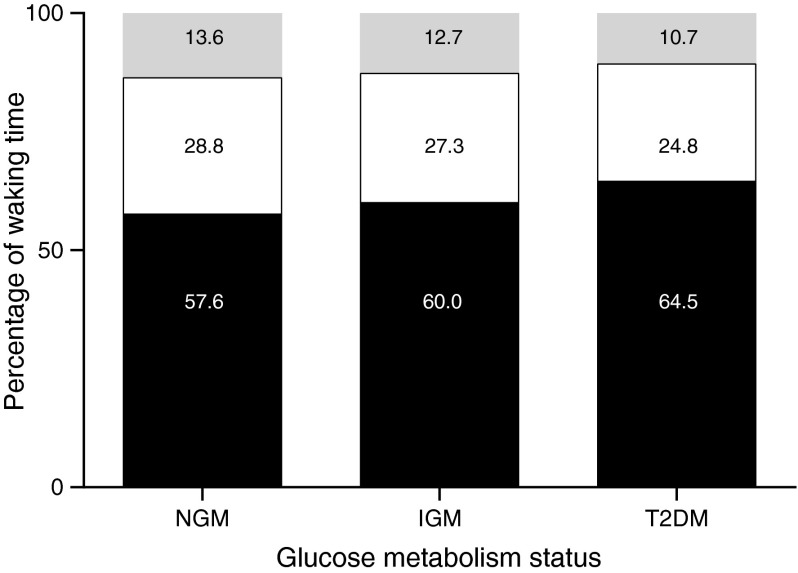
AIMS/HYPOTHESIS: The study investigated cross-sectional associations of total amount and patterns of sedentary behaviour with glucose metabolism status and the metabolic syndrome. METHODS: We included 2,497 participants (mean age 60.0 ± 8.1 years, 52% men) from The Maastricht Study who were asked to wear an activPAL accelerometer 24 h/day for 8 consecutive days. We calculated the daily amount of sedentary time, daily number of sedentary breaks and prolonged sedentary bouts (≥30 min), and the average duration of the sedentary bouts. To determine glucose metabolism status, participants underwent an oral glucose tolerance test. Associations of sedentary behaviour variables with glucose metabolism status and the metabolic syndrome were examined using multinomial logistic regression analyses. RESULTS: Overall, 1,395 (55.9%) participants had normal glucose metabolism, 388 (15.5%) had impaired glucose metabolism and 714 (28.6%) had type 2 diabetes. The odds ratio per additional hour of sedentary time was 1.22 (95% CI 1.13, 1.32) for type 2 diabetes and 1.39 (1.27, 1.53) for the metabolic syndrome. No significant or only weak associations were seen for the number of sedentary breaks, number of prolonged sedentary bouts or average bout duration with either glucose metabolism status or the metabolic syndrome. CONCLUSIONS/INTERPRETATION: An extra hour of sedentary time was associated with a 22% increased odds for type 2 diabetes and a 39% increased odds for the metabolic syndrome. The pattern in which sedentary time was accumulated was weakly associated with the presence of the metabolic syndrome. These results suggest that sedentary behaviour may play a significant role in the development and prevention of type 2 diabetes, although longitudinal studies are needed to confirm our findings.
Overview
The claims and statistics of this paper haven’t been checked yet.
Run the check — free, no account needed. It reads the open-access text and checks the sources it cites.
Integrity signals
Registry
Cites
Statistics
Figures
Verification
Claims the paper makes
The claims and statistics of this paper haven’t been checked yet.
Run the check — free, no account needed. It reads the open-access text and checks the sources it cites.
Claims other papers make about this one
Each is checked against this paper’s own text: does it say what the citing paper says it does?
The source backs part of the claim, not all of it — or backs it for a different population, condition or comparison.
In the citing paper
“It has been shown that sedentary behaviour is a risk factor for cardiometabilic health and all-cause mortality, indepently of the amount of physical activity [86, 87].”
From Can consumer wearable activity tracker-based interventions improve physical activity and cardiometabolic health in patients with chronic diseases? A systematic review and meta-analysis of randomised controlled trials (2020) · cites this paper as [87]
Experimental — accuracy not yet measured
Self-check
Percentages, sums and reported differences re-computed from the paper’s own numbers.
The self-check needs the paper’s full text.
Citations
Cites
Wild, S., Roglic, G., Green, A., Sicree, R., & King, H. (2004) · Diabetes Care · doi:10.2337/diacare.27.5.1047 · Cited by 15,297
Alberti, K. G. M. M., Eckel, R. H., Grundy, S. M., Zimmet, P. Z., Cleeman, J. I., Donato, K. A., Fruchart, J.-C., James, W. P. T., Loria, C. M., & Smith, S. C. (2009) · Circulation · doi:10.1161/circulationaha.109.192644 · Cited by 14,860
Standards of Medical Care in Diabetes
Power, D. V. (2006) · Diabetes Care · doi:10.2337/diacare.29.02.06.dc05-1593 · Cited by 8,676
Standards of medical care in diabetes—2014
American Diabetes Association (2014) · Diabetes Care · doi:10.2337/dc14-s014 · Cited by 4,572
Letter to the Editor: Standardized use of the terms “sedentary” and “sedentary behaviours”
Networ, S. B. R. (2012) · Applied Physiology, Nutrition, and Metabolism · doi:10.1139/h2012-024 · Cited by 1,873
Wilmot, E. G., Edwardson, C. L., Achana, F. A., Davies, M. J., Gorely, T., Gray, L. J., Khunti, K., Yates, T., & Biddle, S. J. H. (2012) · Diabetologia · doi:10.1007/s00125-012-2677-z · Cited by 1,789
Hamilton, M. T., Hamilton, D. G., & Zderic, T. W. (2007) · Diabetes · doi:10.2337/db07-0882 · Cited by 1,655
Healy, G. N., Dunstan, D. W., Salmon, J., Cerin, E., Shaw, J. E., Zimmet, P. Z., & Owen, N. (2008) · Diabetes Care · doi:10.2337/dc07-2046 · Cited by 1,465
Sedentary time and cardio-metabolic biomarkers in US adults: NHANES 2003–06
Healy, G. N., Matthews, C. E., Dunstan, D. W., Winkler, E. A. H., & Owen, N. (2011) · European Heart Journal · doi:10.1093/eurheartj/ehq451 · Cited by 1,368
Objectively Measured Sedentary Time, Physical Activity, and Metabolic Risk
Healy, G. N., Wijndaele, K., Dunstan, D. W., Shaw, J. E., Salmon, J., Zimmet, P. Z., & Owen, N. (2008) · Diabetes Care · doi:10.2337/dc07-1795 · Cited by 1,100
Global guideline for type 2 diabetes
(2014) · Diabetes Research and Clinical Practice · doi:10.1016/j.diabres.2012.10.001 · Cited by 1,064
Validation of Wearable Monitors for Assessing Sedentary Behavior
Keadle, S. K., Libertine, A., Lyden, K. A., STAUDENMAYER, J. W., & Freedson, P. S. (2011) · Medicine & Science in Sports & Exercise · doi:10.1249/mss.0b013e31820ce174 · Cited by 951
Sedentary Activity Associated With Metabolic Syndrome Independent of Physical Activity
Bankoski, A., Harris, T. B., McClain, J. J., Brychta, R. J., Caserotti, P., Chen, K. Y., Berrigan, D., Troiano, R. P., & Koster, A. (2011) · Diabetes Care · doi:10.2337/dc10-0987 · Cited by 535
Self-citationSchram, M. T., Sep, S. J. S., Kallen, C., Dagnelie, P. C., Koster, A., Schaper, N. C., Henry, R. M. A., & Stehouwer, C. D. A. (2014) · European Journal of Epidemiology · doi:10.1007/s10654-014-9889-0 · Cited by 457
Self-citationHenson, J., Yates, T., Biddle, S. J. H., Edwardson, C. L., Khunti, K., Wilmot, E. G., Gray, L. J., Gorely, T., Nimmo, M. A., & Davies, M. J. (2013) · Diabetologia · doi:10.1007/s00125-013-2845-9 · Cited by 337
Methods for objective measure, quantification and analysis of sedentary behaviour and inactivity
Chastin, S. F. M., & Granat, M. H. (2010) · Gait & Posture · doi:10.1016/j.gaitpost.2009.09.002 · Cited by 323
The Effects of Breaking up Prolonged Sitting Time
Benatti, F. B., & Ried‐Larsen, M. (2015) · Medicine & Science in Sports & Exercise · doi:10.1249/mss.0000000000000654 · Cited by 312
Sedentary Behavior, Physical Activity, and Markers of Health in Older Adults
GENNUSO, K. P., GANGNON, R. E., MATTHEWS, C. E., THRAEN-BOROWSKI, K. M., & COLBERT, L. H. (2013) · Medicine & Science in Sports & Exercise · doi:10.1249/mss.0b013e318288a1e5 · Cited by 292
Accelerometer-measured sedentary time and cardiometabolic biomarkers: A systematic review
Brocklebank, L. A., Falconer, C., Page, A. S., Perry, R. A., & Cooper, A. R. (2015) · Preventive Medicine · doi:10.1016/j.ypmed.2015.04.013 · Cited by 245
Using Cadence to Study Free-Living Ambulatory Behaviour
Tudor-Locke, C., & Rowe, D. A. (2012) · Sports Medicine · doi:10.2165/11599170-000000000-00000 · Cited by 231
Tudor-Locke, C. E., Barreira, T. V., Schuna, J. M., Mire, E. F., Chaput, J., Fogelholm, M., Hu, G., Kuriyan, R., Kurpad, A. V., Lambert, E. V., et al. (2015) · International Journal of Behavioral Nutrition and Physical Activity · doi:10.1186/s12966-015-0172-x · Cited by 208
Godfrey, A., Culhane, K. M., & Lyons, G. M. (2006) · Medical Engineering & Physics · doi:10.1016/j.medengphy.2006.10.001 · Cited by 200
Cooper, A. R., Sebire, S., Montgomery, A. A., Peters, T. J., Sharp, D. J., Jackson, N., Fitzsimons, K., Dayan, C. M., & Andrews, R. C. (2012) · Diabetologia · doi:10.1007/s00125-011-2408-x · Cited by 195 · cited 5×
“Furthermore, large amounts of objectively measured sedentary time have been associated with (markers of) insulin resistance [5, 6, 10] and, as mentioned earlier, the metabolic syndrome.”
BackgroundInfluentialSedentary behavior as a mediator of type 2 diabetes
Hamilton, M. T., Hamilton, D. G., & Zderic, T. W. (2014) · Medicine and Sport Science · doi:10.1159/000357332 · Cited by 185
Healy, G. N., Winkler, E. A. H., Brakenridge, C. L., Reeves, M. M., & Eakin, E. G. (2015) · PLoS ONE · doi:10.1371/journal.pone.0119140 · Cited by 123
Cooper, A., Brage, S., Ekelund, U., Wareham, N. J., Griffin, S. J., & Simmons, R. K. (2013) · Diabetologia · doi:10.1007/s00125-013-3069-8 · Cited by 118
Identifying waking time in 24-h accelerometry data in adults using an automated algorithm
van der Berg, J. D., Willems, P. J. B., van der Velde, J. H. P. M., Savelberg, H. H. C. M., Schaper, N. C., Schram, M. T., Sep, S. J. S., Dagnelie, P. C., Bosma, H., Stehouwer, C. D. A., et al. (2016) · Journal of Sports Sciences · doi:10.1080/02640414.2016.1140908 · Cited by 112
Self-citationGibbs, B. B., Gabriel, K. P., Reis, J. P., Jakicic, J. M., Carnethon, M. R., & Sternfeld, B. (2015) · Diabetes Care · doi:10.2337/dc15-0226 · Cited by 85
Wijndaele, K., Orrow, G., Ekelund, U., Sharp, S. J., Brage, S., Griffin, S. J., & Simmons, R. K. (2013) · Diabetologia · doi:10.1007/s00125-013-3102-y · Cited by 78
Gennuso, K. P., Gangnon, R. E., Thraen-Borowski, K. M., & Colbert, L. H. (2014) · Diabetologia · doi:10.1007/s00125-014-3453-z · Cited by 72
Lahjibi, E., Heude, B., Dekker, J. M., Højlund, K., Laville, M., Nolan, J. J., Oppert, J., & Balkau, B. (2013) · Diabetes & Metabolism · doi:10.1016/j.diabet.2012.12.006 · Cited by 43
Research works printed but not linked: 1
- World Health Organization/International Diabetes Federation (2006) Definition and diagnosis of diabetes mellitus and intermediate hyperglycemia. World Health Organization, Geneva
Cited by
Sorted by citations
KANALEY, J. A., COLBERG, S. R., CORCORAN, M. H., MALIN, S. K., RODRIGUEZ, N. R., CRESPO, C. J., KIRWAN, J. P., & ZIERATH, J. R. (2022) · Medicine & Science in Sports & Exercise · doi:10.1249/mss.0000000000002800 · Cited by 931
Role of Inactivity in Chronic Diseases: Evolutionary Insight and Pathophysiological Mechanisms
Booth, F. W., Roberts, C. K., Thyfault, J. P., Ruegsegger, G. N., & Toedebusch, R. G. (2017) · Physiological Reviews · doi:10.1152/physrev.00019.2016 · Cited by 696
Exercise Promotes Healthy Aging of Skeletal Muscle
Cartee, G. D., Hepple, R. T., Bamman, M. M., & Zierath, J. R. (2016) · Cell Metabolism · doi:10.1016/j.cmet.2016.05.007 · Cited by 483
Transcriptomic profiling of skeletal muscle adaptations to exercise and inactivity
Pillon, N. J., Gabriel, B. M., Dollet, L., Smith, J. A. B., Sardón Puig, L., Botella, J., Bishop, D. J., Krook, A., & Zierath, J. R. (2020) · Nature Communications · doi:10.1038/s41467-019-13869-w · Cited by 457
Physiology of sedentary behavior
Pinto, A. J., Bergouignan, A., Dempsey, P. C., Roschel, H., Owen, N. G., Gualano, B., & Dunstan, D. W. (2023) · Physiological Reviews · doi:10.1152/physrev.00022.2022 · Cited by 442
Metadata
- Authors
- van der Berg, J. D., Stehouwer, C. D. A., Bosma, H., van der Velde, J. H. P. M., Willems, P. J. B., Savelberg, H. H. C. M., Schram, M. T., Sep, S. J. S., van der Kallen, C. J. H., Henry, R. M. A., Dagnelie, P. C., Schaper, N. C., & Koster, A.
- Affiliations
- Maastricht University Medical Centre (NL)
- Maastricht University (NL)
- ORCID
- Venue
- Diabetologia
- Published
- 2016-02-02
- Volume
- 59
- Issue
- 4
- Pages
- 709-718
- ISSN
- 0012-186X (ISSN-L)
- 1432-0428
- PMC
- PMC4779127
- OpenAlex
- W2259694028
- Cited by
- 299
- References
- 31
- Citations by year
- 2026: 16 · 2025: 23 · 2024: 23 · 2023: 24 · 2022: 42 · 2021: 36 · 2020: 39 · 2019: 24 · 2018: 31 · 2017: 23 · 2016: 17
- FWCI
- 25.46
- Type
- journal article
- Language
- en
- Open access
- hybrid
- doi.org
- Locations
- Diabetologia (publishedVersion, cc-by)
- Europe PMC (PubMed Central) (publishedVersion, cc-by)
- PubMed Central (publishedVersion, cc-by)
- PubMed (publishedVersion)
- Research Publications (Maastricht University) (publishedVersion, cc-by)
- Research Publications (Maastricht University) (submittedVersion, other-oa)
- Funders
- the Province of Limburg
- European Regional Development Fund via OP-Zuid
- the Pearl String Initiative Diabetes (Amsterdam, the Netherlands)
- Stichting De Weijerhorst (Maastricht, the Netherlands)
- the Dutch Ministry of Economic Affairs (31O.041)
- European Union Seventh Framework Programme (PCIG09-GA-2011-293621)
- Novo Nordisk Farma B.V. (Alphen aan den Rijn, the Netherlands)
- Sanofi-Aventis Netherlands B.V. (Gouda, the Netherlands)
- Cardiovascular Research Institute Maastricht (CARIM, Maastricht, the Netherlands)
- School for Public Health and Primary Care (CAPHRI, Maastricht, the Netherlands)
- the Cardiovascular Center (CVC, Maastricht, the Netherlands)
- Health Foundation Limburg (Maastricht, the Netherlands)
- Janssen-Cilag B.V. (Tilburg, the Netherlands)
- School for Nutrition and Translational Research in Metabolism (NUTRIM, Maastricht, the Netherlands)
- Stichting Annadal (Maastricht, the Netherlands)
- Topics
- Health Sciences › Medicine › Public Health, Environmental and Occupational Health › Physical Activity and Health
- Health Sciences › Medicine › Endocrinology, Diabetes and Metabolism › Diabetes, Cardiovascular Risks, and Lipoproteins
- Health Sciences › Medicine › Endocrinology, Diabetes and Metabolism › Diabetes Management and Research
- Keywords
- sedentary behavior, type 2 diabetes, metabolic syndrome, glucose metabolism, sedentary breaks, prolonged sedentary bouts, accelerometer-measured sedentary time, Maastricht Study
- MeSH terms
- Aged, Cross-Sectional Studies, Diabetes Mellitus, Type 2, Female, Humans, Male, Middle Aged, Risk Factors, Metabolic Syndrome, Sedentary Behavior
About these checks
Registry, retraction, Cites and statistics results are computed, not judged, with one exception: a printed reference that no index lists is read once by a model before it counts as a citation error. Claims are extracted by a model and kept only when their quote appears verbatim in the text; each cited source is then checked, with a model’s help, for whether it says what the claim relies on. Those verdicts can be wrong — read the claim’s quote and the cited source before relying on one.
Statistics and arithmetic are recomputed, not judged.
Confidence bands are shown only for fields calibrated on our annotated test set. None is calibrated yet, so no band is shown.
What counts as a claim ›How we measure confidence ›How we check this ›
Are you an author, or do you see a problem with this page? Request a review
