

Fibre supplementation for the prevention of type 2 diabetes and improvement of glucose metabolism: the randomised controlled Optimal Fibre Trial (OptiFiT)
Open accessThe DOI matches its Crossref record; 31 of the 31 references it cites were found in a registry or an index.
Abstract
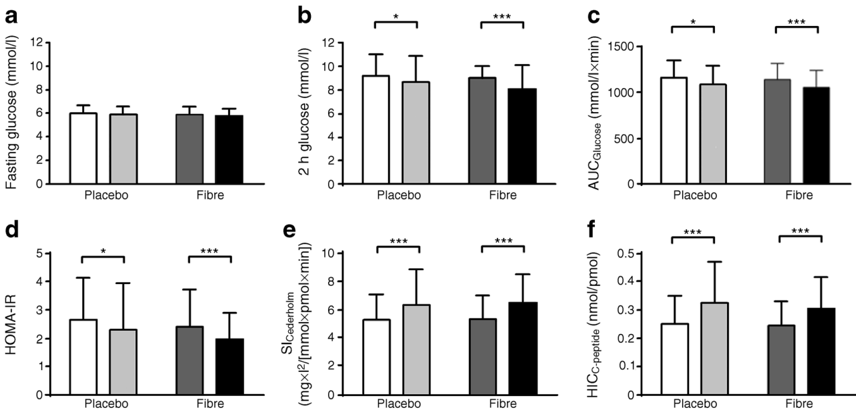
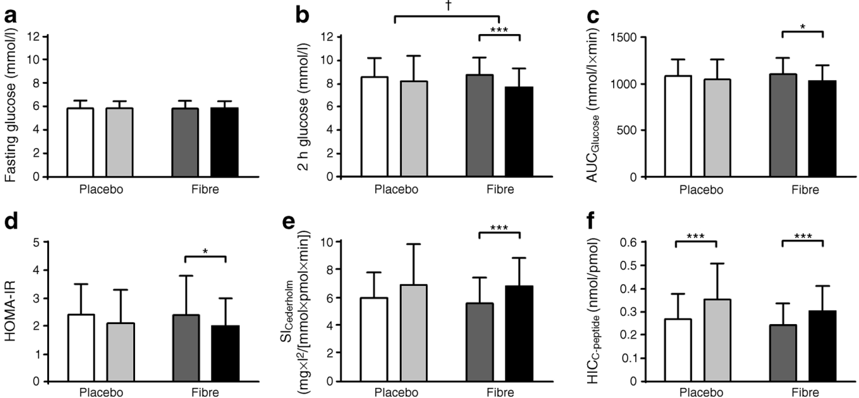
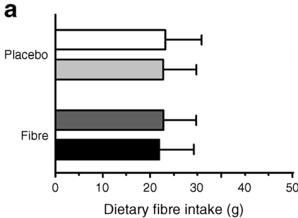
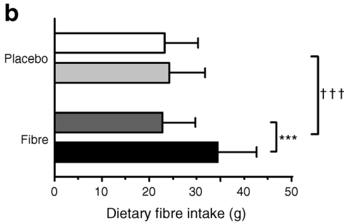
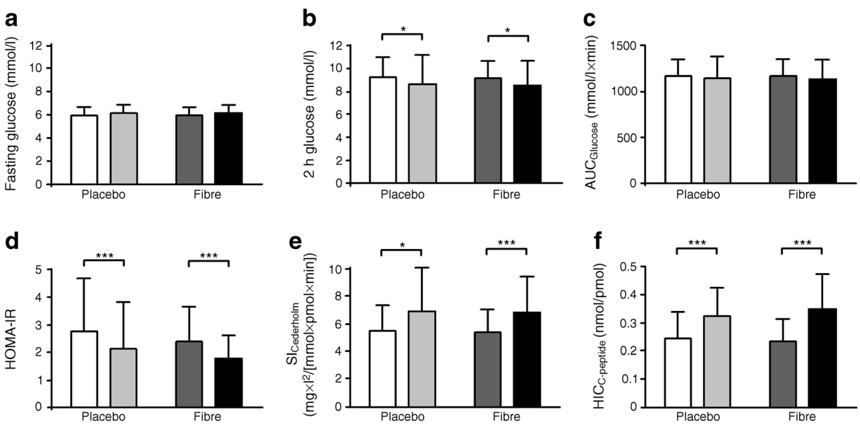
AIMS/HYPOTHESIS: Insoluble cereal fibres have been shown in large prospective cohort studies to be highly effective in preventing type 2 diabetes, but there is a lack of interventional data. Our 2 year randomised double-blind prospective intervention study compared the effect of an insoluble oat fibre extract with that of placebo on glucose metabolism and incidence of diabetes. METHODS: A total of 180 participants with impaired glucose tolerance underwent a modified version of the 1 year lifestyle training programme PREvention of DIAbetes Self-management (PREDIAS) and were randomised to receive a fibre supplement (n = 89; 7.5 g of insoluble fibre per serving) or placebo (n = 91; 0.8 g of insoluble fibre per serving) twice daily for 2 years. Eligible participants were men and women, were at least 18 years old and did not report corticosteroid or other intensive anti-inflammatory treatment, fibre intolerance or any of the following disorders: overt diabetes, chronic or malignant disease, or severe cardiopulmonary, endocrine, psychiatric, gastrointestinal, autoimmune or eating disorder. Participants were recruited at two clinical wards in Berlin and Nuthetal. The allocation was blinded to participants and study caregivers (physicians, dietitians, study nurses). Randomisation was conducted by non-clinical staff, providing neutrally numbered supplement tins. Both supplements were similar in their visual, olfactory and gustatory appearance. Intention-to-treat analysis was applied to all individuals. RESULTS: level was significantly different between the two groups (-0.2 ± 4.6 mmol/mol [-0.0 ± 0.0%; not significant] vs +1.2 ± 5.2 mmol/mol [+0.1 ± 0.0%; not significant]; total difference 1.4 ± 0.7 mmol/mol [0.1 + 0.0%]); p = 0.018); insulin sensitivity and hepatic insulin clearance increased in both groups. After 2 years, improved insulin sensitivity was still present in both groups, although the effect size had diminished. Separate analysis of the sexes revealed a significantly greater reduction in 2 h glucose levels for women in the fibre group (-0.88 ± 1.59 mmol/l [p ≤ 0.001] vs -0.22 ± 1.52 mmol/l [p = 0.311]; total difference 0.67 ± 0.31 mmol/l; p = 0.015). Levels of fasting glucose, adipokines and inflammatory markers remained unchanged in the two groups. Significantly increased fibre intake was restricted to the fibre group, despite dietary counselling for both groups. No severe side effects occurred. CONCLUSIONS/INTERPRETATION: We cannot currently provide strong evidence for a beneficial effect of insoluble cereal fibre on glycaemic metabolism, although further studies may support minor effects of fibre supplementation in reducing glucose levels, insulin resistance and the incidence of type 2 diabetes. TRIAL REGISTRATION: clinicaltrials.gov NCT01681173 Funding: German Diabetes Foundation (grant no. 232/11/08).
Overview
The claims and statistics of this paper haven’t been checked yet.
Free: it reads the open-access text and checks the first 5 claims that cite a source we can check. Create a free account to check every claim.
Integrity signals
Registry
Cites
Statistics
Figures
Verification
Claims the paper makes
The claims and statistics of this paper haven’t been checked yet.
Free: it reads the open-access text and checks the first 5 claims that cite a source we can check. Create a free account to check every claim.
Claims other papers make about this one
Each is checked against this paper’s own text: does it say what the citing paper says it does?
The cited source says what the claim attributes to it.
In the citing paper
“There is much evidence in the literature to support an association between dietary fibre intake and insulin sensitivity [30,31,32,33,34,35].”
From The Health Benefits of Dietary Fibre (2020) · cites this paper as [32]
Experimental — accuracy not yet measuredThe check wasn’t confident either way, so it gives no verdict — never disputed.
In the citing paper
“A large number of cohort studies and epidemiological data demonstrate that vegetarian and vegan diets confer metabolic benefits and are associated with a lower risk of developing T2D.820,829–833”
From American Association of Clinical Endocrinology Clinical Practice Guideline: Developing a Diabetes Mellitus Comprehensive Care Plan-2022 Update. (2022) · cites this paper as [833]
Experimental — accuracy not yet measuredThe check wasn’t confident either way, so it gives no verdict — never disputed.
In the citing paper
“Vegetarian and vegan diets are associated with lower risk of DM, and, in persons with DM, these diets have been shown to lower glycemia and improve CVD risk factors.831,833,931,716–720,833,932”
From American Association of Clinical Endocrinology Clinical Practice Guideline: Developing a Diabetes Mellitus Comprehensive Care Plan-2022 Update. (2022) · cites this paper as [833]
Experimental — accuracy not yet measured
Self-check
Percentages, sums and reported differences re-computed from the paper’s own numbers.
The self-check needs the paper’s full text.
Citations
Cites
Matthews, D. R., Hosker, J. P., Rudenski, A. S., Naylor, B. A., Treacher, D. F., & Turner, R. C. (1985) · Diabetologia · doi:10.1007/bf00280883 · Cited by 31,502
Toprak, O., Kurt, H., Sarı, Y., Şarkış, C., Us, H., & Kırık, A. (2017) · Kidney and Blood Pressure Research · doi:10.1159/000468530 · Cited by 29,627
Reduction in the incidence of type 2 diabetes with lifestyle intervention or metformin
(2002) · New England Journal of Medicine · doi:10.1056/nejmoa012512 · Cited by 19,011 · cited 5×
“The effectiveness of preventing type 2 diabetes mellitus by moderate alterations in lifestyle has been proven in two previous trials [1, 2].”
BackgroundMethodResultInfluentialTuomilehto, J., Lindström, J., Eriksson, J. G., Valle, T. T., Hämäläinen, H., Ilanne-Parikka, P., Keinänen-Kiukaanniemi, S., Laakso, M., Louheranta, A., Rastas, M., et al. (2001) · New England Journal of Medicine · doi:10.1056/nejm200105033441801 · Cited by 10,873 · cited 5×
“The effectiveness of preventing type 2 diabetes mellitus by moderate alterations in lifestyle has been proven in two previous trials [1, 2].”
BackgroundResultInfluentialPan, X.-R., Li, G.-W., Hu, Y.-H., Wang, J.-X., Yang, W.-Y., An, Z.-X., Hu, Z.-X., Juan-Lin, Xiao, J.-Z., Cao, H.-B., et al. (1997) · Diabetes Care · doi:10.2337/diacare.20.4.537 · Cited by 4,320
Katz, A., Nambi, S. S., Mather, K., Baron, A. D., Follmann, D. A., Sullivan, G., & Quon, M. J. (2000) · The Journal of Clinical Endocrinology & Metabolism · doi:10.1210/jcem.85.7.6661 · Cited by 3,931 · cited 1×
“Insulin resistance was estimated by calculating the following fasting indices: HOMA-IR [22], QUICKI [23] and insulin sensitivity index of blood NEFA [24].”
MethodRamachandran, A., Snehalatha, C., Mary, S., Mukesh, B., Bhaskar, A. D., Vijay, V., & Indian Diabetes Prevention Programme (IDPP) (2006) · Diabetologia · doi:10.1007/s00125-005-0097-z · Cited by 1,881
Lindström, J., Ilanne-Parikka, P., Peltonen, M., Aunola, S., Eriksson, J. G., Hemiö, K., Hämäläinen, H., Härkönen, P., Keinänen-Kiukaanniemi, S., Laakso, M., et al. (2006) · The Lancet · doi:10.1016/s0140-6736(06)69701-8 · Cited by 1,799 · cited 1×
“Their counselling programmes were usually successful only with regard to weight loss and physical activity, whereas goals for fibre intake were achieved by as little as 25% of participants [2, 15, 28].”
BackgroundPrevention and management of type 2 diabetes: dietary components and nutritional strategies
Ley, S. H., Hamdy, O., Mohan, V., & Hu, F. B. (2014) · The Lancet · doi:10.1016/s0140-6736(14)60613-9 · Cited by 1,301 · cited 2×
“Additionally, large epidemiological studies have identified dietary fibre as one of the most effective nutrient components for diabetes prevention [3].”
Backgroundde Munter, J. S. L., Hu, F. B., Spiegelman, D., Franz, M., & van Dam, R. M. (2007) · PLoS Medicine · doi:10.1371/journal.pmed.0040261 · Cited by 734 · cited 3×
“studies to be associated with a decreased risk of type 2 diabetes [3, 5, 6, 29].”
BackgroundResult
Research works printed but not linked: 1
- 4. Brombach C, Wagner U, Eisinger-Watzl M, Heyer A (2006) Nationale Verzehrsstudie II. Ernährungs-Umschau 53:4-9 docu- ment in German
Cited by
The Health Benefits of Dietary Fibre
Barber, T. M., Kabisch, S., Pfeiffer, A. F. H., & Weickert, M. O. (2020) · Nutrients · doi:10.3390/nu12103209 · Cited by 892
Self-citationBlonde, L., Umpierrez, G. E., Reddy, S. S., McGill, J. B., Berga, S. L., Bush, M., Chandrasekaran, S., DeFronzo, R. A., Einhorn, D., Galindo, R. J., et al. (2022) · Endocrine Practice · doi:10.1016/j.eprac.2022.08.002 · Cited by 507
Dietary Fibre from Whole Grains and Their Benefits on Metabolic Health
P., N. P. V., & Joye, I. J. (2020) · Nutrients · doi:10.3390/nu12103045 · Cited by 375
Barber, T. M., Kyrou, I., Randeva, H. S., & Weickert, M. O. (2021) · International Journal of Molecular Sciences · doi:10.3390/ijms22020546 · Cited by 169
Self-citationThe Low-Carbohydrate Diet: Short-Term Metabolic Efficacy Versus Longer-Term Limitations
Barber, T. M., Hanson, P., Kabisch, S., Pfeiffer, A. F. H., & Weickert, M. O. (2021) · Nutrients · doi:10.3390/nu13041187 · Cited by 109
Self-citationKhan, J., Khan, M. Z., Ma, Y., Meng, Y., Mushtaq, A., Shen, Q., & Xue, Y. (2022) · International Journal of Environmental Research and Public Health · doi:10.3390/ijerph19053042 · Cited by 113
The Role of Oat Nutrients in the Immune System: A Narrative Review
Chen, O., Mah, E., Dioum, E. M., Marwaha, A., Shanmugam, S., Malleshi, N. G., Sudha, V., Gayathri, R., Unnikrishnan, R., Anjana, R. M., et al. (2021) · Nutrients · doi:10.3390/nu13041048 · Cited by 83
Diet and prevention of type 2 diabetes mellitus: beyond weight loss and exercise
Palacios, O. M., Kramer, M. W., & Maki, K. C. (2018) · Expert Review of Endocrinology & Metabolism · doi:10.1080/17446651.2019.1554430 · Cited by 73
Calabrese, F., Disciglio, V., Franco, I., Sorino, P., Bonfiglio, C., Bianco, A., Campanella, A., Lippolis, T., Pesole, P., Polignano, M., et al. (2022) · Nutrients · doi:10.3390/nu14091773 · Cited by 58
Guess, N. D. (2018) · Nutrients · doi:10.3390/nu10091245 · Cited by 78
Impact of Dietary Fiber on Inflammation in Humans
Kabisch, S., Hajir, J., Sukhobaevskaia, V., Weickert, M. O., & Pfeiffer, A. F. H. (2025) · International Journal of Molecular Sciences · doi:10.3390/ijms26052000 · Cited by 65
Self-citationArreola, E. V., Gong, Q., Hanson, R. L., Wang, J., Sandforth, L., He, S., Sandforth, A., Qian, X., Giacca, M., Bornstein, S. R., et al. (2025) · The Lancet Diabetes & Endocrinology · doi:10.1016/s2213-8587(25)00295-5 · Cited by 59
Self-citationKabisch, S., Meyer, N. M. T., Honsek, C., Gerbracht, C., Dambeck, U., Kemper, M., Osterhoff, M. A., Birkenfeld, A. L., Arafat, A. M., Hjorth, M. F., et al. (2019) · Nutrients · doi:10.3390/nu11102385 · Cited by 38
“The recruitment, inclusion, and exclusion criteria, as well as the overall study design, have been published elsewhere [7].”
BackgroundMethodSelf-citationAndrianasolo, R. M., Herçberg, S., Kesse‐Guyot, E., Druesne‐Pecollo, N., Touvier, M., Galan, P., & Varraso, R. (2019) · British Journal Of Nutrition · doi:10.1017/s0007114519001843 · Cited by 42
Nutritional Strategies in Prediabetes: A Scoping Review of Recent Evidence
Yau, J. W., Thor, S. M., & Ramadas, A. (2020) · Nutrients · doi:10.3390/nu12102990 · Cited by 39
Kabisch, S., Weickert, M. O., & Pfeiffer, A. F. H. (2022) · Critical Reviews in Food Science and Nutrition · doi:10.1080/10408398.2022.2141190 · Cited by 31
Self-citationDietary and Lifestyle Strategies for Obesity
Barber, T. M., Kabisch, S., Pfeiffer, A. F. H., & Weickert, M. O. (2024) · Nutrients · doi:10.3390/nu16162714 · Cited by 42
Self-citationWillmann, C., Heni, M., Linder, K., Wagner, R. J., Stefan, N., Machann, J., Schulze, M. B., Joost, H., Häring, H., & Fritsche, A. (2018) · American Journal of Clinical Nutrition · doi:10.1093/ajcn/nqy307 · Cited by 27
Low IGF1 and high IGFBP1 predict diabetes onset in prediabetic patients
Meyer, N. M. T., Kabisch, S., Dambeck, U., Honsek, C., Kemper, M., Gerbracht, C., Arafat, A. M., Birkenfeld, A. L., Schwarz, P. E. H., Machann, J., et al. (2022) · European Journal of Endocrinology · doi:10.1530/eje-22-0034 · Cited by 25
Self-citationKabisch, S., Meyer, N. M. T., Honsek, C., Gerbracht, C., Dambeck, U., Kemper, M., Osterhoff, M. A., Birkenfeld, A. L., Arafat, A. M., Weickert, M. O., et al. (2019) · Nutrients · doi:10.3390/nu11112726 · Cited by 20
“OptiFiT selectively recruited subjects with impaired glucose tolerance (IGT), a prediabetes condition that is more abundant among women [18].”
BackgroundMethodResultSelf-citationMetabolic-Associated Fatty Liver Disease and Insulin Resistance: A Review of Complex Interlinks
Barber, T. M., Kabisch, S., Pfeiffer, A. F. H., & Weickert, M. O. (2023) · Metabolites · doi:10.3390/metabo13060757 · Cited by 24
Self-citationHigh fiber intake, dietary protein, and prevention of type 2 diabetes
Weickert, M. O. (2018) · Expert Review of Endocrinology & Metabolism · doi:10.1080/17446651.2018.1513320 · Cited by 18
Self-citationDietary recommendations for persons with type 2 diabetes mellitus
Skurk, T., Bosy‐Westphal, A., Grünerbel, A., Kabisch, S., Keuthage, W., Kleinridders, A., Kronsbein, P., Müssig, K., Nussbaumer, H., Pfeiffer, A. F. H., et al. (2022) · Experimental and Clinical Endocrinology & Diabetes · doi:10.1055/a-1624-5095 · Cited by 13
Self-citationMuijsenberg, A., Canfora, E. E., & Blaak, E. E. (2025) · Nutrition Reviews · doi:10.1093/nutrit/nuaf088 · Cited by 16
Kabisch, S., Honsek, C., Kemper, M., Gerbracht, C., Arafat, A. M., Birkenfeld, A. L., Dambeck, U., Osterhoff, M. A., Weickert, M. O., & Pfeiffer, A. F. H. (2021) · Acta Diabetologica · doi:10.1007/s00592-021-01772-0 · Cited by 13
Self-citationLi, X., Kimita, W., Cho, J., Ko, J., Bharmal, S. H., & Petrov, M. S. (2021) · Nutrients · doi:10.3390/nu13041112 · Cited by 14
Torres, N., Ávila-Nava, A., Vera, I., & Tovar, A. R. (2020) · Food engineering series · doi:10.1007/978-3-030-38654-2_9 · Cited by 18
Uchio, R., Okuda-Hanafusa, C., Sakaguchi, H., Saji, R., Muroyama, K., Murosaki, S., Yamamoto, Y., & Hirose, Y. (2024) · Frontiers in Nutrition · doi:10.3389/fnut.2024.1324196 · Cited by 16
Jovanovski, E., Nguyen, M., Kurahashi, Y., Komishon, A., Li, D., Thanh, H. H. V., Khayyat, R., Jenkins, A. L., Khan, T. A., Zurbau, A., et al. (2022) · British Journal Of Nutrition · doi:10.1017/s0007114522002355 · Cited by 13
Empfehlungen zur Ernährung von Personen mit Typ-2-Diabetes mellitus
Skurk, T., Bosy‐Westphal, A., Grünerbel, A., Kabisch, S., Keuthage, W., Kronsbein, P., Müssig, K., Pfeiffer, A. F. H., Simon, M., Tombek, A., et al. (2021) · Diabetologie und Stoffwechsel · doi:10.1055/a-1543-1293 · Cited by 11
Self-citationBarbosa-Yañez, R. L., Markova, M., Dambeck, U., Honsek, C., Machann, J., Schüler, R., Kabisch, S., & Pfeiffer, A. F. H. (2019) · Peptides · doi:10.1016/j.peptides.2019.170237 · Cited by 9
Self-citationEffects of Insoluble Cereal Fibre on Body Fat Distribution in the Optimal Fibre Trial
Kabisch, S., Honsek, C., Kemper, M., Gerbracht, C., Meyer, N. M. T., Arafat, A. M., Birkenfeld, A. L., Machann, J., Dambeck, U., Osterhoff, M. A., et al. (2021) · Molecular Nutrition & Food Research · doi:10.1002/mnfr.202000991 · Cited by 10
Self-citationÇolak, H., Larik, G. N. F., van Baak, M. A., & Canfora, E. E. (2025) · Clinical Nutrition · doi:10.1016/j.clnu.2025.08.003 · Cited by 10
Boukhers, I., Domingo, R., Septembre‐Malaterre, A., Antih, J., Silvestre, C., Petit, T., Kodja, H., & Poucheret, P. (2024) · Nutrients · doi:10.3390/nu16173023 · Cited by 11
Calabrese, F. M., Celano, G., Bonfiglio, C., Campanella, A., Franco, I., Annunziato, A., Giannelli, G., Osella, A. R., & Angelis, M. D. (2023) · Nutrients · doi:10.3390/nu15112457 · Cited by 7
Empfehlungen zur Ernährung von Personen mit Typ-2-Diabetes mellitus
Skurk, T., Bosy‐Westphal, A., Grünerbel, A., Kabisch, S., Keuthage, W., Kronsbein, P., Müssig, K., Nussbaumer, H., Pfeiffer, A. F. H., Simon, M., et al. (2023) · Die Diabetologie · doi:10.1007/s11428-023-01041-4 · Cited by 7
Self-citationMeyer, N. M. T., Kabisch, S., Dambeck, U., Honsek, C., Kemper, M., Gerbracht, C., Arafat, A. M., Birkenfeld, A. L., Schwarz, P. E. H., Machann, J., et al. (2024) · International Journal of Molecular Sciences · doi:10.3390/ijms25126400 · Cited by 6
Self-citationThaiudom, S., Posridee, K., Liangchawengwong, S., Chiaranai, C., Chularee, S., Samanros, A., Oonsivilai, A., Singha-Dong, N., & Oonsivilai, R. (2025) · Foods · doi:10.3390/foods14111919 · Cited by 10
Empfehlungen zur Ernährung von Personen mit Diabetes mellitus Typ 2
Skurk, T., Bosy‐Westphal, A., Grünerbel, A., Kabisch, S., Keuthage, W., Kronsbein, P., Müssig, K., Pfeiffer, A. F. H., Simon, M., Tombek, A., et al. (2022) · Die Diabetologie · doi:10.1007/s11428-022-00908-2 · Cited by 6
Self-citationKabthymer, R. H., Karim, M. N., Hodge, A. M., & de Courten, B. V. (2023) · Diabetes Obesity and Metabolism · doi:10.1111/dom.15054 · Cited by 5
Khalangot, M. D., Gurianov, V. G., Zakharchenko, T. F., Pysarenko, Y. M., & Kravchenko, V. I. (2022) · Nutrition and Metabolic Insights · doi:10.1177/11786388221125181 · Cited by 6
Пивненко, Т. Н. (2023) · Food systems · doi:10.21323/2618-9771-2023-6-2-233-244 · Cited by 5
Dietary Recommendations for Persons with Type 2 Diabetes Mellitus
Skurk, T., Bosy‐Westphal, A., Grünerbel, A., Kabisch, S., Keuthage, W., Kronsbein, P., Müssig, K., Nussbaumer, H., Pfeiffer, A. F. H., Simon, M., et al. (2024) · Experimental and Clinical Endocrinology & Diabetes · doi:10.1055/a-2166-6772 · Cited by 5
Self-citationDonin, A. S., Nightingale, C. M., Perkin, M. R., USSHER, M. H., Jebb, S. A., Landberg, R., Welsh, P. I., Sattar, N. A., Adab, P., Owen, C. G., et al. (2020) · Journal of Nutrition · doi:10.1093/jn/nxaa347 · Cited by 6
Microbe–Diet Interactions and Personalized Nutrition
Kujawska, M., & Hall, L. J. (2025) · Annual Review of Food Science and Technology · doi:10.1146/annurev-food-111523-121845 · Cited by 9
Kabisch, S., Meyer, N. M. T., Honsek, C., Kemper, M., Gerbracht, C., Arafat, A. M., Dambeck, U., Osterhoff, M. A., Weickert, M. O., & Pfeiffer, A. F. H. (2022) · Nutrients · doi:10.3390/nu14224721 · Cited by 3
Self-citationRogal, K., Brandl, B., & Skurk, T. (2024) · Adipositas - Ursachen Folgeerkrankungen Therapie · doi:10.1055/a-2241-3826 · Cited by 2
Empfehlungen zur Ernährung von Personen mit Typ-2-Diabetes mellitus
Skurk, T., Bosy‐Westphal, A., Grünerbel, A., Kabisch, S., Keuthage, W., Kronsbein, P., Müssig, K., Nussbaumer, H., Pfeiffer, A. F. H., Simon, M., et al. (2024) · Diabetologie und Stoffwechsel · doi:10.1055/a-2312-0040 · Cited by 2
Self-citationLi, R., Fang, J., Zou, H., Gu, Q., Luo, Y., Liu, X., & Wang, S. (2024) · Nutrition · doi:10.1016/j.nut.2024.112580 · Cited by 3
Empfehlungen zur Ernährung von Personen mit Typ-2-Diabetes mellitus
Skurk, T., Bosy‐Westphal, A., Grünerbel, A., Kabisch, S., Keuthage, W., Kronsbein, P., Müssig, K., Nussbaumer, H., Pfeiffer, A. F. H., Simon, M., et al. (2022) · Diabetologie und Stoffwechsel · doi:10.1055/a-1886-3959 · Cited by 2
Self-citationINTERVENÇÃO NUTRICIONAL NAS DOENÇAS CRÔNICAS NÃO TRANSMISSÍVEIS: UMA REVISÃO DE LITERATURA
Costa, A. C. S., Alves, M. O., Antunes, P. D., & Vieira, K. H. (2021) · Amazônia Science & Health · doi:10.18606/2318-1419/amazonia.sci.health.v9n1p96-104 · Cited by 8
Empfehlungen zur Ernährung von Personen mit Typ-2-Diabetes mellitus
Skurk, T., Bosy‐Westphal, A., Grünerbel, A., Kabisch, S., Keuthage, W., Kronsbein, P., Müssig, K., Nussbaumer, H., Pfeiffer, A. F. H., Simon, M., et al. (2023) · Diabetologie und Stoffwechsel · doi:10.1055/a-1997-7924 · Cited by 3
Self-citationKabisch, S., Montagna, F., Honsek, C., Kemper, M., Gerbracht, C., Arafat, A. M., Birkenfeld, A. L., Dambeck, U., Osterhoff, M. A., Weickert, M. O., et al. (2026) · Frontiers in Nutrition · doi:10.3389/fnut.2025.1699958 · Cited by 1
Self-citationPolysaccharides as food system stabilizers
Pogorelova, N. A., & Sarnitskaya, N. A. (2024) · BIO Web of Conferences · doi:10.1051/bioconf/20248301009 · Cited by 3
Effects of bioavailability of macronutrients on overall control of plasma glucose: a review
Mwakalu, S. M., Omwenga, V. O., & Ogao, P. J. (2023) · African Journal of Food Agriculture Nutrition and Development · doi:10.18697/ajfand.125.23245
Kommentar zu: Ernährungsfaktoren fördern globale Typ-2-Diabetes-Entwicklung
(2023) · Aktuelle Ernährungsmedizin · doi:10.1055/a-2114-2368
Dietary Management of Diabetes
Guess, N. D. (2024) · Wiley eBooks · doi:10.1002/9781119697473.ch27
Empfehlungen zur Ernährung von Personen mit Typ-2-Diabetes mellitus
Skurk, T., Bosy‐Westphal, A., Grünerbel, A., Kabisch, S., Keuthage, W., Kronsbein, P., Müssig, K., Nussbaumer, H., Pfeiffer, A. F. H., Simon, M., et al. (2024) · Die Diabetologie · doi:10.1007/s11428-024-01174-0
Self-citationEmpfehlungen zur Ernährung von Personen mit Typ-2-Diabetes mellitus
Skurk, T., Bosy‐Westphal, A., Grünerbel, A., Kabisch, S., Keuthage, W., Kronsbein, P., Müssig, K., Nussbaumer, H., Pfeiffer, A. F. H., Simon, M., et al. (2025) · Die Diabetologie · doi:10.1007/s11428-025-01341-x
Self-citationEmpfehlungen zur Ernährung von Personen mit Typ-2-Diabetes mellitus
Skurk, T., Bosy‐Westphal, A., Grünerbel, A., Kabisch, S., Keuthage, W., Kleinridders, A., Kronsbein, P., Müssig, K., Nussbaumer, H., Pfeiffer, A. F. H., et al. (2025) · Diabetologie und Stoffwechsel · doi:10.1055/a-2592-8207
Self-citationEmpfehlungen zur Ernährung von Personen mit Typ-2-Diabetes mellitus
Skurk, T., Bosy‐Westphal, A., Grünerbel, A., Kabisch, S., Keuthage, W., Kleinridders, A., Kronsbein, P., Müssig, K., Nussbaumer, H., Pfeiffer, A. F. H., et al. (2026) · Die Diabetologie · doi:10.1007/s11428-026-01472-9
Self-citationAlimentation et asthme dans la cohorte NutriNet-Santé
Andrianasolo, R. M. (2019) · theses.fr (ABES) · doi:10.70675/6ddfd2b5z78e2z4c83zbfa7zc5c30f3d51ee
Xu, Y., Leong, Z. N., Huang, Y., Ma, Z., Chan, G. C. T., & Kim, J. E. (2026) · European Journal of Nutrition · doi:10.1007/s00394-026-03952-6
Metadata
- Authors
- Honsek, C., Kabisch, S., Kemper, M., Gerbracht, C., Arafat, A. M., Birkenfeld, A. L., Dambeck, U., Osterhoff, M. A., Weickert, M. O., & Pfeiffer, A. F. H.
- Affiliations
- German Institute of Human Nutrition (DE)
- German Center for Diabetes Research (DE)
- University Hospital Coventry (GB)
- Corresponding author
- Kabisch, Stefan
- Weickert, Martin O.
- ORCID
- Venue
- Diabetologia
- Published
- 2018-02-28
- Volume
- 61
- Issue
- 6
- Pages
- 1295-1305
- ISSN
- 0012-186X (ISSN-L)
- 1432-0428
- OpenAlex
- W2792266948
- Semantic Scholar
- c840fd44827d99a2e1c9f5cf8ddda20f27084056
- Cited by
- 63
- References
- 31
- Citations by year
- 2026: 3 · 2025: 8 · 2024: 11 · 2023: 8 · 2022: 11 · 2021: 8 · 2020: 5 · 2019: 5 · 2018: 4
- FWCI
- 4.56
- Type
- journal article
- Language
- en
- Open access
- hybrid
- doi.org
- Licence
- cc-by
- creativecommons.org/licenses/by/4.0 (tdm)
- Locations
- Diabetologia (publishedVersion, cc-by)
- PubMed (publishedVersion)
- Warwick Research Archive Portal (University of Warwick) (acceptedVersion)
- PuSH - Publication Server of Helmholtz Zentrum München (submittedVersion, cc-by)
- Site cant be reached (submittedVersion, cc-by)
- Funders
- German Diabetes Foundation (Grant No. 232/11/08; given to AFHP)
- Topics
- Health Sciences › Nursing › Nutrition and Dietetics › Food composition and properties
- Health Sciences › Medicine › Endocrinology, Diabetes and Metabolism › Diabetes, Cardiovascular Risks, and Lipoproteins
- Health Sciences › Medicine › Public Health, Environmental and Occupational Health › Nutritional Studies and Diet
- Keywords
- insoluble dietary fiber, type 2 diabetes prevention, impaired glucose tolerance, glucose metabolism, insulin sensitivity, hepatic insulin clearance, HOMA-IR, sex differences, HbA1c, fasting insulin
- MeSH terms
- Aged, Diabetes Mellitus, Type 2, Diet, Dietary Fiber, Double-Blind Method, Female, Glucose, Glucose Tolerance Test, Humans, Male, Middle Aged, Prospective Studies, Self Care, Incidence, Caregivers, Dietary Supplements
About these checks
Registry, retraction, Cites and statistics results are computed, not judged, with one exception: a printed reference that no index lists is read once by a model before it counts as a citation error. Claims are extracted by a model and kept only when their quote appears verbatim in the text; each cited source is then checked, with a model’s help, for whether it says what the claim relies on. Those verdicts can be wrong — read the claim’s quote and the cited source before relying on one.
Statistics and arithmetic are recomputed, not judged.
Confidence bands are shown only for fields calibrated on our annotated test set. None is calibrated yet, so no band is shown.
What counts as a claim ›How we measure confidence ›How we check this ›
Are you an author, or do you see a problem with this page? Request a review
Data sources
Bibliographic data: Semantic Scholar, OpenAlex, Crossref.
Contains information from the Semantic Scholar Academic Graph Datasets, made available under the ODC Attribution License (ODC-BY 1.0).
Semantic Scholar’s data is described in: Kinney, R., et al. (2023). The Semantic Scholar Open Data Platform. arXiv:2301.10140.
