

Truth machines: synthesizing veracity in AI language models
Open accessThe DOI matches its Crossref record; 58 of the 58 references it cites were found in a registry or an index.
Abstract
As AI technologies are rolled out into healthcare, academia, human resources, law, and a multitude of other domains, they become de-facto arbiters of truth. But truth is highly contested, with many different definitions and approaches. This article discusses the struggle for truth in AI systems and the general responses to date. It then investigates the production of truth in InstructGPT, a large language model, highlighting how data harvesting, model architectures, and social feedback mechanisms weave together disparate understandings of veracity. It conceptualizes this performance as an operationalization of truth, where distinct, often-conflicting claims are smoothly synthesized and confidently presented into truth-statements. We argue that these same logics and inconsistencies play out in Instruct’s successor, ChatGPT, reiterating truth as a non-trivial problem. We suggest that enriching sociality and thickening “reality” are two promising vectors for enhancing the truth-evaluating capacities of future language models. We conclude, however, by stepping back to consider AI truth-telling as a social practice: what kind of “truth” do we as listeners desire?
Overview
The claims and statistics of this paper haven’t been checked yet.
Free: it reads the open-access text and checks the first 5 claims that cite a source we can check. Create a free account to check every claim.
Integrity signals
Registry
Cites
Statistics
Figures
Verification
Claims the paper makes
The claims and statistics of this paper haven’t been checked yet.
Free: it reads the open-access text and checks the first 5 claims that cite a source we can check. Create a free account to check every claim.
Claims other papers make about this one
Each is checked against this paper’s own text: does it say what the citing paper says it does?
In the citing paper
“critics argue that the reliability of LLMs is likely restricted to bodies of knowledge that are amply represented in their training data (Munn et al., 2023).”
From A phenomenology and epistemology of large language models: transparency, trust, and trustworthiness (2024) · cites this paper as Munn et al., 2023
Self-check
Percentages, sums and reported differences re-computed from the paper’s own numbers.
The self-check needs the paper’s full text.
Citations
Cites
Advances in neural information processing systems 7
Cios, K., & Shields, M. (1997) · Neurocomputing · doi:10.1016/s0925-2312(97)90018-7 · Cited by 22,059
The Structure of Scientific Revolutions: 50th Anniversary Edition
Kuhn, T. S., & Hacking, I. (2012) · doi:10.7208/chicago/9780226458144.001.0001 · Cited by 21,170 · cited 1×
“It is not simply the case that truths change, as for instance when a new conceptual paradigm is ushered in to explain previous inexplicable scientific observations (Kuhn 2012).”
On the Dangers of Stochastic Parrots: Can Language Models Be Too Big? 🦜
Bender, E. M., Gebru, T., McMillan-Major, A., & Shmitchell, S. (2021) · Proceedings of the 2021 ACM Conference on Fairness, Accountability, and Transparency · doi:10.1145/3442188.3445922 · Cited by 6,988
Generative Adversarial Networks: An Overview
Creswell, A., White, T., Dumoulin, V., Arulkumaran, K., Sengupta, B., & Bharath, A. A. (2018) · IEEE Signal Processing Magazine · doi:10.1109/msp.2017.2765202 · Cited by 4,540 · cited 2×
“Adversarial models in machine learning, for instance, consist of “generators” and “discriminators,” a translation of the social roles of “forgers” and “critics” into technical architectures (Creswell et al. 2018).”
BackgroundTraining language models to follow instructions with human feedback
Ouyang, L., Wu, J., Jiang, X., Almeida, D., Wainwright, C. L., Mishkin, P., Zhang, C., Agarwal, S., Slama, K., Ray, A., et al. (2022) · arXiv · doi:10.48550/arxiv.2203.02155 · Cited by 4,208 · cited 13×
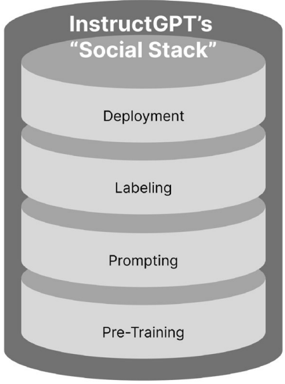
“InstructGPT is a large language model derived from GPT-3 (Ouyang et al. 2022), and is similar to the more famous ChatGPT—both released in 2022.”
InfluentialHacking, I. (1990) · Cambridge University Press eBooks · doi:10.1017/cbo9780511819766 · Cited by 3,586
An Invitation to Social Construction
Gergen, K. J. (2015) · SAGE Publications Ltd eBooks · doi:10.4135/9781473921276 · Cited by 2,698 · cited 1×
“To these four “classic” theories we could add a fifth, the social construction theory of truth (Kvale 1995; Gergen 2015)—particularly relevant given the social circuits and networks embedded in these language models.”
From a Logical Point of View: Nine Logico-Philosophical Essays, Second Revised Edition
Van Orman Quine, W. (1980) · Harvard University Press eBooks · doi:10.2307/j.ctv1c5cx5c · Cited by 2,439
A History of the Modern Fact: Problems of Knowledge in the Sciences of Wealth and Society
Poovey, M. (1998) · University of Chicago Press eBooks · doi:10.7208/chicago/9780226675183.001.0001 · Cited by 1,454 · cited 1×
“Rather than a radical break with “old-fashioned” facts and truths, machine learning and data science continue a long history of shaping these concepts in particular ways through scientific inquiry and economic activity (Poovey 1998; Deringer 2017).”
(2019) · Cited by 1,082
Research works printed but not linked: 13
- Chomsky N (2014) Aspects of the theory of syntax. MIT Press, Cambridge
- Cohen JE (2018) Turning privacy inside out. Theor Inq Law 20(1):1-32
- Dhanjani N (2021) AI powered misinformation and manipulation at Scale #GPT-3. O'Reilly Media. https:// www. oreil ly. com/ radar/ ai-power ed-misin forma tion-and-manip ulati on-at-scale-gpt-3/. Accessed 25 May 2021
- Foucault M (2019) "Discourse and truth" and "Parresia", foucault, fruchaud, lorenzini. In: Fruchaud H-P, Lorenzini D (eds) The Chicago foucault project. University of Chicago Press, Chicago
- Fox NJ (2008) Post-positivism. SAGE Encycl Qual Res Methods 2:659-664
- Heaven WD (2022) Why meta's latest large language model survived only three days online. MIT Technology Review. https:// www. techn ology review. com/ 2022/ 11/ 18/ 10634 87/ meta-large-langu age- model-ai-only-survi ved-three-days-gpt-3-scien ce/. Accessed 18 Nov 2022
- Heikkilä M (2022) How AI-generated text is poisoning the internet. MIT Technology Review. https:// www. techn ology review. com/ 2022/ 12/ 20/ 10656 67/ how-ai-gener ated-text-is-poiso ning-the-inter net/. Accessed 20 Dec 2022
- Jones P (2021) Work without the worker: labour in the age of platform capitalism. Verso Books, London
- Meng K, Bau D, Andonian A, Belinkov Y (2022) Locating and edit- ing factual associations in GPT. Advances in Neural Information Processing Systems, 35:17359-17372
- Passi S, Vorvoreanu M (2022) Overreliance on AI literature review. Microsoft, Seattle. https:// www. micro soft. com/ en-us/ resea rch/ uploa ds/ prod/ 2022/ 06/ Aether-Overr elian ce-on-AI-Review-Final- 6. 21. 22. pdf
- Ryan A (2006) Post-Positivist approaches to research. In: Antonesa M (ed) Researching and writing your thesis: a guide for postgradu- ate students. National University of Ireland, Maynooth, pp 12-26
- Singleton J (2020) Truth discovery: who to trust and what to believe. In: An B, Yorke-Smith N, Seghrouchni AEF, Sukthankar G (eds) International conference on autonomous agents and multi-agent systems 2020. International Foundation for Autonomous Agents and Multiagent Systems, pp 2211-13
- Stiennon N, Ouyang L, Jeffrey Wu, Ziegler D, Lowe R, Voss C, Rad- ford A, Amodei D, Christiano PF (2020) Learning to summarize with human feedback. Adv Neural Inf Process Syst 33:3008-3021
Cited by
Large language models in medical and healthcare fields: applications, advances, and challenges
Wang, D., & Zhang, S. (2024) · Artificial Intelligence Review · doi:10.1007/s10462-024-10921-0 · Cited by 246
“Given the safety–critical nature of medical and health-care domains, erroneous advice regarding patients’ symptoms and medications can result in serious injury or even death (Munn et al. 2023), as exemplified by GPT-3 incorrectly recommending suicide for a patient (Atallah et al. 2023a).”
AI and the future of humanity: ChatGPT-4, philosophy and education – Critical responses
Peters, M. A., Jackson, L., Papastephanou, M., Jandrić, P., Lazaroiu, G., Evers, C. W., Cope, B., Kalantzis, M., Araya, D., Tesar, M., et al. (2024) · Educational Philosophy and Theory · doi:10.1080/00131857.2023.2213437 · Cited by 188
“They also invent non-existent facts when needed to complete a plausible text (Munn et al., 2023).”
Beware of botshit: How to manage the epistemic risks of generative chatbots
Hannigan, T. R., McCarthy, I. P., & Spicer, A. (2024) · Business Horizons · doi:10.1016/j.bushor.2024.03.001 · Cited by 227
Literacy in the Time of Artificial Intelligence
Kalantzis, M., & Cope, B. (2025) · Reading Research Quarterly · doi:10.1002/rrq.591 · Cited by 119
“When Generative AI makes up facts: It only knows how to write good sentences but has no way of checking whether the content is true (Klein, 2023; Munn et al., 2023b).”
A phenomenology and epistemology of large language models: transparency, trust, and trustworthiness
Heersmink, R., de Rooij, B., Clavel Vázquez, M. J., & Colombo, M. (2024) · Ethics and Information Technology · doi:10.1007/s10676-024-09777-3 · Cited by 91
“While this is an impressive track record, critics argue that the reliability of LLMs is likely restricted to bodies of knowledge that are amply represented in their training data (Munn et al., 2023).”
Augmented non-hallucinating large language models as medical information curators
Gilbert, S., Kather, J. N., & Hogan, A. (2024) · npj Digital Medicine · doi:10.1038/s41746-024-01081-0 · Cited by 111
“Although LLMs are a remarkable advance, they lack a model of truth, and have limited ability to reliably check their own accuracy 23 .”
BackgroundDo large language models have a legal duty to tell the truth?
Wachter, S., Mittelstadt, B., & Russell, C. (2024) · Royal Society Open Science · doi:10.1098/rsos.240197 · Cited by 66
To protect science, we must use LLMs as zero-shot translators
Mittelstadt, B., Wachter, S., & Russell, C. (2023) · Nature Human Behaviour · doi:10.1038/s41562-023-01744-0 · Cited by 58
Balancing AI and academic integrity: what are the positions of academic publishers and universities?
Gulumbe, B. H., Audu, S. M., & Hashim, A. M. (2025) · AI & SOCIETY · doi:10.1007/s00146-024-01946-8 · Cited by 53
“…Language Models (LLMs) and their integration into research and publishing have sparked a debate encompassing not just the technical capabilities of AI but also the ethical, regulatory, and societal dimensions of its application (Guersenz-vaig and Sánchez-Monedero 2024; Munn et al. 2023; Toy 2023).”
On Cyber-Social Learning: A Critique of Artificial Intelligence in Education
Cope, B., & Kalantzis, M. (2024) · Postdigital science and education · doi:10.1007/978-3-031-64487-0_1 · Cited by 50
Tell me a story: a framework for critically investigating AI language models
Munn, L., & Henrickson, L. (2024) · Learning Media and Technology · doi:10.1080/17439884.2024.2327024 · Cited by 27
“Although analytics may provide useful support for future predictions, overdependence on past statistics may create conceptual tunnels that bypass new information (Munn, Magee, and Arora 2023).”
Self-citationAre Large Language Models Moral Hypocrites? A Study Based on Moral Foundations
Nunes, J. L., Almeida, G. F. C. F., Araujo, M. D., & Barbosa, S. D. J. (2024) · Proceedings of the AAAI/ACM Conference on AI, Ethics, and Society · doi:10.1609/aies.v7i1.31704 · Cited by 17
Hristova, T., Magee, L., & Soldatić, K. (2024) · AI & Society · doi:10.1007/s00146-024-02039-2 · Cited by 35
“This probabilistic approach to sense-making has provoked the neo-Searlian or neo-Chomskian scepticism voiced by AI critics (including Bender et al. (2023); see also Munn et al. (2023)).”
Self-citationEpistemic authority and medical AI: epistemological differences and challenges in medical practice
Kerasidou, A., & Kerasidou, C. (2025) · Medicine Health Care and Philosophy · doi:10.1007/s11019-025-10306-2 · Cited by 27
Leveraging large language models for word sense disambiguation
Yae, J. H., Skelly, N. C., Ranly, N. C., & LaCasse, P. M. (2024) · Neural Computing and Applications · doi:10.1007/s00521-024-10747-5 · Cited by 42
Eacersall, D. C. F., Pretorius, L., Smirnov, I., Spray, E., Illingworth, S., Chugh, R., Strydom, S. C., Stratton-Maher, D., Simmons, J. S., Jennings, I., et al. (2025) · Journal of Applied Learning & Teaching · doi:10.37074/jalt.2025.8.2.9 · Cited by 44
Liu, Y., & Ke, L. (2025) · Humanities and Social Sciences Communications · doi:10.1057/s41599-025-04509-4 · Cited by 27
“For instance, the generation of false information and algorithmic errors have led to audience uncertainty and fragility of trust (Munn et al. 2023).”
The intentions of information sources can affect what information people think qualifies as true
Handley-Miner, I. J., Pope, M., Atkins, R. K., Jones-Jang, S. M., McKaughan, D. J., Phillips, J., & Young, L. (2023) · Scientific Reports · doi:10.1038/s41598-023-34806-4 · Cited by 13
Natale, S., Surace, B., Mensa, E., & Befera, L. (2025) · New Media & Society · doi:10.1177/14614448251384258 · Cited by 21
Gender and the invisibility of care on Wikipedia
Ford, H., Pietsch, T., & Tall, K. (2023) · Big Data & Society · doi:10.1177/20539517231210276 · Cited by 10
“…systems not only enable us to do things (banking, dieting, learning, driving and dating, for example) more ef fi ciently, they also come to stand in for us – to represent us in ways that are increasingly accepted as more accurate and truthful than other sources (Beer, 2017: 1; Munn et al., 2023).”
BackgroundNavigating uncertainty: public diplomacy vs. AI
Martino, L. D., & Ford, H. (2024) · Place Branding and Public Diplomacy · doi:10.1057/s41254-024-00330-z · Cited by 22
“Munn, Magee, and Arora (2023), drawing from Frankfurt (2009) work, note that “rather than misrepresenting the truth like a liar, bullshit-ters are not interested in it; they subtly change the rules of dialogue so that truth and falsity are irrelevant”.”
InfluentialArtificial Truth: Algorithmic Power, Epistemic Authority, and the Crisis of Democratic Knowledge
Palese, R. (2026) · Societies · doi:10.3390/soc16030102 · Cited by 22
Large language models, politics, and the functionalization of language
Kudina, O., & de Boer, B. (2024) · AI and Ethics · doi:10.1007/s43681-024-00564-w · Cited by 11
He, J., & Yang, C. (2025) · AI & Society · doi:10.1007/s00146-025-02366-y · Cited by 9
“…(LLMs), human users also incline to take the credibility of information generated by LLMs for granted, as if a language model such as ChatGPT is “a de-facto arbiter of truth, with its authoritative-sounding claims spun out into billions of essays, articles, and dialogues” (Munn et al. 2023, 8).”
Nana, V. K., & Marshall, M. T. (2025) · AI · doi:10.3390/ai6110278 · Cited by 7
“Accordingly, LLMs may provide erroneous information and recommendations which could endanger patients’ lives and potentially lead to death [62].”
González-Cantera, T., & Bonacchi, C. (2025) · International Journal of Heritage Studies · doi:10.1080/13527258.2025.2543736 · Cited by 4
“AI models thus appear to over-represent ‘particular understandings of truth (patriarchal, Western, English-speaking, Eurocentric)’ (Munn, Magee, and Arora 2023, 3).”
InfluentialUniversity Students’ Perspective on ChatGPT and Technology Literacies
Dawa, T., Dhendup, S., Tashi, S., & Rosso, M. A. (2024) · Educational innovation and practice · doi:10.17102/eip.7.2024.10 · Cited by 6
The biological objection against strong AI
Grève, S. S. (2025) · Inquiry · doi:10.1080/0020174x.2025.2465369 · Cited by 4
What is a fact in the age of generative AI? Fact-checking as an epistemological lens
Dierickx, L., Opdahl, A. L., Bjerknes, F., & Lindén, C. (2026) · Information Communication & Society · doi:10.1080/1369118x.2026.2630697 · Cited by 10
“Because LLMs outputs can create an illusion of verisimili-tude – similarity to the truth – without any intent to deceive, they risk misleading users about the nature and reliability of the information presented (Hicks et al., 2024; Licon, 2025; Munn et al., 2024).”
A Systematic Review of Research on ChatGPT: The User Perspective
Guan, C., Ding, D., Gupta, P., Hung, Y.-C., & Jiang, Z. (2023) · Advances in digital crime, forensics, and cyber terrorism book series · doi:10.4018/978-1-6684-8422-7.ch007 · Cited by 6
ChatGPT’nin Diş Hekimliğinde Kullanım Alanları ve Sınırlamaları
Özdemir, Ö. T., & Güven, Y. (2025) · Selcuk Dental Journal · doi:10.15311/selcukdentj.1503653 · Cited by 2
Boundary-making practices: LLMs and an artifactual production of objectivity
An, M. (2025) · AI & Society · doi:10.1007/s00146-025-02409-4 · Cited by 5
“This produces a form of “truth synthesis” (Munn et al. 2024), neither purely objective nor subjective, but emerging from complex intra-actions among model capacities, human values, cultural norms, commercial interests, and labor systems.”
Glitching AIEd through feminist cogenerative dialogues: a feminist theoretical kaleidoscope
Tolbert, S., Kim, E.-J. A., Olave, B. T., & Tilsen, J. (2025) · British Journal of Sociology of Education · doi:10.1080/01425692.2025.2517192 · Cited by 2
“This resonates with current research indicating that genAI tends to produce ‘epistemic flatness’ (Munn et al. 2024, 2).”
Anthony, A., & Sharma, S. (2025) · Journal of Educational Technology Systems · doi:10.1177/00472395251356520 · Cited by 5
“The content generated may not be accurate or reliable leading to veracity of information or data (Munn et al., 2023) and its critical to address these issues right now especially in academia, where the integrity of information and authorship is vital.”
The Ethics of Speaking (of) AIs Through the Lens of Natural Language
Buzato, M. E. K. (2025) · Journal of Bioethical Inquiry · doi:10.1007/s11673-025-10426-7 · Cited by 4
“LLMs can generate plausible and convincing narratives by combining patterns in their sources, but they can just as easily fabricate facts (Munn et al. 2023), a limitation that OpenAI explicitly warns users about with ChatGPT.”
AI, post-truth realities, and Thai students’ information-seeking behavior
Slutskiy, P. (2025) · Manusya: Journal of Humanities · doi:10.1163/26659077-20252811 · Cited by 2
Incorporating emergence in data-driven algorithms: the circularity pathway
Deepak, P., Parsodkar, A. P., Nair, V. S., & Chakraborti, S. (2025) · AI and Ethics · doi:10.1007/s43681-025-00763-z · Cited by 1
Xu, M., Lotke, P. S., Figueroa, M., Doty, N., & Baum, J. D. (2025) · Culture Health & Sexuality · doi:10.1080/13691058.2025.2517289 · Cited by 3
“ChatGPT differs from a traditional search engine in that it takes a large collection of data, learns from patterns and structure of language, and then creates a response that sounds human-like and is based on predictive models of that data (Munn, Magee, and Arora 2024).”
Augmented Human and Transhuman: What is the Difference?
Rakkolainen, I. (2025) · Augmented Human Research · doi:10.1007/s41133-025-00089-9 · Cited by 6
Blending Truth and Lies: Using an Ethnographic Sensibility to Study Online Misinformation
Holmes, C. E. (2025) · Perspectives on Politics · doi:10.1017/s1537592725103290 · Cited by 1
AI, Ethics, and the Law: Balancing Innovation and Responsibility
Efthymiou, I.-P. (2026) · Advances in computational intelligence and robotics book series · doi:10.4018/979-8-2600-0000-7.ch007 · Cited by 1
Gao, H., Zheng, Y., & Li, L. (2026) · International Journal of Human-Computer Interaction · doi:10.1080/10447318.2026.2637823 · Cited by 1
Halucynacje chatbotów a prawda: główne nurty debaty i ich interpretacje
Kreft, J., Boguszewicz-Kreft, M., & Cyrek, B. (2024) · Roczniki Nauk Społecznych · doi:10.18290/rns2024.0009 · Cited by 5
Michel, B., & Ecker, Y. (2024) · Geoforum · doi:10.1016/j.geoforum.2024.104175 · Cited by 7
Framework for Managing Artificial Intelligence (AI) Projects: Avoiding Harms, Losses, and Damages
Miller, G. J. (2025) · Information systems engineering and management · doi:10.1007/978-3-031-80275-1_7 · Cited by 4
Transformative Learning and the Test of Truth: Towards Conceptual Validation
Roux, R. (2025) · Journal of Transformative Education · doi:10.1177/15413446251338055 · Cited by 1
“…role that education plays within democratic society, this situation requires educators and researchers to consider theories of truth and associated learning and teaching approaches afresh for the times in which we live (Bridges, 2019; Munn et al., 2023; Peters, 2017; Sinatra & Lombardi, 2020).”
The intentions of information sources can affect what information people think qualifies as truePreprint
Handley-Miner, I. J., Pope, M., Atkins, R. K., Jones-Jang, S. M., McKaughan, D. J., Phillips, J., & Young, L. (2022) · doi:10.31234/osf.io/wf87u
Silva, R. (2024) · Digital Library of Theses and Dissertations (Universidade de São Paulo) · doi:10.11606/t.8.2024.tde-03072024-183251 · Cited by 2
Ground Truthing in Digital Technoculture
Tollmann, V. (2024) · The Nordic Journal of Aesthetics · doi:10.7146/nja.v33i67.148468 · Cited by 1
Marwala, T. (2024) · Springer eBooks · doi:10.1007/978-981-97-9251-1_6
Laskowski, N. G. (2025) · Oxford University Press eBooks · doi:10.1093/9780198945215.003.0066
Cross-Platform Aesthetic Analysis: A Computer Vision Study of REDnote and Instagram
Cai, Y.-Q., Zhao, T.-F., & Ma, L. (2025) · International Conference on Machine Intelligence Theory and Applications (MiTA) · doi:10.1109/mita66017.2025.11100251
“Cross-cultural bias and discrimination in aesthetic culture using AI large models require further validation [15], alongside known challenges in modeling other complex social content such as hate speech [16].”
Unmaking AI: Engaging Critically and Creatively with Generative AI
Munn, L., Khan, A. H., Hettiachchi, D., Sabie, S., Ghahremanlou, L., Saghir, S., Lambourne, N., & Magee, L. (2024) · Australian Conference on Human-Computer Interaction (OzCHI) · doi:10.1145/3726986.3727943
“Generative AI models have a particular logic; they apprehend the world in particular ways, and they produce outputs with particular strengths and weaknesses [42].”
Self-citationLemke, H. U. (2025) · International Journal of Computer Assisted Radiology and Surgery · doi:10.1007/s11548-025-03533-8
“Classical approaches of consensus, correspondence, coherence and pragmatics [9] may not suffice and may have to be complimented with Kullback–Leibler Selecting the “right” model is crucial in the process of making intelligent or even wise decisions in health care.”
Africanizing the Artificial Intelligence Education in South African Universities
Jiang, Y. (2025) · Emerald Group Publishing Limited eBooks · doi:10.1108/978-1-83549-788-320251019
Level of Automation and Accountability in Artificial Intelligence (AI) Projects: An Empirical Study
Miller, G. J. (2025) · doi:10.1109/temsconglobal64363.2025.11238326 · Cited by 2
“They assign weights and probabilities to compose convincing sentences [11].”
The potential of AI-driven truth technologies: opportunities, risks and governance
Béjar, B. P., Schweser, L., Hagelsteen, M., & Becker, P. (2025) · AI and Ethics · doi:10.1007/s43681-025-00901-7 · Cited by 1
“Moreover, the results warn about monopolies controlling truth technologies and potentially being able to manipulate everybody’s thoughts [54].”
InfluentialKomunikasi Digital yang Beretika di Tengah Polarisasi Politik di Indonesia: Kajian Etika Kristen
Nego, O. (2025) · Jurnal Teologi Injili · doi:10.55626/jti.v5i2.246
Marwala, T. (2026) · Elsevier eBooks · doi:10.1016/b978-0-443-36322-1.00009-2
La voz es falsa: mediación técnica y expectativas de autenticidad en Landgren y Abu Hamdan
Ferrete-Vázquez, J. (2026) · Artnodes · doi:10.7238/artnodes.v0i38.432962
Language Justice and Machine Translation on Social Media
Paullada, A., & Haroutunian, L. (2026) · Modern Languages Open · doi:10.3828/mlo.v0i0.466
Belmiro, J. (2026) · Springer eBooks · doi:10.1007/978-3-032-16800-9_12
Barut, E. (2026) · Uluslararası Dil Edebiyat ve Kültür Araştırmaları Dergisi · doi:10.37999/udekad.1934778
Bini, G., & Quattrociocchi, W. (2026) · AI & Society · doi:10.1007/s00146-026-03227-y · Cited by 1
“In public discourse, they are increasingly perceived as reliable interlocutors for ethical judgement (Terwiesch et al. 2023) or as “de facto arbiters of truth” (Munn et al. 2024, p. 2759).”
LLM-augmented progressive search for efficient multi-robot task planning
Xin, L., Wang, J., Yao, W., Qi, J., & Liu, Y. (2026) · Advanced Engineering Informatics · doi:10.1016/j.aei.2026.105169
LABORATORIUM KONWERSACJI – JAK RÓŻNE MODELE JĘZYKOWE INTERPRETUJĄ RZECZYWISTOŚĆ
Grabiec, A., & Łyszkowska, E. (2026) · International Journal of Legal Studies ( IJOLS ) · doi:10.5604/01.3001.0055.9361
Unstable ground: Automated dialect recognition, ground truth, and AI regulation in asylum procedures
Adensamer, A., & Jung, L. (2026) · European Journal of Applied Linguistics · doi:10.1515/eujal-2026-0022
Metadata
- Authors
- Munn, L., Magee, L., & Arora, V.
- Affiliations
- The University of Queensland (AU)
- Western Sydney University (AU)
- University of Stirling (GB)
- Corresponding author
- Munn, Luke
- Venue
- AI & SOCIETY
- Published
- 2023-08-28
- Volume
- 39
- Issue
- 6
- Pages
- 2759-2773
- ISSN
- 0951-5666 (ISSN-L)
- 1435-5655
- OpenAlex
- W4386225382
- Cited by
- 65
- References
- 50
- Citations by year
- 2026: 13 · 2025: 26 · 2024: 20 · 2023: 5
- FWCI
- 16.04
- Type
- journal article
- Language
- en
- Open access
- hybrid
- doi.org
- Licence
- cc-by
- creativecommons.org/licenses/by/4.0 (tdm)
- creativecommons.org/licenses/by/4.0 (vor)
- Locations
- AI & Society (publishedVersion, cc-by)
- arXiv (Cornell University) (submittedVersion, cc-by-nc-sa)
- Stirling Online Research Repository (University of Stirling) (submittedVersion, cc-by)
- arXiv (Cornell University)
- Funders
- The University of Queensland
- Topics
- Physical Sciences › Computer Science › Artificial Intelligence › Ethics and Social Impacts of AI
- Social Sciences › Sociology and Political Science › Misinformation and Its Impacts
- Social Sciences › Arts and Humanities › History and Philosophy of Science › Cybernetics and Technology in Society
- Keywords
- truth, honesty, large language models, ChatGPT, data harvesting, model architecture
About these checks
Registry, retraction, Cites and statistics results are computed, not judged, with one exception: a printed reference that no index lists is read once by a model before it counts as a citation error. Claims are extracted by a model and kept only when their quote appears verbatim in the text; each cited source is then checked, with a model’s help, for whether it says what the claim relies on. Those verdicts can be wrong — read the claim’s quote and the cited source before relying on one.
Statistics and arithmetic are recomputed, not judged.
Confidence bands are shown only for fields calibrated on our annotated test set. None is calibrated yet, so no band is shown.
What counts as a claim ›How we measure confidence ›How we check this ›
Are you an author, or do you see a problem with this page? Request a review
Data sources
Bibliographic data: Semantic Scholar, OpenAlex, Crossref.
Contains information from the Semantic Scholar Academic Graph Datasets, made available under the ODC Attribution License (ODC-BY 1.0).
Semantic Scholar’s data is described in: Kinney, R., et al. (2023). The Semantic Scholar Open Data Platform. arXiv:2301.10140.
