

Truth machines: synthesizing veracity in AI language models
Open accessThe DOI matches its Crossref record; 58 of the 58 references it cites were found in a registry or an index.
Abstract
As AI technologies are rolled out into healthcare, academia, human resources, law, and a multitude of other domains, they become de-facto arbiters of truth. But truth is highly contested, with many different definitions and approaches. This article discusses the struggle for truth in AI systems and the general responses to date. It then investigates the production of truth in InstructGPT, a large language model, highlighting how data harvesting, model architectures, and social feedback mechanisms weave together disparate understandings of veracity. It conceptualizes this performance as an operationalization of truth, where distinct, often-conflicting claims are smoothly synthesized and confidently presented into truth-statements. We argue that these same logics and inconsistencies play out in Instruct’s successor, ChatGPT, reiterating truth as a non-trivial problem. We suggest that enriching sociality and thickening “reality” are two promising vectors for enhancing the truth-evaluating capacities of future language models. We conclude, however, by stepping back to consider AI truth-telling as a social practice: what kind of “truth” do we as listeners desire?
Overview
The claims and statistics of this paper haven’t been checked yet.
Free: it reads the open-access text and checks the first 5 claims that cite a source we can check. Create a free account to check every claim.
Integrity signals
Registry
Cites
Statistics
Figures
Verification
Claims the paper makes
The claims and statistics of this paper haven’t been checked yet.
Free: it reads the open-access text and checks the first 5 claims that cite a source we can check. Create a free account to check every claim.
Claims other papers make about this one
Each is checked against this paper’s own text: does it say what the citing paper says it does?
In the citing paper
“critics argue that the reliability of LLMs is likely restricted to bodies of knowledge that are amply represented in their training data (Munn et al., 2023).”
From A phenomenology and epistemology of large language models: transparency, trust, and trustworthiness (2024) · cites this paper as Munn et al., 2023
Self-check
Percentages, sums and reported differences re-computed from the paper’s own numbers.
The self-check needs the paper’s full text.
Citations
Cites
Advances in neural information processing systems 7
Cios, K., & Shields, M. (1997) · Neurocomputing · doi:10.1016/s0925-2312(97)90018-7 · Cited by 22,059
The Structure of Scientific Revolutions: 50th Anniversary Edition
Kuhn, T. S., & Hacking, I. (2012) · doi:10.7208/chicago/9780226458144.001.0001 · Cited by 21,170 · cited 1×
“It is not simply the case that truths change, as for instance when a new conceptual paradigm is ushered in to explain previous inexplicable scientific observations (Kuhn 2012).”
On the Dangers of Stochastic Parrots: Can Language Models Be Too Big? 🦜
Bender, E. M., Gebru, T., McMillan-Major, A., & Shmitchell, S. (2021) · Proceedings of the 2021 ACM Conference on Fairness, Accountability, and Transparency · doi:10.1145/3442188.3445922 · Cited by 6,988
Generative Adversarial Networks: An Overview
Creswell, A., White, T., Dumoulin, V., Arulkumaran, K., Sengupta, B., & Bharath, A. A. (2018) · IEEE Signal Processing Magazine · doi:10.1109/msp.2017.2765202 · Cited by 4,540 · cited 2×
“Adversarial models in machine learning, for instance, consist of “generators” and “discriminators,” a translation of the social roles of “forgers” and “critics” into technical architectures (Creswell et al. 2018).”
BackgroundTraining language models to follow instructions with human feedback
Ouyang, L., Wu, J., Jiang, X., Almeida, D., Wainwright, C. L., Mishkin, P., Zhang, C., Agarwal, S., Slama, K., Ray, A., et al. (2022) · arXiv · doi:10.48550/arxiv.2203.02155 · Cited by 4,208 · cited 13×
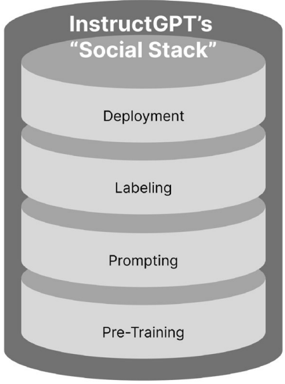
“InstructGPT is a large language model derived from GPT-3 (Ouyang et al. 2022), and is similar to the more famous ChatGPT—both released in 2022.”
InfluentialHacking, I. (1990) · Cambridge University Press eBooks · doi:10.1017/cbo9780511819766 · Cited by 3,586
An Invitation to Social Construction
Gergen, K. J. (2015) · SAGE Publications Ltd eBooks · doi:10.4135/9781473921276 · Cited by 2,698 · cited 1×
“To these four “classic” theories we could add a fifth, the social construction theory of truth (Kvale 1995; Gergen 2015)—particularly relevant given the social circuits and networks embedded in these language models.”
From a Logical Point of View: Nine Logico-Philosophical Essays, Second Revised Edition
Van Orman Quine, W. (1980) · Harvard University Press eBooks · doi:10.2307/j.ctv1c5cx5c · Cited by 2,439
A History of the Modern Fact: Problems of Knowledge in the Sciences of Wealth and Society
Poovey, M. (1998) · University of Chicago Press eBooks · doi:10.7208/chicago/9780226675183.001.0001 · Cited by 1,454 · cited 1×
“Rather than a radical break with “old-fashioned” facts and truths, machine learning and data science continue a long history of shaping these concepts in particular ways through scientific inquiry and economic activity (Poovey 1998; Deringer 2017).”
(2019) · Cited by 1,082
Kittur, A., Nickerson, J. V., Bernstein, M., Gerber, E., Shaw, A., Zimmerman, J., Lease, M., & Horton, J. (2013) · Proceedings of the 2013 conference on Computer supported cooperative work · doi:10.1145/2441776.2441923 · Cited by 1,034 · cited 1×
“This vagueness is a pervasive and longstanding issue in clickwork (Kittur 2013), with jobs on Amazon Mechanical Turk, for instance, plagued by unclear instructions and unfamiliar terminology (Brewer et al. 2016).”
Truth and Interpretation: Perspectives on the Philosophy of Donald Davidson.
Butterfield, J., & Lepore, E. (1989) · The Philosophical Review · doi:10.2307/2185376 · Cited by 973
TruthfulQA: Measuring How Models Mimic Human Falsehoods
Lin, S., Hilton, J., & Evans, O. (2022) · Proceedings of the 60th Annual Meeting of the Association for Computational Linguistics (Volume 1: Long Papers) · doi:10.18653/v1/2022.acl-long.229 · Cited by 904
TruthfulQA: Measuring How Models Mimic Human Falsehoods
Lin, S., Hilton, J., & Evans, O. (2021) · arXiv · doi:10.48550/arxiv.2109.07958 · Cited by 899
The Social Construction of Validity
Kvale, S. (1995) · Qualitative Inquiry · doi:10.1177/107780049500100103 · Cited by 805 · cited 2×
“According to this engineering mindset, truth is stable, universal and objective, “a permanent, ahistorical matrix or framework to which we can ultimately appeal in determining the nature of knowledge, truth, reality, and goodness” (Kvale 1995, 23).”
AI can be sexist and racist — it’s time to make it fair
Zou, J., & Schiebinger, L. (2018) · Nature · doi:10.1038/d41586-018-05707-8 · Cited by 765 · cited 1×
“Training a language model from massive amounts of internet content introduces fact and fiction, misconception and myth, bias and prejudice, as many studies have investigated (Zou and Schiebinger 2018; Roselli et al. 2019; Leavy et al. 2020).”
BackgroundTaxonomy of Risks posed by Language Models
Weidinger, L., Uesato, J., Rauh, M., Griffin, C., Huang, P.-S., Mellor, J., Glaese, A., Cheng, M., Balle, B., Kasirzadeh, A., et al. (2022) · 2022 ACM Conference on Fairness Accountability and Transparency · doi:10.1145/3531146.3533088 · Cited by 764
Calibrate Before Use: Improving Few-Shot Performance of Language Models
Zhao, T. Z., Wallace, E., Feng, S., Klein, D., & Singh, S. (2021) · arXiv · doi:10.48550/arxiv.2102.09690 · Cited by 513 · cited 1×
“One study found that a model often predicted common entities like “America” as a response when the actual answer (Namibia) was a rare entity in the training data (Zhao et al. 2021).”
Between Truth and Power: The Legal Constructions of Informational Capitalism
Cohen, J. E. (2019) · doi:10.1093/oso/9780190246693.001.0001 · Cited by 442
Training a Helpful and Harmless Assistant with Reinforcement Learning from Human Feedback
Bai, Y., Jones, A., Ndousse, K., Askell, A., Chen, A., DasSarma, N., Drain, D., Fort, S., Ganguli, D., Henighan, T., et al. (2022) · arXiv · doi:10.48550/arxiv.2204.05862 · Cited by 442 · cited 2×
“Bender et al (2021) thus argue that large language models are essentially “stochastic parrots:” they excel at mimicking human language and intelligence but have zero understanding of what these words and concepts actually mean.”
All the News That’s Fit to Fabricate: AI-Generated Text as a Tool of Media Misinformation
Kreps, S., McCain, R. M., & Brundage, M. (2022) · Journal of Experimental Political Science · doi:10.1017/xps.2020.37 · Cited by 360 · cited 1×
“As these models proliferate into essay generators, legal reports, and journalism articles, the potential for reinforcing misinformation is significant (Kreps et al. 2022; Danry et al. 2022).”
Behind the Screen: Content Moderation in the Shadows of Social Media
ROBERTS, S. T. (2019) · Yale University Press · doi:10.2307/j.ctvhrcz0v · Cited by 339
Bickmore, T. W., Trinh, H., Olafsson, S., O'Leary, T. K., Asadi, R., Rickles, N. M., & Cruz, R. (2018) · Journal of Medical Internet Research · doi:10.2196/11510 · Cited by 308 · cited 1×
“For instance, incorrect advice on medical symptoms and drugs can lead to patient harm or death (Bickmore et al. 2018), with one medical chatbot based on GPT-3 already advising a patient to kill themselves (Quach 2020).”
Laboratory Life: The Construction of Scientific Facts
Latour, B., & WooIgar, S. (2013) · Princeton University Press eBooks · doi:10.2307/j.ctt32bbxc · Cited by 302
Truth Is a Lie: Crowd Truth and the Seven Myths of Human Annotation
Aroyo, L., & Welty, C. (2015) · AI Magazine · doi:10.1609/aimag.v36i1.2564 · Cited by 244 · cited 3×
“…between annotators is avoided; (3) disagreement is “solved” by adding more instructions; (4) only one person is used to annotate; (5) experts are privileged over “normal” people; (6) examples are viewed mono-lithically; and (7) labeling is seen as a “one-and-done” process (Aroyo and Welty 2015).”
InfluentialRoselli, D., Matthews, J., & Talagala, N. (2019) · Companion Proceedings of The 2019 World Wide Web Conference · doi:10.1145/3308560.3317590 · Cited by 237 · cited 1×
“Training a language model from massive amounts of internet content introduces fact and fiction, misconception and myth, bias and prejudice, as many studies have investigated (Zou and Schiebinger 2018; Roselli et al. 2019; Leavy et al. 2020).”
Behind the Screen: Content Moderation in the Shadows of Social Media
Roberts, S. T. (2019) · Yale University Press eBooks · doi:10.12987/9780300245318 · Cited by 176
Human evaluation of automatically generated text: Current trends and best practice guidelines
van der Lee, C., Gatt, A., van Miltenburg, E., & Krahmer, E. (2021) · Computer Speech & Language · doi:10.1016/j.csl.2020.101151 · Cited by 170 · cited 1×
“While RLHF knowledge leverages human insight, this is attended by all-too-human subjectivity. van der Lee et al (2021) worry that annotators will engage in “satisficing,” succumbing to tedium and fatigue and taking shortcuts to arrive at low-quality answers.”
A General Language Assistant as a Laboratory for Alignment
Askell, A., Bai, Y., Chen, A., Drain, D., Ganguli, D., Henighan, T., Jones, A., Joseph, N., Mann, B., DasSarma, N., et al. (2021) · arXiv · doi:10.48550/arxiv.2112.00861 · Cited by 146
Data, Power and Bias in Artificial IntelligencePreprint
Leavy, S., O’Sullivan, B., & Σιαπέρα, Ε. (2020) · arXiv (Cornell University) · doi:10.48550/arxiv.2008.07341 · Cited by 143 · cited 2×
“Training a language model from massive amounts of internet content introduces fact and fiction, misconception and myth, bias and prejudice, as many studies have investigated (Zou and Schebinger 2018; Roselli et al. 2019; Leavy et al. 2020).”
BackgroundMemory Practices in the Sciences
Eschenfelder, K. R. (2007) · Journal of the American Society for Information Science and Technology · doi:10.1002/asi.20611 · Cited by 138
Technical code and the social construction of the internet
Flanagin, A. J., Flanagin, C., & Flanagin, J. (2009) · New Media & Society · doi:10.1177/1461444809341391 · Cited by 115 · cited 1×
“The internet is a socially constructed artifact (Hrynyshyn 2008; Flanagin et al. 2010), emerging from the disparate thoughts and ideas of individuals, communities, and companies.”
"Why would anybody do this?": Understanding Older Adults' Motivations and Challenges in Crowd Work
Brewer, R., Morris, M. R., & Piper, A. M. (2016) · Proceedings of the 2016 CHI Conference on Human Factors in Computing Systems · doi:10.1145/2858036.2858198 · Cited by 111 · cited 1×
“This vagueness is a pervasive and longstanding issue in clickwork (Kittur 2013), with jobs on Amazon Mechanical Turk, for instance, plagued by unclear instructions and unfamiliar terminology (Brewer et al. 2016).”
The Constitution of Algorithms: Ground-Truthing, Programming, Formulating
Jaton, F. (2021) · The MIT Press eBooks · doi:10.7551/mitpress/12517.001.0001 · Cited by 103
What Tech Calls Thinking: An Inquiry into the Intellectual Bedrock of Silicon Valley
Daub, A. (2020) · Cited by 100
Technologies of Speculation: The Limits of Knowledge in a Data-Driven Society
Hong, S.-H. (2020) · doi:10.18574/nyu/9781479860234.001.0001 · Cited by 96 · cited 1×
“Translating truth theories into actionable architectures and processes updates them in significant ways (Hong 2020; Birhane 2022).”
“Believe it or not: Designing a human-ai partnership for mixed-initiative fact-checking,”
Nguyen, A. T., Kharosekar, A., Krishnan, S., Krishnan, S., Tate, E., Wallace, B. C., & Lease, M. (2018) · Proceedings of the 31st Annual ACM Symposium on User Interface Software and Technology · doi:10.1145/3242587.3242666 · Cited by 95
CrowdLearn: A Crowd-AI Hybrid System for Deep Learning-based Damage Assessment Applications
Zhang, D., Zhang, Y., Li, Q., Plummer, T., & Wang, D. (2019) · 2019 IEEE 39th International Conference on Distributed Computing Systems (ICDCS) · doi:10.1109/icdcs.2019.00123 · Cited by 82 · cited 1×
“Some authors speak of “factual” and “counterfactual” associations (Meng et al. 2022); for others, it seems obvious that truthfulness equates to “accuracy” (Zhang et al. 2019); and others still focus on the reproduction of misconceptions which can deceive human users (Lin et al. 2022).”
Robertson, J., Botha, E., Walker, B., Wordsworth, R., & Balzarova, M. (2022) · International Journal of Retail & Distribution Management · doi:10.1108/ijrdm-10-2021-0514 · Cited by 79
Frankfurt, H. G. (2009) · Princeton University Press eBooks · doi:10.2307/j.ctt7t4wr · Cited by 72
MineDojo: Building Open-Ended Embodied Agents with Internet-Scale Knowledge
Fan, L., Wang, G., Jiang, Y., Mandlekar, A., Yang, Y., Zhu, H., Tang, A., Huang, D.-A., Zhu, Y., & Anandkumar, A. (2022) · arXiv · doi:10.48550/arxiv.2206.08853 · Cited by 72 · cited 2×
“One strategy is to treat AI as an agent in a virtual world— what the authors call a kind of “embodied GPT-3”—allow-ing it to explore, make mistakes, and improve through these encounters with a form of reality (Fan et al. 2022).”
Automating Ambiguity: Challenges and Pitfalls of Artificial IntelligencePreprint
Birhane, A. (2022) · arXiv (Cornell University) · doi:10.48550/arxiv.2206.04179 · Cited by 57 · cited 1×
“Translating truth theories into actionable architectures and processes updates them in significant ways (Hong 2020; Birhane 2022).”
Discovering Latent Knowledge in Language Models Without Supervision
Burns, C., Ye, H., Klein, D., & Steinhardt, J. (2022) · arXiv · doi:10.48550/arxiv.2212.03827 · Cited by 55 · cited 1×
“Other researchers have done low-level work on truth “discovery,” finding a direction in activation space that satisfies logical consistency properties where a statement and its negation have opposite truth values (Burns et al. 2022).”
BackgroundVeracity of Data: From Truth Discovery Computation Algorithms to Models of Misinformation Dynamics
Berti‐Équille, L., & Borge‐Holthoefer, J. (2015) · Synthesis lectures on data management · doi:10.2200/s00676ed1v01y201509dtm042 · Cited by 51 · cited 1×
“While this raises obvious questions about the veracity of training data (Berti-Équille and Borge-Holthoefer 2015), we are interested here in highlighting how socially generated content problematizes any absolute notion of veracity.”
BackgroundLebovitz, S., Levina, N., & Lifshitz-Assaf, H. (2021) · MIS Quarterly · doi:10.25300/misq/2021/16564 · Cited by 49
Truthful AI: Developing and governing AI that does not lie
Evans, O., Cotton-Barratt, O., Finnveden, L., Bales, A., Balwit, A., Wills, P., Righetti, L., & Saunders, W. (2021) · arXiv · doi:10.48550/arxiv.2110.06674 · Cited by 39
Reproducibility, Replicability, and Reliability
Meng, X. (2020) · Harvard Data Science Review · doi:10.1162/99608f92.dbfce7f9 · Cited by 29 · cited 1×
““Reliability does not imply absolute truth,” asserted one stat-istician (Meng 2020), “but it does require that our findings can be triangulated, can pass reasonable stress tests and fair-minded sensitivity tests, and they do not contradict the best available theory and scientific understanding.””
Antecedents of frustration in crowd work and the moderating role of autonomy
Strunk, K. S., Faltermaier, S., Ihl, A., & Fiedler, M. (2021) · Computers in Human Behavior · doi:10.1016/j.chb.2021.107094 · Cited by 29 · cited 1×
“Tasks are baffling but rejected if deemed incorrect, leaving workers to wonder what they did wrong or what they should have done differently (Strunk et al. 2022).”
Hrynyshyn, D. (2008) · New Media & Society · doi:10.1177/1461444808094355 · Cited by 24 · cited 1×
“The internet is a socially constructed artifact (Hrynyshyn 2008; Flanagin et al. 2010), emerging from the disparate thoughts and ideas of individuals, communities, and companies.”
Deringer, W. (2017) · History of Political Economy · doi:10.1215/00182702-3876445 · Cited by 23 · cited 1×
“Rather than a radical break with “old-fashioned” facts and truths, machine learning and data science continue a long history of shaping these concepts in particular ways through scientific inquiry and economic activity (Poovey 1998; Deringer 2017).”
Post-Truth, Social Media, and the “Real” as Phantasm
Sawyer, M. E. (2018) · Springer eBooks · doi:10.1007/978-3-319-96559-8_4 · Cited by 22
Danry, V., Pataranutaporn, P., Epstein, Z., Groh, M., & Maes, P. (2022) · arXiv (Cornell University) · doi:10.48550/arxiv.2210.08960 · Cited by 17 · cited 1×
“As these models proliferate into essay generators, legal reports, and journalism articles, the potential for reinforcing misinformation is significant (Kreps et al. 2022; Danry et al. 2022).”
Ground truth to fake geographies: machine vision and learning in visual practices
Gil-Fournier, A., & Parikka, J. (2020) · Ai & Society · doi:10.1007/s00146-020-01062-3 · Cited by 16
A Social History of Truth: Civility and Science in Seventeenth-Century England
Osler, M. J., & Shapin, S. (1996) · The Journal of Interdisciplinary History · doi:10.2307/206493 · Cited by 14
Detecting Fake News on Twitter Using Machine Learning Models
Cueva, E., Ee, G., Iyer, A., Pereira, A. S., Roseman, A. S., & Martinez, D. (2020) · IEEE MIT Undergraduate Research Technology Conference (URTC) · doi:10.1109/urtc51696.2020.9668872 · Cited by 14 · cited 1×
“From a business perspective, truth becomes a product feature that increases trust and uptake, with companies investing massive time and capital into the moderation and curation of “truth” (Seetharaman 2016; Cueva et al. 2020).”
Maruyama, Y. (2020) · Advances in intelligent systems and computing · doi:10.1007/978-3-030-49342-4_52 · Cited by 8
Have Faith and Question Everything: Understanding QAnon's Allure
Munn, L. (2022) · Platform Journal of Media and Communication · doi:10.46580/p67734 · Cited by 5 · cited 1×
“This is precisely what we see in the distrust of mainstream media and the rise of alternative facts and conspiracy theories, for instance (Munn 2022).”
Self-citationOsterlind, S. J. (2019) · Oxford University Press eBooks · doi:10.1093/oso/9780198831600.001.0001 · Cited by 3 · cited 1×
“Osterlind (2019) suggests that quantitative methods reveal unexpected patterns, challenging old fashioned notions of fact and accuracy based on biased human assumptions.”
Research works printed but not linked: 13
- Chomsky N (2014) Aspects of the theory of syntax. MIT Press, Cambridge
- Cohen JE (2018) Turning privacy inside out. Theor Inq Law 20(1):1-32
- Dhanjani N (2021) AI powered misinformation and manipulation at Scale #GPT-3. O'Reilly Media. https:// www. oreil ly. com/ radar/ ai-power ed-misin forma tion-and-manip ulati on-at-scale-gpt-3/. Accessed 25 May 2021
- Foucault M (2019) "Discourse and truth" and "Parresia", foucault, fruchaud, lorenzini. In: Fruchaud H-P, Lorenzini D (eds) The Chicago foucault project. University of Chicago Press, Chicago
- Fox NJ (2008) Post-positivism. SAGE Encycl Qual Res Methods 2:659-664
- Heaven WD (2022) Why meta's latest large language model survived only three days online. MIT Technology Review. https:// www. techn ology review. com/ 2022/ 11/ 18/ 10634 87/ meta-large-langu age- model-ai-only-survi ved-three-days-gpt-3-scien ce/. Accessed 18 Nov 2022
- Heikkilä M (2022) How AI-generated text is poisoning the internet. MIT Technology Review. https:// www. techn ology review. com/ 2022/ 12/ 20/ 10656 67/ how-ai-gener ated-text-is-poiso ning-the-inter net/. Accessed 20 Dec 2022
- Jones P (2021) Work without the worker: labour in the age of platform capitalism. Verso Books, London
- Meng K, Bau D, Andonian A, Belinkov Y (2022) Locating and edit- ing factual associations in GPT. Advances in Neural Information Processing Systems, 35:17359-17372
- Passi S, Vorvoreanu M (2022) Overreliance on AI literature review. Microsoft, Seattle. https:// www. micro soft. com/ en-us/ resea rch/ uploa ds/ prod/ 2022/ 06/ Aether-Overr elian ce-on-AI-Review-Final- 6. 21. 22. pdf
- Ryan A (2006) Post-Positivist approaches to research. In: Antonesa M (ed) Researching and writing your thesis: a guide for postgradu- ate students. National University of Ireland, Maynooth, pp 12-26
- Singleton J (2020) Truth discovery: who to trust and what to believe. In: An B, Yorke-Smith N, Seghrouchni AEF, Sukthankar G (eds) International conference on autonomous agents and multi-agent systems 2020. International Foundation for Autonomous Agents and Multiagent Systems, pp 2211-13
- Stiennon N, Ouyang L, Jeffrey Wu, Ziegler D, Lowe R, Voss C, Rad- ford A, Amodei D, Christiano PF (2020) Learning to summarize with human feedback. Adv Neural Inf Process Syst 33:3008-3021
Cited by
Large language models in medical and healthcare fields: applications, advances, and challenges
Wang, D., & Zhang, S. (2024) · Artificial Intelligence Review · doi:10.1007/s10462-024-10921-0 · Cited by 246
“Given the safety–critical nature of medical and health-care domains, erroneous advice regarding patients’ symptoms and medications can result in serious injury or even death (Munn et al. 2023), as exemplified by GPT-3 incorrectly recommending suicide for a patient (Atallah et al. 2023a).”
AI and the future of humanity: ChatGPT-4, philosophy and education – Critical responses
Peters, M. A., Jackson, L., Papastephanou, M., Jandrić, P., Lazaroiu, G., Evers, C. W., Cope, B., Kalantzis, M., Araya, D., Tesar, M., et al. (2024) · Educational Philosophy and Theory · doi:10.1080/00131857.2023.2213437 · Cited by 188
“They also invent non-existent facts when needed to complete a plausible text (Munn et al., 2023).”
Beware of botshit: How to manage the epistemic risks of generative chatbots
Hannigan, T. R., McCarthy, I. P., & Spicer, A. (2024) · Business Horizons · doi:10.1016/j.bushor.2024.03.001 · Cited by 227
Literacy in the Time of Artificial Intelligence
Kalantzis, M., & Cope, B. (2025) · Reading Research Quarterly · doi:10.1002/rrq.591 · Cited by 119
“When Generative AI makes up facts: It only knows how to write good sentences but has no way of checking whether the content is true (Klein, 2023; Munn et al., 2023b).”
A phenomenology and epistemology of large language models: transparency, trust, and trustworthiness
Heersmink, R., de Rooij, B., Clavel Vázquez, M. J., & Colombo, M. (2024) · Ethics and Information Technology · doi:10.1007/s10676-024-09777-3 · Cited by 91
“While this is an impressive track record, critics argue that the reliability of LLMs is likely restricted to bodies of knowledge that are amply represented in their training data (Munn et al., 2023).”
Metadata
- Authors
- Munn, L., Magee, L., & Arora, V.
- Affiliations
- The University of Queensland (AU)
- Western Sydney University (AU)
- University of Stirling (GB)
- Corresponding author
- Munn, Luke
- Venue
- AI & SOCIETY
- Published
- 2023-08-28
- Volume
- 39
- Issue
- 6
- Pages
- 2759-2773
- ISSN
- 0951-5666 (ISSN-L)
- 1435-5655
- OpenAlex
- W4386225382
- Cited by
- 65
- References
- 50
- Citations by year
- 2026: 13 · 2025: 26 · 2024: 20 · 2023: 5
- FWCI
- 16.04
- Type
- journal article
- Language
- en
- Open access
- hybrid
- doi.org
- Licence
- cc-by
- creativecommons.org/licenses/by/4.0 (tdm)
- creativecommons.org/licenses/by/4.0 (vor)
- Locations
- AI & Society (publishedVersion, cc-by)
- arXiv (Cornell University) (submittedVersion, cc-by-nc-sa)
- Stirling Online Research Repository (University of Stirling) (submittedVersion, cc-by)
- arXiv (Cornell University)
- Funders
- The University of Queensland
- Topics
- Physical Sciences › Computer Science › Artificial Intelligence › Ethics and Social Impacts of AI
- Social Sciences › Sociology and Political Science › Misinformation and Its Impacts
- Social Sciences › Arts and Humanities › History and Philosophy of Science › Cybernetics and Technology in Society
- Keywords
- truth, honesty, large language models, ChatGPT, data harvesting, model architecture
About these checks
Registry, retraction, Cites and statistics results are computed, not judged, with one exception: a printed reference that no index lists is read once by a model before it counts as a citation error. Claims are extracted by a model and kept only when their quote appears verbatim in the text; each cited source is then checked, with a model’s help, for whether it says what the claim relies on. Those verdicts can be wrong — read the claim’s quote and the cited source before relying on one.
Statistics and arithmetic are recomputed, not judged.
Confidence bands are shown only for fields calibrated on our annotated test set. None is calibrated yet, so no band is shown.
What counts as a claim ›How we measure confidence ›How we check this ›
Are you an author, or do you see a problem with this page? Request a review
Data sources
Bibliographic data: Semantic Scholar, OpenAlex, Crossref.
Contains information from the Semantic Scholar Academic Graph Datasets, made available under the ODC Attribution License (ODC-BY 1.0).
Semantic Scholar’s data is described in: Kinney, R., et al. (2023). The Semantic Scholar Open Data Platform. arXiv:2301.10140.
