

Learning to dislike alcohol: conditioning negative implicit attitudes toward alcohol and its effect on drinking behavior
Open accessThe DOI matches its Crossref record; 29 of the 30 references it cites were found in a registry or an index.
Abstract
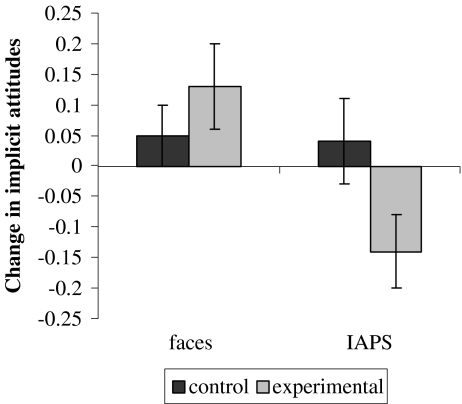
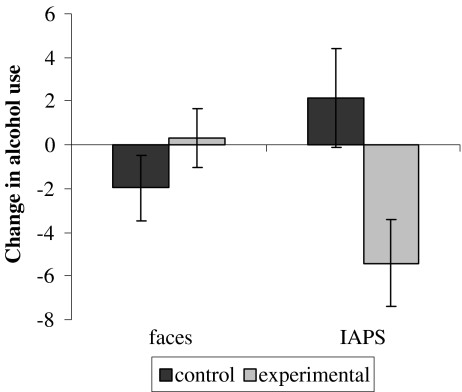
RATIONALE: Since implicit attitudes toward alcohol play an important role in drinking behavior, a possible way to obtain a behavioral change is changing these implicit attitudes. OBJECTIVES: This study examined whether a change in implicit attitudes and in drinking behavior can be achieved via evaluative conditioning. METHODS: Participants were randomly assigned to an experimental condition and a control condition. In the experimental condition, participants were subjected to an evaluative conditioning procedure that consistently pairs alcohol-related cues with negative stimuli. In the control condition, alcohol-related cues were consistently paired with neutral stimuli during the evaluative conditioning phase. Implicit attitudes, explicit attitudes, and drinking behavior were measured before and after the evaluative conditioning phase. RESULTS: Following the evaluative conditioning procedure, participants in the experimental condition showed stronger negative implicit attitudes toward alcohol and consumed less alcohol compared to participants in the control condition. However, this effect was only found when the evaluative conditioning task paired alcohol-related cues with general negative pictures, but not when using pictures of frowning faces. CONCLUSIONS: These results demonstrate that evaluative conditioning can effectively change implicit attitudes toward alcohol and also suggest that this procedure can be used to change drinking behavior. Hence, evaluative conditioning may be a useful new intervention tool to combat alcohol misuse.
Overview
The claims and statistics of this paper haven’t been checked yet.
Free: it reads the open-access text and checks the first 5 claims that cite a source we can check. Create a free account to check every claim.
Integrity signals
Registry
Cites
Statistics
Figures
Verification
Claims the paper makes
The claims and statistics of this paper haven’t been checked yet.
Free: it reads the open-access text and checks the first 5 claims that cite a source we can check. Create a free account to check every claim.
Claims other papers make about this one
Each is checked against this paper’s own text: does it say what the citing paper says it does?
The cited source says what the claim attributes to it.
In the citing paper
“In addition to these re-training paradigms, other paradigms have been developed which demonstrated promising results, such as evaluative conditioning (Houben et al., 2010), neurofeedback training (Sokhadze et al., 2008) and inhibition training in the context of problemrelated stimuli (Houben et al., 2011a), but these procedures have as yet only been tested in student samples.”
From Addiction, adolescence, and the integration of control and motivation (2011) · cites this paper as Houben et al., 2010
Self-check
Percentages, sums and reported differences re-computed from the paper’s own numbers.
The self-check needs the paper’s full text.
Citations
Cites
SAUNDERS, J. B., AASLAND, O. G., BABOR, T. F., DE LA FUENTE, J. R., & GRANT, M. (1993) · Addiction · doi:10.1111/j.1360-0443.1993.tb02093.x · Cited by 13,597 · cited 4×
“…et al. 1993), participants had an average score of 8.26 (SD=4.79) with 43% of the participants scoring above 8, indicating hazardous drinking (Saunders et al. 1993), and 28% of the participants scoring above 10 which has been proposed as a cut-off score for problem drinking in students…”
BackgroundMethodInfluentialMeasuring individual differences in implicit cognition: the implicit association test
Greenwald, A. G., McGhee, D. E., & Schwartz, J. L. K. (1998) · Journal of Personality and Social Psychology · doi:10.1037/0022-3514.74.6.1464 · Cited by 9,210
Understanding and using the Implicit Association Test: I. An improved scoring algorithm.
Greenwald, A. G., Nosek, B. A., & Banaji, M. R. (2003) · Journal of Personality and Social Psychology · doi:10.1037/0022-3514.85.2.197 · Cited by 5,815 · cited 3×
“IAT effects at pre- and posttest were calculated with the D600 algorithm (Greenwald et al. 2003), so that higher scores indicate faster performance when alcohol was paired with pleasant (vs. soft drinks and unpleasant) than when alcohol was paired with unpleasant (vs. soft drinks and pleasant).”
InfluentialThe NimStim set of facial expressions: Judgments from untrained research participants.
Tottenham, N., Tanaka, J. W., Leon, A. C., McCarry, T., Nurse, M., Hare, T. A., Marcus, D. J., Westerlund, A., Casey, B., & Nelson, C. (2009) · Psychiatry Research · doi:10.1016/j.psychres.2008.05.006 · Cited by 3,454 · cited 3×
“The two experimental conditions differed in the type of affective USs used during the EC task: These were either pictures of smiling, frowning, and neutral expressions of men and women taken from the NimStim Set of Facial Expressions (Tottenham et al. 2009) or general positive, negative, and neutral pictures of the In…”
Gawronski, B., & Bodenhausen, G. V. (2006) · Psychological Bulletin · doi:10.1037/0033-2909.132.5.692 · Cited by 2,587 · cited 2×
“Evaluative conditioning”
Lang, P. J., Bradley, M. M., & Cuthbert, B. N. (1999) · Cited by 1,664
De Houwer, J., Thomas, S., & Baeyens, F. (2001) · Psychological Bulletin · doi:10.1037/0033-2909.127.6.853 · Cited by 1,181 · cited 2×
“In this respect, it is interesting to note that EC has been found to be highly resistant to extinction ( De Houwer et al. 2001 )a nd therefore holds the potential to induce long-lasting changes in implicit attitudes and behavior, which may further increase the value of EC as an intervention tool.”
Wiers, R. W., Bartholow, B. D., van den Wildenberg, E., Thush, C., Engels, R. C. M. E., Sher, K. J., Grenard, J., Ames, S. L., & Stacy, A. W. (2007) · Pharmacology Biochemistry and Behavior · doi:10.1016/j.pbb.2006.09.021 · Cited by 734 · cited 3×
“These automatic processes are activated whenever alcohol-related cues are encountered and generate strong impulses to drink alcohol via the automatic activation of behavioral schemas (Deutsch and Strack 2006; Wiers et al. 2007).”
Self-citationImplicit Attitude Formation Through Classical Conditioning
Olson, M. A., & Fazio, R. H. (2001) · Psychological Science · doi:10.1111/1467-9280.00376 · Cited by 512 · cited 2×
“According to general theories of attitude learning, implicit attitudes develop primarily via repeated pairing of attitude objects with positive or negative affect (e.g., Olson and Fazio 2001).”
Handbook of Implicit Cognition and Addiction
Wiers, R., & Stacy, A. (2006) · doi:10.4135/9781412976237 · Cited by 474 · cited 1×
“…appraises stimuli automatically in terms of affective and motivational significance and a slower, reflective system, which includes controlled processes related to conscious deliberations, emotion regulation, and expected outcomes (Deutsch and Strack 2006; Wiers and Stacy 2006; Wiers et al. 2007).”
BackgroundSelf-citation
Research works printed but not linked: 1
- Lang PJ Bradley MM Cuthbert BN International Affective Picture System (IAPS): instruction manual and affective ratings. Technical Report A-6 2005 Gainesville University of Florida
Cited by
Items 101–200 of 213
Zerhouni, O., Houben, K., El-Methni, J., Rutte, N., Werkman, E., & Wiers, R. (2019) · Learning and Motivation · doi:10.1016/j.lmot.2019.02.001 · Cited by 14
Self-citationFriese, M., Gianotti, L. R. R., & Knoch, D. (2015) · Health Psychology · doi:10.1037/hea0000179 · Cited by 17
Brennan, E., Schoenaker, D. A. J. M., Dunstone, K., Slater, M. D., Durkin, S. J., Dixon, H., Pettigrew, S., & Wakefield, M. A. (2020) · Social Science & Medicine · doi:10.1016/j.socscimed.2020.113596 · Cited by 16
Critical and Qualitative Approaches to Behavior Change
Chamberlain, K., & Lyons, A. C. (2020) · Cambridge University Press eBooks · doi:10.1017/9781108677318.030 · Cited by 16
Ostafin, B. D., & Palfai, T. P. (2012) · Addiction Science & Clinical Practice · doi:10.1186/1940-0640-7-25 · Cited by 15
“Initial studies suggest that strategies designed to change automatic associative and attentional biases may lead to reductions in problematic alcohol use [53,54].”
BackgroundAutonomy-Supportive Interventions
Reeve, J., & Cheon, S. H. (2020) · Cambridge University Press eBooks · doi:10.1017/9781108677318.035 · Cited by 15
The Science of Behavior Change: The Road Ahead
Hagger, M. S., Cameron, L. D., Hamilton, K., Hankonen, N. E., & Lintunen, T. (2020) · Cambridge University Press eBooks · doi:10.1017/9781108677318.046 · Cited by 16
Yi, S., Stewart, M. J., Collins, P. S., & Stewart, S. H. (2014) · Journal of Gambling Studies · doi:10.1007/s10899-014-9474-1 · Cited by 15
“For example, Houben et al. (2010) have shown that, in the alcohol field, cognitive retraining procedures designed to alter implicit associations with alcohol from positive to negative are associated with reduced drinking.”
BackgroundImplementation Science and Translation in Behavior Change
Łuszczyńska, A., Łobczowska, K., & Horodyska, K. (2020) · Cambridge University Press eBooks · doi:10.1017/9781108677318.023 · Cited by 13
Milner, J. S., Wagner, M. F., & Crouch, J. L. (2016) · Cognitive Therapy and Research · doi:10.1007/s10608-016-9800-2 · Cited by 14
“…has used EC to change existing positive or negative attitudes, such as racial prejudices (Olson and Fazio 2006), social anxiety (Clerkin and Teachman 2010), alcohol liking (Houben et al. 2010), food choices (Hollands et al. 2011), brand preferences (Gibson 2008), and recycling (Geng et al. 2013).”
MethodProcessus automatiques et activités physiques bénéfiques pour la santé
Cheval, B., Sarrazin, P. G., & Radel, R. (2016) · L’Année psychologique · doi:10.3917/anpsy.162.0295 · Cited by 14
Changing Behavior Using Control Theory
Mansell, W. (2020) · Cambridge University Press eBooks · doi:10.1017/9781108677318.009 · Cited by 13
Maximizing User Engagement with Behavior Change Interventions
Yardley, L., Morrison, L. G., Müller, I., & Bradbury, K. J. (2020) · Cambridge University Press eBooks · doi:10.1017/9781108677318.025 · Cited by 13
Capturing Eating Behavior Where the Action Takes Place: a Comment on McKee et al.
Hofmann, W., & Dohle, S. (2014) · Annals of Behavioral Medicine · doi:10.1007/s12160-014-9625-8 · Cited by 13
Motivational Interviewing Interventions
Berman, A. H., Beckman, M., & Lindqvist, H. (2020) · Cambridge University Press eBooks · doi:10.1017/9781108677318.045 · Cited by 14
de Ridder, D. T. D., Gillebaart, M., & Friese, M. (2020) · Cambridge University Press eBooks · doi:10.1017/9781108677318.040 · Cited by 11
Automatic and Controlled Processes in the Pathway from Drug Abuse to Addiction
Field, M., & Wiers, R. W. H. J. (2012) · Springer eBooks · doi:10.1007/978-1-4614-3375-0_3 · Cited by 11
Self-citationStewart, M. J., Stewart, S. H., Yi, S., & Ellery, M. (2015) · International Gambling Studies · doi:10.1080/14459795.2014.1000357 · Cited by 11
Stewart, M. J., Yi, S., & Stewart, S. H. (2013) · Journal of Gambling Studies · doi:10.1007/s10899-013-9383-8 · Cited by 11
The Role of Memory Associations in Excessive and Problem Gambling
Stiles, M., Hudson, A., Ramasubbu, C., Ames, S. L., Yi, S., Gough, K., & Stewart, S. H. (2017) · Journal of Gambling Issues · doi:10.4309/jgi.2016.34.7 · Cited by 11
Stevenson, B. L., Dvorak, R. D., Kuvaas, N. J., Williams, T. J., & Spaeth, D. T. (2015) · Psychology of Addictive Behaviors · doi:10.1037/adb0000045 · Cited by 11
Luht-Kallas, K. (2020) · DSpace repository (University of Tartu) · Cited by 13
Evaluation of Behavior Change Interventions
Matthews, L., & Simpson, S. A. (2020) · Cambridge University Press eBooks · doi:10.1017/9781108677318.022 · Cited by 10
Innovative Treatment Approaches in Gambling Disorder
Snippe, L., Boffo, M., Stewart, S. H., Dom, G., & Wiers, R. W. H. J. (2019) · Springer eBooks · doi:10.1007/978-3-030-03060-5_10 · Cited by 10
“Interestingly, one study found EC was only effective in changing implicit alcohol attitudes when general negative images were used and not when photos of frowning faces were used [130].”
BackgroundSelf-citationEconomic and Behavioral Economic Approaches to Behavior Change
Brown, P. M., Cameron, L. D., Wilkinson, M., & Taylor, D. (2020) · Cambridge University Press eBooks · doi:10.1017/9781108677318.042 · Cited by 10
Application of item response theory to tests of substance-related associative memory.
Shono, Y., Grenard, J. L., Ames, S. L., & Stacy, A. W. (2014) · Psychology of Addictive Behaviors · doi:10.1037/a0035877 · Cited by 11
Wang, Y., Wang, G., Zhang, D., Wang, L., Cui, X., Zhu, J., & Fang, Y. (2017) · Frontiers in Psychology · doi:10.3389/fpsyg.2017.01468 · Cited by 10
Drinking beyond intentions: The prototype willingness model and alcohol consumption
Davies, E., & Todd, J. (2021) · Springer eBooks · doi:10.1007/978-3-030-66941-6_3 · Cited by 10
Dixon, H., Scully, M. L., Niederdeppe, J., Brennan, E., O’Brien, K., Vandenberg, B., Pettigrew, S., & Wakefield, M. A. (2023) · Addiction · doi:10.1111/add.16317 · Cited by 8
“[43], participants were asked at both time-points (i.e. baseline and follow-up) about their attitude towards drinking beer using six 7-point semantic differential scales anchored by unpleasant/pleasant, boring/fun, bad/good, risky/safe, unhealthy/healthy and negative/positive.”
Cognitive bias modification in the treatment of addiction
Wiers, R. W. H. J., Zerhouni, O., den Uyl, T. E., & Boffo, M. (2019) · Elsevier eBooks · doi:10.1016/b978-0-12-815298-0.00017-4 · Cited by 8
Self-citationTello, N., Jaafari, N., & Chatard, A. (2020) · Alcohol and Alcoholism · doi:10.1093/alcalc/agaa009 · Cited by 8
Epton, T., & Armitage, C. J. (2020) · Cambridge University Press eBooks · doi:10.1017/9781108677318.038 · Cited by 8
Wang, J., & Huang, Y. (2022) · Frontiers in Psychiatry · doi:10.3389/fpsyt.2022.988435 · Cited by 8
Implicit and Explicit Attitudes to Alcohol in Alcohol Dependent and Non-Alcohol Dependent Samples
McPherson, A., & Harris, L. M. (2013) · Journal of Psychopathology and Behavioral Assessment · doi:10.1007/s10862-013-9345-6 · Cited by 8
“Importantly, recent work with non-clinical samples suggests that changing positive implicit associations through evaluative conditioning (Houben et al. 2010), or mindfulness training (Farris et al. 2010) is associated with reduced drinking behavior (Houben et al. 2010), and the present findings…”
BackgroundMethodChanging Behavior Using Integrative Self-Control Theory
Hofmann, W., Dohle, S., & Diel, K. (2020) · Cambridge University Press eBooks · doi:10.1017/9781108677318.011 · Cited by 8
Lauckner, C., Desrosiers, A., Muilenburg, J. L., Killanin, A. D., Genter, E. N., & Kershaw, T. (2019) · Journal of Adolescence · doi:10.1016/j.adolescence.2019.10.013 · Cited by 7
Hadadgar, S., Peimani, J., Hassani‐Abharian, P., Mashayekh, M., Peivandi, P., & Fekrazad, R. (2024) · Photobiomodulation Photomedicine and Laser Surgery · doi:10.1089/photob.2023.0064 · Cited by 7
“43,44,62,65 65–67 Most recently, a study reported an improvement in verbal WM concurrent with a decrease in the number of alcoholic drinks consumed per drinking occasion after a 5-week CogMed training program.”
Petzel, Z. W., & Noel, J. G. (2020) · Journal of Health Psychology · doi:10.1177/1359105320934166 · Cited by 7
“Many researchers seek to develop interventions that reduce students’ HED by influencing cognitive and motivational precursors to high-risk alcohol use (Houben et al., 2010; Noel et al., 2019).”
BackgroundAddressing Underserved Populations and Disparities in Behavior Change
Schüz, B., & Hooper, M. W. (2020) · Cambridge University Press eBooks · doi:10.1017/9781108677318.027 · Cited by 8
Noel, J. G., Petzel, Z. W., & Mulderig, T. H. (2019) · Psychology of Addictive Behaviors · doi:10.1037/adb0000449 · Cited by 7
“Notwithstanding these limitations, results are in line with empirical findings reported by Houben, Havermans, and Wiers (2010) but using a different implicit alcohol assessment and support the APE model, suggesting implicit responses may be influenced by recently acquired associations (i.e., EC),…”
BackgroundResultImplicit and Explicit Associations with Erotic Stimuli in Women with and Without Sexual Problems
van Lankveld, J. J. D. M., Bandell, M. L., Bastin-Hurek, E., van Beurden, M., & Araz, S. (2018) · Archives of Sexual Behavior · doi:10.1007/s10508-018-1152-4 · Cited by 7
Conner, M. T., Williams, D. M., & Rhodes, R. E. (2020) · Cambridge University Press eBooks · doi:10.1017/9781108677318.034 · Cited by 8
Rasera, M., Jayasinghe, H., Parker, F., Short, C. E., Conroy, D. E., Jackson, B., Dimmock, J. A., Rhodes, R. E., de Vries, H., Vandelanotte, C., et al. (2022) · Sport Exercise and Performance Psychology · doi:10.1037/spy0000278 · Cited by 6
Chen, P.-J., Coricelli, C., Kaya, S., Rumiati, R. I., & Foroni, F. (2022) · Neuroscience Research · doi:10.1016/j.neures.2022.07.002 · Cited by 6
Affect, Dual-Processing, Developmental Psychopathology, and Health Behaviors
Wiers, R. W. H. J., Anderson, K. G., Bockstaele, B. V., Salemink, E., & Hommel, B. (2018) · Oxford University Press eBooks · doi:10.1093/oso/9780190499037.003.0008 · Cited by 6
Self-citationWhite, M. J., & Pohl, E. S. (2022) · Psychology of Addictive Behaviors · doi:10.1037/adb0000847 · Cited by 6
Good, M., Linzel, M., & Kosits, R. D. (2019) · International Journal for the Psychology of Religion · doi:10.1080/10508619.2019.1651192 · Cited by 6
Addiction: Brain and Cognitive Stimulation for Better Cognitive Control and Far Beyond
Noël, X., Bechara, A., Saeremans, M., Kornreich, C., Dousset, C., Campanella, S., Chatard, A., Jaafari, N., & Dubuson, M. (2020) · IntechOpen eBooks · doi:10.5772/intechopen.88869 · Cited by 6
Chilcott, T. (2017) · Journal for the Cognitive Science of Religion · doi:10.1558/jcsr.31055 · Cited by 6
Strategien zur Einstellungs- und Verhaltensänderung
Stroebe, W. (2023) · Springer eBooks · doi:10.1007/978-3-662-65297-8_7 · Cited by 5
Vanaelst, J., Spruyt, A., & Houwer, J. D. (2016) · Frontiers in Psychology · doi:10.3389/fpsyg.2016.00717 · Cited by 5
“In line with this reasoning, it has been demonstrated that experimentally induced changes in the automatic evaluation of alcohol-related stimuli can result in a corresponding change in alcohol consumption (e.g., Houben et al., 2010).”
InfluentialWhere is the bias?: Measuring and retraining cognitive biases in problem drinkers
van Deursen, D. S. (2019) · UvA-DARE (University of Amsterdam) · Cited by 5
Changing Behavior in the Digital Age
Kavanagh, D. J. (2020) · Cambridge University Press eBooks · doi:10.1017/9781108677318.029 · Cited by 20
Stimulus variability improves generalization following response inhibition training
Moshon-Cohen, T. E., Weinbach, N., & Bitan, T. (2024) · Psychological Research · doi:10.1007/s00426-023-01913-w · Cited by 4
“GNG training using alcohol stimuli was shown to increase implicit attitudes towards alcohol and reduced alcohol consumption among healthy young adults and heavy drinkers (Houben et al., 2010, 2012).”
Conditionnement évaluatif : apports méthodologiques et réflexion cliniques
Kosinski, T. (2014) · theses.fr (ABES) · doi:10.70675/eceb0b68z0832z4688zaac6z79ca95ee546a · Cited by 5
D’Hooge, S., & Jans, S. D. (2025) · International Journal of Advertising · doi:10.1080/02650487.2025.2529634 · Cited by 3
“While EC interventions have been studied to reduce maladaptive behaviors (e.g. alcoholism; Houben, Havermans, et al. 2010; Houben, Schoenmakers, et al. 2010) and to stimulate healthy behavior (e.g. healthy food consumption; Alblas et al. 2018; Hollands, Prestwich, and Marteau 2011), its application…”
Reciprocal associations between implicit attitudes and drinking in emerging adulthood
Paige, K. J., Weigard, A. S., & Colder, C. R. (2022) · Alcoholism Clinical and Experimental Research · doi:10.1111/acer.14759 · Cited by 3
Interventions for implicit social cognition
Xiaoli, G., Junyao, C., Maajie, S., & Ziyan, Y. (2025) · Advances in Psychological Science · doi:10.3724/sp.j.1042.2025.1630 · Cited by 3
Evaluating alcohol and marijuana use among emerging adult males via analysis of text messages
Pizzicato, L. N., Barbour, R. C., & Kershaw, T. (2019) · Substance Use & Misuse · doi:10.1080/10826084.2019.1594902 · Cited by 3
Kosinski, T., Chafi, A., & Rusinek, S. (2017) · Journal de Thérapie Comportementale et Cognitive · doi:10.1016/j.jtcc.2017.02.001 · Cited by 3
Cheval, B. (2014) · theses.fr (ABES) · doi:10.70675/f615f889z9711z4583zacaaz6d4b26f86632 · Cited by 4
Petzel, Z. W., & Noel, J. G. (2018) · Addictive Behaviors · doi:10.1016/j.addbeh.2018.12.010 · Cited by 2
Cofresí, R. U., Piasecki, T. M., Bartholow, B. D., & Schachtman, T. R. (2022) · Psychopharmacology · doi:10.1007/s00213-022-06231-4 · Cited by 2
Wagner, M. F., Skowronski, J. J., Milner, J. S., Crouch, J. L., & Ammar, J. (2019) · Psychological Reports · doi:10.1177/0033294119894231 · Cited by 2
The timing-dependent effects of stress-induced cortisol release on evaluative conditioning
Halbeisen, G., Buttlar, B., Kamp, S., & Walther, E. (2020) · International Journal of Psychophysiology · doi:10.1016/j.ijpsycho.2020.04.007 · Cited by 2
Implicit and Associative Processes in Addiction
Wiers, R. W. H. J., & Stacy, A. W. (2013) · Elsevier eBooks · doi:10.1016/b978-0-12-398336-7.00042-5 · Cited by 2
Self-citationBehavior Change in Community Contexts
Trickett, E. J., & Paterson, S. E. (2020) · Cambridge University Press eBooks · doi:10.1017/9781108677318.028 · Cited by 2
The Role of Implicit Associations in Alcohol and Substance Use Disorders
Chatard, A., Zerhouni, O., Solinas, M., & Noël, X. (2024) · Springer eBooks · doi:10.1007/978-3-031-55889-4_12 · Cited by 3
Family motivational intervention for reducing cannabis use in recent-onset schizophrenia
Smeerdijk, A. M. (2015) · Data Archiving and Networked Services (DANS) · Cited by 2
Stoppen met drinken kan je leren: Een impulsieve en een reflectieve route naar gedragsverandering
Houben, K. (2010) · Psychologie & gezondheid · doi:10.1007/bf03089375 · Cited by 1
Self-citationMontoya, M. J. C., Montiel, I. D., Sánchez, J. H., & Fajardo-Dolci, G. (2019) · Revista de la Facultad de Medicina UNAM · doi:10.22201/fm.24484865e.2019.62.6.08 · Cited by 1
Cost-Effectiveness Evaluations of Behavior Change Interventions
Wang, T., Downes, M., Byrnes, J., & Scuffham, P. (2020) · Cambridge University Press eBooks · doi:10.1017/9781108677318.026 · Cited by 1
Englert, C., Rhodes, R. E., Pfeffer, I., & Rebar, A. L. (2023) · Frontiers research topics · doi:10.3389/978-2-83251-700-0 · Cited by 1
Tendencias en el estudio de la cognición implícita relacionada con el alcohol
Biscarra, M. A., Conde, K., & Cremonte, M. (2017) · Revista de Psicología · doi:10.18800/psico.201702.012 · Cited by 1
Noel, J. G., & Petzel, Z. W. (2020) · Addictive Behaviors · doi:10.1016/j.addbeh.2020.106460 · Cited by 1
Research Methods for Health Decision Making
Kiviniemi, M. T., & Ellis, E. M. (2016) · Springer eBooks · doi:10.1007/978-1-4939-3486-7_5 · Cited by 1
Examining the effects of gambling-relevant cues on gambling outcome expectancies
Hudson, A., Gough, K., Yi, S., Stiles, M., MacNevin, P. D., & Stewart, S. H. (2017) · International Gambling Studies · doi:10.1080/14459795.2017.1324893 · Cited by 1
“Intervention methods that target implicit alcohol outcome expectancies have shown promise in reducing problem drinking, suggesting that similar methods may be successful in the treatment of problem gambling (Houben et al., 2010; Wiers & Stacy, 2006; Wiers et al., 2005).”
MethodCappelli, C., Pike, J. R., Xie, B., Michaels, J., & Stacy, A. W. (2024) · The American Journal of Drug and Alcohol Abuse · doi:10.1080/00952990.2024.2335979 · Cited by 1
Alcohol Cognitions and College Student Drinking: The Moderating Effect of Executive Abilities
Lavigne, A. M. (2013) · Digital Commons - URI (University of Rhode Island) · doi:10.23860/diss-lavigne-andrea-2013 · Cited by 1
Cannabis use in patients with schizophrenia: motivation for use and relation to clinical variables
Dekker, N. L. (2011) · UvA-DARE (University of Amsterdam) · Cited by 1
Interventions for behaviour change
PhD, R. B. (2013) · Wiley eBooks · doi:10.1002/9781118572894.ch7
Nederkoorn, C. (2011) · Psychologie & gezondheid · doi:10.1007/s12483-011-0053-1
The effects of evaluative conditioning on implicit attitudes toward alcohol in drinkers
Choi, Y., & LeeJangHan (2012) · The Korean Journal of Clinical Psychology · doi:10.15842/kjcp.2012.31.4.001
Brown, A. (2014) · Lincoln Repository (University of Lincoln) · doi:10.24385/lincoln.24327802
Approach-avoidance instructions and training as a method for changing implicit evaluations
Dessel, P. V. (2016) · Ghent University Academic Bibliography (Ghent University)
Working Memory and Food-Related Decision Making
Whitelock, V. (2017) · Middlesex University Research Repository (Middlesex University Of London) · doi:10.13140/rg.2.2.17030.27204
Social psychological perspective on binge drinking in young people
Howard, G. (2016) · UEA Digital Repository (University of East Anglia)
The Role of Cognitive Processes in Social Anxiety Risk for Problematic Drinking
Nitka, D. (2017) · Spectrum Research Repository (Concordia University)
Alcohol consumption and pre-drinking in Australian undergraduates
Caudwell, K. M. (2017) · eSpace (Curtin University)
Graves, A. J. (2017) · NC Digital Online Collection of Knowledge and Scholarship (The University of North Carolina at Greensboro) · doi:10.71889/5fylantbak.29862545
The Influence of Cocaine-Related Images on Inhibitory Control in Cocaine Users
Pike, E. (2017) · UKnowledge (University of Kentucky) · doi:10.13023/etd.2017.320
Mattavelli, S. (2017) · BOA (University of Milano-Bicocca)
Stewart, M. J. (2014) · DalSpace (Dalhousie University)
Callaghan, R. (2017) · Maynooth University ePrints and eTheses Archive (Maynooth University)
Davies, E. (2013) · Radar (Oxford Brookes University) · doi:10.24384/ynde-7h36
Geng, X. (2020) · Otago University Research Archive (University of Otago)
Fear-based health messages for Malay diabetes patients in Singapore
Kawaja, A. (2020) · DR-NTU (Nanyang Technological University) · doi:10.32657/10356/146132
Metadata
- Authors
- Houben, K., Havermans, R. C., & Wiers, R. W.
- Affiliations
- Maastricht University (NL)
- University of Amsterdam (NL)
- Corresponding author
- Houben, Katrijn
- Venue
- Psychopharmacology
- Published
- 2010-04-30
- Volume
- 211
- Issue
- 1
- Pages
- 79-86
- ISSN
- 0033-3158 (ISSN-L)
- 1432-2072
- PMC
- PMC2885295
- OpenAlex
- W2009877681
- Cited by
- 183
- References
- 30
- Citations by year
- 2025: 1 · 2024: 4 · 2023: 3 · 2022: 8 · 2021: 4 · 2020: 58 · 2019: 14 · 2018: 8 · 2017: 10 · 2016: 16 · 2015: 13 · 2014: 12 · 2013: 8 · 2012: 7
- FWCI
- 7.45
- Type
- journal article
- Language
- en
- Open access
- hybrid
- doi.org
- Licence
- cc-by-nc
- Locations
- Psychopharmacology (publishedVersion, cc-by-nc)
- PubMed Central (publishedVersion, cc-by-nc)
- PubMed (publishedVersion)
- Research Publications (Maastricht University) (publishedVersion, cc-by-nc)
- UvA-DARE (University of Amsterdam) (publishedVersion)
- Research Publications (Maastricht University) (submittedVersion, other-oa)
- Data Archiving and Networked Services (DANS) (submittedVersion)
- Funders
- Stichting voor de Technische Wetenschappen
- Topics
- Health Sciences › Medicine › Epidemiology › Substance Abuse Treatment and Outcomes
- Social Sciences › Psychology › Applied Psychology › Behavioral Health and Interventions
- Social Sciences › Sociology and Political Science › Social and Intergroup Psychology
- Keywords
- evaluative conditioning, drinking behavior, alcohol consumption reduction, alcohol cues, explicit attitudes, facial expressions
- MeSH terms
- Adolescent, Adult, Affect, Alcohol Drinking, Alcoholic Beverages, Attitude, Avoidance Learning, Cues, Female, Humans, Internal-External Control, Functional Laterality, Male, Psychomotor Performance, Surveys and Questionnaires, Young Adult
About these checks
Registry, retraction, Cites and statistics results are computed, not judged, with one exception: a printed reference that no index lists is read once by a model before it counts as a citation error. Claims are extracted by a model and kept only when their quote appears verbatim in the text; each cited source is then checked, with a model’s help, for whether it says what the claim relies on. Those verdicts can be wrong — read the claim’s quote and the cited source before relying on one.
Statistics and arithmetic are recomputed, not judged.
Confidence bands are shown only for fields calibrated on our annotated test set. None is calibrated yet, so no band is shown.
What counts as a claim ›How we measure confidence ›How we check this ›
Are you an author, or do you see a problem with this page? Request a review
Data sources
Bibliographic data: Semantic Scholar, OpenAlex, Crossref.
Contains information from the Semantic Scholar Academic Graph Datasets, made available under the ODC Attribution License (ODC-BY 1.0).
Semantic Scholar’s data is described in: Kinney, R., et al. (2023). The Semantic Scholar Open Data Platform. arXiv:2301.10140.
