

Learning to dislike alcohol: conditioning negative implicit attitudes toward alcohol and its effect on drinking behavior
Open accessThe DOI matches its Crossref record; 29 of the 30 references it cites were found in a registry or an index.
Abstract
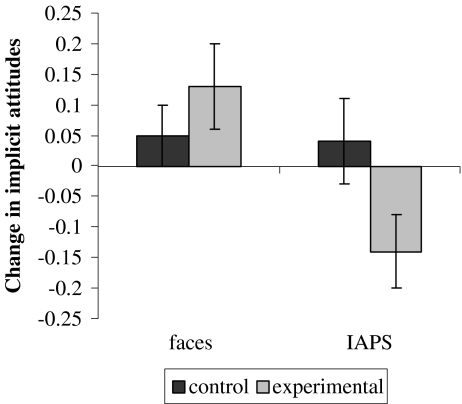
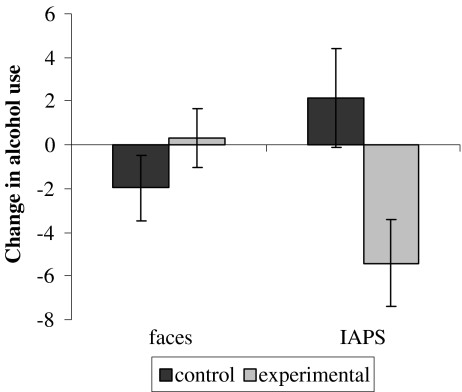
RATIONALE: Since implicit attitudes toward alcohol play an important role in drinking behavior, a possible way to obtain a behavioral change is changing these implicit attitudes. OBJECTIVES: This study examined whether a change in implicit attitudes and in drinking behavior can be achieved via evaluative conditioning. METHODS: Participants were randomly assigned to an experimental condition and a control condition. In the experimental condition, participants were subjected to an evaluative conditioning procedure that consistently pairs alcohol-related cues with negative stimuli. In the control condition, alcohol-related cues were consistently paired with neutral stimuli during the evaluative conditioning phase. Implicit attitudes, explicit attitudes, and drinking behavior were measured before and after the evaluative conditioning phase. RESULTS: Following the evaluative conditioning procedure, participants in the experimental condition showed stronger negative implicit attitudes toward alcohol and consumed less alcohol compared to participants in the control condition. However, this effect was only found when the evaluative conditioning task paired alcohol-related cues with general negative pictures, but not when using pictures of frowning faces. CONCLUSIONS: These results demonstrate that evaluative conditioning can effectively change implicit attitudes toward alcohol and also suggest that this procedure can be used to change drinking behavior. Hence, evaluative conditioning may be a useful new intervention tool to combat alcohol misuse.
Overview
The claims and statistics of this paper haven’t been checked yet.
Free: it reads the open-access text and checks the first 5 claims that cite a source we can check. Create a free account to check every claim.
Integrity signals
Registry
Cites
Statistics
Figures
Verification
Claims the paper makes
The claims and statistics of this paper haven’t been checked yet.
Free: it reads the open-access text and checks the first 5 claims that cite a source we can check. Create a free account to check every claim.
Claims other papers make about this one
Each is checked against this paper’s own text: does it say what the citing paper says it does?
The cited source says what the claim attributes to it.
In the citing paper
“In addition to these re-training paradigms, other paradigms have been developed which demonstrated promising results, such as evaluative conditioning (Houben et al., 2010), neurofeedback training (Sokhadze et al., 2008) and inhibition training in the context of problemrelated stimuli (Houben et al., 2011a), but these procedures have as yet only been tested in student samples.”
From Addiction, adolescence, and the integration of control and motivation (2011) · cites this paper as Houben et al., 2010
Self-check
Percentages, sums and reported differences re-computed from the paper’s own numbers.
The self-check needs the paper’s full text.
Citations
Cites
SAUNDERS, J. B., AASLAND, O. G., BABOR, T. F., DE LA FUENTE, J. R., & GRANT, M. (1993) · Addiction · doi:10.1111/j.1360-0443.1993.tb02093.x · Cited by 13,597 · cited 4×
“…et al. 1993), participants had an average score of 8.26 (SD=4.79) with 43% of the participants scoring above 8, indicating hazardous drinking (Saunders et al. 1993), and 28% of the participants scoring above 10 which has been proposed as a cut-off score for problem drinking in students…”
BackgroundMethodInfluentialMeasuring individual differences in implicit cognition: the implicit association test
Greenwald, A. G., McGhee, D. E., & Schwartz, J. L. K. (1998) · Journal of Personality and Social Psychology · doi:10.1037/0022-3514.74.6.1464 · Cited by 9,210
Understanding and using the Implicit Association Test: I. An improved scoring algorithm.
Greenwald, A. G., Nosek, B. A., & Banaji, M. R. (2003) · Journal of Personality and Social Psychology · doi:10.1037/0022-3514.85.2.197 · Cited by 5,815 · cited 3×
“IAT effects at pre- and posttest were calculated with the D600 algorithm (Greenwald et al. 2003), so that higher scores indicate faster performance when alcohol was paired with pleasant (vs. soft drinks and unpleasant) than when alcohol was paired with unpleasant (vs. soft drinks and pleasant).”
InfluentialThe NimStim set of facial expressions: Judgments from untrained research participants.
Tottenham, N., Tanaka, J. W., Leon, A. C., McCarry, T., Nurse, M., Hare, T. A., Marcus, D. J., Westerlund, A., Casey, B., & Nelson, C. (2009) · Psychiatry Research · doi:10.1016/j.psychres.2008.05.006 · Cited by 3,454 · cited 3×
“The two experimental conditions differed in the type of affective USs used during the EC task: These were either pictures of smiling, frowning, and neutral expressions of men and women taken from the NimStim Set of Facial Expressions (Tottenham et al. 2009) or general positive, negative, and neutral pictures of the In…”
Gawronski, B., & Bodenhausen, G. V. (2006) · Psychological Bulletin · doi:10.1037/0033-2909.132.5.692 · Cited by 2,587 · cited 2×
“Evaluative conditioning”
Lang, P. J., Bradley, M. M., & Cuthbert, B. N. (1999) · Cited by 1,664
De Houwer, J., Thomas, S., & Baeyens, F. (2001) · Psychological Bulletin · doi:10.1037/0033-2909.127.6.853 · Cited by 1,181 · cited 2×
“In this respect, it is interesting to note that EC has been found to be highly resistant to extinction ( De Houwer et al. 2001 )a nd therefore holds the potential to induce long-lasting changes in implicit attitudes and behavior, which may further increase the value of EC as an intervention tool.”
Wiers, R. W., Bartholow, B. D., van den Wildenberg, E., Thush, C., Engels, R. C. M. E., Sher, K. J., Grenard, J., Ames, S. L., & Stacy, A. W. (2007) · Pharmacology Biochemistry and Behavior · doi:10.1016/j.pbb.2006.09.021 · Cited by 734 · cited 3×
“These automatic processes are activated whenever alcohol-related cues are encountered and generate strong impulses to drink alcohol via the automatic activation of behavioral schemas (Deutsch and Strack 2006; Wiers et al. 2007).”
Self-citationImplicit Attitude Formation Through Classical Conditioning
Olson, M. A., & Fazio, R. H. (2001) · Psychological Science · doi:10.1111/1467-9280.00376 · Cited by 512 · cited 2×
“According to general theories of attitude learning, implicit attitudes develop primarily via repeated pairing of attitude objects with positive or negative affect (e.g., Olson and Fazio 2001).”
Handbook of Implicit Cognition and Addiction
Wiers, R., & Stacy, A. (2006) · doi:10.4135/9781412976237 · Cited by 474 · cited 1×
“…appraises stimuli automatically in terms of affective and motivational significance and a slower, reflective system, which includes controlled processes related to conscious deliberations, emotion regulation, and expected outcomes (Deutsch and Strack 2006; Wiers and Stacy 2006; Wiers et al. 2007).”
BackgroundSelf-citation
Research works printed but not linked: 1
- Lang PJ Bradley MM Cuthbert BN International Affective Picture System (IAPS): instruction manual and affective ratings. Technical Report A-6 2005 Gainesville University of Florida
Cited by
Items 201–213 of 213
Hastings, G. (2017) · Stirling Online Research Repository (University of Stirling)
Modifying automatic responses to food cues using cognitive control training and brain stimulation
Sedgmond, J. (2021) · ORCA Online Research @Cardiff (Cardiff University)
Shaw, J. A., & Forman, E. M. (2015) · iDEA - Drexel University Institutional Repository · doi:10.17918/etd-6847
Mierop, A. (2019) · Thesis Commons (OSF Preprints) · doi:10.31237/osf.io/hacw7
Hagger, M. S., Cameron, L. D., Hamilton, K., Hankonen, N. E., & Lintunen, T. (2020) · Cambridge University Press eBooks · doi:10.1017/9781108677318.047
MOBILE TECHNOLOGIES FOR IMPLICIT SELF-REGULATION
Costa, J. M. D. R. (2019) · eCommons (Cornell University) · doi:10.7298/n77w-4z22
D’Hooge, S., & Jans, S. D. (2024) · Ghent University Academic Bibliography (Ghent University)
Ogilvie, D. (2013) · Apollo (University of Cambridge)
A Dual-Force Perspective on Evaluative Conditioning
Sperlich, L. M. (2024) · Kölner Universitäts PublikationsServer (Universität zu Köln)
Maas, J. (2015) · Radboud Repository (Radboud University)
Automatische Evaluationen von Sport
Antoniewicz, F. (. S. (2016) · publish.UP (University of Potsdam)
Batailler, C. (2021) · theses.fr (ABES) · doi:10.70675/98562b77ze495z4550za8d0za64c0a8459f1
Metadata
- Authors
- Houben, K., Havermans, R. C., & Wiers, R. W.
- Affiliations
- Maastricht University (NL)
- University of Amsterdam (NL)
- Corresponding author
- Houben, Katrijn
- Venue
- Psychopharmacology
- Published
- 2010-04-30
- Volume
- 211
- Issue
- 1
- Pages
- 79-86
- ISSN
- 0033-3158 (ISSN-L)
- 1432-2072
- PMC
- PMC2885295
- OpenAlex
- W2009877681
- Cited by
- 183
- References
- 30
- Citations by year
- 2025: 1 · 2024: 4 · 2023: 3 · 2022: 8 · 2021: 4 · 2020: 58 · 2019: 14 · 2018: 8 · 2017: 10 · 2016: 16 · 2015: 13 · 2014: 12 · 2013: 8 · 2012: 7
- FWCI
- 7.45
- Type
- journal article
- Language
- en
- Open access
- hybrid
- doi.org
- Licence
- cc-by-nc
- Locations
- Psychopharmacology (publishedVersion, cc-by-nc)
- PubMed Central (publishedVersion, cc-by-nc)
- PubMed (publishedVersion)
- Research Publications (Maastricht University) (publishedVersion, cc-by-nc)
- UvA-DARE (University of Amsterdam) (publishedVersion)
- Research Publications (Maastricht University) (submittedVersion, other-oa)
- Data Archiving and Networked Services (DANS) (submittedVersion)
- Funders
- Stichting voor de Technische Wetenschappen
- Topics
- Health Sciences › Medicine › Epidemiology › Substance Abuse Treatment and Outcomes
- Social Sciences › Psychology › Applied Psychology › Behavioral Health and Interventions
- Social Sciences › Sociology and Political Science › Social and Intergroup Psychology
- Keywords
- evaluative conditioning, drinking behavior, alcohol consumption reduction, alcohol cues, explicit attitudes, facial expressions
- MeSH terms
- Adolescent, Adult, Affect, Alcohol Drinking, Alcoholic Beverages, Attitude, Avoidance Learning, Cues, Female, Humans, Internal-External Control, Functional Laterality, Male, Psychomotor Performance, Surveys and Questionnaires, Young Adult
About these checks
Registry, retraction, Cites and statistics results are computed, not judged, with one exception: a printed reference that no index lists is read once by a model before it counts as a citation error. Claims are extracted by a model and kept only when their quote appears verbatim in the text; each cited source is then checked, with a model’s help, for whether it says what the claim relies on. Those verdicts can be wrong — read the claim’s quote and the cited source before relying on one.
Statistics and arithmetic are recomputed, not judged.
Confidence bands are shown only for fields calibrated on our annotated test set. None is calibrated yet, so no band is shown.
What counts as a claim ›How we measure confidence ›How we check this ›
Are you an author, or do you see a problem with this page? Request a review
Data sources
Bibliographic data: Semantic Scholar, OpenAlex, Crossref.
Contains information from the Semantic Scholar Academic Graph Datasets, made available under the ODC Attribution License (ODC-BY 1.0).
Semantic Scholar’s data is described in: Kinney, R., et al. (2023). The Semantic Scholar Open Data Platform. arXiv:2301.10140.
