

A double-blind, placebo-controlled study evaluating the effects of caffeine and L-theanine both alone and in combination on cerebral blood flow, cognition and mood
Open accessThe DOI matches its Crossref record; 73 of the 73 references it cites were found in a registry or an index; 12 of the 64 sources its claims cite were checked for support.
Abstract
RATIONALE: Evidence suggests interactive effects of the tea components caffeine and L-theanine on behaviour, yet no data exists exploring the impact of the two on cerebral blood flow (CBF). OBJECTIVES: The current placebo-controlled, double-blind, counterbalanced, crossover study examined the effects of caffeine and L-theanine on CBF and extended previous cognitive and mood findings by using lower doses than previous studies of a similar methodology, which more closely reflect the ratios present in tea. METHODS: Twelve habitual consumers and 12 non-habitual consumers of caffeine each received 75 mg caffeine, 50 mg L-theanine, 75 mg caffeine plus 50 mg L-theanine, and placebo in a counterbalanced order across four separate visits. CBF was measured via near-infrared spectroscopy with cognition and mood assessed at baseline and 30 min post-dose. Salivary caffeine and peripheral haemodynamics were co-monitored. RESULTS: Caffeine reduced oxygenated haemoglobin (oxy-Hb), increased deoxygenated haemoglobin (deoxy-Hb), improved performance on attention tasks and increased overall mood ratings. Increases in deoxy-Hb following caffeine were more pronounced in non-consumers. Some evidence for increased deoxy-Hb remained when caffeine was combined with L-theanine, but this effect was attenuated and the effects of caffeine on oxy-Hb, cognition and mood were eradicated. CONCLUSIONS: Combining L-theanine with caffeine, at levels and ratios equivalent to one to two cups of tea, eliminated the vasoconstrictive effect and behavioural effects of caffeine. This supports previous findings of an interaction between these substances, despite a lack of effects of L-theanine in isolation. However, at the levels tested here, this did not lead to a positive impact on behaviour.
Overview
CoChat Summary
TL;DR
In a double-blind, placebo-controlled crossover study of 24 participants, 75 mg caffeine reduced prefrontal oxygenated haemoglobin, increased deoxygenated haemoglobin, improved attention and mood, but adding 50 mg L-theanine abolished caffeine’s oxy-Hb, cognitive and mood effects. L-theanine alone showed little effect, and the combination did not improve behaviour at these tea-like doses.
Key findings
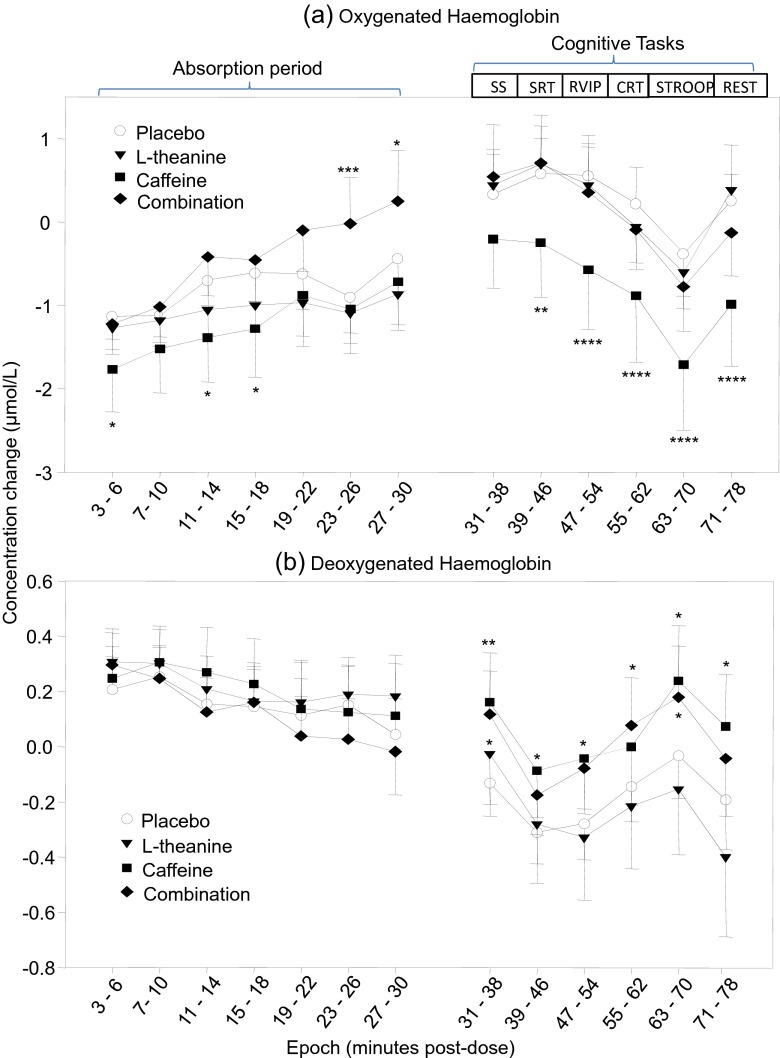
- Caffeine (75 mg) vs placebo reduced oxy-Hb during absorption minutes 3–6 and 11–18 and during SRT, RVIP, CRT, Stroop and rest (p < 0.05 to p < 0.001), and increased deoxy-Hb during serial subtractions, SRT, RVIP, Stroop and rest (p < 0.05 to p < 0.01).
- The combination (75 mg caffeine + 50 mg L-theanine) did not show the caffeine-induced oxy-Hb reduction during cognitive tasks; oxy-Hb was increased during absorption minutes 23–30 vs placebo (p < 0.005 and p < 0.05), while deoxy-Hb remained increased during serial subtractions, CRT and Stroop (p < 0.05).
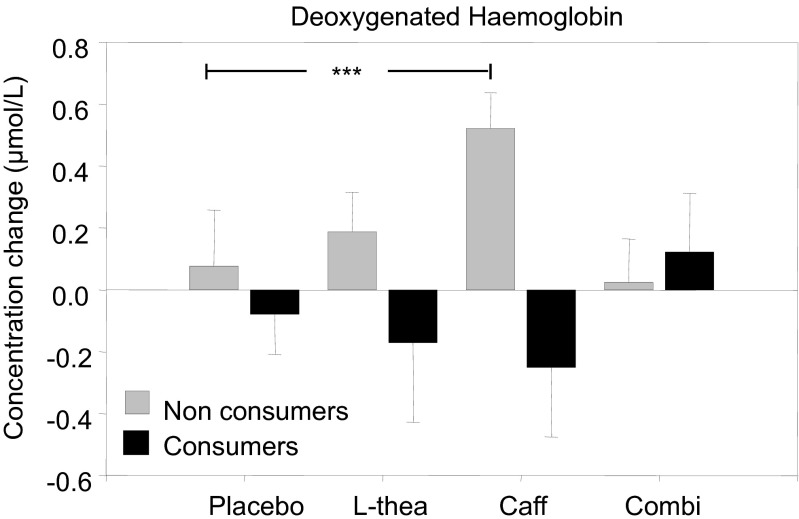
- Caffeine improved choice reaction time (p < 0.05), Stroop total responses (p < 0.005), Stroop reaction time (p < 0.005) and overall mood (p < 0.005); L-theanine alone produced fewer Stroop errors than the combination (p < 0.05). Non-habitual consumers had higher deoxy-Hb following caffeine vs placebo (p < 0.005), and habitual consumers were faster on CRT irrespective of treatment (p < 0.005).
- Salivary caffeine confirmed absorption: baseline 0.34 μg/ml; post-dose 2.33 μg/ml (caffeine) and 2.25 μg/ml (combination), with no significant difference between caffeinated treatments. The combination increased systolic blood pressure vs placebo and L-theanine (p < 0.05) and diastolic blood pressure vs placebo (p < 0.01); no treatment effects on heart rate.
Methods
- Double-blind, placebo-controlled, counterbalanced, within-subjects crossover. Twenty-four healthy young adults (10 males; mean age 21.8, SD 3.19) were recruited: 12 habitual caffeine consumers (>150 mg/day; mean 252.2 mg/day) and 12 non-habitual consumers (<60 mg/day; mean 16.7 mg/day).
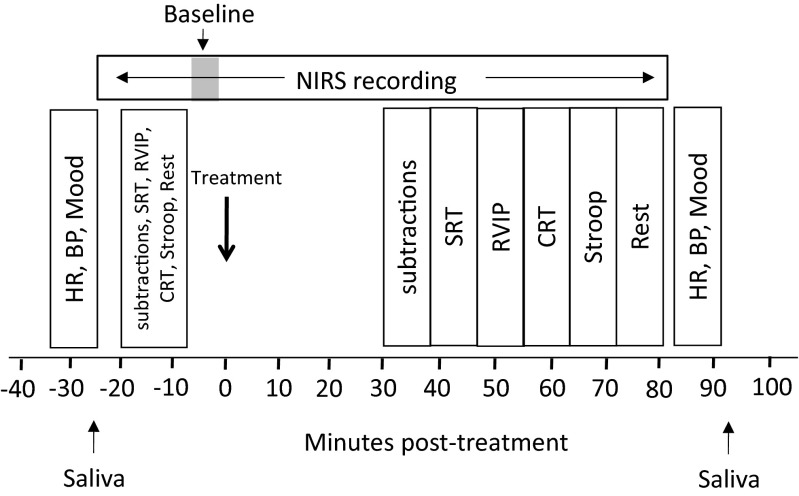
- Participants attended four visits at least 48 h apart and received 75 mg caffeine, 50 mg L-theanine, 75 mg caffeine plus 50 mg L-theanine, or placebo. Cerebral blood flow was measured via 12-channel near-infrared spectroscopy over left and right prefrontal cortex; cognition and mood were assessed at baseline and 30 min post-dose, with salivary caffeine and peripheral haemodynamics co-monitored.
- Analyses used repeated-measures/mixed ANOVAs, planned comparisons with mean squares error from the ANOVA, and the MIXED procedure in SPSS 21.0 with baseline as a time-variant covariate.
Limitations
- Stated: post-dose testing occurred during peak caffeine and L-theanine times, but the duration of L-theanine’s effects on caffeine was not determined; future studies should extend post-dose testing and explore lower doses equivalent to one cup of tea. The paper also notes that tea contains many other compounds that may interact, and that caffeine withdrawal in non-habitual consumers cannot be categorically ruled out because only five reported consuming no caffeine (mean 16.7 mg/day).
- Evident from the text: the sample was small (n = 24) and limited to healthy young adults; treatments were acute single doses; NIRS covered only prefrontal cortex; and the study found no positive behavioural effect of combining L-theanine with caffeine at the doses tested.
Model-written summary. Check it against the paper before relying on it.
Integrity signals
Registry
Cites
Statistics
Figures
Verification
Claims the paper makes
10 Valid · 1 Not valid · 27 Not checked · 85 Own results and interpretations
Some cited sources support this claim and some don’t — read each source’s verdict below.
In the paper
“Data from calibrated (to hypercapnia) BOLD fMRI studies showing that a high single dose of caffeine (~200 mg+), administered to habitual consumers, reduces blood flow but increases oxygen consumption in response to task/stimulation, suggest that this increase in deoxy-Hb is indicative of neural activation”
§ A double-blind, placebo-controlled study evaluating the effects of caffeine and L-theanine both alone and in combination on cerebral blood flow, cognition and mood > Discussion
What the sources say
- Partly supportedcites Chen and Parrish 2009b matched to “Caffeine's effects on cerebrovascular reactivity and coupling between cerebral blood flow and oxygen metabolism” (2009) sourceExperimental — accuracy not yet measured
The Results (page unavailable) report that caffeine increased task-related oxygen consumption relative to blood-flow change. But the Discussion attributes the observed increase in baseline deoxyhemoglobin primarily to reduced resting blood flow; it treats increased neuronal firing as only one possible explanation for altered coupling and says the calibrated BOLD model cannot establish the mechanism. Thus the paper does not establish that the deoxyhemoglobin increase indicates neural activation. (LLM, conf=0.87)
- Disputedcites Perthen et al. 2008 matched to “Caffeine-induced uncoupling of cerebral blood flow and oxygen metabolism: A calibrated BOLD fMRI study” (2008) sourceExperimental — accuracy not yet measured
The Abstract reports that visual stimulation increased oxygen consumption, but caffeine reduced blood flow without a significant change in oxygen consumption. The Discussion attributes the resulting increase in deoxyhemoglobin to greater oxygen extraction after caffeine lowers blood flow, not to neural activation. (LLM, conf=0.88)
Checked by a reasoning model — may be wrong.
hedgedstates an association- Asserted: passes — The authors put it forward as true.
- Checkable: passes — It can be checked against evidence.
- Load-bearing: passes — The paper’s conclusions depend on it.
- Based: passes — The paper gives a reason why it holds.
- Partly supported
The sources with a verdict support this claim; the rest weren’t checked yet, have no full text we could read, or their verdicts aren’t rated yet.
In the paper
“In a withdrawn state, habitual high consumers exhibit higher resting CBF as compared to low consumers, and caffeine use is significantly positively correlated with CBF following both placebo and caffeine (Addicott et al. 2009; Field et al. 2003).”
§ A double-blind, placebo-controlled study evaluating the effects of caffeine and L-theanine both alone and in combination on cerebral blood flow, cognition and mood > Introduction
What the sources say
- Supportedcites Addicott et al. 2009 matched to “The effect of daily caffeine use on cerebral blood flow: How much caffeine can we tolerate?” (2009) source
The Results (Cerebral Perfusion) report that, after 30 hours of caffeine abstention and placebo, high users had greater CBF than low users (p < 0.05). This directly supports the attributed comparison in the withdrawn state. (LLM, conf=0.94)
- Not checked — no full text of the sourcecites Field et al. 2003 matched to “Dietary Caffeine Consumption and Withdrawal: Confounding Variables in Quantitative Cerebral Perfusion Studies?” (2003) source
plainstates an association- Asserted: passes — The authors put it forward as true.
- Checkable: passes — It can be checked against evidence.
- Load-bearing: unclear — It is unclear whether the paper’s conclusions depend on it.
- Based: passes — The paper gives a reason why it holds.
- Supported
The sources with a verdict support this claim; the rest weren’t checked yet, have no full text we could read, or their verdicts aren’t rated yet.
In the paper
“Effects of caffeine on CBF are also dependent upon the level of caffeine habitually consumed.”
§ A double-blind, placebo-controlled study evaluating the effects of caffeine and L-theanine both alone and in combination on cerebral blood flow, cognition and mood > Introduction
What the sources say
- Supportedcites Addicott et al. 2009 matched to “The effect of daily caffeine use on cerebral blood flow: How much caffeine can we tolerate?” (2009) source
The Results (Cerebral Perfusion; page not provided) report that caffeine’s effect on CBF varied with the level of habitual caffeine use, as shown by a significant interaction between caffeine state, drug condition, and caffeine-use group. (LLM, conf=0.94)
- Not checked — no full text of the sourcecites Field et al. 2003 matched to “Dietary Caffeine Consumption and Withdrawal: Confounding Variables in Quantitative Cerebral Perfusion Studies?” (2003) source
plainstates an association- Asserted: passes — The authors put it forward as true.
- Checkable: passes — It can be checked against evidence.
- Load-bearing: unclear — It is unclear whether the paper’s conclusions depend on it.
- Based: passes — The paper gives a reason why it holds.
- Supported
The cited sources support only part of this claim — read each source’s verdict below.
In the paper
“Caffeine has been shown to reduce cerebral blood velocity and CBF assessed using a number of different techniques (Chen and Parrish 2009b; Hasse et al. 2005; Kennedy and Haskell 2011; Laurienti et al. 2003; Mathew and Wilson 1991; Rack-Gomer et al. 2009).”
§ A double-blind, placebo-controlled study evaluating the effects of caffeine and L-theanine both alone and in combination on cerebral blood flow, cognition and mood > Introduction
What the sources say
- Partly supportedcites Chen and Parrish 2009b matched to “Caffeine's effects on cerebrovascular reactivity and coupling between cerebral blood flow and oxygen metabolism” (2009) sourceExperimental — accuracy not yet measured
The Discussion (page not supplied) reports that caffeine reduced resting-state CBF by 26% ± 8% in this study and notes similar findings from earlier ASL and PET studies. It mentions a Doppler study of blood velocity, but only to report unchanged reactivity to CO2 after caffeine; it does not establish a reduction in blood velocity. (LLM, conf=0.85)
- Not checked — no full text of the sourcecites Hasse et al. 2005 matched to “Influences of caffeine, acetazolamide and cognitive stimulation on cerebral blood flow velocities” (2005) source
- Not checked — no full text of the sourcecites Kennedy and Haskell 2011 matched to “Cerebral blood flow and behavioural effects of caffeine in habitual and non-habitual consumers of caffeine: A near infrared spectroscopy study” (2011) source
plainstates a cause- Asserted: passes — The authors put it forward as true.
- Checkable: passes — It can be checked against evidence.
- Load-bearing: passes — The paper’s conclusions depend on it.
- Based: passes — The paper gives a reason why it holds.
- Partly supported
The sources with a verdict support this claim; the rest weren’t checked yet, have no full text we could read, or their verdicts aren’t rated yet.
In the paper
“This assessment system has previously been shown to be sensitive to nutritional interventions (Kennedy et al. 2010a; Stonehouse et al. 2013) including caffeine (Kennedy and Haskell 2011).”
§ A double-blind, placebo-controlled study evaluating the effects of caffeine and L-theanine both alone and in combination on cerebral blood flow, cognition and mood > Methods > Cognitive and mood assessment
What the sources say
- Supportedcites Kennedy et al. 2010a matched to “Effects of high-dose B vitamin complex with vitamin C and minerals on subjective mood and performance in healthy males” (2010) source
The Methods section states that COMPASS administered the computerised cognitive tasks and visual analogue scales. The Results section reports significant effects of vitamin/mineral supplementation on task performance and ratings of mental fatigue and tiredness. The citing sentence attributes caffeine to a separate citation, not to this paper. (LLM, conf=0.90)
- Not checked — no full text of the sourcecites Stonehouse et al. 2013 matched to “DHA supplementation improved both memory and reaction time in healthy young adults: a randomized controlled trial” (2013) source
- Not checked — no full text of the sourcecites Kennedy and Haskell 2011 matched to “Cerebral blood flow and behavioural effects of caffeine in habitual and non-habitual consumers of caffeine: A near infrared spectroscopy study” (2011) source
plainstates an association- Asserted: passes — The authors put it forward as true.
- Checkable: passes — It can be checked against evidence.
- Load-bearing: passes — The paper’s conclusions depend on it.
- Based: passes — The paper gives a reason why it holds.
- Supported
82 more claims · 3 with their cited sources checked
Create a free account to see all 123 claims and every source verdict.
- Probably not a substantial claim. 25
- It may state two separate claims as one. 17
Claims other papers make about this one
Each is checked against this paper’s own text: does it say what the citing paper says it does?
The source backs part of the claim, not all of it — or backs it for a different population, condition or comparison.
In the citing paper
“However, the lowest dose of theanine used in any study included in these analyses was 50 mg,42 which is equivalent to approximately 2 cups of black tea,82 and all other studies used doses >100 mg,36,38,40,41 and no study delivered their interventions as tea or black or green tea–flavored drinks.”
From Effects of Tea (Camellia sinensis) or its Bioactive Compounds l-Theanine or l-Theanine plus Caffeine on Cognition, Sleep, and Mood in Healthy Participants: A Systematic Review and Meta-Analysis of Randomized Controlled Trials (2025) · cites this paper as [42]
Experimental — accuracy not yet measuredThe source backs part of the claim, not all of it — or backs it for a different population, condition or comparison.
In the citing paper
“A recent double-blind, placebo-controlled trial revealed this effect was also seen when L-THE was combined with an amount of caffeine equivalent to one to two cups of tea”
From l-Theanine as a Functional Food Additive: Its Role in Disease Prevention and Health Promotion (2016) · cites this paper as [88]
Experimental — accuracy not yet measuredThe cited source says what the claim attributes to it.
In the citing paper
“Two studies showed a low risk of randomization bias [21,23].”
From Promising, but Not Completely Conclusive—The Effect of l-Theanine on Cognitive Performance Based on the Systematic Review and Meta-Analysis of Randomized Placebo-Controlled Clinical Trials (2025) · cites this paper as [21]
Experimental — accuracy not yet measuredThe cited source says what the claim attributes to it.
In the citing paper
“A total of four studies involving 125 participants were included in the statistical analysis of the time required to process visual stimuli (RVIP/RVRT/continuous performance) [21,22,23,24].”
The cited source says what the claim attributes to it.
In the citing paper
“Results of simple reaction time from four studies involving a total of 126 participants were included in the quantitative analysis [21,22,23,24].”
6 more claims about this paper
Create a free account to see every claim other papers make about this one.
Statistics recomputed
Every reported test result, recomputed from its test statistic and degrees of freedom. A result shows as not adding up only once an independent check has confirmed it.
- ConsistentF(3, 66) = 3.13reported p < .05 · recomputed p = .031
“F(3, 66) = 3.13, p < .05”
- ConsistentF(1, 23) = 63.27reported p < .0001 · recomputed p < .001
“F(1, 23) = 63.27, p < .0001”
- ConsistentF(36, 792) = 1.503reported p < .05 · recomputed p = .031
“F(36, 792) = 1.503, p < .05”
- ConsistentF(36, 792) = 1.617reported p < .05 · recomputed p = .013
“F(36, 792) = 1.617, p < .05”
- ConsistentF(3, 792) = 3.25reported p < .05 · recomputed p = .021
“F(3, 792) = 3.250, p < .05”
10 more recomputed tests
Create a free account to see every test the Stats check recomputed.
Self-check
Percentages, sums and reported differences re-computed from the paper’s own numbers.
Each contradiction between two passages listed here was confirmed by an independent check.
Rated minor: it would not touch a result — a value no result rests on, a p-value that stays on the same side of the significance level, or a conflict that is clerical, resolved elsewhere in the paper, or outside its own findings.
In the paper
§ A double-blind, placebo-controlled study evaluating the effects of caffeine and L-theanine both alone and in combination on cerebral blood flow, cognition and mood > Results > Peripheral haemodynamic effects
“diastolic [F(3, 66) = 3.37, p < 0.05] blood pressure”
§ A double-blind, placebo-controlled study evaluating the effects of caffeine and L-theanine both alone and in combination on cerebral blood flow, cognition and mood > Results > Peripheral haemodynamic effects
“| Diastolic Blood pressure (mmHg) | Placebo | 12/12 | 76.75 ± 2.38 | 75.33 ± 1.51 | 75.75 ± 3.95 | 75.75 ± 2.28 | F = 3.73 p = 0.03 | F = 1.38 p > 0.1 | F = 1.17 p > 0.1 |”
Rated minor: it would not touch a result — a value no result rests on, a p-value that stays on the same side of the significance level, or a conflict that is clerical, resolved elsewhere in the paper, or outside its own findings.
In the paper
§ A double-blind, placebo-controlled study evaluating the effects of caffeine and L-theanine both alone and in combination on cerebral blood flow, cognition and mood > Results > Behavioural effects
“| Stroop errors (number) | L-theanine | 12/12 | 20.8 ± 0.56 | 2.33 ± 0.43 | 8.92 ± 2.62 | 8.25 ± 1.82 | F = 3.18 p = 0.04 | F < 1 | F < 1 |”
§ A double-blind, placebo-controlled study evaluating the effects of caffeine and L-theanine both alone and in combination on cerebral blood flow, cognition and mood > Results > Baseline measures
“A significant on-day pre-treatment difference in baseline Stroop errors [F(3, 66) = 3.13, p < 0.05] was lost following Bonferroni correction.”
Citations
Cites
Beaton, A. E., & Keppel, G. (1975) · American Educational Research Journal · doi:10.3102/00028312012001101 · Cited by 5,855
Design and Analysis: A Researcher's Handbook
Beaton, A. E., & Keppel, G. (1975) · American Educational Research Journal · doi:10.2307/1162588 · Cited by 5,822
Fredholm, B. B., Bättig, K., Holmén, J., Nehlig, A., & Zvartau, E. E. (1999) · Pharmacological Reviews · doi:10.1016/s0031-6997(24)01396-6 · Cited by 2,624 · cited 7×
“The mechanism by which caffeine exerts its effects is now largely accepted to be through non-selective antagonism of adenosine A1 and A2A receptors (Fredholm et al. 1999), with A1 receptors being more closely related to neural activation and A2A receptor antagonism leading to vascular effects, including vasoconstricti…”
BackgroundInfluentialDesign and Analysis: A Researcher's Handbook
Aaker, D. A., & Keppel, G. (1976) · Journal of Marketing Research · doi:10.2307/3150757 · Cited by 2,011
The Role and Regulation of Adenosine in the Central Nervous System
Dunwiddie, T. V., & Masino, S. A. (2001) · Annual Review of Neuroscience · doi:10.1146/annurev.neuro.24.1.31 · Cited by 1,632
A temporal comparison of BOLD, ASL, and NIRS hemodynamic responses to motor stimuli in adult humans
Huppert, T. J., Hoge, R. D., Diamond, S. G., Franceschini, M. A., & Boas, D. A. (2006) · NeuroImage · doi:10.1016/j.neuroimage.2005.08.065 · Cited by 846 · cited 2×
“Near infrared spectroscopy (NIRS) is a method of studying functional activation through monitoring changes in the haemodynamic properties of the brain (Huppert et al. 2006).”
MethodKennedy, D. O., Wightman, E. L., Reay, J. L., Lietz, G., Okello, E. J., Wilde, A., & Haskell, C. F. (2010) · The American Journal of Clinical Nutrition · doi:10.3945/ajcn.2009.28641 · Cited by 415 · cited 3×
“This assessment system has previously been shown to be sensitive to nutritional interventions (Kennedy et al. 2010a; Stonehouse et al. 2013) including caffeine (Kennedy and Haskell 2011).”
BackgroundSelf-citationThe effects of low doses of caffeine on human performance and mood
Lieberman, H. R., Wurtman, R. J., Emde, G. G., Roberts, C., & Coviella, I. L. G. (1987) · Psychopharmacology · doi:10.1007/bf00210835 · Cited by 413
L-Theanine—a unique amino acid of green tea and its relaxation effect in humans
Juneja, L. (1999) · Trends in Food Science & Technology · doi:10.1016/s0924-2244(99)00044-8 · Cited by 363 · cited 2×
“EEG studies have also provided some support for these findings with increases in resting alpha activity observed following 50 mg (Nobre et al. 2008) and 200 mg L-theanine (Juneja et al. 1999), which the authors interpret as being indicative of relaxation.”
BackgroundResultInfluentialHaskell, C. F., Kennedy, D. O., Wesnes, K. A., & Scholey, A. B. (2005) · Psychopharmacology · doi:10.1007/s00213-004-2104-3 · Cited by 356 · cited 2×
“Non-consumers”
BackgroundSelf-citationl-theanine reduces psychological and physiological stress responses
Kimura, K., Ozeki, M., Juneja, L. R., & Ohira, H. (2007) · Biological Psychology · doi:10.1016/j.biopsycho.2006.06.006 · Cited by 349 · cited 2×
“…200mg L-theanine reduced acute stress responses (subjective perception, heart rate and salivary immunoglobulin A) induced by a mental arithmetic task (Kimura et al. 2007), and a 250 mg dose of L-theanine slowed reaction time on a visual probe task, indicating reduced anxiety (Rogers et al. 2008).”
BackgroundSmit, H. J., & Rogers, P. J. (2000) · Psychopharmacology · doi:10.1007/s002130000506 · Cited by 339 · cited 2×
“Despite the observed reduction in CBF, and therefore decreased supply of metabolic substrates, caffeine has consistently been shown to improve reaction times (Childs and de Wit 2006; Haskell et al. 2008; Smit and Rogers 2000) and alertness (Quinlan et al.”
BackgroundCognitive Mechanisms of Nicotine on Visual Attention
Lawrence, N. S., Ross, T. J., & Stein, E. A. (2002) · Neuron · doi:10.1016/s0896-6273(02)01004-8 · Cited by 322 · cited 2×
“measurements, their ability to activate the pre-frontal cortex (Drummond et al. 1999; Lawrence et al. 2002; Schroeter et al. 2002).”
BackgroundSleep deprivation-induced reduction in cortical functional response to serial subtraction
Drummond, S. P. A., Brown, G. G., Stricker, J. L., Buxton, R. B., Wong, E. C., & Gillin, J. C. (1999) · NeuroReport · doi:10.1097/00001756-199912160-00004 · Cited by 285 · cited 2×
“measurements, their ability to activate the pre-frontal cortex (Drummond et al. 1999; Lawrence et al. 2002; Schroeter et al. 2002).”
BackgroundThe Effects of L-Theanine, Caffeine and Their Combination on Cognition and Mood
Haskell, C. F., Kennedy, D. O., Milne, A. L., Wesnes, K. A., & Scholey, A. B. (2008) · Biological Psychology · doi:10.1016/j.biopsycho.2007.09.008 · Cited by 280 · cited 1×
“Non-consumers”
Self-citationSchroeter, M. L., Zysset, S., Kupka, T., Kruggel, F., & von Cramon, D. Y. (2002) · Human Brain Mapping · doi:10.1002/hbm.10052 · Cited by 259 · cited 4×
“measurements, their ability to activate the pre-frontal cortex (Drummond et al. 1999; Lawrence et al. 2002; Schroeter et al. 2002).”
BackgroundMethodInfluentialStonehouse, W., Conlon, C. A., Podd, J., Hill, S. R., Minihane, A. M., Haskell, C., & Kennedy, D. (2013) · The American Journal of Clinical Nutrition · doi:10.3945/ajcn.112.053371 · Cited by 252 · cited 1×
“This assessment system has previously been shown to be sensitive to nutritional interventions (Kennedy et al. 2010a; Stonehouse et al. 2013) including caffeine (Kennedy and Haskell 2011).”
BackgroundSelf-citationJames, J. E. (2004) · Psychosomatic Medicine · doi:10.1097/10.psy.0000107884.78247.f9 · Cited by 232 · cited 1×
“The ability of caffeine to raise blood pressure has been documented previously (James 2004; Rogers et al. 2008; Umemura et al. 2006); therefore, the rise seen in the present study observed following caffeine combined with L-theanine, but not caffeine in isolation, is unexpected.”
BackgroundFunctional Optical Brain Imaging Using Near-Infrared During Cognitive Tasks
Izzetoglu, K., Bunce, S., Onaral, B., Pourrezaei, K., & Chance, B. (2004) · International Journal of Human-Computer Interaction · doi:10.1207/s15327590ijhc1702_6 · Cited by 231 · cited 3×
“…of NIRS to measure blood flow changes following cerebral activation has been validated by its use in a number of studies (Fallgatter and Strik 1998; Izzetoglu et al. 2003, 2004; Schroeter et al. 2002; ShibuyaTayoshi et al. 2007) including following different nutritional interventions (Jackson et…”
BackgroundMethodInfluentialYokogoshi, H., Kobayashi, M., Mochizuki, M., & Terashima, T. (1998) · Neurochemical Research · doi:10.1023/a:1022490806093 · Cited by 229
Childs, E., & de Wit, H. (2006) · Psychopharmacology · doi:10.1007/s00213-006-0341-3 · Cited by 219
The effect of daily caffeine use on cerebral blood flow: How much caffeine can we tolerate?
Addicott, M. A., Yang, L. L., Peiffer, A. M., Burnett, L. R., Burdette, J. H., Chen, M. Y., Hayasaka, S., Kraft, R. A., Maldjian, J. A., & Laurienti, P. J. (2009) · Human Brain Mapping · doi:10.1002/hbm.20732 · Cited by 210 · cited 1×
“In a withdrawn state, habitual high consumers exhibit higher resting CBF as compared to low consumers, and caffeine use is significantly positively correlated with CBF following both placebo and caffeine (Addicott et al. 2009; Field et al. 2003).”
BackgroundInfluentialYokogoshi, H., Kato, Y., Sagesaka, Y. M., Takihara-Matsuura, T., Kakuda, T., & Takeuchi, N. (1995) · Bioscience, Biotechnology, and Biochemistry · doi:10.1271/bbb.59.615 · Cited by 192 · cited 1×
“…have demonstrated that it can dose-dependently increase levels of dopamine in the rat striatum (Yokogoshi et al. 1998), increase gammaaminobutyric acid (GABA) following intraperitoneal administration to mice (Kimura and Murata 1971) and modulate serotonin levels (Yokogoshi et al. 1995, 1998).”
BackgroundEffects of Acute Administration of Caffeine on Vascular Function
Umemura, T., Ueda, K., Nishioka, K., Hidaka, T., Takemoto, H., Nakamura, S., Jitsuiki, D., Soga, J., Goto, C., Chayama, K., et al. (2006) · The American Journal of Cardiology · doi:10.1016/j.amjcard.2006.06.058 · Cited by 189 · cited 1×
“The ability of caffeine to raise blood pressure has been documented previously (James 2004; Rogers et al. 2008; Umemura et al. 2006); therefore, the rise seen in the present study observed following caffeine combined with L-theanine, but not caffeine in isolation, is unexpected.”
BackgroundRogers, P. J., Smith, J. E., Heatherley, S. V., & Pleydell-Pearce, C. W. (2007) · Psychopharmacology · doi:10.1007/s00213-007-0938-1 · Cited by 183 · cited 9×
“…to suggest that L-theanine activates the ERK/eNOS pathway in vitro, thereby increasing endothelial nitric oxide production, a key mediator in vascular function (Siamwala et al. 2013), a finding which may play a role in L-theanine’s previously observed effects on blood pressure (Rogers et al. 2008).”
BackgroundResultInfluentialThe Acute Physiological and Mood Effects of Tea and Coffee
Quinlan, P. T., Lane, J., Moore, K. L., Aspen, J., Rycroft, J. A., & O'Brien, D. C. (2000) · Pharmacology Biochemistry and Behavior · doi:10.1016/s0091-3057(00)00192-1 · Cited by 181 · cited 2×
“2008; Smit and Rogers 2000) and alertness (Quinlan et al. 2000; Rogers 2007).”
BackgroundWightman, E. L., Reay, J. L., Haskell, C. F., Williamson, G., Dew, T. P., & Kennedy, D. O. (2014) · British Journal of Nutrition · doi:10.1017/s0007114514000737 · Cited by 168 · cited 2×
“2007) including following different nutritional interventions (Jackson et al. 2012a, b; Kennedy and Haskell 2011; Kennedy et al. 2010b; Wightman et al. 2014).”
BackgroundSelf-citationOn the Use of Caffeine as a Contrast Booster for BOLD fMRI Studies
Mulderink, T. A., Gitelman, D. R., Mesulam, M.-M., & Parrish, T. B. (2002) · NeuroImage · doi:10.1006/nimg.2001.0973 · Cited by 164 · cited 2×
“however, not unexpected given previously observed neurovascular uncoupling following caffeine (Laurienti et al. 2003; Mulderink et al. 2002; Perthen et al. 2008).”
BackgroundPerthen, J. E., Lansing, A. E., Liau, J., Liu, T. T., & Buxton, R. B. (2008) · NeuroImage · doi:10.1016/j.neuroimage.2007.10.049 · Cited by 162 · cited 4×
“Data from calibrated (to hypercapnia) BOLD fMRI studies showing that a high single dose of caffeine (~200 mg+), administered to habitual consumers, reduces blood flow but increases oxygen consumption in response to task/stimulation, suggest that this increase in deoxy-Hb is indicative of neural activation (Chen and Pa…”
BackgroundInfluentialKennedy, D. O., Veasey, R., Watson, A., Dodd, F., Jones, E., Maggini, S., & Haskell, C. F. (2010) · Psychopharmacology · doi:10.1007/s00213-010-1870-3 · Cited by 159 · cited 1×
“Analysis of the results confirmed that in comparison to baseline levels, salivary caffeine was significantly higher following caffeine and combination treatments [F(1, 23)=63.27, p<0.0001], with no significant difference between treatments.”
ResultSelf-citationCamfield, D. A., Stough, C., Farrimond, J., & Scholey, A. B. (2014) · Nutrition Reviews · doi:10.1111/nure.12120 · Cited by 155 · cited 1×
“The lack of behavioural effects may be due to the lower doses used here and the ratio of compounds favouring caffeine as opposed to L-theanine (see Camfield et al. 2014 for review of behavioural effects of tea constituents).”
Background(2008) · PubMed · Cited by 154
Substance abuse and cerebral blood flow
(1991) · American Journal of Psychiatry · doi:10.1176/ajp.148.3.292 · Cited by 148 · cited 1×
“…and Nutrition Research Centre, Faculty of Health and Life Sciences, Northumbria University, Newcastle upon Tyne NE1 8ST, UK e-mail: crystal.haskell-ramsay@northumbria.ac.uk Hasse et al. 2005; Kennedy and Haskell 2011; Laurienti et al. 2003; Mathew and Wilson 1991; Rack-Gomer et al. 2009).”
BackgroundCaffeine Withdrawal: A Parametric Analysis of Caffeine Dosing Conditions
Evans, S. M., & Griffiths, R. R. (1999) · The Journal of Pharmacology and Experimental Therapeutics · doi:10.1016/s0022-3565(24)38135-2 · Cited by 145 · cited 2×
“34 μg/ml and confirmed overnight abstinence [levels below 1 μg/ml have previously been reported for overnight caffeine abstinence (Evans and Griffiths 1999)].”
BackgroundInfluentialJohansson, B., Ahlberg, S., van der Ploeg, I., Brené, S., Lindefors, N., Persson, H., & Fredholm, B. B. (1993) · Naunyn-Schmiedeberg's Archives of Pharmacology · doi:10.1007/bf00165391 · Cited by 144 · cited 4×
“2003), as has previously been demonstrated (Johansson et al. 1993).”
BackgroundResultInfluentialCho, H.-S., Kim, S., Lee, S.-Y., Park, J. A., Kim, S.-J., & Chun, H. S. (2008) · NeuroToxicology · doi:10.1016/j.neuro.2008.03.004 · Cited by 138 · cited 2×
“…structure is similar to that of the neurotransmitter glutamic acid (Nathan et al. 2006), and it has been shown to increase dopamine concentrations in the rat brain in a dose-dependent manner (Yokogoshi et al. 1998), and to protect against human neuronal cell death in vitro (Cho et al. 2008).”
BackgroundDietary Caffeine Consumption Modulates fMRI Measures
Laurienti, P. J., Field, A. S., Burdette, J. H., Maldjian, J. A., Yen, Y.-F., & Moody, D. M. (2002) · NeuroImage · doi:10.1006/nimg.2002.1237 · Cited by 136 · cited 1×
“Laurienti et al. (2002) also showed that the effects of 250 mg caffeine administration on fMRI BOLD were correlated to dietary caffeine use, with high consumers showing significantly higher signal change than low consumers.”
BackgroundKAKUDA, T., NOZAWA, A., SUGIMOTO, A., & NIINO, H. (2002) · Bioscience, Biotechnology, and Biochemistry · doi:10.1271/bbb.66.2683 · Cited by 131 · cited 1×
“L-theanine has also been shown to antagonise glutamate receptors (Kakuda et al. 2002), a finding which has been linked to neuroprotection against cerebral ischemia in mice and gerbils (Egashira et al. 2004; Kakuda et al. 2000).”
BackgroundFallgatter, A. J., & Strik, W. K. (1998) · European Archives of Psychiatry and Clinical Neuroscience · doi:10.1007/s004060050045 · Cited by 130 · cited 2×
“The ability of NIRS to measure blood flow changes following cerebral activation has been validated by its use in a number of studies (Fallgatter and Strik 1998; Izzetoglu et al. 2003, 2004; Schroeter et al. 2002; ShibuyaTayoshi et al. 2007) including following different nutritional interventions…”
BackgroundMethodDoes caffeine modulate verbal working memory processes? An fMRI study
Koppelstaetter, F., Poeppel, T. D., Siedentopf, C. M., Ischebeck, A., Verius, M., Haala, I., Mottaghy, F. M., Rhomberg, P., Golaszewski, S., Gotwald, T., et al. (2008) · NeuroImage · doi:10.1016/j.neuroimage.2007.08.037 · Cited by 126 · cited 2×
“increasing release of excitatory neurotransmitters and neuronal firing rate at A1 receptors (Koppelstaetter et al. 2008) and decreasing blood flow at A2A receptors (Laurienti et al.”
BackgroundKelly, S. P., Gomez-Ramirez, M., Montesi, J. L., & Foxe, J. J. (2008) · The Journal of Nutrition · doi:10.1093/jn/138.8.1572s · Cited by 119 · cited 9×
“…al. 2008; Owen et al. 2008), providing support for the findings from studies of higher doses, in terms of improved accuracy (Einother et al. 2010; Kelly et al. 2008; Owen et al. 2008) and speed (Einother et al. 2010; Owen et al. 2008) on tasks of attention, and improvements to measures of memory…”
BackgroundResultInfluentialRogers, P. J., Martin, J., Smith, C., Heatherley, S. V., & Smit, H. J. (2003) · Psychopharmacology · doi:10.1007/s00213-002-1360-3 · Cited by 116 · cited 5×
“2005; Hewlett and Smith 2006) rather than reversal of withdrawal (Rogers et al. 2003).”
BackgroundMethodInfluentialField, A. S., Laurienti, P. J., Yen, Y.-F., Burdette, J. H., & Moody, D. M. (2003) · Radiology · doi:10.1148/radiol.2271012173 · Cited by 115
Heatherley, S. V., Hayward, R. C., Seers, H. E., & Rogers, P. J. (2005) · Psychopharmacology · doi:10.1007/s00213-005-2159-9 · Cited by 114 · cited 1×
“However, debate continues as to whether these well-established effects are dependent upon withdrawal (e.g. Heatherley et al. 2005; Rogers et al. 2003) or not (e.g. Christopher et al. 2005; Haskell et al. 2005).”
BackgroundThe combined effects of L-theanine and caffeine on cognitive performance and mood
Owen, G. N., Parnell, H., De Bruin, E. A., & Rycroft, J. A. (2008) · Nutritional Neuroscience · doi:10.1179/147683008x301513 · Cited by 113 · cited 1×
“EEG studies have also provided some support for these findings with increases in resting alpha activity observed following 50 mg (Nobre et al. 2008) and 200 mg L-theanine (Juneja et al. 1999), which the authors interpret as being indicative of relaxation.”
ResultInfluentialGiesbrecht, T., Rycroft, J. A., Rowson, M. J., & De Bruin, E. A. (2010) · Nutritional Neuroscience · doi:10.1179/147683010x12611460764840 · Cited by 108 · cited 1×
“However, Giesbrecht et al. (2010) found that 40 mg caffeine combined with 97 mg L-theanine led to significant increases in systolic blood pressure with a trend towards the same for diastolic.”
BackgroundCaffeine dose effect on activation-induced BOLD and CBF responses
Chen, Y., & Parrish, T. B. (2009) · NeuroImage · doi:10.1016/j.neuroimage.2009.03.012 · Cited by 103 · cited 6×
“A linear dose relationship has been observed between reductions in CBF and caffeine following doses of 1, 2.5 and 5mg/kg caffeine (Chen and Parrish 2009a).”
BackgroundMethodResultInfluentialSHIBUYA‐TAYOSHI, S., SUMITANI, S., KIKUCHI, K., TANAKA, T., TAYOSHI, S., UENO, S., & OHMORI, T. (2007) · Psychiatry and Clinical Neurosciences · doi:10.1111/j.1440-1819.2007.01727.x · Cited by 101 · cited 1×
“The significant increase in deoxy-Hb observed following caffeine relative to placebo is contrary to the decrease in deoxy-Hb generally observed during cognitive demand (Fallgatter and Strik 1998; Izzetoglu et al. 2003, 2004; Kennedy et al. 2010b; Shibuya-Tayoshi et al. 2007).”
BackgroundChen, Y., & Parrish, T. B. (2009) · NeuroImage · doi:10.1016/j.neuroimage.2008.09.057 · Cited by 100 · cited 5×
“A linear dose relationship has been observed between reductions in CBF and caffeine following doses of 1, 2.5 and 5mg/kg caffeine (Chen and Parrish 2009a).”
BackgroundMethodResultInfluentialKIMURA, R., & MURATA, T. (1971) · Chemical and Pharmaceutical Bulletin · doi:10.1248/cpb.19.1257 · Cited by 98 · cited 2×
“…have demonstrated that it can dose-dependently increase levels of dopamine in the rat striatum (Yokogoshi et al. 1998), increase gammaaminobutyric acid (GABA) following intraperitoneal administration to mice (Kimura and Murata 1971) and modulate serotonin levels (Yokogoshi et al. 1995, 1998).”
BackgroundGomez-Ramirez, M., Higgins, B. A., Rycroft, J. A., Owen, G. N., Mahoney, J., Shpaner, M., & Foxe, J. J. (2007) · Clinical Neuropharmacology · doi:10.1097/01.wnf.0000240940.13876.17 · Cited by 96 · cited 1×
“A dose of 250mg of L-theanine has also been shown to decrease tonic alpha activity during task performance (Gomez-Ramirez et al. 2007, 2009).”
BackgroundProtective effect of γ-glutamylethylamide (theanine) on ischemic delayed neuronal death in gerbils
Kakuda, T., Yanase, H., Utsunomiya, K., Nozawa, A., Unno, T., & Kataoka, K. (2000) · Neuroscience Letters · doi:10.1016/s0304-3940(00)01286-6 · Cited by 91 · cited 2×
“L-theanine has also been shown to antagonise glutamate receptors (Kakuda et al. 2002), a finding which has been linked to neuroprotection against cerebral ischemia in mice and gerbils (Egashira et al. 2004; Kakuda et al. 2000).”
BackgroundJackson, P. A., Reay, J. L., Scholey, A. B., & Kennedy, D. O. (2011) · Biological Psychology · doi:10.1016/j.biopsycho.2011.10.006 · Cited by 90 · cited 1×
“…by its use in a number of studies (Fallgatter and Strik 1998; Izzetoglu et al. 2003, 2004; Schroeter et al. 2002; ShibuyaTayoshi et al. 2007) including following different nutritional interventions (Jackson et al. 2012a, b; Kennedy and Haskell 2011; Kennedy et al. 2010b; Wightman et al. 2014).”
BackgroundSelf-citationGomez-Ramirez, M., Kelly, S. P., Montesi, J. L., & Foxe, J. J. (2009) · Brain Topography · doi:10.1007/s10548-008-0068-z · Cited by 90 · cited 3×
“In terms of cognitive function, L-theanine in isolation has been shown to engender decrements in performance (GomezRamirez et al. 2007; Haskell et al. 2008) or, at best, an absence of effects (Gomez-Ramirez et al. 2009; Haskell et al. 2008; Kelly et al. 2008; Owen et al. 2008).”
BackgroundNeuroprotective effect of γ-glutamylethylamide (theanine) on cerebral infarction in mice
Egashira, N., Hayakawa, K., Mishima, K., Kimura, H., Iwasaki, K., & Fujiwara, M. (2004) · Neuroscience Letters · doi:10.1016/j.neulet.2004.03.046 · Cited by 80 · cited 1×
“L-theanine has also been shown to antagonise glutamate receptors (Kakuda et al. 2002), a finding which has been linked to neuroprotection against cerebral ischemia in mice and gerbils (Egashira et al. 2004; Kakuda et al. 2000).”
BackgroundEffects of caffeine in non-withdrawn volunteers
Christopher, G., Sutherland, D., & Smith, A. (2005) · Human Psychopharmacology: Clinical and Experimental · doi:10.1002/hup.658 · Cited by 78 · cited 1×
“However, debate continues as to whether these well-established effects are dependent upon withdrawal (e.g. Heatherley et al. 2005; Rogers et al. 2003) or not (e.g. Christopher et al. 2005; Haskell et al. 2005).”
BackgroundCaffeine reduces resting-state BOLD functional connectivity in the motor cortex
Rack-Gomer, A. L., Liau, J., & Liu, T. T. (2009) · NeuroImage · doi:10.1016/j.neuroimage.2009.02.001 · Cited by 76 · cited 3×
“…and Nutrition Research Centre, Faculty of Health and Life Sciences, Northumbria University, Newcastle upon Tyne NE1 8ST, UK e-mail: crystal.haskell-ramsay@northumbria.ac.uk Hasse et al. 2005; Kennedy and Haskell 2011; Laurienti et al. 2003; Mathew and Wilson 1991; Rack-Gomer et al. 2009).”
BackgroundResult(2003) · PubMed Central · Cited by 75
Kennedy, D. O., & Haskell, C. F. (2011) · Biological Psychology · doi:10.1016/j.biopsycho.2010.12.010 · Cited by 73 · cited 13×
“…caffeine (Chen and Parrish 2009a; Rack-Gomer et al. 2009), including in the form of tea (Vidyasagar et al. 2013), and a reduction in total haemoglobin observed in a more recent study utilising NIRS that administered the same, comparatively low, dose of caffeine as here (Kennedy and Haskell 2011).”
BackgroundMethodResultSelf-citationJackson, P. A., Reay, J. L., Scholey, A. B., & Kennedy, D. O. (2012) · British Journal of Nutrition · doi:10.1017/s0007114511004041 · Cited by 73 · cited 8×
“Table 2 Unadjusted baseline and post-dose ratings for mood for each treatment by consumer status Measure Treatment n Pre-dose baseline score Post-dose score Treatment effect Consumer effect Treatment×consumer interaction Consumers Non-consumers Consumers Non-consumers Relaxed (mm) Placebo 12/12 64.75±2.73 63.83±3.64 5…”
BackgroundInfluentialSelf-citationHuman disposition of L-theanine in tea or aqueous solution
van der Pijl, P. C., Chen, L., & Mulder, T. P. J. (2010) · Journal of Functional Foods · doi:10.1016/j.jff.2010.08.001 · Cited by 66
Chronic Effects of Xanthines on Levels of Central Receptors in Mice
Shi, D., & Daly, J. W. (1999) · Cellular and Molecular Neurobiology · doi:10.1023/a:1006901005925 · Cited by 65 · cited 2×
“2003), with upregulation ofA1 receptors observed following chronic caffeine use (Johansson et al. 1993; Shi and Daly 1999).”
BackgroundInfluentialEinöther, S. J. L., Martens, V. E. G., Rycroft, J. A., & De Bruin, E. A. (2010) · Appetite · doi:10.1016/j.appet.2010.01.003 · Cited by 62 · cited 9×
“This is contrary to previous findings (Einother et al. 2010; Haskell et al. 2008; Kelly et al. 2008; Owen et al. 2008) and is also somewhat surprising given that the combination showed a similar but lesser modulation of deoxy-Hb to caffeine, but did not decrease oxy-Hb (in fact, this was increased…”
BackgroundResultInfluentialVidyasagar, R., Greyling, A., Draijer, R., Corfield, D. R., & Parkes, L. M. (2013) · Journal of Cerebral Blood Flow & Metabolism · doi:10.1038/jcbfm.2013.40 · Cited by 58 · cited 2×
“2009), including in the form of tea (Vidyasagar et al. 2013), and a reduction in total haemoglobin observed in a more recent study utilising NIRS that administered the same, comparatively low, dose of caffeine as here (Kennedy and Haskell 2011).”
Backgroundl-Theanine promotes nitric oxide production in endothelial cells through eNOS phosphorylation
Siamwala, J. H., Dias, P. M., Majumder, S., Joshi, M. K., Sinkar, V. P., Banerjee, G., & Chatterjee, S. (2013) · The Journal of Nutritional Biochemistry · doi:10.1016/j.jnutbio.2012.02.016 · Cited by 58
Acute effects of caffeine in volunteers with different patterns of regular consumption
Hewlett, P., & Smith, A. (2006) · Human Psychopharmacology: Clinical and Experimental · doi:10.1002/hup.752 · Cited by 57 · cited 2×
“The lack of interactive effects between treatment and consumer status would seem to indicate net effects of caffeine (Haskell et al. 2005; Hewlett and Smith 2006) rather than reversal of withdrawal (Rogers et al.”
BackgroundCaffeine and cognitive performance: Persistent methodological challenges in caffeine research
James, J. E. (2014) · Pharmacology Biochemistry and Behavior · doi:10.1016/j.pbb.2014.05.019 · Cited by 56 · cited 2×
“7 mg caffeine per day, cannot be categorically ruled out (James 2014).”
BackgroundInfluentialCaffeine, mood and mental performance in everyday life
Rogers, P. J. (2007) · Nutrition Bulletin · doi:10.1111/j.1467-3010.2007.00607.x · Cited by 55 · cited 2×
“2008; Smit and Rogers 2000) and alertness (Quinlan et al. 2000; Rogers 2007).”
BackgroundGray, J. (1998) · Nutrition & Food Science · doi:10.1108/00346659810235215 · Cited by 36
Behavioural effects of compounds co-consumed in dietary forms of caffeinated plants
Haskell‐Ramsay, C. F., Dodd, F. L., Wightman, E. L., & Kennedy, D. O. (2013) · Nutrition Research Reviews · doi:10.1017/s0954422413000036 · Cited by 17 · cited 1×
“…the beneficial effects of caffeine on cognition and mood have been reported in a number of studies, relatively few studies have looked at the effects of caffeine in combination with other compounds (see Haskell et al. 2013 for review), despite the fact that caffeine is seldom consumed in isolation.”
Self-citationFunctional brain monitoring via NIR based optical spectroscopy
Izzetoglu, K., Yurtsever, G., Bozkurt, A., & Bunce, S. (2003) · 2003 IEEE 29th Annual Proceedings of Bioengineering Conference · doi:10.1109/nebc.2003.1216132 · Cited by 13 · cited 3×
“…of NIRS to measure blood flow changes following cerebral activation has been validated by its use in a number of studies (Fallgatter and Strik 1998; Izzetoglu et al. 2003, 2004; Schroeter et al. 2002; ShibuyaTayoshi et al. 2007) including following different nutritional interventions (Jackson et…”
BackgroundMethodInfluentialInfluences of caffeine, acetazolamide and cognitive stimulation on cerebral blood flow velocities
Haase, C. G., Becka, M., Kuhlmann, J., & Wensing, G. (2005) · Progress in Neuro-Psychopharmacology and Biological Psychiatry · doi:10.1016/j.pnpbp.2005.01.006 · Cited by 9 · cited 1×
“…and Nutrition Research Centre, Faculty of Health and Life Sciences, Northumbria University, Newcastle upon Tyne NE1 8ST, UK e-mail: crystal.haskell-ramsay@northumbria.ac.uk Hasse et al. 2005; Kennedy and Haskell 2011; Laurienti et al. 2003; Mathew and Wilson 1991; Rack-Gomer et al. 2009).”
BackgroundNathan, P. J., Lu, K., Gray, M., & Oliver, C. (2006) · Journal of Herbal Pharmacotherapy · doi:10.1080/j157v06n02_02 · cited 2×
“Its chemical structure is similar to that of the neurotransmitter glutamic acid (Nathan et al. 2006), and it has been shown to increase dopamine concentrations in the rat brain in a dose-dependent manner (Yokogoshi et al.”
Background
Cited by
Neuroprotective Effects and Mechanisms of Tea Bioactive Components in Neurodegenerative Diseases
Chen, S.-Q., Wang, Z.-S., Ma, Y.-X., Zhang, W., Lu, J.-L., Liang, Y.-R., & Zheng, X.-Q. (2018) · Molecules · doi:10.3390/molecules23030512 · Cited by 132
Haskell‐Ramsay, C. F., Stuart, R. C., Okello, E. J., & Watson, A. W. (2017) · European Journal of Nutrition · doi:10.1007/s00394-017-1454-7 · Cited by 117
Self-citationWatson, A. W., Haskell‐Ramsay, C. F., Kennedy, D. O., Cooney, J. M., Trower, T. M., & Scheepens, A. (2015) · Journal of Functional Foods · doi:10.1016/j.jff.2015.06.005 · Cited by 118
Self-citationHaskell-Ramsay, C. F., Jackson, P. A., Forster, J. S., Dodd, F. L., Bowerbank, S. L., & Kennedy, D. O. (2018) · Nutrients · doi:10.3390/nu10101386 · Cited by 95
“This assessment system has previously been shown to be sensitive to nutritional interventions [36,37] including caffeine [20].”
BackgroundSelf-citationHidese, S., Ota, M., Wakabayashi, C., Noda, T., Ozawa, H., Okubo, T., & Kunugi, H. (2017) · Acta Neuropsychiatrica · doi:10.1017/neu.2016.33 · Cited by 81
“Although one recent double-blind randomised controlled trial reported that L-theanine had no beneficial effect on cognition in healthy coffee drinkers (48), the dose (50mg) was substantially lower than ours (250mg).”
Metadata
- Authors
- Dodd, F. L., Kennedy, D. O., Riby, L. M., & Haskell-Ramsay, C. F.
- Affiliations
- Northumbria University (GB)
- Venue
- Psychopharmacology
- Published
- 2015-03-13
- Volume
- 232
- Issue
- 14
- Pages
- 2563-2576
- ISSN
- 0033-3158 (ISSN-L)
- 1432-2072
- PMC
- PMC4480845
- OpenAlex
- W1987855942
- Cited by
- 102
- References
- 72
- Citations by year
- 2026: 12 · 2025: 16 · 2024: 7 · 2023: 6 · 2022: 11 · 2021: 5 · 2020: 8 · 2019: 5 · 2018: 11 · 2017: 9 · 2016: 10 · 2015: 2
- FWCI
- 6.64
- Type
- journal article
- Language
- en
- Open access
- hybrid
- doi.org
- Locations
- Psychopharmacology (publishedVersion, cc-by)
- Europe PMC (PubMed Central) (publishedVersion, cc-by)
- PubMed Central (publishedVersion, cc-by)
- PubMed (publishedVersion)
- Northumbria Research Link (Northumbria University) (acceptedVersion)
- Topics
- Health Sciences › Medicine › Pharmacology (medical) › Coffee research and impacts
- Life Sciences › Agricultural and Biological Sciences › Food Science › Tea Polyphenols and Effects
- Health Sciences › Medicine › Complementary and alternative medicine › Medicinal Plant Extracts Effects
- Keywords
- caffeine, theanine, cerebral blood flow, tea, attention, mood, oxyhemoglobin, deoxyhemoglobin, vasoconstriction
- MeSH terms
- Adolescent, Adult, Affect, Central Nervous System Stimulants, Attention, Caffeine, Cerebrovascular Circulation, Cognition, Double-Blind Method, Female, Glutamates, Hemodynamics, Hemoglobins, Humans, Male, Oxyhemoglobins, Psychomotor Performance, Reaction Time, Vasoconstriction, Cross-Over Studies, Spectroscopy, Near-Infrared, Young Adult
About these checks
Registry, retraction, Cites and statistics results are computed, not judged, with one exception: a printed reference that no index lists is read once by a model before it counts as a citation error. Claims are extracted by a model and kept only when their quote appears verbatim in the text; each cited source is then checked, with a model’s help, for whether it says what the claim relies on. Those verdicts can be wrong — read the claim’s quote and the cited source before relying on one.
The claim verdicts this report counts are experimental: their accuracy is not yet measured.
A language model drew the claims from the paper on 2026-10-05, under version 3 of the claim definition (model deepseek-v4.1-flash, prompt extract-v3).
A second model labelled each claim on 2026-10-05 (model jev-1.13-20260917, definition revision gold-guideline-v0.2).
Cited sources are checked with a language model’s help (gpt-6-sol).
Statistics and arithmetic are recomputed, not judged.
Confidence bands are shown only for fields calibrated on our annotated test set. None is calibrated yet, so no band is shown.
What counts as a claim ›How we measure confidence ›How we check this ›
Are you an author, or do you see a problem with this page? Request a review
Data sources
Bibliographic data: Semantic Scholar, OpenAlex, Crossref.
Contains information from the Semantic Scholar Academic Graph Datasets, made available under the ODC Attribution License (ODC-BY 1.0).
Semantic Scholar’s data is described in: Kinney, R., et al. (2023). The Semantic Scholar Open Data Platform. arXiv:2301.10140.
