

Decoding the bidirectional links between alcohol misuse and aggression: toward a unified translational framework
Open accessThe DOI matches its Crossref record; 455 of the 457 references it cites were found in a registry or an index, and 1 are not checked yet; 86 of the 276 sources its claims cite were checked for support.
Abstract
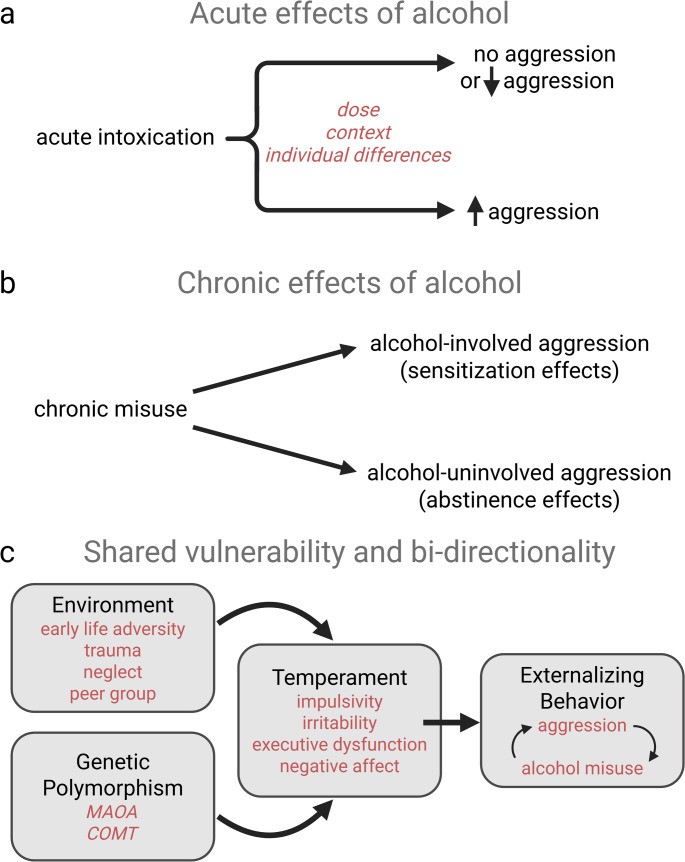
RATIONALE: The relationship between alcohol misuse and aggression has long intrigued clinical and preclinical researchers. While acute alcohol use is well known to promote aggression, converging evidence indicates a more complex, bidirectional association. Both behaviors often arise from shared genetic, neurobiological, and environmental vulnerabilities and can mutually increase risk, creating a vicious spiral in which alcohol misuse and aggression reinforce one another over time. OBJECTIVE: This review synthesizes epidemiological, clinical, and experimental findings to establish an integrated framework linking alcohol misuse and aggression, while introducing a translational perspective connecting human and animal research. RESULTS & CONCLUSIONS: The relationship between alcohol misuse and aggression can be conceptualized through two complementary models. In the first, alcohol use facilitates aggression: acute intoxication disrupts executive control and heightens emotional reactivity, while chronic exposure induces neuroadaptations that sensitize individuals to aggression-promoting effects and may elevate aggression during abstinence. In the second, aggression increases vulnerability to alcohol misuse: longitudinal studies reveal that aggressive traits, emotional dysregulation, and externalizing psychopathology frequently precede problematic drinking. These pathways are influenced by shared dysfunctions within prefrontal-limbic circuits involved in emotion regulation and impulse control. Despite progress in modeling alcohol-induced aggression, little research addresses how aggressive phenotypes contribute to alcohol misuse, representing an important translational gap. Overall, this relationship is best understood as a dynamic, bidirectional system rooted in overlapping neurobehavioral mechanisms. By integrating clinical findings with preclinical models, this framework highlights targets for mechanistic investigation and the development of tailored therapeutic strategies.
Verified 2026-11-22 · 1 reference not checked yet
Overview
CoChat Summary
## TL;DR
This review argues that alcohol misuse and aggression are linked by a dynamic, bidirectional relationship: alcohol can heighten aggression, and aggressive/disregulated traits can also increase risk for alcohol misuse. It proposes a translational framework grounded in shared developmental, neurobiological, and environmental vulnerabilities, with a particular call for more preclinical work on the aggression-to-alcohol pathway.
## Key findings
- Acute alcohol intoxication reliably increases aggression in human laboratory paradigms and animal models; in rodents, low doses of about 1 g/kg can enhance aggression, while higher doses often suppress it because of sedation.
- Chronic alcohol exposure can increase sensitivity to alcohol’s aggression-promoting effects: in one cited rodent study, repeated alcohol administration shifted the proportion of mice showing alcohol-heightened aggression from 37% to 74%, and broadened the dose range that increased aggression from 1 g/kg to 0.6, 1, and 1.7 g/kg.
- Aggression and related externalizing traits often precede alcohol misuse: longitudinal studies cited in the paper report that early aggression, oppositionality, poor self-regulation, and conduct problems predict later heavy drinking and AUD.
- Comorbidity is especially strong for disorders marked by impulsive/reactive aggression, including Conduct Disorder, Intermittent Explosive Disorder (described as affecting approximately 5% of the general population), Antisocial Personality Disorder (lifetime AUD rates exceeding 80% in some forensic/clinical populations), and Borderline Personality Disorder (lifetime AUD comorbidity estimated at 50%–70%).
## Methods
- Narrative review/synthesis of epidemiological, clinical, experimental, and preclinical literature on alcohol misuse and aggression.
- The paper integrates human longitudinal/clinical findings with animal models of acute alcohol effects, chronic exposure, withdrawal/abstinence, early-life adversity, and genetic risk.
- Main analysis is conceptual rather than statistical: it organizes evidence into two complementary pathways—alcohol → aggression and aggression → alcohol misuse—and frames them within shared neurobiological and developmental mechanisms.
## Limitations
- The authors explicitly state that research on how aggressive phenotypes contribute to alcohol misuse is limited, calling this an “important translational gap.”
- They note that evidence for chronic alcohol effects on aggression, especially withdrawal-related aggression in rodents, is more limited than the evidence for acute alcohol-heightened aggression.
- Evident from the text: the article is a review, so it does not present new primary data or a formal quantitative meta-analysis.
Model-written summary of a shortened version of the paper’s full text (it is longer than we read). Check it against the paper before relying on it.
Integrity signals
Registry
Cites
Statistics
Figures
Verification
Claims the paper makes
65 Valid · 8 Not valid · 87 Not checked · 47 Own results and interpretations
At least one cited source doesn’t support this claim or points to a different paper, and none confirmed it — see the verdicts below.
In the paper
“Reduced prefrontal control and heightened amygdala reactivity contribute to emotional dysregulation, impulsivity, and poor threat modulation (Oscar-Berman And Marinković 2007; Heinz et al. 2011).”
§ Decoding the bidirectional links between alcohol misuse and aggression: toward a unified translational framework > Aggression as a precursor and a catalyst of alcohol use > Shared vulnerabilities of aggression and alcohol use
What the sources say
- Disputedcites Oscar-Berman And Marinković 2007 matched to “Alcohol: Effects on Neurobehavioral Functions and the Brain” (2007) sourceExperimental — accuracy not yet measured
The amygdala passage (indexed as Abstract; page unavailable) reports the opposite of heightened reactivity: abstinent long-term alcoholics had blunted amygdala responses to emotional faces compared with controls. The paper does link impaired prefrontal inhibitory control with impulsivity, but that does not support the claim’s heightened-amygdala component. (LLM, conf=0.88)
Checked by a reasoning model — may be wrong.
- Not checked — no full text of the sourcecites Heinz et al. 2011 matched to “Cognitive and neurobiological mechanisms of alcohol-related aggression” (2011) source
plainstates a cause- Asserted: passes — The authors put it forward as true.
- Checkable: passes — It can be checked against evidence.
- Load-bearing: passes — The paper’s conclusions depend on it.
- Based: passes — The paper gives a reason why it holds.
- Disputed
The cited sources support only part of this claim — read each source’s verdict below.
In the paper
“shared impairments in prefrontal–amygdala circuitry appear to underlie both impulsive aggression and alcohol misuse”
- Also stated in: § Shared vulnerabilities of aggression and alcohol use · hedged
“At the neural systems level, shared impairments in prefrontal–amygdala circuitry appear to underlie both impulsive aggression and alcohol misuse (Oscar-Berman And Marinković 2007; Heinz et al. 2011; Gorka et al. 2013; Gan et al. 2015a).”
§ Decoding the bidirectional links between alcohol misuse and aggression: toward a unified translational framework > Aggression as a precursor and a catalyst of alcohol use > Shared vulnerabilities of aggression and alcohol use
What the sources say
- Partly supportedcites Oscar-Berman And Marinković 2007 matched to “Alcohol: Effects on Neurobehavioral Functions and the Brain” (2007) sourceExperimental — accuracy not yet measured
The paper’s Amygdala discussion (indexed as Abstract; page unavailable) describes connections between the amygdala and prefrontal cortex and reports blunted amygdala responses in abstinent alcoholics. Its discussion of aggression and impulsivity (also indexed as Abstract) links alcohol-related disinhibition to possible prefrontal dysfunction. It does not establish that a shared impairment in the prefrontal–amygdala circuit underlies both impulsive aggression and alcohol misuse. (LLM, conf=0.82)
- Not checked — no full text of the sourcecites Heinz et al. 2011 matched to “Cognitive and neurobiological mechanisms of alcohol-related aggression” (2011) source
- Partly supportedcites Gorka et al. 2013 matched to “Alcohol attenuates amygdala–frontal connectivity during processing social signals in heavy social drinkers: A preliminary pharmaco-fMRI study” (2013) sourceExperimental — accuracy not yet measured
The Discussion (page not provided) reports reduced amygdala–OFC connectivity during alcohol intoxication and suggests that this may contribute to aggression. It also describes abnormal connectivity in populations with high aggression. It does not establish that shared circuitry impairments underlie both impulsive aggression and alcohol misuse; the study examined acute alcohol effects, not a common underlying impairment. (LLM, conf=0.85)
hedgedstates a possible cause- Asserted: passes — The authors put it forward as true.
- Checkable: passes — It can be checked against evidence.
- Load-bearing: passes — The paper’s conclusions depend on it.
- Based: passes — The paper gives a reason why it holds.
- Also stated in: § Shared vulnerabilities of aggression and alcohol use · hedged
The sources with a verdict support this claim; the rest weren’t checked yet, have no full text we could read, or their verdicts aren’t rated yet.
In the paper
“longitudinal studies reveal that aggressive traits, emotional dysregulation, and externalizing psychopathology frequently precede problematic drinking”
§ Decoding the bidirectional links between alcohol misuse and aggression: toward a unified translational framework > Abstract > Results & conclusions
What the sources say
- Not checked — no full text of the sourcecites White et al. 1993 matched to “A longitudinal investigation of alcohol use and aggression in adolescence.” (1993) source
- Not checked — no full text of the sourcecites Iacono et al. 2008 matched to “Behavioral Disinhibition and the Development of Early-Onset Addiction: Common and Specific Influences” (2008) source
- Supportedcites Zucker et al. 2008 matched to “Early Developmental Processes and the Continuity of Risk for Underage Drinking and Problem Drinking” (2008) source
The section “Emergence of Behavioral and Emotional Dysregulation and Predisposition to Alcohol Involvement” reports that longitudinal studies link early externalizing symptoms, including aggression and undercontrol, to later problem alcohol use and substance-use disorders. It also describes early emotional and behavioral dysregulation as relevant to the progression into problem alcohol use. (LLM, conf=0.91)
plainstates a cause- Asserted: passes — The authors put it forward as true.
- Checkable: passes — It can be checked against evidence.
- Load-bearing: passes — The paper’s conclusions depend on it.
- Based: passes — The paper gives a reason why it holds.
Every source the paper cites for this claim was checked and supports it.
In the paper
“higher doses of alcohol can increase the motivation to fight, even when fighting performance is impaired (Covington et al. 2018)”
§ Decoding the bidirectional links between alcohol misuse and aggression: toward a unified translational framework > Alcohol use as a cause of aggression > Acute influence of alcohol
What the sources say
- Supportedcites Covington et al. 2018 matched to “The Urge to Fight: Persistent Escalation by Alcohol and Role of NMDA Receptors in Mice” (2018) source
The Results section, “Daily Administrations of Alcohol Dose Dependently Reduced, and Thereafter Escalated, the Motivation to Fight” (page unavailable), reports that repeated higher doses (1.8 or 2.2 g/kg) eventually escalated responding for an aggression reward while fighting performance remained suppressed. The effect followed repeated administration in mice; the first few doses reduced motivated responding. (LLM, conf=0.91)
plainstates a possible cause- Asserted: passes — The authors put it forward as true.
- Checkable: passes — It can be checked against evidence.
- Load-bearing: passes — The paper’s conclusions depend on it.
- Based: passes — The paper gives a reason why it holds.
- Supported
The cited sources support only part of this claim — read each source’s verdict below.
In the paper
“Neuroimaging studies show that even a single dose of alcohol disrupts the regulation of emotional stimuli by attenuating activity in the amygdala during exposure to threatening faces (Gilman et al. 2008; Sripada et al. 2011; Gorka et al. 2013).”
§ Decoding the bidirectional links between alcohol misuse and aggression: toward a unified translational framework > Alcohol use as a cause of aggression > Acute influence of alcohol
What the sources say
- Partly supportedcites Gilman et al. 2008 matched to “Why We Like to Drink: A Functional Magnetic Resonance Imaging Study of the Rewarding and Anxiolytic Effects of Alcohol” (2008) sourceExperimental — accuracy not yet measured
The Neural activity and Volume-of-interest analysis sections report that fearful faces activated the amygdala more than neutral faces under placebo, but not during alcohol intoxication. They do not establish that alcohol reduced amygdala activity during fearful-face exposure itself: the amygdala interaction reached only trend-level significance, and the discussion offers increased activity during neutral-face exposure as an alternative explanation for the smaller difference. (LLM, conf=0.86)
- Partly supportedcites Sripada et al. 2011 matched to “Effects of alcohol on brain responses to social signals of threat in humans” (2011) sourceExperimental — accuracy not yet measured
The Discussion reports that one intoxicating dose of alcohol reduced amygdala reactivity to threatening faces compared with placebo in healthy, non-dependent heavy social drinkers. It does not directly test whether alcohol disrupts the regulation of emotional stimuli; the authors describe a possible link between reduced threat processing and negative affect. (LLM, conf=0.82)
- Partly supportedcites Gorka et al. 2013 matched to “Alcohol attenuates amygdala–frontal connectivity during processing social signals in heavy social drinkers: A preliminary pharmaco-fMRI study” (2013) sourceExperimental — accuracy not yet measured
The Results (Imaging Results; page not provided) show that acute alcohol reduced amygdala activation during viewing of angry and fearful faces. The Discussion describes an effect on emotion regulation as a possible implication, rather than demonstrating that reduced amygdala activity caused a disruption of regulation. (LLM, conf=0.86)
plainstates a cause- Asserted: passes — The authors put it forward as true.
- Checkable: passes — It can be checked against evidence.
- Load-bearing: passes — The paper’s conclusions depend on it.
- Based: passes — The paper gives a reason why it holds.
- Partly supported
114 more claims · 33 with their cited sources checked
Create a free account to see all 207 claims and to verify the 22 references still open.
- It may state two separate claims as one. 73
- Probably not a substantial claim. 23
- The quote only partly states this claim. 1
Citations
Cites
Items 401–457 of 457
Treeby, M. S., Rice, S. M., Cocker, F., Peacock, A., & Bruno, R. (2018) · Addictive Behaviors · doi:10.1016/j.addbeh.2017.12.027 · Cited by 20
Caffeinated and non-caffeinated alcohol use and indirect aggression: The impact of self-regulation
Sheehan, B. E., Linden‐Carmichael, A. N., & Lau‐Barraco, C. (2016) · Addictive Behaviors · doi:10.1016/j.addbeh.2016.02.002 · Cited by 19
Gauthier, J. M., Witte, T. K., & Correia, C. J. (2017) · Suicide and Life-Threatening Behavior · doi:10.1111/sltb.12269 · Cited by 19
Causal attributions in the explanation of alcohol‐related accidents
Pernanen, K. (1993) · Addiction · doi:10.1111/j.1360-0443.1993.tb02107.x · Cited by 18
Association patterns of antisocial personality disorder across substance use disorders
Low, A., Stiltner, B., Nuñez, Y. Z., Adhikari, K., Deak, J. D., Pietrzak, R. H., Kranzler, H. R., Gelernter, J. E., & Polimanti, R. A. (2024) · Translational Psychiatry · doi:10.1038/s41398-024-03054-z · Cited by 18
Ethanol effects on female aggression vary with opponent size and time within session
Blanchard, D. C., Flannelly, K. J., Hori, K., Blanchard, R. J., & Hall, J. C. (1987) · Pharmacology Biochemistry and Behavior · doi:10.1016/0091-3057(87)90188-2 · Cited by 17
Alcohol consumption, anger and hostility: A link to coronary heart disease
Schonwetter, D. J., & Janisse, M. P. (1991) · Personality and Individual Differences · doi:10.1016/0191-8869(91)90034-9 · Cited by 17
Trait Aggression and Hostility in Recovered Alcoholics
Ziherl, S., Čebašek Travnik, Z., Kores Plesničar, B., Tomori, M., & Zalar, B. (2007) · European Addiction Research · doi:10.1159/000097938 · Cited by 17
Ozsoy, S., & Esel, E. (2008) · Progress in Neuro-Psychopharmacology and Biological Psychiatry · doi:10.1016/j.pnpbp.2007.08.034 · Cited by 17
Coelho, A. M., & Bramblett, C. A. (1984) · Primates · doi:10.1007/bf02382393 · Cited by 17
Lievaart, M., van der Veen, F. M., Huijding, J., Naeije, L., Hovens, J. E., & Franken, I. H. A. (2016) · International Journal of Psychophysiology · doi:10.1016/j.ijpsycho.2015.12.001 · Cited by 17
Robertson, K., Forbes, S., & Thyne, M. (2020) · Journal of Interpersonal Violence · doi:10.1177/0886260517696872 · Cited by 17
van Amsterdam, J., Benschop, A., van Binnendijk, S., Snijder, M. B., Lok, A., Schene, A. H., Derks, E. M., & van den Brink, W. (2019) · European Addiction Research · doi:10.1159/000504881 · Cited by 17
Najman, J. M., Plotnikova, M., Horwood, J., Silins, E., Fergusson, D., Patton, G. C., Olsson, C., Hutchinson, D. M., Degenhardt, L., Tait, R., et al. (2019) · Aggressive Behavior · doi:10.1002/ab.21828 · Cited by 17
Treeby, M. S., Rice, S., Wilson, M., Prado, C. E., & Bruno, R. (2019) · Substance Use & Misuse · doi:10.1080/10826084.2019.1683203 · Cited by 17
Sexual differentiation and the effects of alcohol on aggressive behavior in mice
Lisciotto, C. A., DeBold, J. F., & Miczek, K. A. (1990) · Pharmacology Biochemistry and Behavior · doi:10.1016/0091-3057(90)90169-i · Cited by 16
Alcohol‐induced aggression in Drosophila
Park, A., Tran, T., Gutierrez, L., Stojanik, C. J., Plyler, J., Thompson, G. A., Bohm, R. A., Scheuermann, E. A., Smith, D. P., & Atkinson, N. S. (2021) · Addiction Biology · doi:10.1111/adb.13045 · Cited by 16
Varin, M., Liu, L., Gabrys, R. L., Gariépy, G., MacEachern, K. H., & Weeks, M. (2022) · Canadian Journal of Public Health · doi:10.17269/s41997-022-00689-7 · Cited by 16
Dual disorders and suicide during and following the COVID-19 pandemic
Sher, L. (2020) · Acta Neuropsychiatrica · doi:10.1017/neu.2020.37 · Cited by 15
Palmisano, A. N., Norman, S. B., Panza, K. E., Petrakis, I. L., & Pietrzak, R. H. (2021) · Journal of Anxiety Disorders · doi:10.1016/j.janxdis.2021.102496 · Cited by 14
The Harms That Drinkers Cause: Regional Variations Within Countries
Wilsnack, R. W., Kristjanson, A. F., Wilsnack, S. C., Bloomfield, K., Grittner, U., & Crosby, R. D. (2018) · The International Journal of Alcohol and Drug Research · doi:10.7895/ijadr.254 · Cited by 13
Alcohol Use Disorder: Stress, Negative Reinforcement, and Negative Urgency
Vendruscolo, L. F., Koob, G. F., & Zorrilla, E. P. (2023) · Springer eBooks · doi:10.1007/978-3-031-32483-3_36 · Cited by 13
Noradrenergic Mechanisms and Circuitry of Hyperkatifeia in Alcohol Use Disorder
Varodayan, F. P., Erikson, C. M., Scroger, M. V., & Roberto, M. (2025) · Biological Psychiatry · doi:10.1016/j.biopsych.2024.09.009 · Cited by 12
Guilt in alcohol use: A systematic review
Milan, L., Hamonnière, T., & Varescon, I. (2022) · Addictive Behaviors · doi:10.1016/j.addbeh.2022.107531 · Cited by 12
Амикишиева, А. В., & Semendyaeva, S. N. (2007) · Neuroscience and Behavioral Physiology · doi:10.1007/s11055-007-0101-9 · Cited by 11
CHERPITEL, C. J. S., Ye, Y., & Monteiro, M. G. (2018) · Revista Panamericana de Salud Pública · doi:10.26633/rpsp.2018.7 · Cited by 11
Breton, J. M., Cort, Z., Demaestri, C., Critz, M., Nevins, S., Downend, K., Ofray, D., Romeo, R. D., & Bath, K. G. (2024) · Hormones and Behavior · doi:10.1016/j.yhbeh.2023.105464 · Cited by 11
Moskaliuk, V. S., Kozhemyakina, R. V., Khomenko, T. M., Volcho, K. P., Salakhutdinov, N. F., Kulikov, A. V., Naumenko, V. S., & Kulikova, E. A. (2023) · International Journal of Molecular Sciences · doi:10.3390/ijms24020983 · Cited by 11
Adolescent Stress Alters Ethanol Ingestion and Agonistic Behavior in the Male Golden Hamster
FERRIS, C. F., & BREWER, J. (1996) · Annals of the New York Academy of Sciences · doi:10.1111/j.1749-6632.1996.tb32539.x · Cited by 10
Oppositional defiant disorder (ODD), the forerunner of alcohol dependence: A controlled study
Ghosh, A., Malhotra, S., & Basu, D. (2014) · Asian Journal of Psychiatry · doi:10.1016/j.ajp.2014.03.006 · Cited by 10
The Impact of History of Aggression and Alcohol Use on Aggressive: Responding in the Laboratory
Ritter, K., Lookatch, S. J., Schmidt, M. R., & Moore, T. M. (2019) · Substance Abuse Research and Treatment · doi:10.1177/1178221819884328 · Cited by 10
Limited bedding and nesting increases ethanol drinking in female rats
Parks, B. J., Salazar, P., Morrison, L., McGraw, M. K., Gunnell, M., Tobacyk, J., Brents, L. K., & Berquist, M. D. (2024) · Pharmacology Biochemistry and Behavior · doi:10.1016/j.pbb.2024.173756 · Cited by 10
Miczek, K. A., Akdilek, N., Ferreira, V. M. M., Leonard, M. Z., Marinelli, L. R., & Covington, H. E. (2022) · Psychopharmacology · doi:10.1007/s00213-022-06208-3 · Cited by 10
Mice Bred for Severity of Acute Alcohol Withdrawal Respond Differently in a Go/No-Go Task
Moschak, T. M., Stang, K. A., & Mitchell, S. H. (2013) · Alcoholism Clinical and Experimental Research · doi:10.1111/acer.12134 · Cited by 9
Using Signatures of Directional Selection to Guide Discovery
Crabbe, J. C. (2018) · Elsevier eBooks · doi:10.1016/b978-0-12-804078-2.00011-8 · Cited by 9
Ashamed and Alone—Risk Factors for Alcohol Craving Among Depressed Emerging Adults
Bilevicius, E., Clark, C. C., Johnson, E. A., & Keough, M. T. (2020) · Alcohol and Alcoholism · doi:10.1093/alcalc/agaa056 · Cited by 9
Benvenuti, F., Carlo, S. D., Rullo, L., Caffino, L., Losapio, L. M., Morosini, C., Ubaldi, M., Soverchia, L., Cannella, N., Domi, E., et al. (2023) · Neurobiology of Stress · doi:10.1016/j.ynstr.2023.100598 · Cited by 9
Selective antiaggressive effect of an alpha‐2 adrenoceptor agonist naphthylmedetomidine in mice
Votava, M., Hess, L., & Kršiak, M. (2008) · Aggressive Behavior · doi:10.1002/ab.20253 · Cited by 7
Isolation and loneliness as pathways to heavy drinking early in the pandemic
Fendrich, M., Becker, J., Russell, B. S., & Park, C. L. (2024) · Alcohol and Alcoholism · doi:10.1093/alcalc/agae012 · Cited by 7
Predictors of Alcohol Use Disorder: MAOA Gene VNTR Polymorphism, Impulsivity, and Personality Traits
Kaya, H., Kaya, Ö. B., Darçın, A. E., Çavuş, R. S. Y., Kahve, A. C., & Dılbaz, N. (2021) · Psychiatry and Clinical Psychopharmacology · doi:10.5152/pcp.2021.20131 · Cited by 6
Miloslavich, K., & Wardle, M. (2024) · The American Journal of Drug and Alcohol Abuse · doi:10.1080/00952990.2024.2331721 · Cited by 5
McDonnell-Dowling, K., & Miczek, K. A. (2018) · Psychopharmacology · doi:10.1007/s00213-018-4852-5 · Cited by 5
Rawls, E., Marquardt, C. A., Fix, S. T., Bernat, E. M., & Sponheim, S. R. (2025) · Journal of Psychopathology and Clinical Science · doi:10.1037/abn0000925 · Cited by 5
Jarčušková, D., Pallayová, M., Čarnakovič, S., Frajka, M., Fidmik, J., & Bednářová, A. (2024) · Frontiers in Psychiatry · doi:10.3389/fpsyt.2024.1397009 · Cited by 5
EFFECTS OF ETHANOL ON SOCIAL BEHAVIOUR DIRECTED TOWARDS MALE INTRUDERS BY LACTATING SWISS MICE
Smoothy, R., Brain, P. F., Berry, M. S., & Haug, M. (1986) · Alcohol and Alcoholism · doi:10.1093/oxfordjournals.alcalc.a044620 · Cited by 5
Korczyńska, J., Szczuka, A., Urzykowska, J., Kochanowski, M., Andrzejczyk, N. G., Piwowarek, K. J., & Godzińska, E. J. (2023) · Animals · doi:10.3390/ani13172734 · Cited by 4
Age at Drinking Onset and Alcohol Dependence: Age at Onset, Duration, and Severity
Hingson, R. W., Heeren, T., & Winter, M. R. (2006) · Archives of Pediatrics & Adolescent Medicine · doi:10.1001/archpedi.160.7.739 · Cited by 3
Shen, G., Wu, Y., Wang, K., Niculescu, M., Liu, Y., Kang, Y., Luο, X., Wang, W., Chen, Y.-H., Liu, Y., et al. (2024) · Pharmacology Biochemistry and Behavior · doi:10.1016/j.pbb.2024.173708 · Cited by 3
Talani, G., Biggio, F., Mostallino, M. C., Batzu, E., Biggio, G., & Sanna, E. (2025) · Neuropharmacology · doi:10.1016/j.neuropharm.2024.110212 · Cited by 3
Anger, Hostility, and Aggression in Severe Alcohol Use Disorder
Gautier, M., Pabst, A., & Maurage, P. (2022) · Springer eBooks · doi:10.1007/978-3-030-98711-4_48-1 · Cited by 3
Atkinson, N. S. (2021) · Neuroscience Insights · doi:10.1177/26331055211061145 · Cited by 2
Neurobiology of Alcohol-Induced Aggression
Park, A. (2023) · Springer eBooks · doi:10.1007/978-3-031-31547-3_88 · Cited by 2
Shen, G., Chen, L., Liu, Y., Zhu, Q., Kang, Y., Luo, X., Wang, F., & Wang, W. (2024) · BMC Psychiatry · doi:10.1186/s12888-024-05787-z · Cited by 1
Pravikova, P. D., Moskaliuk, V. S., Bazovkina, D. V., Kozhemyakina, R. V., & Naumenko, V. S. (2024) · Journal of Evolutionary Biochemistry and Physiology · doi:10.1134/s0022093024060218 · Cited by 1
Васильева, С. Н., Simutkin, G. G., Roschina, O. V., Surovtseva, A. K., & Bokhan, N. A. (2025) · Journal of Ethnicity in Substance Abuse · doi:10.1080/15332640.2025.2468835 · Cited by 1
Neurobiology of Alcohol-Induced Aggression
Park, A. (2023) · Springer eBooks · doi:10.1007/978-3-030-98711-4_88-1
Pellis, S. M. (1993) · doi:10.1002/1098-2337(1993)19:5
Research works printed but not linked: 11
- Abbey A, Zawacki T, Buck PO et al (2001) Alcohol and sexual assault. Alcohol Res Health 25:43–51 11496965 PMC4484576
- Al-Maliki SJ, Al-Hamood MH (1993) Effects of alpha and beta adrenergic antagonists on aggressive behavior in male mice. Aggressive Behav 19:361–367. 10.1002/1098-2337(1993)19:5%253C361::AID-AB2480190505%253E3.0.CO;2-M · doi:10.1002/1098-2337(1993)19:5<361::aid-ab2480190505>3.0.co;2-m
- Berry MS, Smoothy R (1986) A Critical Evaluation of Claimed Relationships between Alcohol Intake and Aggression in Infra-human Animals. Alcohol and Aggression. Routledge
- Brown SD (1994) The novel anticonvulsant topiramate enhances GABA-mediated chloride flux. Epilepsia 34:122–123
- Coulter DA (1995) Topiramate effects on excitatory amino acid-mediated responses in cultured hippocampal neurons: selective blockade of Kainate currents. Epilepsia 36:S40
- Khantzian EJ (2003) The self-medication hypothesis revisited: the dually diagnosed patient. Prim Psychiatry 10:47–48
- Linehan MM (1993) Cognitive-behavioral treatment of borderline personality disorder. Guilford Press, New York, NY, US
- Miczek KA, DeBold JF, Van Erp AMM (1994b) Neuropharmacological characteristics of individual differences in alcohol effects on aggression in rodents and primates. Behav Pharmacol 5:407–421 11224293 · DOI · Paper page
- Obot I (2006) Alcohol use and related problems in sub-Saharan Africa. Afr J Drug Alcohol Stud 5:17–25
- SAMHSA (2023) Key substance use and mental health indicators in the united states: results from the 2022 National survey on drug use and health. Substance Abuse and Mental Health Services Administration, Rockville, MD
- WHO (2024) Global status report on alcohol and health and treatment of substance use disorders. World Health Organization, Geneva
Cited by
Epidemiology of aggression and violence in mental disorders and the approach of TRR 379
Habel, U., Herpertz, S., Reif, A., Habel, U., Herpertz, S., Reif, A., Wagels, L., Reindl, V., Konrad, K., Holz, N., et al. (2026) · Der Nervenarzt · doi:10.1007/s00115-026-02005-x · Cited by 2
Dacosta‐Sánchez, D., González‐Ponce, B. M., Mancheño‐Velasco, C., Narváez‐Camargo, M., & Lozano, O. M. (2026) · Addictive Behaviors · doi:10.1016/j.addbeh.2026.108688 · Cited by 1
Zhu, L., Chen, Y., Huang, M., Fang, Z., Zhou, Y., Zhao, J., Li, Y., Xie, Y., Hua, L., Wen, L., et al. (2026) · BMC Public Health · doi:10.1186/s12889-026-27477-z
“These included high-risk digital environments like competitive gaming, which is strongly linked to aggression [18], and physiological disinhibitors like alcohol consumption, known to impair impulse control and be associated with aggression [19].”
Metadata
- Authors
- Russell, N. M., Frier, M. D., Bortolato, M., & Mangieri, R. A.
- Affiliations
- The University of Texas at Austin (US)
- Tufts University (US)
- University of Florida (US)
- Corresponding author
- Bortolato, Marco
- Mangieri, Regina A.
- Venue
- Psychopharmacology
- Published
- 2025-10-31
- Volume
- 243
- Issue
- 5
- Pages
- 891-924
- ISSN
- 0033-3158 (ISSN-L)
- 1432-2072
- PMC
- PMC13234934
- OpenAlex
- W4415728474
- Cited by
- 3
- References
- 436
- Citations by year
- 2026: 3
- FWCI
- 0.46
- Type
- journal article
- Language
- en
- Open access
- hybrid
- doi.org
- Licence
- cc-by-nc-nd
- creativecommons.org/licenses/by-nc-nd/4.0 (tdm)
- creativecommons.org/licenses/by-nc-nd/4.0 (vor)
- Locations
- Psychopharmacology (publishedVersion, cc-by-nc-nd)
- PubMed Central (publishedVersion, cc-by-nc-nd)
- PubMed (publishedVersion)
- Funders
- National Institute on Alcohol Abuse and Alcoholism (AA030256, AA016651)
- National Institute of Mental Health (MH104603)
- Waggoner Center for Alcohol and Addiction Research, University of Texas at Austin (Billi Terresa Cowden Endowment)
- Topics
- Health Sciences › Medicine › Epidemiology › Substance Abuse Treatment and Outcomes
- Life Sciences › Neuroscience › Cellular and Molecular Neuroscience › Neurotransmitter Receptor Influence on Behavior
- Life Sciences › Neuroscience › Cognitive Neuroscience › Neural and Behavioral Psychology Studies
- Keywords
- alcohol abuse, aggression, bidirectional relationship, acute poisoning, chronic ethanol exposure, neural adaptation, emotional dysregulation, externalizing psychopathology, executive function, impulse control, translational research
- MeSH terms
- Aggression, Alcohol Drinking, Alcoholism, Animals, Humans, Translational Research, Biomedical
About these checks
Registry, retraction, Cites and statistics results are computed, not judged, with one exception: a printed reference that no index lists is read once by a model before it counts as a citation error. Claims are extracted by a model and kept only when their quote appears verbatim in the text; each cited source is then checked, with a model’s help, for whether it says what the claim relies on. Those verdicts can be wrong — read the claim’s quote and the cited source before relying on one.
The claim verdicts this report counts are experimental: their accuracy is not yet measured.
A language model drew the claims from the paper on 2026-10-10, under version 3 of the claim definition (model deepseek-v4.1-flash, prompt extract-v3).
A second model labelled each claim on 2026-10-10 (model jev-1.13-20260917, definition revision gold-guideline-v0.2).
Cited sources are checked with a language model’s help (gpt-6-sol).
Statistics and arithmetic are recomputed, not judged.
Confidence bands are shown only for fields calibrated on our annotated test set. None is calibrated yet, so no band is shown.
What counts as a claim ›How we measure confidence ›How we check this ›
Are you an author, or do you see a problem with this page? Request a review
Data sources
Bibliographic data: Semantic Scholar, OpenAlex, Crossref.
Contains information from the Semantic Scholar Academic Graph Datasets, made available under the ODC Attribution License (ODC-BY 1.0).
Semantic Scholar’s data is described in: Kinney, R., et al. (2023). The Semantic Scholar Open Data Platform. arXiv:2301.10140.
