

Decoding the bidirectional links between alcohol misuse and aggression: toward a unified translational framework
Open accessThe DOI matches its Crossref record; 455 of the 457 references it cites were found in a registry or an index, and 1 are not checked yet; 86 of the 276 sources its claims cite were checked for support.
Abstract
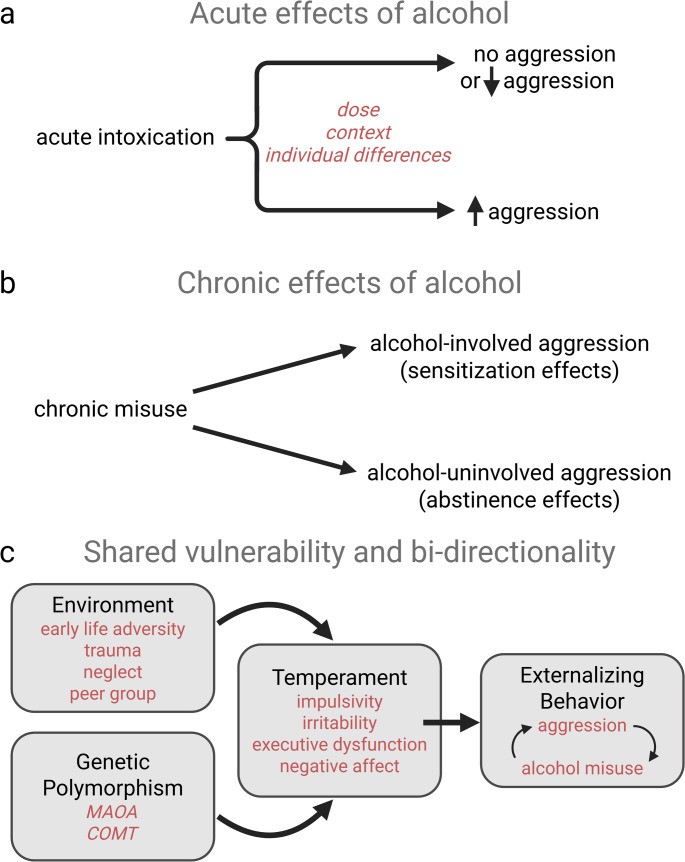
RATIONALE: The relationship between alcohol misuse and aggression has long intrigued clinical and preclinical researchers. While acute alcohol use is well known to promote aggression, converging evidence indicates a more complex, bidirectional association. Both behaviors often arise from shared genetic, neurobiological, and environmental vulnerabilities and can mutually increase risk, creating a vicious spiral in which alcohol misuse and aggression reinforce one another over time. OBJECTIVE: This review synthesizes epidemiological, clinical, and experimental findings to establish an integrated framework linking alcohol misuse and aggression, while introducing a translational perspective connecting human and animal research. RESULTS & CONCLUSIONS: The relationship between alcohol misuse and aggression can be conceptualized through two complementary models. In the first, alcohol use facilitates aggression: acute intoxication disrupts executive control and heightens emotional reactivity, while chronic exposure induces neuroadaptations that sensitize individuals to aggression-promoting effects and may elevate aggression during abstinence. In the second, aggression increases vulnerability to alcohol misuse: longitudinal studies reveal that aggressive traits, emotional dysregulation, and externalizing psychopathology frequently precede problematic drinking. These pathways are influenced by shared dysfunctions within prefrontal-limbic circuits involved in emotion regulation and impulse control. Despite progress in modeling alcohol-induced aggression, little research addresses how aggressive phenotypes contribute to alcohol misuse, representing an important translational gap. Overall, this relationship is best understood as a dynamic, bidirectional system rooted in overlapping neurobehavioral mechanisms. By integrating clinical findings with preclinical models, this framework highlights targets for mechanistic investigation and the development of tailored therapeutic strategies.
Verified 2026-11-22 · 1 reference not checked yet
Overview
CoChat Summary
## TL;DR
This review argues that alcohol misuse and aggression are linked by a dynamic, bidirectional relationship: alcohol can heighten aggression, and aggressive/disregulated traits can also increase risk for alcohol misuse. It proposes a translational framework grounded in shared developmental, neurobiological, and environmental vulnerabilities, with a particular call for more preclinical work on the aggression-to-alcohol pathway.
## Key findings
- Acute alcohol intoxication reliably increases aggression in human laboratory paradigms and animal models; in rodents, low doses of about 1 g/kg can enhance aggression, while higher doses often suppress it because of sedation.
- Chronic alcohol exposure can increase sensitivity to alcohol’s aggression-promoting effects: in one cited rodent study, repeated alcohol administration shifted the proportion of mice showing alcohol-heightened aggression from 37% to 74%, and broadened the dose range that increased aggression from 1 g/kg to 0.6, 1, and 1.7 g/kg.
- Aggression and related externalizing traits often precede alcohol misuse: longitudinal studies cited in the paper report that early aggression, oppositionality, poor self-regulation, and conduct problems predict later heavy drinking and AUD.
- Comorbidity is especially strong for disorders marked by impulsive/reactive aggression, including Conduct Disorder, Intermittent Explosive Disorder (described as affecting approximately 5% of the general population), Antisocial Personality Disorder (lifetime AUD rates exceeding 80% in some forensic/clinical populations), and Borderline Personality Disorder (lifetime AUD comorbidity estimated at 50%–70%).
## Methods
- Narrative review/synthesis of epidemiological, clinical, experimental, and preclinical literature on alcohol misuse and aggression.
- The paper integrates human longitudinal/clinical findings with animal models of acute alcohol effects, chronic exposure, withdrawal/abstinence, early-life adversity, and genetic risk.
- Main analysis is conceptual rather than statistical: it organizes evidence into two complementary pathways—alcohol → aggression and aggression → alcohol misuse—and frames them within shared neurobiological and developmental mechanisms.
## Limitations
- The authors explicitly state that research on how aggressive phenotypes contribute to alcohol misuse is limited, calling this an “important translational gap.”
- They note that evidence for chronic alcohol effects on aggression, especially withdrawal-related aggression in rodents, is more limited than the evidence for acute alcohol-heightened aggression.
- Evident from the text: the article is a review, so it does not present new primary data or a formal quantitative meta-analysis.
Model-written summary of a shortened version of the paper’s full text (it is longer than we read). Check it against the paper before relying on it.
Integrity signals
Registry
Cites
Statistics
Figures
Verification
Claims the paper makes
65 Valid · 8 Not valid · 87 Not checked · 47 Own results and interpretations
At least one cited source doesn’t support this claim or points to a different paper, and none confirmed it — see the verdicts below.
In the paper
“Reduced prefrontal control and heightened amygdala reactivity contribute to emotional dysregulation, impulsivity, and poor threat modulation (Oscar-Berman And Marinković 2007; Heinz et al. 2011).”
§ Decoding the bidirectional links between alcohol misuse and aggression: toward a unified translational framework > Aggression as a precursor and a catalyst of alcohol use > Shared vulnerabilities of aggression and alcohol use
What the sources say
- Disputedcites Oscar-Berman And Marinković 2007 matched to “Alcohol: Effects on Neurobehavioral Functions and the Brain” (2007) sourceExperimental — accuracy not yet measured
The amygdala passage (indexed as Abstract; page unavailable) reports the opposite of heightened reactivity: abstinent long-term alcoholics had blunted amygdala responses to emotional faces compared with controls. The paper does link impaired prefrontal inhibitory control with impulsivity, but that does not support the claim’s heightened-amygdala component. (LLM, conf=0.88)
Checked by a reasoning model — may be wrong.
- Not checked — no full text of the sourcecites Heinz et al. 2011 matched to “Cognitive and neurobiological mechanisms of alcohol-related aggression” (2011) source
plainstates a cause- Asserted: passes — The authors put it forward as true.
- Checkable: passes — It can be checked against evidence.
- Load-bearing: passes — The paper’s conclusions depend on it.
- Based: passes — The paper gives a reason why it holds.
- Disputed
The cited sources support only part of this claim — read each source’s verdict below.
In the paper
“shared impairments in prefrontal–amygdala circuitry appear to underlie both impulsive aggression and alcohol misuse”
- Also stated in: § Shared vulnerabilities of aggression and alcohol use · hedged
“At the neural systems level, shared impairments in prefrontal–amygdala circuitry appear to underlie both impulsive aggression and alcohol misuse (Oscar-Berman And Marinković 2007; Heinz et al. 2011; Gorka et al. 2013; Gan et al. 2015a).”
§ Decoding the bidirectional links between alcohol misuse and aggression: toward a unified translational framework > Aggression as a precursor and a catalyst of alcohol use > Shared vulnerabilities of aggression and alcohol use
What the sources say
- Partly supportedcites Oscar-Berman And Marinković 2007 matched to “Alcohol: Effects on Neurobehavioral Functions and the Brain” (2007) sourceExperimental — accuracy not yet measured
The paper’s Amygdala discussion (indexed as Abstract; page unavailable) describes connections between the amygdala and prefrontal cortex and reports blunted amygdala responses in abstinent alcoholics. Its discussion of aggression and impulsivity (also indexed as Abstract) links alcohol-related disinhibition to possible prefrontal dysfunction. It does not establish that a shared impairment in the prefrontal–amygdala circuit underlies both impulsive aggression and alcohol misuse. (LLM, conf=0.82)
- Not checked — no full text of the sourcecites Heinz et al. 2011 matched to “Cognitive and neurobiological mechanisms of alcohol-related aggression” (2011) source
- Partly supportedcites Gorka et al. 2013 matched to “Alcohol attenuates amygdala–frontal connectivity during processing social signals in heavy social drinkers: A preliminary pharmaco-fMRI study” (2013) sourceExperimental — accuracy not yet measured
The Discussion (page not provided) reports reduced amygdala–OFC connectivity during alcohol intoxication and suggests that this may contribute to aggression. It also describes abnormal connectivity in populations with high aggression. It does not establish that shared circuitry impairments underlie both impulsive aggression and alcohol misuse; the study examined acute alcohol effects, not a common underlying impairment. (LLM, conf=0.85)
hedgedstates a possible cause- Asserted: passes — The authors put it forward as true.
- Checkable: passes — It can be checked against evidence.
- Load-bearing: passes — The paper’s conclusions depend on it.
- Based: passes — The paper gives a reason why it holds.
- Also stated in: § Shared vulnerabilities of aggression and alcohol use · hedged
The sources with a verdict support this claim; the rest weren’t checked yet, have no full text we could read, or their verdicts aren’t rated yet.
In the paper
“longitudinal studies reveal that aggressive traits, emotional dysregulation, and externalizing psychopathology frequently precede problematic drinking”
§ Decoding the bidirectional links between alcohol misuse and aggression: toward a unified translational framework > Abstract > Results & conclusions
What the sources say
- Not checked — no full text of the sourcecites White et al. 1993 matched to “A longitudinal investigation of alcohol use and aggression in adolescence.” (1993) source
- Not checked — no full text of the sourcecites Iacono et al. 2008 matched to “Behavioral Disinhibition and the Development of Early-Onset Addiction: Common and Specific Influences” (2008) source
- Supportedcites Zucker et al. 2008 matched to “Early Developmental Processes and the Continuity of Risk for Underage Drinking and Problem Drinking” (2008) source
The section “Emergence of Behavioral and Emotional Dysregulation and Predisposition to Alcohol Involvement” reports that longitudinal studies link early externalizing symptoms, including aggression and undercontrol, to later problem alcohol use and substance-use disorders. It also describes early emotional and behavioral dysregulation as relevant to the progression into problem alcohol use. (LLM, conf=0.91)
plainstates a cause- Asserted: passes — The authors put it forward as true.
- Checkable: passes — It can be checked against evidence.
- Load-bearing: passes — The paper’s conclusions depend on it.
- Based: passes — The paper gives a reason why it holds.
Every source the paper cites for this claim was checked and supports it.
In the paper
“higher doses of alcohol can increase the motivation to fight, even when fighting performance is impaired (Covington et al. 2018)”
§ Decoding the bidirectional links between alcohol misuse and aggression: toward a unified translational framework > Alcohol use as a cause of aggression > Acute influence of alcohol
What the sources say
- Supportedcites Covington et al. 2018 matched to “The Urge to Fight: Persistent Escalation by Alcohol and Role of NMDA Receptors in Mice” (2018) source
The Results section, “Daily Administrations of Alcohol Dose Dependently Reduced, and Thereafter Escalated, the Motivation to Fight” (page unavailable), reports that repeated higher doses (1.8 or 2.2 g/kg) eventually escalated responding for an aggression reward while fighting performance remained suppressed. The effect followed repeated administration in mice; the first few doses reduced motivated responding. (LLM, conf=0.91)
plainstates a possible cause- Asserted: passes — The authors put it forward as true.
- Checkable: passes — It can be checked against evidence.
- Load-bearing: passes — The paper’s conclusions depend on it.
- Based: passes — The paper gives a reason why it holds.
- Supported
The cited sources support only part of this claim — read each source’s verdict below.
In the paper
“Neuroimaging studies show that even a single dose of alcohol disrupts the regulation of emotional stimuli by attenuating activity in the amygdala during exposure to threatening faces (Gilman et al. 2008; Sripada et al. 2011; Gorka et al. 2013).”
§ Decoding the bidirectional links between alcohol misuse and aggression: toward a unified translational framework > Alcohol use as a cause of aggression > Acute influence of alcohol
What the sources say
- Partly supportedcites Gilman et al. 2008 matched to “Why We Like to Drink: A Functional Magnetic Resonance Imaging Study of the Rewarding and Anxiolytic Effects of Alcohol” (2008) sourceExperimental — accuracy not yet measured
The Neural activity and Volume-of-interest analysis sections report that fearful faces activated the amygdala more than neutral faces under placebo, but not during alcohol intoxication. They do not establish that alcohol reduced amygdala activity during fearful-face exposure itself: the amygdala interaction reached only trend-level significance, and the discussion offers increased activity during neutral-face exposure as an alternative explanation for the smaller difference. (LLM, conf=0.86)
- Partly supportedcites Sripada et al. 2011 matched to “Effects of alcohol on brain responses to social signals of threat in humans” (2011) sourceExperimental — accuracy not yet measured
The Discussion reports that one intoxicating dose of alcohol reduced amygdala reactivity to threatening faces compared with placebo in healthy, non-dependent heavy social drinkers. It does not directly test whether alcohol disrupts the regulation of emotional stimuli; the authors describe a possible link between reduced threat processing and negative affect. (LLM, conf=0.82)
- Partly supportedcites Gorka et al. 2013 matched to “Alcohol attenuates amygdala–frontal connectivity during processing social signals in heavy social drinkers: A preliminary pharmaco-fMRI study” (2013) sourceExperimental — accuracy not yet measured
The Results (Imaging Results; page not provided) show that acute alcohol reduced amygdala activation during viewing of angry and fearful faces. The Discussion describes an effect on emotion regulation as a possible implication, rather than demonstrating that reduced amygdala activity caused a disruption of regulation. (LLM, conf=0.86)
plainstates a cause- Asserted: passes — The authors put it forward as true.
- Checkable: passes — It can be checked against evidence.
- Load-bearing: passes — The paper’s conclusions depend on it.
- Based: passes — The paper gives a reason why it holds.
- Partly supported
114 more claims · 33 with their cited sources checked
Create a free account to see all 207 claims and to verify the 22 references still open.
- It may state two separate claims as one. 73
- Probably not a substantial claim. 23
- The quote only partly states this claim. 1
Citations
Cites
Diagnostic and Statistical Manual of Mental Disorders
American Psychiatric Association (2013) · doi:10.1176/appi.books.9780890425596 · Cited by 116,369
Kytle, J., & Bandura, A. (1978) · Contemporary Sociology · doi:10.2307/2065952 · Cited by 25,422
Adolescence-limited and life-course-persistent antisocial behavior: a developmental taxonomy
Moffitt, T. E. (1993) · Psychological Review · doi:10.1037/0033-295x.100.4.674 · Cited by 9,987
LeDoux, J. E. (2000) · Annual Review of Neuroscience · doi:10.1146/annurev.neuro.23.1.155 · Cited by 8,444
Crick, N. R., & Dodge, K. A. (1994) · Psychological Bulletin · doi:10.1037/0033-2909.115.1.74 · Cited by 5,510
Hawkins, J. D., Catalano, R. F., & Miller, J. Y. (1992) · Psychological Bulletin · doi:10.1037/0033-2909.112.1.64 · Cited by 5,428
A gradient of childhood self-control predicts health, wealth, and public safety
Moffitt, T. E., Arseneault, L., Belsky, D., Dickson, N., Hancox, R. J., Harrington, H., Houts, R., Poulton, R., Roberts, B. W., Ross, S., et al. (2011) · Proceedings of the National Academy of Sciences · doi:10.1073/pnas.1010076108 · Cited by 4,885
Role of genotype in the cycle of violence in maltreated children
Caspi, A., McClay, J., Moffitt, T. E., Mill, J., Martin, J., Craig, I. W., Taylor, A., & Poulton, R. (2002) · Science · doi:10.1126/science.1072290 · Cited by 4,842
The cognitive control of emotion
OCHSNER, K., & GROSS, J. (2005) · Trends in Cognitive Sciences · doi:10.1016/j.tics.2005.03.010 · Cited by 4,495
Whiteside, S. P., & Lynam, D. R. (2001) · Personality and Individual Differences · doi:10.1016/s0191-8869(00)00064-7 · Cited by 4,123
Regier, D. A. (1990) · JAMA · doi:10.1001/jama.1990.03450190043026 · Cited by 3,962
Relational Aggression, Gender, and Social-Psychological Adjustment
Crick, N. R., & Grotpeter, J. K. (1995) · Child Development · doi:10.1111/j.1467-8624.1995.tb00900.x · Cited by 3,954
A social neuroscience perspective on adolescent risk-taking
Steinberg, L. (2008) · Developmental Review · doi:10.1016/j.dr.2007.08.002 · Cited by 3,644
Functional neuroanatomy of emotion: A meta-analysis of emotion activation studies in PET and fMRI
Phan, K. L., Wager, T., Taylor, S. F., & Liberzon, I. (2002) · NeuroImage · doi:10.1006/nimg.2002.1087 · Cited by 3,502
Casey, B. J., Jones, R. M., & Hare, T. A. (2008) · Annals of the New York Academy of Sciences · doi:10.1196/annals.1440.010 · Cited by 3,345
Kotov, R., Krueger, R. F., Watson, D., Achenbach, T. M., Althoff, R. R., Bagby, R. M., Brown, T. A., Carpenter, W. T., Caspi, A., Clark, L. A., et al. (2017) · Journal of Abnormal Psychology · doi:10.1037/abn0000258 · Cited by 3,335
Relational Aggression, Gender, and Social-Psychological Adjustment
Crick, N. R., & Grotpeter, J. K. (1995) · Child Development · doi:10.2307/1131945 · Cited by 2,373
Alcohol myopia: Its prized and dangerous effects.
Steele, C. M., & Josephs, R. A. (1990) · American Psychologist · doi:10.1037/0003-066x.45.8.921 · Cited by 2,070
A developmental perspective on antisocial behavior
Patterson, G. R., DeBaryshe, B. D., & Ramsey, E. (1989) · American Psychologist · doi:10.1037/0003-066x.44.2.329 · Cited by 2,048
Drinking to regulate positive and negative emotions: A motivational model of alcohol use
Cooper, M. L., Frone, M. R., Russell, M., & Mudar, P. (1995) · Journal of Personality and Social Psychology · doi:10.1037/0022-3514.69.5.990 · Cited by 1,975
Sex Differences in Aggression in Real-World Settings: A Meta-Analytic Review
Archer, J. (2004) · Review of General Psychology · doi:10.1037/1089-2680.8.4.291 · Cited by 1,916
The Neural Bases of Emotion Regulation: Reappraisal and Suppression of Negative Emotion
Goldin, P. R., McRae, K., Ramel, W., & Gross, J. J. (2008) · Biological Psychiatry · doi:10.1016/j.biopsych.2007.05.031 · Cited by 1,886
Plotsky, P. M., & Meaney, M. J. (1993) · Molecular Brain Research · doi:10.1016/0169-328x(93)90189-v · Cited by 1,638
Willner, P. (2005) · Neuropsychobiology · doi:10.1159/000087097 · Cited by 1,605
Human emotion and memory: Interactions of the amygdala and hippocampal complex
Phelps, E. A. (2004) · Current Opinion in Neurobiology · doi:10.1016/j.conb.2004.03.015 · Cited by 1,577
Why do young people drink? A review of drinking motives
Kuntsche, E., Knibbe, R., Gmel, G., & Engels, R. (2005) · Clinical Psychology Review · doi:10.1016/j.cpr.2005.06.002 · Cited by 1,472
Recognizing emotion from facial expressions: psychological and neurological mechanisms
Adolphs, R. (2002) · Behavioral and Cognitive Neuroscience Reviews · doi:10.1177/1534582302001001003 · Cited by 1,432
Krueger, R. F., Hicks, B. M., Patrick, C. J., Carlson, S. R., Iacono, W. G., & McGue, M. (2002) · Journal of Abnormal Psychology · doi:10.1037/0021-843x.111.3.411 · Cited by 1,378
Borderline personality disorder
Lieb, K., Zanarini, M. C., Schmahl, C., Linehan, M. M., & Bohus, M. (2004) · The Lancet · doi:10.1016/s0140-6736(04)16770-6 · Cited by 1,369
Crowell, S. E., Beauchaine, T. P., & Linehan, M. M. (2009) · Psychological Bulletin · doi:10.1037/a0015616 · Cited by 1,292
A Hundred Cases of Suicide: Clinical Aspects
Barraclough, B. M., Bunch, J., Nelson, B., & Sainsbury, P. (1974) · British Journal of Psychiatry · doi:10.1192/bjp.125.4.355 · Cited by 1,283
Swanson, J. W., Holzer, C. E., Ganju, V. K., & Jono, R. T. (1990) · Psychiatric Services · doi:10.1176/ps.41.7.761 · Cited by 1,277
Amygdala–frontal connectivity during emotion regulation
Banks, S. J., Eddy, K. T., Angstadt, M., Nathan, P. J., & Phan, K. L. (2007) · Social Cognitive and Affective Neuroscience · doi:10.1093/scan/nsm029 · Cited by 1,187
Bechara, A., Dolan, S., Denburg, N., Hindes, A., Anderson, S. W., & Nathan, P. E. (2001) · Neuropsychologia · doi:10.1016/s0028-3932(00)00136-6 · Cited by 1,168
The pandemic paradox: The consequences of COVID-19 on domestic violence
Bradbury‐Jones, C., & Isham, L. (2020) · Journal of Clinical Nursing · doi:10.1111/jocn.15296 · Cited by 1,165
Caspi, A. (1996) · Archives of General Psychiatry · doi:10.1001/archpsyc.1996.01830110071009 · Cited by 1,159
Emotion-based dispositions to rash action: positive and negative urgency
Cyders, M. A., & Smith, G. T. (2008) · Psychological Bulletin · doi:10.1037/a0013341 · Cited by 1,136
Aggression in humans correlates with cerebrospinal fluid amine metabolites
Brown, G. L., Goodwin, F. K., Ballenger, J. C., Goyer, P. F., & Major, L. F. (1979) · Psychiatry Research · doi:10.1016/0165-1781(79)90053-2 · Cited by 1,132
Substance Use Disorders in Patients With Posttraumatic Stress Disorder: A Review of the Literature
Jacobsen, L. K., Southwick, S. M., & Kosten, T. R. (2001) · American Journal of Psychiatry · doi:10.1176/appi.ajp.158.8.1184 · Cited by 1,041
Erol, A., & Karpyak, V. M. (2015) · Drug and Alcohol Dependence · doi:10.1016/j.drugalcdep.2015.08.023 · Cited by 1,022
Neural mechanisms of genetic risk for impulsivity and violence in humans
Meyer-Lindenberg, A., Buckholtz, J. W., Kolachana, B., R. Hariri, A., Pezawas, L., Blasi, G., Wabnitz, A., Honea, R., Verchinski, B., Callicott, J. H., et al. (2006) · Proceedings of the National Academy of Sciences · doi:10.1073/pnas.0511311103 · Cited by 876
Gogos, J. A., Morgan, M., Luine, V., Santha, M., Ogawa, S., Pfaff, D., & Karayiorgou, M. (1998) · Proceedings of the National Academy of Sciences · doi:10.1073/pnas.95.17.9991 · Cited by 864
Mental disorders and comorbidity in suicide
(1993) · American Journal of Psychiatry · doi:10.1176/ajp.150.6.935 · Cited by 861
Krueger, R. F., Markon, K. E., Patrick, C. J., Benning, S. D., & Kramer, M. D. (2007) · Journal of Abnormal Psychology · doi:10.1037/0021-843x.116.4.645 · Cited by 861
FERGUSSON, D. M., HORWOOD, L. J., & LYNSKEY, M. T. (1996) · Journal of the American Academy of Child & Adolescent Psychiatry · doi:10.1097/00004583-199610000-00024 · Cited by 826
Stress and alcohol use: Moderating effects of gender, coping, and alcohol expectancies.
Cooper, M. L., Russell, M., Skinner, J. B., Frone, M. R., & Mudar, P. (1992) · Journal of Abnormal Psychology · doi:10.1037/0021-843x.101.1.139 · Cited by 817
Shank, R. P., Gardocki, J. F., Streeter, A. J., & Maryanoff, B. E. (2000) · Epilepsia · doi:10.1111/j.1528-1157.2000.tb02163.x · Cited by 810
Modulation of aggressive behaviour by fighting experience: mechanisms and contest outcomes
Hsu, Y., Earley, R. L., & Wolf, L. L. (2005) · Biological Reviews · doi:10.1017/s146479310500686x · Cited by 765
Frith, C. D., & Frith, U. (2007) · Current Biology · doi:10.1016/j.cub.2007.05.068 · Cited by 759
Effects of alcohol on human aggression: An intergrative research review.
Bushman, B. J., & Cooper, H. M. (1990) · Psychological Bulletin · doi:10.1037/0033-2909.107.3.341 · Cited by 710
Skodol, A. E., Gunderson, J. G., McGlashan, T. H., Dyck, I. R., Stout, R. L., Bender, D. S., Grilo, C. M., Shea, M. T., Zanarini, M. C., Morey, L. C., et al. (2002) · American Journal of Psychiatry · doi:10.1176/appi.ajp.159.2.276 · Cited by 708
Mental Disorders and Violence in a Total Birth Cohort: Results From the Dunedin Study
Arseneault, L., Moffitt, T. E., Caspi, A., Taylor, P. J., & Silva, P. A. (2000) · Archives of General Psychiatry · doi:10.1001/archpsyc.57.10.979 · Cited by 692
Impulsivity, frontal lobes and risk for addiction
Crews, F. T., & Boettiger, C. A. (2009) · Pharmacology Biochemistry and Behavior · doi:10.1016/j.pbb.2009.04.018 · Cited by 679
Grant, B. F., Stinson, F. S., Dawson, D. A., Chou, S. P., Ruan, W. J., & Pickering, R. P. (2004) · Archives of General Psychiatry · doi:10.1001/archpsyc.61.4.361 · Cited by 644
Shamed into anger? The relation of shame and guilt to anger and self-reported aggression.
Tangney, J. P., Wagner, P., Fletcher, C., & Gramzow, R. (1992) · Journal of Personality and Social Psychology · doi:10.1037/0022-3514.62.4.669 · Cited by 620
Alcohol: Effects on Neurobehavioral Functions and the Brain
Oscar-Berman, M., & Marinković, K. (2007) · Neuropsychology Review · doi:10.1007/s11065-007-9038-6 · Cited by 619
Virkkunen, M. (1994) · Archives of General Psychiatry · doi:10.1001/archpsyc.1994.03950010020003 · Cited by 593
Allen, J. J., Anderson, C. A., & Bushman, B. J. (2018) · Current Opinion in Psychology · doi:10.1016/j.copsyc.2017.03.034 · Cited by 589
Diagnosis and Pharmacotherapy of Alcohol Use Disorder: A Review
Kranzler, H. R., & Soyka, M. (2018) · JAMA · doi:10.1001/jama.2018.11406 · Cited by 580
Hariri, A. R., Brown, S. M., Williamson, D. E., Flory, J. D., de Wit, H., & Manuck, S. B. (2006) · The Journal of Neuroscience · doi:10.1523/jneurosci.3446-06.2006 · Cited by 557
Iacono, W. G., Malone, S. M., & McGue, M. (2008) · Annual Review of Clinical Psychology · doi:10.1146/annurev.clinpsy.4.022007.141157 · Cited by 554
Age at first drink and the first incidence of adult-onset DSM-IV alcohol use disorders
Dawson, D. A., Goldstein, R. B., Patricia Chou, S., June Ruan, W., & Grant, B. F. (2008) · Alcoholism: Clinical and Experimental Research · doi:10.1111/j.1530-0277.2008.00806.x · Cited by 548
Coskunpinar, A., Dir, A. L., & Cyders, M. A. (2013) · Alcoholism: Clinical and Experimental Research · doi:10.1111/acer.12131 · Cited by 541
Seo, D., Patrick, C. J., & Kennealy, P. J. (2008) · Aggression and Violent Behavior · doi:10.1016/j.avb.2008.06.003 · Cited by 520
SINHA, R., & LI, C. ‐. R. (2007) · Drug and Alcohol Review · doi:10.1080/09595230601036960 · Cited by 497
Neurocircuitry in alcoholism: a substrate of disruption and repair
Sullivan, E. V., & Pfefferbaum, A. (2005) · Psychopharmacology · doi:10.1007/s00213-005-2267-6 · Cited by 496
Anderson, C. A., Deuser, W. E., & DeNeve, K. M. (1995) · Personality and Social Psychology Bulletin · doi:10.1177/0146167295215002 · Cited by 495
Neurobiology of opioid addiction: Opponent process, hyperkatifeia, and negative reinforcement
Koob, G. F. (2020) · Biological Psychiatry · doi:10.1016/j.biopsych.2019.05.023 · Cited by 477
Don't mind if I do: disinhibited eating under cognitive load
Ward, A., & Mann, T. (2000) · Journal of Personality and Social Psychology · doi:10.1037/0022-3514.78.4.753 · Cited by 463
Stress and coping in early adolescence: Relationships to substance use in urban school samples.
Wills, T. A. (1986) · Health Psychology · doi:10.1037/0278-6133.5.6.503 · Cited by 455
Aggressive behavioral phenotypes in mice
Miczek, K. A., Maxson, S. C., Fish, E. W., & Faccidomo, S. (2001) · Behavioural Brain Research · doi:10.1016/s0166-4328(01)00298-4 · Cited by 448
Van Ryzin, M. J., Fosco, G. M., & Dishion, T. J. (2012) · Addictive Behaviors · doi:10.1016/j.addbeh.2012.06.020 · Cited by 447
Jakupcak, M., Conybeare, D., Phelps, L., Hunt, S., Holmes, H. A., Felker, B., Klevens, M., & McFall, M. E. (2007) · Journal of Traumatic Stress · doi:10.1002/jts.20258 · Cited by 444
Monahan, K. C., Steinberg, L., & Cauffman, E. (2009) · Developmental Psychology · doi:10.1037/a0017417 · Cited by 439
REVIEW: Acute withdrawal, protracted abstinence and negative affect in alcoholism: are they linked?
Heilig, M., Egli, M., Crabbe, J. C., & Becker, H. C. (2010) · Addiction Biology · doi:10.1111/j.1369-1600.2009.00194.x · Cited by 435
Long-Term Behavioral Effects of Repetitive Pain in Neonatal Rat Pups
Anand, K. J. S., Coskun, V, Thrivikraman, K. V., Nemeroff, C. B., & Plotsky, P. M. (1999) · Physiology & Behavior · doi:10.1016/s0031-9384(98)00338-2 · Cited by 432
Gender differences in aggression
Björkqvist, K. (2018) · Current Opinion in Psychology · doi:10.1016/j.copsyc.2017.03.030 · Cited by 422
An internalizing pathway to alcohol use and disorder.
Hussong, A. M., Jones, D. J., Stein, G. L., Baucom, D. H., & Boeding, S. (2011) · Psychology of Addictive Behaviors · doi:10.1037/a0024519 · Cited by 420
Young, S. E., Friedman, N. P., Miyake, A., Willcutt, E. G., Corley, R. P., Haberstick, B. C., & Hewitt, J. K. (2009) · Journal of Abnormal Psychology · doi:10.1037/a0014657 · Cited by 420
Miczek, K. A., Fish, E. W., de Bold, J. F., & de Almeida, R. M. (2002) · Psychopharmacology · doi:10.1007/s00213-002-1139-6 · Cited by 419
Walker, C.-D., Bath, K. G., Joels, M., Korosi, A., Larauche, M., Lucassen, P. J., Morris, M. J., Raineki, C., Roth, T. L., Sullivan, R. M., et al. (2017) · Stress · doi:10.1080/10253890.2017.1343296 · Cited by 404
Sex differences in psychopathy and antisocial personality disorder
Cale, E. M., & Lilienfeld, S. O. (2002) · Clinical Psychology Review · doi:10.1016/s0272-7358(01)00125-8 · Cited by 395
Early life stress confers lifelong stress susceptibility in mice via ventral tegmental area OTX2
Peña, C. J., Kronman, H. G., Walker, D. M., Cates, H. M., Bagot, R. C., Purushothaman, I., Issler, O., Loh, Y.-H. E., Leong, T., Kiraly, D. D., et al. (2017) · Science · doi:10.1126/science.aan4491 · Cited by 394
On the importance of distinguishing shame from guilt: Relations to problematic alcohol and drug use
Dearing, R. L., Stuewig, J., & Tangney, J. P. (2005) · Addictive Behaviors · doi:10.1016/j.addbeh.2005.02.002 · Cited by 391
Kessler, R. C., Coccaro, E. F., Fava, M., Jaeger, S., Jin, R., & Walters, E. (2006) · Archives of General Psychiatry · doi:10.1001/archpsyc.63.6.669 · Cited by 388
Alcohol and Crimes of Violence: Present Issues
Murdoch, D., & Ross, D. (1990) · International Journal of the Addictions · doi:10.3109/10826089009058873 · Cited by 382
Parental, Sibling, and Peer Influences on Adolescent Substance Use and Alcohol Problems
Windle, M. (2000) · Applied Developmental Science · doi:10.1207/s1532480xads0402_5 · Cited by 373
A test of the four-factor model of impulsivity-related traits
Miller, J., Flory, K., Lynam, D., & Leukefeld, C. (2003) · Personality and Individual Differences · doi:10.1016/s0191-8869(02)00122-8 · Cited by 373
Deaths: leading causes for 2000.
Anderson, R. N. (2002) · PubMed · Cited by 369
Cognitive and neurobiological mechanisms of alcohol-related aggression
Heinz, A. J., Beck, A., Meyer-Lindenberg, A., Sterzer, P., & Heinz, A. (2011) · Nature Reviews Neuroscience · doi:10.1038/nrn3042 · Cited by 368
Fox, H. C., Hong, K. A., & Sinha, R. (2008) · Addictive Behaviors · doi:10.1016/j.addbeh.2007.10.002 · Cited by 366
Deviant Peer Affiliations, Crime and Substance Use: A Fixed Effects Regression Analysis
Fergusson, D. M., Swain-Campbell, N. R., & Horwood, L. J. (2002) · Journal of Abnormal Child Psychology · doi:10.1023/a:1015774125952 · Cited by 365
Ito, T. A., Miller, N., & Pollock, V. E. (1996) · Psychological Bulletin · doi:10.1037/0033-2909.120.1.60 · Cited by 364
A somatic marker theory of addiction
Verdejo-García, A., & Bechara, A. (2009) · Neuropharmacology · doi:10.1016/j.neuropharm.2008.07.035 · Cited by 363
A psychometric analysis of the self-regulation questionnaire
Carey, K. B., Neal, D. J., & Collins, S. E. (2004) · Addictive Behaviors · doi:10.1016/j.addbeh.2003.08.001 · Cited by 357
Denson, T. F., Pedersen, W. C., Friese, M., Hahm, A., & Roberts, L. (2011) · Personality and Social Psychology Bulletin · doi:10.1177/0146167211401420 · Cited by 357
Alcohol abuse as a risk factor for and consequence of child abuse.
Widom, C. S., & Hiller-Sturmhöfel, S. (2001) · PubMed Central · Cited by 347
Harper, C., & Matsumoto, I. (2005) · Current Opinion in Pharmacology · doi:10.1016/j.coph.2004.06.011 · Cited by 342
Mental disorders and suicide in Northern Ireland
Foster, T., Gillespie, K., & McClelland, R. (1997) · British Journal of Psychiatry · doi:10.1192/bjp.170.5.447 · Cited by 335
Impulsive Responding in Alcoholics
Mitchell, J. M., Fields, H. L., D'Esposito, M., & Boettiger, C. A. (2005) · Alcoholism: Clinical and Experimental Research · doi:10.1097/01.alc.0000191755.63639.4a · Cited by 331
Alcohol use disorders and mortality: a systematic review and meta-analysis
Roerecke, M., & Rehm, J. (2013) · Addiction · doi:10.1111/add.12231 · Cited by 326
Integrating affect and impulsivity: The role of positive and negative urgency in substance use risk
Smith, G. T., & Cyders, M. A. (2016) · Drug and Alcohol Dependence · doi:10.1016/j.drugalcdep.2015.08.038 · Cited by 323
Sartor, C. E., Lynskey, M. T., Heath, A. C., Jacob, T., & True, W. (2007) · Addiction · doi:10.1111/j.1360-0443.2006.01661.x · Cited by 321
Miczek, K. A., & O'Donnell, J. M. (1978) · Psychopharmacology · doi:10.1007/bf00426957 · Cited by 314
Reactive and proactive aggression: Similarities and differences
Miller, J. D., & Lynam, D. R. (2006) · Personality and Individual Differences · doi:10.1016/j.paid.2006.06.004 · Cited by 313
Associations of Childhood and Adolescent Depression With Adult Psychiatric and Functional Outcomes
Copeland, W. E., Alaie, I., Jonsson, U., & Shanahan, L. (2021) · Journal of the American Academy of Child & Adolescent Psychiatry · doi:10.1016/j.jaac.2020.07.895 · Cited by 310
Lejuez, C. W., Magidson, J. F., Mitchell, S. H., Sinha, R., Stevens, M. C., & De Wit, H. (2010) · Alcoholism: Clinical and Experimental Research · doi:10.1111/j.1530-0277.2010.01217.x · Cited by 293
Cross-cultural evidence of female indirect aggression
Österman, K., Björkqvist, K., Lagerspetz, K. M. J., Kaukiainen, A., Landau, S. F., Frączek, A., & Caprara, G. V. (1998) · Aggressive Behavior · doi:10.1002/(sici)1098-2337(1998)24:1<1::aid-ab1>3.0.co;2-r · Cited by 288
Giancola, P. R., Josephs, R. A., Parrott, D. J., & Duke, A. A. (2010) · Perspectives on Psychological Science · doi:10.1177/1745691610369467 · Cited by 280
Specifying the relations between affect and heavy alcohol use among young adults.
Hussong, A. M., Hicks, R. E., Levy, S. A., & Curran, P. J. (2001) · Journal of Abnormal Psychology · doi:10.1037/0021-843x.110.3.449 · Cited by 278
Settles, R. E., Fischer, S., Cyders, M. A., Combs, J. L., Gunn, R. L., & Smith, G. T. (2012) · Journal of Abnormal Psychology · doi:10.1037/a0024948 · Cited by 277
Higley, J. D., Hasert, M. F., Suomi, S. J., & Linnoila, M. (1991) · Proceedings of the National Academy of Sciences · doi:10.1073/pnas.88.16.7261 · Cited by 277
(2009) · Monographs of the Society for Research in Child Development · doi:10.1111/j.1540-5834.2009.00528.x · Cited by 276
Early Developmental Processes and the Continuity of Risk for Underage Drinking and Problem Drinking
Zucker, R. A., Donovan, J. E., Masten, A. S., Mattson, M. E., & Moss, H. B. (2008) · Pediatrics · doi:10.1542/peds.2007-2243b · Cited by 276
Modulation of High‐Voltage–Activated Calcium Channels in Dentate Granule Cells by Topiramate
Zhang, X., Velumian, A. A., Jones, O. T., & Carlen, P. L. (2000) · Epilepsia · doi:10.1111/j.1528-1157.2000.tb02173.x · Cited by 276
Neural correlates of regulating negative emotions related to moral violations
Harenski, C. L., & Hamann, S. (2006) · NeuroImage · doi:10.1016/j.neuroimage.2005.09.034 · Cited by 272
Effects of early life stress on adult male aggression and hypothalamic vasopressin and serotonin.
Veenema, A. H., Blume, A., Niederle, D., Buwalda, B., & Neumann, I. D. (2006) · European Journal of Neuroscience · doi:10.1111/j.1460-9568.2006.05045.x · Cited by 271
Gilman, J. M., Ramchandani, V. A., Davis, M. B., Bjork, J. M., & Hommer, D. W. (2008) · The Journal of Neuroscience · doi:10.1523/jneurosci.0086-08.2008 · Cited by 267
Englund, M. M., Egeland, B., Oliva, E. M., & Collins, W. A. (2008) · Addiction · doi:10.1111/j.1360-0443.2008.02174.x · Cited by 264
Veenema, A. H., Bredewold, R., & Neumann, I. D. (2007) · Psychoneuroendocrinology · doi:10.1016/j.psyneuen.2007.02.008 · Cited by 263
Childhood and adolescent predictors of alcohol abuse and dependence in young adulthood.
Guo, J., Hawkins, J. D., Hill, K. G., & Abbott, R. D. (2001) · Journal of Studies on Alcohol · doi:10.15288/jsa.2001.62.754 · Cited by 263
Tarter, R. E., Kirisci, L., Habeych, M., Reynolds, M., & Vanyukov, M. (2004) · Drug and Alcohol Dependence · doi:10.1016/j.drugalcdep.2003.07.004 · Cited by 247
Developmental associations between substance use and violence
WHITE, H. R., LOEBER, R., STOUTHAMER–LOEBER, M., & FARRINGTON, D. P. (1999) · Development and Psychopathology · doi:10.1017/s0954579499002321 · Cited by 244
Perceived Burdensomeness as an Indicator of Suicidal Symptoms
Van Orden, K. A., Lynam, M. E., Hollar, D., & Joiner, T. E. (2006) · Cognitive Therapy and Research · doi:10.1007/s10608-006-9057-2 · Cited by 244
Alcohol use and alcohol-related consequences: associations with emotion regulation difficulties
Dvorak, R. D., Sargent, E. M., Kilwein, T. M., Stevenson, B. L., Kuvaas, N. J., & Williams, T. J. (2014) · The American Journal of Drug and Alcohol Abuse · doi:10.3109/00952990.2013.877920 · Cited by 241
Relationship of alcohol use and risky sexual behavior: A review and analysis of findings
Halpern-Felsher, B. L., Millstein, S. G., & Ellen, J. M. (1996) · Journal of Adolescent Health · doi:10.1016/s1054-139x(96)00024-9 · Cited by 241
The impact of substance abuse on the course of bipolar disorder
Strakowski, S. M., DelBello, M. P., Fleck, D. E., & Arndt, S. (2000) · Biological Psychiatry · doi:10.1016/s0006-3223(00)00900-8 · Cited by 236
P300 amplitude as an indicator of externalizing in adolescent males
Patrick, C. J., Bernat, E. M., Malone, S. M., Iacono, W. G., Krueger, R. F., & McGue, M. (2006) · Psychophysiology · doi:10.1111/j.1469-8986.2006.00376.x · Cited by 235
MacDonald, T. K., MacDonald, G., Zanna, M. P., & Fong, G. (2000) · Health Psychology · doi:10.1037//0278-6133.19.3.290 · Cited by 233
Sex Differences in Alcohol Use Disorder
Agabio, R., Pisanu, C., Gessa, G. L., & Franconi, F. (2017) · Current Medicinal Chemistry · doi:10.2174/0929867323666161202092908 · Cited by 230
Ducci, F., Enoch, M.-A., Hodgkinson, C., Xu, K., Catena, M., Robin, R. W., & Goldman, D. (2008) · Molecular Psychiatry · doi:10.1038/sj.mp.4002034 · Cited by 229
Personality and the genetic risk for alcohol dependence.
Slutske, W. S., Heath, A. C., Madden, P. A. F., Bucholz, K. K., Statham, D. J., & Martin, N. G. (2002) · Journal of Abnormal Psychology · doi:10.1037/0021-843x.111.1.124 · Cited by 224
Graham, K., Bernards, S., Wilsnack, S. C., & Gmel, G. (2011) · Journal of Interpersonal Violence · doi:10.1177/0886260510370596 · Cited by 220
Further evidence for the validity of the Taylor Aggression Paradigm
Giancola, P. R., & Parrott, D. J. (2008) · Aggressive Behavior · doi:10.1002/ab.20235 · Cited by 218
Frye, M. A., Altshuler, L. L., McElroy, S. L., Suppes, T., Keck, P. E., Denicoff, K., Nolen, W. A., Kupka, R., Leverich, G. S., Pollio, C., et al. (2003) · American Journal of Psychiatry · doi:10.1176/appi.ajp.160.5.883 · Cited by 215
Alcohol and homicide: a cross-cultural comparison of the relationship in 14 European countries
Rossow, I. (2001) · Addiction · doi:10.1080/09652140020021198 · Cited by 212
Leonard, K. E., & Quigley, B. M. (2017) · Drug and Alcohol Review · doi:10.1111/dar.12434 · Cited by 212
Current directions in research on understanding and preventing intoxicated aggression
Graham, K., Leonard, K. E., Room, R., Wild, T. C., Pihl, R. O., Bois, C., & Single, E. (1998) · Addiction · doi:10.1046/j.1360-0443.1998.9356593.x · Cited by 210
Substance use disorders, externalizing psychopathology, and P300 event-related potential amplitude
Iacono, W. G., Malone, S. M., & McGue, M. (2003) · International Journal of Psychophysiology · doi:10.1016/s0167-8760(03)00052-7 · Cited by 209
Alcohol and human physical aggression: pharmacological versus expectancy effects.
Chermack, S. T., & Taylor, S. P. (1995) · Journal of Studies on Alcohol · doi:10.15288/jsa.1995.56.449 · Cited by 203
Baclofen in the Treatment of Alcohol Withdrawal Syndrome: A Comparative Study vs Diazepam
Addolorato, G., Leggio, L., Abenavoli, L., Agabio, R., Caputo, F., Capristo, E., Colombo, G., Gessa, G. L., & Gasbarrini, G. (2006) · The American Journal of Medicine · doi:10.1016/j.amjmed.2005.08.042 · Cited by 203
Effects of Alcohol on Human Aggression
Bushman, B. J. (2002) · Recent Developments in Alcoholism · doi:10.1007/0-306-47141-8_13 · Cited by 201
Fava, M., Hwang, I., Rush, A. J., Sampson, N., Walters, E. E., & Kessler, R. C. (2010) · Molecular Psychiatry · doi:10.1038/mp.2009.20 · Cited by 201
Trucco, E. M., Colder, C. R., & Wieczorek, W. F. (2011) · Addictive Behaviors · doi:10.1016/j.addbeh.2011.02.008 · Cited by 199
Hingson, R., Heeren, T., Winter, M. R., & Wechsler, H. (2003) · Pediatrics · doi:10.1542/peds.111.1.34 · Cited by 199
Is There a Causal Relationship between Alcohol Use and Violence?
Lipsey, M. W., Wilson, D. B., Cohen, M. A., & Derzon, J. H. (2002) · Recent Developments in Alcoholism · doi:10.1007/0-306-47141-8_14 · Cited by 197
Penton-Voak, I. S., Thomas, J., Gage, S. H., McMurran, M., McDonald, S., & Munafò, M. R. (2013) · Psychological Science · doi:10.1177/0956797612459657 · Cited by 196
Borderline personality disorder and substance use disorders: an updated review
Trull, T. J., Freeman, L. K., Vebares, T. J., Choate, A. M., Helle, A. C., & Wycoff, A. M. (2018) · Borderline Personality Disorder and Emotion Dysregulation · doi:10.1186/s40479-018-0093-9 · Cited by 196
Prater, K. E., Hosanagar, A., Klumpp, H., Angstadt, M., & Luan Phan, K. (2013) · Depression and Anxiety · doi:10.1002/da.22014 · Cited by 194
Intermittent Explosive Disorder as a Disorder of Impulsive Aggression for DSM-5
Coccaro, E. F. (2012) · American Journal of Psychiatry · doi:10.1176/appi.ajp.2012.11081259 · Cited by 194
Psychopathology as a predictor of adolescent drug use trajectories.
White, H. R., Xie, M., Thompson, W., Loeber, R., & Stouthamer-Loeber, M. (2001) · Psychology of Addictive Behaviors · doi:10.1037/0893-164x.15.3.210 · Cited by 191
Vodka and Violence: Alcohol Consumption and Homicide Rates in Russia
Pridemore, W. A. (2002) · American Journal of Public Health · doi:10.2105/ajph.92.12.1921 · Cited by 191
Motivational Models of Substance Use
Cooper, M. L., Kuntsche, E., Levitt, A., Barber, L. L., & Wolf, S. (2015) · Oxford Handbooks Online · doi:10.1093/oxfordhb/9780199381678.013.017 · Cited by 190
Alcoholics’Deficits in the Decoding of Emotional Facial Expression
Philippot, P., Kornreich, C., Blairy, S., Baert, I., Dulk, A. D., Bon, O. L., Streel, E., Hess, U., Pelc, I., & Verbanck, P. (1999) · Alcoholism: Clinical and Experimental Research · doi:10.1111/j.1530-0277.1999.tb04221.x · Cited by 190
Shame and aggression: Theoretical considerations
Elison, J., Garofalo, C., & Velotti, P. (2014) · Aggression and Violent Behavior · doi:10.1016/j.avb.2014.05.002 · Cited by 184
Ficks, C. A., & Waldman, I. D. (2014) · Behavior Genetics · doi:10.1007/s10519-014-9661-y · Cited by 182
A Path Model of Risk Factors for Intimate Partner Violence among Couples in the United States
Schafer, J., Caetano, R., & Cunradi, C. B. (2004) · Journal of Interpersonal Violence · doi:10.1177/0886260503260244 · Cited by 179
Alcohol use trajectories and the ubiquitous cat's cradle: Cause for concern?
Sher, K. J., Jackson, K. M., & Steinley, D. (2011) · Journal of Abnormal Psychology · doi:10.1037/a0021813 · Cited by 179
Nickel, M. K., Nickel, C., Mitterlehner, F. O., Tritt, K., Lahmann, C., Leiberich, P. K., Rother, W. K., & Loew, T. H. (2004) · The Journal of Clinical Psychiatry · doi:10.4088/jcp.v65n1112 · Cited by 177
Early life adversity shapes neural circuit function during sensitive postnatal developmental periods
Malave, L., van Dijk, M. T., & Anacker, C. (2022) · Translational Psychiatry · doi:10.1038/s41398-022-02092-9 · Cited by 177
Measuring the Shadow Pandemic: Violence Against Women During COVID-19
Women, U. N. (2021) · United Nations eBooks · doi:10.18356/9789210012232 · Cited by 177
A longitudinal investigation of alcohol use and aggression in adolescence.
White, H. R., Brick, J., & Hansell, S. (1993) · Journal of Studies on Alcohol, Supplement · doi:10.15288/jsas.1993.s11.62 · Cited by 172
Fighting Females: Neural and Behavioral Consequences of Social Defeat Stress in Female Mice
Newman, E. L., Covington, H. E., Suh, J., Bicakci, M. B., Ressler, K. J., DeBold, J. F., & Miczek, K. A. (2019) · Biological Psychiatry · doi:10.1016/j.biopsych.2019.05.005 · Cited by 170
The association between impulsivity, emotion regulation, and symptoms of alcohol use disorder
Jakubczyk, A., Trucco, E. M., Kopera, M., Kobyliński, P., Suszek, H., Fudalej, S., Brower, K. J., & Wojnar, M. (2018) · Journal of Substance Abuse Treatment · doi:10.1016/j.jsat.2018.05.004 · Cited by 170
Stringaris, A., Maughan, B., Copeland, W. S., Costello, E. J., & Angold, A. (2013) · Journal of the American Academy of Child & Adolescent Psychiatry · doi:10.1016/j.jaac.2013.05.017 · Cited by 169
Alcohol misuse and juvenile offending in adolescence
FERGUSSON, D. M., LYNSKEY, M. T., & HORWOOD, L. J. (1996) · Addiction · doi:10.1046/j.1360-0443.1996.9144834.x · Cited by 162
Effects of Adverse Early‐Life Events on Aggression and Anti‐Social Behaviours in Animals and Humans
Haller, J., Harold, G., Sandi, C., & Neumann, I. D. (2014) · Journal of Neuroendocrinology · doi:10.1111/jne.12182 · Cited by 162
Fish, E. W., Faccidomo, S., & Miczek, K. A. (1999) · Psychopharmacology · doi:10.1007/pl00005484 · Cited by 161
DeLorenzo, R. J., Sombati, S., & Coulter, D. A. (2000) · Epilepsia · doi:10.1111/j.1528-1157.2000.tb06048.x · Cited by 161
Alcohol, Aggression, and Violence: From Public Health to Neuroscience
Sontate, K. V., Rahim Kamaluddin, M., Naina Mohamed, I., Mohamed, R. M. P., Shaikh, M. F., Kamal, H., & Kumar, J. (2021) · Frontiers in Psychology · doi:10.3389/fpsyg.2021.699726 · Cited by 161
The Epidemiology of Post-Traumatic Stress Disorder and Alcohol Use Disorder
Smith, N. (2018) · Alcohol Research: Current Reviews · doi:10.35946/arcr.v39.2.02 · Cited by 160
Accentuated Decrease in Social Interaction in Rats Subjected to Repeated Ethanol Withdrawals
Overstreet, D. H., Knapp, D. J., & Breese, G. R. (2002) · Alcoholism: Clinical and Experimental Research · doi:10.1111/j.1530-0277.2002.tb02665.x · Cited by 160
Executive Cognitive Functioning in Alcohol Use Disorders
Giancola, P. R., & Moss, H. B. (1998) · Springer eBooks · doi:10.1007/0-306-47148-5_10 · Cited by 159
A biosocial model of the alcohol-aggression relationship.
Pihl, R. O., Peterson, J. B., & Lau, M. A. (1993) · Journal of Studies on Alcohol, Supplement · doi:10.15288/jsas.1993.s11.128 · Cited by 158
Mechanisms of anger and treatment outcome in combat veterans with posttraumatic stress disorder
Forbes, D., Parslow, R., Creamer, M., Allen, N., McHugh, T., & Hopwood, M. (2008) · Journal of Traumatic Stress · doi:10.1002/jts.20315 · Cited by 158
Introduction to alcohol withdrawal.
Saitz, R. (1998) · PubMed Central · Cited by 156
Motivational pathways to alcohol use and abuse among Black and White adolescents.
Cooper, M. L., Krull, J. L., Agocha, V. B., Flanagan, M. E., Orcutt, H. K., Grabe, S., Dermen, K. H., & Jackson, M. (2008) · Journal of Abnormal Psychology · doi:10.1037/a0012592 · Cited by 153
de Almeida, R. (2002) · Neuropsychopharmacology · doi:10.1016/s0893-133x(02)00291-9 · Cited by 149
McFall, M., Fontana, A., Raskind, M., & Rosenheck, R. (1999) · Journal of Traumatic Stress · doi:10.1023/a:1024771121189 · Cited by 149
Bartholow, B. D., Henry, E. A., Lust, S. A., Saults, J. S., & Wood, P. K. (2012) · Journal of Abnormal Psychology · doi:10.1037/a0023664 · Cited by 149
Lopez, M. F., Doremus-Fitzwater, T. L., & Becker, H. C. (2011) · Alcohol · doi:10.1016/j.alcohol.2010.08.017 · Cited by 146
Couples' Drinking Patterns, Intimate Partner Violence, and Alcohol-Related Partnership Problems
Leadley, K., Clark, C. L., & Caetano, R. (2000) · Journal of Substance Abuse · doi:10.1016/s0899-3289(00)00025-0 · Cited by 146
Bipolar disorder and comorbid alcoholism: prevalence rate and treatment considerations
Frye, M. A., & Salloum, I. M. (2006) · Bipolar Disorders · doi:10.1111/j.1399-5618.2006.00370.x · Cited by 146
Ethological approach to social isolation effects in behavioral studies of laboratory rodents
Arakawa, H. (2018) · Behavioural Brain Research · doi:10.1016/j.bbr.2017.12.022 · Cited by 144
A prospective study of the precursors to problem drinking in young adulthood.
Pulkkinen, L., & Pitkänen, T. (1994) · Journal of Studies on Alcohol · doi:10.15288/jsa.1994.55.578 · Cited by 143
Family History of Alcoholism in Violent Offenders and Impulsive Fire Setters
Linnoila, M. (1989) · Archives of General Psychiatry · doi:10.1001/archpsyc.1989.01810070039006 · Cited by 142
Moberg, C. A., & Curtin, J. J. (2009) · Journal of Abnormal Psychology · doi:10.1037/a0015636 · Cited by 138
Kolla, N. J., & Bortolato, M. (2020) · Progress in Neurobiology · doi:10.1016/j.pneurobio.2020.101875 · Cited by 138
Self-citationShame and aggression: Different trajectories and implications
Velotti, P., Elison, J., & Garofalo, C. (2014) · Aggression and Violent Behavior · doi:10.1016/j.avb.2014.04.011 · Cited by 136
Decision making in altered states: Effects of alcohol on attitudes toward drinking and driving.
MacDonald, T. K., Zanna, M. P., & Fong, G. T. (1995) · Journal of Personality and Social Psychology · doi:10.1037//0022-3514.68.6.973 · Cited by 136
Children’s Proneness to Shame and Guilt Predict Risky and Illegal Behaviors in Young Adulthood
Stuewig, J., Tangney, J. P., Kendall, S., Folk, J. B., Meyer, C. R., & Dearing, R. L. (2015) · Child Psychiatry & Human Development · doi:10.1007/s10578-014-0467-1 · Cited by 136
Antisocial personality disorder, alcohol, and aggression.
Moeller, F. G., & Dougherty, D. M. (2001) · PubMed Central · Cited by 136
Early social deprivation induces disturbed social communication and violent aggression in adulthood.
Tóth, M., Halász, J., Mikics, É., Barsy, B., & Haller, J. (2008) · Behavioral Neuroscience · doi:10.1037/0735-7044.122.4.849 · Cited by 134
Menopause, ageing, and alcohol use disorders in women
Milić, J., Glišić, M., Voortman, T., Pletsch‐Borba, L., Asllanaj, E., Rojas, L. Z., Troup, J., Jong, J. C. K., van Beeck, E., Muka, T., et al. (2018) · Maturitas · doi:10.1016/j.maturitas.2018.03.006 · Cited by 134
Thorberg, F. A., & Lyvers, M. (2006) · Addictive Behaviors · doi:10.1016/j.addbeh.2005.05.050 · Cited by 131
Wells, S., Graham, K., Speechley, M., & J. Koval, J. (2005) · Addiction · doi:10.1111/j.1360-0443.2005.001121.x · Cited by 131
Weavers, B., Heron, J., Thapar, A. K., Stephens, A., Lennon, J., Bevan Jones, R., Eyre, O., Anney, R. J., Collishaw, S., Thapar, A., et al. (2021) · The Lancet Psychiatry · doi:10.1016/s2215-0366(21)00281-9 · Cited by 131
The impact of co-morbid alcohol use disorder in bipolar patients
Cardoso, B. M., Kauer‐Sant’Anna, M., Dias, V. V., Andreazza, A. C., Ceresér, K. M. M., & Kapczinski, F. P. (2008) · Alcohol · doi:10.1016/j.alcohol.2008.05.003 · Cited by 126
What Were They Thinking? Men Who Murder an Intimate Partner
Emerson Dobash, R., & Dobash, R. P. (2011) · Violence Against Women · doi:10.1177/1077801210391219 · Cited by 124
Effects of alcohol on human aggression
Parrott, D. J., & Eckhardt, C. I. (2018) · Current Opinion in Psychology · doi:10.1016/j.copsyc.2017.03.023 · Cited by 123
Research works printed but not linked: 11
- Abbey A, Zawacki T, Buck PO et al (2001) Alcohol and sexual assault. Alcohol Res Health 25:43–51 11496965 PMC4484576
- Al-Maliki SJ, Al-Hamood MH (1993) Effects of alpha and beta adrenergic antagonists on aggressive behavior in male mice. Aggressive Behav 19:361–367. 10.1002/1098-2337(1993)19:5%253C361::AID-AB2480190505%253E3.0.CO;2-M · doi:10.1002/1098-2337(1993)19:5<361::aid-ab2480190505>3.0.co;2-m
- Berry MS, Smoothy R (1986) A Critical Evaluation of Claimed Relationships between Alcohol Intake and Aggression in Infra-human Animals. Alcohol and Aggression. Routledge
- Brown SD (1994) The novel anticonvulsant topiramate enhances GABA-mediated chloride flux. Epilepsia 34:122–123
- Coulter DA (1995) Topiramate effects on excitatory amino acid-mediated responses in cultured hippocampal neurons: selective blockade of Kainate currents. Epilepsia 36:S40
- Khantzian EJ (2003) The self-medication hypothesis revisited: the dually diagnosed patient. Prim Psychiatry 10:47–48
- Linehan MM (1993) Cognitive-behavioral treatment of borderline personality disorder. Guilford Press, New York, NY, US
- Miczek KA, DeBold JF, Van Erp AMM (1994b) Neuropharmacological characteristics of individual differences in alcohol effects on aggression in rodents and primates. Behav Pharmacol 5:407–421 11224293 · DOI · Paper page
- Obot I (2006) Alcohol use and related problems in sub-Saharan Africa. Afr J Drug Alcohol Stud 5:17–25
- SAMHSA (2023) Key substance use and mental health indicators in the united states: results from the 2022 National survey on drug use and health. Substance Abuse and Mental Health Services Administration, Rockville, MD
- WHO (2024) Global status report on alcohol and health and treatment of substance use disorders. World Health Organization, Geneva
Cited by
Epidemiology of aggression and violence in mental disorders and the approach of TRR 379
Habel, U., Herpertz, S., Reif, A., Habel, U., Herpertz, S., Reif, A., Wagels, L., Reindl, V., Konrad, K., Holz, N., et al. (2026) · Der Nervenarzt · doi:10.1007/s00115-026-02005-x · Cited by 2
Dacosta‐Sánchez, D., González‐Ponce, B. M., Mancheño‐Velasco, C., Narváez‐Camargo, M., & Lozano, O. M. (2026) · Addictive Behaviors · doi:10.1016/j.addbeh.2026.108688 · Cited by 1
Zhu, L., Chen, Y., Huang, M., Fang, Z., Zhou, Y., Zhao, J., Li, Y., Xie, Y., Hua, L., Wen, L., et al. (2026) · BMC Public Health · doi:10.1186/s12889-026-27477-z
“These included high-risk digital environments like competitive gaming, which is strongly linked to aggression [18], and physiological disinhibitors like alcohol consumption, known to impair impulse control and be associated with aggression [19].”
Metadata
- Authors
- Russell, N. M., Frier, M. D., Bortolato, M., & Mangieri, R. A.
- Affiliations
- The University of Texas at Austin (US)
- Tufts University (US)
- University of Florida (US)
- Corresponding author
- Bortolato, Marco
- Mangieri, Regina A.
- Venue
- Psychopharmacology
- Published
- 2025-10-31
- Volume
- 243
- Issue
- 5
- Pages
- 891-924
- ISSN
- 0033-3158 (ISSN-L)
- 1432-2072
- PMC
- PMC13234934
- OpenAlex
- W4415728474
- Cited by
- 3
- References
- 436
- Citations by year
- 2026: 3
- FWCI
- 0.46
- Type
- journal article
- Language
- en
- Open access
- hybrid
- doi.org
- Licence
- cc-by-nc-nd
- creativecommons.org/licenses/by-nc-nd/4.0 (tdm)
- creativecommons.org/licenses/by-nc-nd/4.0 (vor)
- Locations
- Psychopharmacology (publishedVersion, cc-by-nc-nd)
- PubMed Central (publishedVersion, cc-by-nc-nd)
- PubMed (publishedVersion)
- Funders
- National Institute on Alcohol Abuse and Alcoholism (AA030256, AA016651)
- National Institute of Mental Health (MH104603)
- Waggoner Center for Alcohol and Addiction Research, University of Texas at Austin (Billi Terresa Cowden Endowment)
- Topics
- Health Sciences › Medicine › Epidemiology › Substance Abuse Treatment and Outcomes
- Life Sciences › Neuroscience › Cellular and Molecular Neuroscience › Neurotransmitter Receptor Influence on Behavior
- Life Sciences › Neuroscience › Cognitive Neuroscience › Neural and Behavioral Psychology Studies
- Keywords
- alcohol abuse, aggression, bidirectional relationship, acute poisoning, chronic ethanol exposure, neural adaptation, emotional dysregulation, externalizing psychopathology, executive function, impulse control, translational research
- MeSH terms
- Aggression, Alcohol Drinking, Alcoholism, Animals, Humans, Translational Research, Biomedical
About these checks
Registry, retraction, Cites and statistics results are computed, not judged, with one exception: a printed reference that no index lists is read once by a model before it counts as a citation error. Claims are extracted by a model and kept only when their quote appears verbatim in the text; each cited source is then checked, with a model’s help, for whether it says what the claim relies on. Those verdicts can be wrong — read the claim’s quote and the cited source before relying on one.
The claim verdicts this report counts are experimental: their accuracy is not yet measured.
A language model drew the claims from the paper on 2026-10-10, under version 3 of the claim definition (model deepseek-v4.1-flash, prompt extract-v3).
A second model labelled each claim on 2026-10-10 (model jev-1.13-20260917, definition revision gold-guideline-v0.2).
Cited sources are checked with a language model’s help (gpt-6-sol).
Statistics and arithmetic are recomputed, not judged.
Confidence bands are shown only for fields calibrated on our annotated test set. None is calibrated yet, so no band is shown.
What counts as a claim ›How we measure confidence ›How we check this ›
Are you an author, or do you see a problem with this page? Request a review
Data sources
Bibliographic data: Semantic Scholar, OpenAlex, Crossref.
Contains information from the Semantic Scholar Academic Graph Datasets, made available under the ODC Attribution License (ODC-BY 1.0).
Semantic Scholar’s data is described in: Kinney, R., et al. (2023). The Semantic Scholar Open Data Platform. arXiv:2301.10140.
