

Decoding the bidirectional links between alcohol misuse and aggression: toward a unified translational framework
Open accessThe DOI matches its Crossref record; 455 of the 457 references it cites were found in a registry or an index, and 1 are not checked yet; 86 of the 276 sources its claims cite were checked for support.
Abstract
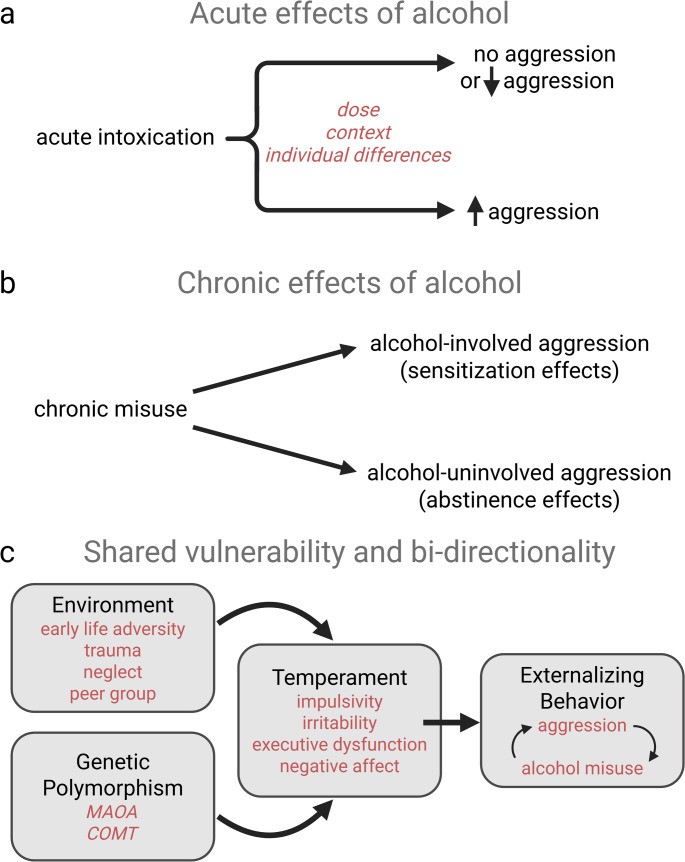
RATIONALE: The relationship between alcohol misuse and aggression has long intrigued clinical and preclinical researchers. While acute alcohol use is well known to promote aggression, converging evidence indicates a more complex, bidirectional association. Both behaviors often arise from shared genetic, neurobiological, and environmental vulnerabilities and can mutually increase risk, creating a vicious spiral in which alcohol misuse and aggression reinforce one another over time. OBJECTIVE: This review synthesizes epidemiological, clinical, and experimental findings to establish an integrated framework linking alcohol misuse and aggression, while introducing a translational perspective connecting human and animal research. RESULTS & CONCLUSIONS: The relationship between alcohol misuse and aggression can be conceptualized through two complementary models. In the first, alcohol use facilitates aggression: acute intoxication disrupts executive control and heightens emotional reactivity, while chronic exposure induces neuroadaptations that sensitize individuals to aggression-promoting effects and may elevate aggression during abstinence. In the second, aggression increases vulnerability to alcohol misuse: longitudinal studies reveal that aggressive traits, emotional dysregulation, and externalizing psychopathology frequently precede problematic drinking. These pathways are influenced by shared dysfunctions within prefrontal-limbic circuits involved in emotion regulation and impulse control. Despite progress in modeling alcohol-induced aggression, little research addresses how aggressive phenotypes contribute to alcohol misuse, representing an important translational gap. Overall, this relationship is best understood as a dynamic, bidirectional system rooted in overlapping neurobehavioral mechanisms. By integrating clinical findings with preclinical models, this framework highlights targets for mechanistic investigation and the development of tailored therapeutic strategies.
Verified 2026-11-22 · 1 reference not checked yet
Overview
CoChat Summary
## TL;DR
This review argues that alcohol misuse and aggression are linked by a dynamic, bidirectional relationship: alcohol can heighten aggression, and aggressive/disregulated traits can also increase risk for alcohol misuse. It proposes a translational framework grounded in shared developmental, neurobiological, and environmental vulnerabilities, with a particular call for more preclinical work on the aggression-to-alcohol pathway.
## Key findings
- Acute alcohol intoxication reliably increases aggression in human laboratory paradigms and animal models; in rodents, low doses of about 1 g/kg can enhance aggression, while higher doses often suppress it because of sedation.
- Chronic alcohol exposure can increase sensitivity to alcohol’s aggression-promoting effects: in one cited rodent study, repeated alcohol administration shifted the proportion of mice showing alcohol-heightened aggression from 37% to 74%, and broadened the dose range that increased aggression from 1 g/kg to 0.6, 1, and 1.7 g/kg.
- Aggression and related externalizing traits often precede alcohol misuse: longitudinal studies cited in the paper report that early aggression, oppositionality, poor self-regulation, and conduct problems predict later heavy drinking and AUD.
- Comorbidity is especially strong for disorders marked by impulsive/reactive aggression, including Conduct Disorder, Intermittent Explosive Disorder (described as affecting approximately 5% of the general population), Antisocial Personality Disorder (lifetime AUD rates exceeding 80% in some forensic/clinical populations), and Borderline Personality Disorder (lifetime AUD comorbidity estimated at 50%–70%).
## Methods
- Narrative review/synthesis of epidemiological, clinical, experimental, and preclinical literature on alcohol misuse and aggression.
- The paper integrates human longitudinal/clinical findings with animal models of acute alcohol effects, chronic exposure, withdrawal/abstinence, early-life adversity, and genetic risk.
- Main analysis is conceptual rather than statistical: it organizes evidence into two complementary pathways—alcohol → aggression and aggression → alcohol misuse—and frames them within shared neurobiological and developmental mechanisms.
## Limitations
- The authors explicitly state that research on how aggressive phenotypes contribute to alcohol misuse is limited, calling this an “important translational gap.”
- They note that evidence for chronic alcohol effects on aggression, especially withdrawal-related aggression in rodents, is more limited than the evidence for acute alcohol-heightened aggression.
- Evident from the text: the article is a review, so it does not present new primary data or a formal quantitative meta-analysis.
Model-written summary of a shortened version of the paper’s full text (it is longer than we read). Check it against the paper before relying on it.
Integrity signals
Registry
Cites
Statistics
Figures
Verification
Claims the paper makes
65 Valid · 8 Not valid · 87 Not checked · 47 Own results and interpretations
At least one cited source doesn’t support this claim or points to a different paper, and none confirmed it — see the verdicts below.
In the paper
“Reduced prefrontal control and heightened amygdala reactivity contribute to emotional dysregulation, impulsivity, and poor threat modulation (Oscar-Berman And Marinković 2007; Heinz et al. 2011).”
§ Decoding the bidirectional links between alcohol misuse and aggression: toward a unified translational framework > Aggression as a precursor and a catalyst of alcohol use > Shared vulnerabilities of aggression and alcohol use
What the sources say
- Disputedcites Oscar-Berman And Marinković 2007 matched to “Alcohol: Effects on Neurobehavioral Functions and the Brain” (2007) sourceExperimental — accuracy not yet measured
The amygdala passage (indexed as Abstract; page unavailable) reports the opposite of heightened reactivity: abstinent long-term alcoholics had blunted amygdala responses to emotional faces compared with controls. The paper does link impaired prefrontal inhibitory control with impulsivity, but that does not support the claim’s heightened-amygdala component. (LLM, conf=0.88)
Checked by a reasoning model — may be wrong.
- Not checked — no full text of the sourcecites Heinz et al. 2011 matched to “Cognitive and neurobiological mechanisms of alcohol-related aggression” (2011) source
plainstates a cause- Asserted: passes — The authors put it forward as true.
- Checkable: passes — It can be checked against evidence.
- Load-bearing: passes — The paper’s conclusions depend on it.
- Based: passes — The paper gives a reason why it holds.
- Disputed
The cited sources support only part of this claim — read each source’s verdict below.
In the paper
“shared impairments in prefrontal–amygdala circuitry appear to underlie both impulsive aggression and alcohol misuse”
- Also stated in: § Shared vulnerabilities of aggression and alcohol use · hedged
“At the neural systems level, shared impairments in prefrontal–amygdala circuitry appear to underlie both impulsive aggression and alcohol misuse (Oscar-Berman And Marinković 2007; Heinz et al. 2011; Gorka et al. 2013; Gan et al. 2015a).”
§ Decoding the bidirectional links between alcohol misuse and aggression: toward a unified translational framework > Aggression as a precursor and a catalyst of alcohol use > Shared vulnerabilities of aggression and alcohol use
What the sources say
- Partly supportedcites Oscar-Berman And Marinković 2007 matched to “Alcohol: Effects on Neurobehavioral Functions and the Brain” (2007) sourceExperimental — accuracy not yet measured
The paper’s Amygdala discussion (indexed as Abstract; page unavailable) describes connections between the amygdala and prefrontal cortex and reports blunted amygdala responses in abstinent alcoholics. Its discussion of aggression and impulsivity (also indexed as Abstract) links alcohol-related disinhibition to possible prefrontal dysfunction. It does not establish that a shared impairment in the prefrontal–amygdala circuit underlies both impulsive aggression and alcohol misuse. (LLM, conf=0.82)
- Not checked — no full text of the sourcecites Heinz et al. 2011 matched to “Cognitive and neurobiological mechanisms of alcohol-related aggression” (2011) source
- Partly supportedcites Gorka et al. 2013 matched to “Alcohol attenuates amygdala–frontal connectivity during processing social signals in heavy social drinkers: A preliminary pharmaco-fMRI study” (2013) sourceExperimental — accuracy not yet measured
The Discussion (page not provided) reports reduced amygdala–OFC connectivity during alcohol intoxication and suggests that this may contribute to aggression. It also describes abnormal connectivity in populations with high aggression. It does not establish that shared circuitry impairments underlie both impulsive aggression and alcohol misuse; the study examined acute alcohol effects, not a common underlying impairment. (LLM, conf=0.85)
hedgedstates a possible cause- Asserted: passes — The authors put it forward as true.
- Checkable: passes — It can be checked against evidence.
- Load-bearing: passes — The paper’s conclusions depend on it.
- Based: passes — The paper gives a reason why it holds.
- Also stated in: § Shared vulnerabilities of aggression and alcohol use · hedged
The sources with a verdict support this claim; the rest weren’t checked yet, have no full text we could read, or their verdicts aren’t rated yet.
In the paper
“longitudinal studies reveal that aggressive traits, emotional dysregulation, and externalizing psychopathology frequently precede problematic drinking”
§ Decoding the bidirectional links between alcohol misuse and aggression: toward a unified translational framework > Abstract > Results & conclusions
What the sources say
- Not checked — no full text of the sourcecites White et al. 1993 matched to “A longitudinal investigation of alcohol use and aggression in adolescence.” (1993) source
- Not checked — no full text of the sourcecites Iacono et al. 2008 matched to “Behavioral Disinhibition and the Development of Early-Onset Addiction: Common and Specific Influences” (2008) source
- Supportedcites Zucker et al. 2008 matched to “Early Developmental Processes and the Continuity of Risk for Underage Drinking and Problem Drinking” (2008) source
The section “Emergence of Behavioral and Emotional Dysregulation and Predisposition to Alcohol Involvement” reports that longitudinal studies link early externalizing symptoms, including aggression and undercontrol, to later problem alcohol use and substance-use disorders. It also describes early emotional and behavioral dysregulation as relevant to the progression into problem alcohol use. (LLM, conf=0.91)
plainstates a cause- Asserted: passes — The authors put it forward as true.
- Checkable: passes — It can be checked against evidence.
- Load-bearing: passes — The paper’s conclusions depend on it.
- Based: passes — The paper gives a reason why it holds.
Every source the paper cites for this claim was checked and supports it.
In the paper
“higher doses of alcohol can increase the motivation to fight, even when fighting performance is impaired (Covington et al. 2018)”
§ Decoding the bidirectional links between alcohol misuse and aggression: toward a unified translational framework > Alcohol use as a cause of aggression > Acute influence of alcohol
What the sources say
- Supportedcites Covington et al. 2018 matched to “The Urge to Fight: Persistent Escalation by Alcohol and Role of NMDA Receptors in Mice” (2018) source
The Results section, “Daily Administrations of Alcohol Dose Dependently Reduced, and Thereafter Escalated, the Motivation to Fight” (page unavailable), reports that repeated higher doses (1.8 or 2.2 g/kg) eventually escalated responding for an aggression reward while fighting performance remained suppressed. The effect followed repeated administration in mice; the first few doses reduced motivated responding. (LLM, conf=0.91)
plainstates a possible cause- Asserted: passes — The authors put it forward as true.
- Checkable: passes — It can be checked against evidence.
- Load-bearing: passes — The paper’s conclusions depend on it.
- Based: passes — The paper gives a reason why it holds.
- Supported
The cited sources support only part of this claim — read each source’s verdict below.
In the paper
“Neuroimaging studies show that even a single dose of alcohol disrupts the regulation of emotional stimuli by attenuating activity in the amygdala during exposure to threatening faces (Gilman et al. 2008; Sripada et al. 2011; Gorka et al. 2013).”
§ Decoding the bidirectional links between alcohol misuse and aggression: toward a unified translational framework > Alcohol use as a cause of aggression > Acute influence of alcohol
What the sources say
- Partly supportedcites Gilman et al. 2008 matched to “Why We Like to Drink: A Functional Magnetic Resonance Imaging Study of the Rewarding and Anxiolytic Effects of Alcohol” (2008) sourceExperimental — accuracy not yet measured
The Neural activity and Volume-of-interest analysis sections report that fearful faces activated the amygdala more than neutral faces under placebo, but not during alcohol intoxication. They do not establish that alcohol reduced amygdala activity during fearful-face exposure itself: the amygdala interaction reached only trend-level significance, and the discussion offers increased activity during neutral-face exposure as an alternative explanation for the smaller difference. (LLM, conf=0.86)
- Partly supportedcites Sripada et al. 2011 matched to “Effects of alcohol on brain responses to social signals of threat in humans” (2011) sourceExperimental — accuracy not yet measured
The Discussion reports that one intoxicating dose of alcohol reduced amygdala reactivity to threatening faces compared with placebo in healthy, non-dependent heavy social drinkers. It does not directly test whether alcohol disrupts the regulation of emotional stimuli; the authors describe a possible link between reduced threat processing and negative affect. (LLM, conf=0.82)
- Partly supportedcites Gorka et al. 2013 matched to “Alcohol attenuates amygdala–frontal connectivity during processing social signals in heavy social drinkers: A preliminary pharmaco-fMRI study” (2013) sourceExperimental — accuracy not yet measured
The Results (Imaging Results; page not provided) show that acute alcohol reduced amygdala activation during viewing of angry and fearful faces. The Discussion describes an effect on emotion regulation as a possible implication, rather than demonstrating that reduced amygdala activity caused a disruption of regulation. (LLM, conf=0.86)
plainstates a cause- Asserted: passes — The authors put it forward as true.
- Checkable: passes — It can be checked against evidence.
- Load-bearing: passes — The paper’s conclusions depend on it.
- Based: passes — The paper gives a reason why it holds.
- Partly supported
114 more claims · 33 with their cited sources checked
Create a free account to see all 207 claims and to verify the 22 references still open.
- It may state two separate claims as one. 73
- Probably not a substantial claim. 23
- The quote only partly states this claim. 1
Citations
Cites
Items 201–400 of 457
Chappell, A. M., Carter, E., McCool, B. A., & Weiner, J. L. (2013) · Alcoholism: Clinical and Experimental Research · doi:10.1111/j.1530-0277.2012.01926.x · Cited by 122
Xiao, L., Bechara, A., Gong, Q., Huang, X., Li, X., Xue, G., Wong, S., Lu, Z.-L., Palmer, P., Wei, Y., et al. (2013) · Psychology of Addictive Behaviors · doi:10.1037/a0027892 · Cited by 121
Coid, J., Yang, M., Roberts, A., Ullrich, S., Moran, P., Bebbington, P., Brugha, T., Jenkins, R., Farrell, M., Lewis, G., et al. (2006) · British Journal of Psychiatry · doi:10.1192/bjp.189.1.12 · Cited by 121
Alegría, A. A., Blanco, C., Petry, N. M., Skodol, A. E., Liu, S.-M., Grant, B. F., & Hasin, D. S. (2013) · Personality Disorders Theory Research and Treatment · doi:10.1037/a0031681 · Cited by 119
Townshend, J. M., Kambouropoulos, N., Griffin, A., Hunt, F. J., & Milani, R. M. (2014) · Alcoholism: Clinical and Experimental Research · doi:10.1111/acer.12333 · Cited by 117
Noradrenergic targets for the treatment of alcohol use disorder
Haass-Koffler, C. L., Swift, R. M., & Leggio, L. (2018) · Psychopharmacology · doi:10.1007/s00213-018-4843-6 · Cited by 117
Effects of baclofen and nitrendipine on ethanol withdrawal responses in the rat
File, S. E., Zharkovsky, A., & Gulati, K. (1991) · Neuropharmacology · doi:10.1016/0028-3908(91)90202-m · Cited by 116
Gan, G., Guevara, A., Marxen, M., Neumann, M., Jünger, E., Kobiella, A., Mennigen, E., Pilhatsch, M., Schwarz, D., Zimmermann, U. S., et al. (2014) · Biological Psychiatry · doi:10.1016/j.biopsych.2013.12.017 · Cited by 114
Anger expression, coping, and substance use in adolescent offenders
Eftekhari, A., Turner, A. P., & Larimer, M. E. (2004) · Addictive Behaviors · doi:10.1016/j.addbeh.2004.02.050 · Cited by 113
Alcohol and Aggression: A Test of the Attention-Allocation Model
Giancola, P. R., & Corman, M. D. (2007) · Psychological Science · doi:10.1111/j.1467-9280.2007.01953.x · Cited by 113
Attentional mediation of cigarette smoking's effect on anxiety.
Kassel, J. D., & Shiffman, S. (1997) · Health Psychology · doi:10.1037//0278-6133.16.4.359 · Cited by 113
The role of the orbitofrontal cortex in alcohol use, abuse, and dependence
Moorman, D. E. (2018) · Progress in Neuro-Psychopharmacology and Biological Psychiatry · doi:10.1016/j.pnpbp.2018.01.010 · Cited by 113
Maurage, P., Campanella, S., Philippot, P., Charest, I., Martin, S., & de Timary, P. (2009) · Alcohol and Alcoholism · doi:10.1093/alcalc/agp037 · Cited by 112
Age-dependent effects of isolation housing on the self-administration of ethanol in laboratory rats
Schenk, S., Gorman, K., & Amit, Z. (1990) · Alcohol · doi:10.1016/0741-8329(90)90090-y · Cited by 110
Dubow, E. F., Boxer, P., & Huesmann, L. R. (2008) · Addiction · doi:10.1111/j.1360-0443.2008.02175.x · Cited by 109
Excessive aggression as model of violence: a critical evaluation of current preclinical methods
Miczek, K. A., de Boer, S. F., & Haller, J. (2013) · Psychopharmacology · doi:10.1007/s00213-013-3008-x · Cited by 109
Maternal separation stress in male mice: long-term increases in alcohol intake
Cruz, F. C., Quadros, I. M., da S. Planeta, C., & Miczek, K. A. (2008) · Psychopharmacology · doi:10.1007/s00213-008-1307-4 · Cited by 109
Swann, A. C. (2010) · Annals of the New York Academy of Sciences · doi:10.1111/j.1749-6632.2009.05146.x · Cited by 109
Bartholow, B. D., & Heinz, A. (2006) · Psychological Science · doi:10.1111/j.1467-9280.2005.01661.x · Cited by 108
Role of α 2 -Agonists in the Treatment of Acute Alcohol Withdrawal
Muzyk, A. J., Fowler, J. A., Norwood, D. K., & Chilipko, A. (2011) · Annals of Pharmacotherapy · doi:10.1345/aph.1p575 · Cited by 107
Rosenbloom, M. J., & Pfefferbaum, A. (2008) · PubMed Central · Cited by 107
Butler, T. R., Karkhanis, A. N., Jones, S. R., & Weiner, J. L. (2016) · Alcoholism: Clinical and Experimental Research · doi:10.1111/acer.13075 · Cited by 106
Alcohol Use Disorder and Antisocial and Borderline Personality Disorders
Helle, A. C., Watts, A. L., Trull, T. J., & Sher, K. J. (2019) · Alcohol research · doi:10.35946/arcr.v40.1.05 · Cited by 105
Hall, F. S., Huang, S., Pert, A., Linnoila, M., & Fong, G. W. (1998) · Psychopharmacology · doi:10.1007/s002130050706 · Cited by 104
Treeby, M., & Bruno, R. (2012) · Personality and Individual Differences · doi:10.1016/j.paid.2012.05.011 · Cited by 103
Maladaptive Aggression: With a Focus on Impulsive Aggression in Children and Adolescents
Connor, D. F., Newcorn, J. H., Saylor, K. E., Amann, B. H., Scahill, L. D., Robb, A. S., Jensen, P. S., Vitiello, B., Findling, R. L., & Buitelaar, J. K. (2019) · Journal of Child and Adolescent Psychopharmacology · doi:10.1089/cap.2019.0039 · Cited by 103
Escalated aggression as a reward: corticosterone and GABAA receptor positive modulators in mice
Fish, E. W., DeBold, J. F., & Miczek, K. A. (2005) · Psychopharmacology · doi:10.1007/s00213-005-0064-x · Cited by 102
Parrott, D. J., & Giancola, P. R. (2004) · Alcoholism: Clinical and Experimental Research · doi:10.1097/01.alc.0000128226.92708.21 · Cited by 101
Connor, D. F., Findling, R. L., Kollins, S. H., Sallee, F., López, F. A., Lyne, A., & Tremblay, G. (2010) · CNS Drugs · doi:10.2165/11537790-000000000-00000 · Cited by 101
Effects of alcohol on brain responses to social signals of threat in humans
Sripada, C. S., Angstadt, M., McNamara, P., King, A. C., & Phan, K. L. (2011) · NeuroImage · doi:10.1016/j.neuroimage.2010.11.062 · Cited by 101
Haller, M., Handley, E., Chassin, L., & Bountress, K. (2010) · Development and Psychopathology · doi:10.1017/s0954579410000532 · Cited by 101
McCloskey, M. S., Berman, M. E., Noblett, K. L., & Coccaro, E. F. (2006) · Journal of Psychiatric Research · doi:10.1016/j.jpsychires.2005.07.004 · Cited by 98
The effects of alcohol and provocation on aggressive behavior in men and women.
Giancola, P. R., Helton, E. L., Osborne, A. B., Terry, M. K., Fuss, A. M., & Westerfield, J. A. (2002) · Journal of Studies on Alcohol · doi:10.15288/jsa.2002.63.64 · Cited by 97
Brain-wide functional architecture remodeling by alcohol dependence and abstinence
Kimbrough, A., Lurie, D. J., Collazo, A., Kreifeldt, M., Sidhu, H., Macedo, G. C., D’Esposito, M., Contet, C., & George, O. (2020) · Proceedings of the National Academy of Sciences · doi:10.1073/pnas.1909915117 · Cited by 97
Barnow, S. (2004) · Alcohol and Alcoholism · doi:10.1093/alcalc/agh048 · Cited by 96
Schindler, A., & Bröning, S. (2015) · Substance Abuse · doi:10.1080/08897077.2014.983586 · Cited by 95
Qayyum, A., C. Zai, C., Hirata, Y., K. Tiwari, A., Cheema, S., Nowrouzi, B., Beitchman, J., & Kennedy, L. (2015) · Current Neuropharmacology · doi:10.2174/1570159x13666150612225836 · Cited by 95
The Use of Baclofen as a Treatment for Alcohol Use Disorder: A Clinical Practice Perspective
de Beaurepaire, R., Sinclair, J. M. A., Heydtmann, M., Addolorato, G., Aubin, H.-J., Beraha, E. M., Caputo, F., Chick, J. D., de La Selle, P., Franchitto, N., et al. (2019) · Frontiers in Psychiatry · doi:10.3389/fpsyt.2018.00708 · Cited by 95
Early life stress and substance use disorders: The critical role of adolescent substance use
Kirsch, D. E., & Lippard, E. (2022) · Pharmacology Biochemistry and Behavior · doi:10.1016/j.pbb.2022.173360 · Cited by 94
Kendler, K. S., Jacobson, K., Myers, J. M., & Eaves, L. J. (2008) · Psychological Medicine · doi:10.1017/s0033291707001821 · Cited by 92
Antisocial Personality Disorder and Alcohol‐Induced Aggression
Moeller, F. G., Dougherty, D. M., Lane, S. D., Steinberg, J. L., & Cherek, D. R. (1998) · Alcoholism: Clinical and Experimental Research · doi:10.1111/j.1530-0277.1998.tb05896.x · Cited by 92
Social Deficits and Perseverative Behaviors, but not Overt Aggression, in MAO-A Hypomorphic Mice
Bortolato, M., Chen, K., Godar, S. C., Chen, G., Wu, W., Rebrin, I., Farrell, M. R., Scott, A. L., Wellman, C. L., & Shih, J. C. (2011) · Neuropsychopharmacology · doi:10.1038/npp.2011.157 · Cited by 90
Self-citationAlcoholism, alcohol, intoxication and assaultive behavior.
Mayfield, D. G. (1976) · PubMed · Cited by 90
Substance use and shame: A systematic and meta-analytic review
Luoma, J. B., Chwyl, C., & Kaplan, J. (2019) · Clinical Psychology Review · doi:10.1016/j.cpr.2019.03.002 · Cited by 88
Oliveira, V. E. D. M., Neumann, I. D., & de Jong, T. R. (2019) · Neuropharmacology · doi:10.1016/j.neuropharm.2019.01.019 · Cited by 87
Alcoholics, aggression and antisocial personality.
Jaffe, J. H., Babor, T. F., & Fishbein, D. H. (1988) · Journal of Studies on Alcohol · doi:10.15288/jsa.1988.49.211 · Cited by 86
How Bad Could It Be? Alcohol Dampens Stress Responses to Threat of Uncertain Intensity
Bradford, D. E., Shapiro, B. L., & Curtin, J. J. (2013) · Psychological Science · doi:10.1177/0956797613499923 · Cited by 86
Nilsson, K. W., Sjöberg, R. L., Wargelius, H., Leppert, J., Lindström, L., & Oreland, L. (2007) · Addiction · doi:10.1111/j.1360-0443.2006.01702.x · Cited by 85
Alcohol and aggression: a social information processing analysis.
Sayette, M. A., Wilson, G. T., & Elias, M. J. (1993) · Journal of Studies on Alcohol · doi:10.15288/jsa.1993.54.399 · Cited by 85
Whisman, M. A., & Schonbrun, Y. C. (2009) · Journal of Personality Disorders · doi:10.1521/pedi.2009.23.4.410 · Cited by 85
Substance use disorder and personality disorder
Sher, K. J., & Trull, T. J. (2002) · Current Psychiatry Reports · doi:10.1007/s11920-002-0008-7 · Cited by 84
The boundaries of the internalizing and externalizing genetic spectra in men and women
Kendler, K. S., & Myers, J. (2014) · Psychological Medicine · doi:10.1017/s0033291713000585 · Cited by 84
Laurent, J., Catanzaro, S. J., & Callan, M. K. (1997) · Journal of Studies on Alcohol · doi:10.15288/jsa.1997.58.644 · Cited by 82
Parent Alcoholism Impacts the Severity and Timing of Children’s Externalizing Symptoms
Hussong, A. M., Huang, W., Curran, P. J., Chassin, L., & Zucker, R. A. (2010) · Journal of Abnormal Child Psychology · doi:10.1007/s10802-009-9374-5 · Cited by 82
Alcohol and “bursts” of aggressive behavior: ethological analysis of individual differences in rats
Miczek, K. A., Weerts, E. M., Tornatzky, W., DeBold, J. F., & Vatne, T. M. (1992) · Psychopharmacology · doi:10.1007/bf02245270 · Cited by 81
Function and Dysfunction of Prefrontal Brain Circuitry in Alcoholic Korsakoff’s Syndrome
Oscar-Berman, M. (2012) · Neuropsychology Review · doi:10.1007/s11065-012-9198-x · Cited by 81
Alcohol Consumption and 15 Causes of Fatal Injuries: A Systematic Review and Meta-Analysis
Alpert, H. R., Slater, M. E., Yoon, Y.-H., Chen, C. M., Winstanley, N., & Esser, M. B. (2022) · American Journal of Preventive Medicine · doi:10.1016/j.amepre.2022.03.025 · Cited by 81
The influence of trait anger on the alcohol-aggression relation in men and women.
Giancola, P. R. (2002) · PubMed · doi:10.1097/01.alc.0000030842.77279.c4 · Cited by 80
Repeated alcohol: behavioral sensitization and alcohol-heightened aggression in mice
Fish, E., DeBold, J., & Miczek, K. (2002) · Psychopharmacology · doi:10.1007/s00213-001-0934-9 · Cited by 79
Zhang, L., Welte, J. W., & Wieczorek, W. W. (2002) · Substance Use & Misuse · doi:10.1081/ja-120002805 · Cited by 79
Partner alcohol use, violence and women's mental health: population-based survey in India
Nayak, M. B., Patel, V., Bond, J. C., & Greenfield, T. K. (2010) · British Journal of Psychiatry · doi:10.1192/bjp.bp.109.068049 · Cited by 79
Montgomery, C., Fisk, J. E., Murphy, P. N., Ryland, I., & Hilton, J. (2012) · Human Psychopharmacology: Clinical and Experimental · doi:10.1002/hup.1268 · Cited by 77
Intermittent Explosive Disorder in the National Comorbidity Survey Replication Adolescent Supplement
McLaughlin, K. A., Green, J. G., Hwang, I., Sampson, N. A., Zaslavsky, A. M., & Kessler, R. C. (2012) · Archives of General Psychiatry · doi:10.1001/archgenpsychiatry.2012.592 · Cited by 77
Siep, N., Tonnaer, F., van de Ven, V., Arntz, A., Raine, A., & Cima, M. (2019) · Brain Imaging and Behavior · doi:10.1007/s11682-018-9945-6 · Cited by 77
Kohl, C., Wang, X.-D., Grosse, J., Fournier, C., Harbich, D., Westerholz, S., Li, J.-T., Bacq, A., Sippel, C., Hausch, F., et al. (2015) · Psychoneuroendocrinology · doi:10.1016/j.psyneuen.2015.02.016 · Cited by 76
Alcohol Intoxication and Violent Crime: Implications for Public Health Policy
McClelland, G. M., & Teplin, L. A. (2001) · The American Journal on Addictions · doi:10.1080/10550490150504155 · Cited by 76
Glutamate Input in the Dorsal Raphe Nucleus As a Determinant of Escalated Aggression in Male Mice
Takahashi, A., Lee, R. X., Iwasato, T., Itohara, S., Arima, H., Bettler, B., Miczek, K. A., & Koide, T. (2015) · The Journal of Neuroscience · doi:10.1523/jneurosci.2450-14.2015 · Cited by 75
Broadwater, M., Varlinskaya, E. I., & Spear, L. P. (2011) · Alcoholism: Clinical and Experimental Research · doi:10.1111/j.1530-0277.2011.01474.x · Cited by 75
Recent advances in the study of aggression
Flanigan, M. E., & Russo, S. J. (2019) · Neuropsychopharmacology · doi:10.1038/s41386-018-0226-2 · Cited by 75
Alcohol stress response dampening: selective reduction of anxiety in the face of uncertain threat
Hefner, K. R., & Curtin, J. J. (2012) · Journal of Psychopharmacology · doi:10.1177/0269881111416691 · Cited by 74
Gobbi, G., Gaudreau, P.-O., & Leblanc, N. (2006) · Journal of Clinical Psychopharmacology · doi:10.1097/01.jcp.0000237945.35022.45 · Cited by 74
The Influence of Being under the Influence: Alcohol Effects on Adolescent Violence
Felson, R. B., Teasdale, B., & Burchfield, K. B. (2008) · Journal of Research in Crime and Delinquency · doi:10.1177/0022427807313704 · Cited by 74
Miczek, K. A., Weerts, E. M., & DeBold, J. F. (1993) · Journal of Studies on Alcohol, Supplement · doi:10.15288/jsas.1993.s11.170 · Cited by 73
Depression and Violence in Adolescence and Young Adults: Findings From Three Longitudinal Cohorts
Yu, R., Aaltonen, M., Branje, S., Ristikari, T., Meeus, W., Salmela‐Aro, K., Goodwin, G. M., & Fazel, S. (2017) · Journal of the American Academy of Child & Adolescent Psychiatry · doi:10.1016/j.jaac.2017.05.016 · Cited by 73
Alcohol and violence: use of possible confounders in a time‐series analysis
Bye, E. K. (2007) · Addiction · doi:10.1111/j.1360-0443.2006.01701.x · Cited by 72
Giancola, P. R., Duke, A. A., & Ritz, K. Z. (2011) · Addictive Behaviors · doi:10.1016/j.addbeh.2011.05.006 · Cited by 72
The experience of aggressive outbursts in Intermittent Explosive Disorder
Kulper, D. A., Kleiman, E. M., McCloskey, M. S., Berman, M. E., & Coccaro, E. F. (2014) · Psychiatry Research · doi:10.1016/j.psychres.2014.11.008 · Cited by 72
Early life stress disrupts peripubertal development of aggression in male mice
Tsuda, M. C., Yamaguchi, N., & Ogawa, S. (2011) · NeuroReport · doi:10.1097/wnr.0b013e328344495a · Cited by 72
Gorka, S. M., Fitzgerald, D. A., King, A. C., & Phan, K. L. (2013) · Psychopharmacology · doi:10.1007/s00213-013-3090-0 · Cited by 71
Illegal Acts Committed by Adolescents Under the Influence of Alcohol and Drugs
White, H. R., Tice, P. C., Loeber, R., & Stouthamer-Loeber, M. (2002) · Journal of Research in Crime and Delinquency · doi:10.1177/002242780203900201 · Cited by 70
Alcohol and Heightened Aggression in Individual Mice
Miczek, K. A., Barros, H. M., Sakoda, L., & Weerts, E. M. (1998) · Alcoholism: Clinical and Experimental Research · doi:10.1111/j.1530-0277.1998.tb03968.x · Cited by 70
Functional Alterations in the Dorsal Raphe Nucleus Following Acute and Chronic Ethanol Exposure
Lowery‐Gionta, E. G., Marcinkiewcz, C. A., & Kash, T. L. (2014) · Neuropsychopharmacology · doi:10.1038/npp.2014.205 · Cited by 69
Rossetti, Z. L., Carboni, S., & Fadda, F. (1999) · Neuroscience · doi:10.1016/s0306-4522(99)00250-x · Cited by 69
Loeber, S., & Duka, T. (2009) · Addiction · doi:10.1111/j.1360-0443.2009.02718.x · Cited by 69
Childhood and Adolescent Depression Symptoms and Young Adult Mental Health and Psychosocial Outcomes
Psychogiou, L., Navarro, M. C., Orri, M., Côté, S. M., & Ahun, M. N. (2024) · JAMA Network Open · doi:10.1001/jamanetworkopen.2024.25987 · Cited by 68
Alcohol and violence: neuropeptidergic modulation of monoamine systems
Miczek, K. A., DeBold, J. F., Hwa, L. S., Newman, E. L., & de Almeida, R. M. M. (2015) · Annals of the New York Academy of Sciences · doi:10.1111/nyas.12862 · Cited by 67
Barrett, E. L., Teesson, M., & Mills, K. L. (2014) · Addictive Behaviors · doi:10.1016/j.addbeh.2014.03.003 · Cited by 67
Komori, T., Okamura, K., Ikehara, M., Yamamuro, K., Endo, N., Okumura, K., Yamauchi, T., Ikawa, D., Ouji-Sageshima, N., Toritsuka, M., et al. (2024) · Molecular Psychiatry · doi:10.1038/s41380-024-02413-y · Cited by 66
A Latent Class Analysis of DSM‐IV Alcohol Use Disorder Criteria and Binge Drinking in Undergraduates
Beseler, C. L., Taylor, L. A., Kraemer, D. T., & Leeman, R. F. (2012) · Alcoholism: Clinical and Experimental Research · doi:10.1111/j.1530-0277.2011.01595.x · Cited by 65
Negative urgency, mood induction, and alcohol seeking behaviors
VanderVeen, J. D., Plawecki, M. H., Millward, J. B., Hays, J., Kareken, D. A., O’Connor, S., & Cyders, M. A. (2016) · Drug and Alcohol Dependence · doi:10.1016/j.drugalcdep.2016.05.026 · Cited by 65
Somkuwar, S. S., Vendruscolo, L. F., Fannon, M. J., Schmeichel, B. E., Nguyen, T. B., Guevara, J., Sidhu, H., Contet, C., Zorrilla, E. P., & Mandyam, C. D. (2017) · Psychoneuroendocrinology · doi:10.1016/j.psyneuen.2017.06.006 · Cited by 64
(2009) · Monographs of the Society for Research in Child Development · doi:10.1111/j.1540-5834.2009.00529.x · Cited by 64
Faccidomo, S., Bannai, M., & Miczek, K. A. (2008) · Neuropsychopharmacology · doi:10.1038/npp.2008.7 · Cited by 62
Borders, A., Barnwell, S. S., & Earleywine, M. (2007) · Aggressive Behavior · doi:10.1002/ab.20187 · Cited by 62
Chefer, V., Meis, J., Wang, G., Kuzmin, A., Bakalkin, G., & Shippenberg, T. (2011) · Addiction Biology · doi:10.1111/j.1369-1600.2010.00272.x · Cited by 61
Workman, J. L., Fonken, L. K., Gusfa, J., Kassouf, K. M., & Nelson, R. J. (2011) · Pharmacology Biochemistry and Behavior · doi:10.1016/j.pbb.2011.07.008 · Cited by 61
Alcohol consumption and escalatory aggression in intoxicated and sober dyads.
Leonard, K. E. (1984) · Journal of Studies on Alcohol · doi:10.15288/jsa.1984.45.75 · Cited by 60
Effects of Trait Anger on Alcohol Consumption and Consequences
Leibsohn, M. T., Oetting, E. R., & Deffenbacher, J. L. (1994) · Journal of Child & Adolescent Substance Abuse · doi:10.1300/j029v03n03_02 · Cited by 60
Morphine attenuates ultrasonic vocalization during agonistic encounters in adult male rats
Vivian, J. A., & Miczek, K. A. (1993) · Psychopharmacology · doi:10.1007/bf02244954 · Cited by 60
Miczek, K. A., DeBold, J. F., & van Erp, A. M. M. (1994) · Behavioural Pharmacology · doi:10.1097/00008877-199408000-00004 · Cited by 59
Deliberate Self-Harm Patients with Alcohol Disorders: Characteristics, Treatment, and Outcome
Haw, C., Houston, K., Townsend, E., & Hawton, K. (2001) · Crisis · doi:10.1027//0227-5910.22.3.93 · Cited by 59
Griffin, B. J., Moloney, J. M., Green, J. D., Worthington, Jr., Cork, B., Tangney, J. P., Van Tongeren, D. R., Davis, D. E., & Hook, J. N. (2016) · Self and Identity · doi:10.1080/15298868.2016.1187669 · Cited by 59
Emotion Recognition Biases in Alcohol Use Disorder
Freeman, C. R., Wiers, C. E., Sloan, M. E., Zehra, A., Ramirez, V., Wang, G., & Volkow, N. D. (2018) · Alcoholism: Clinical and Experimental Research · doi:10.1111/acer.13802 · Cited by 57
Kingree, J. B., & Thompson, M. (2015) · Journal of Interpersonal Violence · doi:10.1177/0886260514540806 · Cited by 56
Tuominen, K., Hilakivi, L. A., Päivärinta, P., & Korpi, E. R. (1990) · Alcohol · doi:10.1016/0741-8329(90)90094-s · Cited by 56
Flanigan, M. E., Hon, O. J., D’Ambrosio, S., Boyt, K. M., Hassanein, L. A., Castle, M. Z. D., Haun, H. L., Pina, M. M., & Kash, T. L. (2023) · Nature Communications · doi:10.1038/s41467-023-36808-2 · Cited by 56
Effects of MAOA‐Genotype, Alcohol Consumption, and Aging on Violent Behavior
Tikkanen, R., Sjöberg, R. L., Ducci, F., Goldman, D., Holi, M., Tiihonen, J., & Virkkunen, M. (2009) · Alcoholism: Clinical and Experimental Research · doi:10.1111/j.1530-0277.2008.00853.x · Cited by 55
NETER ALCOHOLIC TYPOLOGY (NAT)a
CARDOSO, J. M. N., BARBOSA, A., ISMAIL, F., & POMBO, S. (2006) · Alcohol and Alcoholism · doi:10.1093/alcalc/agh247 · Cited by 55
Anger and substance abuse: a systematic review and meta-analysis
Laitano, H. V., Ely, A., Sordi, A. O., Schuch, F. B., Pechansky, F., Hartmann, T. C., Hilgert, J. B., Wendland, E., Dimen, L. V., Scherer, J. N., et al. (2022) · Brazilian Journal of Psychiatry · doi:10.1590/1516-4446-2020-1133 · Cited by 55
Biased Self-Perceptions, Peer Rejection, and Aggression in Children
White, B. C., & Kistner, J. A. (2011) · Research on Child and Adolescent Psychopathology · doi:10.1007/s10802-011-9506-6 · Cited by 52
Takahashi, A., Kwa, C., DeBold, J. F., & Miczek, K. A. (2010) · Psychopharmacology · doi:10.1007/s00213-010-1920-x · Cited by 52
Generation and Characterization of Humanized Mice Carrying COMT158 Met/Val Alleles
Risbrough, V. B., Ji, B., Hauger, R., & Zhou, X. (2014) · Neuropsychopharmacology · doi:10.1038/npp.2014.29 · Cited by 52
Locci, A., Geoffroy, P., Miesch, M., Mensah-Nyagan, A.-G., & Pinna, G. (2017) · Frontiers in Cellular Neuroscience · doi:10.3389/fncel.2017.00208 · Cited by 52
Neural and Behavioral Correlates of Alcohol-Induced Aggression Under Provocation
Gan, G., Sterzer, P., Marxen, M., Zimmermann, U. S., & Smolka, M. N. (2015) · Neuropsychopharmacology · doi:10.1038/npp.2015.141 · Cited by 51
Bácskai, E., Czobor, P., & Gerevich, J. (2011) · Progress in Neuro-Psychopharmacology and Biological Psychiatry · doi:10.1016/j.pnpbp.2011.04.005 · Cited by 51
Sidhu, H., Kreifeldt, M., & Contet, C. (2018) · Alcoholism: Clinical and Experimental Research · doi:10.1111/acer.13760 · Cited by 51
Youth Violence Trajectories and Proximal Characteristics of Intimate Partner Violence
Herrenkohl, T. I., Kosterman, R., Mason, W. A., & Hawkins, J. D. (2007) · Violence and Victims · doi:10.1891/088667007780842793 · Cited by 50
Disruptive Behavior Disorders and Substance Use Disorders in Adolescents
Bukstein, O. G. (2000) · Journal of Psychoactive Drugs · doi:10.1080/02791072.2000.10400213 · Cited by 50
Moderate adolescent drug use and the development of substance use self-regulation
Percy, A. (2008) · International Journal of Behavioral Development · doi:10.1177/0165025408093664 · Cited by 49
Morphine withdrawal aggression: modification with D1 and D2 receptor agonists
Tidey, J. W., & Miczek, K. A. (1992) · Psychopharmacology · doi:10.1007/bf02245304 · Cited by 48
Kantak, K. M., & Miczek, K. A. (1988) · Psychopharmacology · doi:10.1007/bf02180026 · Cited by 48
De Mojá, C. A., & Spielberger, C. D. (1997) · Psychological Reports · doi:10.2466/pr0.1997.81.1.152 · Cited by 47
Hwa, L. S., Nathanson, A. J., Shimamoto, A., Tayeh, J. K., Wilens, A. R., Holly, E. N., Newman, E. L., DeBold, J. F., & Miczek, K. A. (2015) · Psychopharmacology · doi:10.1007/s00213-015-3925-y · Cited by 47
Gorka, S. M., Lieberman, L., Phan, K. L., & Shankman, S. A. (2016) · Drug and Alcohol Dependence · doi:10.1016/j.drugalcdep.2016.04.034 · Cited by 47
NMDA receptor antagonism: escalation of aggressive behavior in alcohol-drinking mice
Newman, E. L., Chu, A., Bahamón, B., Takahashi, A., DeBold, J. F., & Miczek, K. A. (2012) · Psychopharmacology · doi:10.1007/s00213-012-2734-9 · Cited by 46
Treatment of aggression with topiramate in male borderline patients, part II: 18-month follow-up
Nickel, M. K., & Loew, T. H. (2008) · European Psychiatry · doi:10.1016/j.eurpsy.2007.09.004 · Cited by 46
Buu, A., Dabrowska, A., Mygrants, M., Puttler, L. I., Jester, J. M., & Zucker, R. A. (2014) · Journal of Studies on Alcohol and Drugs · doi:10.15288/jsad.2014.75.850 · Cited by 46
Role of Alcohol Consumption in Escalation to Violence
MICZEK, K. A., FISH, E. W., De ALMEIDA, R. M. M., FACCIDOMO, S., & DEBOLD, J. F. (2004) · Annals of the New York Academy of Sciences · doi:10.1196/annals.1330.018 · Cited by 45
A novel mouse model for vulnerability to alcohol dependence induced by early-life adversity
Okhuarobo, A., Bolton, J. L., Igbe, I., Zorrilla, E. P., Baram, T. Z., & Contet, C. (2020) · Neurobiology of Stress · doi:10.1016/j.ynstr.2020.100269 · Cited by 45
The Relationship of Alcoholism to Violent Behaviour Resulting in Long-term Imprisonment
Nicol, A. R., Gunn, J. C., Gristwood, J., Foggitt, R. H., & Watson, J. P. (1973) · British Journal of Psychiatry · doi:10.1192/bjp.123.1.47 · Cited by 44
Alcohol and social behaviour in group-housed female mice
Smoothy, R., Brain, P. F., Berry, M. S., & Haug, M. (1986) · Physiology & Behavior · doi:10.1016/0031-9384(86)90173-3 · Cited by 44
The Moderating Effects of Gender and Hostility on the Alcohol-Aggression Relationship
WHITE, H. R., & HANSELL, S. (1996) · Journal of Research in Crime and Delinquency · doi:10.1177/0022427896033004004 · Cited by 43
Patock-Peckham, J. A., Canning, J. R., & Leeman, R. F. (2018) · Personality and Individual Differences · doi:10.1016/j.paid.2017.09.023 · Cited by 43
Deficient inhibition in alcohol-dependence: let’s consider the role of the motor system!
Quoilin, C., Wilhelm, E., Maurage, P., de Timary, P., & Duque, J. (2018) · Neuropsychopharmacology · doi:10.1038/s41386-018-0074-0 · Cited by 43
Psychosocial impairment in DSM-5 intermittent explosive disorder
Rynar, L. Z., & Coccaro, E. F. (2018) · Psychiatry Research · doi:10.1016/j.psychres.2018.03.077 · Cited by 43
Giannoni‐Guzmán, M. A., Giray, T., Agosto, J. L., Stevison, B. K., Freeman, B., Ricci, P., Brown, E. A., & Abramson, C. I. (2014) · PLoS ONE · doi:10.1371/journal.pone.0100894 · Cited by 42
Bloch, S., Holleran, K. M., Kash, T. L., Vazey, E. M., Rinker, J. A., Lebonville, C. L., O’Hara, K., Lopez, M. F., Jones, S. R., Grant, K. A., et al. (2022) · Alcohol · doi:10.1016/j.alcohol.2022.02.001 · Cited by 42
Miranda, R., Meyerson, L. A., Myers, R. R., & Lovallo, W. R. (2003) · Alcoholism: Clinical and Experimental Research · doi:10.1097/01.alc.0000099263.71214.f9 · Cited by 41
ALCOHOL USE IN ADOLESCENTS FROM NORTHERN RUSSIA: THE ROLE OF THE SOCIAL CONTEXT
Koposov, R. A. (2002) · Alcohol and Alcoholism · doi:10.1093/alcalc/37.3.297 · Cited by 41
Interpersonal Guilt and Substance Use in College Students
Locke, G. W., Shilkret, R., Everett, J. E., & Petry, N. M. (2015) · Substance Abuse · doi:10.1080/08897077.2014.885482 · Cited by 41
Winslow, J. T., Ellingboe, J., & Miczek, K. (1988) · Psychopharmacology · doi:10.1007/bf00181947 · Cited by 41
Johansson, A., Westberg, L., Sandnabba, K. N., Jern, P., Salo, B., & Santtila, P. O. (2012) · Psychoneuroendocrinology · doi:10.1016/j.psyneuen.2012.02.009 · Cited by 40
Loeber, R., Stouthamer‐Loeber, M., Farrington, D. P., Lahey, B. B., Keenan, K. E., & WHITE, H. R. (2002) · Criminal Behaviour and Mental Health · doi:10.1002/cbm.483 · Cited by 40
Curtis, A., Vandenberg, B., Mayshak, R., Coomber, K., Hyder, S., Walker, A., Liknaitzky, P., & Miller, P. G. (2019) · Drug and Alcohol Review · doi:10.1111/dar.12925 · Cited by 40
New Zealand Pacific peoples' drinking style: too much or nothing at all?
Huakau, J. T., Asiasiga, L., Ford, M., Pledger, M. J., Casswell, S., Suaalii‐Sauni, T., & Lima, I. (2005) · PubMed · Cited by 40
The Relationship between Hostility and Behavioral Risk Factors for Poor Health in Women Veterans
Calhoun, P. S., Bosworth, H. B., Siegler, I. C., & Bastian, L. A. (2001) · Preventive Medicine · doi:10.1006/pmed.2001.0921 · Cited by 39
Alcohol�s Negative Emotional Side: The Role of Stress Neurobiology in Alcohol Use Disorder
Sinha, R. (2022) · Alcohol Research: Current Reviews · doi:10.35946/arcr.v42.1.12 · Cited by 39
Electrophysiological correlates of the disrupted processing of anger in alcoholism
Maurage, P., Campanella, S., Philippot, P., Vermeulen, N., Constant, E., Luminet, O., & de Timary, P. (2008) · International Journal of Psychophysiology · doi:10.1016/j.ijpsycho.2008.05.572 · Cited by 39
van der Kooij, M. A., Grosse, J., Zanoletti, O., Papilloud, A., & Sandi, C. (2015) · Neuroscience · doi:10.1016/j.neuroscience.2015.10.058 · Cited by 39
Anger and Its Association with Substance Use Treatment Outcomes in a Sample of Adolescents
Serafini, K., Toohey, M. J., Kiluk, B. D., & Carroll, K. M. (2016) · Journal of Child & Adolescent Substance Abuse · doi:10.1080/1067828x.2015.1049394 · Cited by 39
Abramson, C. I., Place, A. J., Aquino, I. S., & Fernández, A. (2004) · Psychological Reports · doi:10.2466/pr0.94.3c.1107-1115 · Cited by 39
Coccaro, E. F., Fanning, J. R., & Lee, R. (2017) · The Journal of Clinical Psychiatry · doi:10.4088/jcp.15m10306 · Cited by 38
A Role for Prefrontal Cortical NMDA Receptors in Murine Alcohol-Heightened Aggression
Newman, E. L., Terunuma, M., Wang, T. L., Hewage, N., Bicakci, M. B., Moss, S. J., DeBold, J. F., & Miczek, K. A. (2018) · Neuropsychopharmacology · doi:10.1038/npp.2017.253 · Cited by 38
Neurophysiological and Interpersonal Correlates of Emotional Face Processing in Alcohol Use Disorder
Hoffman, L. A., Lewis, B., & Nixon, S. J. (2019) · Alcoholism Clinical and Experimental Research · doi:10.1111/acer.14152 · Cited by 38
Kantak, K., & Miczek, K. (1986) · Psychopharmacology · doi:10.1007/bf00174059 · Cited by 37
OZSOY, S., ESEL, E., IZGI, H. B., & SOFUOGLU, S. (2006) · Alcohol and Alcoholism · doi:10.1093/alcalc/agl056 · Cited by 37
The role of social isolation stress in escalated aggression in rodent models
Takahashi, A. (2025) · Neuroscience Research · doi:10.1016/j.neures.2022.07.009 · Cited by 37
Shubina, O., Mshana, G. H., Sichalwe, S., Malibwa, D., Mosha, N. R., Hashim, R., Nahay, F., Ayieko, P., Kapiga, S., & Stöckl, H. (2023) · Global Health Action · doi:10.1080/16549716.2023.2185967 · Cited by 37
Sellers, C. M., McManama O’Brien, K. H., Hernandez, L., & Spirito, A. (2018) · Journal of the Society for Social Work and Research · doi:10.1086/695809 · Cited by 36
Voorhees, E. E. V., Dennis, P. A., Elbogen, E. B., Fuemmeler, B. F., Neal, L. C., Calhoun, P. S., & Beckham, J. C. (2018) · Psychiatry Research · doi:10.1016/j.psychres.2017.12.080 · Cited by 36
Individual differences in alcohol-induced aggression. A nonhuman-primate model.
Higley, J. D. (2001) · PubMed Central · Cited by 36
Takahashi, A., Schilit, A. N., Kim, J., DeBold, J. F., Koide, T., & Miczek, K. A. (2012) · Psychopharmacology · doi:10.1007/s00213-012-2654-8 · Cited by 35
Fredriksson, I., Jayaram-Lindström, N., Wirf, M., Nylander, E., Nyström, E., Jardemark, K., & Steensland, P. (2015) · Neuropsychopharmacology · doi:10.1038/npp.2014.294 · Cited by 35
Developmental Sequences and Comorbidity of Substance Use and Violence
White, H. R., Jackson, K. M., & Loeber, R. (2009) · Handbooks of Sociology and Social Research · doi:10.1007/978-1-4419-0245-0_21 · Cited by 34
Problematic substance use in depressed adolescents: Prevalence and clinical correlates
Marino, E. N., Jha, M. K., Minhajuddin, A., Ayvaci, E. R., Levinson, S., Pipes, R., Emslie, G. J., & Trivedi, M. H. (2024) · Addictive Behaviors Reports · doi:10.1016/j.abrep.2024.100539 · Cited by 34
Alcohol and Expectations of Attack
Schmutte, G. T., Leonard, K. E., & Taylor, S. P. (1979) · Psychological Reports · doi:10.2466/pr0.1979.45.1.163 · Cited by 33
Godar, S. C., Mosher, L. J., Scheggi, S., Devoto, P., Moench, K. M., Strathman, H. J., Jones, C. M., Frau, R., Melis, M., Gambarana, C., et al. (2019) · Neuropharmacology · doi:10.1016/j.neuropharm.2019.01.028 · Cited by 33
Self-citationLovallo, W. R., Cohoon, A. J., Sorocco, K. H., Vincent, A. S., Acheson, A., Hodgkinson, C. A., & Goldman, D. (2019) · Alcoholism: Clinical and Experimental Research · doi:10.1111/acer.14079 · Cited by 33
Griffin, S. M., Karia, F. P., Zimmerman, A., Minnig, M. C., Swahn, M. H., Makelarski, J. A., Mmbaga, B. T., Vissoci, J. R. N., & Staton, C. A. (2020) · Alcoholism Clinical and Experimental Research · doi:10.1111/acer.14402 · Cited by 32
Higley, J. D., Linnoila, M., & Suomi, S. J. (1994) · Springer eBooks · doi:10.1007/978-1-4615-2403-8_2 · Cited by 32
Effects of rearing on aggression and subordination in papio monkeys
Coelho, A. M., & Bramblett, C. A. (1981) · American Journal of Primatology · doi:10.1002/ajp.1350010405 · Cited by 31
Core competencies and the prevention of youth violence
Sullivan, T. N., Farrell, A. D., Bettencourt, A. F., & Helms, S. W. (2008) · New Directions for Child and Adolescent Development · doi:10.1002/cd.227 · Cited by 31
Waleewong, O., Laslett, A., Chenhall, R. D., & Room, R. (2018) · International Journal of Drug Policy · doi:10.1016/j.drugpo.2018.03.015 · Cited by 31
Zhan, N., Zhang, L., Gong, M., & Geng, F. (2024) · Psychological Trauma Theory Research Practice and Policy · doi:10.1037/tra0001498 · Cited by 31
Anger mediates the effect of ostracism on risk-taking
Svetieva, E., Zadro, L., Denson, T. F., Dale, E., O’Moore, K., & Zheng, W. Y. (2016) · Journal of Risk Research · doi:10.1080/13669877.2014.1003320 · Cited by 30
Capacity for cognitive and emotional empathy in alcohol-dependent patients.
Dethier, M., & Blairy, S. (2012) · Psychology of Addictive Behaviors · doi:10.1037/a0028673 · Cited by 30
Long-Term Impact of Early-Life Stress on Serotonin Connectivity
Ramkumar, R., Edge-Partington, M., Terstege, D. J., Adigun, K., Ren, Y., Khan, N. S., Rouhi, N., Jamani, N. F., Tsutsui, M., Epp, J. R., et al. (2024) · Biological Psychiatry · doi:10.1016/j.biopsych.2024.01.024 · Cited by 30
Rauschtrinken bei Jugendlichen und jungen Erwachsenen
Karagülle, D., Donath, C., Graessel, E., Bleich, S., & Hillemacher, T. (2010) · Fortschritte der Neurologie · Psychiatrie · doi:10.1055/s-0028-1110028 · Cited by 29
Bhardwaj, V., Angkaw, A. C., Franceschetti, M., Rao, R. R., & Baker, D. G. (2019) · Aggressive Behavior · doi:10.1002/ab.21827 · Cited by 29
Recent alcohol intake and suicidality — a neuropsychological perspective
O'Connell, H. P., & LAWLOR, B. A. (2005) · Irish Journal of Medical Science (1971 -) · doi:10.1007/bf03168983 · Cited by 28
Early life stress and altered social behaviors: A perspective across species
Parise, L. F., Joseph Burnett, C., & Russo, S. J. (2025) · Neuroscience Research · doi:10.1016/j.neures.2023.11.005 · Cited by 28
Crane, C. A., Licata, M. L., Schlauch, R. C., Testa, M., & Easton, C. J. (2017) · Psychology of Addictive Behaviors · doi:10.1037/adb0000244 · Cited by 27
The Disguise of Sobriety: Unveiled by Alcohol in Persons With an Aggressive Personality
Giancola, P. R., Parrott, D. J., Silvia, P. J., DeWall, C. N., Bègue, L., Subra, B., Duke, A. A., & Bushman, B. J. (2012) · Journal of Personality · doi:10.1111/j.1467-6494.2011.00726.x · Cited by 26
Jennings, W. G., Piquero, A. R., Rocque, M., & Farrington, D. P. (2015) · Journal of Criminal Justice · doi:10.1016/j.jcrimjus.2015.09.002 · Cited by 26
Howard, R., Finn, P., Jose, P., & Gallagher, J. (2012) · The Journal of Forensic Psychiatry & Psychology · doi:10.1080/14789949.2011.641996 · Cited by 26
What Violent Offenders Remember of their Crime: Empirical Explorations ∗
Evans, C. (2006) · Australian & New Zealand Journal of Psychiatry · doi:10.1080/j.1440-1614.2006.01833.x · Cited by 25
Vanderkam, P., Solinas, M., Ingrand, I., Doux, N., Ebrahimighavam, S., Jaafari, N., & Lafay‐Chebassier, C. (2021) · Addiction · doi:10.1111/add.15265 · Cited by 25
The Urge to Fight: Persistent Escalation by Alcohol and Role of NMDA Receptors in Mice
Covington, H. E., Newman, E. L., Tran, S., Walton, L., Hayek, W., Leonard, M. Z., DeBold, J. F., & Miczek, K. A. (2018) · Frontiers in Behavioral Neuroscience · doi:10.3389/fnbeh.2018.00206 · Cited by 25
Lane, S. D., Gowin, J. L., Green, C. E., Steinberg, J. L., Moeller, F. G., & Cherek, D. R. (2009) · Pharmacology Biochemistry and Behavior · doi:10.1016/j.pbb.2009.01.002 · Cited by 24
Puhalla, A. A., Berman, M. E., Coccaro, E. F., Fahlgren, M. K., & McCloskey, M. S. (2020) · Journal of Psychiatric Research · doi:10.1016/j.jpsychires.2020.02.025 · Cited by 24
Zhukov, I. S., Karpova, I. V., Krotova, N. A., Tissen, I. Y., Demin, K. A., Shabanov, P. D., Budygin, E. A., Kalueff, A. V., & Gainetdinov, R. R. (2022) · International Journal of Molecular Sciences · doi:10.3390/ijms232214066 · Cited by 24
Siciliano, V., Mezzasalma, L., Lorenzoni, V., Pieroni, S., & Molinaro, S. (2013) · BMC Public Health · doi:10.1186/1471-2458-13-950 · Cited by 23
Cherek, D. R., Lane, S. D., Pietras, C. J., Sharon, J., & Steinberg, J. L. (2002) · Psychopharmacology · doi:10.1007/s00213-002-1167-2 · Cited by 23
A Comparative Study of Self-Regulation in Substance Dependent and Non-Dependent Individuals
Bakhshani, N. M., & Hosseinbor, M. (2013) · Global Journal of Health Science · doi:10.5539/gjhs.v5n6p40 · Cited by 23
Watkins, L. E., Schumacher, J. A., & Coffey, S. F. (2016) · Journal of Aggression, Maltreatment & Trauma · doi:10.1080/10926771.2015.1129657 · Cited by 23
Frau, R., Fanni, S., Serra, V., Simola, N., Godar, S. C., Traccis, F., Devoto, P., Bortolato, M., & Melis, M. (2019) · Neuropharmacology · doi:10.1016/j.neuropharm.2019.01.032 · Cited by 23
Self-citationJohansson, A., Santtila, P., Corander, J., Alanko, K., Jern, P., von der Pahlen, B., & Sandnabba, N. K. (2010) · Biological Psychology · doi:10.1016/j.biopsycho.2010.07.016 · Cited by 22
LAGERSPETZ, K. M. J., & Ekqvist, K. (1978) · Aggressive Behavior · doi:10.1002/1098-2337(1978)4:2<105::aid-ab2480040202>3.0.co;2-2 · Cited by 22
Bendre, M., Comasco, E., Nylander, I., & Nilsson, K. W. (2015) · Translational Psychiatry · doi:10.1038/tp.2015.186 · Cited by 21
Directional Relationships Between Alcohol Use and Antisocial Behavior Across Adolescence
Cho, S.-B., Heron, J., Aliev, F., Salvatore, J. E., Lewis, G., Macleod, J., Hickman, M., Maughan, B., Kendler, K. S., & Dick, D. M. (2014) · Alcoholism: Clinical and Experimental Research · doi:10.1111/acer.12446 · Cited by 20
Research works printed but not linked: 11
- Abbey A, Zawacki T, Buck PO et al (2001) Alcohol and sexual assault. Alcohol Res Health 25:43–51 11496965 PMC4484576
- Al-Maliki SJ, Al-Hamood MH (1993) Effects of alpha and beta adrenergic antagonists on aggressive behavior in male mice. Aggressive Behav 19:361–367. 10.1002/1098-2337(1993)19:5%253C361::AID-AB2480190505%253E3.0.CO;2-M · doi:10.1002/1098-2337(1993)19:5<361::aid-ab2480190505>3.0.co;2-m
- Berry MS, Smoothy R (1986) A Critical Evaluation of Claimed Relationships between Alcohol Intake and Aggression in Infra-human Animals. Alcohol and Aggression. Routledge
- Brown SD (1994) The novel anticonvulsant topiramate enhances GABA-mediated chloride flux. Epilepsia 34:122–123
- Coulter DA (1995) Topiramate effects on excitatory amino acid-mediated responses in cultured hippocampal neurons: selective blockade of Kainate currents. Epilepsia 36:S40
- Khantzian EJ (2003) The self-medication hypothesis revisited: the dually diagnosed patient. Prim Psychiatry 10:47–48
- Linehan MM (1993) Cognitive-behavioral treatment of borderline personality disorder. Guilford Press, New York, NY, US
- Miczek KA, DeBold JF, Van Erp AMM (1994b) Neuropharmacological characteristics of individual differences in alcohol effects on aggression in rodents and primates. Behav Pharmacol 5:407–421 11224293 · DOI · Paper page
- Obot I (2006) Alcohol use and related problems in sub-Saharan Africa. Afr J Drug Alcohol Stud 5:17–25
- SAMHSA (2023) Key substance use and mental health indicators in the united states: results from the 2022 National survey on drug use and health. Substance Abuse and Mental Health Services Administration, Rockville, MD
- WHO (2024) Global status report on alcohol and health and treatment of substance use disorders. World Health Organization, Geneva
Cited by
Epidemiology of aggression and violence in mental disorders and the approach of TRR 379
Habel, U., Herpertz, S., Reif, A., Habel, U., Herpertz, S., Reif, A., Wagels, L., Reindl, V., Konrad, K., Holz, N., et al. (2026) · Der Nervenarzt · doi:10.1007/s00115-026-02005-x · Cited by 2
Dacosta‐Sánchez, D., González‐Ponce, B. M., Mancheño‐Velasco, C., Narváez‐Camargo, M., & Lozano, O. M. (2026) · Addictive Behaviors · doi:10.1016/j.addbeh.2026.108688 · Cited by 1
Zhu, L., Chen, Y., Huang, M., Fang, Z., Zhou, Y., Zhao, J., Li, Y., Xie, Y., Hua, L., Wen, L., et al. (2026) · BMC Public Health · doi:10.1186/s12889-026-27477-z
“These included high-risk digital environments like competitive gaming, which is strongly linked to aggression [18], and physiological disinhibitors like alcohol consumption, known to impair impulse control and be associated with aggression [19].”
Metadata
- Authors
- Russell, N. M., Frier, M. D., Bortolato, M., & Mangieri, R. A.
- Affiliations
- The University of Texas at Austin (US)
- Tufts University (US)
- University of Florida (US)
- Corresponding author
- Bortolato, Marco
- Mangieri, Regina A.
- Venue
- Psychopharmacology
- Published
- 2025-10-31
- Volume
- 243
- Issue
- 5
- Pages
- 891-924
- ISSN
- 0033-3158 (ISSN-L)
- 1432-2072
- PMC
- PMC13234934
- OpenAlex
- W4415728474
- Cited by
- 3
- References
- 436
- Citations by year
- 2026: 3
- FWCI
- 0.46
- Type
- journal article
- Language
- en
- Open access
- hybrid
- doi.org
- Licence
- cc-by-nc-nd
- creativecommons.org/licenses/by-nc-nd/4.0 (tdm)
- creativecommons.org/licenses/by-nc-nd/4.0 (vor)
- Locations
- Psychopharmacology (publishedVersion, cc-by-nc-nd)
- PubMed Central (publishedVersion, cc-by-nc-nd)
- PubMed (publishedVersion)
- Funders
- National Institute on Alcohol Abuse and Alcoholism (AA030256, AA016651)
- National Institute of Mental Health (MH104603)
- Waggoner Center for Alcohol and Addiction Research, University of Texas at Austin (Billi Terresa Cowden Endowment)
- Topics
- Health Sciences › Medicine › Epidemiology › Substance Abuse Treatment and Outcomes
- Life Sciences › Neuroscience › Cellular and Molecular Neuroscience › Neurotransmitter Receptor Influence on Behavior
- Life Sciences › Neuroscience › Cognitive Neuroscience › Neural and Behavioral Psychology Studies
- Keywords
- alcohol abuse, aggression, bidirectional relationship, acute poisoning, chronic ethanol exposure, neural adaptation, emotional dysregulation, externalizing psychopathology, executive function, impulse control, translational research
- MeSH terms
- Aggression, Alcohol Drinking, Alcoholism, Animals, Humans, Translational Research, Biomedical
About these checks
Registry, retraction, Cites and statistics results are computed, not judged, with one exception: a printed reference that no index lists is read once by a model before it counts as a citation error. Claims are extracted by a model and kept only when their quote appears verbatim in the text; each cited source is then checked, with a model’s help, for whether it says what the claim relies on. Those verdicts can be wrong — read the claim’s quote and the cited source before relying on one.
The claim verdicts this report counts are experimental: their accuracy is not yet measured.
A language model drew the claims from the paper on 2026-10-10, under version 3 of the claim definition (model deepseek-v4.1-flash, prompt extract-v3).
A second model labelled each claim on 2026-10-10 (model jev-1.13-20260917, definition revision gold-guideline-v0.2).
Cited sources are checked with a language model’s help (gpt-6-sol).
Statistics and arithmetic are recomputed, not judged.
Confidence bands are shown only for fields calibrated on our annotated test set. None is calibrated yet, so no band is shown.
What counts as a claim ›How we measure confidence ›How we check this ›
Are you an author, or do you see a problem with this page? Request a review
Data sources
Bibliographic data: Semantic Scholar, OpenAlex, Crossref.
Contains information from the Semantic Scholar Academic Graph Datasets, made available under the ODC Attribution License (ODC-BY 1.0).
Semantic Scholar’s data is described in: Kinney, R., et al. (2023). The Semantic Scholar Open Data Platform. arXiv:2301.10140.
