

Age-Related Changes in the Composition of Gut Bifidobacterium Species
Open accessThe DOI matches its Crossref record; 44 of the 44 references it cites were found in a registry or an index.
Abstract
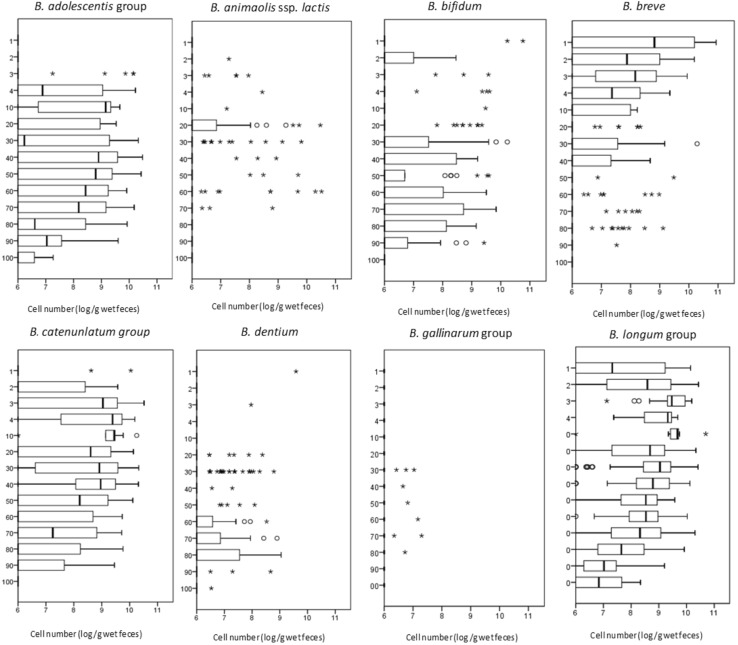
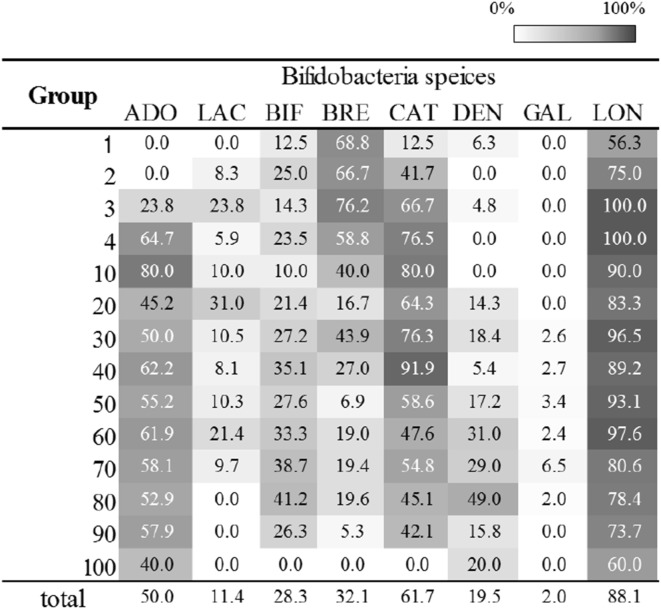
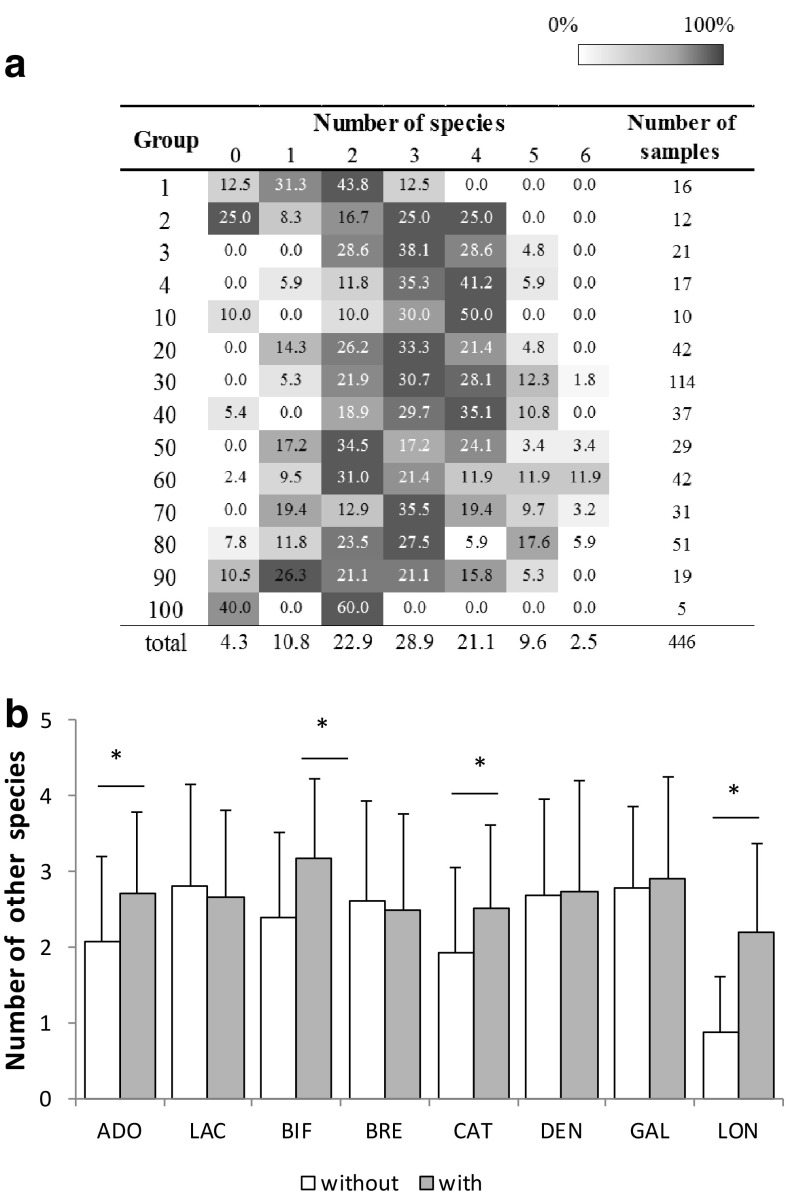
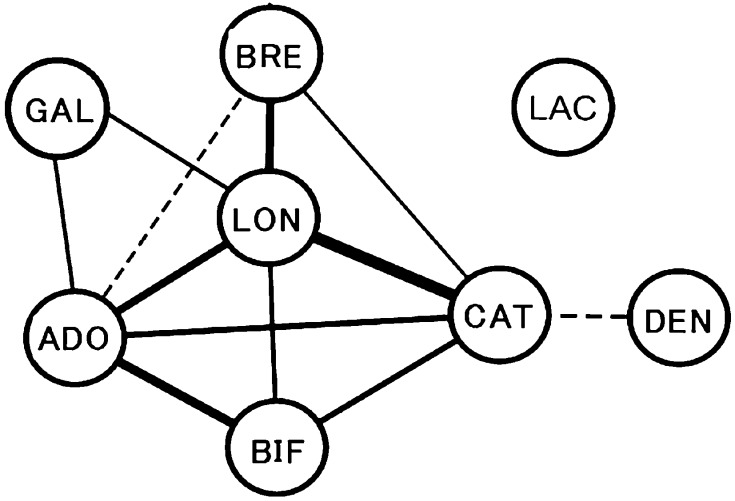
Bifidobacteria are one of the major components in human microbiota that are suggested to function in maintaining human health. The colonization and cell number of Bifidobacterium species in human intestine vary with ageing. However, sequential changes of Bifidobacterium species ranging from newborns to centenarians remain unresolved. Here, we investigated the gut compositional changes of Bifidobacterium species over a wide range of ages. Faecal samples of 441 healthy Japanese subjects between the ages of 0 and 104 years were analysed using real-time PCR with species-specific primers. B. longum group was widely detected from newborns to centenarians, with the highest detection rate. B. breve was detected in approximately 70% of children under 3 years old. B. adolescentis and B. catenulatum groups were predominant after weaning. B. bifidum was detected at almost all ages. The detection rate of B. dentium was higher in the elderly than in other ages. B. animalis ssp. lactis was detected in 11.4% of the subjects and their ages were restricted. B. gallinarum goup was detected in only nine subjects, while B. minimum and B. mongoliense were undetected at any age. The presence of certain Bifidobacterium groups was associated with significantly higher numbers of other Bifidobacterium species/subspecies. Inter-species correlations were found among each species, exception for B. animalis ssp. lactis. These results revealed the patterns and transition points with respect to compositional changes of Bifidobacterium species that occur with ageing, and the findings indicate that there may be symbiotic associations between some of these species in the gut microbiota.
Overview
The claims and statistics of this paper haven’t been checked yet.
Free: it reads the open-access text and checks the first 5 claims that cite a source we can check. Create a free account to check every claim.
Integrity signals
Registry
Cites
Statistics
Figures
Verification
Claims the paper makes
The claims and statistics of this paper haven’t been checked yet.
Free: it reads the open-access text and checks the first 5 claims that cite a source we can check. Create a free account to check every claim.
Claims other papers make about this one
Each is checked against this paper’s own text: does it say what the citing paper says it does?
In the citing paper
“The association of Bifidobacterium and old age indicates that the loss of Bifidobacterium occurs not only in infants, but continues throughout adulthood (An et al., 2018; Biagi et al., 2010, 2016; Kato et al., 2017; Mueller et al., 2006).”
From Gut microbiome stability and dynamics in healthy donors and patients with non-gastrointestinal cancers (2021) · cites this paper as Kato et al., 2017
Self-check
Percentages, sums and reported differences re-computed from the paper’s own numbers.
The self-check needs the paper’s full text.
Citations
Cites
MEGA6: Molecular Evolutionary Genetics Analysis Version 6.0
Tamura, K., Stecher, G., Peterson, D., Filipski, A., & Kumar, S. (2013) · Molecular Biology and Evolution · doi:10.1093/molbev/mst197 · Cited by 47,205 · cited 1×
“After multiple alignments by MEGA 6 [31], unique regions were selected as a target for the specific primers.”
Human gut microbiome viewed across age and geography
Yatsunenko, T., Rey, F. E., Manary, M. J., Trehan, I., Dominguez-Bello, M. G., Contreras, M., Magris, M., Hidalgo, G., Baldassano, R. N., Anokhin, A. P., et al. (2012) · Nature · doi:10.1038/nature11053 · Cited by 7,815 · cited 1×
“However, the numbers of this genus substantially decrease after weaning and continue to decrease with age [33, 40, 44].”
The impact of diet and lifestyle on gut microbiota and human health
Conlon, M., & Bird, A. (2014) · Nutrients · doi:10.3390/nu7010017 · Cited by 1,567 · cited 2×
“Some reports have shown that there are intermittent differences between age groups [3, 8, 27, 41].”
Odamaki, T., Kato, K., Sugahara, H., Hashikura, N., Takahashi, S., Xiao, J.-Z., Abe, F., & Osawa, R. (2016) · BMC Microbiology · doi:10.1186/s12866-016-0708-5 · Cited by 1,521
Self-citationHopkins, M. J., Sharp, R., & Macfarlane, G. T. (2001) · Gut · doi:10.1136/gut.48.2.198 · Cited by 577
Fanning, S., Hall, L. J., Cronin, M., Zomer, A., MacSharry, J., Goulding, D., O'Connell Motherway, M., Shanahan, F., Nally, K., Dougan, G., et al. (2012) · Proceedings of the National Academy of Sciences · doi:10.1073/pnas.1115621109 · Cited by 564 · cited 1×
“[7] found that co-cultivating Bifidobacterium species in media that simulated the adult and infant human gut environments resulted in an increase in the transcription of key genes required for biosynthesis of exopolysaccharides, which have been reported to have some important roles for modulating various aspects of bi…”
Matsuki, T., Watanabe, K., Fujimoto, J., Kado, Y., Takada, T., Matsumoto, K., & Tanaka, R. (2004) · Applied and Environmental Microbiology · doi:10.1128/aem.70.1.167-173.2004 · Cited by 496
The function of our microbiota: who is out there and what do they do?
Ottman, N., Smidt, H., de Vos, W. M., & Belzer, C. (2012) · Frontiers in Cellular and Infection Microbiology · doi:10.3389/fcimb.2012.00104 · Cited by 488 · cited 1×
“Some reports have shown that there are intermittent differences between age groups [3, 8, 27, 41].”
Matsuki, T., Watanabe, K., Tanaka, R., Fukuda, M., & Oyaizu, H. (1999) · Applied and Environmental Microbiology · doi:10.1128/aem.65.10.4506-4512.1999 · Cited by 457
Intestinal bacteria and ageing
Woodmansey, E. J. (2007) · Journal of Applied Microbiology · doi:10.1111/j.1365-2672.2007.03400.x · Cited by 445 · cited 1×
“However, the numbers of this genus substantially decrease after weaning and continue to decrease with age [33, 40, 44].”
Research works printed but not linked: 1
- Mitsuoka T Human microbiota research - present and future- J Intest Microbiol 2005 19 179 192
Cited by
Health Benefits of Heat-Killed (Tyndallized) Probiotics: An Overview
Piqué, N., Berlanga, M., & Miñana-Galbis, D. (2019) · International Journal of Molecular Sciences · doi:10.3390/ijms20102534 · Cited by 642
“Other low-molecular-weight (LMW) peptides secreted from LGG induce expression of heat shock proteins and activate MAPKs [35] .”
BackgroundInfluentialLaursen, M. F., Sakanaka, M., von Burg, N., Mörbe, U., Andersen, D., Moll, J. M., Pekmez, C. T., Rivollier, A., Michaelsen, K. F., Mølgaard, C., et al. (2021) · Nature Microbiology · doi:10.1038/s41564-021-00970-4 · Cited by 581
Qin, Y., Havulinna, A. S., Liu, Y., Jousilahti, P., Ritchie, S. C., Tokolyi, A., Sanders, J. G., Valsta, L., Brożyńska, M., Zhu, Q., et al. (2022) · Nature Genetics · doi:10.1038/s41588-021-00991-z · Cited by 586
The Gut Microbiome, Aging, and Longevity: A Systematic Review
Badal, V. D., Vaccariello, E. D., Murray, E. R., Yu, K. E., Knight, R., Jeste, D. V., & Nguyen, T. T. (2020) · Nutrients · doi:10.3390/nu12123759 · Cited by 551
“, 2017 [31] Japan (U) Age Groups 100: 5 (100 and up) 90: 19 (90–99) 80: 51 (80–89) 70: 31 (70–79) 60: 42 (60–69) 50: 29 (50–59) 40: 37 (40–49) 30: 114 (30–39) 20: 42 (20–29) 10: 10 (10–19) 4: 17 (4–9) 3: 21 (weaned—3 years old) 2: 12 (weaning; mean: 0.”
BackgroundImmunomodulatory potential of gut microbiome-derived short-chain fatty acids (SCFAs)
Ratajczak, W., Rył, A., Mizerski, A., Walczakiewicz, K., Sipak, O., & Laszczyńska, M. (2019) · Acta Biochimica Polonica · doi:10.18388/abp.2018_2648 · Cited by 514
Metadata
- Authors
- Kato, K., Odamaki, T., Mitsuyama, E., Sugahara, H., Xiao, J.-Z., & Osawa, R.
- Affiliations
- Morinaga (Japan) (JP)
- Kobe University (JP)
- Corresponding author
- Kato, Kumiko
- Venue
- Current Microbiology
- Published
- 2017-06-08
- Volume
- 74
- Issue
- 8
- Pages
- 987-995
- ISSN
- 0343-8651 (ISSN-L)
- 1432-0991
- PMC
- PMC5486783
- OpenAlex
- W2622475329
- Cited by
- 180
- References
- 44
- Citations by year
- 2026: 12 · 2025: 21 · 2024: 22 · 2023: 15 · 2022: 22 · 2021: 36 · 2020: 26 · 2019: 17 · 2018: 7 · 2017: 2
- FWCI
- 5.81
- Type
- journal article
- Language
- en
- Open access
- hybrid
- doi.org
- Locations
- Current Microbiology (publishedVersion, cc-by)
- PubMed Central (publishedVersion, cc-by)
- PubMed (publishedVersion)
- Institutional Repositories DataBase (IRDB) (acceptedVersion, cc-by)
- Kobe University Repository Kernel (Kobe University) (submittedVersion, cc-by)
- Topics
- Life Sciences › Biochemistry, Genetics and Molecular Biology › Molecular Biology › Gut microbiota and health
- Life Sciences › Agricultural and Biological Sciences › Food Science › Probiotics and Fermented Foods
- Health Sciences › Nursing › Nutrition and Dietetics › Infant Nutrition and Health
- Keywords
- Bifidobacterium, gut microbiota, aging, age-related changes, fecal microbiota composition, Bifidobacterium breve, Bifidobacterium adolescentis, Bifidobacterium catenulatum, Bifidobacterium bifidum, Bifidobacterium dentium, Bifidobacterium animalis subsp. lactis, species-specific detection, weaning, centenarians
- MeSH terms
- Gastrointestinal Microbiome, Adolescent, Adult, Age Factors, Aged, Aged, 80 and over, Aging, Bifidobacterium, Child, Child, Preschool, Feces, Female, Humans, Infant, Infant, Newborn, Japan, Male, Middle Aged, Gastrointestinal Tract, Young Adult, Real-Time Polymerase Chain Reaction, Healthy Volunteers
About these checks
Registry, retraction, Cites and statistics results are computed, not judged, with one exception: a printed reference that no index lists is read once by a model before it counts as a citation error. Claims are extracted by a model and kept only when their quote appears verbatim in the text; each cited source is then checked, with a model’s help, for whether it says what the claim relies on. Those verdicts can be wrong — read the claim’s quote and the cited source before relying on one.
Statistics and arithmetic are recomputed, not judged.
Confidence bands are shown only for fields calibrated on our annotated test set. None is calibrated yet, so no band is shown.
What counts as a claim ›How we measure confidence ›How we check this ›
Are you an author, or do you see a problem with this page? Request a review
Data sources
Bibliographic data: Semantic Scholar, OpenAlex, Crossref.
Contains information from the Semantic Scholar Academic Graph Datasets, made available under the ODC Attribution License (ODC-BY 1.0).
Semantic Scholar’s data is described in: Kinney, R., et al. (2023). The Semantic Scholar Open Data Platform. arXiv:2301.10140.
