

An update on genetic frontotemporal dementia
Open accessThe DOI matches its Crossref record; 91 of the 91 references it cites were found in a registry or an index.
Abstract
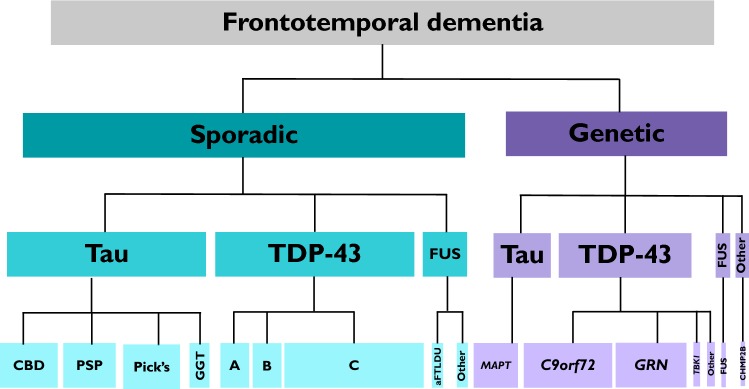
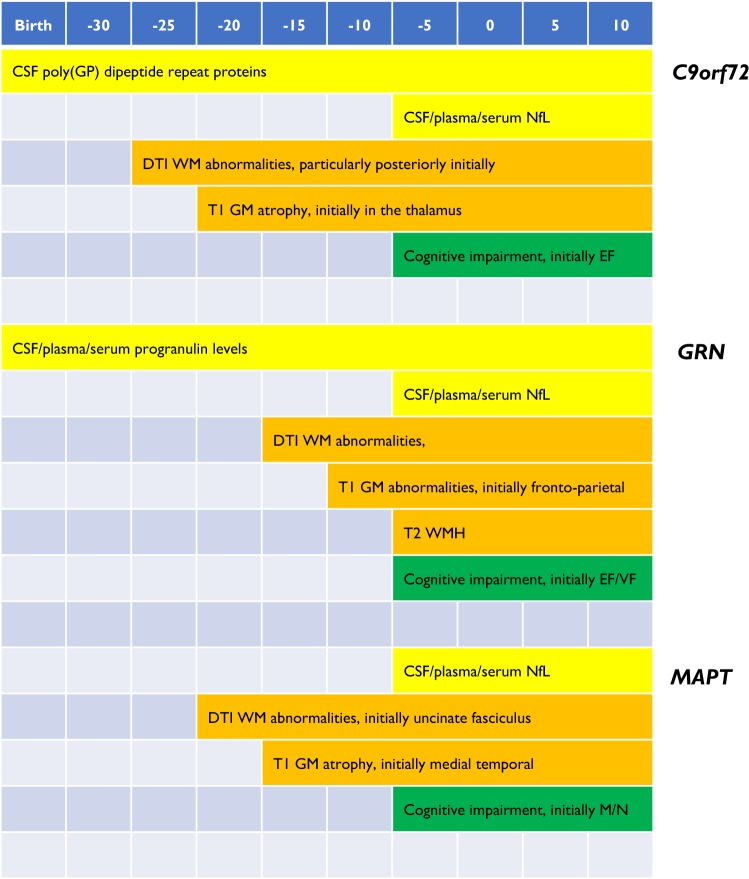
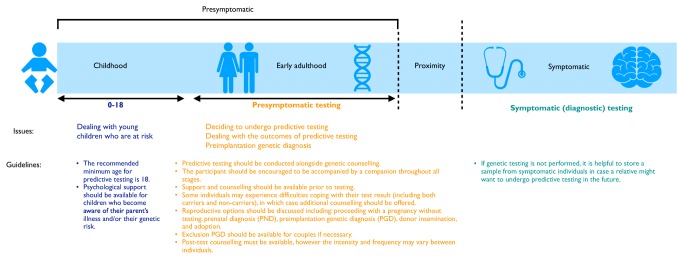
Frontotemporal dementia (FTD) is a highly heritable group of neurodegenerative disorders, with around 30% of patients having a strong family history. The majority of that heritability is accounted for by autosomal dominant mutations in the chromosome 9 open reading frame 72 (C9orf72), progranulin (GRN), and microtubule-associated protein tau (MAPT) genes, with mutations more rarely seen in a number of other genes. This review will discuss the recent updates in the field of genetic FTD. Age at symptom onset in genetic FTD is variable with recently identified genetic modifiers including TMEM106B (in GRN carriers particularly) and a polymorphism at a locus containing two overlapping genes LOC101929163 and C6orf10 (in C9orf72 carriers). Behavioural variant FTD (bvFTD) is the most common diagnosis in each of the genetic groups, although in C9orf72 carriers amyotrophic lateral sclerosis either alone, or with bvFTD, is also common. An atypical neuropsychiatric presentation is also seen in C9orf72 carriers and family members of carriers are at greater risk of psychiatric disorders including schizophrenia and autistic spectrum disorders. Large natural history studies of presymptomatic genetic FTD are now underway both in Europe/Canada (GENFI-the Genetic FTD Initiative) and in the US (ARTFL/LEFFTDS study), collaborating together under the banner of the FTD Prevention Initiative (FPI). These studies are taking forward the validation of cognitive, imaging and fluid biomarkers that aim to robustly measure disease onset, staging and progression in genetic FTD. Grey matter changes on MRI and hypometabolism on FDG-PET are seen at least 10 years before symptom onset with white matter abnormalities seen earlier, but the pattern and exact timing of changes differ between different genetic groups. In contrast, tau PET has yet to show promise in genetic FTD. Three key fluid biomarkers have been identified so far that are likely to be helpful in clinical trials-CSF or blood neurofilament light chain levels (in all groups), CSF or blood progranulin levels (in GRN carriers) and CSF poly(GP) dipeptide repeat protein levels (in C9orf72 carriers). Increased knowledge about genetic FTD has led to more clinical presymptomatic genetic testing but this has not yet been mirrored in the development of either an accepted FTD-specific testing protocol or provision of appropriate psychological support mechanisms for those living through the at-risk phase. This will become even more relevant as disease-modifying therapy trials start in each of the genetic groups over the next few years.
Overview
The claims and statistics of this paper haven’t been checked yet.
Free: it reads the open-access text and checks the first 5 claims that cite a source we can check. Create a free account to check every claim.
Integrity signals
Registry
Cites
Statistics
Figures
Verification
Claims the paper makes
The claims and statistics of this paper haven’t been checked yet.
Free: it reads the open-access text and checks the first 5 claims that cite a source we can check. Create a free account to check every claim.
Claims other papers make about this one
Each is checked against this paper’s own text: does it say what the citing paper says it does?
The source backs part of the claim, not all of it — or backs it for a different population, condition or comparison.
In the citing paper
“Known genetic modifiers of f-FTD disease progression were not included, such as specific mutations (for MAPT) and TMEM106B, a modifier of penetrance in GRN.2,40”
From Temporal order of clinical and biomarker changes in familial frontotemporal dementia (2022) · cites this paper as [2]
Experimental — accuracy not yet measuredThe cited source says what the claim attributes to it.
In the citing paper
“Approximately 20–30% of FTD is caused by autosomal dominant mutations (familial, or f-FTD), usually in one of three genes: chromosome 9 open reading frame 72 (C9orf72), progranulin (GRN), or microtubule-associated protein tau (MAPT).2”
From Temporal order of clinical and biomarker changes in familial frontotemporal dementia (2022) · cites this paper as [2]
The cited source says what the claim attributes to it.
In the citing paper
“Although the clinical manifestations of the f-FTD mutations are similar, the biology and neuropathology associated with C9orf72, GRN, and MAPT mutations are vastly different.2”
From Temporal order of clinical and biomarker changes in familial frontotemporal dementia (2022) · cites this paper as [2]
The cited source says what the claim attributes to it.
In the citing paper
“Mutations in genes such as microtubule-associated protein tau (MAPT), progranulin (GRN), and chromosome 9 open reading frame 72 (C9ORF72) represent the most common genetic cause of FTD [5].”
From A role for astrocytic miR-129-5p in frontotemporal dementia (2025) · cites this paper as [5]
In the citing paper
“since 70 % of bvFTD cases is non-genetic (Greaves and Rohrer, 2019)”
From The pursuit for markers of disease progression in behavioral variant frontotemporal dementia: a scoping review to optimize outcome measures for clinical trials (2024) · cites this paper as Greaves and Rohrer, 2019
Self-check
Percentages, sums and reported differences re-computed from the paper’s own numbers.
The self-check needs the paper’s full text.
Citations
Cites
Sensitivity of revised diagnostic criteria for the behavioural variant of frontotemporal dementia
Rascovsky, K., Hodges, J. R., Knopman, D., Mendez, M. F., Kramer, J. H., Neuhaus, J., van Swieten, J. C., Seelaar, H., Dopper, E. G. P., Onyike, C. U., et al. (2011) · Brain · doi:10.1093/brain/awr179 · Cited by 5,221
Self-citationClassification of primary progressive aphasia and its variants
Gorno-Tempini, M. L., Hillis, A. E., Weintraub, S., Kertesz, A., Mendez, M., Cappa, S. F., Ogar, J. M., Rohrer, J. D., Black, S., Boeve, B. F., et al. (2011) · Neurology · doi:10.1212/wnl.0b013e31821103e6 · Cited by 5,141
Self-citationClinical diagnosis of progressive supranuclear palsy: The movement disorder society criteria
Höglinger, G. U., Respondek, G., Stamelou, M., Kurz, C., Josephs, K. A., Lang, A. E., Mollenhauer, B., Müller, U., Nilsson, C., Whitwell, J. L., et al. (2017) · Movement Disorders · doi:10.1002/mds.26987 · Cited by 2,359
Criteria for the diagnosis of corticobasal degeneration
Armstrong, M. J., Litvan, I., Lang, A. E., Bak, T. H., Bhatia, K. P., Borroni, B., Boxer, A. L., Dickson, D. W., Grossman, M., Hallett, M., et al. (2013) · Neurology · doi:10.1212/wnl.0b013e31827f0fd1 · Cited by 1,904
Strong, M. J., Abrahams, S., Goldstein, L. H., Woolley, S., Mclaughlin, P., Snowden, J., Mioshi, E., Roberts-South, A., Benatar, M., HortobáGyi, T., et al. (2017) · Amyotrophic Lateral Sclerosis and Frontotemporal Degeneration · doi:10.1080/21678421.2016.1267768 · Cited by 909
Young, A. L., Marinescu, R. V., Oxtoby, N. P., Bocchetta, M., Yong, K., Firth, N. C., Cash, D. M., Thomas, D. L., Dick, K. M., Cardoso, J., et al. (2018) · Nature Communications · doi:10.1038/s41467-018-05892-0 · Cited by 596
Self-citationMutations in progranulin are a major cause of ubiquitin-positive frontotemporal lobar degeneration
Gass, J., Cannon, A., Mackenzie, I. R., Boeve, B., Baker, M., Adamson, J., Crook, R., Melquist, S., Kuntz, K., Petersen, R., et al. (2006) · Human Molecular Genetics · doi:10.1093/hmg/ddl241 · Cited by 580
Prevalence, characteristics, and survival of frontotemporal lobar degeneration syndromes
Coyle-Gilchrist, I. T. S., Dick, K. M., Patterson, K., Vázquez Rodríquez, P., Wehmann, E., Wilcox, A., Lansdall, C. J., Dawson, K. E., Wiggins, J., Mead, S., et al. (2016) · Neurology · doi:10.1212/wnl.0000000000002638 · Cited by 540
Rohrer, J. D., Nicholas, J. M., Cash, D. M., van Swieten, J., Dopper, E., Jiskoot, L., van Minkelen, R., Rombouts, S. A., Cardoso, M. J., Clegg, S., et al. (2015) · The Lancet Neurology · doi:10.1016/s1474-4422(14)70324-2 · Cited by 538
Self-citationThe heritability and genetics of frontotemporal lobar degeneration
Rohrer, J. D., Guerreiro, R., Vandrovcova, J., Uphill, J., Reiman, D., Beck, J., Isaacs, A. M., Authier, A., Ferrari, R., Fox, N. C., et al. (2009) · Neurology · doi:10.1212/wnl.0b013e3181bf997a · Cited by 536
Self-citation
Cited by
Items 501–541 of 541
Precision therapeutics and innovative clinical trial design in neurodegenerative diseases
Garcia, A., Delgado-Uriarte, J. C., & Cervantes‐Arriaga, A. (2026) · Revista de investigaci�n Cl�nica · doi:10.1016/j.ric.2026.100050
de Vienne, D., & de Vienne, D. M. (2026) · PLoS Genetics · doi:10.1371/journal.pgen.1012230
When ALS–FTD comes home: lessons from a TARDBP family for presymptomatic detection and care
Sullivan, A. C. (2026) · npj Dementia · doi:10.1038/s44400-026-00132-5
“…fi ed early biological indicators of diseaseprogression,including fl uidbiomarkers,neuroimagingchanges,and subtle cognitive or behavioral differences that may emerge before clear symptoms develop 6,7 and this research is necessary for prevention trials and variant speci fi c therapeutic development.”
Machine-learning MRI stratification of genetic frontotemporal dementia for clinical trial enrichmentPreprint
Soltaninejad, M., Iturria‐Medina, Y., Bouzigues, A., Russell, L. L., Foster, P. H., Ferry‐Bolder, E., Swieten, J. C. V., Jiskoot, L. C., Seelaar, H., Sánchez‐Valle, R., et al. (2026) · bioRxiv (Cold Spring Harbor Laboratory) · doi:10.64898/2026.07.22.740145
Self-citationProteome-wide Mendelian randomization identifies causal plasma proteins in frontotemporal dementia
Yao, Y., Zou, Q., & Chen, K. (2026) · Neurological Sciences · doi:10.1007/s10072-026-09249-0
Progranulin haploinsufficiency remodels the cerebral microvasculature and neurovascular unitPreprint
Chakraborty, S., Weick, M., Franciosa, S. A., Tabrizi, Z., Swinehart, C., Moore, G. R., Lee, D., Bhatt, N. N., Cano, A., Poorva, P., et al. (2026) · bioRxiv (Cold Spring Harbor Laboratory) · doi:10.64898/2026.07.20.738719
“Despite these circumstantial links between PGRN and vascular biology, mechanistic studies in FTD have overwhelmingly focused on neurons, microglia, and lysosomal pathways, leaving the cerebrovascular compartment comparatively understudied 17 .”
Fumi, R., Caraiscos, I., Jabbari, E., Rittman, T., Rowe, J. B., Ben‐Shlomo, Y., Hu, M. T., & Morris, H. R. (2026) · BMJ Open · doi:10.1136/bmjopen-2026-123017
Potts, E. M. (2025) · Digital Commons - URI (University of Rhode Island) · doi:10.23860/diss-4530
A novel gross deletion in the progranulin gene in four subjects with frontotemporal dementia
Ricci, M., Fede, G. D., Caroppo, P., Aprea, V., Villa, C., Romeo, A., Tiraboschi, P., Marti, A., Grisoli, M., Piccione, M. M., et al. (2026) · Neurological Sciences · doi:10.1007/s10072-026-09030-3
Sorrell, A. (2024) · The Scholarship East Carolina University's Institutional Repository (East Carolina University)
Talbot, R., Keogh, R., Rosenthal, L., Anthony, B. F., Pearson, M., Edwards, R. T., Henry, M. L., Warren, J. D., Varley, R. A., BCPPA Patient and Public Involvement Advisory Group, et al. (2026) · BMJ Open · doi:10.1136/bmjopen-2026-117509
Clinical genome sequencing in neurodegenerative diseases–outcome in the first 500 patients
Ehn, E., Thonberg, H., Nennesmo, I., Lindstrand, A., Kvarnung, M., & Graff, C. (2026) · Human Molecular Genetics · doi:10.1093/hmg/ddag072
“The number of identified likely pathogenic (LP) and pathogenic (P) findings for each group is summarized in the ‘LP/P findings’ third of FTD cases and in such cases, a monogenic cause is identified in up to 20% [ 4].”
Black Faith-based Organization Leaders and their Role in Mental Health
Green, A. T. (2026) · ScholarWorks (Walden University)
Houwer, J. F. H. D., Kang, W., van Buuren, R., de Boer, L., Swartenbroekx, T., Rajicic, A., Bouzigues, A., Russell, L. L., Foster, P. H., Ferry‐Bolder, E., et al. (2026) · Alzheimer s Research & Therapy · doi:10.1186/s13195-026-02159-5
Self-citationCzech, J., Weyland, C. S., Neumann, M., Drzezga, A. E., & Schulz, J. B. (2026) · Springer eBooks · doi:10.1007/978-3-032-13040-2_6
Kacar, E., Gomes, T. D., O’Donoghue, C., Venslovaite, G., Hardiman, O. M., McLaughlin, R. L., & Byrne, R. P. (2026) · medRxiv · doi:10.64898/2026.08.17.26360494
Evaluating Diagnostic Tools for Frontotemporal Dementia: Current Limitations and Emerging Advances
Manda, A. (2026) · International journal of high school research · doi:10.36838/ijhsr812.36
Spires‐Jones, T. L. (2026) · Oxford University Press eBooks · doi:10.1093/9780198995296.003.0002
Steinbeck, J., Viggiano, N., & Speelman, D. (2026) · Dementia and Geriatric Cognitive Disorders · doi:10.1159/dem/aciag003
Wilczkowski, P., Palka, A., Krzysztofek, N., Kopyciński, W., Grzybowska, M., Boszczyk, K., Krawczyk, N., Kamela, M., Baran, A., & Krawczyk, O. (2026) · International Journal of Innovative Technologies in Social Science · doi:10.31435/ijitss.3(51).2026.6339
The mechanism of cerebellar involvement in cognitive disorders and therapeutic prospects
Chen, X., Fu, P., Kang, C., Wu, Y., Wu, Y., Luo, X., Chen, L., Liu, H., 欧阳建龙, Zhang, M., et al. (2026) · Experimental Gerontology · doi:10.1016/j.exger.2026.113324
Al-Hinai, S., Al-Balushi, A., Al-Maskari, M., & Al-Mahruqi, S. (2026) · Journal of Medical Sciences and Interdisciplinary Research · doi:10.51847/ihwllyz68z
Time to diagnosis in FTLD‐associated syndromes in Latin America
Guimet, N. M., García, F. M., Santos, L. D. L., Cristalli, C. A. A., Tabernero, M. E., Chaves, H., Bagnati, P., Allegri, R., Migeot, J., Acosta‐Uribe, J., et al. (2026) · Alzheimer s & Dementia Diagnosis Assessment & Disease Monitoring · doi:10.1002/dad2.70476
A Review of Dementia with Emphasis on Alzheimer’s Disease
Githenya, V. (2026) · International Journal of Research Publication and Reviews · doi:10.55248/gengpi.06.1226.2808
Li, Y., Pu, K., Li, D., Zhao, Y., Cai, Q., Zhou, X., Li, S., Chen, Y., Zhou, Z., & Liu, Y. (2026) · Ageing Research Reviews · doi:10.1016/j.arr.2026.103376
The value of a family history to distinguish monogenic from polygenic amyotrophic lateral sclerosisPreprint
Beele, P., Veldink, J. H., & van Rheenen, W. (2026) · medRxiv · doi:10.64898/2026.09.16.26362994
Rodgers, C. C. (2026) · Journal of dementia and Alzheimer's disease · doi:10.3390/jdad3040046
“…mutations disrupt microtubule stability and increase proteostatic burden; GRN haploinsufficiency impairs lysosomal function and heightens neuroimmune reactivity; and C9orf72 expansions generate toxic RNA and dipeptide repeats that strain mitochondrial and proteostatic capacity simultaneously [17].”
Spillman, A. M., Alsop, E. B., Gittings, L. M., Garcia‐Mansfield, K., Piras, I. S., Bonfitto, A., Martinez, M. N., Sharma, R., Preller, K. R., Huentelman, M. J., et al. (2026) · Acta Neuropathologica · doi:10.1007/s00401-026-03084-5
“…after symptom onset, and currently no disease-modifying treatments exist for individuals with FTD. Approximately 20–25% of FTD cases are caused by pathogenic mutations [23], the most common genetic contributor being a hexa-nucleotide repeat expansion (HRE) in the C9ORF72 gene (C9) [16, 22, 57].”
Lee, H., Mackenzie, I. R., Beg, M. F., Popuri, K., Wittenberg, D., Huang, W., & Hsiung, G. R. (2026) · Journal of Alzheimer s Disease · doi:10.1177/13872877261493102
Mandić‐Stojmenović, G., Kostić, V., Marjanović, A., Novaković, I. V., Aleksić, P., Stojković, T., & Stefanova, E. D. (2026) · Diseases · doi:10.3390/diseases14100359
“Most monogenic FTD cases are associated with C9orf72 repeat expansions and pathogenic variants in progranulin ( GRN ) and microtubule-associated protein tau ( MAPT ), although their relative frequencies vary across populations, with C9orf72 being the most common genetic cause worldwide [15].”
Heikkinen, S. (2025) · UEF eRepo (University of Eastern Finland)
Peña-Baeza, N. (2021) · Repositorio Institucional Académico , Sistema de Bibliotecas Universidad Andrés Bello (UNAB) (Universidad Andrés Bello (UNAB))
Frontotemporal lobar degeneration therapeutic development pipeline: 2026
Benussi, A., Saccavini, A., Palacino, F., Boeve, B. F., Boxer, A. L., Huey, E. D., Ber, I. L., Migliaccio, R., Onyike, C. U., Piguet, O., et al. (2026) · Alzheimer s & Dementia Translational Research & Clinical Interventions · doi:10.1002/trc2.70326
Self-citationNormative transcriptomic clues to thalamic developmental vulnerability in C9orf7 2-FTLDPreprint
So, I., Bouzigues, A., Ferry‐Bolder, E., Cullen, E., Russell, L., Foster, P. H., Farley, S., Convery, R. S., Swieten, J. C. V., Jiskoot, L. C., et al. (2026) · medRxiv · doi:10.64898/2026.10.09.26365172
Self-citationTherapeutic intervention strategies in frontotemporal dementia: drug development pipeline
Perrone, F., Locuratolo, N., Carbone, E., Cappella, M., Rivabene, R., Fabrizi, E., Talarico, G., Vanacore, N., Lacorte, E., & Piscopo, P. (2026) · Alzheimer s & Dementia Translational Research & Clinical Interventions · doi:10.1002/trc2.70243
Nijland, D. M., van der Lee, S. J., de Haan, E. M., Ramesh, N., de Boer, S. C. M., Vijverberg, E. G. B., Holstege, H. H., Pijnenburg, Y. A. L., Ophoff, R. A., & Reus, L. M. (2026) · Annals of Neurology · doi:10.1002/ana.78395
Disorders and diseases of the nervous system
El-hashash, A., Rao, A., El-Sawaf, M., & Banerjee, H. (2026) · Elsevier eBooks · doi:10.1016/b978-0-323-99870-3.00012-0
Fazal, R., Tharkeshwar, A. K., Beel, S., Storm, A., Schevenels, B., Tomé, S. O., Thal, D. R., Bosch, L. V. D., Beckers, J., & Damme, P. V. (2026) · Frontiers in Molecular Neuroscience · doi:10.3389/fnmol.2026.1970154
“MAPT mutations lead to tau accumulation, whereas GRN and C9orf72 mutations are associated with TAR DNA-binding protein 43 (TDP-43) aggregation.”
InfluentialPhase 3 randomized trial of latozinemab in frontotemporal dementia due to GRN mutations
Simmons, A., Boeve, B., Ber, I. L., Borroni, B., Mummery, C. J., Rohrer, J. D., Zamboni, G., Onur, O. A., Rowe, J. B., Boxer, A. L., et al. (2026) · Alzheimer s & Dementia · doi:10.1002/alz.71947
Self-citationYue, A., He, Q., Lu, H., Chen, Y., Hou, J., Xu, Y., Wu, L., & Chu, M. (2026) · Brain and Behavior · doi:10.1002/brb3.71892
The GFAP/NfL ratio does not outperform NfL or GFAP in genetic frontotemporal dementia
Houwer, J. F. H. D., Dopper, E. G. P., van Buuren, R., de Boer, L., Swartenbroekx, T., Rajicic, A., Sogorb‐Esteve, A., Bouzigues, A., Russell, L. L., Foster, P. H., et al. (2026) · Alzheimer s & Dementia Diagnosis Assessment & Disease Monitoring · doi:10.1002/dad2.70483
Self-citation
Metadata
- Authors
- Greaves, C. V., & Rohrer, J. D.
- Affiliations
- UCL Queen Square Institute of Neurology (GB)
- Corresponding author
- Rohrer, Jonathan D.
- Venue
- Journal of Neurology
- Published
- 2019-05-22
- Volume
- 266
- Issue
- 8
- Pages
- 2075-2086
- ISSN
- 0012-1037 (ISSN-L)
- 0340-5354
- 1432-1459
- PMC
- PMC6647117
- OpenAlex
- W2946423464
- Semantic Scholar
- a2e7ba961fbe79feb913f4882aa50a437a1e08c7
- Cited by
- 500
- References
- 91
- Citations by year
- 2026: 55 · 2025: 78 · 2024: 77 · 2023: 65 · 2022: 100 · 2021: 78 · 2020: 42 · 2019: 4
- FWCI
- 7.53
- Type
- journal article
- Language
- en
- Open access
- hybrid
- doi.org
- Licence
- cc-by
- creativecommons.org/licenses/by/4.0 (tdm)
- creativecommons.org/licenses/by/4.0 (vor)
- Locations
- Journal of Neurology (publishedVersion, cc-by)
- Europe PMC (PubMed Central) (publishedVersion, cc-by)
- PubMed Central (publishedVersion, cc-by)
- PubMed (publishedVersion)
- UCL Discovery (University College London) (submittedVersion)
- Funders
- National Institute for Health and Care Research (CL-2012-18-010)
- Medical Research Council (MR/M023664/1, MR/M008525/1, MR/J009482/1)
- Topics
- Health Sciences › Medicine › Clinical Neurology › Amyotrophic Lateral Sclerosis Research
- Health Sciences › Medicine › Psychiatry and Mental health › Dementia and Cognitive Impairment Research
- Life Sciences › Neuroscience › Cellular and Molecular Neuroscience › Alzheimer's disease research and treatments
- Keywords
- frontotemporal dementia, genetic frontotemporal dementia, C9orf72, progranulin, MAPT, TMEM106B, behavioral variant frontotemporal dementia, amyotrophic lateral sclerosis, presymptomatic genetic testing, genetic modifiers, neurofilament light chain, dipeptide repeat proteins, biomarkers
- MeSH terms
- C9orf72 Protein, Humans, Membrane Proteins, Mutation, Nerve Tissue Proteins, Biomarkers, Genetic Predisposition to Disease, Frontotemporal Dementia
About these checks
Registry, retraction, Cites and statistics results are computed, not judged, with one exception: a printed reference that no index lists is read once by a model before it counts as a citation error. Claims are extracted by a model and kept only when their quote appears verbatim in the text; each cited source is then checked, with a model’s help, for whether it says what the claim relies on. Those verdicts can be wrong — read the claim’s quote and the cited source before relying on one.
Statistics and arithmetic are recomputed, not judged.
Confidence bands are shown only for fields calibrated on our annotated test set. None is calibrated yet, so no band is shown.
What counts as a claim ›How we measure confidence ›How we check this ›
Are you an author, or do you see a problem with this page? Request a review
Data sources
Bibliographic data: Semantic Scholar, OpenAlex, Crossref.
Contains information from the Semantic Scholar Academic Graph Datasets, made available under the ODC Attribution License (ODC-BY 1.0).
Semantic Scholar’s data is described in: Kinney, R., et al. (2023). The Semantic Scholar Open Data Platform. arXiv:2301.10140.
