

The DOI matches its Crossref record; 103 of the 106 references it cites were found in a registry or an index.
Anxiety and perceptual-motor performance: toward an integrated model of concepts, mechanisms, and processes
Open accessAbstract
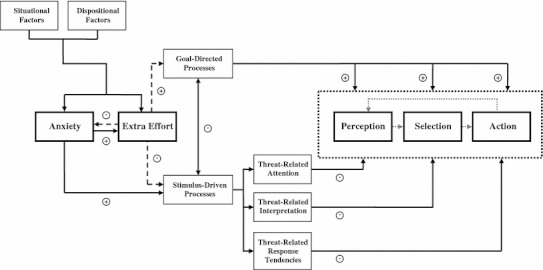
Under anxiety, people sometimes perform poorly. This concerns cognitive performance (e.g., taking an important exam) as well as perceptual-motor performance (e.g., picking up a cup from a table). There is still much debate about how anxiety affects perceptual-motor performance. In the current paper we review the experimental literature on anxiety and perceptual-motor performance, thereby focusing on how anxiety affects the perception, selection, and realization of action possibilities. Based on this review we discuss the merits of two opposing theoretical explanations and build on existing frameworks of anxiety and cognitive performance to develop an integrated model that explains the various ways in which anxiety may specifically affect perceptual-motor performance. This model distinguishes between positive and negative effects of anxiety and, moving beyond previous approaches, recognizes three operational levels (i.e., attentional, interpretational, and behavioral) at which anxiety may affect different aspects of goal-directed action. Finally, predictions are formulated and directions for future research suggested.
Overview
The claims and statistics of this paper haven’t been checked yet.
Run the check — free, no account needed. It reads the open-access text and checks the sources it cites.
Integrity signals
Registry
Cites
Statistics
Figures
Verification
Claims the paper makes
The claims and statistics of this paper haven’t been checked yet.
Run the check — free, no account needed. It reads the open-access text and checks the sources it cites.
Claims other papers make about this one
Each is checked against this paper’s own text: does it say what the citing paper says it does?
The cited source says what the claim attributes to it.
In the citing paper
“Competitive anxiety is a common psychological challenge among athletes and can negatively affect sports performance.”
From The Effect of Different Psychological Interventions on Athletes' Competitive Anxiety: A Systematic Review and Bayesian Network Meta-Analysis. (2026) · cites this paper as [8]
Self-check
Percentages, sums and reported differences re-computed from the paper’s own numbers.
The self-check needs the paper’s full text.
Citations
Cites
The Ecological Approach to Visual Perception
Bornstein, M. H., & Gibson, J. J. (1980) · The Journal of Aesthetics and Art Criticism · doi:10.2307/429816 · Cited by 22,935 · cited 1×
“Our own approach to perceptual-motor behavior can be considered embodied (e.g., Beilock, 2008b; Proffitt, 2006; Wilson, 2002), and ultimately has its origins in ecological psychology (Gibson, 1979).”
BackgroundThe Ecological Approach to Visual Perception: Classic Edition
Gibson, J. J. (2014) · doi:10.4324/9781315740218 · Cited by 12,132
Feeling and thinking: Preferences need no inferences.
Zajonc, R. B. (1980) · American Psychologist · doi:10.1037/0003-066x.35.2.151 · Cited by 8,094 · cited 2×
“…et al., 2007)—but also affects interpretational processes (Bishop, 2007; Blanchette & Richards, 2010) and facilitates emotion-specific behavioral responses (Frijda, 1988; Zajonc, 1980; see also Krieglmeyer et al., 2010, 2011; Lavender & Hommel, 2007; Schutter et al., 2008; Stins et al., 2011).”
BackgroundFodor, J. A. (1983) · doi:10.7551/mitpress/4737.001.0001 · Cited by 7,734
The relation of strength of stimulus to rapidity of habit formation
Yerkes, R. M., & Dodson, J. D. (1908) · Journal of Comparative Neurology and Psychology · doi:10.1002/cne.920180503 · Cited by 6,911
Journal of experimental psychology: Human Perception and performance
Jong, R. D., Coles, M. G. H., Logan, G. D., & Gratton, G. (1987) · Journal of Sound and Vibration · doi:10.1016/0022-460x(87)90423-8 · Cited by 5,411
Anxiety and cognitive performance: Attentional control theory
Eysenck, M. W., Derakshan, N., Santos, R., & Calvo, M. G. (2007) · Emotion · doi:10.1037/1528-3542.7.2.336 · Cited by 5,289
Cummins, R., & Fodor, J. A. (1985) · The Philosophical Review · doi:10.2307/2184717 · Cited by 4,791
Six views of embodied cognition
Wilson, M. (2002) · Psychonomic Bulletin & Review · doi:10.3758/bf03196322 · Cited by 4,782
Threat-related attentional bias in anxious and nonanxious individuals: a meta-analytic study.
Bar-Haim, Y., Lamy, D., Pergamin, L., Bakermans-Kranenburg, M. J., & van IJzendoorn, M. H. (2007) · Psychological Bulletin · doi:10.1037/0033-2909.133.1.1 · Cited by 3,721
Research works printed but not linked: 2
- Frijda, N. H. (1988). The laws of emotions. American Psychologist, 43, 349–358. · DOI
- Nibbeling, N., Daanen, H. A. M., Gerritsma, R. M., Hofland, R. M., & Oudejans, R. R. D. (2011). Effects of anxiety on running. Journal of Sports Sciences (in press).
Cited by
Sorted by citations
Items 101–200 of 265
Karbownik, M. S., Kręczyńska, J., Wiktorowska‐Owczarek, A., Kwarta, P., Cybula, M., Stilinović, N., Pietras, T., & Kowalczyk, E. (2022) · Frontiers in Endocrinology · doi:10.3389/fendo.2021.800023 · Cited by 14
Inferior olive CRF plays a role in motor performance under challenging conditions
Ezra-Nevo, G., Volk, N., Ramot, A., Kühne, C., Tsoory, M., Deussing, J. M., & Chen, A. (2018) · Translational Psychiatry · doi:10.1038/s41398-018-0145-3 · Cited by 12
Exploring “Sledging” and Interpersonal Emotion-Regulation Strategies in Professional Cricket
Davis, P., Davis, L., Wills, S., Appleby, R., & Nieuwenhuys, A. (2018) · The Sport Psychologist · doi:10.1123/tsp.2017-0078 · Cited by 11
Self-citationGoh, W. X., Lim, B. H. Y., Wylde, M. J., Macnaughton, M., Chow, J. Y., & Lee, M. J. C. (2018) · Journal of Sports Sciences · doi:10.1080/02640414.2018.1436764 · Cited by 11
Zechner, O., Schrom-Feiertag, H., Wespi, R., Pretolesi, D., Nguyen, Q., & Tscheligi, M. (2024) · JMIR XR and spatial computing. · doi:10.2196/57655 · Cited by 10
Conscious motor processing and the pressure-performance relationship: a systematic review
Sullivan, R., Uiga, L., Masters, R. S. W., Anson, J. G., & Nieuwenhuys, A. (2022) · International Review of Sport and Exercise Psychology · doi:10.1080/1750984x.2022.2127327 · Cited by 10
Self-citationThe Functional Anatomy of Nociception: Effective Connectivity in Chronic Pain and Placebo Response
Nara, S., Baliki, M. N., Friston, K. J., & Ray, D. (2025) · Journal of Neuroscience · doi:10.1523/jneurosci.1447-24.2025 · Cited by 9
“…insula were selected as lower nodes. u It should be pointed out here that posterior insula is widely considered as the primary interoceptive cortex (Nieuwenhuys & Oudejans, 2012; Barrett & Simmons, 2015; Wilson-Mendenhall et al., 2019). a n As higher regions we chose the right and left lateral…”
Alder, D. B., Ford, P. R., Causer, J., & Williams, A. M. (2018) · Human Movement Science · doi:10.1016/j.humov.2018.07.002 · Cited by 9
Gladwin, T. E., Möbius, M., & Vink, M. (2019) · Consciousness and Cognition · doi:10.1016/j.concog.2019.102795 · Cited by 9
Biggs, A. T., Pettijohn, K. A., & Gardony, A. L. (2021) · Quarterly Journal of Experimental Psychology · doi:10.1177/1747021820985819 · Cited by 9
A systematic review and meta-analysis of the relationship between flow states and performancePreprint
Harris, D., Allen, K., Vine, S. J., & Wilson, M. (2020) · doi:10.31234/osf.io/qg852 · Cited by 9
Gutiérrez-Capote, A., Jiménez-Martínez, J., Madinabeitia, I., Torre, E., Leicht, A. S., Botia, M., Alarcón, F., & Vélez, D. C. (2025) · Psychology of sport and exercise · doi:10.1016/j.psychsport.2025.102960 · Cited by 9
Churchill, S., Jessop, D. C., Goodwin, S., Ritchie, L., & Harris, P. R. (2017) · Psychology of Music · doi:10.1177/0305735617705007 · Cited by 9
The effects of cognitive interference during the preparation and execution of the golf swing
Roberts, L. J., Jackson, M. S., & Grundy, I. H. (2019) · International Journal of Sport and Exercise Psychology · doi:10.1080/1612197x.2019.1674901 · Cited by 8
Translating Attentional Control Theory to Applied Psychological Eye Tracking Research
Young, W. R., & Ellmers, T. J. (2022) · Neuromethods · doi:10.1007/978-1-0716-2391-6_8 · Cited by 8
Daviaux, Y., Crémoux, S., Tallet, J., Amarantini, D., Cornu, C., & Deschamps, T. (2015) · Psychological Research · doi:10.1007/s00426-015-0653-1 · Cited by 8
ANXIETY LEVEL AND PARAMETERS OF THE CARDIOVASCULAR SYSTEM IN ATHLETES OF VARIOUS QUALIFICATIONS
Вячеславовна, Т. Н., Bulygin, A., Юрьевна, Р. И., Karpov, N., & Elifanov, A. V. (2020) · Human Sport Medicine · doi:10.14529/hsm190402 · Cited by 8
Mascret, N., Danthony, S., & Cury, F. (2019) · Current Psychology · doi:10.1007/s12144-019-00481-w · Cited by 8
Hoskens, M. C. J., Uiga, L., Cooke, A., Capio, C. M., & Masters, R. S. W. (2021) · Journal of Experimental Psychology General · doi:10.1037/xge0000905 · Cited by 7
“Participants in our study may have used 819 explicit hypothesis testing to maintain goal-driven, top-down behaviour (see for example, 820 Nieuwenhuys & Oudejans, 2012).”
Wang, J., Deane, F. P., Kelly, P. J., & Robinson, L. D. (2023) · Drug and Alcohol Review · doi:10.1111/dar.13591 · Cited by 7
Does high state anxiety exacerbate distractor interference?
Roberts, J. W., Lawrence, G. P., Welsh, T. N., & Wilson, M. (2021) · Human Movement Science · doi:10.1016/j.humov.2021.102773 · Cited by 9
Interventions to Reduce Anxiety for Gifted Children and Adolescents
Gaesser, A. H. (2014) · OpenCommons - UConn (University of Connecticut) · Cited by 7
Exploring New Approaches to Youth Sports Programs: Montessori Motor Development
Rigaud, V., & Quinn, R. W. (2023) · Journal of Physical Education, Recreation & Dance · doi:10.1080/07303084.2023.2237550 · Cited by 5
Goalkeepers benefit from using deceptive actions in the soccer penalty kick
Zheng, R., van der Zijden, B., Janssen, T., & van der Kamp, J. (2024) · Journal of Sports Sciences · doi:10.1080/02640414.2024.2387969 · Cited by 6
Facing the fear: a narrative review on the potential of pressure training in music
de Bie, N., Hill, Y., Pijpers, J. R., & Oudejans, R. R. D. (2024) · Frontiers in Psychology · doi:10.3389/fpsyg.2024.1501014 · Cited by 8
Self-citationEffects of state anxiety on gait: a 7.5% carbon dioxide challenge study
Attwood, A. S., Ludwig, C. J. H., Penton‐Voak, I. S., Poh, J., Kwong, A. S. F., & Munafo, M. R. (2020) · Psychological Research · doi:10.1007/s00426-020-01393-2 · Cited by 6
“While there is little research on walking behaviour during anxious states, a review of the effects of state anxiety on perceptual–motor tasks identifies that anxiety may make individuals less accurate in their movements or require more time to execute them accurately (Nieuwenhuys & Oudejans, 2012).”
BackgroundEffects of Contextual Interference on Learning of Falling Techniques
Krstulović, S., Giorgio, A. D., Andrés, O., Franchini, É., & Kuvačić, G. (2020) · Motor Control · doi:10.1123/mc.2020-0066 · Cited by 8
Roberts, L. J., Jackson, M. S., & Grundy, I. H. (2022) · The Sport Psychologist · doi:10.1123/tsp.2021-0151 · Cited by 6
Criteria for the High Quality Training of Police Officers
Hutter, V., Renden, P. G., Kok, M., Oudejans, R. R. D., Koedijk, M., & Kleygrewe, L. (2023) · Springer eBooks · doi:10.1007/978-3-031-41100-7_2 · Cited by 11
Self-citationBaker, C., Fairclough, S. H., Ogden, R., Barnes, R., & Tootill, J. (2024) · Scientific Reports · doi:10.1038/s41598-024-60300-6 · Cited by 10
Wie Höhenschwindel die visuelle Exploration und den Gang beeinträchtigt
Kugler, G., Huppert, D., Schneider, E., & Brandt, T. H. (2013) · Der Nervenarzt · doi:10.1007/s00115-013-3905-6 · Cited by 6
Análise das Relações entre Ansiedade-Estado e Coesão de Atletas de Handebol
Júnior, J. R. A. D. N., Balbim, G. M., Vissoci, J. R. N., Moreira, C. R., Passos, P. C. B., & Vieira, L. F. (2016) · Psicologia - Teoria e Prática · doi:10.15348/1980-6906/psicologia.v18n2p89-102 · Cited by 6
Yoon, S., 入江, 一., Lee, J., & Lim, S.-M. (2021) · International Journal of Environmental Research and Public Health · doi:10.3390/ijerph182312856 · Cited by 6
Yang, J.-H., Park, K., & Shin, M. (2019) · Frontiers in Psychology · doi:10.3389/fpsyg.2019.02027 · Cited by 6
Yu, G., Wu, X., Liu, Z., Becker, B., Zhang, K., Kuang, N., Kang, J., Dong, G., Zhao, X., Schumann, G., et al. (2021) · medRxiv · doi:10.1101/2021.09.02.21263005 · Cited by 6
Klingner, F. C., Huijgen, B. C. H., & Kempe, M. (2023) · Journal of Sports Sciences · doi:10.1080/02640414.2023.2230032 · Cited by 6
Harris, D., Arthur, T., Wilson, M., Gallais, B. L., Parsons, T. D., Dill, A., & Vine, S. (2025) · Biological Cybernetics · doi:10.1007/s00422-025-01006-4 · Cited by 6
Lawrence, G. P., Owen, R., Gottwald, V. M., & Khan, M. A. (2022) · Human Movement Science · doi:10.1016/j.humov.2022.103022 · Cited by 5
Hill, Y., Cuijpers, L., da Silva, P. L. P., Hartigh, R. J. R. D., & Kiefer, A. W. (2023) · Brazilian Journal of Motor Behavior · doi:10.20338/bjmb.v17i6.398 · Cited by 5
High-pressure protocol during practice evokes competition-like psychological states in gymnasts
Oudejans, R. R. D., Groothuis, I. N. W., Muller, R. C., & Hill, Y. (2024) · International Journal of Sports Science & Coaching · doi:10.1177/17479541241295338 · Cited by 7
Self-citationHigh school baseball players’ experiences with static qigong training: A qualitative approach
Kim, T. Y., & Kim, J. (2020) · Complementary Therapies in Clinical Practice · doi:10.1016/j.ctcp.2020.101158 · Cited by 5
Giessing, L., & Frenkel, M. O. (2022) · Springer eBooks · doi:10.1007/978-3-658-34158-9_36 · Cited by 5
Li, L., Wang, J., Li, Q., & Fu, Q. (2026) · Sports Medicine - Open · doi:10.1186/s40798-026-01007-y · Cited by 5
“A substantial body of evidence indicates that both cognitive and somatic anxiety can divert attention from task-relevant cues, impair athletic performance, and increase injury risk [1, 8, 9].”
Han, M. T. (2025) · Research in Sport Education and Sciences · doi:10.62425/rses.1679329 · Cited by 4
Schade, S., & Schack, T. (2023) · Springer eBooks · doi:10.1007/978-3-658-40118-4_14 · Cited by 4
Dijkstra, F. S., Grijpma, J. W., de la Croix, A., van Schuppen, H., Meeter, M., & Renden, P. G. (2024) · Nurse Education Today · doi:10.1016/j.nedt.2024.106534 · Cited by 5
Show me How You Use Your Mouse and I Tell You How You Feel? Sensing Affect With the Computer Mouse
Freihaut, P., & Göritz, A. S. (2024) · IEEE Transactions on Affective Computing · doi:10.1109/taffc.2024.3357733 · Cited by 4
Trystuła, M., Półrola, P. J., & Kropotov, J. D. (2016) · Annals of Agricultural and Environmental Medicine · doi:10.5604/12321966.1226855 · Cited by 4
Target Versus Ball Focused Aiming When Putting: What Has Been Done and What Has Been Missed
Moffat, D., Collins, D. J., & Carson, H. J. (2017) · International Journal of Golf Science · doi:10.1123/ijgs.2017-0002 · Cited by 4
Koncz, Á., Köteles, F. G., Aranyosy, B., & Horváth, Á. (2025) · PLoS ONE · doi:10.1371/journal.pone.0319061 · Cited by 3
Unifying rules for simplified information processing during actions – less is more
Voigt, L., Raab, M., Masters, R. S. W., Eckardt, V. C., Grove, P. A., Hoskens, M. C. J., Laborde, S., Park, S. H., Pizzera, A., Redlich, D., et al. (2025) · International Journal of Sport and Exercise Psychology · doi:10.1080/1612197x.2025.2525236 · Cited by 3
Self-citationApplying Sport Psychology to Aviation
Caso, S., Vlaskamp, D., & Landman, A. (2026) · Aviation Psychology and Applied Human Factors · doi:10.1027/2192-0923/a000315 · Cited by 3
Mascret, N., Vors, O., Marqueste, T., & Cury, F. (2021) · Psychological Reports · doi:10.1177/00332941211040442 · Cited by 3
Sunglass tint does not impact the indoor catching performance of cricket fielders
Christie, C. J.-A., Nellemann, S., Davies, T., Fourie, J., & Davy, J. (2023) · Frontiers in Sports and Active Living · doi:10.3389/fspor.2023.1188270 · Cited by 3
Hwang, E., Kim, M., Shin, H., Kim, E., Ahn, C. R., & Lee, J. (2025) · Journal of Safety Research · doi:10.1016/j.jsr.2025.06.019 · Cited by 3
Chitra, J., Fernandes, J., & Parikh, J. (2020) · International Journal of Innovative Science and Research Technology (IJISRT) · doi:10.38124/ijisrt20jul440 · Cited by 3
MUSIC EDUCATION ASSESSMENTS IN CHINA: BIBLIOMETRIC ANALYSIS
Yunchao, Z., & Kamarudin, D. (2024) · International Journal of Social Science and Business Management · doi:10.59021/ijssbm.v2i01.100 · Cited by 3
Slope climbing challenges, fear of heights, anxiety and time of the day
Ennaceur, A., Hussain, M. D., Abuhamdah, R. M. A., Mostafa, R. M., & Chazot, P. L. (2016) · Behavioural Brain Research · doi:10.1016/j.bbr.2016.09.010 · Cited by 3
Guo, J., Zhou, X.-N., Huang, C.-W., Hu, T., Wang, M.-Y., & Jiang, C. (2025) · Journal of Applied Sport Psychology · doi:10.1080/10413200.2025.2495569 · Cited by 3
Makaracı, M., & Makaracı, Y. (2025) · BMC Sports Science Medicine and Rehabilitation · doi:10.1186/s13102-025-01344-7 · Cited by 2
Inferring Mental States via Linear and Non-Linear Body Movement Dynamics: A Pilot Study
Brunyé, T. T., Okano, K., McIntyre, J., Sandone, M. K., Townsend, L. N., Lee, M. M., Smith, M., & Hughes, G. I. (2025) · Sensors · doi:10.3390/s25226990 · Cited by 2
Valls, M., Sessa, G., Tardif, É., & Mascret, N. (2025) · Frontiers in Education · doi:10.3389/feduc.2025.1682152 · Cited by 2
Do brief mindfulness-based interventions improve sport-related performance? A systematic review
Cao, S., Cheng, Y., Liu, J., & Wang, Z. (2026) · Frontiers in Public Health · doi:10.3389/fpubh.2026.1702327 · Cited by 2
Somatic Research Bibliography: A Working Tool for Somatics and Somatic Psychology
Hanna, E. C. (2020) · International Journal of Transpersonal Studies · doi:10.24972/ijts.2020.39.1-2.179 · Cited by 3
Nam, S., Koo, D.-K., & Kwon, J. W. (2023) · Medicina · doi:10.3390/medicina59091610 · Cited by 2
Hexed by Pressure: How Action-State Orientation Explains Propensity to Choke in Super Hexagon
Johanson, C., Poeller, S., Klarkowski, M., & Mandryk, R. L. (2024) · Proceedings of the ACM on Human-Computer Interaction · doi:10.1145/3677077 · Cited by 2
Nieuwenhuys, A., Wadsley, C. G., Sullivan, R., Cirillo, J., & Byblow, W. D. (2024) · SLEEP · doi:10.1093/sleep/zsae275 · Cited by 4
Self-citationÜbung oder Ernst? Von Stressinduktion im Polizeitraining zu Stressbewältigung im Einsatz
Giessing, L., & Frenkel, M. O. (2022) · Springer eBooks · doi:10.1007/978-3-658-34158-9_35 · Cited by 2
The perceived effect of load carriage on marksmanship in the tactical athlete
Orr, R. M., Poke, D., Stierli, M., & Hinton, B. (2015) · Journal of science and medicine in sport · doi:10.1016/j.jsams.2015.12.354 · Cited by 2
Do Construal Levels Affect Athletes’ Imagery and Performance Outcomes? It Depends on the Task!
Kacperski, C., & Hall, C. R. (2016) · Journal of Applied Sport Psychology · doi:10.1080/10413200.2016.1220992 · Cited by 2
Kim, D. H., Lim, T. H., Hwang, Y. J., & Kim, S. (2023) · Journal of Health Communication · doi:10.1080/10810730.2023.2236963 · Cited by 2
Choking under Pressure und Ego Depletion
Englert, C. (2015) · Zeitschrift für Sportpsychologie · doi:10.1026/1612-5010/a000151 · Cited by 2
Effect of Diet Management on Anxiety in Combat Sports
Rodríguez, A. M., Vicente-Salar, N., Montero-Carretero, C., Cervelló, E. M., & Roche, E. (2019) · Universitas Psychologica · doi:10.11144/javeriana.upsy18-2.edma · Cited by 2
Beliefs, traits, and motivations underlying rumination
Borders, A. (2020) · Elsevier eBooks · doi:10.1016/b978-0-12-812545-8.00008-5 · Cited by 2
Performance-related stress mediates the online control and integration of sequential movements
Goddard, N. S., & Roberts, J. W. (2020) · Acta Psychologica · doi:10.1016/j.actpsy.2020.103105 · Cited by 2
Biggs, A. T., Huffman, G., Hamilton, J. A., Javes, K., & Markwald, R. R. (2021) · Journal of Police and Criminal Psychology · doi:10.1007/s11896-021-09453-y · Cited by 2
Small-sided games in youth soccer: performance and behavior compared to the official match
Olthof, S. B. H. (2019) · doi:10.33612/diss.96266862 · Cited by 2
Trofimova, I. N. (2022) · Reviews in the Neurosciences · doi:10.1515/revneuro-2022-0120 · Cited by 1
Prevention focus and conscientiousness drive accurate responding in stimulus detection
LIU, X., Read, S. J., Rabin, A., Pollard, K. A., & Files, B. T. (2023) · Journal of Research in Personality · doi:10.1016/j.jrp.2023.104430 · Cited by 2
Arthur-Cameselle, J. N., & Keeler, L. A. (2024) · Journal of Clinical Sport Psychology · doi:10.1123/jcsp.2023-0063 · Cited by 1
Non-dominant hand contractions do not facilitate performance under pressure in common desktop tasks
Eng, Y. F., Little, D. R., Yang, A., Wensinger, A., & Roberts, L. J. (2025) · PLoS ONE · doi:10.1371/journal.pone.0316355 · Cited by 1
Hua, A., Westlake, K. P., Bonnet, C. T., & Wang, J. (2025) · Frontiers in Human Neuroscience · doi:10.3389/fnhum.2025.1632265 · Cited by 1
Psychological predictors of competitive levels in badminton athletes: a gender-stratified analysis
Wang, Y., Li, Z., Xie, X., Yang, G., Chen, T., & Wang, H. (2025) · Frontiers in Psychology · doi:10.3389/fpsyg.2025.1698010 · Cited by 1
Koedijk, M., Landman, A., Bottenheft, C., Fonken, Y. M., & Binsch, O. (2026) · Frontiers in Psychology · doi:10.3389/fpsyg.2025.1540936 · Cited by 1
Task Performance of Social Workers Declines Under Verbal Aggression: A Scenario Study
Maassen, N., Hill, Y., Renden, P. G., Koekkoek, B., Biesebroek, M., & Oudejans, R. R. D. (2026) · Research on Social Work Practice · doi:10.1177/10497315261423539 · Cited by 1
Self-citationMaassen, N., Hill, Y., Renden, P. G., Koekkoek, B., & Oudejans, R. R. D. (2026) · Journal of Social Work · doi:10.1177/14680173261441996 · Cited by 1
Self-citationKarademir, S., Kara, Ö. K., Köklükaya, H. N., Çetin, S. Y., Küpesiz, F. T., KÜPESİZ, O. A., & Anaby, D. (2026) · Journal of Pediatric Nursing · doi:10.1016/j.pedn.2026.08.014 · Cited by 1
Anxiety and Depression Symptoms in Athletes and Their Attitudes Towards These Problems
Hálfdanardóttir, B. F. (2016) · Cited by 1
Weisling, A. (2016) · CHI Conference Extended Abstracts on Human Factors in Computing Systems (CHI EA) · doi:10.1145/2851581.2891084 · Cited by 1
Behavioral Consequences of a Rumbling Tummy: Fasting Alters Emotional State via the Vagus Nerve
Noble, E. E. (2022) · Biological Psychiatry · doi:10.1016/j.biopsych.2022.08.006 · Cited by 1
Analysis of attentional biases in anxiety using 24 facial priming sequences
León, F. G., Martínez, J. M. A., Lamas, B., & Nieto, M. Á. P. (2023) · Cognitive Processing · doi:10.1007/s10339-023-01132-6 · Cited by 1
Police Conflict Management, Volume II
Staller, M. S., Koerner, S., & Zaiser, B. (2023) · Springer eBooks · doi:10.1007/978-3-031-41100-7 · Cited by 2
Mentale Leistungsphänomene im Sport
Klämpfl, M. K. (2021) · Springer eBooks · doi:10.1007/978-3-662-53407-6_50 · Cited by 1
Mesagno, C., Ehrlenspiel, F., Wergin, V. V., & Gröpel, P. (2021) · Oxford University Press eBooks · doi:10.1093/oso/9780197512494.003.0003 · Cited by 2
Ismayilova, K. Y., Sultanov, M., & Kazimov, A. G. (2023) · African Journal for Physical Activity and Health Sciences (AJPHES) · doi:10.37597/ajphes.2023.29.2.6 · Cited by 1
Kleygrewe, L. (2023) · doi:10.5463/thesis.312 · Cited by 1
An exploration of flow experiences in professional jump jockeys
Jackman, P. C. (2015) · SETU Waterford Libraries - Open Access Repository
Examining the Effects of Anxiety on Running Efficiency in a Cognitive-motor Dual-task
Dovan, M.-L. (2013) · Spectrum Research Repository (Concordia University)
Rousseau, N. (2015) · University of Birmingham Institutional Research Archive (University of Birmingham)
Anticipation and visual search in elite sport; the effects of anxiety, training and expertise
Alder, D. B. (2016) · Liverpool John Moores University · doi:10.24377/ljmu.t.00004530
Metadata
- Authors
- Nieuwenhuys, A., & Oudejans, R. R. D.
- Affiliations
- Amsterdam Movement Sciences (NL)
- Vrije Universiteit Amsterdam (NL)
- Corresponding author
- Nieuwenhuys, Arne
- Venue
- Psychological Research
- Published
- 2011-10-29
- Volume
- 76
- Issue
- 6
- Pages
- 747-759
- ISSN
- 0033-3026 (ISSN-L)
- 0340-0727
- 1430-2772
- PMC
- PMC3470682
- OpenAlex
- W2167386533
- Cited by
- 265
- References
- 106
- Citations by year
- 2026: 35 · 2025: 23 · 2024: 24 · 2023: 23 · 2022: 20 · 2021: 20 · 2020: 21 · 2019: 20 · 2018: 18 · 2017: 11 · 2016: 18 · 2015: 16 · 2014: 7 · 2013: 8 · 2012: 1
- FWCI
- 6.60
- Type
- journal article
- Language
- en
- Open access
- hybrid
- doi.org
- Licence
- Locations
- Psychological Research (publishedVersion, cc-by-nc)
- Europe PMC (PubMed Central) (publishedVersion, cc-by-nc)
- PubMed Central (publishedVersion, cc-by-nc)
- PubMed (publishedVersion)
- VU Research Portal (publishedVersion, other-oa)
- Radboud Repository (Radboud University) (submittedVersion)
- Data Archiving and Networked Services (DANS) (submittedVersion, other-oa)
- Topics
- Social Sciences › Psychology › Experimental and Cognitive Psychology › Anxiety, Depression, Psychometrics, Treatment, Cognitive Processes
- Social Sciences › Psychology › Developmental and Educational Psychology › Sport Psychology and Performance
- Life Sciences › Neuroscience › Cognitive Neuroscience › Neural and Behavioral Psychology Studies
- Keywords
- anxiety, perceptual-motor performance, action selection, goal-directed action, cognitive performance
- MeSH terms
- Anxiety, Attention, Humans, Models, Psychological, Psychomotor Performance, Performance Anxiety
About these checks
Registry, retraction, Cites and statistics results are computed, not judged, with one exception: a printed reference that no index lists is read once by a model before it counts as a citation error. Claims are extracted by a model and kept only when their quote appears verbatim in the text; each cited source is then checked, with a model’s help, for whether it says what the claim relies on. Those verdicts can be wrong — read the claim’s quote and the cited source before relying on one.
Statistics and arithmetic are recomputed, not judged.
Confidence bands are shown only for fields calibrated on our annotated test set. None is calibrated yet, so no band is shown.
What counts as a claim ›How we measure confidence ›How we check this ›
Are you an author, or do you see a problem with this page? Request a review
