

The DOI matches its Crossref record; 103 of the 106 references it cites were found in a registry or an index.
Anxiety and perceptual-motor performance: toward an integrated model of concepts, mechanisms, and processes
Open accessAbstract
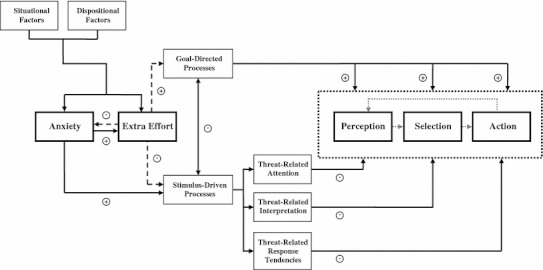
Under anxiety, people sometimes perform poorly. This concerns cognitive performance (e.g., taking an important exam) as well as perceptual-motor performance (e.g., picking up a cup from a table). There is still much debate about how anxiety affects perceptual-motor performance. In the current paper we review the experimental literature on anxiety and perceptual-motor performance, thereby focusing on how anxiety affects the perception, selection, and realization of action possibilities. Based on this review we discuss the merits of two opposing theoretical explanations and build on existing frameworks of anxiety and cognitive performance to develop an integrated model that explains the various ways in which anxiety may specifically affect perceptual-motor performance. This model distinguishes between positive and negative effects of anxiety and, moving beyond previous approaches, recognizes three operational levels (i.e., attentional, interpretational, and behavioral) at which anxiety may affect different aspects of goal-directed action. Finally, predictions are formulated and directions for future research suggested.
Overview
The claims and statistics of this paper haven’t been checked yet.
Run the check — free, no account needed. It reads the open-access text and checks the sources it cites.
Integrity signals
Registry
Cites
Statistics
Figures
Verification
Claims the paper makes
The claims and statistics of this paper haven’t been checked yet.
Run the check — free, no account needed. It reads the open-access text and checks the sources it cites.
Claims other papers make about this one
Each is checked against this paper’s own text: does it say what the citing paper says it does?
The cited source says what the claim attributes to it.
In the citing paper
“Competitive anxiety is a common psychological challenge among athletes and can negatively affect sports performance.”
From The Effect of Different Psychological Interventions on Athletes' Competitive Anxiety: A Systematic Review and Bayesian Network Meta-Analysis. (2026) · cites this paper as [8]
Self-check
Percentages, sums and reported differences re-computed from the paper’s own numbers.
The self-check needs the paper’s full text.
Citations
Cites
The Ecological Approach to Visual Perception
Bornstein, M. H., & Gibson, J. J. (1980) · The Journal of Aesthetics and Art Criticism · doi:10.2307/429816 · Cited by 22,935 · cited 1×
“Our own approach to perceptual-motor behavior can be considered embodied (e.g., Beilock, 2008b; Proffitt, 2006; Wilson, 2002), and ultimately has its origins in ecological psychology (Gibson, 1979).”
BackgroundThe Ecological Approach to Visual Perception: Classic Edition
Gibson, J. J. (2014) · doi:10.4324/9781315740218 · Cited by 12,132
Feeling and thinking: Preferences need no inferences.
Zajonc, R. B. (1980) · American Psychologist · doi:10.1037/0003-066x.35.2.151 · Cited by 8,094 · cited 2×
“…et al., 2007)—but also affects interpretational processes (Bishop, 2007; Blanchette & Richards, 2010) and facilitates emotion-specific behavioral responses (Frijda, 1988; Zajonc, 1980; see also Krieglmeyer et al., 2010, 2011; Lavender & Hommel, 2007; Schutter et al., 2008; Stins et al., 2011).”
BackgroundFodor, J. A. (1983) · doi:10.7551/mitpress/4737.001.0001 · Cited by 7,734
The relation of strength of stimulus to rapidity of habit formation
Yerkes, R. M., & Dodson, J. D. (1908) · Journal of Comparative Neurology and Psychology · doi:10.1002/cne.920180503 · Cited by 6,911
Journal of experimental psychology: Human Perception and performance
Jong, R. D., Coles, M. G. H., Logan, G. D., & Gratton, G. (1987) · Journal of Sound and Vibration · doi:10.1016/0022-460x(87)90423-8 · Cited by 5,411
Anxiety and cognitive performance: Attentional control theory
Eysenck, M. W., Derakshan, N., Santos, R., & Calvo, M. G. (2007) · Emotion · doi:10.1037/1528-3542.7.2.336 · Cited by 5,289
Cummins, R., & Fodor, J. A. (1985) · The Philosophical Review · doi:10.2307/2184717 · Cited by 4,791
Six views of embodied cognition
Wilson, M. (2002) · Psychonomic Bulletin & Review · doi:10.3758/bf03196322 · Cited by 4,782
Threat-related attentional bias in anxious and nonanxious individuals: a meta-analytic study.
Bar-Haim, Y., Lamy, D., Pergamin, L., Bakermans-Kranenburg, M. J., & van IJzendoorn, M. H. (2007) · Psychological Bulletin · doi:10.1037/0033-2909.133.1.1 · Cited by 3,721
Research works printed but not linked: 2
- Frijda, N. H. (1988). The laws of emotions. American Psychologist, 43, 349–358. · DOI
- Nibbeling, N., Daanen, H. A. M., Gerritsma, R. M., Hofland, R. M., & Oudejans, R. R. D. (2011). Effects of anxiety on running. Journal of Sports Sciences (in press).
Cited by
Sorted by citations
Items 201–265 of 265
Mentale Leistungsphänomene im Sport
Klämpfl, M. K. (2018) · Springer eBooks · doi:10.1007/978-3-662-53385-7_50-1
Ducrocq, E. (2019) · BIROn (Birkbeck, University of London) · doi:10.18743/pub.00040386 · Cited by 1
SCOPE OF ATTENTION VARIATION AS A FUNCTION OF ANXIETY AND DEPRESSION
O'Donnell, K. (2020) · CSUSB ScholarWorks (California State University, San Bernardino)
Golf putting : establishing the impact and mechanisms of a target focus with high level golfers
Moffat, D. C. (2020) · CLOK (University of Central Lancashire)
Геннадьевна, Б. М., & Zueva, E. (2020) · Applied psychology and pedagogy · doi:10.12737/2500-0543-2020-72-86
Prosekin, G. A., Ким, В. Н., Кривулина, Г. Б., Долгова, Е. Н., & Парастаев, С. А. (2021) · Sports medicine research and practice · doi:10.47529/2223-2524.2020.4.1
New Perspectives on Choking at the Free-throw Line
Maher, R. (2018) · Victoria University Research Repository (Victoria University)
Martina, S. D. (2021) · Memorial University Research Repository (Memorial University) · doi:10.48336/mw2e-8h33
Mentale Leistungsphänomene im Sport
Klämpfl, M. K. (2019) · Springer eBooks · doi:10.1007/978-3-662-53385-7_50-2
Baldwin, S. (2021) · Carleton University's Institutional Repository (MacOdrum Library, Carleton University) · doi:10.22215/etd/2021-14909
Do construal levels affect athletes’ imagery and performance outcomes? It depends on the task!Preprint
Kacperski, C. (2022) · doi:10.31234/osf.io/ehx29
Kobayashi, T., Takemi, M., & Nozaki, D. (2022) · bioRxiv (Cold Spring Harbor Laboratory) · doi:10.1101/2022.08.23.505043
Setiawan, L. A., Susmartini, S., & Herdiman, L. (2023) · AIP conference proceedings · doi:10.1063/5.0117357
Roberts, L. J., Little, D. R., Jackson, M. S., & Spittal, M. J. (2023) · PLoS ONE · doi:10.1371/journal.pone.0287700
Harris, D., Arthur, T., Wilson, M., Gallais, B. L., Parsons, T. D., Dill, A., & Vine, S. J. (2023) · doi:10.31234/osf.io/654h3
Unifying Rules for Simplified Information Processing in Action – Less is MorePreprint
Voigt, L., Raab, M., Masters, R. S. W., Eckardt, V. C., Grove, P. A., Hoskens, M. C. J., Laborde, S., Park, S. H., Pizzera, A., Redlich, D., et al. (2024) · doi:10.31234/osf.io/23sfd
Self-citationSullivan, R., Uiga, L., Masters, R. S. W., Anson, J. G., & Nieuwenhuys, A. (2024) · International Journal of Sport and Exercise Psychology · doi:10.1080/1612197x.2024.2336164
Self-citationNakamoto, H., Hashimoto, S., Kamei, M., Murata, M., Ikudome, S., Karakida, K., & Tanaka, Y. (2024) · Journal of Sport and Exercise Psychology · doi:10.1123/jsep.2023-0042 · Cited by 2
Majeed, K., Syed, H., Batool, A., & Hanif, Z. M. (2024) · Neurosurgical Review · doi:10.1007/s10143-024-02622-7
Bartura, K., Gustafsson, H., & Abrahamsen, F. E. (2024) · doi:10.31234/osf.io/svjmc
Wadhwani, B. D., Lim, H. B. T., & McConnell, B. L. (2024) · Applied Psychology · doi:10.1111/apps.12579 · Cited by 1
Zechner, O., Schrom-Feiertag, H., Wespi, R., Pretolesi, D., Nguyen, Q., & Tscheligi, M. (2024) · doi:10.2196/preprints.57655
Sakemoto, N., & Tanaka, H. (2024) · Psychiatry International · doi:10.3390/psychiatryint5040068
Sleepless but vigilant: unraveling the interplay of sleep loss and threat in response inhibition
Boardman, J. M., & Lim, J. Y. L. (2025) · SLEEP · doi:10.1093/sleep/zsaf008
Forte, R., Lucia, S., TRENTIN, C., Tocci, N., & Russo, F. D. (2025) · The Journal of Sports Medicine and Physical Fitness · doi:10.23736/s0022-4707.24.16380-3
Ko, A., Chan, A., Purcell, A. A., & Thomas, D. (2025) · International Journal of Speech-Language Pathology · doi:10.1080/17549507.2024.2444397
“When experiencing heightened emotion, fewer cognitive resources are available to focus on managing the present tasks effectively (Nieuwenhuys & Oudejans, 2012).”
Do construal levels affect athletes’ imagery and performance outcomes? It depends on the task!Preprint
Kacperski, C. (2022) · doi:10.31234/osf.io/ehx29_v1
Assessing the impact of neurocognitive load on trunk variability in athletes during a hopping task
Wong, H., Triglione, L., Feinn, R., & Garbalosa, J. C. (2025) · Gait & Posture · doi:10.1016/j.gaitpost.2025.06.001
Shimabukuro, S., Miyake, T., Akamine, T., Okubo, C., Yanagihara, D., & Tamaki, E. (2025) · Frontiers in Sports and Active Living · doi:10.3389/fspor.2025.1561808
Hill, Y., Oudejans, R. R. D., de Klok, I. A. V., Dijkstra, J., Russchen, N. A., & Kok, M. (2025) · International Journal of Sports Science & Coaching · doi:10.1177/17479541251406629
Self-citationBartura, K., Gustafsson, H., & Abrahamsen, F. E. (2026) · Perceptual and Motor Skills · doi:10.1177/00315125261419408
Anxiety Affects State Self-Esteem as Well as State Self-Efficacy
Śniecińska, J., & Lachowicz-Tabaczek, K. (2026) · Social Psychology · doi:10.1027/1864-9335/a000588
Guidetti, M., Cupello, S., Marceglia, S. R. F., Pagani, R., Biglioli, F., Bocci, T., Priori, A., & Previtera, A. M. (2026) · doi:10.2196/preprints.94305
From the Hand of God to the eye of VAR
Eisikovits, N., & Stubbs, A. (2026) · Sport Ethics and Philosophy · doi:10.1080/17511321.2026.2649767
Shapri, J. @. A., Wazir, M. R. W. N., & Nazarudin, M. N. (2026) · International Journal of Education Psychology and Counseling · doi:10.35631/ijepc.1162065
Beyond the transfer gap: an ecological dynamics framework for police training design
Blair, J. P. (2026) · Evidence Base · doi:10.1080/30679125.2026.2662641
Volgemute, K., Ulme, G., & Vazne, Ž. (2026) · Sports Medicine - Open · doi:10.1186/s40798-026-01023-y · Cited by 1
The influence of trait anxiety on performance in the CatWalk test
Parrella, E., Salari, V., Meamarzadegan, Y., Torroni, L., Jha, V., Spagnoli, G., Fereidouni, A. J., Lazzarin, A., Giuliari, V., Bertini, G., et al. (2026) · Frontiers in Behavioral Neuroscience · doi:10.3389/fnbeh.2026.1682995
Loose, F., Belghiti-Mahut, S., & Lafont, A.-L. (2025) · Revue internationale de Psychosociologie · doi:10.54695/rips1.085.0005
The “Release Illusion”: A Conceptual Model of Motor Skill Formation in Archery
Kalynichenko, O. (2026) · Journal of Learning Theory and Methodology · doi:10.17309/jltm.2026.7.2.01
Im, C.-H. (2026) · Frontiers in Psychology · doi:10.3389/fpsyg.2026.1810460
Anxiety disorders alter cognitive-motor integration during visuomotor adaptation and retention
Barzi, L., Wilson, M., & Hill, C. M. (2026) · Experimental Brain Research · doi:10.1007/s00221-026-07304-y
Schade, S., & Thielgen, M. M. (2026) · Springer eBooks · doi:10.1007/978-3-658-49902-0_2
Dransmann, M., Koddebusch, M., Wicker, P. V., Gröben, D., & Gröben, B. (2026) · Healthcare · doi:10.3390/healthcare14101418
Visaetsilapanonta, T., Butt, J., Mahwinney, C., Low, W. R., Treeraj, A., Prachakul, W., & Mills, A. (2026) · International Journal of Sport and Exercise Psychology · doi:10.1080/1612197x.2026.2674625
Do Anxiety Levels Affect Postural Stability?
Çinpolat, A. Z., Yiğit, Ö., & Aksoy, S. (2026) · American Journal of Audiology · doi:10.1044/2026_aja-25-00226
Giles, D., Mangan, K., & Draper, N. (2026) · The Spanish Journal of Psychology · doi:10.1017/sjp.2026.10036
Liu, X., Zhai, Y., Qiu, S., & Wang, Y. (2026) · International Journal of Sport and Exercise Psychology · doi:10.1080/1612197x.2026.2687403
Police officer wellness: findings from the national wellness survey for public safety personnel
Blalock, J. R., Tavakoli, A., Bourke, M. L., Black, R. A., & Hasselt, V. B. V. (2026) · Policing An International Journal · doi:10.1108/pijpsm-02-2026-0053
What’s Important Now: The Foundational Role of Mindfulness Training in Performance
Jha, A. P., Rooks, J. D., Rogers, S. L., & McGehee, C. (2026) · Springer eBooks · doi:10.1007/978-3-032-21528-4_9
Training under stress for aggression management in social work: a scoping review
Maassen, N., Hill, Y., Beckers, T., Renden, P. G., Koekkoek, B., & Oudejans, R. R. D. (2026) · European Journal of Social Work · doi:10.1080/13691457.2026.2710837
Self-citationChen, Z., Lian, L., & Zhong, S. (2026) · Frontiers in Psychology · doi:10.3389/fpsyg.2026.1842687
Kim, H., Liu, N., & O’Sullivan, D. M. (2026) · Proceedings of the Institution of Mechanical Engineers Part P Journal of Sports Engineering and Technology · doi:10.1177/17543371261480201
ОСОБЕННОСТИ СЕНСОМОТОРНОГО КОНТРОЛЯ КАК ПСИХОФИЗИОЛОГИЧЕСКИЕ МАРКЕРЫ ТРЕВОЖНОСТИ
Efimova, V. L., Druzhinin, O. A., Мазурова, И. С., & Васильева, В. Ю. (2026) · Человеческий капитал. · doi:10.25629/hc.2026.09.12
Yildiz‐Ahola, T., Kastrati, G., Fransson, P., Åhs, F., Furmark, T., Manzouri, A., Timmann, D., Månsson, K. N. T., & Rosén, J. (2026) · Human Brain Mapping · doi:10.1002/hbm.70655
愛下, 由., Makizako, H., Shiratsuchi, D., Akaida, S., Kiuchi, Y., Tateishi, M., Kiyama, R., Kubozono, T., Takenaka, T., & Ohishi, M. (2026) · World Journal of Urology · doi:10.1007/s00345-026-06864-6
Cognitive workload across subjective and electrodermal measures in relation to previous-night sleep
Lachowicz, M., Wilk, I., Hrehorowicz, I., Bałamucki, S., Lisowski, M., Jamro, D., Zurek, G., & Andrzejewski, W. (2026) · Frontiers in Cognition · doi:10.3389/fcogn.2026.1928964
Nunziata, S., Iachini, T., & Ruggiero, G. (2026) · Journal of Environmental Psychology · doi:10.1016/j.jenvp.2026.103253
Sportif Başarıda Psikolojik Etkenler: Duygusal Zekâ ve Zihinsel Dayanıklılık
ZENGİN, S., & Fidel, B. (2026) · Özgür Yayınları eBooks · doi:10.58830/ozgur.pub1466.c6441
António, H., Gamito, P., Bouchard, S., & Pinto, R. (2026) · Social Sciences & Humanities Open · doi:10.1016/j.ssaho.2026.103901
Miles, C. A. L. (2014) · UPT. Syiah Kuala University Library (Syiah Kuala University)
Metadata
- Authors
- Nieuwenhuys, A., & Oudejans, R. R. D.
- Affiliations
- Amsterdam Movement Sciences (NL)
- Vrije Universiteit Amsterdam (NL)
- Corresponding author
- Nieuwenhuys, Arne
- Venue
- Psychological Research
- Published
- 2011-10-29
- Volume
- 76
- Issue
- 6
- Pages
- 747-759
- ISSN
- 0033-3026 (ISSN-L)
- 0340-0727
- 1430-2772
- PMC
- PMC3470682
- OpenAlex
- W2167386533
- Cited by
- 265
- References
- 106
- Citations by year
- 2026: 35 · 2025: 23 · 2024: 24 · 2023: 23 · 2022: 20 · 2021: 20 · 2020: 21 · 2019: 20 · 2018: 18 · 2017: 11 · 2016: 18 · 2015: 16 · 2014: 7 · 2013: 8 · 2012: 1
- FWCI
- 6.60
- Type
- journal article
- Language
- en
- Open access
- hybrid
- doi.org
- Licence
- Locations
- Psychological Research (publishedVersion, cc-by-nc)
- Europe PMC (PubMed Central) (publishedVersion, cc-by-nc)
- PubMed Central (publishedVersion, cc-by-nc)
- PubMed (publishedVersion)
- VU Research Portal (publishedVersion, other-oa)
- Radboud Repository (Radboud University) (submittedVersion)
- Data Archiving and Networked Services (DANS) (submittedVersion, other-oa)
- Topics
- Social Sciences › Psychology › Experimental and Cognitive Psychology › Anxiety, Depression, Psychometrics, Treatment, Cognitive Processes
- Social Sciences › Psychology › Developmental and Educational Psychology › Sport Psychology and Performance
- Life Sciences › Neuroscience › Cognitive Neuroscience › Neural and Behavioral Psychology Studies
- Keywords
- anxiety, perceptual-motor performance, action selection, goal-directed action, cognitive performance
- MeSH terms
- Anxiety, Attention, Humans, Models, Psychological, Psychomotor Performance, Performance Anxiety
About these checks
Registry, retraction, Cites and statistics results are computed, not judged, with one exception: a printed reference that no index lists is read once by a model before it counts as a citation error. Claims are extracted by a model and kept only when their quote appears verbatim in the text; each cited source is then checked, with a model’s help, for whether it says what the claim relies on. Those verdicts can be wrong — read the claim’s quote and the cited source before relying on one.
Statistics and arithmetic are recomputed, not judged.
Confidence bands are shown only for fields calibrated on our annotated test set. None is calibrated yet, so no band is shown.
What counts as a claim ›How we measure confidence ›How we check this ›
Are you an author, or do you see a problem with this page? Request a review
