

Behavioral and Socio-Emotional Disorders in Intellectual Giftedness: A Systematic Review
Open accessThe DOI matches its Crossref record, with a small difference in title or year; 64 of the 67 references it cites were found in a registry or an index; 73 of the 147 sources its claims cite were checked for support.
Abstract
This work systematically reviewed past literature to investigate the association between intellectual giftedness and socio-emotional and/or behavioral disorders. Nineteen studies met the inclusion criteria, 17 of which have children and/or adolescents as participants, and 12 have a non-gifted control group. Socio-emotional problems, such as withdrawal, were found in 3 out of 8 studies; internalizing disorders, such as anxiety, were found in 5 out of 9; externalizing disorders, such as hyperactivity, were found in 3 out of 5. The most investigated comorbidity was attention-deficit/hyperactivity disorder. A univocal conclusion on the relationship between intellectual giftedness and socio-emotional/behavioral problems cannot be drawn, principally because of the heterogeneity of participants’ age, informants, and instruments. The review highlights the need for future studies to use multi-informant and comprehensive assessments, to reach more robust findings, and suggests that age and discrepancy between verbal and non-verbal intellectual abilities should be considered critical factors.
Overview
CoChat Summary
TL;DR
This systematic review examined whether intellectual giftedness is associated with socio-emotional and/or behavioral disorders across 19 studies. It found inconsistent evidence: some studies reported more problems in gifted groups, others found no differences or better adjustment, and no univocal conclusion could be drawn.
Key findings
- Of 19 included studies, 17 had children and/or adolescents as participants, and 12 included a non-gifted control group.
- Socio-emotional problems such as withdrawal were found in 3 out of 8 studies; internalizing disorders such as anxiety in 5 out of 9; externalizing disorders such as hyperactivity in 3 out of 5.
- The most investigated comorbidity was ADHD (9/19 studies); twice-exceptionality with ADHD or ASD was more consistently associated with socio-emotional and behavioral problems than giftedness alone.
- The review concludes that a univocal answer is not possible, mainly because of heterogeneity in participants’ age, informants, and instruments; age and verbal–non-verbal IQ discrepancy are highlighted as critical factors.
Methods
- PRISMA-guided systematic review of peer-reviewed English studies published 2000–2020, searched in PubMed and Web of Science, including standardized measures of socio-emotional/behavioral problems and full IQ ≥ 120.
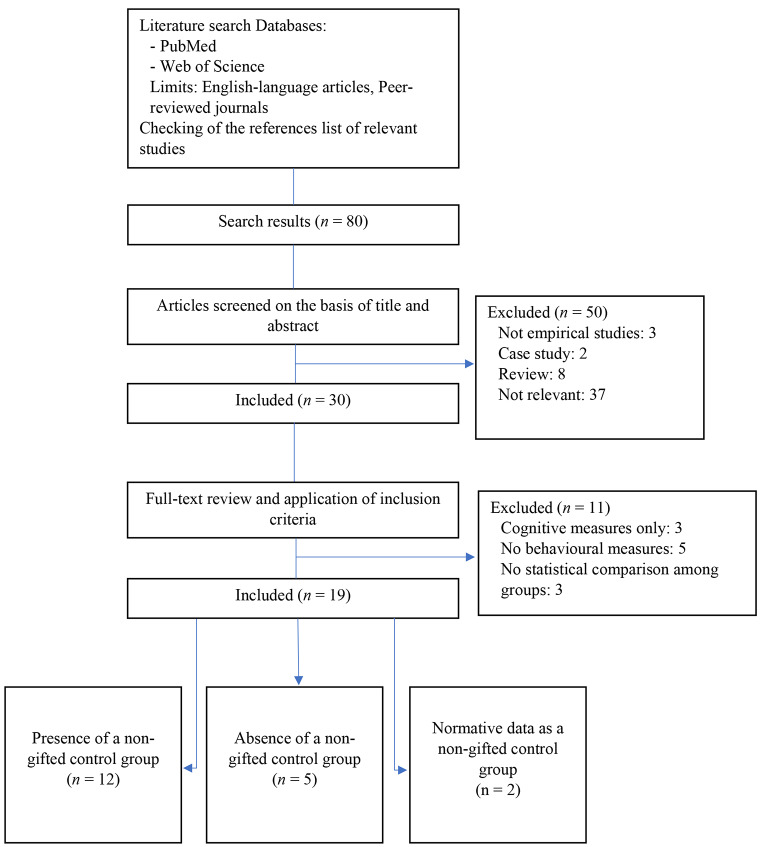
- From 80 search results, 50 were selected by title/abstract, and 19 met inclusion criteria; two authors independently screened titles, abstracts, and full texts, resolving disagreements by discussion.
- Results were grouped narratively into socio-emotional, internalizing, and externalizing symptoms; study characteristics, control groups, recruitment settings, behavioral measures, and outcomes were summarized in Table 1.
Limitations
- The paper states that the main limitation of the examined studies is an IQ-based categorization of giftedness, sometimes based on only two Wechsler tests, and that heterogeneity in age, informants, and instruments prevents robust conclusions.
- The paper notes that twice-exceptionality studies often lacked a non-gifted control group with ADHD or ASD, limiting conclusions about whether giftedness attenuates or exacerbates psychopathology; it also states that only one included study examined ASD comorbidity and that no empirical studies investigated giftedness with learning disabilities.
- Evident from the text: the review is a narrative synthesis without meta-analysis, and some included studies had small samples, such as Chae et al.’s limited number of gifted children with ADHD, which the authors say should be interpreted cautiously.
Model-written summary. Check it against the paper before relying on it.
Integrity signals
Registry
Cites
Statistics
Figures
Verification
Claims the paper makes
55 Valid · 6 Not valid · 51 Not checked · 62 Own results and interpretations
At least one cited source doesn’t support this claim or points to a different paper, and none confirmed it — see the verdicts below.
In the paper
“Finally, only one study [26] investigated adults and found no socio-emotional difficulties.”
§ Behavioral and Socio-Emotional Disorders in Intellectual Giftedness: A Systematic Review > Results > Socio-Emotional Problems
What the sources say
- Disputedcites [26] Karpinski RI Kinase Kolb AM Tetreault NA Borowski TB High intelligence: A risk factor for psychological and physiological overexcitabilities Intelligence 2018 66 8 23 10.1016/j.intell.2017.09.001 sourceExperimental — accuracy not yet measured
The Participants section confirms that the study investigated adults aged 18–91. But §3.1, Psychological disorders, reports higher rates of mood and anxiety disorders in the high-intelligence sample than in the national comparison data, contrary to the claim that it found no socio-emotional difficulties. Page numbers were not available in our copy. (LLM, conf=0.90)
Checked by a reasoning model — may be wrong.
plain- Asserted: passes — The authors put it forward as true.
- Checkable: passes — It can be checked against evidence.
- Load-bearing: unclear — It is unclear whether the paper’s conclusions depend on it.
- Based: passes — The paper gives a reason why it holds.
- Disputed
At least one cited source doesn’t support this claim or points to a different paper, and none confirmed it — see the verdicts below.
In the paper
“We did not find empirical studies investigating the comorbidity of intellectual giftedness with learning disabilities, although this is observed in clinical practice [75].”
§ Behavioral and Socio-Emotional Disorders in Intellectual Giftedness: A Systematic Review > Discussion > Final Remarks
What the sources say
- Disputedcites [75] Beckmann E Minnaert A Non-cognitive characteristics of gifted students with learning disabilities: An in-depth systematic review Front Psychol 2018 9 504 10.3389/fpsyg.2018.00504 29731728 PMC5919977 sourceExperimental — accuracy not yet measured
The Methods (Study selection; page unavailable) report that the review identified 23 relevant studies after screening for empirical data and a focus on gifted students with learning disabilities. The paper therefore contradicts the quoted claim that no empirical studies investigating this combination were found. (LLM, conf=0.88)
Checked by a reasoning model — may be wrong.
plain- Asserted: passes — The authors put it forward as true.
- Checkable: passes — It can be checked against evidence.
- Load-bearing: passes — The paper’s conclusions depend on it.
- Based: passes — The paper gives a reason why it holds.
- Disputed
Every source the paper cites for this claim was checked and supports it.
In the paper
“On the other hand, gifted individuals could be socially isolated because of problems in meeting intellectual peers [7].”
§ Behavioral and Socio-Emotional Disorders in Intellectual Giftedness: A Systematic Review > Twice-Exceptionality
What the sources say
- Supportedcites [7] Boschi A Planche P Hemimou C From high intellectual potential to asperger syndrome: Evidence for differences and a fundamental overlap-A systematic review Front Psychol 2016 7 1605 10.3389/fpsyg.2016.01605 27812341 PMC5071629 source
The Introduction explicitly says that some children with high intellectual potential are socially isolated because they have trouble meeting intellectual peers. This supports the citing sentence’s qualified claim; the source does not suggest it applies to all gifted individuals. (LLM, conf=0.95)
hedgedstates a possible cause- Asserted: passes — The authors put it forward as true.
- Checkable: passes — It can be checked against evidence.
- Load-bearing: unclear — It is unclear whether the paper’s conclusions depend on it.
- Based: passes — The paper gives a reason why it holds.
- Supported
The cited sources support only part of this claim — read each source’s verdict below.
In the paper
“Some gifted profiles might share socio-emotional problems with highfunctioning autism, mainly regarding social abilities, adaptation disorders, withdrawal in imaginary and/or intellectual abstraction, attention deficit, clumsiness, excessive attention to restricted interests, and hypersensitivity [7, 15, 16].”
§ Behavioral and Socio-Emotional Disorders in Intellectual Giftedness: A Systematic Review > Twice-Exceptionality
What the sources say
- Supportedcites [7] Boschi A Planche P Hemimou C From high intellectual potential to asperger syndrome: Evidence for differences and a fundamental overlap-A systematic review Front Psychol 2016 7 1605 10.3389/fpsyg.2016.01605 27812341 PMC5071629 source
The Introduction (page not available in our copy) says that some children with high intellectual potential share clinical features with children with autism spectrum disorder without language or intellectual delay. Its list matches the claimed social, emotional, attentional, motor, sensory, and restricted-interest difficulties; it also cautions that the features do not always occur together and may have different origins. (LLM, conf=0.94)
- Partly supportedcites [15] Burger-Veltmeijer AEJ Minnaert AEMG Van Houten-Van den Bosch EJ The co-occurrence of intellectual giftedness and Autism Spectrum Disorders Educ Res Rev-Neth 2011 6 67 88 10.1016/j.edurev.2010.10.001 sourceExperimental — accuracy not yet measured
Section 3.2.6 identifies social issues, hypersensitivity and intense focus as possible similarities between intellectual giftedness and ASD; Section 4.2 also describes social isolation and restricted interests. But Section 3.3.4 presents motor clumsiness as a distinguishing feature of ASD, not a shared trait, and the cited passages do not establish withdrawal into imaginary or intellectual abstraction or attention deficit as shared traits. (LLM, conf=0.87)
- Partly supportedcites [16] Crespi BJ Autism as a disorder of high intelligence Front Neurosci 2016 10 300 10.3389/fnins.2016.00300 27445671 PMC4927579 sourceExperimental — accuracy not yet measured
In “Sensory functions, attention, and special abilities” (page not provided), the paper reports high attention to detail among child prodigies and in autism, and discusses sensory sensitivity and reduced social abilities in relation to autism or savant skills. It does not establish that gifted profiles share the full list of socio-emotional problems with high-functioning autism; adaptation disorders, imaginative withdrawal, attention deficit, and clumsiness are not supported by these passages. (LLM, conf=0.86)
hedgedstates an association- Asserted: passes — The authors put it forward as true.
- Checkable: passes — It can be checked against evidence.
- Load-bearing: passes — The paper’s conclusions depend on it.
- Based: passes — The paper gives a reason why it holds.
- Supported
The sources with a verdict support this claim; the rest weren’t checked yet, have no full text we could read, or their verdicts aren’t rated yet.
In the paper
“Beyond the contrasting findings, the two latter studies revealed that the “level” of intellectual giftedness might impact behavior.”
§ Behavioral and Socio-Emotional Disorders in Intellectual Giftedness: A Systematic Review > Results > Internalizing Problems
What the sources say
- Not checked — no full text of the sourcecites [28] Shaywitz SE Holahan JM Freudenheim DA Heterogeneity within the gifted: Higher IQ boys exhibit behaviors resembling boys with learning disabilities Gifted Child Quart 2001 45 16 23 10.1177/001698620104500103 source
- Supportedcites [29] Guénolé F Louis J Creveuil C Behavioral profiles of clinically referred children with intellectual giftedness BioMed Res Int 540153 2013 10.1155/2013/540153 PMC3722901 23956988 source
The Results (section 3; page not provided) report significant differences in behavioral profiles between low-gifted and highly gifted children. The Discussion (section 4) notes that low-gifted children had more somatic complaints and mixed syndromes, although higher IQ was not associated with more behavioral problems overall. This supports the hedged claim that level of giftedness might matter for behavior in this clinically referred sample. (LLM, conf=0.90)
hedgedstates a possible cause- Asserted: passes — The authors put it forward as true.
- Checkable: passes — It can be checked against evidence.
- Load-bearing: passes — The paper’s conclusions depend on it.
- Based: passes — The paper gives a reason why it holds.
98 more claims · 30 with their cited sources checked
Create a free account to see all 174 claims and to verify the 5 references still open.
- It may state two separate claims as one. 52
- Probably not a substantial claim. 22
- The quote only partly states this claim. 3
Self-check
Percentages, sums and reported differences re-computed from the paper’s own numbers.
Each contradiction between two passages listed here was confirmed by an independent check.
Rated major: it would touch a result — a value a result rests on, reported and recomputed p-values on opposite sides of the significance level, two passages that conflict with no sign which is right, or a cited work retracted before this paper was published.
In the paper
§ Behavioral and Socio-Emotional Disorders in Intellectual Giftedness: A Systematic Review > Discussion > Internalizing and Externalizing Problems
“Guénolé et al. [29] found a greater prevalence of internalizing and externalizing symptoms in the low-gifted group, whereas very high IQs were not associated with increased behavioral problems”
§ Behavioral and Socio-Emotional Disorders in Intellectual Giftedness: A Systematic Review > Methods > Selection Process
“The high-gifted subgroup reported higher percentages of externalizing disorders compared to the low-gifted subgroup (34.5% versus 14%)”
Rated minor: it would not touch a result — a value no result rests on, a p-value that stays on the same side of the significance level, or a conflict that is clerical, resolved elsewhere in the paper, or outside its own findings.
In the paper
§ Behavioral and Socio-Emotional Disorders in Intellectual Giftedness: A Systematic Review > Discussion > Socio-Emotional Problems
“Richards et al. [35] found no difference between the gifted and the non-gifted group of children (7 to 10 years) in the social skill scale scored by teachers.”
§ Behavioral and Socio-Emotional Disorders in Intellectual Giftedness: A Systematic Review > Methods > Selection Process
“grades 7–10; M.age = 14.5”
Rated minor: it would not touch a result — a value no result rests on, a p-value that stays on the same side of the significance level, or a conflict that is clerical, resolved elsewhere in the paper, or outside its own findings.
In the paper
§ Behavioral and Socio-Emotional Disorders in Intellectual Giftedness: A Systematic Review > Discussion > Internalizing and Externalizing Problems
“Richards et al. [35] found a lower rate of internalizing and externalizing disorders in gifted compared to non-gifted peers, according to parents, teachers, and self-report ratings.”
§ Behavioral and Socio-Emotional Disorders in Intellectual Giftedness: A Systematic Review > Methods > Selection Process
“BASC Teachers: no significant differences were found between the two groups.”
Rated minor: it would not touch a result — a value no result rests on, a p-value that stays on the same side of the significance level, or a conflict that is clerical, resolved elsewhere in the paper, or outside its own findings.
In the paper
§ Behavioral and Socio-Emotional Disorders in Intellectual Giftedness: A Systematic Review > Methods > Selection Process
“non-gifted 5th graders (n = 20; M.age = 113 y, SD = 0.4).”
§ Behavioral and Socio-Emotional Disorders in Intellectual Giftedness: A Systematic Review > Results > Socio-Emotional Problems
“they exhibited significantly more social concerns than the non-gifted control group matched for age.”
Citations
Cites
PRISMA-P Group, Moher, D., Shamseer, L., Clarke, M., Ghersi, D., Liberati, A., Petticrew, M., Shekelle, P., & Stewart, L. A. (2015) · Systematic Reviews · doi:10.1186/2046-4053-4-1 · Cited by 26,223
(1991) · Medical Entomology and Zoology · Cited by 8,071
THE McMASTER FAMILY ASSESSMENT DEVICE*
Epstein, N. B., Baldwin, L. M., & Bishop, D. S. (1983) · Journal of Marital and Family Therapy · doi:10.1111/j.1752-0606.1983.tb01497.x · Cited by 3,510
The PedsQL™: Measurement Model for the Pediatric Quality of Life Inventory
Varni, J. W., Seid, M., & Rode, C. A. (1999) · Medical Care · doi:10.1097/00005650-199902000-00003 · Cited by 3,291 · cited 1×
“I V ) . and in a control group of participants of a regular school, using multiple instruments, namely, the K-SADS-PL, the SDQ, and the Pediatric Quality of Life Inventory (PedsQL; [54]), completed by parents and children (adolescent only in the case of SDQ).”
MethodThe g factor: the science of mental ability
(1998) · Choice Reviews Online · doi:10.5860/choice.36-2443 · Cited by 2,746
Wechsler Adult Intelligence Scale--Third Edition
Wechsler, D. (2019) · PsycTESTS Dataset · doi:10.1037/t49755-000 · Cited by 2,327
Goodman, R., Meltzer, H., & Bailey, V. (1998) · European Child & Adolescent Psychiatry · doi:10.1007/s007870050057 · Cited by 2,238 · cited 1×
“…presence of multiple psychopathologies (e.g., depression and ADHD) according to DSM-IV criteria; the Strengths and Difficulties Questionnaire (SDQ [ 52]), wich measures pro-social behaviors, emotional symptoms, conduct problems, inattention/hyperactivity symptoms and peer relationship/problems;…”
Method(1998) · Cited by 2,026
(1993) · PubMed · Cited by 1,900
Assessment of social adjustment by patient self report.
Weissman, M. M. (1976) · Archives of General Psychiatry · doi:10.1001/archpsyc.1976.01770090101010 · Cited by 1,782 · cited 1×
“Moreover, they reported lower quality-of-life ratings (in Quality of Life Enjoyment and Satisfaction Questionnaire, Q-LES-Q [67]) and more functional impairments across a variety of occupational, social and family domains (in Social Adjustment Scale-Self-Report [68]).”
BackgroundSubotnik, R. F., Olszewski-Kubilius, P., & Worrell, F. C. (2011) · Psychological Science in the Public Interest · doi:10.1177/1529100611418056 · Cited by 1,269
What Makes Giftedness?: Reexamining a Definition
Renzulli, J. S. (2011) · Phi Delta Kappan · doi:10.1177/003172171109200821 · Cited by 1,181
Mainstream science on intelligence: An editorial with 52 signatories, history, and bibliography
Gottfredson, L. S. (1997) · Intelligence · doi:10.1016/s0160-2896(97)90011-8 · Cited by 1,137 · cited 1×
“In line with this approach, intelligence is a set of cognitive skills, related to planning, learning speed, reasoning, problem solving, understanding complex ideas, etc. [6].”
BackgroundPerfectionism and maladjustment: An overview of theoretical, definitional, and treatment issues.
Flett, G. L., & Hewitt, P. L. (2002) · Perfectionism: Theory, research, and treatment. · doi:10.1037/10458-001 · Cited by 712
State-Trait Anxiety Inventory for Children
Spielberger, C. D., Edwards, C. D., Montouri, J., & Lushene, R. (2012) · PsycTESTS Dataset · doi:10.1037/t06497-000 · Cited by 558
Child and adolescent psychopathology
(2008) · Choice Reviews Online · doi:10.5860/choice.46-1183 · Cited by 498
Toward a triarchic theory of human intelligence
Sternberg, R. J. (1984) · Behavioral and Brain Sciences · doi:10.1017/s0140525x00044629 · Cited by 489
Keller, F., Grieb, J., Ernst, M., Spröber, N., Fegert, J. M., & Kölch, M. (2011) · Zeitschrift für Kinder- und Jugendpsychiatrie und Psychotherapie · doi:10.1024/1422-4917/a000090 · Cited by 453
Revised Children's Manifest Anxiety Scale (RCMAS). Manual
Reynolds, C. R., & Richmond, B. O. (1985) · Open Scholarship Institutional Repository (Washington University in St. Louis) · Cited by 424
Wechsler Preschool and Primary Scale of Intelligence--Third Edition
Wechsler, D. (2012) · PsycTESTS Dataset · doi:10.1037/t15177-000 · Cited by 331
Goodman, R., Meltzer, H., & Bailey, V. (2003) · International Review of Psychiatry · doi:10.1080/0954026021000046137 · Cited by 320
Wechsler Intelligence Scale for Children – Fourth UK Edition (WISC-IV UK)
Wechsler, D. (2004) · doi:10.53841/bpstest.2004.wisc4 · Cited by 306
Empirical Investigation of Twice-Exceptionality: Where Have We Been and Where Are We Going?
Foley Nicpon, M., Allmon, A., Sieck, B., & Stinson, R. D. (2011) · Gifted Child Quarterly · doi:10.1177/0016986210382575 · Cited by 299
Saúde suplementar no Brasil: abordagens sobre a articulação público/privada na assistência à saúde
Sestelo, J. A. D. F., Souza, L. E. P. F. D., & Bahia, L. (2013) · Cadernos de Saúde Pública · doi:10.1590/s0102-311x2013000100004 · Cited by 244 · cited 1×
“Since the studies of Antshel et al. lacked a non-gifted control group, we compared the average scores of the gifted participants without ADHD with the normative cut-offs [ 64, 65].”
ResultJOHN, K., GAMMON, D. G., PRUSOFF, B. A., & WARNER, V. (1987) · Journal of the American Academy of Child & Adolescent Psychiatry · doi:10.1097/00004583-198726060-00015 · Cited by 236
Kearney, C. A. (2002) · Journal of Psychopathology and Behavioral Assessment · doi:10.1023/a:1020774932043 · Cited by 224 · cited 1×
“Lacour & Zdanowicz [41] found that gifted adolescents between 12 and 16 years reported having fewer friends in real life and fewer virtual friends compared to a non-gifted group, as assessed by the K-SADS-PL and the School Refusal Assessment Scale-Revised [55, 56].”
MethodHigh intelligence: A risk factor for psychological and physiological overexcitabilities
Karpinski, R. I., Kinase Kolb, A. M., Tetreault, N. A., & Borowski, T. B. (2018) · Intelligence · doi:10.1016/j.intell.2017.09.001 · Cited by 217 · cited 10×
“In one study [26], the gifted group was enrolled by the MENSA, an internationally recognized association grouping people with a verified IQ score within the top 2% of the general population.”
BackgroundMethodResultInfluentialMcCoach, D. B., & Siegle, D. (2003) · Educational and Psychological Measurement · doi:10.1177/0013164403063003005 · Cited by 206
The Munich Model of Giftedness Designed to Identify and Promote Gifted Students
Heller, K. A., Perleth, C., & Lim, T. K. (2005) · Conceptions of Giftedness · doi:10.1017/cbo9780511610455.010 · Cited by 206
Mental Disorders Among Gifted and Nongifted Youth: A Selected Review of the Epidemiologic Literature
Martin, L. T., Burns, R. M., & Schonlau, M. (2010) · Gifted Child Quarterly · doi:10.1177/0016986209352684 · Cited by 158
Autism As a Disorder of High Intelligence
Crespi, B. J. (2016) · Frontiers in Neuroscience · doi:10.3389/fnins.2016.00300 · Cited by 156 · cited 1×
“…might share socio-emotional prob - lems with highfunctioning autism, mainly regarding social abilities, adaptation disorders, withdrawal in imaginary and/or intellectual abstraction, attention deficit, clumsi - ness, excessive attention to restricted interests, and hyper-sensitivity [7, 15, 16].”
BackgroundThe construct of asynchronous development
Silverman, L. K. (1997) · Peabody Journal of Education · doi:10.1080/0161956x.1997.9681865 · Cited by 149
Antshel, K. M., Faraone, S. V., Stallone, K., Nave, A., Kaufmann, F. A., Doyle, A., Fried, R., Seidman, L., & Biederman, J. (2007) · Journal of Child Psychology and Psychiatry · doi:10.1111/j.1469-7610.2007.01735.x · Cited by 117
Gifted Children With Asperger's Syndrome
Neihart, M. (2000) · Gifted Child Quarterly · doi:10.1177/001698620004400403 · Cited by 110 · cited 1×
“Conversely, children with Asperger’s have great difficulty understanding the perspective of others and fail to grasp the social behaviors that other children intuitively learn, being unaware of social conventions [18, 19].”
BackgroundFrancis, R., Hawes, D. J., & Abbott, M. (2016) · Exceptional Children · doi:10.1177/0014402915598779 · Cited by 104 · cited 5×
“As already raised in two previous reviews [5, 23], a non-gifted control group should be recruited and the recruitment setting should be considered.”
BackgroundInfluentialBeckmann, E., & Minnaert, A. (2018) · Frontiers in Psychology · doi:10.3389/fpsyg.2018.00504 · Cited by 101 · cited 1×
“We did not find empirical studies investigating the comorbidity of intellectual giftedness with learning disabilities, although this is observed in clinical practice [75].”
BackgroundMick, E., Faraone, S. V., Spencer, T., Zhang, H. F., & Biederman, J. (2008) · Journal of Attention Disorders · doi:10.1177/1087054707308468 · Cited by 95 · cited 2×
“On the other hand, the gifted adults without ADHD of Antshel et al. [25] had lower scores on Q-LES-Q in physical health, in the ability to get around without dizziness compared to the study by Mick et al. [69].”
ResultRichards, J., Encel, J., & Shute, R. (2003) · High Ability Studies · doi:10.1080/1359813032000163889 · Cited by 93 · cited 5×
“In line with this, Richards et al. [35 ] found no difference between the gifted and the non-gifted group of children (7 to 10 years) in the social skill scale scored by teachers.”
BackgroundMethodResultInfluentialProfoundly Gifted Girls and Autism Spectrum Disorder: A Psychometric Case Study Comparison
Assouline, S. G., Nicpon, M. F., & Doobay, A. (2009) · Gifted Child Quarterly · doi:10.1177/0016986208330565 · Cited by 88 · cited 2×
“According to clinical records, attention-deficit/hyperactivity disorder (ADHD), autism spectrum disorder (ASD), and learning disabilities are the three diagnoses most often reported in comorbidity with giftedness [9, 10 ].”
BackgroundSelf-Esteem and Self-Concept Examination Among Gifted Students With ADHD
Foley-Nicpon, M., Rickels, H., Assouline, S. G., & Richards, A. (2012) · Journal for the Education of the Gifted · doi:10.1177/0162353212451735 · Cited by 88
Gallagher, S. A. (1985) · Roeper Review · doi:10.1080/02783198509552950 · Cited by 86
Emotional and Behavioral Characteristics of Gifted Children and Their Families
Eren, F., Omerelli Cete, A., Avcil, S., & Baykara, B. (2017) · Noro Psikiyatri Arsivi · doi:10.5152/npa.2017.12731 · Cited by 79 · cited 10×
“Indeed, the study by Eren et al. [33], which was the only one that directly tested sex effects, reported greater social problems (peer relationship problems and social behavior) in gifted vs. non-gifted boys but not in girls.”
BackgroundResultInfluentialIs adult attention deficit hyperactivity disorder a valid diagnosis in the presence of high IQ?
Antshel, K. M., Faraone, S. V., Maglione, K., Doyle, A., Fried, R., Seidman, L., & Biederman, J. (2009) · Psychological Medicine · doi:10.1017/s0033291708004959 · Cited by 75
Shaywitz, S. E., Schnell, C., Shaywitz, B. A., & Towle, V. R. (1986) · Research on Child and Adolescent Psychopathology · doi:10.1007/bf00915431 · Cited by 73
Perfectionism and Anxiety: A Paradox in Intellectual Giftedness?
Guignard, J.-H., Jacquet, A.-Y., & Lubart, T. I. (2012) · PLoS ONE · doi:10.1371/journal.pone.0041043 · Cited by 69 · cited 9×
“Among the four studies involving children, two studies [29, 34] revealed the presence of socio-emotional problems in the gifted group.”
BackgroundResultInfluentialPeyre, H., Ramus, F., Melchior, M., Forhan, A., Heude, B., & Gauvrit, N. (2016) · Personality and Individual Differences · doi:10.1016/j.paid.2016.02.014 · Cited by 65 · cited 9×
“In 5–6 years old children, Peyre et al. [30] found no association between intellectual giftedness and anxiety or depressive symptoms, rated by parents in the SDQ. Guig-nard et al. [34] assessed anxiety and perfectionism in gifted or absence of an association between intellectual giftedness and…”
BackgroundResultInfluentialNeuropsychological Profile of Intellectually Gifted Children: A Systematic Review
Bucaille, A., Jarry, C., Allard, J., Brochard, S., Peudenier, S., & Roy, A. (2021) · Journal of the International Neuropsychological Society · doi:10.1017/s1355617721000515 · Cited by 63
Behavioral Profiles of Clinically Referred Children with Intellectual Giftedness
Guénolé, F., Louis, J., Creveuil, C., Baleyte, J.-M., Montlahuc, C., Fourneret, P., & Revol, O. (2013) · BioMed Research International · doi:10.1155/2013/540153 · Cited by 62 · cited 9×
“In contrast, the study of Guénolé et al. [29], which compared scores on parent-rated CBCL of clinically-referred gifted school children, aged 8 to 12, to scores of age-and sex-matched group of children recruited at school, revealed that gifted children displayed increased behavioral problems in the…”
BackgroundResultInfluentialDoobay, A. F., Foley-Nicpon, M., Ali, S. R., & Assouline, S. G. (2014) · Journal of Autism and Developmental Disorders · doi:10.1007/s10803-014-2082-1 · Cited by 62 · cited 4×
“Specifically, Doobay et al. [ 37] investigated adaptive and psychosocial functioning in gifted participants with ASD (from 5 to 17 years).”
BackgroundResultInfluentialAntshel, K. M., Faraone, S. V., Maglione, K., Doyle, A., Fried, R., Seidman, L., & Biederman, J. (2008) · Journal of the American Academy of Child & Adolescent Psychiatry · doi:10.1097/chi.0b013e318172eecf · Cited by 56 · cited 7×
“In their longitudinal study, Antshel et al. [19, 25, 36] found that, compared to gifted people without ADHD, gifted people with ADHD (children, adolescents, and adults) showed more psychopathological comorbidities (major depressive disorder, generalized anxiety, obsessive-compulsive disorder),…”
BackgroundInfluentialHigh intelligence and the risk of ADHD and other psychopathology
Rommelse, N., Antshel, K., Smeets, S., Greven, C., Hoogeveen, L., Faraone, S. V., & Hartman, C. A. (2017) · British Journal of Psychiatry · doi:10.1192/bjp.bp.116.184382 · Cited by 47 · cited 9×
“Although the use of a and/or home) [27, 42].”
BackgroundMethodResultInfluentialJoh, J., Kim, S. S., Park, J. L., & Kim, Y. (2013) · Korean Journal of Family Medicine · doi:10.4082/kjfm.2013.34.3.169 · Cited by 46
Shaywitz, S. E., Holahan, J. M., Freudenheim, D. A., Fletcher, J. M., Makuch, R. W., & Shaywitz, B. A. (2001) · Gifted Child Quarterly · doi:10.1177/001698620104500103 · Cited by 44 · cited 8×
“Participants were mainly enrolled in special programs for gifted children/adolescents [28, 31–35], whereas some of them were recruited in hospitals/clinics [19, 25, 29, 36– 40], or from specialized associations for gifted children [27, 41].”
BackgroundInfluentialDiagnosis of ADHD Among Gifted Children in Relation to KEDI-WISC and T.O.V.A. Performance
Chae, P. K., Kim, J.-H., & Noh, K.-S. (2003) · Gifted Child Quarterly · doi:10.1177/001698620304700303 · Cited by 44 · cited 4×
“Chae et al. [31] found that gifted children with ADHD obtained poorer scores on the CBCL social competency scale compared to both gifted children without ADHD and non-gifted children.”
BackgroundResultInfluentialGifted Children with ADHD: How Are They Different from Non-gifted Children with ADHD?
Gomez, R., Stavropoulos, V., Vance, A., & Griffiths, M. D. (2020) · International Journal of Mental Health and Addiction · doi:10.1007/s11469-019-00125-x · Cited by 41 · cited 1×
“A more recent study compared two groups of gifted children, with and without ADHD, to two groups of non-gifted age-matched children, with and without ADHD [39].”
BackgroundPay Attention to Inattention: Exploring ADHD Symptoms in a Sample of Underachieving Gifted Students
McCoach, D. B., Siegle, D., & Rubenstein, L. D. (2020) · Gifted Child Quarterly · doi:10.1177/0016986219901320 · Cited by 36 · cited 5×
“Although the use of a and/or home) [27, 42].”
BackgroundResultInfluentialAnxiety Disorders in Children with High Intellectual Potential
Kermarrec, S., Attinger, L., Guignard, J.-H., & Tordjman, S. (2020) · BJPsych Open · doi:10.1192/bjo.2019.104 · Cited by 36
ADHD and Giftedness: A Neurocognitive Consideration of Twice Exceptionality
Budding, D., & Chidekel, D. (2012) · Applied Neuropsychology: Child · doi:10.1080/21622965.2012.699423 · Cited by 35 · cited 2×
“Individuals with high intelligence may show typical ADHD-like features, such as high levels of activity, low impulse control, frustration and boredom, and poor attentional span [11 ].”
BackgroundTaking a multiple intelligences (MI) perspective
Gardner, H. (2017) · Behavioral and Brain Sciences · doi:10.1017/s0140525x16001631 · Cited by 35
Boschi, A., Planche, P., Hemimou, C., Demily, C., & Vaivre-Douret, L. (2016) · Frontiers in Psychology · doi:10.3389/fpsyg.2016.01605 · Cited by 34 · cited 3×
“On the other hand, gifted individuals could be socially isolated because of problems in meeting intellectual peers [7].”
BackgroundThe co-occurrence of intellectual giftedness and Autism Spectrum Disorders
Burger-Veltmeijer, A. E. J., Minnaert, A. E. M. G., & Van Houten-Van den Bosch, E. J. (2011) · Educational Research Review · doi:10.1016/j.edurev.2010.10.001 · Cited by 33 · cited 1×
“…might share socio-emotional prob - lems with highfunctioning autism, mainly regarding social abilities, adaptation disorders, withdrawal in imaginary and/or intellectual abstraction, attention deficit, clumsi - ness, excessive attention to restricted interests, and hyper-sensitivity [7, 15, 16].”
BackgroundChung, D., Yun, K., Kim, J. H., Jang, B., & Jeong, J. (2011) · PLoS ONE · doi:10.1371/journal.pone.0017044 · Cited by 19 · cited 2×
“Moreover, Chung et al. [32] found that gifted adolescents involved in a game showed more cooperative behaviors toward their peers.”
BackgroundDisorder Versus Disability: The Challenge of ADHD in the Context of a High IQ
Antshel, K. M., Hendricks, K., Faraone, S. V., & Gordon, M. (2011) · The ADHD Report · doi:10.1521/adhd.2011.19.2.4 · Cited by 8
(2019) · PubMed · Cited by 7
Clausen, H. H. (2003) · Child Neuropsychology · doi:10.1076/chin.9.3.234.16453 · Cited by 6
Children’s Depression Inventory (CDI)
(2011) · Encyclopedia of Child Behavior and Development · doi:10.1007/978-0-387-79061-9_4285 · Cited by 5
Research works printed but not linked: 11
- Neihart M, Reis SM, Robinson N, Moon S (2002) The social and emotional development of gifted children: What do we know? Prufrock Press Inc.
- Dąbrowski K Psychoneurosis is not an illness: Neuroses and psychoneuroses from the perspective of positive disintegration 1972 London Gryf Publications
- Clark B (1997) Growing up gifted. 5th еd. Merrill/Prentice Hall, Upper Saddle River, NJ
- Wechsler D Manual for the Wechsler intelligence scale for children, revised 1974 San Antonio, TX The Psychological Corporation
- Wechsler D Wechsler Intelligence Scale for Children–3rd edition manual 1991 San Antonio, TX The Psychological Corporation
- Raynolds CR Kamphaus RW Behavior assessment system for children: Manual 2004 Circle Pines, MN American Guidance Service
- Orvaschel H Puig-Antich J Schedule for affective disorder and schizophrenia for school-age children: Epidemiologic version: Kiddie-SADS-E (K-SADS-E) 1987 Fort Lauderdale, Fla Nova University, Center for Psychological Studies
- Brandibas G Jeunier B Gaspard JL Fouraste R Evaluation des modes de refus de l’école: validation française de la SRAS (School refusal assessment scale) [Evaluation of schoolrefusal modes: French validation of the SRAS (school refusal assessment scale)] Psychol Psychometrie 2001 22 45 58
- Poznanski EO Mokros HB Children’s depression rating scale, revised (CDRS-R) 1996 Los Angeles, CA Western Psychological Services
- Piers EV Herzberg DS Piers-Harris 2. Piers-Harris Childrens Self- Concept Scale 2002 2 USA Western Psychological Services
- Sparrow SS Cicchetti DV Balla DA Vineland adaptive behavior scales:(Vineland II), survey interview form/caregiver rating form 2005 Livonia, MN Pearson Assessments
Cited by
Suárez-Manzano, S., Ruiz‐Ariza, A., Loureiro, N., & López, E. J. M. (2024) · Behavioral Sciences · doi:10.3390/bs14040330 · Cited by 75
Dechaume, M., Mercier, M., Feybesse, C., Lubart, T., Chouvelon, G., Kermarrec, S., & Tordjman, S. (2024) · Learning and Individual Differences · doi:10.1016/j.lindif.2024.102575 · Cited by 28
Helsper, C. A., DeShon, L., Boylan, L. E., Galliher, J., & Rubenstein, L. D. (2025) · Behavioral Sciences · doi:10.3390/bs15020235 · Cited by 26
Impacts of enrichment programs on cognitive and affective skills of gifted students: A meta-analysis
Gül, M. D., & Ayık, Z. (2025) · PLoS ONE · doi:10.1371/journal.pone.0333714 · Cited by 22
Saß, S., Köller, O., & Zimmermann, F. (2025) · Gifted Child Quarterly · doi:10.1177/00169862241310871 · Cited by 16
Metadata
- Authors
- Tasca, I., Guidi, M., Turriziani, P., Mento, G., & Tarantino, V.
- Affiliations
- University of Palermo (IT)
- University of Padua (IT)
- Corresponding author
- Tarantino, Vincenza
- Venue
- Child Psychiatry & Human Development
- Published
- 2022-10-01
- Volume
- 55
- Issue
- 3
- Pages
- 768-789
- ISSN
- 0009-398X (ISSN-L)
- 1573-3327
- PMC
- PMC11061066
- OpenAlex
- W4298156434
- Cited by
- 44
- References
- 66
- Citations by year
- 2026: 13 · 2025: 17 · 2024: 12 · 2023: 2
- FWCI
- 1.14
- Type
- journal article
- Language
- en
- Open access
- hybrid
- doi.org
- Licence
- cc-by
- creativecommons.org/licenses/by/4.0 (tdm)
- creativecommons.org/licenses/by/4.0 (vor)
- Locations
- Child Psychiatry & Human Development (publishedVersion, cc-by)
- PubMed Central (publishedVersion, cc-by)
- PubMed (publishedVersion)
- Nova Science Publishers (Nova Science Publishers, Inc.) (submittedVersion, other-oa)
- Padua Research Archive (University of Padova) (submittedVersion, cc-by)
- Funders
- Università degli Studi di Palermo
- Topics
- Social Sciences › Psychology › Developmental and Educational Psychology › Education, Achievement, and Giftedness
- Social Sciences › Psychology › Clinical Psychology › Child and Adolescent Psychosocial and Emotional Development
- Health Sciences › Medicine › Psychiatry and Mental health › Attention Deficit Hyperactivity Disorder
- Keywords
- intellectual giftedness, social-emotional problems, behavioral disorders, internalizing disorders, externalizing disorders, anxiety, attention deficit hyperactivity disorder, comorbidities, social withdrawal, hyperactivity, children and adolescents
- MeSH terms
- Adolescent, Attention Deficit Disorder with Hyperactivity, Child, Child, Gifted, Humans, Comorbidity
About these checks
Registry, retraction, Cites and statistics results are computed, not judged, with one exception: a printed reference that no index lists is read once by a model before it counts as a citation error. Claims are extracted by a model and kept only when their quote appears verbatim in the text; each cited source is then checked, with a model’s help, for whether it says what the claim relies on. Those verdicts can be wrong — read the claim’s quote and the cited source before relying on one.
The claim verdicts this report counts are experimental: their accuracy is not yet measured.
A language model drew the claims from the paper on 2026-10-10, under version 3 of the claim definition (model deepseek-v4.1-flash, prompt extract-v3).
A second model labelled each claim on 2026-10-10 (model jev-1.13-20260917, definition revision gold-guideline-v0.2).
Cited sources are checked with a language model’s help (gpt-6-sol).
Statistics and arithmetic are recomputed, not judged.
Confidence bands are shown only for fields calibrated on our annotated test set. None is calibrated yet, so no band is shown.
What counts as a claim ›How we measure confidence ›How we check this ›
Are you an author, or do you see a problem with this page? Request a review
Data sources
Bibliographic data: Semantic Scholar, OpenAlex, Crossref.
Contains information from the Semantic Scholar Academic Graph Datasets, made available under the ODC Attribution License (ODC-BY 1.0).
Semantic Scholar’s data is described in: Kinney, R., et al. (2023). The Semantic Scholar Open Data Platform. arXiv:2301.10140.
