

Learning design to support student-AI collaboration: perspectives of leading teachers for AI in education
Open accessThe DOI matches its Crossref record; 68 of the 68 references it cites were found in a registry or an index.
Abstract
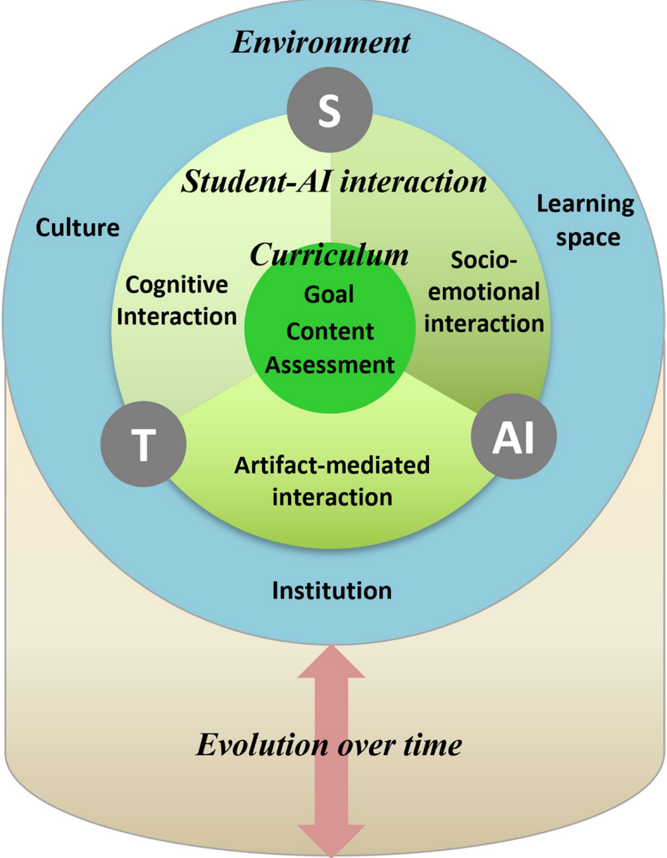
Preparing students to collaborate with AI remains a challenging goal. As AI technologies are new to K-12 schools, there is a lack of studies that inform how to design learning when AI is introduced as a collaborative learning agent to classrooms. The present study, therefore, aimed to explore teachers’ perspectives on what (1) curriculum design, (2) student-AI interaction, and (3) learning environments are required to design student-AI collaboration (SAC) in learning and (4) how SAC would evolve. Through in-depth interviews with 10 Korean leading teachers in AI in Education (AIED), the study found that teachers perceived capacity and subject-matter knowledge building as the optimal learning goals for SAC. SAC can be facilitated through interdisciplinary learning, authentic problem solving, and creative tasks in tandem with process-oriented assessment and collaboration performance assessment. While teachers expressed instruction on AI principles, data literacy, error analysis, AI ethics, and AI experiences in daily life were crucial support, AI needs to offer an instructional scaffolding and possess attributes as a learning mate to enhance student-AI interaction. In addition, teachers highlighted systematic AIED policy, flexible school system, the culture of collaborative learning, and a safe to fail environment are significant. Teachers further anticipated students would develop collaboration with AI through three stages: (1) learn about AI, (2) learn from AI, and (3) learn together. These findings can provide a more holistic understanding of the AIED and implications for the educational policies, educational AI design as well as instructional design that are aimed at enhancing SAC in learning.
Overview
The claims and statistics of this paper haven’t been checked yet.
Free: it reads the open-access text and checks the first 5 claims that cite a source we can check. Create a free account to check every claim.
Integrity signals
Registry
Cites
Statistics
Figures
Verification
Claims the paper makes
The claims and statistics of this paper haven’t been checked yet.
Free: it reads the open-access text and checks the first 5 claims that cite a source we can check. Create a free account to check every claim.
Claims other papers make about this one
Each is checked against this paper’s own text: does it say what the citing paper says it does?
The cited source says what the claim attributes to it.
In the citing paper
“This collaborative process aligns with the vision that AI tools act not just as implementers of human ideas, but as active collaborators in the creative process [7, 23].”
From Scaffolding Creativity: Integrating Generative AI Tools and Real-World Experiences in Business Education (2025) · cites this paper as [7]
The cited source says what the claim attributes to it.
In the citing paper
“Similarly, the positive effects of SI are consistent with prior research indicating that social expectations, peer endorsement, and collective support can shape users’ acceptance of new technologies [61,103,104,105,106].”
In the citing paper
“For many teachers, it may be their first time to use AIED technologies for teaching.They may not have rich experience of using AIED technologies to teach, and they face various challenges such as technological difficulties, communication and collaboration problems when using these novel-to-teacher technologies (Kim et al., 2022).”
From Teachers’ AI digital competencies and twenty-first century skills in the post-pandemic world (2023) · doi:10.1007/s11423-023-10203-6 · cites this paper as Kim et al., 2022
Self-check
Percentages, sums and reported differences re-computed from the paper’s own numbers.
The self-check needs the paper’s full text.
Citations
Cites
Using thematic analysis in psychology
Braun, V., & Clarke, V. (2006) · Qualitative Research in Psychology · doi:10.1191/1478088706qp063oa · Cited by 194,414
Zawacki-Richter, O., Marín, V. I., Bond, M., & Gouverneur, F. (2019) · International Journal of Educational Technology in Higher Education · doi:10.1186/s41239-019-0171-0 · Cited by 7,242 · cited 2×
“In particular, the time and cost of developing and introducing an appropriate methodology for implementing AIED pose a major challenge in public educational institutions (Zawacki-Richter et al., 2019).”
BackgroundIntelligent agents: theory and practice
Wooldridge, M., & Jennings, N. R. (1995) · The Knowledge Engineering Review · doi:10.1017/s0269888900008122 · Cited by 6,810
Hollan, J., Hutchins, E., & Kirsh, D. (2000) · ACM Transactions on Computer-Human Interaction · doi:10.1145/353485.353487 · Cited by 2,300 · cited 1×
“Second, the analysis looks for a range of mechanisms that can partake in the cognitive system rather than restricting itself to symbol manipulation and computation – e.g. the interplay between human memory, external representations, and the manipulation of objects (Hollan et al., 2000, p. 176).”
BackgroundThe evolution of research on collaborative learning
Dillenbourg, P., Baker, M. J., Blaye, A., & O’Malley, C. L. (1995) · HAL · Cited by 2,018
How a Cockpit Remembers Its Speeds
Hutchins, E. (1995) · Cognitive Science · doi:10.1207/s15516709cog1903_1 · Cited by 1,880 · cited 2×
“…an effective framework for a holistic understanding of the complex relations and interactions among heterogeneous agents (i.e., students, AI, and teachers), the multiple existing digital technologies, and practices in the classroom environment (Hutchins, 1995; Perkins, 1993; Nardi & O’Day, 1999).”
BackgroundBarr, V., & Stephenson, C. (2011) · ACM Inroads · doi:10.1145/1929887.1929905 · Cited by 1,692 · cited 1×
“While discussions on CT skills were narrowly positioned within the field of computer science or STEM-related subjects (Barr & Stephenson, 2011; Lee et al., 2020), this study moves CT forward to be extensible and embedded across disciplines.”
BackgroundDemystifying computational thinking
Shute, V. J., Sun, C., & Asbell-Clarke, J. (2017) · Educational Research Review · doi:10.1016/j.edurev.2017.09.003 · Cited by 1,466 · cited 1×
“…improving computational thinking (CT), a set of skills including decomposition, abstraction, algorithm design, debugging, testing/simulation, heuristic reasoning, and generalization, is being accentuated to understand and use AI effectively to solve problems (Shute et al., 2017; NRC, 2010).”
BackgroundAUGMENTING HUMAN INTELLECT: A CONCEPTUAL FRAMEWORK
ENGELBART, D. C. (1962) · doi:10.21236/ad0289565 · Cited by 1,082
New Technology and Digital Worlds: Analyzing Evidence of Equity in Access, Use, and Outcomes
Warschauer, M., & Matuchniak, T. (2010) · Review of Research in Education · doi:10.3102/0091732x09349791 · Cited by 1,047
Research works printed but not linked: 4
- Ai, R., Bhatt, M., Chevrier, S., Ciccarelli, R., Grady, R., Kumari, V., Li, K., Nazarli, N., Rahimi, H., Roberts, J., Sachs, J., Schepmyer, A., Wang, M., & Wong, H. (2008). Choose your own inquiry. , University Press of America.
- Big Innovation Center. (2020). AI in education: Embedding AI tools into teaching curricula. Big Innova- tion Centre.
- Johnson, D. W., & Johnson, R. T. (2006). Cooperation and the use of technology. In D. H. Jonassen (Ed.), Handbook of research on educational communications and technology (2 ed.), (pp. 785-811). , Lawrence Erlbaum Associates.
- Okoye, K., Nganji, J. T., & Hosseini, S. (2020). Learning analytics for educational innovation: A sys- tematic mapping study of early indicators and success factors. International Journal of Computer Information Systems and Industrial Management Applications, 12, 138-154.
Cited by
Items 201–300 of 669
EFFECTIVE USE OF ARTIFICIAL INTELLIGENCE TOOLS IN STEM EDUCATION: PERSPECTIVES OF STEM EDUCATORS
Uyar, A. (2025) · Journal of Baltic Science Education · doi:10.33225/jbse/25.24.552 · Cited by 10
Lin, X., Zheng, L., Du, L., Lin, X., Mao, Y., Jiang, H., Wang, S., Yuan, C., Zhong, W. H., & Yu, Z. (2025) · Energy and AI · doi:10.1016/j.egyai.2025.100610 · Cited by 10
Reicho, M., Otrel-Cass, K., Ebner, M., Brünner, B., Freinhofer, D., & Jahić, I. (2026) · International Journal of Educational Technology in Higher Education · doi:10.1186/s41239-026-00596-8 · Cited by 24
“…as social and communicative, emphasising collaboration and the ability to explain AI-related work to diverse stakeholders (Cardon et al., 2024; Kim et al., 2022), or as drivers of innovation and performance, highlighting creativity, idea generation, and problem solving (Ciolacu et al., 2024;…”
Designing Language Learning Experiences With Generative AI Tools
Czerkawski, B. C. (2024) · Advances in educational technologies and instructional design book series · doi:10.4018/979-8-3693-0872-1.ch015 · Cited by 9
Wangsa, K., Sandu, N., Karim, S., Elkhodr, M., & Gide, E. (2024) · International Conference on Information Technology Based Higher Education and Training (ITHET) · doi:10.1109/ithet61869.2024.10837608 · Cited by 11
“Since more education institutions require teachers to teach AI, it is now up to teachers’ readiness to manage and deliver a successful learning experience [24], [25], [26], [27].”
Sholeh, M. I. (2025) · Advances in computational intelligence and robotics book series · doi:10.4018/979-8-3693-7260-9.ch002 · Cited by 9
Question Making Training with LOTS, MOTS, and HOTS Cognitive Levels for High School Teachers
Pisriwati, S. A., Siswanto, D. H., Hardi, Y., & Alghiffari, E. K. (2024) · Journal of Social and Community Development · doi:10.56741/jscd.v1i01.666 · Cited by 19
Outamgharte, B., Yeou, M., & Zyad, H. (2025) · Reflective Practice · doi:10.1080/14623943.2025.2494319 · Cited by 12
“While the augmentation perspective calls for finding ways to improve learning through teacher-AI collaboration (TAC) (Cukurova et al., 2019; Mavrikis et al., 2021), the replacement perspective argues for allowing AI to take over and substitute teachers (Kim et al., 2022; Siemon et al., 2019).”
Judson, H. (2025) · Teaching Sociology · doi:10.1177/0092055x251342530 · Cited by 10
“This scholarship argues that genAI in the classroom is unavoidable and that instructors need to promote AI literacy in their classrooms alongside other skills, for example, through curriculum design or student-AI interaction (Kim, Lee, and Cho 2022; Long and Magerko 2020).”
Exploring Generative AI as Part of the Design and Creative Process
Wagler, A. (2025) · Journal of Advertising Education · doi:10.1177/10980482251347510 · Cited by 12
“A collaborative learning environment creates a safe-to-fail space that signi fi cantly supports learning about AI together (Kim et al., 2022).”
Eğitimde Yapay Zekâ Çalışmalarında Öğretmenlerin Rolü ve Bakış Açıları
Yurtsever, M., & Yurtsever, G. G. (2025) · Cumhuriyet International Journal of Education · doi:10.30703/cije.1453360 · Cited by 9
Analysing EFL Teachers’ Perceptions of AI’s Role in Academic Integrity and Pedagogy with BERT-LSTM
Praveen, R., Irudayasamy, J., Garlapati, B. S., Nithyasri, S., John, A., & Praveena, S. (2025) · Global Conference in Emerging Technology (GINOTECH) · doi:10.1109/ginotech63460.2025.11076689 · Cited by 9
“The study examines student-AI collaboration, identifying instructional design, interaction, and learning environments as critical aspects, derived from interviews with educators [9].”
ChatGPT as a Virtual Peer: Enhancing Critical Thinking in Flipped Veterinary Anatomy Education
Martín‐Alguacil, N., Avedillo, L., Mota-Blanco, R. A., Marañón-Almendros, M., & Gallego-Agúndez, M. (2025) · International Medical Education · doi:10.3390/ime4030034 · Cited by 12
“To ensure the meaningful and responsible implementation of AI in education, institutions must invest in faculty development, digital infrastructure, and ethical guidelines [54,55].”
Li, H., & Thien, L. M. (2025) · Asian Education and Development Studies · doi:10.1108/aeds-02-2025-0088 · Cited by 10
Yuan, G. (2025) · Simulation & Gaming · doi:10.1177/10468781251377585 · Cited by 10
“AI-driven adaptive learning systems have attracted attention in education research for their ability to deliver personalized instruction at scale (Kim et al., 2022).”
Li, X., Tang, X., Zheng, X., Huang, Y., & Tu, Y. (2025) · International Journal of Technology and Design Education · doi:10.1007/s10798-025-10034-x · Cited by 11
“Students felt empowered to co‑construct knowledge with faculty and classmates, confirming Kim et al.’s ( 2022) insights on collaborative learning and extending them into an AI-mediated context.”
Alkubaisi, M. (2025) · Discover Artificial Intelligence · doi:10.1007/s44163-025-00522-3 · Cited by 17
“Researchers argued that preparing students and teachers alike to be able to integrate these promising tools is still an existing challenge [19].”
Ali, M., Ma, M., Muneeb, M., & Wong, G. K. W. (2025) · Metrics · doi:10.3390/metrics2040023 · Cited by 6
Ziying, L., Yongchun, H., & Qiaoping, Z. (2026) · Computers and Education Open · doi:10.1016/j.caeo.2026.100330 · Cited by 17
Rahman, M. I. (2026) · Nurse Education in Practice · doi:10.1016/j.nepr.2026.104756 · Cited by 13
Ding, N., Hu, L., Kim, K.-T., & Chen, M. (2026) · Sustainability · doi:10.3390/su18041775 · Cited by 12
Moussa, M. K. (2024) · Studies in big data · doi:10.1007/978-3-031-52280-2_30 · Cited by 6
AI and Personalised Grading Criteria
Ahmed, S., Zaki, A., & Bentley, Y. (2024) · Advances in Educational Technologies and Instructional Design · doi:10.4018/979-8-3693-2145-4.ch004 · Cited by 6
Soledad, M., Oliva-Córdova, L. M., & Patiño, A. (2024) · Lecture notes in educational technology · doi:10.1007/978-981-97-1814-6_16 · Cited by 14
Suggestion of the Course Design Methods for AI-integrated Education
Heo, H., & Kang, S. (2024) · The Journal of Korean Association of Computer Education · doi:10.32431/kace.2024.27.1.006 · Cited by 6
Liow, M. L. S. (2024) · Advances in educational technologies and instructional design book series · doi:10.4018/979-8-3693-8252-3.ch008 · Cited by 10
Breideband, T., Bush, J. B., Reitman, J. G., Rose, S., Weatherley, J., Penuel, W. R., & D’Mello, S. K. (2025) · International Journal of Artificial Intelligence in Education · doi:10.1007/s40593-025-00509-2 · Cited by 5
“It is important to distinguish between the more commonly investigated tools that support collaboration to learn (Kim et al., 2022; MacNeil et al., 2019; Sam-rose et al., 2021; Tan et al., 2022) in which there is automation of sub-tasks (e.g., automated summaries of team conversations, task list…”
Integrating AI and Sustainability In Education: A New Paradigm for Modern Literacy
Asrifan, A., Khristianto, K., Aini, N. L., & Wahira, W. (2025) · Advances in computational intelligence and robotics book series · doi:10.4018/979-8-3373-0725-1.ch002 · Cited by 8
AI constructs gendered struggle narratives: Implications for self-concept and systems design.
Fitzsimons, A., Gerber, E. M., & Long, D. (2025) · ACM Conference on Fairness, Accountability, and Transparency (FAccT) · doi:10.1145/3715275.3732156 · Cited by 10
Türközü, T., & Dinçer, S. (2025) · Discover Education · doi:10.1007/s44217-025-00823-w · Cited by 15
“For instance, in South Korea, teachers are equipped with the skills to integrate artificial intelligence and gamification into lesson planning, thereby supporting adaptive and personalized learning processes [74, 75].”
Daryanto, T., Stil, S., Ding, X., Manesh, D., Lee, S. W., Lee, T., Lunn, S. J., Rodriguez, S. L., Brown, C., & Rho, E. H. R. (2025) · IEEE Symposium on Visual Languages and Human-Centric Computing (VL/HCC) · doi:10.1109/vl-hcc65237.2025.00029 · Cited by 7
“One potential direction could be leveraging human-AI collaboration that leverages the potential of both humans and AI [96], [97].”
Augmenting Intelligence With Generative AI: A Guide for Teaching Talented Students
Doyle, S. (2023) · Advances in educational technologies and instructional design book series · doi:10.4018/978-1-6684-5806-8.ch006 · Cited by 7
Academic Use of Artificial Intelligence Tools by University Students
Ibieta, A., Aguilera, S. G., Constanza-Medina, M., Ignacia-Sepúlveda, M., & Castellanos-Alvarenga, L. M. (2025) · Communications in computer and information science · doi:10.1007/978-3-031-95627-0_23 · Cited by 6
Integrating AI-generated art styles into traditional illustration design teaching course
Tang, Y. F., & Leong, W. Y. (2025) · Eurasia Journal of Mathematics Science and Technology Education · doi:10.29333/ejmste/16602 · Cited by 10
“By off-loading repetitive tasks to AI, designers can focus on creativity, allowing traditional cultural elements to be revitalized in contemporary works that remain rooted in heritage while aligning with modern aesthetics (Kim et al., 2022).”
Siricharoen, W. V. (2023) · Lecture notes in educational technology · doi:10.1007/978-981-99-5961-7_27 · Cited by 8
Vocational Technology Education Innovation: Building a Generation of Experts in the Digital Age
Rama, A., Ambiyar, A., Lapisa, R., & Verawardina, U. (2024) · Jurnal EDUCATIO Jurnal Pendidikan Indonesia · doi:10.29210/1202323361 · Cited by 13
Challenges of Artificial Intelligence in Design Education
Tien, Y.-T., & Chen, R. (2024) · International Conference on e-Education, e-Business, e-Management and e-Learning · doi:10.1145/3670013.3670044 · Cited by 14
Yingsoon, G. Y., Zhang, S., & Chua, N. A. (2024) · Advances in educational technologies and instructional design book series · doi:10.4018/979-8-3373-1017-6.ch001 · Cited by 9
AI-enhanced professional learning communities: a new era of personalized teacher education
Arefian, M. H. (2026) · Cogent Education · doi:10.1080/2331186x.2026.2626629 · Cited by 5
From Potential to Peril: Evaluating AI and the Metaverse in Modern Research
Al‐Romeedy, B. S., Hussein, H., Emam, M. E., & Singh, A. (2025) · Advances in computational intelligence and robotics book series · doi:10.4018/979-8-3373-0340-6.ch027 · Cited by 4
Gao, E., Liu, Y., Zhou, Y., Guo, J., & Chen, Z. (2025) · International Journal of Human-Computer Studies · doi:10.1016/j.ijhcs.2025.103551 · Cited by 5
Demir, A. N., & Zaimoğlu, S. (2025) · Bayburt Eğitim Fakültesi Dergisi · doi:10.35675/befdergi.1647707 · Cited by 8
Desperately Seeking Advertising Creativity: AI’s Impact
Habib, S. (2025) · Journal of Advertising Education · doi:10.1177/10980482251359224 · Cited by 6
“In addition, ethical training has increasingly been embedded into these frameworks, re fl ecting concerns that AI-driven models sometimes rely on datasets prone to cultural or algorithmic biases (Kim et al., 2022).”
InfluentialGnedykh, D., Bordovskaia, N. V., Кошкина, Е., Posokhova, S. T., Khromova, M. A., & Iskhakova, M. P. (2025) · The Education and science journal · doi:10.17853/1994-5639-2025-8-9-34 · Cited by 8
Factors of AI Adoption in Educational Contexts: A Meta-Analytic Synthesis Through the UTAUT
Zhuang, Y., Li, R., & Duan, S. (2025) · International Conference on Distance Education and Learning (ICDEL) · doi:10.1109/icdel65868.2025.11193611 · Cited by 7
“Although the use of AI in education has always been a focus of academic research and studies have looked at various scenarios where learning occurs [2], it seems that the realization of collaboration with AI in educational practice is still not ready [3].”
The challenges encountered by preschool and primary educators in implementing educational robotics
Gavrilas, L., Kotsis, K. Τ., & Papanikolaou, M.-S. (2025) · Research in Science & Technological Education · doi:10.1080/02635143.2025.2578308 · Cited by 6
Jin, Q., & Yuan, Y. (2025) · International Journal of Child-Computer Interaction · doi:10.1016/j.ijcci.2025.100787 · Cited by 9
Big data analytics in e-learning: ethical challenges and opportunities for engineering education
Dritsas, E., & Τρίγκα, Μ. (2025) · AI and Ethics · doi:10.1007/s43681-025-00866-7 · Cited by 8
“Embedding explainability into the design of edu - cational analytics not only promotes ethical alignment but also enhances the pedagogical value of data-driven tools [41].”
Guo, K., Zhang, J., & Ansari, H. W. A. (2025) · Acta Psychologica · doi:10.1016/j.actpsy.2025.105977 · Cited by 12
Yang, C., Hou, S., Zhao, M., Yan, J., & Chen, J. (2025) · Artificial Intelligence in Education · doi:10.1108/aiie-05-2025-0087 · Cited by 8
Kellam, H., & Cortés, L. E. P. (2026) · AI & Society · doi:10.1007/s00146-026-02881-6 · Cited by 4
Engineering Human–AI Leadership for School Equity
Ismail, M. A. (2026) · Advances in computational intelligence and robotics book series · doi:10.4018/979-8-2600-0388-6.ch003 · Cited by 4
Developing and Validating a University Language Teacher Belief Scale for AI-Assisted Instruction
Wang, X., Gao, Y., & Reynolds, B. L. (2026) · Language Teaching Research · doi:10.1177/13621688261478927 · Cited by 6
Through a Teacher’s Lens: Combating Bias in AI-Powered Education for a Just Future
Poornesh, M. (2024) · The Clearing House A Journal of Educational Strategies Issues and Ideas · doi:10.1080/00098655.2024.2393153 · Cited by 8
“By promoting open communication and collaboration, we can effectively utilize AI as a powerful tool to personalize learning experiences and empower all students to achieve their maximum potential (Kim, Lee, and Cho 2022; Zhang and Aslan 2021).”
Jumaera, S., Blessing, O. T., & Rukondo, N. (2024) · Journal of Chemical Learning Innovation. · doi:10.37251/jocli.v1i2.1147 · Cited by 24
“This model is believed to be able to solve problems experienced by students, because the problem solving learning model is designed to increase students' sense of responsibility for their own learning (practicing questions, working on questions) and also the learning of others [27]-[29].”
Esfandiari, R., & Allaf-Akbary, O. (2025) · Innoeduca International Journal of Technology and Educational Innovation · doi:10.24310/ijtei.111.2025.20896 · Cited by 11
“Rajab Esfandiari & Omid Allaf-Akbary students connect AI knowledge with their field-specific learning, fostering a comprehensive understanding of AI’s impact and developing critical evaluation skills (Kim et al., 2022).”
Alanazi, A. S., Alqazlan, S., Rayan, A., & Benlaria, H. (2025) · Education and Information Technologies · doi:10.1007/s10639-025-13696-1 · Cited by 5
Liang, Y., Jin, S., Chen, T., & Li, N. (2025) · Innovation in Language Learning and Teaching · doi:10.1080/17501229.2025.2565289 · Cited by 6
“According to Kim, Lee, and Cho (2022), AI distinguishes itself from other technologies by functioning as adaptive agents within classrooms, and thus how to strategically implement AI in education is the most-in-demand by teachers.”
Jiang, H., & Liu, Y. (2026) · Thinking Skills and Creativity · doi:10.1016/j.tsc.2026.102216 · Cited by 6
THE LEARNING ENVIRONMENT OF A FAR-FLUNG NATIONAL HIGH SCHOOL: STAKEHOLDERS’ PERSPECTIVE
Alcontin, P. C. S., & Concepcion, K. M. D. (2024) · European Journal of Education Studies · doi:10.46827/ejes.v11i2.5213 · Cited by 5
Kaplan, O. (2024) · Adıyaman Üniversitesi Eğitim Bilimleri Dergisi · doi:10.17984/adyuebd.1463794 · Cited by 10
A Review Analysis on Using "AIED" to Improve Student Engagement in Hybrid Education
Joseph, S., Tahir, A., Bibi, F., Hamid, K., Iqbal, M. W., Ruk, S. A., & Ahmad, S. Z. (2024) · Bulletin of Business and Economics (BBE) · doi:10.61506/01.00348 · Cited by 18
Heil, J., Delcker, J., Ifenthaler, D., Seufert, S., & Spirgi, L. (2024) · Informatik-Spektrum · doi:10.1007/s00287-024-01570-2 · Cited by 7
TutorCraftEase: Enhancing Pedagogical Question Creation with Large Language Models
Kang, W., Zhang, L., Peng, X., Zhang, H., Li, A., Wang, M., Huang, J., Tian, F., & Dai, G. (2025) · CHI Conference on Human Factors in Computing Systems · doi:10.1145/3706598.3713731 · Cited by 13
“Therefore, metrics of creative achievement [38, 52], ownership [103], quality [69, 70], controllability [87], collaboration [44, 52] are also included to provide a more comprehensive evaluation.”
Enhancing Student Engagement With Generative AI
Kim, J. H., Moldavan, A. M., Terry, R., & Massey, C. C. (2025) · Advances in computational intelligence and robotics book series · doi:10.4018/979-8-3693-8744-3.ch004 · Cited by 4
Self-citationResearch on the Impact of Artificial Intelligence on the Development of Education
Dong, Z. (2023) · Lecture Notes in Education Psychology and Public Media · doi:10.54254/2753-7048/28/20231364 · Cited by 6
A Theoretical Framework of Student Agency in AI-Assisted Learning: A Grounded Theory Approach
Dai, Y., & Lai, S. (2025) · Oxford University Press eBooks · doi:10.1093/9780198945253.003.0009 · Cited by 6
Ko, E. G., & Hughes, J. E. (2026) · Computers and Education: Artificial Intelligence · doi:10.1016/j.caeai.2026.100560 · Cited by 3
Artificial Intelligence as a Harbinger of Engagement and Collaboration
Ouariach, S., Ouariach, F. Z., & Khaldi, M. (2025) · Advances in educational technologies and instructional design book series · doi:10.4018/979-8-3373-2262-9.ch006 · Cited by 6
Suripah, Retnawati, H., Zetriuslita, Zafrullah, Z., & Hidayat, R. (2025) · International Journal of Cognitive Research in Science Engineering and Education · doi:10.23947/2334-8496-2025-13-1-97-116 · Cited by 13
Whitty, M. T. (2025) · Electronics · doi:10.3390/electronics14204104 · Cited by 6
The implications of artificial intelligence usage on management students’ academic productivity
Idrissi, I. E., & Alami, Y. (2025) · Artificial Intelligence in Education · doi:10.1108/aiie-05-2025-0103 · Cited by 7
Enhancing collaborative learning through AI-powered feedback systems
Qi, X., Zhou, J. J., Dong, Y., & Chen, F. (2025) · International Journal of Data Science and Analytics · doi:10.1007/s41060-025-00882-0 · Cited by 7
“Furthermore, Kim and Jeong [7] explore educators’ perspectives on designing student–AI collaboration.”
Symbiotic learning: developing multiliteracies in human-AI collaboration
Wang, F.-Y., & Lee, S.-Y. (2025) · Pedagogies An International Journal · doi:10.1080/1554480x.2025.2606234 · Cited by 7
“Tools like Windows Movie Maker, iMovie, and PowerPoint to integrate images, narration, and background music have been utilized before GenAI to craft narratives with elevated ideation, content development, and multimodal integration (Kim et al., 2022; Liang & Lim, 2021).”
Nyale, D., Karume, S., Kipkebut, A. K., Mukudi, F., & Sharafat, A. (2026) · Discover Education · doi:10.1007/s44217-026-01180-y · Cited by 5
“This challenge is particularly amenable to Artificial Intelligence (AI) intervention due to AI's capacity for processing vast datasets, identifying complex patterns, and facilitating continuous adaptation [4, 11, 21, 22].”
Namaziandost, E., & Hwang, G.-J. (2026) · Computers & Education X Reality · doi:10.1016/j.cexr.2026.100138 · Cited by 8
Bali, B. (2026) · Next research. · doi:10.1016/j.nexres.2026.101570 · Cited by 12
Luo, J., Qu, L., Wang, M., & Li, H. (2026) · Interactive Learning Environments · doi:10.1080/10494820.2026.2642871 · Cited by 5
“Research has highlighted that teachers play a pivotal role in designing students’ meaningful GenAI interactions and ensuring GenAI’s ethical uses (Casal-Otero et al., 2023; Kim et al., 2022; Park et al., 2023; Xu & Ouyang, 2022).”
Yin, J., Yuan, T., Zhang, Y., Yang, G., & Wang, X. (2026) · Frontiers in Psychology · doi:10.3389/fpsyg.2026.1735465 · Cited by 5
Investigating pre-service teachers’ AI literacy for ELL instruction: A mixed-methods study
Kushki, A., Garcia, A., Lowell, V. L., & Wright, W. E. (2026) · Language Teaching Research · doi:10.1177/13621688261426620 · Cited by 6
Adult learners’ perspectives of AI applications in supporting andragogy
Kim, J., Lin, X., Yu, S., & Detrick, R. (2026) · Educational Technology Research and Development · doi:10.1007/s11423-026-10621-2 · Cited by 5
“Studies suggested that interpretable AI interfaces significantly enhance learners’ ability to critically evaluate AI-generated outputs and adjust their learning strategies accordingly (Kim et al., 2022, 2025b).”
Self-citationSong, F., & Xu, B. (2026) · Frontiers in Psychology · doi:10.3389/fpsyg.2026.1847432 · Cited by 9
“This result supports earlier study that AI systems should be provided instructional scaffolding and possess the key attributes of a learning partner in order to strengthen the interaction between students and AI (Kim et al., 2022).”
Sun, H. (2026) · Frontiers in Psychology · doi:10.3389/fpsyg.2026.1919875 · Cited by 4
“…learning, where self-regulated practice is central and feedback is closely tied to deliberate, cyclical work on technique (Hatfield et al., 2016; Miksza et al., 2018; Nielsen, 2015), and where AI applications are increasingly positioned to support that practice (Jin et al., 2023; Kim et al., 2022).”
Gamification in Education in the Age of Artificial Intelligence
Samur, Y., & Cömert, Z. (2024) · Advances in educational marketing, administration, and leadership book series · doi:10.4018/979-8-3693-4119-3.ch011 · Cited by 3
Teacher’s Perceptions of Applying Artificial Intelligence in Education: A Systematic Review
Zhou, C. (2024) · World Journal of Social Science Research · doi:10.22158/wjssr.v11n3p62 · Cited by 7
Application of AI in Literature: A Study on Evolution of Stories and Novels
Selvi, V. T., & Ramya, P. (2024) · Recent Research Reviews Journal · doi:10.36548/rrrj.2024.2.003 · Cited by 3
“Moreover, the use of AI-generated content in education has been explored, with Kim (2020) discussing the potential benefits and drawbacks of using AI-generated content in educational settings [10].”
Kuzmenko, H., Konovalova, O., Sotska, H. I., Ковальчук, О. В., Melenets, L. I., & Ситник, І. В. (2024) · WSEAS Transactions on Information Science and Applications archive · doi:10.37394/23209.2024.21.41 · Cited by 3
Assessing the Extent of AI Implementations in Arabic L2 Courses
El-Zeiny, M. E., Alwaely, S. A., Aburezeq, I. M., AlKhaza’leh, M. S., Aqtash, S. K. A., & Abdo, N. F. (2024) · International Conference on Intelligent Data Science Technologies and Applications (IDSTA) · doi:10.1109/idsta62194.2024.10746992 · Cited by 4
“Despite challenges related to cultural nuances and data quality, successful implementations in other language contexts provide valuable insights for Arabic L2 education [14].”
BackgroundZhang, X., Zhang, J., & Oubibi, M. (2025) · Journal of Academic Ethics · doi:10.1007/s10805-025-09622-2 · Cited by 13
“In summary, to regulate college students’ ethical AI behavior, it is necessary to play the role of teachers as “gatekeepers” and effectively supervise the learning process of students (Kim et al., 2022).”
AI artifacts in the mathematics didactical tetrahedron: A developed model
Mani, J. P., & Zargeh, C. (2025) · Eurasia Journal of Mathematics Science and Technology Education · doi:10.29333/ejmste/16307 · Cited by 9
“In this regard, the pioneering research conducted by Kim et al. (2022) sheds a light on the potential role of educational AI in enabling students to become autonomous learners by externalizing their ideas, thereby enhancing their learning experiences and self-efficacy.”
InfluentialAlcruz, J., & Schroeder, M. K. (2025) · Theory Into Practice · doi:10.1080/00405841.2025.2528542 · Cited by 5
“Modeling AI’s proper use can also enhance students’ writing abilities, especially when it comes to content organization and scaffolding (Kim et al., 2022).”
A proposal to include Maori perspectives in AIed
Koh, J., & Tuazon, G. F. (2023) · ASCILITE Publications · doi:10.14742/apubs.2023.498 · Cited by 2
“This model is informed by the Student-AI collaboration model (Kim et al., 2022) and underpinned by Te Whare Tapa Whā.”
MethodEmerging Paradigms: Student Perspectives on the Integration of Artificial Intelligence in Education
Dubey, P., Thakur, A., Akhter, P., Bhagat, P. N., Moon, S., & Kakde, P. R. (2023) · International Conference on Advances in Electronics Computers and Communications · doi:10.1109/icaecc59324.2023.10560152 · Cited by 5
Exploring ChatGPT's Role in English Learning for EFL Students: Insights and Experiences
Barabad, M. G., & Anwar, M. B. (2024) · International Journal of Innovative Science and Research Technology (IJISRT) · doi:10.38124/ijisrt/ijisrt24sep347 · Cited by 9
“Suggestions for using natural language processing and peer feedback in digital settings (Bauer et al., 2023) and investigating student-AI collaboration (Kim et al., 2022) reflect progressive strategies for curriculum development.”
Amin, M. R. M., Sivakumaran, V. M., Gan, K. H., Darmaraj, S. R., Hoo, W. C., & Yew, L. K. (2024) · Advances in educational marketing, administration, and leadership book series · doi:10.4018/979-8-3693-6351-5.ch009 · Cited by 3
Using Artificial Intelligence in Arabic Learning: Opportunities and Challenges
Azwir, A., Zulkhairi, Z., Zulhelmi, Z., Yasir, M., & Rahmi, M. (2024) · EL-MAQALAH Journal of Arabic Language Teaching and Linguistics · doi:10.22373/maqalah.v5i2.6219 · Cited by 15
Uso de analítica de aprendizaje para mejorar la toma de decisiones pedagógicas
Vaca, A. M. V., Vega, J. G. B., Alvarez, S. M. Q., Barros, T. I. C., Nastul, K. M. V., & Porras, J. M. C. (2025) · South Florida Journal of Development · doi:10.46932/sfjdv6n1-011 · Cited by 6
A Scoping Review of AI Literacy for Teachers
Tang, W. K.-W., & Zhang, A. (2025) · Lecture notes in educational technology · doi:10.1007/978-981-96-8931-6_26 · Cited by 5
Methodology and Framework for AI-Based Solutions for Special Education
Meshram, V. A., Kumar, S. D., Meshram, V. V., Patil, V., Patil, K. R., Bewoor, L., & Gawande, P. G. (2023) · Advances in educational technologies and instructional design book series · doi:10.4018/979-8-3693-0378-8.ch002 · Cited by 3
Zaidi, S. F. A., Ullah, N., Kamran, M., & Urooj, J. (2023) · EDUCATIONAL RESEARCH AND INNOVATION · doi:10.61866/eri.v3i2.69 · Cited by 6
Metadata
- Authors
- Kim, J., Lee, H., & Cho, Y. H.
- Affiliations
- Seoul National University (KR)
- Corresponding author
- Cho, Young Hoan
- Venue
- Education and Information Technologies
- Published
- 2022-01-28
- Volume
- 27
- Issue
- 5
- Pages
- 6069-6104
- ISSN
- 1360-2357 (ISSN-L)
- 1573-7608
- OpenAlex
- W4221079197
- Cited by
- 669
- References
- 66
- Citations by year
- 2026: 206 · 2025: 247 · 2024: 158 · 2023: 51 · 2022: 6
- FWCI
- 114.37
- Type
- journal article
- Language
- en
- Open access
- hybrid
- doi.org
- Licence
- cc-by
- creativecommons.org/licenses/by/4.0 (tdm)
- creativecommons.org/licenses/by/4.0 (vor)
- Locations
- Education and Information Technologies (publishedVersion, cc-by)
- Seoul National University Open Repository (Seoul National University) (submittedVersion)
- Topics
- Social Sciences › Education › Artificial Intelligence in Education
- Physical Sciences › Computer Science › Artificial Intelligence › Intelligent Tutoring Systems and Adaptive Learning
- Social Sciences › Psychology › Developmental and Educational Psychology › Innovative Teaching and Learning Methods
- Keywords
- learning design, artificial intelligence in education, teacher perceptions, curriculum development, student-AI interaction, learning environment, interdisciplinary learning, authentic problem solving, process-oriented assessment, data literacy, AI ethics, instructional scaffolding, collaborative learning culture, K-12 education
About these checks
Registry, retraction, Cites and statistics results are computed, not judged, with one exception: a printed reference that no index lists is read once by a model before it counts as a citation error. Claims are extracted by a model and kept only when their quote appears verbatim in the text; each cited source is then checked, with a model’s help, for whether it says what the claim relies on. Those verdicts can be wrong — read the claim’s quote and the cited source before relying on one.
Statistics and arithmetic are recomputed, not judged.
Confidence bands are shown only for fields calibrated on our annotated test set. None is calibrated yet, so no band is shown.
What counts as a claim ›How we measure confidence ›How we check this ›
Are you an author, or do you see a problem with this page? Request a review
Data sources
Bibliographic data: Semantic Scholar, OpenAlex, Crossref.
Contains information from the Semantic Scholar Academic Graph Datasets, made available under the ODC Attribution License (ODC-BY 1.0).
Semantic Scholar’s data is described in: Kinney, R., et al. (2023). The Semantic Scholar Open Data Platform. arXiv:2301.10140.
