

Learning design to support student-AI collaboration: perspectives of leading teachers for AI in education
Open accessThe DOI matches its Crossref record; 68 of the 68 references it cites were found in a registry or an index.
Abstract
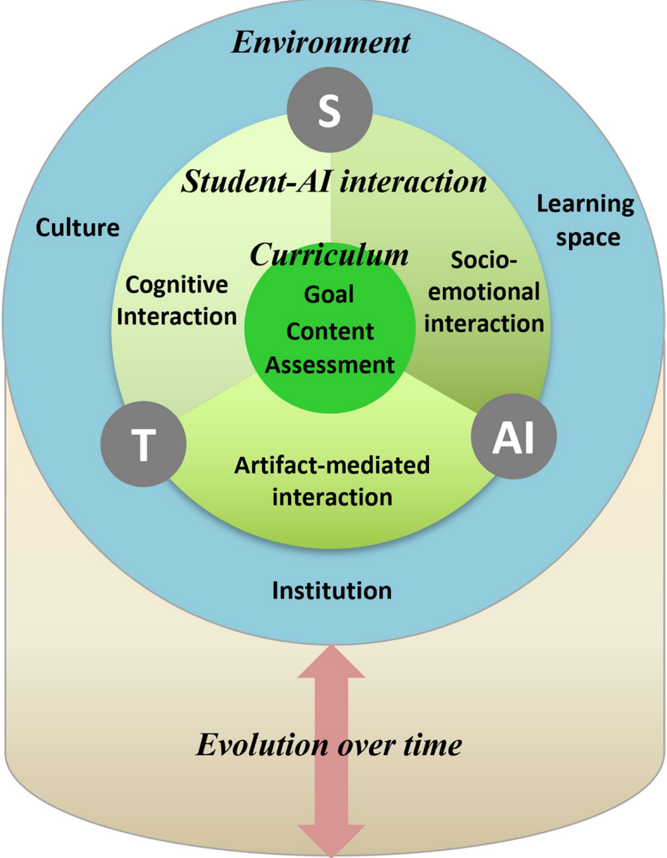
Preparing students to collaborate with AI remains a challenging goal. As AI technologies are new to K-12 schools, there is a lack of studies that inform how to design learning when AI is introduced as a collaborative learning agent to classrooms. The present study, therefore, aimed to explore teachers’ perspectives on what (1) curriculum design, (2) student-AI interaction, and (3) learning environments are required to design student-AI collaboration (SAC) in learning and (4) how SAC would evolve. Through in-depth interviews with 10 Korean leading teachers in AI in Education (AIED), the study found that teachers perceived capacity and subject-matter knowledge building as the optimal learning goals for SAC. SAC can be facilitated through interdisciplinary learning, authentic problem solving, and creative tasks in tandem with process-oriented assessment and collaboration performance assessment. While teachers expressed instruction on AI principles, data literacy, error analysis, AI ethics, and AI experiences in daily life were crucial support, AI needs to offer an instructional scaffolding and possess attributes as a learning mate to enhance student-AI interaction. In addition, teachers highlighted systematic AIED policy, flexible school system, the culture of collaborative learning, and a safe to fail environment are significant. Teachers further anticipated students would develop collaboration with AI through three stages: (1) learn about AI, (2) learn from AI, and (3) learn together. These findings can provide a more holistic understanding of the AIED and implications for the educational policies, educational AI design as well as instructional design that are aimed at enhancing SAC in learning.
Overview
The claims and statistics of this paper haven’t been checked yet.
Free: it reads the open-access text and checks the first 5 claims that cite a source we can check. Create a free account to check every claim.
Integrity signals
Registry
Cites
Statistics
Figures
Verification
Claims the paper makes
The claims and statistics of this paper haven’t been checked yet.
Free: it reads the open-access text and checks the first 5 claims that cite a source we can check. Create a free account to check every claim.
Claims other papers make about this one
Each is checked against this paper’s own text: does it say what the citing paper says it does?
The cited source says what the claim attributes to it.
In the citing paper
“This collaborative process aligns with the vision that AI tools act not just as implementers of human ideas, but as active collaborators in the creative process [7, 23].”
From Scaffolding Creativity: Integrating Generative AI Tools and Real-World Experiences in Business Education (2025) · cites this paper as [7]
The cited source says what the claim attributes to it.
In the citing paper
“Similarly, the positive effects of SI are consistent with prior research indicating that social expectations, peer endorsement, and collective support can shape users’ acceptance of new technologies [61,103,104,105,106].”
In the citing paper
“For many teachers, it may be their first time to use AIED technologies for teaching.They may not have rich experience of using AIED technologies to teach, and they face various challenges such as technological difficulties, communication and collaboration problems when using these novel-to-teacher technologies (Kim et al., 2022).”
From Teachers’ AI digital competencies and twenty-first century skills in the post-pandemic world (2023) · doi:10.1007/s11423-023-10203-6 · cites this paper as Kim et al., 2022
Self-check
Percentages, sums and reported differences re-computed from the paper’s own numbers.
The self-check needs the paper’s full text.
Citations
Cites
Using thematic analysis in psychology
Braun, V., & Clarke, V. (2006) · Qualitative Research in Psychology · doi:10.1191/1478088706qp063oa · Cited by 194,414
Zawacki-Richter, O., Marín, V. I., Bond, M., & Gouverneur, F. (2019) · International Journal of Educational Technology in Higher Education · doi:10.1186/s41239-019-0171-0 · Cited by 7,242 · cited 2×
“In particular, the time and cost of developing and introducing an appropriate methodology for implementing AIED pose a major challenge in public educational institutions (Zawacki-Richter et al., 2019).”
BackgroundIntelligent agents: theory and practice
Wooldridge, M., & Jennings, N. R. (1995) · The Knowledge Engineering Review · doi:10.1017/s0269888900008122 · Cited by 6,810
Hollan, J., Hutchins, E., & Kirsh, D. (2000) · ACM Transactions on Computer-Human Interaction · doi:10.1145/353485.353487 · Cited by 2,300 · cited 1×
“Second, the analysis looks for a range of mechanisms that can partake in the cognitive system rather than restricting itself to symbol manipulation and computation – e.g. the interplay between human memory, external representations, and the manipulation of objects (Hollan et al., 2000, p. 176).”
BackgroundThe evolution of research on collaborative learning
Dillenbourg, P., Baker, M. J., Blaye, A., & O’Malley, C. L. (1995) · HAL · Cited by 2,018
How a Cockpit Remembers Its Speeds
Hutchins, E. (1995) · Cognitive Science · doi:10.1207/s15516709cog1903_1 · Cited by 1,880 · cited 2×
“…an effective framework for a holistic understanding of the complex relations and interactions among heterogeneous agents (i.e., students, AI, and teachers), the multiple existing digital technologies, and practices in the classroom environment (Hutchins, 1995; Perkins, 1993; Nardi & O’Day, 1999).”
BackgroundBarr, V., & Stephenson, C. (2011) · ACM Inroads · doi:10.1145/1929887.1929905 · Cited by 1,692 · cited 1×
“While discussions on CT skills were narrowly positioned within the field of computer science or STEM-related subjects (Barr & Stephenson, 2011; Lee et al., 2020), this study moves CT forward to be extensible and embedded across disciplines.”
BackgroundDemystifying computational thinking
Shute, V. J., Sun, C., & Asbell-Clarke, J. (2017) · Educational Research Review · doi:10.1016/j.edurev.2017.09.003 · Cited by 1,466 · cited 1×
“…improving computational thinking (CT), a set of skills including decomposition, abstraction, algorithm design, debugging, testing/simulation, heuristic reasoning, and generalization, is being accentuated to understand and use AI effectively to solve problems (Shute et al., 2017; NRC, 2010).”
BackgroundAUGMENTING HUMAN INTELLECT: A CONCEPTUAL FRAMEWORK
ENGELBART, D. C. (1962) · doi:10.21236/ad0289565 · Cited by 1,082
New Technology and Digital Worlds: Analyzing Evidence of Equity in Access, Use, and Outcomes
Warschauer, M., & Matuchniak, T. (2010) · Review of Research in Education · doi:10.3102/0091732x09349791 · Cited by 1,047
Research works printed but not linked: 4
- Ai, R., Bhatt, M., Chevrier, S., Ciccarelli, R., Grady, R., Kumari, V., Li, K., Nazarli, N., Rahimi, H., Roberts, J., Sachs, J., Schepmyer, A., Wang, M., & Wong, H. (2008). Choose your own inquiry. , University Press of America.
- Big Innovation Center. (2020). AI in education: Embedding AI tools into teaching curricula. Big Innova- tion Centre.
- Johnson, D. W., & Johnson, R. T. (2006). Cooperation and the use of technology. In D. H. Jonassen (Ed.), Handbook of research on educational communications and technology (2 ed.), (pp. 785-811). , Lawrence Erlbaum Associates.
- Okoye, K., Nganji, J. T., & Hosseini, S. (2020). Learning analytics for educational innovation: A sys- tematic mapping study of early indicators and success factors. International Journal of Computer Information Systems and Industrial Management Applications, 12, 138-154.
Cited by
Chiu, T. K. F., Xia, Q., Zhou, X., Chai, C. S., & Cheng, M. (2023) · Computers and Education: Artificial Intelligence · doi:10.1016/j.caeai.2022.100118 · Cited by 1,181
Teachers’ AI digital competencies and twenty-first century skills in the post-pandemic world
(2023) · doi:10.1007/s11423-023-10203-6 · Cited by 734
Jeon, J., & Lee, S. (2023) · Education and Information Technologies · doi:10.1007/s10639-023-11834-1 · Cited by 696
“…underscore the importance of teacher-student interaction in understanding the teacher-AI relationship (Choi et al., 2023a; Luckin et al., 2022; Kim et al., 2022; Xu & Ouyang, 2022), as Teacher 9 stated that teachers’ pedagogical decisions regarding ChatGPT should be made based on the rapport…”
BackgroundResultExploring students' perspectives on generative AI-assisted academic writing
Kim, J., Yu, S., Detrick, R., & Li, N. (2025) · Education and Information Technologies · doi:10.1007/s10639-024-12878-7 · Cited by 438
“This entails designing learning experiences that enhances learners’ performance by leveraging AI to amplify the complementary strengths of humans and AI, thereby promoting active collaboration through human-AI interactions in an educational context (Kim et al., 2022; Kim, 2023; Kim & Cho, 2023).”
InfluentialSelf-citationJi, H., Han, I., & Ko, Y. (2023) · Journal of Research on Technology in Education · doi:10.1080/15391523.2022.2142873 · Cited by 394
“Compared to many promises that AI-enabled technologies could bring to language learning settings, few guidelines are available for teachers on how they utilize AI technologies for enhancing student learning (Kim et al., 2022).”
BackgroundResultInfluentialThe AI Revolution in Education: Will AI Replace or Assist Teachers in Higher Education?
Chan, C. K. Y., & Tsi, L. H. Y. (2023) · arXiv · doi:10.48550/arxiv.2305.01185 · Cited by 387
Leading teachers' perspective on teacher-AI collaboration in education
Kim, J. (2024) · Education and Information Technologies · doi:10.1007/s10639-023-12109-5 · Cited by 376
“In this regard, Kim et al. (2022a) highlight a system-wide policy that orchestrates the top-down reflection, directing and communicating the desired goals of AIED, and bottom-up reflection, supporting interdisciplinary collaboration to translate theory into practice and practice into the theory to…”
InfluentialSelf-citationWill generative AI replace teachers in higher education? A study of teacher and student perceptions
Chan, C. K. Y., & Tsi, L. H. Y. (2024) · Studies in Educational Evaluation · doi:10.1016/j.stueduc.2024.101395 · Cited by 387
Karataş, F., Abedi, F. Y., Ozek Gunyel, F., Karadeniz, D., & Kuzgun, Y. (2024) · Education and Information Technologies · doi:10.1007/s10639-024-12574-6 · Cited by 252
“Proposals for employing natural language processing and peer feedback within digital environments (Bauer et al., 2023) and the exploration of student-AI collaboration (Kim et al., 2022) indicate forward-thinking approaches to curriculum development.”
Enhancing Student Engagement: Harnessing “AIED”’s Power in Hybrid Education—A Review Analysis
Almusaed, A., Almssad, A., Yitmen, I., & Homod, R. Z. (2023) · Education Sciences · doi:10.3390/educsci13070632 · Cited by 242
“In addition, active learning may be fostered through multidisciplinary education, authentic problem-solving, creative assignments, and performance evaluations that focus on process orientation and teamwork [15].”
BackgroundMustafa, M. Y., Tlili, A., Lampropoulos, G., Huang, R., Jandrić, P., Zhao, J., Salha, S., Xu, L., Panda, S., Kinshuk, et al. (2024) · Smart Learning Environments · doi:10.1186/s40561-024-00350-5 · Cited by 235
“Proper alignment would also ensure that AI supports sane pedagogical principles that enable creativity, critical thinking, and problem-solving (Kim et al., 2022).”
Cain, W. (2024) · TechTrends · doi:10.1007/s11528-023-00896-0 · Cited by 232
“Thus, LLM AI’s natural language capabilities can champion personalized learning dynamics, where students remain at the helm of their learning trajectory, maintaining steady engagement and pacing (Kim et al., 2022).”
Bower, M., Torrington, J., Lai, J. W. M., Petocz, P., & Alfano, M. (2024) · Education and Information Technologies · doi:10.1007/s10639-023-12405-0 · Cited by 213
“Teachers have proposed a variety of possible learning designs that integrate AI, which centre around interdisciplinary learning, authentic problem solving, and creativity tasks (Kim et al., 2022).”
InfluentialLee, U., Jung, H., Jeon, Y., Sohn, Y., Hwang, W., Moon, J., & Kim, H. (2024) · Education and Information Technologies · doi:10.1007/s10639-023-12249-8 · Cited by 217
“Given AQG’s scalability, exploring the protocol’s adaptability in varied learning contexts is crucial (Goel, 2020; Kim et al., 2022).”
Fu, Y., & Weng, Z. (2024) · Computers and Education Artificial Intelligence · doi:10.1016/j.caeai.2024.100306 · Cited by 195
Exploring the AI competencies of elementary school teachers in South Korea
Kim, K., & Kwon, K. (2023) · Computers and Education: Artificial Intelligence · doi:10.1016/j.caeai.2023.100137 · Cited by 172
ED-AI Lit: An Interdisciplinary Framework for AI Literacy in Education
Allen, L. K., & Kendeou, P. (2024) · Policy Insights from the Behavioral and Brain Sciences · doi:10.1177/23727322231220339 · Cited by 168
“AI literacy does not simply entail understanding code; it encompasses a set of competencies that enables students to understand how AI works, critically evaluate them, and use them effectively to communicate and collaborate in various contexts (Kim et al., 2022; Long & Magerko, 2020).”
BackgroundArtificial intelligence potential for net zero sustainability: Current evidence and prospects
Olawade, D. B., Wada, O. Z., David-Olawade, A. C., Fapohunda, O., Ige, A. O., & Ling, J. (2024) · Next Sustainability · doi:10.1016/j.nxsust.2024.100041 · Cited by 214
Delcker, J., Heil, J., Ifenthaler, D., Seufert, S., & Spirgi, L. (2024) · International Journal of Educational Technology in Higher Education · doi:10.1186/s41239-024-00452-7 · Cited by 147
“Furthermore, AI technology will change the various learning processes within higher education (Kim et al., 2022).”
InfluentialHarnessing AI to Foster Equity in Education: Opportunities, Challenges, and Emerging Strategies
Roshanaei, M., Olivares, H., & Lopez, R. R. (2023) · Journal of Intelligent Learning Systems and Applications · doi:10.4236/jilsa.2023.154009 · Cited by 147
The Impact of AI on Teaching and Learning in Higher Education Technology
Singh, S. V., & Hiran, K. K. (2022) · Journal of Higher Education Theory and Practice · doi:10.33423/jhetp.v22i13.5514 · Cited by 134
Liu, H., & Fan, J. (2024) · European Journal of Education · doi:10.1111/ejed.12813 · Cited by 179
Higher Education's Generative Artificial Intelligence Paradox: The Meaning of Chatbot Mania
Rudolph, J., Mohamed Ismail, F. M., & Popenici, S. (2024) · Journal of University Teaching and Learning Practice · doi:10.53761/54fs5e77 · Cited by 189
“Kim et al. (2022) described in their study how GenAI can present real-world problems for students to think about and discuss.”
BackgroundAbbasi, B. N., Wu, Y., & Luo, Z. (2024) · Education and Information Technologies · doi:10.1007/s10639-024-13113-z · Cited by 219
“…and Kerr (2017) AI on teaching and learning, Chen et al. (2020) AI in education, Crompton and Song (2021) AI’s potential in higher education, Kim et al. (2022) student-AI collaboration design, Nguyen et al. (2023) ethical principles for AI, Ogunode & Ukozor (2023) AI in curriculum…”
Guan, L., Zhang, Y., & Gu, M. M. (2024) · Computers and Education Artificial Intelligence · doi:10.1016/j.caeai.2024.100341 · Cited by 275
Li, T., Ji, Y., & Zhan, Z. (2024) · Asia Pacific Journal of Education · doi:10.1080/02188791.2024.2305163 · Cited by 133
“Additionally, the effective integration of AI tools into the curriculum remains a complex issue that requires careful planning and consideration (J. Kim et al., 2022).”
Ellikkal, A., & Rajamohan, S. (2025) · Vilakshan - XIMB Journal of Management · doi:10.1108/xjm-02-2024-0023 · Cited by 118
Teachers and AI: Understanding the factors influencing AI integration in K-12 education
Filiz, O., Kaya, M. H., & Adıgüzel, T. (2025) · Education and Information Technologies · doi:10.1007/s10639-025-13463-2 · Cited by 277
“These concerns are currently being addressed by many researchers (Akgun & Greenhow, 2022; Holmes et al., 2021; Kim et al., 2022; Su & Zhong, 2022; Yau et al., 2022).”
Exploring the Role of Generative AI in Enhancing Language Learning: Opportunities and Challenges
Creely, E. (2024) · International Journal of Changes in Education · doi:10.47852/bonviewijce42022495 · Cited by 113
“Interactive materials do more than just display data; they engage learners actively, promoting a participatory and collective educational journey (Kim et al., 2022).”
BackgroundIntegrating AI literacy into teacher education: a critical perspective paper
Daher, R. (2025) · Discover Artificial Intelligence · doi:10.1007/s44163-025-00475-7 · Cited by 253
“Moreover, smart content, such as digital books, video lectures, and virtual simulations, enriches learning experiences and streamlines teaching tasks, reducing teacher workloads and allowing for greater focus on direct instruction and student support [16].”
InfluentialPolicy guidelines and recommendations on AI use in teaching and learning: A meta-synthesis study
Funa, A. A., & Gabay, R. A. E. (2024) · Social Sciences & Humanities Open · doi:10.1016/j.ssaho.2024.101221 · Cited by 194
Sanusi, I. T., Olaleye, S. A., Oyelere, S. S., & Dixon, R. A. (2022) · Computers and Education Open · doi:10.1016/j.caeo.2022.100083 · Cited by 102
AI ethics education: A systematic literature review
Wiese, L. J., Patil, I., Schiff, D. S., & Magana, A. J. (2025) · Computers and Education Artificial Intelligence · doi:10.1016/j.caeai.2025.100405 · Cited by 259
Groothuijsen, S., van den Beemt, A., Remmers, J. C., & van Meeuwen, L. W. (2024) · Computers and Education: Artificial Intelligence · doi:10.1016/j.caeai.2024.100290 · Cited by 92
Potential Risks of Artificial Intelligence Integration into School Education: A Systematic Review
Karan, B., & Angadi, G. R. (2023) · Bulletin of Science, Technology & Society · doi:10.1177/02704676231224705 · Cited by 87
“AI system needs high volumes of data to run and support AIEd, eventually there may have high privacy risk if data goes wrong, and can threaten children ’ s rights to privacy, safety, and security (Holmes et al., 2022; Kim et al., 2022; Su & Zhong, 2022; Yau et al., 2022).”
BackgroundWang, D., & Huang, X. G. (2025) · Interactive Learning Environments · doi:10.1080/10494820.2025.2465451 · Cited by 157
“AI is also skilled of analyzing interaction data from students in these environments, which can delivervital information about how apprentices learn and point out areas for development, making education more real and responsive (Alam & Mohanty, 2022b; Kim et al., 2022).”
Beyond the hype: exploring faculty perceptions and acceptability of AI in teaching practices
Ofosu-Ampong, K. (2024) · Discover Education · doi:10.1007/s44217-024-00128-4 · Cited by 79
“Research [35] suggests that intuitive interfaces, clear instructions, and readily available technical support can enhance teachers’ confidence and willingness to adopt AI tools [36].”
Karataş, F., & Yüce, E. (2024) · The International Review of Research in Open and Distributed Learning · doi:10.19173/irrodl.v25i3.7785 · Cited by 172
“(Kim et al., 2022) Reflect on how your understanding of AI in education has evolved.”
BackgroundInfluentialFadlelmula, F. K., & Qadhi, S. M. (2024) · Journal of University Teaching and Learning Practice · doi:10.53761/pswgbw82 · Cited by 75
“…Eager & Brunton, 2023; Lodge, de Barba & Broadbent, 2023), increase in unemployment (Chiu, Xia, Zhou, Chai & Cheng, 2023), difficulty of understanding the algorithms (Kim et al., 2022), interpretation of data (Sharma et al., 2019) and poor quality, biased or incorrect output (Crawford et al., 2023.”
BackgroundTypes of teacher-AI collaboration in K-12 classroom instruction: Chinese teachers’ perspective
Kim, J. (2024) · Education and Information Technologies · doi:10.1007/s10639-024-12523-3 · Cited by 120
“Teachers in the study echo the barriers found in other studies related to shallow discussions regarding the long-term visions and goals of AIED (Abdelaziz, 2019; Kim et al., 2022).”
InfluentialSelf-citationKohnke, L., & Moorhouse, B. L. (2025) · Computers in Human Behavior · doi:10.1016/j.chb.2025.108600 · Cited by 75
The Role of Artificial Intelligence in the Study of the Psychology of Religion
Alkhouri, K. I. (2024) · Religions · doi:10.3390/rel15030290 · Cited by 139
“Matching individuals with similar interests, fostering connections, and facilitating the exchange of ideas and experiences related to their faith are all made possible by AI algorithms (Kim et al. 2022).”
BackgroundChen, A., Zhang, Y., Jia, J., Liang, M., Cha, Y., & Lim, C. P. (2025) · Journal of Computer Assisted Learning · doi:10.1111/jcal.13064 · Cited by 67
Meylani, R. (2024) · Journal of Computer and Education Research · doi:10.18009/jcer.1477709 · Cited by 139
Kim, J., Yu, S., Lee, S.-S., & Detrick, R. (2025) · Journal of Research on Technology in Education · doi:10.1080/15391523.2025.2456043 · Cited by 137
“Rather it should be viewed as a co-evolution model, a structural coupling of meaning-based cognitive, social, and interindividual processes in which multiple voices come into contact (Hutchins, 1995; Kim et al., 2022).”
Self-citationYan, W., Nakajima, T., & Sawada, R. (2024) · Education Sciences · doi:10.3390/educsci14040433 · Cited by 60
An AI-enabled feedback-feedforward approach to promoting online collaborative learning
Zheng, L., Fan, Y., Chen, B., Huang, Z., LeiGao, & Long, M. (2023) · Education and Information Technologies · doi:10.1007/s10639-023-12292-5 · Cited by 80
“In addition, AI technologies can be utilized to empower the provision of adaptive and personalized feedback (Kim et al., 2022 ).”
Allil, K. (2024) · Journal of Marketing Analytics · doi:10.1057/s41270-023-00281-z · Cited by 57
“Using scaffolded learning techniques Scaffolded learning techniques, such as guided instruction and worked examples, can help students develop problem-solving skills by gradually increasing the complexity of tasks and the level of independence required to complete them (Kim et al. 2022).”
Artificial Intelligence Across Industries: A Comprehensive Review With a Focus on Education
Yadav, U., & Shrawankar, U. N. (2024) · Advances in educational marketing, administration, and leadership book series · doi:10.4018/979-8-3693-5443-8.ch010 · Cited by 91
Exploring the potential of LLM to enhance teaching plans through teaching simulation
Hu, B., Zhu, J., Pei, Y., & Gu, X. (2025) · npj Science of Learning · doi:10.1038/s41539-025-00300-x · Cited by 109
“This approach would enable the simulation of more diverse teaching scenarios across various disciplines 44 , thereby enhancing and re fi ning teaching plans to better suit speci fi c teaching environments and learning needs 3 .”
Imjai, N., Aujirapongpan, S., & Yaacob, Z. (2024) · International Journal of Educational Research Open · doi:10.1016/j.ijedro.2024.100329 · Cited by 125
Vygotsky’s Creativity Options and Ideas in 21st-Century Technology-Enhanced Learning Design
Rigopouli, K., Kotsifakos, D., & Psaromiligkos, Y. (2025) · Education Sciences · doi:10.3390/educsci15020257 · Cited by 112
Kong, X., Fang, H., Chen, W., Xiao, J., & Zhang, M. (2025) · Humanities and Social Sciences Communications · doi:10.1057/s41599-025-05097-z · Cited by 93
“To acquire new knowledge in human – AI hybrid intelligence learning environments, it is essential that students cultivate the awareness and ability of human – AI collaboration and coexist harmoniously with machines (Kim et al. 2022).”
My teammate is AI: understanding students’ perceptions of student-AI collaboration in drawing tasks
Kim, J., & Cho, Y. H. (2025) · Asia Pacific Journal of Education · doi:10.1080/02188791.2023.2286206 · Cited by 50
“Teachers should play an important role to facilitate SAC particularly for students with low competencies to collaborate with AI (Kim et al., 2022).”
InfluentialSelf-citationAsad, M. M., & Ajaz, A. (2024) · International Journal of Information and Learning Technology · doi:10.1108/ijilt-06-2024-0103 · Cited by 87
Makeleni, S., Mutongoza, B. H., & Linake, M. A. (2023) · Journal of Culture and Values in Education · doi:10.46303/jcve.2023.14 · Cited by 64
“The researchers recognise the various efforts being made to develop AI systems that can understand and generate text and speech in a variety of languages, and there has been progress in this area in recent years (Kim et al., 2022; Nemorin et al., 2023).”
BackgroundGenerative AI backstories for simulation preparation
Reed, J. M., & Dodson, T. M. (2024) · Nurse Educator · doi:10.1097/nne.0000000000001590 · Cited by 48
Lee, G.-G., Mun, S., Shin, M.-K., & Zhaı, X. (2024) · Science & Education · doi:10.1007/s11191-024-00526-y · Cited by 94
“As researchers and developers, the authors of this study will continue to develop the system based on the lessons learned from this initial report.”
Preparing educators to teach and create with generative artificial intelligence
MacDowell, P., Moskalyk, K., Korchinski, K., & Morrison, D. (2024) · Canadian Journal of Learning and Technology · doi:10.21432/cjlt28606 · Cited by 49
“While teachers need not be GAI experts, they must possess appropriate competencies and confidence to integrate technology in ways that are responsible and innovative (Cope et al., 2020; Kaplan-Rakowski et al., 2023; Kim et al., 2022).”
BackgroundMethodAljabr, F. S., & Al-Ahdal, A. A. M. H. (2024) · Acta Psychologica · doi:10.1016/j.actpsy.2024.104605 · Cited by 112
Xiao, J., Bozkurt, A., Nichols, M., Pazurek, A., Stracke, C. M., Bai, J. Y. H., Farrow, R., Mulligan, D., Nerantzi, C., Sharma, R. C., et al. (2025) · TechTrends · doi:10.1007/s11528-025-01060-6 · Cited by 68
“For example, a study conducted by Kim et al. (2022) elicited the views and perspectives of 10 leading teachers about key considerations for the integration of AI in education (AIEd) in K-12 educational contexts.”
Laru, J., Çelik, İ., Jokela, I., & Mäkitalo‐Siegl, K. (2025) · European Journal of Teacher Education · doi:10.1080/02619768.2025.2535623 · Cited by 77
“As AI evolves, new teaching methods and tools will emerge, and AI-literate teachers can more easily adapt and incorporate these innovations into their teaching to better engage students and meet their learning needs (Casal-Otero et al. 2023; Kim, Lee, and Cho 2022; Nazaretsky et al. 2022).”
Exploring prompt pattern for generative artificial intelligence in automatic question generation
Wang, L., Song, R., Guo, W., & Yang, H. (2024) · Interactive Learning Environments · doi:10.1080/10494820.2024.2412082 · Cited by 70
“It is consistent with the possibility of discussing the underlying concepts of how distributed cognition takes place when teachers engage with ChatGPT during human-AI collaborations (Kim et al., 2022; Ouyang & Jiao, 2021; Price & Flach, 2017).”
Woo, D. J., Wang, Y., Susanto, H., & Guo, K. (2023) · Journal of Educational Computing Research · doi:10.1177/07356331231175999 · Cited by 44
“Evidence suggests that students can learn from AI, that is, actively and independently develop strategies to work and to interact with AI to complete a task (Kim et al., 2022).”
BackgroundDaryanto, T., Ding, X., Wilhelm, L. A., Stil, S., Knutsen, K. M., & Rho, E. H. R. (2025) · Proceedings of the ACM on Human-Computer Interaction · doi:10.1145/3701188 · Cited by 72
Sun, D., Cheng, G., Yu, P. L. H., Jia, J., Zheng, Z., & Chen, A. (2025) · Interactive Learning Environments · doi:10.1080/10494820.2025.2462156 · Cited by 69
“Similarly, the theme of personalization is evident in 10 studies, where AI tools provide customized feedback, recommend personalized learning paths, and offer resources tailored to each student ’ s unique profile (Kim et al., 2022).”
Kim, J., Ham, Y., & Lee, S.-S. (2024) · Australasian Journal of Educational Technology · doi:10.14742/ajet.8859 · Cited by 43
“In line with this, there is a growing expectation that AI will serve in important educational roles, such as collaborative peer and personal tutor rather than a simple learning tool (Kim et al., 2022; Kim & Lee, 2023).”
BackgroundSelf-citationMultimodal composing with generative AI: Examining preservice teachers’ processes and perspectives
Smith, B. E., Shimizu, A. Y., Burriss, S. K., Hundley, M. K., & Pendergrass, E. (2024) · Computers & composition/Computers and composition · doi:10.1016/j.compcom.2024.102896 · Cited by 76
Chen, Z. (2024) · Human Resource Development Review · doi:10.1177/15344843241273316 · Cited by 41
“The interaction between AI and human intelligence allows trainers to rede fi ne their roles toward facilitating higher-order thinking and collaborative learning experiences (Kim et al., 2022).”
Bhattacharjee, A., Zeng, Y., Xu, S. Y., Kulzhabayeva, D., Ma, M., Kornfield, R., Ahmed, S. I., Mariakakis, A. T., Czerwinski, M. P., Kuzminykh, A., et al. (2024) · CHI Conference on Human Factors in Computing Systems · doi:10.1145/3613904.3642081 · Cited by 73
“Implementing such collaborative support features could aid users in navigating the complexities of interacting with the LLM-based tool and offer them guidelines or best practices through the experiences of others [11].”
BackgroundModel of AI acceptance in higher education: arguing teaching staff and students perspectives
Hazaimeh, M., & Al-Ansi, A. M. (2024) · The International Journal of Information and Learning Technology · doi:10.1108/ijilt-01-2024-0005 · Cited by 44
Korucu‐Kış, S. (2024) · Thinking Skills and Creativity · doi:10.1016/j.tsc.2024.101639 · Cited by 58
Huang, M. (2024) · Education and Information Technologies · doi:10.1007/s10639-024-12989-1 · Cited by 77
“AI-assisted learning has enhanced students’ metacognitive skills and self-directed learning capabilities (Kim et al., 2022).”
Kim, J., Detrick, R., Yu, S., Song, Y., Bol, L., & Li, N. (2025) · Education and Information Technologies · doi:10.1007/s10639-024-13187-9 · Cited by 81
“For instance, although educators have shared the importance of enhancing socio-emotional interactions (Kim et al., 2022), GenAI often struggles to effectively interpret students’ socio-emotional cues.”
InfluentialSelf-citationYi, M., & Chen, M. (2025) · Frontiers in Psychology · doi:10.3389/fpsyg.2025.1568239 · Cited by 79
Hao, Z., Cao, J., Li, R., Yu, J., Liu, Z., & Zhang, Y. (2025) · Computers & Education · doi:10.1016/j.compedu.2025.105472 · Cited by 77
Poláková, P., & Klímová, B. (2024) · Cogent Education · doi:10.1080/2331186x.2024.2355385 · Cited by 85
“Similarly, Lee et al. (2022) state that their 38 university students also improved their academic performance.”
Ke, Q., Gong, Y., & Ke, C. (2025) · Humanities and Social Sciences Communications · doi:10.1057/s41599-025-05775-y · Cited by 86
“In addition, research by Kim et al. (2022) suggests that when faculty actively use AI in their own teaching and research, it reinforces students ’ belief in AI ’ s credibility and usefulness.”
AI Image-Generation as a Teaching Strategy in Nursing Education
Reed, J., Alterio, B., Coblenz, H., O'Lear, T., & Metz, T. (2023) · Journal of Interactive Learning Research · doi:10.70725/729255gdiorw · Cited by 38
Siller, H.-S., & Ahmad, S. (2024) · Eurasia Journal of Mathematics Science and Technology Education · doi:10.29333/ejmste/14153 · Cited by 118
“(2022) delved into the connection between collaborative learning and mathematics attitudes within a diverse environment.”
BackgroundAdopting AI in education: optimizing human resource management considering teacher perceptions
Gârdan, I. P., Manu, M. B., Gârdan, D. A., Negoiţă, L., Paștiu, C. A., Ghiță, E., & Zaharia, A. (2025) · Frontiers in Education · doi:10.3389/feduc.2025.1488147 · Cited by 68
Jasin, J., Ng, H. T., Atmosukarto, I., Iyer, P., Osman, F., Wong, P. Y. K., Pua, C. Y., & Cheow, W. S. (2023) · Education and Information Technologies · doi:10.1007/s10639-023-11602-1 · Cited by 48
“An important function that educational chatbots should possess is the ability to scaffold the learning of an individual (Kim et al., 2022a) by teaching them a certain topic or concept step-by-step, slowly building competency until a student is able to reach an acceptable level of mastery (Gazulla…”
Explainable Artificial Intelligence in Education: A Comprehensive Review
Chaushi, B. A., Selimi, B., Chaushi, A., & Apostolova, M. (2023) · Communications in computer and information science · doi:10.1007/978-3-031-44067-0_3 · Cited by 58
The Role of AI in Automating Grading: Enhancing Feedback and Efficiency
Gnanaprakasam, J., & Lourdusamy, R. (2024) · Artificial intelligence · doi:10.5772/intechopen.1005025 · Cited by 54
Ning, Y., Zheng, H., Wu, H., Jin, Z. M., Chang, H., & Wijaya, T. T. (2025) · Education and Information Technologies · doi:10.1007/s10639-025-13477-w · Cited by 44
“Using the Unified Theory of Acceptance and Use of Technology (UTAUT) as a theoretical framework, Kim and Lee (2022) investigated in-service teachers’ acceptance and use of artificial intelligence.”
Transformation of Entrepreneurship and Digital Technology Students in the Era of Revolution 4.0
Lukita, C., Hardini, M. G., Pranata, S., Julianingsih, D., & Santoso, N. P. L. (2023) · Aptisi Transactions On Technopreneurship (ATT) · doi:10.34306/att.v5i3.356 · Cited by 114
“Universities must play a proactive role in implementing these changes, making students not only recipients of information, but also parties capable of learning, innovating and collaborating effectively [15].”
BackgroundRott, K. J., Lao, L., Petridou, E., & Schmidt‐Hertha, B. (2022) · Computers and Education Artificial Intelligence · doi:10.1016/j.caeai.2022.100102 · Cited by 58
Kotsis, K. Τ. (2024) · European Journal of Contemporary Education and E-Learning · doi:10.59324/ejceel.2024.2(3).04 · Cited by 44
“By monitoring the implementation of AI tools and consistently evaluating their effects, educators can make well-informed decisions regarding their integration into the curriculum (Kim et al., 2022).”
BackgroundAhmad, S. F., Alam, M. M., Rahmat, M. K., Shahid, M. K., Aslam, M., Salim, N. A., & Al‐Abyadh, M. H. A. (2023) · Sustainability · doi:10.3390/su15086540 · Cited by 57
Ma, H., Ismail, L., & Han, W. (2024) · Education and Information Technologies · doi:10.1007/s10639-024-12848-z · Cited by 65
“According to the literature, numerous works have examined the per - ceptions regarding the use of AI in language teaching and learning among educators, teachers and learners (Pokrivcakova, 2019 ; Kim et al., 2022 ).”
Perceptions of STEM education and artificial intelligence: a Twitter (X) sentiment analysis
Smith-Mutegi, D., Mamo, Y., Kim, J., Crompton, H., & McConnell, M. (2025) · International Journal of STEM Education · doi:10.1186/s40594-025-00527-5 · Cited by 62
“…with students and teachers (Chounta et al., 2022; Kim & Heo, 2021), developing teaching and learning models and programs for AI utilization (Kim et al., 2022; Southworth et al., 2023), and by conducting comparative studies with overseas AI education policies and curriculum (Galgotia &…”
InfluentialSelf-citationAlgorithmic learning or learner autonomy? Rethinking AI’s role in digital education
Nopas, D.-S. (2025) · Qualitative Research Journal · doi:10.1108/qrj-11-2024-0282 · Cited by 67
The Impact of AI-Powered Personalization on Academic Performance in Students
Shete, S. G., Koshti, P., & Pujari, V. I. (2024) · International Conference on Recent Trends in Computer Science and Technology (ICRTCST) · doi:10.1109/icrtcst61793.2024.10578480 · Cited by 49
Baharuddin, B., & Burhan (2025) · Cogent Education · doi:10.1080/2331186x.2025.2497142 · Cited by 88
“As Kim et al. (2022) and Mendenhall et al. (2021) highlight, reform success hinges on teachers ’ understanding and ownership of new approaches.”
Alwakid, W. N., Dahri, N. A., Humayun, M., & Alwakid, G. N. (2025) · Systems · doi:10.3390/systems13070517 · Cited by 76
K-12 teachers’ ethical competencies for AI literacy: Insights from a systematic literature review
Tagare, D., Karki, T., & Yu, W. (2025) · Computers & Education · doi:10.1016/j.compedu.2025.105435 · Cited by 67
Designing AI-powered learning: adult learners’ expectations for curriculum and human-AI interaction
Kim, J., Yu, S., Detrick, R., Lin, X. Y., & Li, N. (2025) · Educational Technology Research and Development · doi:10.1007/s11423-025-10549-z · Cited by 47
“Curriculum design aims to reflect educational philosophies and beliefs, align content with learning objectives, incorporate teaching strategies into the syllabus, and develop assessments to support learners in achieving academic success (Kim et al., 2022; Posner & Rudnitsky, 1994).”
InfluentialSelf-citationPreparing Teachers of the Future in the Era of Artificial Intelligence
Isma’il, A., Aliu, A., Ibrahim, M., & Sulaiman, A. (2024) · Journal of Artificial Intelligence Machine Learning and Neural Network · doi:10.55529/jaimlnn.44.31.41 · Cited by 80
Wu, D., Zhang, X., Wang, K., Wu, L., & Yang, W. (2024) · Educational Technology Research and Development · doi:10.1007/s11423-024-10419-0 · Cited by 43
“Collaborative learning extends beyond student collaboration to include collaboration between students and machines (Kim et al., 2022).”
Aravantinos, S., Lavidas, K., Komis, V., Karalis, T., & Papadakis, S. (2026) · Computers · doi:10.3390/computers15010049 · Cited by 87
“Many teachers were aware of the dynamic nature of AI and the need for refining their assessment strategies, but they also urged for PD [38] and training programs to continuously support them in developing AI knowledge and applying it in practice [59].”
Influential
Metadata
- Authors
- Kim, J., Lee, H., & Cho, Y. H.
- Affiliations
- Seoul National University (KR)
- Corresponding author
- Cho, Young Hoan
- Venue
- Education and Information Technologies
- Published
- 2022-01-28
- Volume
- 27
- Issue
- 5
- Pages
- 6069-6104
- ISSN
- 1360-2357 (ISSN-L)
- 1573-7608
- OpenAlex
- W4221079197
- Cited by
- 669
- References
- 66
- Citations by year
- 2026: 206 · 2025: 247 · 2024: 158 · 2023: 51 · 2022: 6
- FWCI
- 114.37
- Type
- journal article
- Language
- en
- Open access
- hybrid
- doi.org
- Licence
- cc-by
- creativecommons.org/licenses/by/4.0 (tdm)
- creativecommons.org/licenses/by/4.0 (vor)
- Locations
- Education and Information Technologies (publishedVersion, cc-by)
- Seoul National University Open Repository (Seoul National University) (submittedVersion)
- Topics
- Social Sciences › Education › Artificial Intelligence in Education
- Physical Sciences › Computer Science › Artificial Intelligence › Intelligent Tutoring Systems and Adaptive Learning
- Social Sciences › Psychology › Developmental and Educational Psychology › Innovative Teaching and Learning Methods
- Keywords
- learning design, artificial intelligence in education, teacher perceptions, curriculum development, student-AI interaction, learning environment, interdisciplinary learning, authentic problem solving, process-oriented assessment, data literacy, AI ethics, instructional scaffolding, collaborative learning culture, K-12 education
About these checks
Registry, retraction, Cites and statistics results are computed, not judged, with one exception: a printed reference that no index lists is read once by a model before it counts as a citation error. Claims are extracted by a model and kept only when their quote appears verbatim in the text; each cited source is then checked, with a model’s help, for whether it says what the claim relies on. Those verdicts can be wrong — read the claim’s quote and the cited source before relying on one.
Statistics and arithmetic are recomputed, not judged.
Confidence bands are shown only for fields calibrated on our annotated test set. None is calibrated yet, so no band is shown.
What counts as a claim ›How we measure confidence ›How we check this ›
Are you an author, or do you see a problem with this page? Request a review
Data sources
Bibliographic data: Semantic Scholar, OpenAlex, Crossref.
Contains information from the Semantic Scholar Academic Graph Datasets, made available under the ODC Attribution License (ODC-BY 1.0).
Semantic Scholar’s data is described in: Kinney, R., et al. (2023). The Semantic Scholar Open Data Platform. arXiv:2301.10140.
