

Learning design to support student-AI collaboration: perspectives of leading teachers for AI in education
Open accessThe DOI matches its Crossref record; 68 of the 68 references it cites were found in a registry or an index.
Abstract
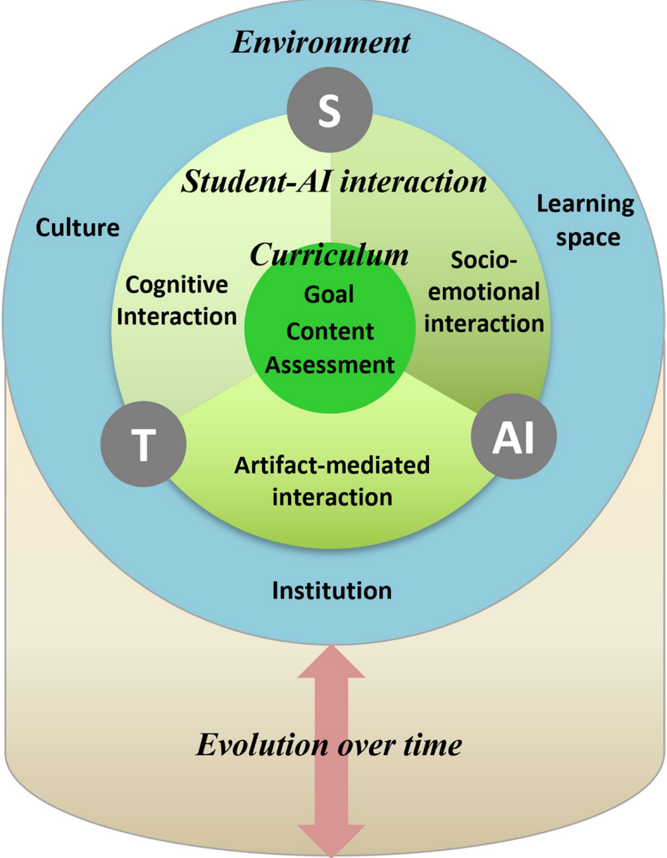
Preparing students to collaborate with AI remains a challenging goal. As AI technologies are new to K-12 schools, there is a lack of studies that inform how to design learning when AI is introduced as a collaborative learning agent to classrooms. The present study, therefore, aimed to explore teachers’ perspectives on what (1) curriculum design, (2) student-AI interaction, and (3) learning environments are required to design student-AI collaboration (SAC) in learning and (4) how SAC would evolve. Through in-depth interviews with 10 Korean leading teachers in AI in Education (AIED), the study found that teachers perceived capacity and subject-matter knowledge building as the optimal learning goals for SAC. SAC can be facilitated through interdisciplinary learning, authentic problem solving, and creative tasks in tandem with process-oriented assessment and collaboration performance assessment. While teachers expressed instruction on AI principles, data literacy, error analysis, AI ethics, and AI experiences in daily life were crucial support, AI needs to offer an instructional scaffolding and possess attributes as a learning mate to enhance student-AI interaction. In addition, teachers highlighted systematic AIED policy, flexible school system, the culture of collaborative learning, and a safe to fail environment are significant. Teachers further anticipated students would develop collaboration with AI through three stages: (1) learn about AI, (2) learn from AI, and (3) learn together. These findings can provide a more holistic understanding of the AIED and implications for the educational policies, educational AI design as well as instructional design that are aimed at enhancing SAC in learning.
Overview
The claims and statistics of this paper haven’t been checked yet.
Free: it reads the open-access text and checks the first 5 claims that cite a source we can check. Create a free account to check every claim.
Integrity signals
Registry
Cites
Statistics
Figures
Verification
Claims the paper makes
The claims and statistics of this paper haven’t been checked yet.
Free: it reads the open-access text and checks the first 5 claims that cite a source we can check. Create a free account to check every claim.
Claims other papers make about this one
Each is checked against this paper’s own text: does it say what the citing paper says it does?
The cited source says what the claim attributes to it.
In the citing paper
“This collaborative process aligns with the vision that AI tools act not just as implementers of human ideas, but as active collaborators in the creative process [7, 23].”
From Scaffolding Creativity: Integrating Generative AI Tools and Real-World Experiences in Business Education (2025) · cites this paper as [7]
The cited source says what the claim attributes to it.
In the citing paper
“Similarly, the positive effects of SI are consistent with prior research indicating that social expectations, peer endorsement, and collective support can shape users’ acceptance of new technologies [61,103,104,105,106].”
In the citing paper
“For many teachers, it may be their first time to use AIED technologies for teaching.They may not have rich experience of using AIED technologies to teach, and they face various challenges such as technological difficulties, communication and collaboration problems when using these novel-to-teacher technologies (Kim et al., 2022).”
From Teachers’ AI digital competencies and twenty-first century skills in the post-pandemic world (2023) · doi:10.1007/s11423-023-10203-6 · cites this paper as Kim et al., 2022
Self-check
Percentages, sums and reported differences re-computed from the paper’s own numbers.
The self-check needs the paper’s full text.
Citations
Cites
Using thematic analysis in psychology
Braun, V., & Clarke, V. (2006) · Qualitative Research in Psychology · doi:10.1191/1478088706qp063oa · Cited by 194,414
Zawacki-Richter, O., Marín, V. I., Bond, M., & Gouverneur, F. (2019) · International Journal of Educational Technology in Higher Education · doi:10.1186/s41239-019-0171-0 · Cited by 7,242 · cited 2×
“In particular, the time and cost of developing and introducing an appropriate methodology for implementing AIED pose a major challenge in public educational institutions (Zawacki-Richter et al., 2019).”
BackgroundIntelligent agents: theory and practice
Wooldridge, M., & Jennings, N. R. (1995) · The Knowledge Engineering Review · doi:10.1017/s0269888900008122 · Cited by 6,810
Hollan, J., Hutchins, E., & Kirsh, D. (2000) · ACM Transactions on Computer-Human Interaction · doi:10.1145/353485.353487 · Cited by 2,300 · cited 1×
“Second, the analysis looks for a range of mechanisms that can partake in the cognitive system rather than restricting itself to symbol manipulation and computation – e.g. the interplay between human memory, external representations, and the manipulation of objects (Hollan et al., 2000, p. 176).”
BackgroundThe evolution of research on collaborative learning
Dillenbourg, P., Baker, M. J., Blaye, A., & O’Malley, C. L. (1995) · HAL · Cited by 2,018
How a Cockpit Remembers Its Speeds
Hutchins, E. (1995) · Cognitive Science · doi:10.1207/s15516709cog1903_1 · Cited by 1,880 · cited 2×
“…an effective framework for a holistic understanding of the complex relations and interactions among heterogeneous agents (i.e., students, AI, and teachers), the multiple existing digital technologies, and practices in the classroom environment (Hutchins, 1995; Perkins, 1993; Nardi & O’Day, 1999).”
BackgroundBarr, V., & Stephenson, C. (2011) · ACM Inroads · doi:10.1145/1929887.1929905 · Cited by 1,692 · cited 1×
“While discussions on CT skills were narrowly positioned within the field of computer science or STEM-related subjects (Barr & Stephenson, 2011; Lee et al., 2020), this study moves CT forward to be extensible and embedded across disciplines.”
BackgroundDemystifying computational thinking
Shute, V. J., Sun, C., & Asbell-Clarke, J. (2017) · Educational Research Review · doi:10.1016/j.edurev.2017.09.003 · Cited by 1,466 · cited 1×
“…improving computational thinking (CT), a set of skills including decomposition, abstraction, algorithm design, debugging, testing/simulation, heuristic reasoning, and generalization, is being accentuated to understand and use AI effectively to solve problems (Shute et al., 2017; NRC, 2010).”
BackgroundAUGMENTING HUMAN INTELLECT: A CONCEPTUAL FRAMEWORK
ENGELBART, D. C. (1962) · doi:10.21236/ad0289565 · Cited by 1,082
New Technology and Digital Worlds: Analyzing Evidence of Equity in Access, Use, and Outcomes
Warschauer, M., & Matuchniak, T. (2010) · Review of Research in Education · doi:10.3102/0091732x09349791 · Cited by 1,047
Research works printed but not linked: 4
- Ai, R., Bhatt, M., Chevrier, S., Ciccarelli, R., Grady, R., Kumari, V., Li, K., Nazarli, N., Rahimi, H., Roberts, J., Sachs, J., Schepmyer, A., Wang, M., & Wong, H. (2008). Choose your own inquiry. , University Press of America.
- Big Innovation Center. (2020). AI in education: Embedding AI tools into teaching curricula. Big Innova- tion Centre.
- Johnson, D. W., & Johnson, R. T. (2006). Cooperation and the use of technology. In D. H. Jonassen (Ed.), Handbook of research on educational communications and technology (2 ed.), (pp. 785-811). , Lawrence Erlbaum Associates.
- Okoye, K., Nganji, J. T., & Hosseini, S. (2020). Learning analytics for educational innovation: A sys- tematic mapping study of early indicators and success factors. International Journal of Computer Information Systems and Industrial Management Applications, 12, 138-154.
Cited by
Items 301–400 of 669
Teaching Assistant Based on a Brazilian Large Language Model
Siqueira, E. S., Portela, C. D. S., & Moraes, A. N. (2025) · Anais do Simpósio Brasileiro de Sistemas de Informação (SBSI) · doi:10.5753/sbsi.2025.246480 · Cited by 2
Caboni, F., & Pizzichini, L. (2025) · Springer series on cultural computing · doi:10.1007/978-3-031-86551-0_4 · Cited by 2
Student Learning Behavior Analysis and Feedback Algorithm based on Intelligent Model
Yin, G. (2025) · International Conference on Distributed Computing and Electrical Circuits and Electronics (ICDCECE) · doi:10.1109/icdcece65353.2025.11035528 · Cited by 2
“Kim et al. [11] adopted a qualitative research method, collected the views of many education experts and front-line teachers through interviews and case analysis, and explored how to integrate AI technology into teaching design to promote effective collaboration between students and AI.”
Harnessing AI for Education and Transforming Learning
Pandey, S., & Gaikwad, H. V. (2025) · Lecture notes in networks and systems · doi:10.1007/978-981-97-9526-0_35 · Cited by 3
Navigating the Impact of Artificial Intelligence Tools on Design Learning
Zuhra, F.-T. (2025) · Journal of Design and Textiles · doi:10.32350/jdt.41.01 · Cited by 2
An exploratory study of ChatGPT in STEM teaching on heat and temperature topic
Utami, A., Dhitareka, P. H., Husna, H. N., & Prima, E. C. (2025) · Discover Education · doi:10.1007/s44217-025-00751-9 · Cited by 5
“…[117], improve student engagement [91], foster adaptive and personalized learning experiences, understand the patterns of students’ learning behavior [5, 155], encourage interactive learning, generate automatic assessment [89, 90], provide real-time learning feedback and recommendations [24].”
La integración de la tecnología en la Educación Básica: un análisis de su impacto en el aprendizaje
Mayorga, S. X. E., Moyulema, L. V. A., Portilla, J. A. V., & Flores, M. S. Y. (2025) · Revista Ciencia Innovadora · doi:10.64422/rci.v3n4.2025.80 · Cited by 6
Kiński, C., Kiński, B., & Przyborowska, A. (2025) · Neofilolog · doi:10.14746/n.2025.65.1.4 · Cited by 6
“In conclusion, it seems that maintaining a strong, respectful teacher-student relationship is essential to ensure that AI technologies enhance rather than replace critical thinking and the learning process (Alharbi, 2023; Kim et al., 2022; Creely, 2023; Guilherme, 2019).”
The Missing Link: Knowledge Management in AI-Powered Education Frameworks
Sen, A. A., Joy, J. M., Jennex, M. E., Babb, J. S., & Dana, K. (2025) · Innovations in Pedagogy and Technology · doi:10.63385/ipt.v1i3.114 · Cited by 3
Students’ perceptions of the impact of interactive technology on engagement in STEM classes
Ragab, K., Martínez-Jiménez, E., & Fernández-Ahumada, E. (2025) · Contemporary Educational Technology · doi:10.30935/cedtech/17408 · Cited by 2
Augmentation or substitution: defining role of large language model in physical education
Yang, H., Huang, B., & Li, X. (2025) · Frontiers in Sports and Active Living · doi:10.3389/fspor.2025.1662056 · Cited by 6
“In addition, there are studies that focus on teacher-large language model collaboration, suggesting that the combination of teachers and large language models can create a more effective learning experience than either working alone (30).”
Engagement patterns of middle school students with AI teachable agents in mathematics learning
Liu, Z., Xing, W., Ngo, B., Jiao, X., Jiang, S., & Li, C. (2025) · Scientific Reports · doi:10.1038/s41598-025-24841-8 · Cited by 14
“These findings echo broader concerns that students often act as passive recipients when interacting with AI tutors or pedagogical agents, especially when the system dictates a pre-defined learning path 49 .”
Sun, Z., & Ding, J. (2025) · Human Behavior and Emerging Technologies · doi:10.1155/hbe2/6901297 · Cited by 2
Oflaz, M. (2025) · Journal of Education for Students Placed at Risk (JESPAR) · doi:10.1080/10824669.2025.2600542 · Cited by 5
Finkelstein, I., & Soffer-Vital, S. (2025) · Educational Research and Evaluation · doi:10.1080/13803611.2025.2596373 · Cited by 6
“For academic staff, AI technologies provide valuable support by enabling the selection of appropriate tools to monitor student progress and deliver personalized assistance (Kim et al., 2022; Wang et al., 2021a, 2021b).”
AI-mediated problem-based language learning: easing the load for teachers, empowering students
Arani, S. M. N. (2025) · Computer Assisted Language Learning · doi:10.1080/09588221.2025.2599156 · Cited by 7
Nursing Educators’ Perceptions of AI in Research: Risks and Benefits
MRAYYAN, M. T., & Alomari, A. K. (2026) · Nursing Research and Practice · doi:10.1155/nrp/2058036 · Cited by 4
“Te existence of a supportive partner may enhance the time and resources available for professional growth and the exploration of innovative research methodologies, including AI [63].”
Alam, A. (2026) · Advances in computational intelligence and robotics book series · doi:10.4018/979-8-3373-5747-8.ch008 · Cited by 3
The impact of AI usage, literacy and proactive innovation behavior on scholars' mental health
Gao, X., Ding, Y., ZHANG, H., Liang, W., & Zuo, R. (2026) · Industrial Management & Data Systems · doi:10.1108/imds-05-2025-0593 · Cited by 5
Öncü, S., Guillén‐Gámez, F. D., & Çiğdem, H. (2026) · Springer eBooks · doi:10.1007/978-981-95-4871-2_6 · Cited by 2
Sun, N. (2026) · Australian Journal of Electrical & Electronics Engineering · doi:10.1080/1448837x.2026.2618423 · Cited by 3
Rahim, F., & Ysmailova, R. A. (2026) · Discover Computing · doi:10.1007/s10791-026-09992-0 · Cited by 11
“The study of programming languages and computer science enhances the educational experience [26].”
Chen, X., Jian-jun, L., & Ryoo, J. (2026) · Quality Assurance in Education · doi:10.1108/qae-02-2025-0040 · Cited by 5
Shen, W., Chai, C. S., Chiu, T. K. F., Yau, K. W., Meng, H. M. L., King, I., Wong, S., & Yeung, Y. A. M. (2026) · Computers and Education Artificial Intelligence · doi:10.1016/j.caeai.2026.100564 · Cited by 8
Hao, Z., Liu, X., Fan, J., Long, Y., Yu, J., Chen, W., & Zhang, Y. (2026) · Journal of Research on Technology in Education · doi:10.1080/15391523.2026.2722962 · Cited by 2
“Generative AI systems can now contribute to CPS by analyzing goals, synthesizing information, generating alternatives, and supporting iterative refinement across multiple modalities (Kim et al., 2022).”
Kwon, K., Yang, S., Kale, U., Kim, K., & Park, J. (2026) · Computers and Education Artificial Intelligence · doi:10.1016/j.caeai.2026.100588 · Cited by 5
Human, AI, or Co-Creation? Exploring Conventional, AI-Based, and Human-AI Collaborative Learning
Kang, Y., & Li, M. (2026) · Journal of Hospitality & Tourism Education · doi:10.1080/10963758.2026.2673964 · Cited by 2
“This Human-AI collaboration model highlights the value of blending subjective observations with objective data to achieve more comprehensive evaluations, which supports previous research emphasizing the benefits of integrating AI with human judgment (Kim et al., 2022; Suriano et al., 2025).”
InfluentialAL-Smadi, M., Debbek, S., & Tawileh, W. (2026) · IEEE Global Engineering Education Conference (EDUCON) · doi:10.1109/educon67543.2026.11574349 · Cited by 2
“Research underscores the importance of balanced AI integration that addresses potential risks while ensuring academic integrity [11], [12], [14].”
AI Literacy Scale for Undergraduate Design Students: Development and Validation
Lin, S., & Tan, Z. (2026) · SAGE Open · doi:10.1177/21582440261463131 · Cited by 6
“General AI literacy frameworks developed for K-12 and STEM education typically foreground computational thinking, algorithmic reasoning and subject-specific problem solving (Chan, 2024; Kim et al., 2022).”
Co-designing Digital Humans for Online Learning: A Framework for Human-AI Pedagogical Integration
Lei, X., Pang, C. C., Jiang, Y., Tong, X., & Hui, P. (2026) · Lecture notes in computer science · doi:10.1007/978-3-032-30784-2_34 · Cited by 5
“…[113,114]; (3) AI literacy and collaboration, encompassing the understanding of AI mechanics and learning to partner with AI on complex tasks [115, 116]; and (4) effective interaction, which focuses on responsive, trustworthy experiences tailored to individual demands to enhance performance…”
White, K., Detert, R., Hornik, S., Guerra-Pujol, F. E., & Rosenthal, L. (2026) · Journal of Accounting Education · doi:10.1016/j.jaccedu.2026.101047 · Cited by 2
Mikriukov, D. (2023) · IEEE Smart World Congress (SWC) · doi:10.1109/swc57546.2023.10448913 · Cited by 2
“For instance, AI can help create a personalised approach to different students [8], which can happen in real-time [9].”
BackgroundAIoT in Education Transforming Learning Environments and Educational Technology
Vashishth, T. K., Sharma, V., Sharma, K. K., Kumar, B., Chaudhary, S., & Panwar, R. (2024) · Advances in computational intelligence and robotics book series · doi:10.4018/979-8-3693-0993-3.ch004 · Cited by 2
AI and AR in the Elementary School Art Class: A Multiliteracies Approach
Mossalim, J. (2024) · Advances in educational technologies and instructional design book series · doi:10.4018/979-8-3693-3184-2.ch005 · Cited by 2
Inclusive Education in the Artificial Intelligence Era: Opportunities and Challenges
Salhab, R. A. (2024) · Advances in educational technologies and instructional design book series · doi:10.4018/979-8-3693-7255-5.ch001 · Cited by 7
From Traditional to Technological: The Evolving Role of Teachers in the AI-Powered Classroom
Chaudhary, N., Jain, P., & Sharma, C. (2024) · Advances in educational marketing, administration, and leadership book series · doi:10.4018/979-8-3373-1692-5.ch004 · Cited by 4
Başaran, M., Vural, Ö. F., Metin, Ş., & Tamur, S. (2025) · International Journal of Early Childhood · doi:10.1007/s13158-024-00411-3 · Cited by 4
“…technologies contribute to both teaching efficiency and student participation for teachers (Pokrivcakova, 2019; Schmidt & Strasser, 2022; Jeon & Lee, 2023; Octavio et al., 2024; Meniado, 2023; Liu et al., 2023; Mhlanga, 2023; Sallam, 2023; Holstein et al., 2020; Kim et al., 2022; Hong, 2023).”
Influence of Age on Second Language Acquisition: A Big Data Analysis in English Teaching
Liu, W., & Wang, Y. (2025) · International Journal of Web-Based Learning and Teaching Technologies · doi:10.4018/ijwltt.368222 · Cited by 4
Navigating New Frontiers: AI in Assessments From the Perspectives of Teachers and Students
Roberts, L. N. (2025) · Advances in educational technologies and instructional design book series · doi:10.4018/979-8-3693-6527-4.ch011 · Cited by 4
Asrifan, A., & Ingilan, S. S. (2025) · Advances in computational intelligence and robotics book series · doi:10.4018/979-8-3693-8985-0.ch006 · Cited by 2
Revolutionizing PE Harnessing the Power of Artificial Intelligence in Vietnamese Universities
Thuc, D. C. (2025) · Advances in computational intelligence and robotics book series · doi:10.4018/979-8-3693-8744-3.ch011 · Cited by 2
Beyond conventional adoption: new insights into AI facilitators in Higher Education Institutions
Low, M. P., Soliman, M. S. A., Balushi, M. K. A., & Leong, C. (2025) · Sustainable Futures · doi:10.1016/j.sftr.2025.100781 · Cited by 9
Desmistificando o Ensino de Inteligência Artificial e Aprendizado de Máquina
Coura, P., Freitas, I., Costa, H., Nacif, J. A. M., & Ferreira, R. (2025) · doi:10.5753/educomp_estendido.2025.6578 · Cited by 2
Galera, J. V., & Estrellan, J. C. (2025) · Psychology and Education A Multidisciplinary Journal · doi:10.70838/pemj.410209 · Cited by 3
Creating Holistic Learning Environments: Integrating AI, Education, and Psychological Principles
Kadir, A., Sairin, S., Madjid, A., Widigdo, M. S. A., Ramli, S. A., & Asrifan, A. (2025) · Advances in computational intelligence and robotics book series · doi:10.4018/979-8-3373-5786-7.ch002 · Cited by 2
A Review on Augmented Reality in Education and Geography: State of the Art and Perspectives
Rus, B.-A., & Sita, V. (2025) · Applied Sciences · doi:10.3390/app15137574 · Cited by 9
Maanu, V., Boateng, F. O., & Larbi, E. (2025) · International Journal of Scientific Research and Modern Technology. · doi:10.38124/ijsrmt.v4i9.828 · Cited by 3
Development Education in Digital Era
Gupta, S. (2023) · Proceeding International Conference on Science and Engineering · doi:10.52783/cienceng.v11i1.266 · Cited by 2
“Not only these digital platforms acted as a mediator platform rather they are turning into a collaborative platform with the active intervention of artificial intelligence (Kim et al., 2022).”
BackgroundSemeniuk, R., Holovnia, Y., Huda, O., & Савастру, Н. (2024) · Futurity Education · doi:10.57125/fed.2024.03.25.02 · Cited by 15
“We found that group learning enhances critical thinking, improves communicative and decision-making skills, promotes deeper understanding of the topic through increasing their attention and maintaining their focus on the tasks (Kim et al., 2022b).”
Crear comunidades de aprendizaje a través del aprendizaje en línea para profesores de inglés
Phuong, V. T. (2024) · Alteridad · doi:10.17163/alt.v19n2.2024.07 · Cited by 3
Empowering Educators: A Practical Approach to AI Literacy in K-12 ClassroomsPreprint
Nelson, K. R., Du, S., Marshall, D. T., Bowers, S., & Ali, A. (2025) · SocArXiv (OSF Preprints) · doi:10.31235/osf.io/ueyba_v2 · Cited by 4
Artificial Intelligence Across Borders: Transforming Industries Through Intelligent Innovation
Panda, S. P. (2025) · doi:10.70593/978-93-49910-25-6 · Cited by 30
Asuncion, I., & Natividad, L. (2025) · doi:10.2139/ssrn.5085611 · Cited by 2
ASL Educators' Perspectives on AI for Enhancing Student Learning in American Sign Language Education
Hassan, S., Nourian, L., de Lacerda Pataca, C., M Olson, M., D'aurio, T., Agarwal, K., Asad, S. M. N., Tigwell, G. W., & Huenerfauth, M. (2026) · Proceedings of the 2026 CHI Conference on Human Factors in Computing Systems · doi:10.1145/3772318.3791928 · Cited by 3
Qaralleh, R., & Ahmed, S. N. (2024) · Advances in educational marketing, administration, and leadership book series · doi:10.4018/979-8-3693-7016-2.ch005 · Cited by 1
AI-Driven Innovations in Pedagogical and Andragogical Approaches: A Case Study Analysis
Asrifan, A., Shafa, S., Octaberlina, L. R., Ersyad, Z. M., Hermansyah, S., & Amri, N. A. (2024) · Advances in educational technologies and instructional design book series · doi:10.4018/979-8-3693-6130-6.ch009 · Cited by 3
Optimizing the Use of Digital Libraries in Basic Education
Putri, C. A., Syaifuddin, A., Rohman, N., Aziz, A., & Ponijan, R. M. P. (2025) · Edunesia Jurnal Ilmiah Pendidikan · doi:10.51276/edu.v6i1.940 · Cited by 1
“In addition, the madrasah library serves as a learning centre that offers a variety of learning programs and academic assistance that can assist students in acquiring new knowledge and skills (Kim et al., 2022).”
Kong, X., Fang, H., Ma, X., & Hong, X. (2024) · International Conference on Artificial Intelligence and Teacher Education (ICAITE) · doi:10.1145/3702386.3702402 · Cited by 1
Ragusa, A., Caggiano, V., & Alor, I. O. B. (2025) · EDUCATION SCIENCES AND SOCIETY · doi:10.3280/ess2-2024oa18314 · Cited by 2
Mi, Z., & Li, K. (2024) · International Conference on Educational Technology Management (ICETM) · doi:10.1145/3711403.3711425 · Cited by 2
“In recent years, many scholars have explored intelligent learning [3], innovative learning spaces, and AI+ teachers from the perspective of human-machine collaboration and have analyzed classroom teaching assisted by AI [4].”
Topal, İ. H. (2025) · Journal of AI · doi:10.61969/jai.1633592 · Cited by 1
Meletiadou, E. (2025) · Advances in computational intelligence and robotics book series · doi:10.4018/979-8-3693-5623-4.ch001 · Cited by 2
Enhancing Critical Thinking: The Role of AI in Modern Education
Asrifan, A., Khristianto, K., Budiman, A., Astuti, P. I., & Rossydi, A. (2025) · Advances in computational intelligence and robotics book series · doi:10.4018/979-8-3373-4576-5.ch012 · Cited by 8
Mundir, M., & Rojabi, A. R. (2025) · Annual Conference of Islamic Education (ACIE) · doi:10.4108/eai.14-10-2024.2355576 · Cited by 1
Saavedra, A. M., Patiño, A., & Ibarra-Vázquez, G. (2025) · Institute for the Future of Education Conference (IFE) · doi:10.1109/ife63672.2025.11025037 · Cited by 2
“In the new educational paradigm of student-centered learning, several pedagogical proposals focus on specific ways of conceptualizing teaching [4].”
TPRS: AI-Assisted Research Topic Refinement for Distance Learners
Duong‐Trung, N., Wang, X., Bhoyar, R. R., Jose, A. M., Wrede, S. E., van Rijn, L., Panse, T., de Witt, C., & Pinkwart, N. (2025) · Communications in computer and information science · doi:10.1007/978-3-031-99264-3_9 · Cited by 1
Massouti, A. (2025) · IGI Global eBooks · doi:10.4018/979-8-3373-0837-1.ch009 · Cited by 2
Hossain, A., Shazed, A. N., Haque, M. M., Alif, A., & Alam, S. (2025) · Advances in computational intelligence and robotics book series · doi:10.4018/979-8-3373-6018-8.ch009 · Cited by 1
Li, S., Aliabadi, R., Albinus, A., & Ehrlich, J. (2025) · ACM SIGCAS/SIGCHI Conference on Computing and Sustainable Societies (COMPASS) · doi:10.1145/3715335.3735457 · Cited by 1
“The dynamic human-AI interaction enables students to work on domain-specific tasks where AI acts as the copilot to facilitate learning or as an interface of knowledge exchange [26].”
InfluentialDeveloping an Ethical Framework for Youth
Ahrari, S., & Al-Issa, R. S. (2025) · Advances in computational intelligence and robotics book series · doi:10.4018/979-8-3373-2170-7.ch010 · Cited by 1
Choi, Y.-S., & Kim, M. (2025) · Journal of the Korean earth science society · doi:10.5467/jkess.2025.46.3.226 · Cited by 1
Wang, Y., Zhang, C., & Zhang, J. (2025) · Journal of Comparative Economics · doi:10.1016/j.jce.2025.09.001 · Cited by 2
Bridging the engagement gap in B2B marketing education: Integrating storytelling and AI
Malhan, M. (2025) · The International Journal of Management Education · doi:10.1016/j.ijme.2025.101279 · Cited by 6
Nimbalkar, A. M., Nimbalkar, M., Gondhalekar, M., Dhandal, Y. S., Mahalle, P. N., Chandre, P. R., & Barot, J. (2025) · Lecture notes in networks and systems · doi:10.1007/978-981-96-7505-0_43 · Cited by 1
From Chalkboards to Chatbots: The Role of Generative AI in Philippine Teacher Education Assessment
Gamusa, E. V., Sim, M. J. C., Medina, J. B., Acut, D. P., Garcia, M. B., & Lahby, M. (2025) · Information systems engineering and management · doi:10.1007/978-3-032-05306-0_12 · Cited by 2
Faculty Responses to Generative AI: The Shifting Landscape of Higher Education
Neumann, M. D., & Gerstl-Pepin, C. (2025) · IEEE International Symposium on Technology and Society (ISTAS) · doi:10.1109/istas65609.2025.11269643 · Cited by 2
“Since GenAI launched into the public sphere, universities, and particularly the fields of education and human services (e.g., social work, counseling), are working to understand how these tools not only affect learning but their implications on society [22, 23, 40].”
AI & Social Learning? An Examination of Preservice Teachers’ Perspectives
Li, Q., Bailey, E. J., Wadadekar, R., & Levi, M. C. (2025) · Journal of Educational Technology Systems · doi:10.1177/00472395251401925 · Cited by 2
“To facilitate this, learning design must shift to include social learning environments in which curriculum design considers not just relationships between learners/learners and learners/instructors, but also learners/AI (Kim et al., 2022).”
Artificial intelligence in education
Khmelnitska, I., Кардаков, В. О., & Usychenko, V. (2025) · Scientific Journal of National Pedagogical Dragomanov University Series 15 Scientific and pedagogical problems of physical culture (physical culture and sports) · doi:10.31392/udu-nc.series15.2025.12(199).42 · Cited by 3
Harjono, H., Sumarni, W., Sumarti, S. S., Munzil, Muntholib, Setiawan, B., Wicaksono, I. R., & Ramadhani, D. G. (2026) · Journal of Science Education and Technology · doi:10.1007/s10956-025-10286-1 · Cited by 1
“This analysis, particularly when supported by AI-driven feedback systems, enables personalized interventions tailored to address specific learning gaps, fostering deeper understanding and improving overall learning outcomes (Kim et al., 2022 ; Bucea-Manea-Țoniș et al., 2022).”
Erita, Y., Anggraeni, A., Amini, R., & Hevria, S. (2025) · Jurnal Penelitian Pendidikan IPA · doi:10.29303/jppipa.v11i12.13096 · Cited by 1
“Teacher professional development remains a cornerstone, with calls for nationwide AI literacy programs targeted at elementary educators (Kim et al., 2022).”
The 4C Framework: Integrating AI in Creating and Solving Case Studies
Kolesnyk, D., & van Berlo, Z. M. C. (2026) · Journal of Advertising Education · doi:10.1177/10980482261418592 · Cited by 2
“The rapid advancement of arti fi cial intelligence (AI) is reshaping the landscape of advertising education (e.g., Habib, 2025; Kim et al., 2022; Pavlik, 2023; Wagler, 2025) and advertising research (e.g., Huh et al., 2023; Van Berlo et al., 2024).”
AI in Enhancing Student Academic Performance: A Bibliometric Analysis
Shehab, J. M., Marni, N., Zitawi, D. U. D. D. M. A., & Kılıç, M. A. (2025) · International Conference on Artificial Intelligence for Sustainable Innovation (AI-SI) · doi:10.1109/ai-si66213.2025.11341004 · Cited by 2
“From intelligent tutoring systems to predictive analytics, AI is helping improve how students learn, how teachers instruct, and ultimately how academic performance is measured and supported [1]; [2]; [3].”
The Impact of AI Anxiety and Quiet Quitting on Employee Turnover Intention
Sayem, S. M., Islam, Z., Yesmin, A., Alam, A., & Rahman, M. I. (2026) · International Conference on Ubiquitous Information Management and Communication (IMCOM) · doi:10.1109/imcom69009.2026.11360936 · Cited by 3
“AI configuration anxiety is the fear, unease, or trepidation experienced during the setup, operation, or adjustment of AI-integrated systems, including the notion that these technologies are difficult to operate [11].”
A Literature Review on the Role of Artificial Intelligence in Marketing
Wang, Z. (2025) · The Development of Humanities and Social Sciences · doi:10.71204/1p7n5w97 · Cited by 3
Personalized Learning Framework for Student-Centered Education in Higher Education
Johan, M. C., Langi, A. Z. R., & Nugraha, I. G. B. B. (2025) · International Conference on ICT for Smart Society (ICISS) · doi:10.1109/iciss66954.2025.11389582 · Cited by 1
Thakur, M., Chauhan, A., & Sharma, V. (2026) · International Journal of Educational Development · doi:10.1016/j.ijedudev.2026.103557 · Cited by 2
Gao, M., Liu, Y., & Lin, X. Y. (2026) · Adult Learning · doi:10.1177/10451595261436346 · Cited by 2
“AI technologies, such as generative AI and machine learning algorithms, enable customized content delivery, real-time feedback, and immersive simulations that align with the needs of online adult learners for fl exibility and relevance (Kim et al., 2022; Lin, 2025; Lin et al., 2025).”
Generative AI and management education: a knowledge management perspective
Rai, H., Malik, N., & Varma, A. (2026) · Journal of Knowledge Management · doi:10.1108/jkm-01-2025-0102 · Cited by 3
The impact of AI tools: ChatGPT, Gamma and Autopilot on performance in academic assignments
Mohareb, T. W. A., & Al-Qayyem, R. (2026) · Learning Futures and Emerging Technologies · doi:10.1108/lfet-04-2025-0040 · Cited by 3
Avidov‐Ungar, O., & Ganon-Shilon, S. (2026) · Artificial Intelligence in Education · doi:10.1108/aiie-08-2025-0205 · Cited by 1
Sari, E. F., Sukestiyarno, Y. L., Isnaeni, W., & Sarwi (2026) · Multidisciplinary Reviews · doi:10.31893/multirev.2026477 · Cited by 1
“Teachers need an understanding that enables them to explain concepts simply, anticipate student errors, choose appropriate representations, and develop learning strategies tailored to student characteristics (Prediger et al., 2023; Liao et al., 2024; Kim et al., 2022).”
A Technology-Enhanced Learning Perspective on Educational Robotics in Vocational Teacher Education
Nannim, F. A., Mosia, M. S., & Egara, F. O. (2026) · IGI Global eBooks · doi:10.4018/979-8-3373-5865-9.ch002 · Cited by 1
Yeh, H., Fu, J. S., & Chang, Y.-N. (2026) · International Journal for Lesson and Learning Studies · doi:10.1108/ijlls-09-2025-0254 · Cited by 1
Hamsiah, A., Rizal, A., & Malik, A. R. (2026) · Discover Education · doi:10.1007/s44217-026-01627-2 · Cited by 15
“Kim et al. [31] propose the concept of shared agency, suggesting that AI can function as a co-participant in learning if students retain control over decision-making and evaluative judgment.”
Student-AI interaction patterns in collaborative problem solving using ordered network analysis
Kim, J., Yang, G., Detrick, R., Fan, L., Chan, W. K., & Li, N. (2026) · Interactive Learning Environments · doi:10.1080/10494820.2026.2664072 · Cited by 1
“Although CPS with AI provides multiple benefits and learning gains for students, spanning cognitive, metacognitive, and affective domains (Kim et al., 2022, 2025d), it also presents a complex challenge since CPS comprises socio-cognitive, interactive, interdependent, and temporal processes heavily…”
Self-citationPaliwal, A. C., Bansal, K., Singh, A. K., & Singh, P. P. (2026) · American Journal of Distance Education · doi:10.1080/08923647.2026.2672819 · Cited by 2
Lin, Q., Zhou, Q., Long, Q., Zhu, M., & Ma, H. (2026) · Education and Information Technologies · doi:10.1007/s10639-026-14036-7 · Cited by 5
“Additionally, studies have shown that many teachers lack an understanding of AI technology and experience in using AI for teaching, facing difficulties such as technical issues, communication challenges, and collaboration problems (Kim et al., 2022).”
Razmerita, L., Zheng, X., & Allen, J. P. (2026) · Computers and Education Artificial Intelligence · doi:10.1016/j.caeai.2026.100625 · Cited by 2
Tekin, S., & Atar, C. (2026) · Journal of Learning and Teaching in Digital Age · doi:10.53850/joltida.1827535 · Cited by 1
Abdelhalim, S. M., & Almaneea, M. O. (2026) · Asian-Pacific Journal of Second and Foreign Language Education · doi:10.1186/s40862-026-00430-8 · Cited by 7
“However, empirical evidence remains limited regarding how GenAI influences measurable learning outcomes when embedded in sustained instructional interventions rather than short-term interactions or perception-based evaluations (Chen et al., 2021; Kim et al., 2022; Xinghua et al., 2024).”
Metadata
- Authors
- Kim, J., Lee, H., & Cho, Y. H.
- Affiliations
- Seoul National University (KR)
- Corresponding author
- Cho, Young Hoan
- Venue
- Education and Information Technologies
- Published
- 2022-01-28
- Volume
- 27
- Issue
- 5
- Pages
- 6069-6104
- ISSN
- 1360-2357 (ISSN-L)
- 1573-7608
- OpenAlex
- W4221079197
- Cited by
- 669
- References
- 66
- Citations by year
- 2026: 206 · 2025: 247 · 2024: 158 · 2023: 51 · 2022: 6
- FWCI
- 114.37
- Type
- journal article
- Language
- en
- Open access
- hybrid
- doi.org
- Licence
- cc-by
- creativecommons.org/licenses/by/4.0 (tdm)
- creativecommons.org/licenses/by/4.0 (vor)
- Locations
- Education and Information Technologies (publishedVersion, cc-by)
- Seoul National University Open Repository (Seoul National University) (submittedVersion)
- Topics
- Social Sciences › Education › Artificial Intelligence in Education
- Physical Sciences › Computer Science › Artificial Intelligence › Intelligent Tutoring Systems and Adaptive Learning
- Social Sciences › Psychology › Developmental and Educational Psychology › Innovative Teaching and Learning Methods
- Keywords
- learning design, artificial intelligence in education, teacher perceptions, curriculum development, student-AI interaction, learning environment, interdisciplinary learning, authentic problem solving, process-oriented assessment, data literacy, AI ethics, instructional scaffolding, collaborative learning culture, K-12 education
About these checks
Registry, retraction, Cites and statistics results are computed, not judged, with one exception: a printed reference that no index lists is read once by a model before it counts as a citation error. Claims are extracted by a model and kept only when their quote appears verbatim in the text; each cited source is then checked, with a model’s help, for whether it says what the claim relies on. Those verdicts can be wrong — read the claim’s quote and the cited source before relying on one.
Statistics and arithmetic are recomputed, not judged.
Confidence bands are shown only for fields calibrated on our annotated test set. None is calibrated yet, so no band is shown.
What counts as a claim ›How we measure confidence ›How we check this ›
Are you an author, or do you see a problem with this page? Request a review
Data sources
Bibliographic data: Semantic Scholar, OpenAlex, Crossref.
Contains information from the Semantic Scholar Academic Graph Datasets, made available under the ODC Attribution License (ODC-BY 1.0).
Semantic Scholar’s data is described in: Kinney, R., et al. (2023). The Semantic Scholar Open Data Platform. arXiv:2301.10140.
