

Learning design to support student-AI collaboration: perspectives of leading teachers for AI in education
Open accessThe DOI matches its Crossref record; 68 of the 68 references it cites were found in a registry or an index.
Abstract
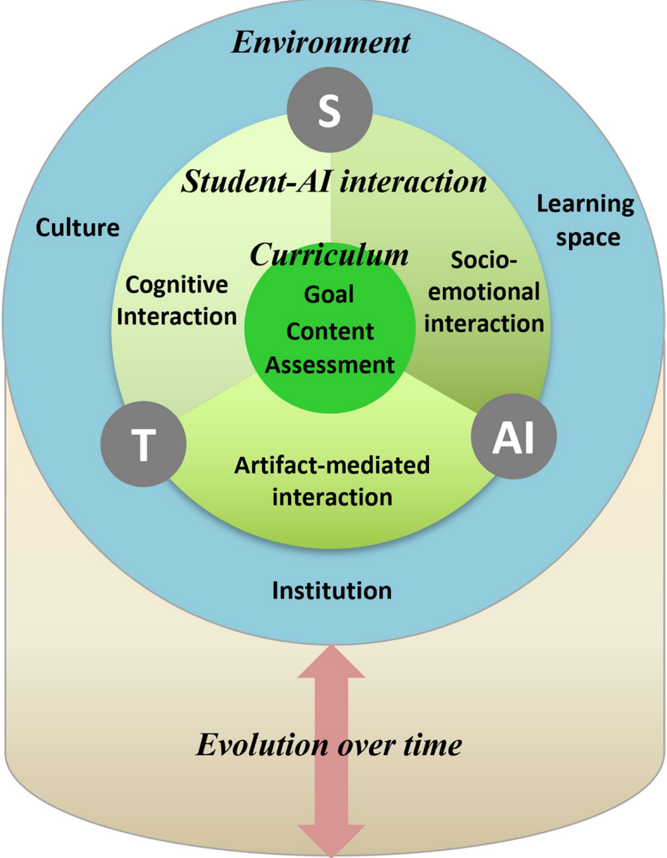
Preparing students to collaborate with AI remains a challenging goal. As AI technologies are new to K-12 schools, there is a lack of studies that inform how to design learning when AI is introduced as a collaborative learning agent to classrooms. The present study, therefore, aimed to explore teachers’ perspectives on what (1) curriculum design, (2) student-AI interaction, and (3) learning environments are required to design student-AI collaboration (SAC) in learning and (4) how SAC would evolve. Through in-depth interviews with 10 Korean leading teachers in AI in Education (AIED), the study found that teachers perceived capacity and subject-matter knowledge building as the optimal learning goals for SAC. SAC can be facilitated through interdisciplinary learning, authentic problem solving, and creative tasks in tandem with process-oriented assessment and collaboration performance assessment. While teachers expressed instruction on AI principles, data literacy, error analysis, AI ethics, and AI experiences in daily life were crucial support, AI needs to offer an instructional scaffolding and possess attributes as a learning mate to enhance student-AI interaction. In addition, teachers highlighted systematic AIED policy, flexible school system, the culture of collaborative learning, and a safe to fail environment are significant. Teachers further anticipated students would develop collaboration with AI through three stages: (1) learn about AI, (2) learn from AI, and (3) learn together. These findings can provide a more holistic understanding of the AIED and implications for the educational policies, educational AI design as well as instructional design that are aimed at enhancing SAC in learning.
Overview
The claims and statistics of this paper haven’t been checked yet.
Free: it reads the open-access text and checks the first 5 claims that cite a source we can check. Create a free account to check every claim.
Integrity signals
Registry
Cites
Statistics
Figures
Verification
Claims the paper makes
The claims and statistics of this paper haven’t been checked yet.
Free: it reads the open-access text and checks the first 5 claims that cite a source we can check. Create a free account to check every claim.
Claims other papers make about this one
Each is checked against this paper’s own text: does it say what the citing paper says it does?
The cited source says what the claim attributes to it.
In the citing paper
“This collaborative process aligns with the vision that AI tools act not just as implementers of human ideas, but as active collaborators in the creative process [7, 23].”
From Scaffolding Creativity: Integrating Generative AI Tools and Real-World Experiences in Business Education (2025) · cites this paper as [7]
The cited source says what the claim attributes to it.
In the citing paper
“Similarly, the positive effects of SI are consistent with prior research indicating that social expectations, peer endorsement, and collective support can shape users’ acceptance of new technologies [61,103,104,105,106].”
In the citing paper
“For many teachers, it may be their first time to use AIED technologies for teaching.They may not have rich experience of using AIED technologies to teach, and they face various challenges such as technological difficulties, communication and collaboration problems when using these novel-to-teacher technologies (Kim et al., 2022).”
From Teachers’ AI digital competencies and twenty-first century skills in the post-pandemic world (2023) · doi:10.1007/s11423-023-10203-6 · cites this paper as Kim et al., 2022
Self-check
Percentages, sums and reported differences re-computed from the paper’s own numbers.
The self-check needs the paper’s full text.
Citations
Cites
Using thematic analysis in psychology
Braun, V., & Clarke, V. (2006) · Qualitative Research in Psychology · doi:10.1191/1478088706qp063oa · Cited by 194,414
Zawacki-Richter, O., Marín, V. I., Bond, M., & Gouverneur, F. (2019) · International Journal of Educational Technology in Higher Education · doi:10.1186/s41239-019-0171-0 · Cited by 7,242 · cited 2×
“In particular, the time and cost of developing and introducing an appropriate methodology for implementing AIED pose a major challenge in public educational institutions (Zawacki-Richter et al., 2019).”
BackgroundIntelligent agents: theory and practice
Wooldridge, M., & Jennings, N. R. (1995) · The Knowledge Engineering Review · doi:10.1017/s0269888900008122 · Cited by 6,810
Hollan, J., Hutchins, E., & Kirsh, D. (2000) · ACM Transactions on Computer-Human Interaction · doi:10.1145/353485.353487 · Cited by 2,300 · cited 1×
“Second, the analysis looks for a range of mechanisms that can partake in the cognitive system rather than restricting itself to symbol manipulation and computation – e.g. the interplay between human memory, external representations, and the manipulation of objects (Hollan et al., 2000, p. 176).”
BackgroundThe evolution of research on collaborative learning
Dillenbourg, P., Baker, M. J., Blaye, A., & O’Malley, C. L. (1995) · HAL · Cited by 2,018
How a Cockpit Remembers Its Speeds
Hutchins, E. (1995) · Cognitive Science · doi:10.1207/s15516709cog1903_1 · Cited by 1,880 · cited 2×
“…an effective framework for a holistic understanding of the complex relations and interactions among heterogeneous agents (i.e., students, AI, and teachers), the multiple existing digital technologies, and practices in the classroom environment (Hutchins, 1995; Perkins, 1993; Nardi & O’Day, 1999).”
BackgroundBarr, V., & Stephenson, C. (2011) · ACM Inroads · doi:10.1145/1929887.1929905 · Cited by 1,692 · cited 1×
“While discussions on CT skills were narrowly positioned within the field of computer science or STEM-related subjects (Barr & Stephenson, 2011; Lee et al., 2020), this study moves CT forward to be extensible and embedded across disciplines.”
BackgroundDemystifying computational thinking
Shute, V. J., Sun, C., & Asbell-Clarke, J. (2017) · Educational Research Review · doi:10.1016/j.edurev.2017.09.003 · Cited by 1,466 · cited 1×
“…improving computational thinking (CT), a set of skills including decomposition, abstraction, algorithm design, debugging, testing/simulation, heuristic reasoning, and generalization, is being accentuated to understand and use AI effectively to solve problems (Shute et al., 2017; NRC, 2010).”
BackgroundAUGMENTING HUMAN INTELLECT: A CONCEPTUAL FRAMEWORK
ENGELBART, D. C. (1962) · doi:10.21236/ad0289565 · Cited by 1,082
New Technology and Digital Worlds: Analyzing Evidence of Equity in Access, Use, and Outcomes
Warschauer, M., & Matuchniak, T. (2010) · Review of Research in Education · doi:10.3102/0091732x09349791 · Cited by 1,047
Research works printed but not linked: 4
- Ai, R., Bhatt, M., Chevrier, S., Ciccarelli, R., Grady, R., Kumari, V., Li, K., Nazarli, N., Rahimi, H., Roberts, J., Sachs, J., Schepmyer, A., Wang, M., & Wong, H. (2008). Choose your own inquiry. , University Press of America.
- Big Innovation Center. (2020). AI in education: Embedding AI tools into teaching curricula. Big Innova- tion Centre.
- Johnson, D. W., & Johnson, R. T. (2006). Cooperation and the use of technology. In D. H. Jonassen (Ed.), Handbook of research on educational communications and technology (2 ed.), (pp. 785-811). , Lawrence Erlbaum Associates.
- Okoye, K., Nganji, J. T., & Hosseini, S. (2020). Learning analytics for educational innovation: A sys- tematic mapping study of early indicators and success factors. International Journal of Computer Information Systems and Industrial Management Applications, 12, 138-154.
Cited by
Items 501–600 of 669
CANTIK Economic Learning Model as a Stimulator of Students' Reactive Behavior
Setiaji, C. A., Rinawati, A., Rahmawati, L., & Ibrahim, N. (2025) · JURNAL IQRA · doi:10.25217/ji.v10i3.6626 · Cited by 1
An RL ‐Driven Adaptive Game Approach to Support Cultural Heritage Learning
Tsita, C., Gogos, C., Dimitriou, N., Tzovaras, D. K., & Satratzemi, M. (2025) · Journal of Computer Assisted Learning · doi:10.1111/jcal.70156
Teacher-AI: A Collaborative Approach to Transforming Education
Chaturvedi, K., Chobharkar, A. P., Shrivastav, A., Sankathala, S., & Das, S. (2025) · Advances in computational intelligence and robotics book series · doi:10.4018/979-8-3373-4621-2.ch010 · Cited by 1
Kim, S.-B., & Kwon, K. (2025) · SSRN Electronic Journal · doi:10.2139/ssrn.5853486
Chen, P., & Xu, C. (2025) · Journal of Visualized Experiments · doi:10.3791/69016
Závodná, M., Havlásková, T., Javorčík, T., & Kostolányová, K. (2025) · International Conference on Emerging eLearning Technologies and Applications (ICETA) · doi:10.1109/iceta67772.2025.11280247
“Teachers play a key role and should be adequately trained to design innovative learning activities using AI [6] [8] [19] [20].”
Delcker, J., Heil, J., Ifenthaler, D., Seufert, S., & Spirgi, L. (2024) · Figshare · doi:10.6084/m9.figshare.26690500
Ekawati, W., Mustaji, Jannah, M., & Arifin, Z. (2025) · Multidisciplinary Science Journal · doi:10.31893/multiscience.2026081
From Chalkboards to Chatbots: The Transformation of Language Learning Through AI
Asrifan, A., Vivekanantharasa, R., Aini, N., Azar, A. S., & Jakob, J. C. (2025) · Advances in computational intelligence and robotics book series · doi:10.4018/979-8-3373-0275-1.ch002
SDG-4 Quality Education in South Korea: SDG-4 Perspective
Chung, C., Moon, G., Yeon, G., & Rawat, S. (2025) · Emerald Group Publishing Limited eBooks · doi:10.1108/978-1-83608-872-120251009
Trends and Challenges of AI Integration in Basic Education: Insights from a Bibliometric Study
Schwarzbach, L. D. S., Vicari, R. M., Ribeiro, L. O. M., & Barwaldt, R. (2025) · doi:10.5753/eniac.2025.14169
“Several initiatives aim to integrate AI into elementary and secondary education, promoting computational thinking and preparing teachers for future technological demands [ANTONENKO and ABRAMOWITZ 2022, KIM et al. 2022].”
Feitosa, Y. R. G., Castilho, M. A., & Kutzke, A. R. (2025) · Anais ... Workshops do Congresso Brasileiro de Informática na Educação · doi:10.5753/cbie_estendido.2025.16080
Ten Tips for AI‑Assisted Key Feature Problems: A Validity‑Informed Guide for Medical Education
Zafar, I., Farooq, M., Çalışkan, S. A., & Magzoub, M. E. (2025) · F1000Research · doi:10.12688/f1000research.173421.1 · Cited by 1
González, M. E. F., López, J. A. D. V., Morales, E. R. H., Rico, F. S., & Machado, M. E. R. (2026) · Lecture notes in networks and systems · doi:10.1007/978-3-032-02999-7_7 · Cited by 1
Digital Learning Environments (Web-Based/Online)
Khine, M. S., & Koul, R. B. (2026) · Springer eBooks · doi:10.1007/978-981-95-4326-7_5 · Cited by 1
Inclusive Design, Accessibility, and Human-Centered Design for AI-Empowered Learning Systems
Peng, P., Fenyvesi, K., Lau, J., & Ng, D. T. K. (2025) · Bridging human and machine: future education with intelligence · doi:10.1007/978-981-95-0950-8_11 · Cited by 1
Optimizing Collaborative Learning for Sustainability
Chauhan, M., & Kumar, A. (2026) · Springer eBooks · doi:10.1007/978-981-95-3767-9_1
Building the Tomorrow: Technology’s Transformative Role in ASEAN’s Built Environment Education
Alwi, N. M., Abidin, N. Z., Lim, N. H. H., & Hasnan, L. (2026) · Springer eBooks · doi:10.1007/978-3-032-07285-6_8
Does the impact of GenAI persist in learning? comparing AI and instructor feedback on accessibility
Deriba, F. G., Saqr, M., & Tukiainen, M. (2026) · Universal Access in the Information Society · doi:10.1007/s10209-025-01268-6 · Cited by 2
“In computing education, although emerging research explores AI's role in programming and interface development [ 56], the application of AI in accessibility pedagogy remains significantly under-investigated [ 63].”
Wang, G., & Xu, L. (2025) · Higher education and practice. · doi:10.62381/h251a17
Leonardo, L. D., Donati, M. A., Vehkalahti, K., & Primi, C. (2026) · Frontiers in Psychology · doi:10.3389/fpsyg.2026.1659707
“…these outcomes, leading to improved academic success and more favorable attitudes toward mathematics among primary school students (Ahmad and Dogar, 2023; Gillies, 2019; Huang et al., 2012; Johnson and Johnson, 2018; Kim et al., 2022; Mathias et al., 2023; Nazari, 2023; Obafemi et al., 2023).”
Culturally Responsive AI: Enhancing Student Engagement and Belonging in Transnational Education
Ala, M. (2026) · Advances in computational intelligence and robotics book series · doi:10.4018/979-8-3373-5403-3.ch006 · Cited by 1
Ali, M., Guo, Z., Tam, P. Y., & Wong, G. K. W. (2025) · IEEE International Conference on Teaching, Assessment, and Learning for Engineering · doi:10.1109/tale66047.2025.11346627
“Scholars have increasingly called for the development of assessment tools that are grounded in context-appropriate frameworks, empirically validated through pilot studies, and refined through iterative feedback from educators and learners (e.g., [3], [7], [4]).”
Mardiyanti, L., Syarif, E. A., Saparuddin, S., Sadikin, A., & Retni Sulistiyoning, B. (2025) · ABDIMASY Jurnal Pengabdian dan Pemberdayaan Masyarakat · doi:10.46963/ams.v6i2.3230
Cao, H. (2026) · International Journal of Education and Social Development · doi:10.54097/ct6m0084
Beyond Bell Curve: Reimagining Gifted and High-Functioning Education
Sakpal, S. S., & Kumar, S. (2026) · IGI Global eBooks · doi:10.4018/979-8-3373-2317-6.ch009
Evaluation of Learning in AI Integration Training for Learning Assessment Among MTs Teachers
Pradana, H. D., & Sumarno, A. (2025) · Jurnal Penelitian Pendidikan IPA · doi:10.29303/jppipa.v11i7.11595 · Cited by 1
“To maximize AI's potential in education, a holistic approach considering pedagogical, social, and cultural factors is essential (J. Kim et al., 2022; Kizilcec, 2024).”
Demir, A. N., & Zaimoğlu, S. (2025) · Bayburt Eğitim Fakültesi Dergisi
Julien, G. (2026) · IGI Global eBooks · doi:10.4018/979-8-3373-9494-7.ch010
Jamal, B. (2026) · Qlantic journal of social sciences. · doi:10.55737/qjss.vii-i.26464
Fauziah, Malago, J. D., & Martawijaya, M. A. (2025) · Jurnal Penelitian Pendidikan IPA · doi:10.29303/jppipa.v11i7.5602 · Cited by 1
Faisal, R., Mohamed, A., & Ghazal, M. A. (2025) · IEEE Smart World Congress (SWC) · doi:10.1109/swc65939.2025.00044
“The second phase translates these insights into a working prototype of an emotionally responsive AI dashboard [9].”
InfluentialOng, Y. C., Singh, U., Alwi, S. S. E., Usop, N. S. M., Muda, R., & Bongsu, R. H. R. (2025) · IEEE International Conference on Engineering Education (ICEED) · doi:10.1109/iceed66794.2025.11400487 · Cited by 2
“Design, Problem-Solving, and Metacognitive Development in CS Education Teaching OOD and problem-solving in computer science frequently utilizes project-based learning, scaffolded design tasks, and iterative feedback to promote deeper understanding [8].”
Aravantinos, S., Lavidas, K., Papadakis, S., Karalis, T., & Komis, V. (2026) · Advances in computational intelligence and robotics book series · doi:10.4018/979-8-2600-0101-1.ch012 · Cited by 3
Optimizing the role of AI in teacher competency development in the digital age
Fitriyah, A. W., Farihin, A., Zainollah, Z., Nurul Layli, R., Zarkasi, Z., & Sabar, S. (2026) · AIP conference proceedings · doi:10.1063/5.0317754
Collaborative learning in action: Building problem-solving communities in accounting education
Walusa, A., & Mahlomaholo, M. R. (2026) · International Journal of Research in Business and Social Science (2147-4478) · doi:10.20525/ijrbs.v15i1.4626
Building Future-Ready Schools With Strategic Planning for AI-Powered Educational Leadership
Radhwan, M. G. (2026) · Advances in computational intelligence and robotics book series · doi:10.4018/979-8-3373-4908-4.ch007
Exploring Research Trends in AI-Integrated Design Education
Chung, K., & Lee, M. (2026) · The Korean Society of Costume · doi:10.7233/jksc.2026.76.1.001
Rasheed, Q. U. A. (2026) · Leadership and Policy in Schools · doi:10.1080/15700763.2026.2640592 · Cited by 6
When AI Moves Into the Classroom: Teachers' Hopes and Fears
Jackaria, P. M., Campo, C. J. L., Sukarno, A. A., Jackaria, T. A., & Gapul, A.-A. A. (2026) · Advances in computational intelligence and robotics book series · doi:10.4018/979-8-3373-4521-5.ch018
K-12 AI Curriculum Design: A Review of Frameworks, Approaches, and Evaluation
Lei, N., Zhao, Z., Li, Z., & Tian, X. (2026) · Information Systems Education Journal · doi:10.62273/giii1608
Including AI in K-12 Education: Key Concepts, Paradigms, and Optimal Approaches
Mallik, T. R., Nova, Z. T., Anjum, H., & Saroar, M. B. (2026) · Advances in computational intelligence and robotics book series · doi:10.4018/979-8-3693-6346-1.ch010
Designing a Teacher Training Program of AI Literacy for K–12 Educators
Lal, R., & Aarzoo (2026) · Advances in computational intelligence and robotics book series · doi:10.4018/979-8-3693-6346-1.ch005 · Cited by 1
Human-AI collaboration or obedient and often clueless AI in instruct, serve, repeat dynamics?
Saqr, M., Misiejuk, K., & López‐Pernas, S. (2026) · The Internet and Higher Education · doi:10.1016/j.iheduc.2026.101087 · Cited by 9
Applying Generative Artificial Intelligence to Mobile App Icon Design and Evaluation
Feng, C.-S., & Chen, C.-C. (2025) · International Conference on Modern Educational Technology (ICMET) · doi:10.1109/icmet67594.2025.11452058
“Since artificial intelligence technology is still a new thing for the design education industry, there is currently a lack of research on the collaboration between artificial intelligence and the design education industry [7].”
Abu‐Gweder, A. (2026) · International Journal of Early Childhood · doi:10.1007/s13158-026-00508-x
Designing Inclusive Hybrid Pedagogies in Physical Science With AI From Classroom to Cloud
Devaki, V., Suresh, C., Vidya, V., & Boopathi, L. (2026) · Advances in computational intelligence and robotics book series · doi:10.4018/979-8-3373-7462-8.ch009 · Cited by 1
Human-AI Collaboration in Education: Evolving Roles of Educators and Learners
Singh, A. (2026) · Advances in computational intelligence and robotics book series · doi:10.4018/979-8-3373-8027-8.ch001
Artificial Intelligence and Inclusive Education: What Is the Teacher’s Vision for the Future?
Daniusevičiūtė-Brazaitė, L., Gaižiūnienė, L., & Pučėtaitė, R. (2026) · Communications in computer and information science · doi:10.1007/978-3-032-16808-5_18
Çokçalışkan, A., & Şener, S. (2026) · Advances in computational intelligence and robotics book series · doi:10.4018/979-8-3373-6325-7.ch013 · Cited by 3
Wang, Z., Li, L., Zeng, C., Zuo, M., & Sun, J. (2026) · IEEE Transactions on Computational Social Systems · doi:10.1109/tcss.2026.3677207
“Smart education, centered around intelligent technologies, drives the innovation of educational models through deep integration with educational contexts, achieving goals such as personalized learning, precise teaching, and scientific educational management [4], [5], [6].”
Wei, Q., & Guo, X. (2026) · International Journal of Human-Computer Interaction · doi:10.1080/10447318.2026.2656818
Khasawneh, Y. J. A., Gharaibeh, M., Ayasrah, M. N., Al‐Rousan, A. H., & Khasawneh, M. A. S. (2026) · Journal of Religion and Health · doi:10.1007/s10943-026-02643-0
“When AI-generated indicators suggest declining performance, teachers may need to interpret cognitive signals, apply ethical discernment, and redesign instruction at the same time (Kim, 2024; Kim et al., 2022; Marín et al., 2025; Tan et al., 2025).”
Kong, S. C., Yang, Y., & Hou, C. Y. (2026) · Springer international handbooks of education · doi:10.1007/978-981-96-3901-4_1-1
From Tools to Teammates: The Role of Agentic AI in Collaborative Learning and Classroom Dynamics
Almukhaini, A. M. A. R., Almukhaini, A. R. T., Harthi, W. S. A., & Nahwi, S. N. A. (2026) · Lecture notes in networks and systems · doi:10.1007/978-3-032-15806-2_48
Ibraeva, G. R., Sergeeva, O. V., ZHELTUKHINA, M. R., Gribova, Y. V., Kelina, K. G., & Sokolova, N. L. (2026) · Online Journal of Communication and Media Technologies · doi:10.30935/ojcmt/18492 · Cited by 1
Tandra, T. E., Rosadi, C. L., Ningtji, N. K., Gui, A., Tuan, N. M., & Halim, E. (2026) · International Conference on Information Networking · doi:10.1109/icoin68469.2026.11480632
Shree, P. N., & Nagaraj, P. (2026) · Lecture notes in networks and systems · doi:10.1007/978-3-032-19675-0_49
Predicting Performance, Risking Fairness: The Ethical Dilemma of Educational Analytics
Thapliyal, P., Zourlidou, S., & Hopfgartner, F. (2026) · Lecture notes in networks and systems · doi:10.1007/978-3-032-18888-5_22
Liu, Y., Liu, Y., Li, Y., & Gao, Y. (2026) · PeerJ Computer Science · doi:10.7717/peerj-cs.3757
Generative AI Framework for Professional Development for K-12 STEM Teachers and Educators
Gulbahar, Y., & Adanır, G. A. (2026) · Studies in computational intelligence · doi:10.1007/978-3-032-16157-4_10
Manganyi, I. J. (2026) · Springer eBooks · doi:10.1007/978-981-95-8240-2_11
Chandler, L., Hutchins, N. M., Zhang, S., Lin, Y., McKenna, J., Barrett, J. R., & Israel, M. (2026) · Springer eBooks · doi:10.1007/978-3-032-17190-0_5
An Empirical Study of Students’ Intention to Use AI Chatbots for Academic Assistance
Bangun, T. P., muhammad, A., & Mailangkay, A. B. L. (2026) · International Conference on ICT for Smart Society (ICISS) · doi:10.1109/iciss71466.2026.11715541
Building Serious Creative Intelligence in Business Executives: The Games We Play
de Villiers, R., & Dennett, P. (2026) · Advances in Science, Technology & Innovation/Advances in science, technology & innovation · doi:10.1007/978-3-032-22039-4_4
Du, Z., Dankina, G., Zhou, Z., Imanberdiev, D., & Karabalaeva, G. (2026) · Social Sciences & Humanities Open · doi:10.1016/j.ssaho.2026.102892 · Cited by 1
The Ethical and Pedagogical Implications of Generative AI Tools in Australian University Classrooms
Chu, T. S., Ashraf, M., & Khalifa, N. (2025) · The Australian Journal of Artificial Intelligence Review · doi:10.67065/6ajeaj69
Jiang, J., Zhao, J.-X., Tao, S., Bao, Y.-D., Xiong, J.-L., & Wang, K. F. (2026) · International Conference on Educational and Information Technology · doi:10.1109/iceit68991.2026.11521278
“[10-13].”
AI as a Teaching Assistant: Intelligent Tutoring Systems in Statistics Education
Kayyali, M. (2026) · Advances in computational intelligence and robotics book series · doi:10.4018/979-8-3373-6259-5.ch003
Liu, P., & Musta’ámal, A. H. (2026) · Journal of Education for Teaching International Research and Pedagogy · doi:10.1080/02607476.2026.2676259
Harnessing Artificial Intelligence in universities: motivation, intention, efficacy, and creativity
Khalid, K., & Alsini, J. (2026) · IJERI International Journal of Educational Research and Innovation · doi:10.46661/ijeri.12533
Reframing Agency in AI-Mediated Education: Comparative Insights From Spain, Chile, and Mexico
Suárez, L. M. C., & Rodríguez, C. C. (2026) · Advances in computational intelligence and robotics book series · doi:10.4018/979-8-3373-6471-1.ch012
ПРОЕКТИРОВАНИЕ ЗАНЯТИЙ ПО ИНОСТРАННОМУ ЯЗЫКУ НА ОСНОВЕ ОБРАЗОВАТЕЛЬНОЙ МОДЕЛИ TPACK
Dolzhich, E. A., & Dmitrichenkova, S. V. (2026) · Современные наукоемкие технологии (Modern High Technologies) · doi:10.17513/snt.40749
The Role of Computational and AI-Assisted Tools in Interdisciplinary Teaching
Pandey, A., Pandey, A., & Khan, T. (2026) · BENTHAM SCIENCE PUBLISHERS eBooks · doi:10.2174/9798898816483126010017
Kishore, S. H. (2026) · AIP conference proceedings · doi:10.1063/5.0327195
Generative AI and metaverse in developing pre-service teachers’ content knowledge
Lee, S., & Jeon, J. (2026) · Language learning & technology · doi:10.64152/10125/73690
“For this, TMLT constructs (Bower, 2019) informed the primary probes on affordance noticing, agentive decision-making, and design-based learning, whereas SAC (Kim et al., 2022) was used as a heuristic to probe student–AI collaboration (Kim & Cho, 2025; Lee et al., 2025).”
InfluentialAlruwaili, H. R. (2026) · Technology and Disability · doi:10.1177/10554181261458683 · Cited by 1
Bologa, R., Toma, A., Mirea, C.-M., Plăcintă, D.-D., Grigorescu, A. E., Întorsureanu, I., VESPAN, D. M., Ion, A.-M., Bătăgan, L., & Costan, S. (2026) · Computers · doi:10.3390/computers15060385
Collaborative AI for Smart and Adaptive Educational Environments
Raghu, N., Gayratovich, E. N., Sapaev, G. B., Azizbek, I., & Babaxanovich, B. A. (2026) · Advances in computational intelligence and robotics book series · doi:10.4018/979-8-3373-7036-1.ch009
Wang, J., & Li, Y. (2026) · Cogent Education · doi:10.1080/2331186x.2026.2691562 · Cited by 2
Sharma, S., & Rautela, S. (2026) · Learning Futures and Emerging Technologies · doi:10.1108/lfet-03-2026-0037
Preserving teacher agency and human connection in the era of automated learning ecosystems
Asri, A., Misnawati, M., Yusriadi, Y., Sibali, A., & Munir, N. S. (2026) · Discover Education · doi:10.1007/s44217-026-01726-0
“As Kim et al. [20] suggest, dialogue is critical; in this context, such dialogue must address both practical questions about AI use and deeper reflections on what education is meant to cultivate.”
Sehgal, S., Gupta, G., Saini, K., & Ojha, T. N. (2026) · Abhigyan · doi:10.1177/09702385261457699
“Building on multidimensional creativity frameworks (Sasser & Koslow, 2008), evaluation criteria should incorporate measures of bias awareness, transparency in AI use, and the student’s ability to balance machine-generated ideas with human values and cultural insight (Kim et al., 2022; Yang, 2023).”
Alexan, W., & Temperini, M. (2026) · IEEE Global Engineering Education Conference (EDUCON) · doi:10.1109/educon67543.2026.11574057
“A growing consensus advocates a guiding instructional stance in which agents scaffold thinking with Socratic prompts, stepwise decomposition, and hinting rather than providing final answers, in order to foster metacognition and transfer [47].”
InfluentialAI Copilots for Differentiated Learning in Linux System Administration: A RAG-Based Approach
Lin, F., & Yong-Fu, H. (2026) · IEEE Global Engineering Education Conference (EDUCON) · doi:10.1109/educon67543.2026.11574115
Li, X. Y. (2026) · International Conference on Integrated Circuits and Communication Systems (ICICACS) · doi:10.1109/icicacs68679.2026.11578906
Köken, C. (2026) · Adıyaman Üniversitesi Eğitim Bilimleri Dergisi · doi:10.17984/adyuebd.1817149
The Role of Artificial Intelligence in Personalized Learning From a Psychological Perspective
Wang, Y. (2026) · Education for Information · doi:10.1177/01678329261463736 · Cited by 2
Xiao, J. (2026) · Lecture notes on data engineering and communications technologies · doi:10.1007/978-981-95-8876-3_61
Xu, T., Chen, Y., Zhu, B., Fan, B., Wu, Y., & Jiang, Y. (2026) · Scientific Reports · doi:10.1038/s41598-026-60406-z
An Instrument for Human-Based Evaluation of GenAI Educational Alignment
Ahmed, H., López‐Pernas, S., Vogelsmeier, L. V. D. E., Tukiainen, M., & Saqr, M. (2026) · Technology Knowledge and Learning · doi:10.1007/s10758-026-10005-8
Zhao, S., Wang, Z., Chen, T., Kang, C., & Lan, Y. (2026) · Educational Technology Research and Development · doi:10.1007/s11423-026-10663-6 · Cited by 2
Reimagining Educational Leadership Beyond Automation
Dilshoda, I., Tilavov, U. G., Arabova, G., Babaxanovich, B. A., Azizbek, I., B., A. N., & Raghu, N. (2026) · IGI Global eBooks · doi:10.4018/979-8-3373-8495-5.ch008
Dewi, P. K., Rofi’uddin, A., & Basuki, I. A. (2026) · Multidisciplinary Science Journal · doi:10.31893/multiscience.2026798 · Cited by 1
“However, students must remain vigilant in assessing the credibility and accuracy of information obtained from AI (Kim et al., 2022).”
The ontological limitations of artificial intelligence in pedagogical practice
Mahfuz, M. L. (2026) · Learning Futures and Emerging Technologies · doi:10.1108/lfet-09-2025-0102
Performance of ChatGPT in solving wave problems
Rangkuti, M. A., Bunawan, W., Agustian, H. Y., Hardianti, T., Wulandari, D., & Hudaiby, N. (2026) · Physical Review Physics Education Research · doi:10.1103/4dgy-1dg1 · Cited by 1
Mahmudah, A., Prastowo, A., Hidayat, N., & Muqowin (2026) · Decision Sciences in Human Learning and Development · doi:10.64268/decision.v1i1.5
“AI-assisted learning tools provide a platform for students to collaborate, communicate, and create content in meaningful ways (Kim et al., 2022; Lai, 2021; Purba et al., 2025).”
Wang, H., & Guo, K. (2026) · Assessing Writing · doi:10.1016/j.asw.2026.101100
Dilhara, I. W. C., & Gayanika, S. (2026) · Communications in computer and information science · doi:10.1007/978-3-032-33997-3_9
Metadata
- Authors
- Kim, J., Lee, H., & Cho, Y. H.
- Affiliations
- Seoul National University (KR)
- Corresponding author
- Cho, Young Hoan
- Venue
- Education and Information Technologies
- Published
- 2022-01-28
- Volume
- 27
- Issue
- 5
- Pages
- 6069-6104
- ISSN
- 1360-2357 (ISSN-L)
- 1573-7608
- OpenAlex
- W4221079197
- Cited by
- 669
- References
- 66
- Citations by year
- 2026: 206 · 2025: 247 · 2024: 158 · 2023: 51 · 2022: 6
- FWCI
- 114.37
- Type
- journal article
- Language
- en
- Open access
- hybrid
- doi.org
- Licence
- cc-by
- creativecommons.org/licenses/by/4.0 (tdm)
- creativecommons.org/licenses/by/4.0 (vor)
- Locations
- Education and Information Technologies (publishedVersion, cc-by)
- Seoul National University Open Repository (Seoul National University) (submittedVersion)
- Topics
- Social Sciences › Education › Artificial Intelligence in Education
- Physical Sciences › Computer Science › Artificial Intelligence › Intelligent Tutoring Systems and Adaptive Learning
- Social Sciences › Psychology › Developmental and Educational Psychology › Innovative Teaching and Learning Methods
- Keywords
- learning design, artificial intelligence in education, teacher perceptions, curriculum development, student-AI interaction, learning environment, interdisciplinary learning, authentic problem solving, process-oriented assessment, data literacy, AI ethics, instructional scaffolding, collaborative learning culture, K-12 education
About these checks
Registry, retraction, Cites and statistics results are computed, not judged, with one exception: a printed reference that no index lists is read once by a model before it counts as a citation error. Claims are extracted by a model and kept only when their quote appears verbatim in the text; each cited source is then checked, with a model’s help, for whether it says what the claim relies on. Those verdicts can be wrong — read the claim’s quote and the cited source before relying on one.
Statistics and arithmetic are recomputed, not judged.
Confidence bands are shown only for fields calibrated on our annotated test set. None is calibrated yet, so no band is shown.
What counts as a claim ›How we measure confidence ›How we check this ›
Are you an author, or do you see a problem with this page? Request a review
Data sources
Bibliographic data: Semantic Scholar, OpenAlex, Crossref.
Contains information from the Semantic Scholar Academic Graph Datasets, made available under the ODC Attribution License (ODC-BY 1.0).
Semantic Scholar’s data is described in: Kinney, R., et al. (2023). The Semantic Scholar Open Data Platform. arXiv:2301.10140.
