

Learning design to support student-AI collaboration: perspectives of leading teachers for AI in education
Open accessThe DOI matches its Crossref record; 68 of the 68 references it cites were found in a registry or an index.
Abstract
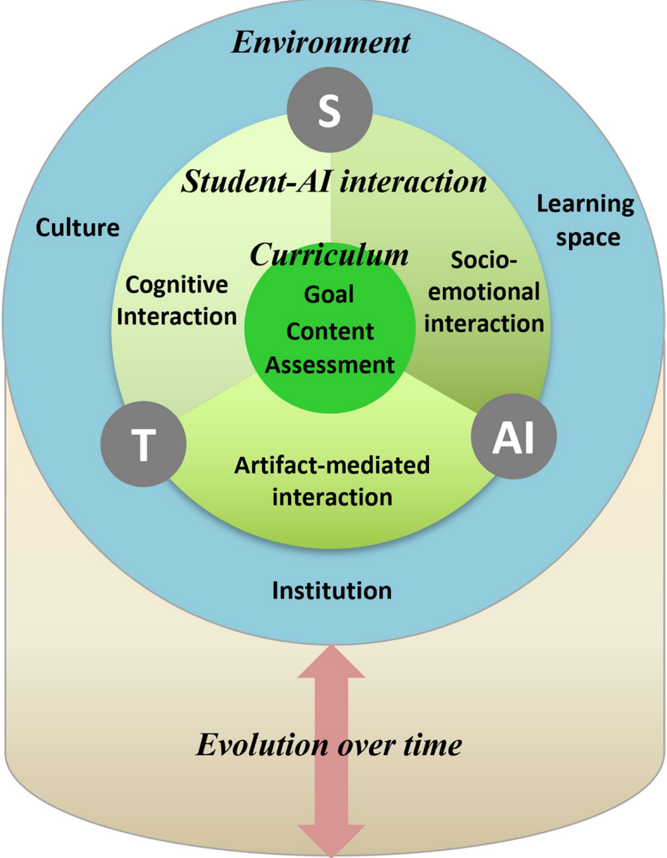
Preparing students to collaborate with AI remains a challenging goal. As AI technologies are new to K-12 schools, there is a lack of studies that inform how to design learning when AI is introduced as a collaborative learning agent to classrooms. The present study, therefore, aimed to explore teachers’ perspectives on what (1) curriculum design, (2) student-AI interaction, and (3) learning environments are required to design student-AI collaboration (SAC) in learning and (4) how SAC would evolve. Through in-depth interviews with 10 Korean leading teachers in AI in Education (AIED), the study found that teachers perceived capacity and subject-matter knowledge building as the optimal learning goals for SAC. SAC can be facilitated through interdisciplinary learning, authentic problem solving, and creative tasks in tandem with process-oriented assessment and collaboration performance assessment. While teachers expressed instruction on AI principles, data literacy, error analysis, AI ethics, and AI experiences in daily life were crucial support, AI needs to offer an instructional scaffolding and possess attributes as a learning mate to enhance student-AI interaction. In addition, teachers highlighted systematic AIED policy, flexible school system, the culture of collaborative learning, and a safe to fail environment are significant. Teachers further anticipated students would develop collaboration with AI through three stages: (1) learn about AI, (2) learn from AI, and (3) learn together. These findings can provide a more holistic understanding of the AIED and implications for the educational policies, educational AI design as well as instructional design that are aimed at enhancing SAC in learning.
Overview
The claims and statistics of this paper haven’t been checked yet.
Free: it reads the open-access text and checks the first 5 claims that cite a source we can check. Create a free account to check every claim.
Integrity signals
Registry
Cites
Statistics
Figures
Verification
Claims the paper makes
The claims and statistics of this paper haven’t been checked yet.
Free: it reads the open-access text and checks the first 5 claims that cite a source we can check. Create a free account to check every claim.
Claims other papers make about this one
Each is checked against this paper’s own text: does it say what the citing paper says it does?
The cited source says what the claim attributes to it.
In the citing paper
“This collaborative process aligns with the vision that AI tools act not just as implementers of human ideas, but as active collaborators in the creative process [7, 23].”
From Scaffolding Creativity: Integrating Generative AI Tools and Real-World Experiences in Business Education (2025) · cites this paper as [7]
The cited source says what the claim attributes to it.
In the citing paper
“Similarly, the positive effects of SI are consistent with prior research indicating that social expectations, peer endorsement, and collective support can shape users’ acceptance of new technologies [61,103,104,105,106].”
In the citing paper
“For many teachers, it may be their first time to use AIED technologies for teaching.They may not have rich experience of using AIED technologies to teach, and they face various challenges such as technological difficulties, communication and collaboration problems when using these novel-to-teacher technologies (Kim et al., 2022).”
From Teachers’ AI digital competencies and twenty-first century skills in the post-pandemic world (2023) · doi:10.1007/s11423-023-10203-6 · cites this paper as Kim et al., 2022
Self-check
Percentages, sums and reported differences re-computed from the paper’s own numbers.
The self-check needs the paper’s full text.
Citations
Cites
Using thematic analysis in psychology
Braun, V., & Clarke, V. (2006) · Qualitative Research in Psychology · doi:10.1191/1478088706qp063oa · Cited by 194,414
Zawacki-Richter, O., Marín, V. I., Bond, M., & Gouverneur, F. (2019) · International Journal of Educational Technology in Higher Education · doi:10.1186/s41239-019-0171-0 · Cited by 7,242 · cited 2×
“In particular, the time and cost of developing and introducing an appropriate methodology for implementing AIED pose a major challenge in public educational institutions (Zawacki-Richter et al., 2019).”
BackgroundIntelligent agents: theory and practice
Wooldridge, M., & Jennings, N. R. (1995) · The Knowledge Engineering Review · doi:10.1017/s0269888900008122 · Cited by 6,810
Hollan, J., Hutchins, E., & Kirsh, D. (2000) · ACM Transactions on Computer-Human Interaction · doi:10.1145/353485.353487 · Cited by 2,300 · cited 1×
“Second, the analysis looks for a range of mechanisms that can partake in the cognitive system rather than restricting itself to symbol manipulation and computation – e.g. the interplay between human memory, external representations, and the manipulation of objects (Hollan et al., 2000, p. 176).”
BackgroundThe evolution of research on collaborative learning
Dillenbourg, P., Baker, M. J., Blaye, A., & O’Malley, C. L. (1995) · HAL · Cited by 2,018
How a Cockpit Remembers Its Speeds
Hutchins, E. (1995) · Cognitive Science · doi:10.1207/s15516709cog1903_1 · Cited by 1,880 · cited 2×
“…an effective framework for a holistic understanding of the complex relations and interactions among heterogeneous agents (i.e., students, AI, and teachers), the multiple existing digital technologies, and practices in the classroom environment (Hutchins, 1995; Perkins, 1993; Nardi & O’Day, 1999).”
BackgroundBarr, V., & Stephenson, C. (2011) · ACM Inroads · doi:10.1145/1929887.1929905 · Cited by 1,692 · cited 1×
“While discussions on CT skills were narrowly positioned within the field of computer science or STEM-related subjects (Barr & Stephenson, 2011; Lee et al., 2020), this study moves CT forward to be extensible and embedded across disciplines.”
BackgroundDemystifying computational thinking
Shute, V. J., Sun, C., & Asbell-Clarke, J. (2017) · Educational Research Review · doi:10.1016/j.edurev.2017.09.003 · Cited by 1,466 · cited 1×
“…improving computational thinking (CT), a set of skills including decomposition, abstraction, algorithm design, debugging, testing/simulation, heuristic reasoning, and generalization, is being accentuated to understand and use AI effectively to solve problems (Shute et al., 2017; NRC, 2010).”
BackgroundAUGMENTING HUMAN INTELLECT: A CONCEPTUAL FRAMEWORK
ENGELBART, D. C. (1962) · doi:10.21236/ad0289565 · Cited by 1,082
New Technology and Digital Worlds: Analyzing Evidence of Equity in Access, Use, and Outcomes
Warschauer, M., & Matuchniak, T. (2010) · Review of Research in Education · doi:10.3102/0091732x09349791 · Cited by 1,047
Research works printed but not linked: 4
- Ai, R., Bhatt, M., Chevrier, S., Ciccarelli, R., Grady, R., Kumari, V., Li, K., Nazarli, N., Rahimi, H., Roberts, J., Sachs, J., Schepmyer, A., Wang, M., & Wong, H. (2008). Choose your own inquiry. , University Press of America.
- Big Innovation Center. (2020). AI in education: Embedding AI tools into teaching curricula. Big Innova- tion Centre.
- Johnson, D. W., & Johnson, R. T. (2006). Cooperation and the use of technology. In D. H. Jonassen (Ed.), Handbook of research on educational communications and technology (2 ed.), (pp. 785-811). , Lawrence Erlbaum Associates.
- Okoye, K., Nganji, J. T., & Hosseini, S. (2020). Learning analytics for educational innovation: A sys- tematic mapping study of early indicators and success factors. International Journal of Computer Information Systems and Industrial Management Applications, 12, 138-154.
Cited by
Items 401–500 of 669
Dahri, N. A., Hussain, A., Amjad, A. I., Fauadi, M. H. F. M., & Soomro, R. B. (2026) · Information and Software Technology · doi:10.1016/j.infsof.2026.108287 · Cited by 1
Empowering educators: A pilot study on AI literacy in K–12 professional development
Nelson, K., Du, S., Marshall, D. T., Bowers, S., & Ali, A. (2026) · Online Learning · doi:10.24059/olj.v30i3.5251 · Cited by 1
El uso de la inteligencia artificial en un entorno académico
Márquez-Benavides, L., Goytia, E. L. M., & Ramirez, L. F. G. (2023) · Ciencia Nicolaita · doi:10.35830/cn.vi89.721 · Cited by 11
Ihejirika, N. O., Ogana, M., & OYISE, U. E. (2023) · Direct Research Journal of Social Science and Educational Studies · doi:10.26765/drjsses19591767 · Cited by 7
Direct/Explicit Instruction and Social Constructivist Practices in The Inclusive Classroom
Matthews, A. M. (2024) · in education · doi:10.37119/ojs2024.v29i1.738 · Cited by 6
First-Year Students’ Usage of and Attitudes Towards Mindless and Mindful AI-Technology
Delcker, J., Heil, J., Ifenthaler, D., Seufert, S., & Spirgi, L. (2024) · Cognition and exploratory learning in the digital age · doi:10.1007/978-3-031-66462-5_2 · Cited by 1
PECULIARITIES OF AI-TOOLS UTILIZATION AS A SUPPORTER DURING THE MARTIAL LAW
Момот, В. Є., & Lytvynenko, O. M. (2024) · Actual Problems in the System of Education General Secondary Education Institution – Pre-University Training – Higher Education Institution · doi:10.18372/2786-5487.1.18726 · Cited by 1
University Moral Education Management System using Ensemble Learning in Data Mining
Wang, Y. (2024) · International Conference on Data Science and Network Security (ICDSNS) · doi:10.1109/icdsns62112.2024.10690914 · Cited by 1
“The data size gathered by different researchers varies significantly and depends on the university [12].”
BackgroundThe Challenge Based Learning Challenge
Beattie, S. (2024) · Springer texts in education · doi:10.1007/978-981-96-0198-1_1 · Cited by 2
Xu, Q., Gu, J., & Lu, J. (2024) · International Conference on Computer Technology and Development · doi:10.1109/techdev64369.2024.00021 · Cited by 6
Masripah, Anisah, A. S., & Irvani, A. I. (2024) · Eduscape Journal of Education Insight · doi:10.61978/eduscape.v2i4.410 · Cited by 14
“…how technology serves as a bridge to access new information and perspectives, enabling deeper and more relevant exploration of diverse viewpoints within Islamic thought in response to contemporary challenges (Adiyono & Anshor, 2024; Broo et al., 2022; Kim et al., 2022; Laufer et al., 2021).”
Xu, Q., & Gan, Y. (2025) · Applied Mathematics and Nonlinear Sciences · doi:10.2478/amns-2025-0625 · Cited by 1
Luo, P. (2025) · International Conference on Intelligent Systems and Computational Networks (ICISCN) · doi:10.1109/iciscn64258.2025.10934565 · Cited by 1
Collaborative Learning Environments by Educational Agent Feedback Systems
Qi, X., Meng, H., & Yu, X. (2024) · International Conference on Intelligent Education and Intelligent Research (IEIR) · doi:10.1109/ieir62538.2024.10959855 · Cited by 2
Assessing the Use of ChatGPT as a Pedagogical Tool: A Small Study
Otto, L. (2024) · Africa Education Review · doi:10.1080/18146627.2025.2471272 · Cited by 5
“Kim et al. (2022) highlight that more work is, however, needed to inform how AI introduced as a “collaborative learning agent in the classroom,” and this study reflects an acceptance of that challenge.”
Karafli, K. E. (2025) · Advances in computational intelligence and robotics book series · doi:10.4018/979-8-3373-1827-1.ch014 · Cited by 2
Educational Experience and Expertise: Exploring Terminological Dimensions in Shaping Childhood
Asrifan, A., Ilyas, S. N., Asti, A. S. W., Afifah, F., Lismayani, A., & Syamsuardi, S. (2025) · IGI Global eBooks · doi:10.4018/979-8-3693-9969-9.ch001 · Cited by 2
Osypova, N. V., Kokhanovska, O., & Zhorova, I. (2026) · CTE Workshop Proceedings · doi:10.55056/cte.982 · Cited by 1
Pemanfaatan Kecerdasan Buatan (AI) dalam Meningkatkan Pembelajaran Siswa Sekolah Menengah Pertama
Kusumaningtyas, W. (2025) · RIGGS Journal of Artificial Intelligence and Digital Business · doi:10.31004/riggs.v4i2.827 · Cited by 11
AI-Enhanced Teacher Support: Empowering Educators to Achieve More
Abdullah, Z. B., & Said, M. N. H. M. (2025) · Advances in Science, Technology & Innovation/Advances in science, technology & innovation · doi:10.1007/978-3-031-56848-0_10 · Cited by 3
Enlightening Educators: Unlocking the Benefits of AI in Faculty Development
Morton, T. B. (2025) · Advances in computational intelligence and robotics book series · doi:10.4018/979-8-3373-1122-7.ch004 · Cited by 1
Astra, I. M., Henukh, A., Irvani, A. I., & Jua, S. K. (2025) · Journal of Physics Conference Series · doi:10.1088/1742-6596/3139/1/012096 · Cited by 1
Sun, L., & Zheng, Y. (2026) · Journal of Research on Technology in Education · doi:10.1080/15391523.2026.2711656 · Cited by 1
Empowering Educators: A Practical Approach to AI Literacy in K-12 ClassroomsPreprint
Nelson, K. R., Du, S., Marshall, D. T., Bowers, S., & Ali, A. (2025) · SocArXiv (OSF Preprints) · doi:10.31235/osf.io/ueyba_v1 · Cited by 2
AI Ethics Knowledge Among Chinese Teachers: An Empirical AssessmentPreprint
Zhang, J., & Rhee, G. S. (2025) · Research Square · doi:10.21203/rs.3.rs-7042877/v1 · Cited by 5
Zhou, Z., Zhou, Y., Ouyang, B., Man, S. S., & Chan, A. H. S. (2026) · Healthcare · doi:10.3390/healthcare14131978
Kim, J., Yang, G., Chan, W. S., Lin, X., Song, Y., & Li, N. (2026) · European Journal of Education · doi:10.1111/ejed.70658 · Cited by 1
Self-citationDelgado, R. P. R., Laguado-Ramírez, R. I., & Villamizar, F. Y. H. (2020) · Mundo FESC · doi:10.15562/bmj.v9i3.2075
Woo, D. J., Susanto, H., & Wang, Y. (2022) · EdArXiv (OSF Preprints) · doi:10.35542/osf.io/mv7nj
Peer Review #1 of "A step toward building a unified framework for managing AI bias (v0.1)"
(2023) · PeerJ Computer Science · doi:10.7287/peerj-cs.1630v0.1/reviews/1
Peer Review #2 of "A step toward building a unified framework for managing AI bias (v0.1)"
(2023) · PeerJ Computer Science · doi:10.7287/peerj-cs.1630v0.1/reviews/2
Peer Review #2 of "A step toward building a unified framework for managing AI bias (v0.2)"
(2023) · PeerJ Computer Science · doi:10.7287/peerj-cs.1630v0.2/reviews/2
Peer Review #2 of "A step toward building a unified framework for managing AI bias (v0.3)"
(2023) · PeerJ Computer Science · doi:10.7287/peerj-cs.1630v0.3/reviews/2
The Barcelona Conference on Arts, Media & Culture 2023: Official Conference Proceedings
(2023) · The Barcelona Conference on Arts, Media & Culture official conference proceedings · doi:10.22492/issn.2435-9475.2023 · Cited by 4
Yıldız, G., & Bianchi, F. (2023) · The Barcelona Conference on Arts, Media & Culture official conference proceedings · doi:10.22492/issn.2435-9475.2023.7 · Cited by 1
Dealing with Learning Vulnerability: Service Robots to Nudge Student Engagement
Ranieri, A., Bernardo, I. D., Mele, C., & Spena, T. R. (2023) · IEEE International Conference on Metrology for eXtended Reality, Artificial Intelligence and Neural Engineering (MetroXRAINE) · doi:10.1109/metroxraine58569.2023.10405581
“In other words, they play a vital role in facilitating real-time interactions, leading to engaging learning experiences [29].”
Backgroundمدى توافر الكفايات الرقمية للذكاء الاصطناعي لدى معلمي المرحلة الثانوية بمنطقة الحدود الشمالية
الضلعان, م. ب. ص. (2024) · Maǧallaẗ Kulliyyaẗ Al-Tarbiyyaẗ Bil-Manṣūraẗ · doi:10.21608/maed.2024.353556 · Cited by 1
Navigating Educational Reforms: Urban-Rural Divergence in Indonesian Teachers' ExperiencesPreprint
Baharuddin, B., & Burhan, B. (2024) · SSRN Electronic Journal · doi:10.2139/ssrn.4885503
Chandel, A., Sharma, A. R., Chowdary, A. P., & Saluja, S. (2024) · Advances in marketing, customer relationship management, and e-services book series · doi:10.4018/979-8-3693-6660-8.ch011
Analisis konten budaya kolaboratif berbasis Grounded Theory menggunakan Text Mining
Julians, A. R., Manongga, D. H. F., & Hendry, H. (2024) · AITI · doi:10.24246/aiti.v21i2.230-250 · Cited by 1
The Impact of AI Assistance on Student Learning: A Cross-Disciplinary Study in STEM Education
Fried, M., & Alshibli, M. (2024) · ASEE Middle Atlantic Section Spring Conference · doi:10.18260/1-2--49457
Lanham, J., & Smith, G. (2024) · Advances in educational technologies and instructional design book series · doi:10.4018/979-8-3373-1017-6.ch013 · Cited by 2
The Future of Education: Student Attitudes Toward AI-Enhanced Online Courses
Jindal, A., & Kumar, P. (2024) · Lecture notes in networks and systems · doi:10.1007/978-981-97-6581-2_33 · Cited by 2
Comparing Inclusive Education Practices Implemented in Schools According to Stages of Education
Karaman, H. S., & Maya, İ. (2024) · Özgür Yayınları eBooks · doi:10.58830/ozgur.pub590.c2456
Yapay Zeka ile Eğitimde Dönüşüm: Fırsatlar, Zorluklar ve Yeni Dinamikler
Özdere, M. (2024) · Özgür Yayınları eBooks · doi:10.58830/ozgur.pub590.c2455
Güncel Eğitim Yönetimi Uygulamaları
Erdemir, B., Özdere, M., Karaman, H. S., Maya, İ., Yılmaz, Z., Kılçık, F., Serin, H., Dörterler, S. Ö., Uslu, S., Gezmen, R., et al. (2024) · Özgür Yayınları eBooks · doi:10.58830/ozgur.pub590
Mutlu, A. (2024) · Özgür Yayınları eBooks · doi:10.58830/ozgur.pub590.c2460
Yılmaz, Z., Kılçık, F., & Serin, H. (2024) · Özgür Yayınları eBooks · doi:10.58830/ozgur.pub590.c2457
Yazıcı, S. Ç., & Kaya, G. (2024) · Özgür Yayınları eBooks · doi:10.58830/ozgur.pub590.c2603
Sosyal Bilgiler Öğretmen Adaylarının Coğrafi İşaretli Ürünleri Satın Almaya Yönelik Tutumları
Uslu, S., Gezmen, R., & Özalp, A. (2024) · Özgür Yayınları eBooks · doi:10.58830/ozgur.pub590.c2459
Erken Çocukluk Eğitiminde Yönetim
Dörterler, S. Ö. (2024) · Özgür Yayınları eBooks · doi:10.58830/ozgur.pub590.c2458
Utilization of the YouTube Application in Learning Akidah Akhlak at Senior High School
Fathurrohman, F., As’ad, M., Ninsiana, W., Asy’arie, B. F., & Al-Mahdi (2024) · Bustanul Ulum Journal of Islamic Education · doi:10.62448/bujie.v2i2.99
Cantika, V. M., & Munir, M. (2024) · Al Hikmah Journal of Education · doi:10.54168/ahje.v5i2.320
“This technology enables educators to develop customized resources, including pertinent conversational dialogues and interactive presentations (Kim et al., 2022) of Javanese traditional stories.”
Pemanfaatan Perplexity.ai sebagai Instrumen Asesmen Diagnostik Produk Puisi Kelas VIII SMP
Setyowati, P. A., Sufanti, M., & Rahmawati, L. E. (2024) · Kajian Linguistik dan Sastra · doi:10.23917/kls.v9i2.6675
Navarro, E., Samaniego, J. A. B., Ordóñez, A. J. Q., Nuñez, G. L. N., & Maliza-Cruz, W. I. (2024) · Data & Metadata · doi:10.56294/dm2024.211
Transforming Early Childhood Language Pedagogy
Manditereza, B. (2025) · IGI Global eBooks · doi:10.4018/979-8-3693-7437-5.ch001
Entre Neuronas y Algoritmos: El Nuevo Horizonte de la Creatividad
Sánchez, E. D. A., Pérez, N. A. G., Aguilar, I. L. P., & constante, L. A. R. (2025) · Estudios y Perspectivas Revista Científica y Académica · doi:10.61384/r.c.a..v5i1.979
Cao, H. (2025) · International Journal of Education and Humanities · doi:10.54097/6jmf2j57
Subaash, S. R., Sundaram, A., Nimma, D., Kalaiarasan, C., Shukla, T. D., & Karthik, M. (2024) · IEEE International Conference on Green Industrial Electronics and Sustainable Technologies (GIEST) · doi:10.1109/giest62955.2024.10959765
“Moreover, AI-pushed systems excel in personalizing the getting to know enjoy [3].”
Leveraging AI Tools for Language Learning Activities
Torres, K. M., & Statti, A. L. C. (2025) · Advances in computational intelligence and robotics book series · doi:10.4018/979-8-3693-7260-9.ch007 · Cited by 1
Research on Teaching Design for AI-Enabled Higherorder Thinking Cultivation
Ke, W., Xuan, D., He, D., & Pan, M. (2024) · IEEE/WIC/ACM International Conference on Web Intelligence and Intelligent Agent Technology (WI-IAT) · doi:10.1109/wi-iat62293.2024.00125
“In an AI-enabled learning ecosystem, students can not only receive support during their studies but also continue to receive recommendations and guidance on educational resources during their careers[6].”
Leveraging Generative AI for Problem-Based Learning: Promoting Student-Initiated ScaffoldingPreprint
Jiang, J., & Kahai, S. S. (2025) · SSRN Electronic Journal · doi:10.2139/ssrn.5204175 · Cited by 3
Wang, Z. (2024) · International Conference on Information Education and Artificial Intelligence (ICIEAI) · doi:10.1145/3724504.3724637
“Before this model, students were portrayed as massive recipients, however, recent in a study [18] learners are shown as collaborators, who interact with AI and achieve optimized learning AI has shown its increasing role to permeate the educational ecosystem by interacting with students.”
InfluentialImproving English language proficiency through text-based activities with the help of ChatGPT
Enamorado, M. Á. J. (2025) · Nordic Journal of Digital Literacy · doi:10.18261/njdl.20.1.8 · Cited by 3
Li, N., & Fan, Q. (2025) · IEEE International Conference on Electronics, Energy Systems and Power Engineering (EESPE) · doi:10.1109/eespe63401.2025.10986931
“Kim et al. explored teachers' views on students' collaboration with artificial intelligence, focusing on course design, student interaction, learning environment, and future development [10].”
How Effective are AI Tools for Diverse Learners? A Case Study on Python and Data Science Education
Kehar, A., Abro, A., & Fatima, S. (2025) · VAWKUM Transactions on Computer Sciences · doi:10.21015/vtcs.v13i1.2075 · Cited by 1
San-hong, T., YaoYang, W., Li, W., Jun, P., & Sarwar, U. (2025) · Advances in computational intelligence and robotics book series · doi:10.4018/979-8-3373-1827-1.ch002
The New Frontiers of Stories: Exploring Literature in An Era of AI and Technological Revolution
Gulzar., D. (2025) · Shanlax International Journal of Arts Science and Humanities · doi:10.34293/sijash.v12is3-jan.8816
Intelligent Tutoring Systems for Leveraging Manufacturing Practical Skill Development
Fang, W., Meng, H., Zhao, Q., & Shen, J. (2025) · International Conference on Computer Supported Cooperative Work in Design (CSCWD) · doi:10.1109/cscwd64889.2025.11033502
AI-Tutors: Can AI replace human teachers
Singh, A. K., & Singh, T. (2025) · International Journal of Statistics and Applied Mathematics · doi:10.22271/maths.2025.v10.i6b.2068 · Cited by 2
AI som underviser: Coping med Copilot gav nye indsigter
Elmer, H., & Hansen, K. (2025) · Tidsskriftet Læring og Medier (LOM) · doi:10.7146/lom.v18i31.156169
Mustafa, S. W., Sari, H., Asriany, A., & Hajeni, H. (2025) · Advances in computational intelligence and robotics book series · doi:10.4018/979-8-3373-5786-7.ch007 · Cited by 1
Romadhon, D. R., Lubis, A. B., Wulansari, N. F., Yudi, Y., & Masae, A. (2025) · CRC Press eBooks · doi:10.1201/9781003645542-63 · Cited by 2
Artificial Intelligence’s Adoption in Higher Education Institutions to Maintain Sustainability
Almukharreq, Z., & Sengupta, N. (2025) · Studies in big data · doi:10.1007/978-3-031-80656-8_51 · Cited by 1
AI’s Functions and Influences Among University Students in Indonesian Context
Maryansyah, Y., Badeni, B., & Masito, F. (2025) · Journal of English Education and Teaching · doi:10.33369/jeet.9.1.128-148
“This statement is consistent with what has been noticed by (Kim et al., 2022).”
Bridging Educational Gaps Across Nations with Al-Supported Collaboration Tools
Syamsuddin, N., Putra, A., Iman, B., Ishak, M. S., & Mustafa, M. (2025) · Advances in computational intelligence and robotics book series · doi:10.4018/979-8-3373-5781-2.ch008
Designing Virtual Teamwork for Creativity: Strategies for Higher Education
Asrifan, A., & Syahruddin, S. (2025) · IGI Global eBooks · doi:10.4018/979-8-3373-0375-8.ch003
AI in Education: Shaping Curriculum and Student Assessment
Dey, S. (2025) · Advances in computational intelligence and robotics book series · doi:10.4018/979-8-3373-5102-5.ch003
Toward AI Literacy: How Future Educators View the Role of Artificial Intelligence in Schools
Ranieri, M., Biagini, G., & Cuomo, S. (2025) · Communications in computer and information science · doi:10.1007/978-3-031-94002-6_11 · Cited by 2
A Study of the K-12 Teachers' Competency for the Artificial Intelligence Curriculum in China
Ning, K., Xu, E., Liu, Y., & Feng, X. (2025) · International Conference on Computer Science and Technologies in Education (CSTE) · doi:10.1109/cste64638.2025.11091913
“They illustrate a trend of gradual deepening from the top of the iceberg to the bottom or from the surface of the onion to the core, respectively, and correspond to the competency dimensions of the subject's knowledge and skills, social roles and self-concept, traits, and motivation [16][17][18].”
Boulhrir, T. (2025) · SSRN Electronic Journal · doi:10.2139/ssrn.5383761 · Cited by 5
Murtarelli, G., & Romenti, S. (2025) · IGI Global eBooks · doi:10.4018/979-8-3693-9067-2.ch010
Ma, R., & Yuan, B. (2025) · Transactions on Social Science Education and Humanities Research · doi:10.62051/8x97k644
The role of grit in idea planning for accounting education: A multi-context study
Liu, C.-H. S., Dong, T., Gan, B. K., & Vu, H. T. (2025) · The International Journal of Management Education · doi:10.1016/j.ijme.2025.101262
ChatGPT and Instructional Design: An Ally for Inclusion?
Lombardi, D., Traetta, L., & Maffei, A. (2025) · Communications in computer and information science · doi:10.1007/978-3-032-03021-4_9
Knowledge Scaffolding Recommendation System for Supervising Term Papers
Duong‐Trung, N., Wang, X., Bhoyar, R. R., Jose, A. M., Wrede, S. E., van Rijn, L., Panse, T., de Witt, C., & Pinkwart, N. (2025) · Lecture notes in computer science · doi:10.1007/978-3-032-03870-8_10 · Cited by 1
Xu, X. (2025) · Journal of Education Humanities and Social Sciences · doi:10.54097/2atvp377 · Cited by 1
“With the growing presence of AI in classrooms, researchers emphasize human-AI collaboration, suggesting that combining human facilitation with AI's capabilities would enhance learning outcomes more effectively than either alone [27].”
Jang, S., & Lee, Y.-J. (2025) · The Korean Society of Costume · doi:10.7233/jksc.2025.75.4.0154
Collaborative Learning Supported by Generative Artificial Intelligence and Rotation Station Model
Асатуллоевна, Д. М., & Владимировна, Ч. Е. (2025) · doi:10.1109/icaie64856.2025.11158520 · Cited by 1
“For instance, J. Kim et al. demonstrate that alternating between individual and group activities reduces cognitive load and enables students to focus on complex tasks without overworking [11].”
Li, W., & Su, N. (2025) · doi:10.1109/icaie64856.2025.11158384 · Cited by 2
“For instance, devices and programs that utilize AI can capture, aggregate, and analyze students ’ learning performance data in real-time from different sources to develop a student learning profile and automatically provide customized content, feedback, and learning parameters [13].”
Garcia, F., & Chevalier, L. (2025) · Management & Avenir · doi:10.3917/mav.148.0021
From Theory to Practice: Exploring Students’ Everyday Use of Physics Knowledge
Kotsis, K. Τ. (2025) · European Journal of Contemporary Education and E-Learning · doi:10.59324/ejceel.2025.3(5).05 · Cited by 3
Williams, J. E., Luongo, N., Finetti, M., & Garrels, J. (2025) · Advances in computational intelligence and robotics book series · doi:10.4018/979-8-3373-0396-3.ch007
Artificial Intelligence in Education: The Future of Learning
Bala, M., & Sharma, R. (2025) · BENTHAM SCIENCE PUBLISHERS eBooks · doi:10.2174/9798898810511125010009 · Cited by 1
The Rise of Artificial Intelligence
Bala, M., & Sharma, R. (2025) · BENTHAM SCIENCE PUBLISHERS eBooks · doi:10.2174/9798898810511125010004
AI-Powered English Education: Promoting Inclusivity and Equal Access in Language Learning for SDGs
Rosmayanti, V., Fara, G. R., Safaruddin, S., Aminah, I., & Yuliana, B. (2025) · IGI Global eBooks · doi:10.4018/979-8-3373-1837-0.ch007
Mariani, C., Aaltonen, K., Ingason, H. Þ., Mancini, M., & Huemann, M. (2025) · Project Leadership and Society · doi:10.1016/j.plas.2025.100199 · Cited by 6
Human: The Final Decision-Maker in the Technological Era
Fung, K. C., Cheung, K. Y., & Lai, C. Y. (2025) · Signals and communication technology · doi:10.1007/978-3-031-96855-6_9
Khaleel, F., Harte, P., & Avdukić, A. (2025) · Emerald Group Publishing Limited eBooks · doi:10.1108/978-1-83549-788-320251030
Metadata
- Authors
- Kim, J., Lee, H., & Cho, Y. H.
- Affiliations
- Seoul National University (KR)
- Corresponding author
- Cho, Young Hoan
- Venue
- Education and Information Technologies
- Published
- 2022-01-28
- Volume
- 27
- Issue
- 5
- Pages
- 6069-6104
- ISSN
- 1360-2357 (ISSN-L)
- 1573-7608
- OpenAlex
- W4221079197
- Cited by
- 669
- References
- 66
- Citations by year
- 2026: 206 · 2025: 247 · 2024: 158 · 2023: 51 · 2022: 6
- FWCI
- 114.37
- Type
- journal article
- Language
- en
- Open access
- hybrid
- doi.org
- Licence
- cc-by
- creativecommons.org/licenses/by/4.0 (tdm)
- creativecommons.org/licenses/by/4.0 (vor)
- Locations
- Education and Information Technologies (publishedVersion, cc-by)
- Seoul National University Open Repository (Seoul National University) (submittedVersion)
- Topics
- Social Sciences › Education › Artificial Intelligence in Education
- Physical Sciences › Computer Science › Artificial Intelligence › Intelligent Tutoring Systems and Adaptive Learning
- Social Sciences › Psychology › Developmental and Educational Psychology › Innovative Teaching and Learning Methods
- Keywords
- learning design, artificial intelligence in education, teacher perceptions, curriculum development, student-AI interaction, learning environment, interdisciplinary learning, authentic problem solving, process-oriented assessment, data literacy, AI ethics, instructional scaffolding, collaborative learning culture, K-12 education
About these checks
Registry, retraction, Cites and statistics results are computed, not judged, with one exception: a printed reference that no index lists is read once by a model before it counts as a citation error. Claims are extracted by a model and kept only when their quote appears verbatim in the text; each cited source is then checked, with a model’s help, for whether it says what the claim relies on. Those verdicts can be wrong — read the claim’s quote and the cited source before relying on one.
Statistics and arithmetic are recomputed, not judged.
Confidence bands are shown only for fields calibrated on our annotated test set. None is calibrated yet, so no band is shown.
What counts as a claim ›How we measure confidence ›How we check this ›
Are you an author, or do you see a problem with this page? Request a review
Data sources
Bibliographic data: Semantic Scholar, OpenAlex, Crossref.
Contains information from the Semantic Scholar Academic Graph Datasets, made available under the ODC Attribution License (ODC-BY 1.0).
Semantic Scholar’s data is described in: Kinney, R., et al. (2023). The Semantic Scholar Open Data Platform. arXiv:2301.10140.
