

Learning design to support student-AI collaboration: perspectives of leading teachers for AI in education
Open accessThe DOI matches its Crossref record; 68 of the 68 references it cites were found in a registry or an index.
Abstract
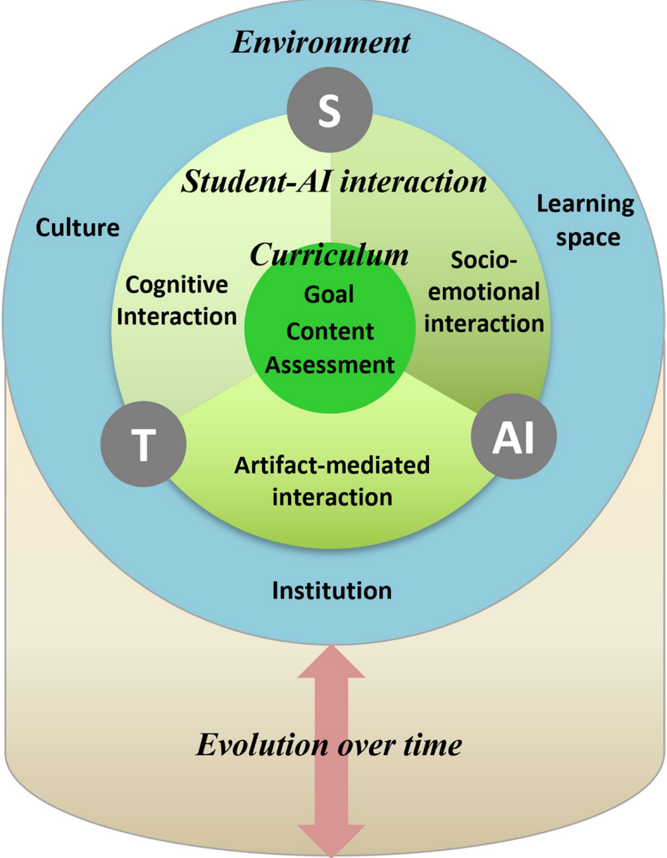
Preparing students to collaborate with AI remains a challenging goal. As AI technologies are new to K-12 schools, there is a lack of studies that inform how to design learning when AI is introduced as a collaborative learning agent to classrooms. The present study, therefore, aimed to explore teachers’ perspectives on what (1) curriculum design, (2) student-AI interaction, and (3) learning environments are required to design student-AI collaboration (SAC) in learning and (4) how SAC would evolve. Through in-depth interviews with 10 Korean leading teachers in AI in Education (AIED), the study found that teachers perceived capacity and subject-matter knowledge building as the optimal learning goals for SAC. SAC can be facilitated through interdisciplinary learning, authentic problem solving, and creative tasks in tandem with process-oriented assessment and collaboration performance assessment. While teachers expressed instruction on AI principles, data literacy, error analysis, AI ethics, and AI experiences in daily life were crucial support, AI needs to offer an instructional scaffolding and possess attributes as a learning mate to enhance student-AI interaction. In addition, teachers highlighted systematic AIED policy, flexible school system, the culture of collaborative learning, and a safe to fail environment are significant. Teachers further anticipated students would develop collaboration with AI through three stages: (1) learn about AI, (2) learn from AI, and (3) learn together. These findings can provide a more holistic understanding of the AIED and implications for the educational policies, educational AI design as well as instructional design that are aimed at enhancing SAC in learning.
Overview
The claims and statistics of this paper haven’t been checked yet.
Free: it reads the open-access text and checks the first 5 claims that cite a source we can check. Create a free account to check every claim.
Integrity signals
Registry
Cites
Statistics
Figures
Verification
Claims the paper makes
The claims and statistics of this paper haven’t been checked yet.
Free: it reads the open-access text and checks the first 5 claims that cite a source we can check. Create a free account to check every claim.
Claims other papers make about this one
Each is checked against this paper’s own text: does it say what the citing paper says it does?
The cited source says what the claim attributes to it.
In the citing paper
“This collaborative process aligns with the vision that AI tools act not just as implementers of human ideas, but as active collaborators in the creative process [7, 23].”
From Scaffolding Creativity: Integrating Generative AI Tools and Real-World Experiences in Business Education (2025) · cites this paper as [7]
The cited source says what the claim attributes to it.
In the citing paper
“Similarly, the positive effects of SI are consistent with prior research indicating that social expectations, peer endorsement, and collective support can shape users’ acceptance of new technologies [61,103,104,105,106].”
In the citing paper
“For many teachers, it may be their first time to use AIED technologies for teaching.They may not have rich experience of using AIED technologies to teach, and they face various challenges such as technological difficulties, communication and collaboration problems when using these novel-to-teacher technologies (Kim et al., 2022).”
From Teachers’ AI digital competencies and twenty-first century skills in the post-pandemic world (2023) · doi:10.1007/s11423-023-10203-6 · cites this paper as Kim et al., 2022
Self-check
Percentages, sums and reported differences re-computed from the paper’s own numbers.
The self-check needs the paper’s full text.
Citations
Cites
Using thematic analysis in psychology
Braun, V., & Clarke, V. (2006) · Qualitative Research in Psychology · doi:10.1191/1478088706qp063oa · Cited by 194,414
Zawacki-Richter, O., Marín, V. I., Bond, M., & Gouverneur, F. (2019) · International Journal of Educational Technology in Higher Education · doi:10.1186/s41239-019-0171-0 · Cited by 7,242 · cited 2×
“In particular, the time and cost of developing and introducing an appropriate methodology for implementing AIED pose a major challenge in public educational institutions (Zawacki-Richter et al., 2019).”
BackgroundIntelligent agents: theory and practice
Wooldridge, M., & Jennings, N. R. (1995) · The Knowledge Engineering Review · doi:10.1017/s0269888900008122 · Cited by 6,810
Hollan, J., Hutchins, E., & Kirsh, D. (2000) · ACM Transactions on Computer-Human Interaction · doi:10.1145/353485.353487 · Cited by 2,300 · cited 1×
“Second, the analysis looks for a range of mechanisms that can partake in the cognitive system rather than restricting itself to symbol manipulation and computation – e.g. the interplay between human memory, external representations, and the manipulation of objects (Hollan et al., 2000, p. 176).”
BackgroundThe evolution of research on collaborative learning
Dillenbourg, P., Baker, M. J., Blaye, A., & O’Malley, C. L. (1995) · HAL · Cited by 2,018
How a Cockpit Remembers Its Speeds
Hutchins, E. (1995) · Cognitive Science · doi:10.1207/s15516709cog1903_1 · Cited by 1,880 · cited 2×
“…an effective framework for a holistic understanding of the complex relations and interactions among heterogeneous agents (i.e., students, AI, and teachers), the multiple existing digital technologies, and practices in the classroom environment (Hutchins, 1995; Perkins, 1993; Nardi & O’Day, 1999).”
BackgroundBarr, V., & Stephenson, C. (2011) · ACM Inroads · doi:10.1145/1929887.1929905 · Cited by 1,692 · cited 1×
“While discussions on CT skills were narrowly positioned within the field of computer science or STEM-related subjects (Barr & Stephenson, 2011; Lee et al., 2020), this study moves CT forward to be extensible and embedded across disciplines.”
BackgroundDemystifying computational thinking
Shute, V. J., Sun, C., & Asbell-Clarke, J. (2017) · Educational Research Review · doi:10.1016/j.edurev.2017.09.003 · Cited by 1,466 · cited 1×
“…improving computational thinking (CT), a set of skills including decomposition, abstraction, algorithm design, debugging, testing/simulation, heuristic reasoning, and generalization, is being accentuated to understand and use AI effectively to solve problems (Shute et al., 2017; NRC, 2010).”
BackgroundAUGMENTING HUMAN INTELLECT: A CONCEPTUAL FRAMEWORK
ENGELBART, D. C. (1962) · doi:10.21236/ad0289565 · Cited by 1,082
New Technology and Digital Worlds: Analyzing Evidence of Equity in Access, Use, and Outcomes
Warschauer, M., & Matuchniak, T. (2010) · Review of Research in Education · doi:10.3102/0091732x09349791 · Cited by 1,047
Research works printed but not linked: 4
- Ai, R., Bhatt, M., Chevrier, S., Ciccarelli, R., Grady, R., Kumari, V., Li, K., Nazarli, N., Rahimi, H., Roberts, J., Sachs, J., Schepmyer, A., Wang, M., & Wong, H. (2008). Choose your own inquiry. , University Press of America.
- Big Innovation Center. (2020). AI in education: Embedding AI tools into teaching curricula. Big Innova- tion Centre.
- Johnson, D. W., & Johnson, R. T. (2006). Cooperation and the use of technology. In D. H. Jonassen (Ed.), Handbook of research on educational communications and technology (2 ed.), (pp. 785-811). , Lawrence Erlbaum Associates.
- Okoye, K., Nganji, J. T., & Hosseini, S. (2020). Learning analytics for educational innovation: A sys- tematic mapping study of early indicators and success factors. International Journal of Computer Information Systems and Industrial Management Applications, 12, 138-154.
Cited by
Items 601–669 of 669
Ibrahim, A., & Nemt-allah, M. A. (2026) · Scientific Reports · doi:10.1038/s41598-026-62798-4 · Cited by 4
A narrative inquiry framework for AI-supported reflective thinking in architectural design education
Kang, E., Shin, Y., & Park, E. J. (2026) · International Journal of Architectural Research Archnet-IJAR · doi:10.1108/arch-12-2025-0565
Xie, Z., Niu, W., & Zhang, W. (2026) · Current Psychology · doi:10.1007/s12144-026-09829-5
“Unlike previous research that mostly employed a qualitative method in investigating factors facilitating AI education (Kim et al., 2022 ), we employed a survey design.”
Exploring the potential of generative AI and teacher collaboration in evaluating academic papers
Zhong, Q., Ji, H., Liu, T., Li, F., & Wang, X. (2026) · Education and Information Technologies · doi:10.1007/s10639-025-13864-3
“In the design of student-AI collaboration (SAC) courses, AI has been positioned as a learning partner to foster student competencies (Kim et al., 2022 ).”
Habibi, M. M., & Islami, J. M. M. (2026) · Research Square · doi:10.21203/rs.3.rs-10490075/v1
Research on Utilizing AI in Educational Environment
Ichimov, M. A. M., Moiceanu, G., Simion, P. C., & Kabaş, A. (2026) · Proceedings of the ... International Conference on Business Excellence · doi:10.2478/picbe-2026-0179
“Kim, Lee, and Cho (2022) explored learning models for student-AI collaboration and highlighted teachers’ perspectives on how to structure effective interactions, emphasizing the need to balance technological capability with pedagogical intent.”
Ren, T., Hong, Y., Gong, Y., & Yang, Y. (2026) · Global Education Bulletin · doi:10.71052/grb2025/esjg4926
Rethinking assessment in the age of AI: Towards authentic and AI-resilient practices
Vaghjee, G., & Vaghjee, H. (2026) · Elsevier eBooks · doi:10.1016/b978-0-443-36775-5.00008-4
Gan, X., & Hou, Y. (2026) · Connection Science · doi:10.1080/09540091.2026.2682059
Timbao, G. A., & ESPINOSA, F. (2026) · Psychology and Education A Multidisciplinary Journal · doi:10.70838/pemj.600802
Li, T., Liu, Z., & Zou, D. (2026) · PLoS ONE · doi:10.1371/journal.pone.0355494 · Cited by 2
“On the positive side, more frequent and active engagement with AI writing tools may provide learners with greater linguistic support [61–63], improved efficiency [2,64,65], and stronger confidence during the writing process [4,7,44].”
Muliyani, R., Suhandi, A., Prima, E. C., Muslim, M., Kurniawan, Y., & Priatna, D. R. (2026) · F1000Research · doi:10.12688/f1000research.186991.1
“AI should therefore not be confounded with information (Jose et al., 2025; Kim et al., 2022; Yan et al., 2024).”
Kim, K., Kwon, K., 권혜성, & Brush, T. A. (2026) · Educational Technology Research and Development · doi:10.1007/s11423-026-10692-1
Chen, P., & Lin, C. (2026) · Interactive Learning Environments · doi:10.1080/10494820.2026.2711951
Student–AI interaction: unveiling the impact of AI agents on vocabulary learning – A meta-analysis
Gao, K.-W., Shi, X., & Zhang, J. (2026) · IRAL - International Review of Applied Linguistics in Language Teaching · doi:10.1515/iral-2025-0382 · Cited by 3
“The present study is theoretically grounded in the student – AI collaboration (SAC) model proposed by Kim et al. (2022b).”
Grab, M. Ö. (2026) · Social Sciences & Humanities Open · doi:10.1016/j.ssaho.2026.103465 · Cited by 2
Guo, J. (2026) · International Journal of Web-Based Learning and Teaching Technologies · doi:10.4018/ijwltt.419119
From Either/or to and/Both: A Dialogical Reframing of The Research We Need
Kopcha, T. J., Ocak, C., & Walters, K. (2026) · TechTrends · doi:10.1007/s11528-026-01217-x
“Some AI studies explore how a teacher’s interaction with students changes when students use AI to access content in new ways (e.g., Kim et al., 2022), or how a student’s interactions with other students might improve when collaborating with AI as part of generating new knowledge (Chen et al., 2023).”
A Systematic Review of the Areas of Classroom Management and Curriculum Enhancement.
Sohail, T. B., Nazir, F., Sabahat, N., Zaib, M., & Qamar, N. (2026) · Advances in computational intelligence and robotics book series · doi:10.4018/979-8-2600-3663-1.ch003
Putra, . S., Kim, J. L., & Lumbera, M. P. (2026) · ASEE Annual Conference & Exposition · doi:10.18260/1-2--60944
Self-citationEducator Empowerment: Leveraging AI for Classroom Management and Teaching Support
Sarkar, S. K., & Sen, A. (2026) · Advances in computational intelligence and robotics book series · doi:10.4018/979-8-2600-3663-1.ch005 · Cited by 1
Reconceptualizing community of inquiry in the age of generative artificial intelligence
Ba, S., Gašević, D., Cher-Ping, L. I. M., & Anderson, T. (2026) · Computers and Education Artificial Intelligence · doi:10.1016/j.caeai.2026.100671 · Cited by 1
From crisis to co–creation: rethinking management education in the age of Industry 5.0
Philip, B., Billsberry, J., & Shah, A. (2026) · Organization Management Journal · doi:10.1108/omj-05-2026-3182
Truong, V. L., & Nguyen, T. T. H. (2026) · AI & Society · doi:10.1007/s00146-026-03306-0
Fenty, N. S., & Park, J. (2026) · Advances in computational intelligence and robotics book series · doi:10.4018/979-8-2600-3840-6.ch008
A Conceptual Framework for Cognitive Engagement and Human Agency in AI-Mediated Learning
Rhodes, S., Galanti, T. M., Delaney, V., Yılmaz, Z., Bae, Y., Aga, Z. G., & Hutt, S. J. (2026) · Advances in computational intelligence and robotics book series · doi:10.4018/979-8-2600-3840-6.ch001
Sari, E. S., Ghaluh, B. M., Syamsi, K., & Wulandari, E. (2026) · Language Teaching Research · doi:10.1177/13621688261477200
Preparing Educators for the AI-Enhanced Classroom: Strategies and Training
Asrifan, A., Muhayyang, M., Sadaruddin, S., Syamsuardi, S., & Octaberlina, L. R. (2025) · Advances in computational intelligence and robotics book series · doi:10.4018/979-8-3693-8382-7.ch003
Xu, S., Zhang, G., & Xu, W. (2026) · Frontiers in Psychology · doi:10.3389/fpsyg.2026.1828350
“Only when teachers can successfully combine their understanding of AI with their profound knowledge of subject teaching can their value be fully realized (Kim et al., 2022).”
Peracchia, K. (2026) · Digital Commons - DU (University of Denver) · doi:10.56902/etdcrp.2026.115
Luo, X., Zhou, W., Zhang, C., & Zhang, R. (2026) · Interactive Learning Environments · doi:10.1080/10494820.2026.2721390
Gadot, R., & Tsybulsky, D. (2026) · Education Sciences · doi:10.3390/educsci16091402
Guo, R., Shaharom, M. S. N., & Chua, K. H. (2026) · Education Sciences · doi:10.3390/educsci16091431
Pan, Y., & Aslam, M. Z. (2026) · Frontiers in Psychology · doi:10.3389/fpsyg.2026.1785568
“This collaborative interaction reflects social-constructivist principles (Vygotsky, 1978; Bruner, 1990; Kim et al., 2022), as learners and designers create meaning together through facilitated dialogue (Ata¸s A and Yildirim, 2025; Cober et al., 2015; Nielsen et al., 2003).”
Mapping AI’s Potential for Social-Emotional Support in Second Language Acquisition: A Scoping Review
Gao, K.-W., Huang, D., Feng, S., He, W., & Zhang, J. (2026) · SAGE Open · doi:10.1177/21582440261488375
백승애, & Kim, M.-R. (2026) · The Journal of Korean Association of Computer Education · doi:10.32431/kace.2026.29.8.002
Mulyono, H., Suryoputro, G., Azizah, U. S. A., & Falah, Z. A. (2026) · SN Social Sciences · doi:10.1007/s43545-026-01716-x
“CI focuses on intelligence augmenta - tion, where AI extends human capacities while human judgement, contextual under - standing, creativity, and responsibility remain central (Bhatt and Bae 2023 ; Kim et al. 2022 ).”
Lyu, M., Wang, C., Cheng, M., & Ji, F. (2026) · Journal of Educational Computing Research · doi:10.1177/07356331261487830 · Cited by 1
Large Language Models in Mathematics Education: Practitioners as Pedagogical Prompt Engineers
Caspari-Sadeghi, S. (2026) · Journal of Higher Education Theory and Practice · doi:10.33423/7csntx42
“By enabling large-scale personalization, adaptive learning, automated assessment, and real-time feedback, GenAI can enhance both teaching and learning processes (Cain, 2024; Caspari-Sadeghi, 2025, 2026a; Kim et al., 2022; Mioa & Cukurova, 2024).”
Zhang, X., & Reiss, M. J. (2026) · International Journal of Science Education · doi:10.1080/09500693.2026.2733687
AI in inclusive education: teachers’ visions of future-oriented practices
Daniusevičiūtė-Brazaitė, L., Gaižiūnienė, L., & Pučėtaitė, R. (2026) · Frontiers in Education · doi:10.3389/feduc.2026.1890925
Evaluation of the Effectiveness of AI-Based STEM Learning Program
Adiyono, A., Muhtadin, M., Rahayu, A. P., Endarwati, R., & Hanur, B. S. (2026) · Advances in computational intelligence and robotics book series · doi:10.4018/979-8-2600-0383-1.ch010
Torion, J. G., Baguhin, C. L. N., Mamba, H. L., & Reyes, J. (2026) · Studies in big data · doi:10.1007/978-3-032-20412-7_47
Efficacy and ease of use of AI applications among teachers in Serbian HEIs
Šević, A., Slijepčević, M., Šević, N. P., & Nikolić, T. M. (2026) · Marketing · doi:10.5937/mkng2603191s
Артыкбаевна, К. Д., Myrzabayev, A., Mamirova, K., Kuandykova, E., Yerekeyeva, S., SAULEMBAYEV, A. T., Amerbekov, E., Nazarova, G., Токтаганова, Г. Б., & Avezov, M. M. (2026) · Frontiers in Education · doi:10.3389/feduc.2026.1894372
Baoyi, W., & Khan, F. U. (2026) · Frontiers in Psychology · doi:10.3389/fpsyg.2026.1881032
“All these issues that teachers have noticed with the DM are related to ethical concerns about the authenticity of learning and the challenge to authority (Kim et al., 2022).”
Akonye, J. E., Ayanwale, M. A., Ukeje, I. O., Robinson, D.-F., Ojogbane, R. S., Ngene, I. A., Nwaigwe, H. C., & Igwe, K. C. (2026) · Social Sciences & Humanities Open · doi:10.1016/j.ssaho.2026.103755
GradingBench: Evaluating End-to-End Compositional Reasoning of MLLMs for Automated Exam Grading
Wang, Y., Guo, Z., You, W., Ji, Z., Bai, J., & Zuo, W. (2026) · Lecture notes in computer science · doi:10.1007/978-3-032-37467-7_12
Relationships That Generate Meaning: A Vision for Hybrid Educational Environments
Vinci, V., & Berardi, P. (2026) · Communications in computer and information science · doi:10.1007/978-3-032-39067-7_29
Varadharajan, D., Suresh, C., & Rajendran, K. (2026) · Advances in computational intelligence and robotics book series · doi:10.4018/979-8-3373-8735-2.ch006
Hasan, M. N., Onee, K. A., Akter, S., Nieon, N. A., Bose, P. P., Ferdushie, Z., & Hossain, M. I. (2026) · International Journal of Learning Teaching and Educational Research · doi:10.26803/ijlter.25.9.16
Zhao, L., Yaccob, N. S., & Yunus, M. M. (2026) · International Journal of Learning Teaching and Educational Research · doi:10.26803/ijlter.25.9.3
AI Implementation Model to Improve Learning Success Among Students
Maulidan, I. A., Dermawan, R. R., Rinaldi, S., & Kristin, D. M. (2026) · International Conference on ICT for Smart Society (ICISS) · doi:10.1109/iciss71466.2026.11715035
Oyedeji, S., Abdullai, L., Adisa, M. O., & Tripathi, A. (2026) · Lecture notes of the Institute for Computer Sciences, Social Informatics and Telecommunications Engineering · doi:10.1007/978-3-032-39734-8_24
Aljarrah, R., Abdo, A., Abuishmais, I., Shahroury, F. R., & Jarrah, M. A. (2026) · IEEE Access · doi:10.1109/access.2026.3740808
“[107] further highlights that this interdisciplinary approach allows students to build a holistic understanding of how AI itself connects to roots in social science and economics.”
Chiu, T. K. F. (2026) · Interactive Learning Environments · doi:10.1080/10494820.2026.2744403
From medical to pedagogical care: A bibliometric review of AI agent research in education
Tang, X., Chen, S., & Chen, J. (2026) · Medicine · doi:10.1097/md.0000000000050895
“[6,7] Critically, the intellectual and empirical foundations of AI agent research lie not in education but in healthcare.”
Feng, Y., Qin, H., Liu, G., & Ye, Q. (2026) · Discover Artificial Intelligence · doi:10.1007/s44163-026-02114-1
“Kim et al. [36] explored learning design to support student-AI collaboration from the perspective of leading teachers, emphasizing that AI systems need deep understanding of instructional contexts, resonating with this paper’s emphasis on linguistic semantic coherence in the multimodal feature…”
Kargın, T., Altun, D., & Aydemir, Z. (2026) · Journal of Early Childhood Literacy · doi:10.1177/14687984261497078
Wang, Z., & Hu, X. (2026) · IEEE International Conference on Advanced Learning Technologies (ICALT) · doi:10.1109/icalt68022.2026.00052
Biswas, M. I., Talukder, M. S., & Opel, M. I. T. (2026) · Research Square · doi:10.21203/rs.3.rs-10395816/v1
Yapay Zekâ Çağında Öğrenme Kültürünü Yeniden Düşünmek
Orhan, Ü. G. (2026) · Özgür Yayınları eBooks · doi:10.58830/ozgur.pub1556.c6361
AI-Driven Sustainability Education in Business Schools: Expectations of Educators
Gigauri, I., Gabelaia, I., & Tskhadadze, K. (2026) · World sustainability series · doi:10.1007/978-3-032-34574-5_7
Song, J., Wei, Z., He, C., Liao, J., Xu, X., & Yip, D. K. M. (2026) · International Journal of Human-Computer Interaction · doi:10.1080/10447318.2026.2745545
Student-AI collaboration in learning: A case of a student solving a Math+CT task
Yunianto, W., & Lavicza, Z. (2026) · Social Sciences & Humanities Open · doi:10.1016/j.ssaho.2026.103864
Capability, opportunity and motivation in university students’ generative AI usage
Opoku‐Mensah, E., Ankrah, S. T., Agyapong, R. A., & Tuffour, P. (2026) · Educational Studies · doi:10.1080/03055698.2026.2751074
What makes a high-quality performance assessment? Insights from a systematic review
Chen, S., & Gareis, C. R. (2026) · Cogent Education · doi:10.1080/2331186x.2026.2752747
Jiao, Y., Ye, C., & Shi, M. (2026) · International Conference on Artificial Intelligence and Smart Manufacturing · doi:10.1145/3842793.3842817
“Learning design research also emphasizes that AI tools should be embedded in teacher-led activities instead of being treated as independent substitutes [4-5].”
Ibrahem, U. M., Alrashood, J. S., Diab, H. M., Alrosaa, T. M., Alkhabra, Y. A., Alotaibi, S. B., & Moussa, M. A. (2026) · Scientific Reports · doi:10.1038/s41598-026-75785-6 · Cited by 1
“Equally critical are ethical issues related to algorithmic bias and data privacy, which teachers perceive as threats to fairness and inclusivity in education 21,22 .”
Influential
Metadata
- Authors
- Kim, J., Lee, H., & Cho, Y. H.
- Affiliations
- Seoul National University (KR)
- Corresponding author
- Cho, Young Hoan
- Venue
- Education and Information Technologies
- Published
- 2022-01-28
- Volume
- 27
- Issue
- 5
- Pages
- 6069-6104
- ISSN
- 1360-2357 (ISSN-L)
- 1573-7608
- OpenAlex
- W4221079197
- Cited by
- 669
- References
- 66
- Citations by year
- 2026: 206 · 2025: 247 · 2024: 158 · 2023: 51 · 2022: 6
- FWCI
- 114.37
- Type
- journal article
- Language
- en
- Open access
- hybrid
- doi.org
- Licence
- cc-by
- creativecommons.org/licenses/by/4.0 (tdm)
- creativecommons.org/licenses/by/4.0 (vor)
- Locations
- Education and Information Technologies (publishedVersion, cc-by)
- Seoul National University Open Repository (Seoul National University) (submittedVersion)
- Topics
- Social Sciences › Education › Artificial Intelligence in Education
- Physical Sciences › Computer Science › Artificial Intelligence › Intelligent Tutoring Systems and Adaptive Learning
- Social Sciences › Psychology › Developmental and Educational Psychology › Innovative Teaching and Learning Methods
- Keywords
- learning design, artificial intelligence in education, teacher perceptions, curriculum development, student-AI interaction, learning environment, interdisciplinary learning, authentic problem solving, process-oriented assessment, data literacy, AI ethics, instructional scaffolding, collaborative learning culture, K-12 education
About these checks
Registry, retraction, Cites and statistics results are computed, not judged, with one exception: a printed reference that no index lists is read once by a model before it counts as a citation error. Claims are extracted by a model and kept only when their quote appears verbatim in the text; each cited source is then checked, with a model’s help, for whether it says what the claim relies on. Those verdicts can be wrong — read the claim’s quote and the cited source before relying on one.
Statistics and arithmetic are recomputed, not judged.
Confidence bands are shown only for fields calibrated on our annotated test set. None is calibrated yet, so no band is shown.
What counts as a claim ›How we measure confidence ›How we check this ›
Are you an author, or do you see a problem with this page? Request a review
Data sources
Bibliographic data: Semantic Scholar, OpenAlex, Crossref.
Contains information from the Semantic Scholar Academic Graph Datasets, made available under the ODC Attribution License (ODC-BY 1.0).
Semantic Scholar’s data is described in: Kinney, R., et al. (2023). The Semantic Scholar Open Data Platform. arXiv:2301.10140.
