

A cross-sectional look at teacher reactions, worries, and professional development needs related to generative AI in an urban school district
Open accessThe DOI matches its Crossref record; 37 of the 37 references it cites were found in a registry or an index; 1 of the 20 sources its claims cite were checked for support.
Abstract
Public interest has surged around artificial intelligence (AI) due to new capabilities demonstrated by new AI chatbot technologies, such as ChatGPT. This study investigates teachers’ immediate perceptions, concerns, and professional development needs with respect to AI in a large urban school district. Using a mixed methods approach, we analyzed survey responses from 1,454 teachers to understand how teacher attitudes toward AI chatbots are associated with characteristics such as grade level taught, subject area, and teaching experience. Findings identify key concerns and benefits teachers report for themselves and for their students regarding the adaptation of AI chatbot usage in educational settings. Teachers in secondary school settings were less willing to allow AI chatbot usage, relative to those in elementary settings. While elementary and middle school teachers prioritized basic AI literacy as a professional development need, high school teachers emphasized strategies for guiding students to use AI and detecting AI-generated work. These findings offer insights for developing targeted professional development programs and policies for effective AI integration across K-12 settings.
Overview
CoChat Summary
TL;DR
This cross-sectional mixed-methods study surveyed 1,454 teachers in a large urban district about generative AI chatbot use, concerns, and professional development needs. It finds that willingness to allow AI chatbot use decreased as grade level increased, and that professional development needs differed significantly by grade level.
Key findings
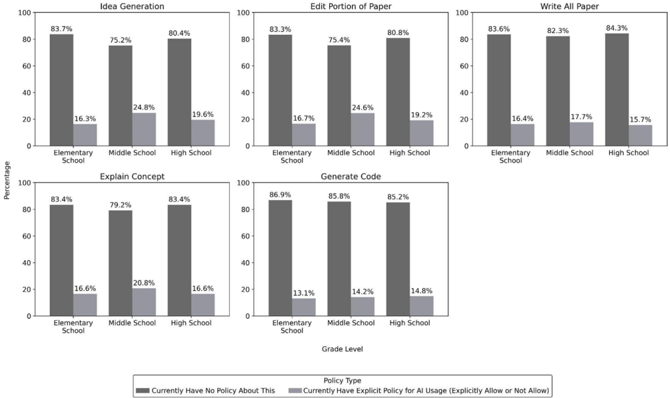
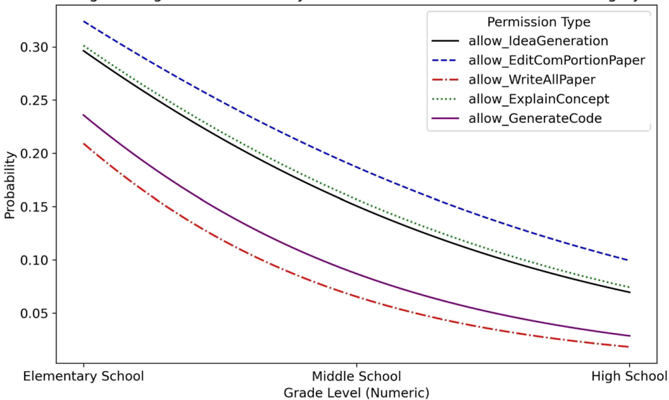
- As grade level increased from elementary to middle to high school, teachers’ likelihood of allowing student AI chatbot use decreased for all five queried uses: idea generation by 12.07%, paper editing by 11.66%, full paper writing by 13.52%, concept explaining by 12.49%, and code generation by 14.99%. Teachers had the highest probability of disallowing AI for editing or completing a paper.
- More experienced elementary teachers (>10 years) were significantly less likely than less experienced teachers to allow writing support: allowance probability reductions were 49% for idea generation, 50% for editing/completing a paper, and 58% for writing an entire paper; for concept explanation the reduction was 45.6%, and for code generation 50.03%. Experienced high school humanities teachers were more likely to disallow idea generation, and experienced STEM/humanities teachers were more likely to disallow paper editing/completion; experienced STEM teachers may be 3% more likely to disallow than experienced humanities teachers for paper editing.
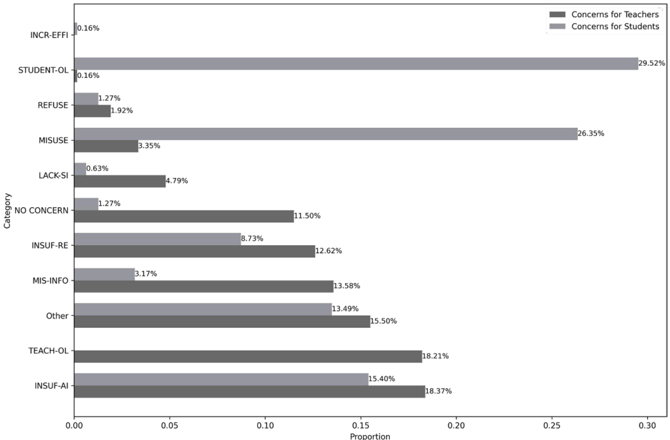
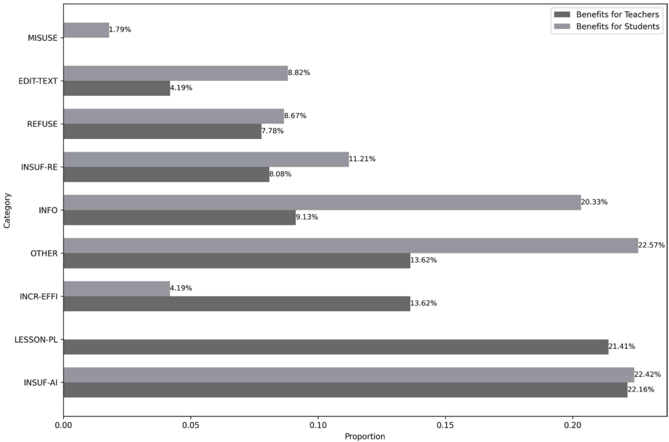
- Overreliance was the top concern for both teacher and student AI use and was mentioned 10% more often for students than for teachers. Plagiarism was a concern for 26.35% of teachers regarding students’ AI use versus 3.35% for teachers’ own use; misinformation was a concern for 13.58% regarding teachers’ use versus 3.17% regarding students’ use. For benefits, teachers named insufficient personal knowledge about AI (22.16%), preparing lesson plans/materials (21.41%), and increased efficiency (13.62%); for students, information retrieval was named by 20.33%.
- Professional development needs varied significantly by grade level (χ² = 63.949, df = 21, p = 0.000) but not by subject (χ² = 17.376, df = 14, p = 0.237). Elementary and middle school teachers prioritized basic AI literacy, while high school teachers emphasized instructing/managing student AI use (12.195%) and detecting AI-generated work (11.707%). The need to appropriately use AI for pedagogical purposes was common across experience and subject groups (less experienced 33.146%; more experienced 26.429%).
Methods
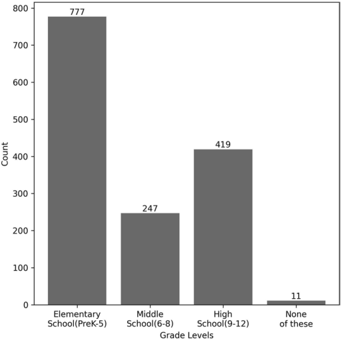
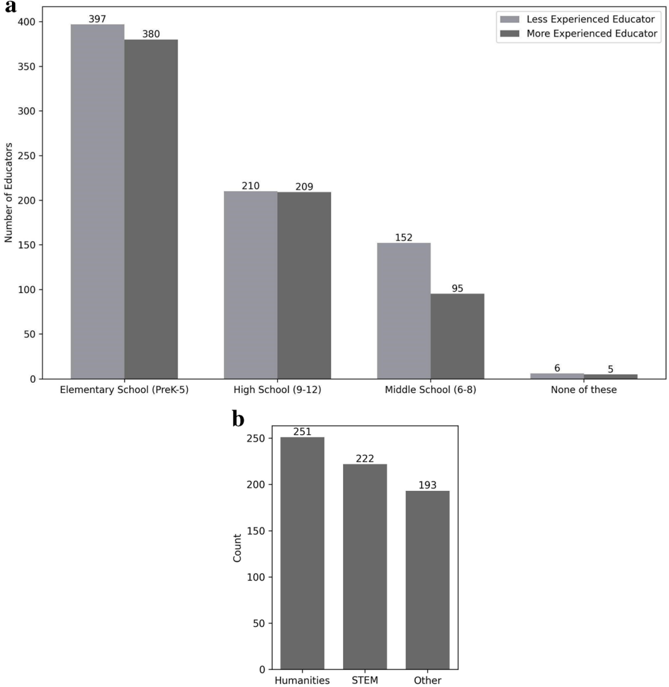
- Cross-sectional mixed-methods survey in one large urban school district; 1,454 teacher responses were analyzed after preprocessing. The district had 118 schools, served about 63,629 students, and invited 2,535 teachers; the effective response rate was 57.35% (overall 66.04%). The sample was 53.43% elementary, 16.99% middle, and 28.82% high school teachers; 70.99% female and 28.26% male; 35.84% White, 33.63% Asian, 17.02% Hispanic/Latinx, and 3.51% Black.
- The survey included AI allowability items for five uses (generate ideas, edit/complete a portion, write an entire paper, explain a concept, generate code), prior chatbot use, policy questions, and open-ended questions on benefits, concerns, and professional development needs. Qualitative coding used a two-level scheme with Cohen’s κ = 0.94.
- Quantitative analysis used logistic regression marginal effects for allowability, with chi-square tests when models did not converge; VIFs were below 3, indicating no concerning multicollinearity.
Limitations
- Stated: the study used a single urban district and had a self-selective response pattern, with approximately 60% of invited teachers participating; although balance tests suggested general representativeness, bias is possible. Findings may not generalize to districts with different grade-level distributions, and small subgroup sample sizes—especially for middle school teachers—limited statistical power, so some null results should be interpreted cautiously.
- Stated: the correlational design means no causal inferences can be drawn, and the 2023 survey may not reflect how teacher perspectives changed after their first year with AI. The survey’s limited response length and choices may not capture other facets of teacher experience and thinking about AI.
- Evident from the text: middle school models failed to converge because of small sample size, so chi-square tests were used instead and some middle school results were inconclusive.
Model-written summary. Check it against the paper before relying on it.
Integrity signals
Registry
Cites
Statistics
Figures
Verification
Claims the paper makes
0 Valid · 4 Not valid · 17 Not checked · 116 Own results and interpretations
A result the paper reports from its own data — it cites no other source for it, so there is none to check. The quote shows it is in the paper.
In the paper
“This also shows that more experienced teachers teaching STEM may be 3% more likely to disallow than the more experienced teachers teaching humanities.”
§ A cross-sectional look at teacher reactions, worries, and professional development needs related to generative AI in an urban school district > 5.1.1 Writing support usage
hedgedstates a possible cause- Asserted: passes — The authors put it forward as true.
- Checkable: passes — It can be checked against evidence.
- Load-bearing: unclear — It is unclear whether the paper’s conclusions depend on it.
- Based: passes — The paper gives a reason why it holds.
A result the paper reports from its own data — it cites no other source for it, so there is none to check. The quote shows it is in the paper.
In the paper
“A chi-squared test for the variable of subject taught and teaching experience separately with teachers' allowabilities show that the variation in teachers' allowances was not significantly associated with 2 dof =1 = 0.027, p = 0.869 ; Write All Paper:foot_1 dof =0 = 0.000, p = 1.000 ).”
§ A cross-sectional look at teacher reactions, worries, and professional development needs related to generative AI in an urban school district > 5.1.1 Writing support usage
plain- Asserted: passes — The authors put it forward as true.
- Checkable: passes — It can be checked against evidence.
- Load-bearing: unclear — It is unclear whether the paper’s conclusions depend on it.
- Based: passes — The paper gives a reason why it holds.
A result the paper reports from its own data — it cites no other source for it, so there is none to check. The quote shows it is in the paper.
In the paper
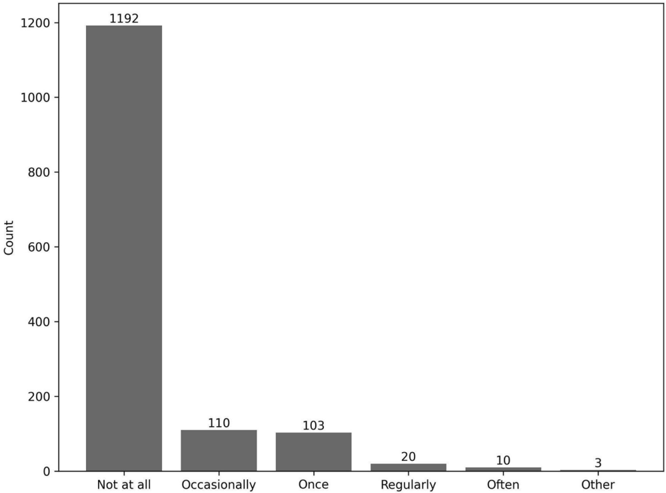
“the following bar graph (Fig. 4) demonstrates that most teachers had not established their policy for these.”
§ A cross-sectional look at teacher reactions, worries, and professional development needs related to generative AI in an urban school district > 4.2.2 AI-centric survey responses
boosted- Asserted: passes — The authors put it forward as true.
- Checkable: passes — It can be checked against evidence.
- Load-bearing: unclear — It is unclear whether the paper’s conclusions depend on it.
- Based: passes — The paper gives a reason why it holds.
- Rests on an assumption not shown here.
A result the paper reports from its own data — it cites no other source for it, so there is none to check. The quote shows it is in the paper.
In the paper
“Regarding using AI chatbots for concept explanation, the negative coefficients (shown in Table 11) for teachers with more experience suggested that compared to teachers with less experience, more experienced teachers were more likely to disallow students to use AI chatbots to explain concepts learned in class.”
§ A cross-sectional look at teacher reactions, worries, and professional development needs related to generative AI in an urban school district > 5.1.2 Other uses of AI chatbots
hedgedstates an association- Asserted: passes — The authors put it forward as true.
- Checkable: passes — It can be checked against evidence.
- Load-bearing: unclear — It is unclear whether the paper’s conclusions depend on it.
- Based: passes — The paper gives a reason why it holds.
A result the paper reports from its own data — it cites no other source for it, so there is none to check. The quote shows it is in the paper.
In the paper
“For concept explanation and code generation, more experienced elementary school teachers were more likely to disallow student AI chatbot usage.”
§ A cross-sectional look at teacher reactions, worries, and professional development needs related to generative AI in an urban school district > 5.1.2 Other uses of AI chatbots
plainstates an association- Asserted: passes — The authors put it forward as true.
- Checkable: passes — It can be checked against evidence.
- Load-bearing: unclear — It is unclear whether the paper’s conclusions depend on it.
- Based: passes — The paper gives a reason why it holds.
58 more claims
Create a free account to see all 137 claims and every source verdict.
- Probably not a substantial claim. 28
- Borderline: one of the tests for a substantial claim is unclear. 1
- It may state two separate claims as one. 39
- The quote only partly states this claim. 10
Claims other papers make about this one
Each is checked against this paper’s own text: does it say what the citing paper says it does?
In the citing paper
“Recent research with over 1,400 teachers reveals that educators express varying concerns, such as misinformation and reduced social interaction, about using AI chatbots in their daily tasks at school (Chen et al., 2025).”
From Cheating in the second year of generative AI chatbots: a follow-up study on high school student cheating behaviors (2026) · cites this paper as Chen et al., 2025
Self-check
Percentages, sums and reported differences re-computed from the paper’s own numbers.
Each contradiction between two passages listed here was confirmed by an independent check.
Rated minor: it would not touch a result — a value no result rests on, a p-value that stays on the same side of the significance level, or a conflict that is clerical, resolved elsewhere in the paper, or outside its own findings.
In the paper
§ A cross-sectional look at teacher reactions, worries, and professional development needs related to generative AI in an urban school district > 5.3 Research question #3: Professional developmental needs
“the differences by subjects for middle and high school teachers are not significant ( 2dof =14 = 17.376, p = 0.237 )”
§ A cross-sectional look at teacher reactions, worries, and professional development needs related to generative AI in an urban school district > 5.3 Research question #3: Professional developmental needs
“we did not find statistically significant differences in professional development needs between teachers of different subjects ( 2dof =14 = 16.019,p = 0.312 )”
Rated minor: it would not touch a result — a value no result rests on, a p-value that stays on the same side of the significance level, or a conflict that is clerical, resolved elsewhere in the paper, or outside its own findings.
In the paper
§ A cross-sectional look at teacher reactions, worries, and professional development needs related to generative AI in an urban school district > 2.3 Academic integrity
“The main exception is among Asian educators, who are underrepresented in the sample by 4.21 percentage points (p = 0.001)”
§ A cross-sectional look at teacher reactions, worries, and professional development needs related to generative AI in an urban school district > Appendix I: Gender & ethnicity distribution & balance test of the sample certificated educators (teachers)
“Asian (not Hispanic or Latinx)* 29.42% 23.55% 33.63% -10.08%* 0.000 -4.21%* 0.001”
Rated minor: it would not touch a result — a value no result rests on, a p-value that stays on the same side of the significance level, or a conflict that is clerical, resolved elsewhere in the paper, or outside its own findings.
In the paper
§ A cross-sectional look at teacher reactions, worries, and professional development needs related to generative AI in an urban school district > 6 Discussion and conclusion
“for teachers, the top benefit is efficiency improvement.”
§ A cross-sectional look at teacher reactions, worries, and professional development needs related to generative AI in an urban school district > Additional information
“| Prepare lesson plans or lesson materials | LESSON-Pl | 21.41% | | Increased efficiency other than the reasons above | INCR-EFFI | 13.62% |”
Citations
Cites
Using thematic analysis in psychology
Braun, V., & Clarke, V. (2006) · Qualitative Research in Psychology · doi:10.1191/1478088706qp063oa · Cited by 194,414
Those Who Understand: Knowledge Growth in Teaching
SHULMAN, L. S. (1986) · Educational Researcher · doi:10.3102/0013189x015002004 · Cited by 18,546
Technological Pedagogical Content Knowledge: A Framework for Teacher Knowledge
Mishra, P., & Koehler, M. J. (2006) · Teachers College Record: The Voice of Scholarship in Education · doi:10.1111/j.1467-9620.2006.00684.x · Cited by 12,604
The Coding Manual for Qualitative Researchers
Lungu, M. (2022) · American Journal of Qualitative Research · doi:10.29333/ajqr/12085 · Cited by 10,826 · cited 1×
“We pulled a random sample of one hundred responses for qualitative analysis and then applied live coding using exact words and phrases from responses (Saldaña, 2012).”
Algorithms of Oppression: How Search Engines Reinforce Racism
Noble, S. U. (2020) · doi:10.2307/j.ctt1pwt9w5 · Cited by 2,709
Addressing first- and second-order barriers to change: Strategies for technology integration
Ertmer, P. A. (1999) · Educational Technology Research and Development · doi:10.1007/bf02299597 · Cited by 2,189 · cited 1×
“Ertmer (1999) has described first order and second order barriers in teacher technology adoption or integration, with first order referring to infrastructural resources and the capacity to integrate technology.”
Teacher beliefs and technology integration practices: A critical relationship
Ertmer, P. A., Ottenbreit-Leftwich, A. T., Sadik, O., Sendurur, E., & Sendurur, P. (2012) · Computers & Education · doi:10.1016/j.compedu.2012.02.001 · Cited by 2,107 · cited 3×
“For example, Ertmer et al.,’s (2012) study of 12 teachers considered exemplary in technology use suggests, that science teacher in middle school have a distinct affinity for educational technology relative to language, social studies, math, and general classroom teachers in elementary schools.”
InfluentialNew Era of Artificial Intelligence in Education: Towards a Sustainable Multifaceted Revolution
Kamalov, F., Santandreu Calonge, D., & Gurrib, I. (2023) · Sustainability · doi:10.3390/su151612451 · Cited by 1,089 · cited 1×
“Much publicized generative AI tutor projects encountered real-world challenges (Barua et al., 2022; Kamalov et al., 2023).”
Factors Affecting Technology Uses in Schools: An Ecological Perspective
Zhao, Y., & Frank, K. A. (2003) · American Educational Research Journal · doi:10.3102/00028312040004807 · Cited by 947 · cited 1×
“Zhao and Frank (2003) conducted an analysis suggesting that English teachers and high school teachers were more likely to integrate technology into instruction compared to their counterparts.”
ChatGPT and the rise of generative AI: Threat to academic integrity?
Eke, D. O. (2023) · Journal of Responsible Technology · doi:10.1016/j.jrt.2023.100060 · Cited by 532 · cited 2×
“Much of the concern around generative AI and chatbot technology like ChatGPT has been around concerns of integrity (Eke, 2023; Meça & Shkëlzeni, 2023), particularly regarding teachers’ and students’ use of AI in performing school-related tasks.”
Context and Technological Pedagogical Content Knowledge (TPACK): A Systematic Review
Rosenberg, J. M., & Koehler, M. J. (2015) · Journal of Research on Technology in Education · doi:10.1080/15391523.2015.1052663 · Cited by 473 · cited 2×
“Looking beyond the level of an individual classroom and considering differences in schools, districts, and regional policies can explain variation in the literature (Rosenberg & Koehler, 2015).”
Algorithms of Oppression: How Search Engines Reinforce Racism
Noble, S. U. (2020) · New York University Press eBooks · doi:10.18574/nyu/9781479833641.001.0001 · Cited by 416
(2001) · The Journal of Technology and Teacher Education · Cited by 390
Leading teachers' perspective on teacher-AI collaboration in education
Kim, J. (2024) · Education and Information Technologies · doi:10.1007/s10639-023-12109-5 · Cited by 376 · cited 2×
“This distinction mirrors patterns observed in previous studies of educational technology adoption, where teachers often prioritize tools that streamline administrative tasks while being more cautious about technologies that directly impact student learning processes (Kim, 2023).”
Barua, P. D., Vicnesh, J., Gururajan, R., Oh, S. L., Palmer, E., Azizan, M. M., Kadri, N. A., & Acharya, U. R. (2022) · International Journal of Environmental Research and Public Health · doi:10.3390/ijerph19031192 · Cited by 270 · cited 1×
“Much publicized generative AI tutor projects encountered real-world challenges (Barua et al., 2022; Kamalov et al., 2023).”
EJ Extra: A Snapshot of Writing Instruction in Middle Schools and High Schools [FREE ACCESS]
Applebee, A. N., & Langer, J. A. (2011) · English Journal · doi:10.58680/ej201116413 · Cited by 264 · cited 1×
“…will eventually hurt students in developing the necessary analytical and interpretative skills, especially in those areas that require originality, subtlety, and personal involvement with the text, as shown through their short responses in over reliance and plagiarism (Applebee & Langer, 2011).”
Cheating in online courses: Evidence from online proctoring
Dendir, S., & Maxwell, R. S. (2020) · Computers in Human Behavior Reports · doi:10.1016/j.chbr.2020.100033 · Cited by 257 · cited 1×
“…there is no systematically proved cause-and-effect relationship to date between the use of AI technologies and academic integrity, these concerns may largely influence teachers’ AI adoption decisions and classroom policies regarding AI chatbot usage (Bilen & Matros, 2021; Dendir & Maxwell, 2020).”
Bilen, E., & Matros, A. (2021) · Journal of Economic Behavior & Organization · doi:10.1016/j.jebo.2020.12.004 · Cited by 237 · cited 2×
“Bilen and Matros (2021) also argued that fears about widespread cheating often exceed documented cases.”
‘Not necessarily a bad thing …’: a study of online plagiarism amongst undergraduate students
Selwyn, N. (2008) · Assessment & Evaluation in Higher Education · doi:10.1080/02602930701563104 · Cited by 201 · cited 2×
“The emphasis on plagiarism for students echoes longstanding concerns about academic integrity in digital environments (Evering & Moorman, 2012; Selwyn, 2008; Josephson Institute, 2012), even though interestingly, recent research suggests that fears about increased cheating due to AI have been…”
New Era of Artificial Intelligence in Education: Towards a Sustainable Multifaceted Revolution
Kamalov, F., Calong, D. S., & Gurrib, I. (2025) · Tropical Africa Spectrum · doi:10.48550/arxiv.2305.18303 · Cited by 145
Rethinking Plagiarism in the Digital Age
Evering, L. C., & Moorman, G. (2012) · Journal of Adolescent & Adult Literacy · doi:10.1002/jaal.00100 · Cited by 131 · cited 2×
“The emphasis on plagiarism for students echoes longstanding concerns about academic integrity in digital environments (Evering & Moorman, 2012; Selwyn, 2008; Josephson Institute, 2012), even though interestingly, recent research suggests that fears about increased cheating due to AI have been…”
Lee, V. R., Pope, D., Miles, S., & Zárate, R. C. (2024) · Computers and Education: Artificial Intelligence · doi:10.1016/j.caeai.2024.100253 · Cited by 130 · cited 5×
“Recent empirical research examining high school students’ self-reported cheating behaviors found no significant increase in academic dishonesty following ChatGPT’s release, with rates remaining consistent at around 60–65% across pre-and post-ChatGPT periods (Lee et al., 2024).”
InfluentialSelf-citationLearning in the cloud: how (and why) to transform schools with digital media
(2012) · Choice Reviews Online · doi:10.5860/choice.49-4598 · Cited by 120
Roshanaei, M. (2024) · Education and Information Technologies · doi:10.1007/s10639-024-12605-2 · Cited by 118 · cited 1×
“The bias in underlying AI systems raised equity concerns, as these technologies often failed to account for diverse student experiences, especially those from the marginalized social groups, and writing styles across different cultural and linguistic backgrounds (Roshanaei, 2024).”
Explaining technology integration in K-12 classrooms: a multilevel path analysis model
Liu, F., Ritzhaupt, A. D., Dawson, K., & Barron, A. E. (2017) · Educational Technology Research and Development · doi:10.1007/s11423-016-9487-9 · Cited by 116 · cited 2×
“…professional development design should consider such differences when selecting materials and resources to address unique needs, while also acknowledging what Liu et al. (2017) identified as the relationship between teacher confidence with technology and their professional learning preferences.”
Technology integration in K-12 science classrooms: An analysis of barriers and implications
Hechter, R. P., & Vermette, L. A. (2013) · Cited by 98
How Teachers' Uses of Technology Vary by Tenure and Longevity
Russell, M., O'Dwyer, L. M., Bebell, D., & Tao, W. (2007) · Journal of Educational Computing Research · doi:10.2190/ec.37.4.d · Cited by 94 · cited 2×
“Russell et al. (2007) examined whether the amount of time teachers have been in the teaching profession and at their particular school was associated with more or less technology use for various functions.”
Trends in NLP for personalized learning: LDA and sentiment analysis insights
Yu, J. H., & Chauhan, D. (2024) · Education and Information Technologies · doi:10.1007/s10639-024-12988-2 · Cited by 62 · cited 1×
“Others viewed the revolution as a customizable tutoring system; educational technology organizations, like Khan Academy, immediately began work to attempt to develop that (Aleven et al., 2022; Mohamed et al., 2024; Yu & Chauhan, 2024).”
Chan, K. K.-W., & Tang, W. K.-W. (2024) · World Journal of English Language · doi:10.5430/wjel.v15n1p129 · Cited by 54 · cited 1×
“This targeted approach could help address both the technical and pedagogical barriers to AI integration that Chan and Tang (2024) identified as crucial for successful technology adoption in schools.”
AI ethics should be mandatory for schoolchildren
Dabbagh, H., Earp, B. D., Mann, S. P., Plozza, M., Salloch, S., & Savulescu, J. (2024) · AI and Ethics · doi:10.1007/s43681-024-00462-1 · Cited by 52 · cited 1×
“Some have argued that this changes the content of what people need to teach and learn about, offering “AI literacy” as a necessary competency for all people to have and for schools to develop (Dabbagh et al., 2024; Hong & Kim, 2024).”
Academic Integrity in the Face of Generative Language Models
Meça, A., & Shkëlzeni, N. (2023) · Lecture notes of the Institute for Computer Sciences, Social Informatics and Telecommunications Engineering · doi:10.1007/978-3-031-50215-6_5 · Cited by 29
A Dashboard to Support Teachers During Students’ Self-paced AI-Supported Problem-Solving Practice
Aleven, V., Blankestijn, J., Lawrence, L., Nagashima, T., & Taatgen, N. (2022) · Lecture Notes in Computer Science · doi:10.1007/978-3-031-16290-9_2 · Cited by 28 · cited 1×
“Others viewed the revolution as a customizable tutoring system; educational technology organizations, like Khan Academy, immediately began work to attempt to develop that (Aleven et al., 2022; Mohamed et al., 2024; Yu & Chauhan, 2024).”
Online Cheating Amid COVID-19Preprint
Bilen, E., & Matros, A. (2020) · SSRN Electronic Journal · doi:10.2139/ssrn.3691363 · Cited by 27
Impact of AIoT education program on digital and AI literacy of elementary school students
Hong, J. C., & Kim, K. (2024) · Education and Information Technologies · doi:10.1007/s10639-024-12758-0 · Cited by 24 · cited 1×
“Some have argued that this changes the content of what people need to teach and learn about, offering “AI literacy” as a necessary competency for all people to have and for schools to develop (Dabbagh et al., 2024; Hong & Kim, 2024).”
Mohamed, A., Faisal, R., & Shaalan, K. (2024) · Lecture Notes in Computer Science · doi:10.1007/978-3-031-71713-0_8 · Cited by 6 · cited 2×
“Others viewed the revolution as a customizable tutoring system; educational technology organizations, like Khan Academy, immediately began work to attempt to develop that (Aleven et al., 2022; Mohamed et al., 2024; Yu & Chauhan, 2024).”
Using Artificial Intelligence Tools in K–12 Classrooms
(2024) · doi:10.7249/rra956-21 · Cited by 5
Warschauer, M. (2010) · doi:10.65528/9780807770849
Cited by
Rahman, M. K., Hossain, D., Ismail, N. A., Hossen, M. S., & Sultana, M. (2025) · Interactive Technology and Smart Education · doi:10.1108/itse-12-2024-0312 · Cited by 83
Mindset matters: Fostering teachers’ responsible AI use through professional development
Huynh, L., Le, T. H., Dang, B., An, B. T., Vu, C. T., & Nguyen, A. (2025) · Journal of New Approaches in Educational Research · doi:10.1007/s44322-025-00043-y · Cited by 22
“…as a means to enhance instructional practice and support students’ skill development to some extent (e.g., in early stages of writing and revising) (Chen et al., 2025), others remain skeptical and reject it due to concerns about misinformation, uncertainty about its effectiveness, or fears of…”
Middle school students’ perspectives on adopting generative AI in K-12 education
Adisa, I. O., & Adefisayo, A. O. (2025) · The Journal of Educational Research · doi:10.1080/00220671.2025.2510393 · Cited by 13
“In fact, few teachers currently explore GenAI with their students in the classroom (Madden et al., 2024; Merod, 2024), while many others neither use GenAI nor incorporate it into their instruction (Chen et al., 2025; Prothero, 2024).”
Du, H., Sun, Y., Jiang, H., Islam, A. Y. M. A., & Adarkwah, M. A. (2025) · Interactive Learning Environments · doi:10.1080/10494820.2025.2556810 · Cited by 19
“…such as adoption (Chou et al., 2024; Du et al., 2024; Li, 2025), perception (Chounta et al., 2022; Niu et al., 2022), knowledge (Celik et al., 2022; Chen et al., 2025; Karataş & Ataç, 2024; Ning et al., 2024), self-efficacy (Du et al., 2024), attitudes (Ayanwale et al., 2025) and literacy (Du et…”
Chen, R., Lee, V. R., Kuo, A. C., Pope, D. C., & Miles, S. (2026) · Educational technology research and development · doi:10.1007/s11423-026-10587-1 · Cited by 8
Self-citation
Metadata
- Authors
- Chen, R., Lee, V. R., & G Lee, M.
- Affiliations
- Stanford University (US)
- Corresponding author
- Chen, Ruishi
- Venue
- Education and Information Technologies
- Published
- 2025-02-19
- Volume
- 30
- Issue
- 11
- Pages
- 16045-16082
- ISSN
- 1360-2357 (ISSN-L)
- 1573-7608
- OpenAlex
- W4407750016
- Semantic Scholar
- 5e90a04e917690472de5671ac91c9cca3c8253a4
- Cited by
- 43
- References
- 32
- Citations by year
- 2026: 30 · 2025: 13
- FWCI
- 44.52
- Type
- journal article
- Language
- en
- Open access
- hybrid
- doi.org
- Licence
- cc-by-nc-nd
- creativecommons.org/licenses/by-nc-nd/4.0 (tdm)
- creativecommons.org/licenses/by-nc-nd/4.0 (vor)
- Locations
- Education and Information Technologies (publishedVersion, cc-by-nc-nd)
- Topics
- Social Sciences › Education › Artificial Intelligence in Education
- Health Sciences › Medicine › Health Informatics › Artificial Intelligence in Healthcare and Education
- Social Sciences › Education › Education and Technology Integration
- Keywords
- generative AI, AI chatbots, teacher attitudes, teacher concerns, professional training needs, AI literacy, secondary school teachers, primary school teachers, K-12 education, urban school districts, ChatGPT
About these checks
Registry, retraction, Cites and statistics results are computed, not judged, with one exception: a printed reference that no index lists is read once by a model before it counts as a citation error. Claims are extracted by a model and kept only when their quote appears verbatim in the text; each cited source is then checked, with a model’s help, for whether it says what the claim relies on. Those verdicts can be wrong — read the claim’s quote and the cited source before relying on one.
The claim verdicts this report counts are experimental: their accuracy is not yet measured.
A language model drew the claims from the paper on 2026-10-10, under version 3 of the claim definition (model deepseek-v4.1-flash, prompt extract-v3).
A second model labelled each claim on 2026-10-10 (model jev-1.13-20260917, definition revision gold-guideline-v0.2).
Statistics and arithmetic are recomputed, not judged.
Confidence bands are shown only for fields calibrated on our annotated test set. None is calibrated yet, so no band is shown.
What counts as a claim ›How we measure confidence ›How we check this ›
Are you an author, or do you see a problem with this page? Request a review
Data sources
Bibliographic data: Semantic Scholar, OpenAlex, Crossref.
Contains information from the Semantic Scholar Academic Graph Datasets, made available under the ODC Attribution License (ODC-BY 1.0).
Semantic Scholar’s data is described in: Kinney, R., et al. (2023). The Semantic Scholar Open Data Platform. arXiv:2301.10140.
