

A Cognitive Load Theory Approach to Defining and Measuring Task Complexity Through Element Interactivity
Open accessThe DOI matches its Crossref record; 52 of the 52 references it cites were found in a registry or an index; 5 of the 30 sources its claims cite were checked for support.
Abstract
Abstract Educational researchers have been confronted with a multitude of definitions of task complexity and a lack of consensus on how to measure it. Using a cognitive load theory-based perspective, we argue that the task complexity that learners experience is based on element interactivity. Element interactivity can be determined by simultaneously considering the structure of the information being processed and the knowledge held in long-term memory of the person processing the information. Although the structure of information in a learning task can easily be quantified by counting the number of interacting information elements, knowledge held in long-term memory can only be estimated using teacher judgment or knowledge tests. In this paper, we describe the different perspectives on task complexity and present some concrete examples from cognitive load research on how to estimate the levels of element interactivity determining intrinsic and extraneous cognitive load. The theoretical and practical implications of the cognitive load perspective of task complexity for instructional design are discussed.
Overview
CoChat Summary
## TL;DR
This review argues that task complexity in education should be defined and measured through element interactivity, which depends on both the structure of the material and the learner’s prior knowledge in long-term memory. It concludes that element interactivity is an imprecise but usable estimate for both intrinsic and extraneous cognitive load, and it is especially important for instructional design.
## Key findings
- The paper distinguishes task complexity from task difficulty: some tasks can be difficult without being complex, and some can be complex because their elements must be processed simultaneously in working memory.
- A review of prior work cited by the paper found 24 distinct definitions of task complexity (Liu and Li, 2012), but only two of those categories reference learners’ prior knowledge.
- For intrinsic cognitive load, the paper gives examples where novice learners may face high element interactivity: solving 3x = 9 is described as requiring 15 symbols/elements to be processed simultaneously, while an algebraic transformation example is described as involving 28 interacting elements.
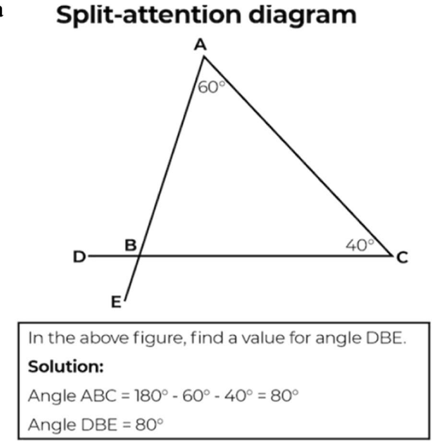
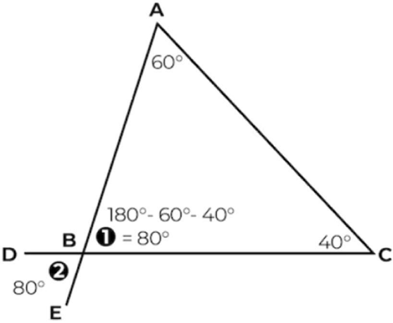
- For extraneous cognitive load, the paper compares instructional formats: one geometry split-attention example is estimated at 8 elements in the split format versus 2 elements in the integrated format.
- The paper argues that expert knowledge can reduce element interactivity, so the same material can be complex for novices but simple for experts; it notes that some effects, such as the worked-example effect, can disappear or reverse with increased expertise.
## Methods
- This is a review article that synthesizes cognitive load theory work on task complexity, element interactivity, intrinsic cognitive load, and extraneous cognitive load.
- It draws on conceptual frameworks of task complexity and on examples from prior cognitive load theory experiments, including mathematics, geometry, algebra, trigonometry, and an expository text example on Kleefstra syndrome.
- The main analysis is theoretical comparison and illustration: the paper contrasts objective vs subjective complexity frameworks and explains how element interactivity can be estimated by counting interacting elements and considering learner expertise.
## Limitations
- The paper states that estimating the number of interacting elements may not always be accurate because learners’ knowledge is difficult to measure precisely.
- The paper states that its examples are drawn primarily from well-structured tasks, such as mathematics, with fewer examples for expository materials.
- Evident from the text: the paper provides a conceptual and illustrative review rather than a new empirical study, so its claims are not based on a single original dataset.
Model-written summary. Check it against the paper before relying on it.
Integrity signals
Registry
Cites
Statistics
Figures
Verification
Claims the paper makes
3 Valid · 14 Not valid · 27 Not checked · 73 Own results and interpretations
At least one cited source doesn’t support this claim or points to a different paper, and none confirmed it — see the verdicts below.
In the paper
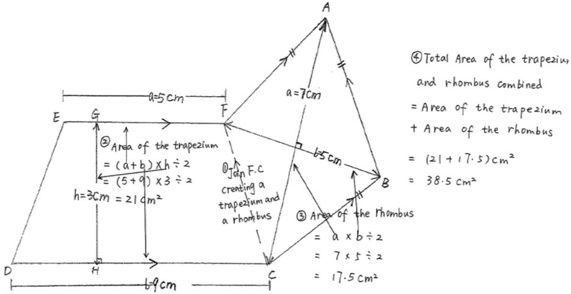
“As an example, to memorise the formula of the area of a parallelogram, the base × the height, included 4 interacting elements for a novice - the area, the base, the multiplication relation, and the height.”
What the sources say
- Disputedcites Chen et al. (2015) matched to “The worked example effect, the generation effect, and element interactivity.” (2015) sourceExperimental — accuracy not yet measured
In §8.1.2 Materials (page unavailable), the paper uses memorising the parallelogram area formula as an example but says its five equation elements do not interact. It estimates the interacting-element count for Grade 4 students as one, not four. (LLM, conf=0.93)
Checked by a reasoning model — may be wrong.
plain- Asserted: passes — The authors put it forward as true.
- Checkable: passes — It can be checked against evidence.
- Load-bearing: unclear — It is unclear whether the paper’s conclusions depend on it.
- Based: passes — The paper gives a reason why it holds.
- Disputed
At least one cited source doesn’t support this claim or points to a different paper, and none confirmed it — see the verdicts below.
In the paper
“Finally, the two separate area values added together involved another 3 elements giving, in total, about 25 interactive elements.”
What the sources say
- Disputedcites Chen et al. (2015) matched to “The worked example effect, the generation effect, and element interactivity.” (2015) sourceExperimental — accuracy not yet measured
In §8.1.2 Materials (page unavailable), the source estimates about 20 interacting elements for Grade 4 students calculating the composite shape, not about 25. It counts adding the two area values as one element, not three. (LLM, conf=0.88)
Checked by a reasoning model — may be wrong.
hedged- Asserted: passes — The authors put it forward as true.
- Checkable: passes — It can be checked against evidence.
- Load-bearing: unclear — It is unclear whether the paper’s conclusions depend on it.
- Based: passes — The paper gives a reason why it holds.
- Disputed
Every source the paper cites for this claim was checked and supports it.
In the paper
“However, when novices need to calculate the area of a composite shape, element interactivity is higher compared to memorising formulae.”
What the sources say
- Supportedcites Chen et al. (2015) matched to “The worked example effect, the generation effect, and element interactivity.” (2015) source
Section 8.1.2 (Materials) compares the tasks for Grade 4 students: memorising a formula has an interacting-element count of one, while calculating the area of a composite shape involves an estimated 20 interacting elements. This supports the claim for the novice learners described in the paper. (LLM, conf=0.94)
plainstates an association- Asserted: passes — The authors put it forward as true.
- Checkable: passes — It can be checked against evidence.
- Load-bearing: passes — The paper’s conclusions depend on it.
- Based: passes — The paper gives a reason why it holds.
- Supported
The cited sources support only part of this claim — read each source’s verdict below.
In the paper
“Most cognitive load theory effects disappear or even reverse when students study low element interactivity information, leading to the expertise reversal effect (Chen etal., 2017).”
What the sources say
- Partly supportedcites Chen et al., 2017 matched to “The Expertise Reversal Effect is a Variant of the More General Element Interactivity Effect” (2017) sourceExperimental — accuracy not yet measured
The indexed repository description (no section or page given) says the expertise reversal effect is linked to changes in relative element interactivity. It distinguishes changes caused by the material from those caused by learners’ expertise. The available passages do not support the broader claim that most cognitive load theory effects disappear or reverse with low-interactivity information, or that studying such information alone leads to expertise reversal. (LLM, conf=0.76)
plainstates a cause- Asserted: passes — The authors put it forward as true.
- Checkable: passes — It can be checked against evidence.
- Load-bearing: passes — The paper’s conclusions depend on it.
- Based: passes — The paper gives a reason why it holds.
- Partly supported
In the paper
“Out of 24 categories, only two reference learners' prior knowledge.”
What the sources say
- Not checked — no full text of the sourcecites Liu and Li (2012) matched to “Task complexity: A review and conceptualization framework” (2012) source
plain- Asserted: passes — The authors put it forward as true.
- Checkable: passes — It can be checked against evidence.
- Load-bearing: passes — The paper’s conclusions depend on it.
- Based: passes — The paper gives a reason why it holds.
38 more claims
Create a free account to see all 117 claims and every source verdict.
- Probably not a substantial claim. 60
- It may state two separate claims as one. 31
- The quote only partly states this claim. 1
Claims other papers make about this one
Each is checked against this paper’s own text: does it say what the citing paper says it does?
The cited source says what the claim attributes to it.
In the citing paper
“Similarly, CLT suggests that instructional design should consider the learner’s prior knowledge, with more guidance needed for novices than for experts (Chen et al., 2023).”
From Does difficulty moderate learning? A comparative analysis of the desirable difficulties framework and cognitive load theory (2025) · cites this paper as Chen et al., 2023
In the citing paper
“According to cognitive load theory, task complexity decreases with increased familiarity when (1) the number of interactive elements (i.e., how much information must be simultaneously processed in working memory) are reduced and (2) individuals can extract related elements crucial for problem-solving and ignore irrelevant details (Chen et al., 2023).”
From The Effect of Playback Speed and Distractions on the Comprehension of Audio and Audio-Visual Materials (2024) · cites this paper as Chen et al., 2023
Citations
Cites
The magical number seven, plus or minus two: Some limits on our capacity for processing information.
Miller, G. A. (1956) · Psychological Review · doi:10.1037/h0043158 · Cited by 17,812 · cited 1×
“Irrespective of how it is acquired, information must be processed by a working memory that has very limited capacity (Cowan, 2001; Miller, 1956) and duration (Peterson & Peterson, 1959).”
BackgroundThe magical number 4 in short-term memory: A reconsideration of mental storage capacity
Cowan, N. (2001) · Behavioral and Brain Sciences · doi:10.1017/s0140525x01003922 · Cited by 6,779 · cited 1×
“Irrespective of how it is acquired, information must be processed by a working memory that has very limited capacity (Cowan, 2001; Miller, 1956) and duration (Peterson & Peterson, 1959).”
BackgroundNewell, A. (1972) · Cited by 6,222
Cognitive Architecture and Instructional Design
Sweller, J., van Merrienboer, J. J. G., & Paas, F. G. W. C. (1998) · Educational Psychology Review · doi:10.1023/a:1022193728205 · Cited by 6,023
Self-citationCognitive load theory, learning difficulty, and instructional design
Sweller, J. (1994) · Learning and Instruction · doi:10.1016/0959-4752(94)90003-5 · Cited by 5,426 · cited 4×
“While Sweller and Chandler (1994) occasionally mentioned that differences in extraneous cognitive load also are due to differences in element interactivity, they made no attempt to provide details.”
BackgroundInfluentialSelf-citationEricsson, K. A., & Kintsch, W. (1995) · Psychological Review · doi:10.1037/0033-295x.102.2.211 · Cited by 3,498
Short-term retention of individual verbal items.
Peterson, L., & Peterson, M. J. (1959) · Journal of Experimental Psychology · doi:10.1037/h0049234 · Cited by 2,939 · cited 1×
“Irrespective of how it is acquired, information must be processed by a working memory that has very limited capacity (Cowan, 2001; Miller, 1956) and duration (Peterson & Peterson, 1959).”
BackgroundGoal setting and task performance: 1969–1980.
Locke, E. A., Shaw, K. N., Saari, L. M., & Latham, G. P. (1981) · Psychological Bulletin · doi:10.1037/0033-2909.90.1.125 · Cited by 2,452
Cognitive Architecture and Instructional Design: 20 Years Later
Sweller, J., van Merriënboer, J. J. G., & Paas, F. (2019) · Educational Psychology Review · doi:10.1007/s10648-019-09465-5 · Cited by 2,337
Self-citationElement Interactivity and Intrinsic, Extraneous, and Germane Cognitive Load
Sweller, J. (2010) · Educational Psychology Review · doi:10.1007/s10648-010-9128-5 · Cited by 2,020 · cited 11×
“Similar explanations are 1 3 Educational Psychology Review (2023) 35:63 Page 7 of 18 63 available for other cognitive load effects (Sweller, 2010).”
BackgroundInfluentialSelf-citation
Research works printed but not linked: 1
- Gill, T. G., & Murphy, W. (2011). Task complexity and design science. In 9th International Conference on Education and Information Systems, Technologies and Applications (EISTA 2011) . <!-- image -->
Cited by
Sweller, J. (2023) · Educational Psychology Review · doi:10.1007/s10648-023-09817-2 · Cited by 220
“Over 40 years later, I still seem to be periodically fighting this battle for direct instruction rather than asking students to engage in problem solving (Chen et al., 2023; Zhang et al., 2022).”
InfluentialSelf-citationCognitive load theory and individual differences
Sweller, J. (2024) · Learning and Individual Differences · doi:10.1016/j.lindif.2024.102423 · Cited by 214
Self-citationThe synergy of embodied cognition and cognitive load theory for optimized learning
Zou, L., Zhang, Z., Mavilidi, M., Chen, Y., Herold, F., Ouwehand, K., & Paas, F. (2025) · Nature Human Behaviour · doi:10.1038/s41562-025-02152-2 · Cited by 131
Self-citationResearch Avenues Supporting Embodied Cognition in Learning and Instruction
Castro-Alonso, J. C., Ayres, P., Zhang, S., de Koning, B. B., & PAAS, F. G. W. C. (2024) · Educational Psychology Review · doi:10.1007/s10648-024-09847-4 · Cited by 163
“Note that task complexity depends on the task itself and also on the expertise of the learner attempting the task (see Chen et al., 2023).”
Self-citationEEG-based brain-computer interface enables real-time robotic hand control at individual finger level
Ding, Y., Udompanyawit, C., Zhang, Y., & He, B. (2025) · Nature Communications · doi:10.1038/s41467-025-61064-x · Cited by 142
Too much social media? Unveiling the effects of determinants in social media fatigue
Qin, C., Li, Y., Wang, T., Zhao, J., Tong, L., Yang, J.-W., & Liu, Y. (2024) · Frontiers in Psychology · doi:10.3389/fpsyg.2024.1277846 · Cited by 72
Klingenberg, S., Bosse, R., Mayer, R. E., & Makransky, G. (2024) · Educational Psychology Review · doi:10.1007/s10648-024-09956-0 · Cited by 76
“This was ideal, as we were interested in a topic that was novel to most students to avoid a ceiling effect, isolate the effect of the educational intervention, and because novel topics tend to induce the highest cognitive load effects on students (see Chen et al., 2023).”
The End is the Beginning is the End: The closed-loop learning analytics framework
Sailer, M., Ninaus, M., Huber, S. E., Bauer, E., & Greiff, S. (2024) · Computers in Human Behavior · doi:10.1016/j.chb.2024.108305 · Cited by 53
Sweller, J., Zhang, L., Ashman, G., Cobern, W. W., & Kirschner, P. A. (2023) · Educational Research Review · doi:10.1016/j.edurev.2023.100584 · Cited by 78
Self-citationComplexity affects performance, cognitive load, and awareness
Zeitlhofer, I., Zumbach, J., & Schweppe, J. (2024) · Learning and Instruction · doi:10.1016/j.learninstruc.2024.102001 · Cited by 81
Cognitive Reappraisal: The Bridge between Cognitive Load and Emotion
Brockbank, R. B., & Feldon, D. F. (2024) · Education Sciences · doi:10.3390/educsci14080870 · Cited by 73
“Effective instructional procedures, therefore, aim to reduce unnecessary levels of element interactivity [3,43].”
The Effectiveness of Concept Maps on Students’ Achievement in Science: A Meta-Analysis
Anastasiou, D., Wirngo, C. N., & Bagos, P. (2024) · Educational Psychology Review · doi:10.1007/s10648-024-09877-y · Cited by 36
“In other words, because working memory is limited, teachers should design learning experiences to reduce the extraneous cognitive load related to the additional cognitive load imposed by instructional design and presentation of information (Chen et al., 2023; Sweller et al., 1998, 2011).”
Thomann, H., & Deutscher, V. (2025) · Educational Research Review · doi:10.1016/j.edurev.2025.100686 · Cited by 40
Lyu, C., & Deng, S. (2024) · Learning and Individual Differences · doi:10.1016/j.lindif.2024.102564 · Cited by 54
Chen, A., Kumar, S. E., Varkhedi, R., & Murphy, D. H. (2024) · Educational Psychology Review · doi:10.1007/s10648-024-09917-7 · Cited by 30
“When someone is familiar with a subject, they can recognize its characteristics, nuances, or patterns and can often navigate related discussions, problems, or contexts with a degree of ease and confidence (Chen et al., 2023; Gilboa & Marlatte, 2017).”
Vessonen, T., Dahlberg, M., Hellstrand, H., Widlund, A., Korhonen, J., Aunio, P., & Laine, A. (2024) · Educational Psychology Review · doi:10.1007/s10648-024-09954-2 · Cited by 87
“Mathematical word problem-solving is a demanding process that requires multiple aspects of students’ limited cognitive capacity (e.g., working memory, reading comprehension; Chen et al., 2023; Jaffe & Bolger, 2023).”
InfluentialGorbunova, A., Lange, C. H., Savelyev, A., Adamovich, K., & Costley, J. (2024) · Education Sciences · doi:10.3390/educsci14080860 · Cited by 54
David, L., Biwer, F., Baars, M., Wijnia, L., PAAS, F. G. W. C., & de Bruin, A. B. H. (2024) · Educational Psychology Review · doi:10.1007/s10648-024-09903-z · Cited by 37
“For tasks within these cognitive limits, and depending on the complexity of the task, various strategies exist to further enhance learning (Chen et al., 2018, 2023).”
Self-citationZhu, L., Wei, S., An, Y., Hu, W., & Xie, X. (2025) · Frontiers in Public Health · doi:10.3389/fpubh.2025.1654389 · Cited by 33
“These schemas allow them to bypass step-by-step deliberation and directly identify meaningful patterns or priorities within complex alarm situations (48).”
Enhancing Teaching Strategies through Cognitive Load Theory: Process vs. Product Worked Examples
Sozio, G., Agostinho, S., Tindall‐Ford, S., & PAAS, F. G. W. C. (2024) · Education Sciences · doi:10.3390/educsci14080813 · Cited by 33
“This finding is also consistent with existing CLT research in well-structured learning domains [1,29,43,44].”
InfluentialSelf-citationSchuessler, K., Fischer, V., & Walpuski, M. (2024) · Instructional Science · doi:10.1007/s11251-024-09692-6 · Cited by 26
“…the analytic method offers an a priori estimate of intrinsic cognitive load (Zheng & Greenberg, 2017) and has been used several times to investigate cognitive load in studies about learning (Leahy & Sweller, 2004, 2005, 2008, 2016; Sweller & Chandler, 1994; for a review, see Chen et al., 2023).”
Gkintoni, E., Sortwell, A., Vassilopoulos, S. P., & Nikolaou, G. (2025) · Multimodal Technologies and Interaction · doi:10.3390/mti10010005 · Cited by 32
Pyke, W., Lunau, J., & Javadi, A.-H. (2025) · Quarterly Journal of Experimental Psychology · doi:10.1177/17470218241308143 · Cited by 15
“However, CLT suggests that this benefit is contingent upon the material being low in element interactivity (Chen et al., 2015, 2023; Sweller, 2023).”
Afzal, M. A., Gu, Z., Afzal, B., & Bukhari, S. U. (2023) · Electronics · doi:10.3390/electronics12194008 · Cited by 18
Endres, T., Bender, L., Sepp, S., Zhang, S., David, L., Trypke, M., Lieck, D., Désiron, J. C., Bohm, J., Weißgerber, S. C., et al. (2025) · Educational Psychology Review · doi:10.1007/s10648-024-09978-8 · Cited by 20
“We manipulated ICL by varying the degree of element interactivity (see Chen et al., 2023 for an overview).”
Self-citationAre Inductive Teaching Methods Compatible with Cognitive Load Theory?
Gorbunova, A., van Merriënboer, J. J. G., & Costley, J. (2023) · Educational Psychology Review · doi:10.1007/s10648-023-09828-z · Cited by 31
“If the number of interacting elements in working memory is too high, cognitive overload occurs and learning is hampered (Chen et al., 2023).”
BackgroundLin, Z., & Sweller, J. (2024) · European Journal of Psychology of Education · doi:10.1007/s10212-024-00799-5 · Cited by 23
“It is dependent on the nature of the content and on learners’ expertise levels with respect to that content (Chen et al., 2023; Sweller, 2010).”
Self-citationJhang, J.-N., Lin, Y.-C., & Lin, Y.-T. (2025) · Sustainability · doi:10.3390/su17156775 · Cited by 26
The relationship between interleaving and variability effects: a cognitive load theory perspective
Chen, O., Retnowati, E., Castro-Alonso, J. C., Paas, F., & Sweller, J. (2023) · Education Sciences · doi:10.3390/educsci13111138 · Cited by 11
Self-citationBalancing AI transparency: Trust, Certainty, and Adoption
Ngo, V. M. (2025) · Information Development · doi:10.1177/02666669251346124 · Cited by 30
Schewior, L., & Lindner, M. A. (2024) · Educational Psychology Review · doi:10.1007/s10648-024-09883-0 · Cited by 15
“Recent research should be considered to adequately define and measure item and task complexity, for example, building on the concept of element interactivity (e.g., Chen et al., 2023).”
Trypke, M., Stebner, F., & Wirth, J. (2024) · Education Sciences · doi:10.3390/educsci14080872 · Cited by 11
Hutson, J., Franklin, A. E., Rogers, B., & Walker, D. (2024) · Clinical Simulation in Nursing · doi:10.1016/j.ecns.2024.101607 · Cited by 22
Akram, S., Hameed, U. R., & Pervaiz, Z. (2023) · Review of Education · doi:10.1002/rev3.3438 · Cited by 14
Impact of question presence and interactivity in instructional videos on student learning
Deng, R., Yang, Y., & Shen, S. (2024) · Education and Information Technologies · doi:10.1007/s10639-024-12862-1 · Cited by 20
“Intrinsic cognitive load is associated with the inherent complexity of learning materials, whereas extraneous cognitive load is linked to how information is presented or taught (Chen et al., 2023).”
Olatunbosun, S. O., Duorinaah, F. X., Haan, C.-H., Yi, C., & Kim, M.-K. (2025) · Applied Acoustics · doi:10.1016/j.apacoust.2025.110571 · Cited by 11
A Survey of Subgraph Optimization for Expert Team Formation
Saeedi, M., Hosseini, H., Wong, C., & Fani, H. (2025) · ACM Computing Surveys · doi:10.1145/3737455 · Cited by 12
“It has long been well-established in the fields of psychology and cognitive science that human individuals have limited capacity to store and process information, making large-scale computation beyond their capacity [9, 87].”
Swanson, H. L., Orosco, M. J., & Reed, D. K. (2024) · Child Neuropsychology · doi:10.1080/09297049.2024.2382202 · Cited by 11
“…load is synonymous with WM load, and instruction is designed to make sure cognitive resources between selective attention, distractor information, and WM to retention are adequate In general, our results fit within the context of cognitive load theory (O. Chen et al., 2023; Sweller, 2023).”
Leng, X., Zhu, W., Mayer, R. E., & Wang, F. (2024) · Learning and Instruction · doi:10.1016/j.learninstruc.2024.102004 · Cited by 9
Shahin, M., Maghanaki, M., & Chen, F. F. (2026) · Expert Systems with Applications · doi:10.1016/j.eswa.2026.131606 · Cited by 12
Effects of Split-Attention and Task Complexity on Individual and Collaborative Learning
Guzmán, J., & Jimmy Zambrano, R. (2024) · Education Sciences · doi:10.3390/educsci14091035 · Cited by 17
Chen, O., Chan, B. K. Y., Anderson, E., O’Sullivan, R., Jay, T., Ouwehand, K., PAAS, F. G. W. C., & Sweller, J. (2024) · Contemporary Educational Psychology · doi:10.1016/j.cedpsych.2024.102281 · Cited by 15
Self-citationNgu, B. H., Chen, O., Phan, H. P., Usop, H. H., & Anding, P. N. (2025) · Education Sciences · doi:10.3390/educsci15040504 · Cited by 11
“…of cognitive load that influence learning: i. Intrinsic cognitive load is the cognitive load imposed by the inherent complexity of learning materials (Chen et al., 2023) , which is influenced by the level of element interactivity and varies with the learner’s expertise in a given domain (Sweller,…”
Self-citationAl-kfairy, M., Alfandi, O., & Khaddaj, S. A. (2025) · Journal of Information Communication and Ethics in Society · doi:10.1108/jices-04-2025-0080 · Cited by 16
An Integrated Human Cognitive Architecture
Sweller, J. (2025) · Educational Psychology Review · doi:10.1007/s10648-025-10089-1 · Cited by 18
“Categorising information according to its element interactivity is a central concept of cognitive load theory Chen et al., 2017; Chen et al., 2023.”
InfluentialSelf-citationBiological evolution and human cognition are analogous information processing systems
Castro-Alonso, J. C., Hidalgo, A. A., & Sweller, J. (2024) · Frontiers in Psychology · doi:10.3389/fpsyg.2023.1330345 · Cited by 12
Self-citationYılmaz, T. K., Yılmaz, Z., & Arpacık, Ö. (2025) · Journal of Educational Computing Research · doi:10.1177/07356331251347008 · Cited by 9
“Task dif fi culty is closely related to cognitive load, as an increase in task dif fi culty typically leads to higher cognitive load (Chen et al., 2023).”
Assessment tasks in STEM education: integrating Bloom’s Revised Taxonomy and Cognitive Load Theory
Sultanova, G. (2025) · Research in Science & Technological Education · doi:10.1080/02635143.2025.2586564 · Cited by 16
A Bayesian active learning approach to comparative judgement within education assessment
Gray, A., Rahat, A., Crick, T., & Lindsay, S. (2024) · Computers and Education Artificial Intelligence · doi:10.1016/j.caeai.2024.100245 · Cited by 18
Martella, A. M., Swisher, M., & Mayer, R. E. (2024) · Contemporary Educational Psychology · doi:10.1016/j.cedpsych.2024.102316 · Cited by 11
Effects of an Onscreen Instructor’s Emotions and Picture Types on Poetry Appreciation
Wang, Y., Zhang, M., Yu, Q., Zhou, Z., & PAAS, F. G. W. C. (2025) · The Journal of Experimental Education · doi:10.1080/00220973.2025.2496709 · Cited by 6
Self-citationLi, H., Yang, F., & Liu, J. (2026) · BMC Psychology · doi:10.1186/s40359-026-04204-2 · Cited by 13
“Based on these findings, educators should design tasks so that complexity is moderate and CL is supported, thereby enabling students to handle complex tasks without over-reliance on technological assistance [85, 86].”
Unlearning to learn in simulation-based learning
Angelini, M. L. (2026) · Learning and Instruction · doi:10.1016/j.learninstruc.2026.102376 · Cited by 10
Kreps, A., Brown, I., Wenzel, T. J., & Cole, R. S. (2024) · Journal of Chemical Education · doi:10.1021/acs.jchemed.4c00783 · Cited by 10
Masón, L., Carretti, B., Ronconi, A., Pizzigallo, E., Haverkamp, Y. E., & Bråten, I. (2024) · Computers & Education · doi:10.1016/j.compedu.2024.105172 · Cited by 9
Chikha, H. B., Mguidich, H., Zoudji, B., & Khacharem, A. (2024) · International Journal of Sports Science & Coaching · doi:10.1177/17479541241258708 · Cited by 6
Cabanag, M., Stanton, C. J., & Cass, J. (2024) · International Conference on Human-Agent Interaction (HAI) · doi:10.1145/3687272.3688305 · Cited by 4
“Readers may find a resemblance with the CLT concepts of Extrinsic and Intrinsic Load [9, 16, 58].”
Designing adaptive feedback systems for managing cognitive load in augmented reality
Sun, J., & Liao, T. (2025) · Design Science · doi:10.1017/dsj.2025.10040 · Cited by 11
Wang, J.-F., Yao, Z., & Wang, T. (2025) · Biological Psychology · doi:10.1016/j.biopsycho.2025.109127 · Cited by 5
Brunstein, J. C., & Heckhausen, H. (2025) · Springer eBooks · doi:10.1007/978-3-031-87947-0_6 · Cited by 11
Jin, S., & Zhong, Z. (2025) · Journal of Educational Computing Research · doi:10.1177/07356331251396412 · Cited by 10
“Cognitive load indicates the mental effort required to process and retain information (Chen et al., 2023).”
Costley, J., Kapuza, A., Gorbunova, A., & Щеглова, И. А. (2025) · Instructional Science · doi:10.1007/s11251-025-09736-5 · Cited by 5
“Another explanation for interconnections in a concept map having no impact on intrinsic cognitive load lies in the concept of element interactivity itself, as it requires simultaneous processing in working memory (Chen et al., 2023).”
Stahmann, P., Rodda, A., Nebel, M., van der Staay, A., Janiesch, C., & Teuteberg, F. (2025) · Journal of Decision System · doi:10.1080/12460125.2025.2593245 · Cited by 7
“Specifically, predictions provide insights on manufacturing process states in the near future (C. Chen et al., 2023).”
Yin, P., & Sun, T. (2026) · Frontiers in Psychology · doi:10.3389/fpsyg.2025.1739300 · Cited by 8
Krieglstein, F., Schmitz, M., Wesenberg, L., Spitzer, M., & Rey, G. D. (2025) · Memory & Cognition · doi:10.3758/s13421-025-01764-3 · Cited by 7
“ICL refers to the inherent complexity of the task, which is determined by the concept of element interactivity (Chen et al., 2023).”
Pavel, M. I., Mahmud, M. R., Setu, J. N., Desai, K., & Quarles, J. P. (2025) · ACM Symposium on Virtual Reality Software and Technology (VRST) · doi:10.1145/3756884.3766053 · Cited by 8
“However, various research studies have investigated cognitive load in VR but omitted multimodal features [6, 22, 83], which are essential for improving the accuracy of cognitive load assessment [8].”
Choi, S., & Song, J. (2023) · International Journal of Educational Methodology · doi:10.12973/ijem.9.3.567 · Cited by 6
“Second, offloading methods can holistically support more complex learning (e.g., Chen et al., 2023).”
MethodTesting Rhythmic Abilities in Developmental Dyslexia
Rossi, M., Smit, E. A., van der Werff, J., Ravignani, A., & Rathcke, T. V. (2024) · Music Perception An Interdisciplinary Journal · doi:10.1525/mp.2024.42.2.135 · Cited by 3
Krieglstein, F., Beege, M., Wesenberg, L., Rey, G. D., & Schneider, S. (2024) · Educational Psychology Review · doi:10.1007/s10648-024-09980-0 · Cited by 10
“One indicator of complexity is the concept of element interactivity, which refers to the amount of information that must be processed simultaneously (Chen et al., 2023).”
Li, C., Dai, C., & Chan, W. K. (2024) · Lecture notes in computer science · doi:10.1007/978-3-031-60692-2_5 · Cited by 5
Impact of prior experience and gender on cognitive load during initial drone use
Garofalo, S. G., Farenga, S. J., & Subramaniam, G. (2024) · Discover Psychology · doi:10.1007/s44202-024-00274-8 · Cited by 2
“Rather, several different meth-ods over the three decades of cognitive load research have been employed through multidimensional and unidi-mensional scales and measures [21, 26, 27].”
ML-Driven Cognitive Workload Estimation in a VR-based Sustained Attention Task*
Szczepaniak, D., Harvey, M., & Deligianni, F. (2024) · IEEE International Symposium on Mixed and Augmented Reality Adjunct (ISMAR-Adjunct) · doi:10.1109/ismar-adjunct64951.2024.00160 · Cited by 3
“With increasing objective difficulty, the task demand increased as well, consistent with the literature [5].”
Abu-Rayyash, H., & Alhawamdeh, S. (2024) · Translation Cognition & Behavior · doi:10.1075/tcb.24002.abu · Cited by 3
Rossi, M., Smit, E. A., & Rathcke, T. V. (2025) · Reading and Writing · doi:10.1007/s11145-025-10656-6 · Cited by 5
Gärtner, R., Peters, H., & Holzhausen, Y. (2025) · BMC Medical Education · doi:10.1186/s12909-025-08083-w · Cited by 2
“Additionally, by gradually increasing the complexity of tasks and providing appropriate support at each stage, educators can help students build their skills and knowledge in a more structured and manageable manner [6, 13, 34, 35].”
Miró, À., Alier, M., Chen, O., Serrano, J. M., & Castro-Alonso, J. C. (2025) · Journal of Curriculum Studies · doi:10.1080/00220272.2025.2585442 · Cited by 4
Self-citationLeveraging the power and potential of feedback: Conceptual contributions and areas for expansion
Koenka, A. C., McManus, D. N., & Nicolai, K. D. (2025) · Contemporary Educational Psychology · doi:10.1016/j.cedpsych.2025.102427 · Cited by 4
Yusof, I. J., Ashari, Z. M., Ismail, L. H., & Panadi, M. (2025) · BenchCouncil Transactions on Benchmarks Standards and Evaluations · doi:10.1016/j.tbench.2025.100254 · Cited by 4
Cognitive Load in Web Interface Design: A Study Based on Visual Complexity and Task Difficulty
Liao, Q. (2025) · International Conference on Intelligent Design (ICID) · doi:10.1109/icid67979.2025.11351397 · Cited by 2
“This corroborates prior studies on visual clutter [7] and task demands [9], but extends them to web-specific contexts where dynamic elements prevail.”
Ren, W., Zhao, J., & Liu, L. (2026) · SAGE Open · doi:10.1177/21582440251415316 · Cited by 5
“The model further explains that perceived AP fosters technology acceptance, reinforcing the learner’s belief in the platform’s value and effectiveness (O. Chen, Paas, & Sweller, 2023).”
Cognitive Load Optimization of Context and Digital Game-Based Vocabulary Learning and Retention
Rasti-Behbahani, A., Khallaf, N. M., Sadeghi, K., & Sulaiman, M. A. B. A. (2026) · International Journal of Computer-Assisted Language Learning and Teaching · doi:10.4018/ijcallt.405414 · Cited by 2
The Relationship Between Cognitive Offloading and the Transient Information Effect
Chen, O., Allen, R. J., Waterman, A., & Sweller, J. (2026) · Educational Psychology Review · doi:10.1007/s10648-026-10132-9 · Cited by 2
Self-citationZhang, H., & Jiang, R.-J. (2026) · Education and Information Technologies : Official Journal of the IFIP technical committee on Education · doi:10.1007/s10639-026-14026-9 · Cited by 6
“For intrinsic cognitive load (ICL), overly complex tasks—often characterised by high interactivity among elements—tend to impose heavy demands on working memory (Chen et al., 2023 ).”
Jou, M., & Hao, Y. (2026) · Journal of Computing in Higher Education · doi:10.1007/s12528-026-09496-2 · Cited by 4
Germane processes moderate the effectiveness of complex desirable difficulty tasks
Zeitlhofer, I., & Zumbach, J. (2026) · Instructional Science · doi:10.1007/s11251-026-09807-1 · Cited by 3
“Variations in these factors are reflected in differences in intrinsic, extrane - ous, and germane cognitive load (Chen et al., 2023; Sweller, 2010 , 2020).”
Papathanasiou-Zuhrt, D. (2024) · Springer proceedings in business and economics · doi:10.1007/978-3-031-51038-0_23 · Cited by 3
The Worked-Example Effect and a Mastery Approach Goal Orientation
Lee, H. M., & Ayres, P. (2024) · Education Sciences · doi:10.3390/educsci14060597 · Cited by 10
The Effect of Cognitive Load on Visual Search Tasks in Multisensory Immersive Environments
Pina, J., Bernal-Berdun, E., Martin, D., Malpica, S., Real, C., Julián, P. A., Lázaro, J. M., Martín-Yebra, A., Masiá, B., & Serrano, A. (2025) · IEEE Conference on Virtual Reality and 3D User Interfaces Abstracts and Workshops (VRW) · doi:10.1109/vrw66409.2025.00368 · Cited by 2
“The study of cognitive load (CL) has been an active area of research [11, 10, 4] since the publication of the seminal work from John Sweller [9], which established the basis of the cognitive load theory.”
Kreps, A., Dailey, K., & Cole, R. S. (2025) · Chemistry Education Research and Practice · doi:10.1039/d5rp00225g · Cited by 3
Going Beyond a Singular ‘Science of Learning’ Framework
Tytler, R., Salimpour, S., & Prain, V. (2025) · New Zealand Journal of Educational Studies · doi:10.1007/s40841-025-00414-1 · Cited by 3
“Research in the field has focused on such things as develop - ing measures of cognitive load, on refining models of attention in working memory to account for multiple modes, or on examining the role of ‘element interactivity’ in designing learning approaches (Chen et al., 2023).”
Attri, R., Korayim, D., Alshaghdali, N. O., Galgotia, D., & Walsh, S. T. (2025) · Journal of Enterprise Information Management · doi:10.1108/jeim-03-2025-0163 · Cited by 4
The Digital Democracy Paradox: When Usability and Literacy Barriers Undermine Inclusive E-Government
LATIF, S. B. A., Biswas, S., Khan, F. M., Biswas, S., Masud, S. M., Mrittika, A. P., & Noor, J. (2026) · CHI Conference on Human Factors in Computing Systems · doi:10.1145/3772318.3791250 · Cited by 3
“This weighted scoring system is consistent with applications of cognitive load theory in digital literacy assessment, where task complexity corresponds to the number of distinct cognitive elements a user must process simultaneously [11].”
Effects of an Onscreen Instructor’s Emotions and Picture Types on Poetry Aesthetic AppreciationPreprint
Wang, Y., Zhang, M., Yu, Q., et al. (2024) · Research Square · doi:10.21203/rs.3.rs-4233583/v1 · Cited by 2
Self-citationRetrieval Practice Versus Elaborative Encoding: A Systematic and Meta-analytic Review
Gonçalves, A. D. O., Muniz, B. F. B., & Jaeger, A. (2025) · Educational Psychology Review · doi:10.1007/s10648-025-10076-6 · Cited by 10
Innovative Media: A Successful Approach to Improve Learning Quality
Universitas Muhammadiyah Parepare. Address Jend.Ahmad Yani KM 6 Parepare, S. S., Mustafa, S., Baharullah, B., Universitas Muhammadiyah Makassar. Address Sultan Alauddin No.259, S. S., Maming, K., Universitas Muhammadiyah Parepare. Address Jend.Ahmad Yani KM 6 Parepare, S. S., Asrinan, A., & Universitas Muhammadiyah Parepare. Address Jend.Ahmad Yani KM 6 Parepare, S. S. (2024) · International Journal of Innovative Research in Multidisciplinary Education · doi:10.58806/ijirme.2024.v3i7n11 · Cited by 1
Shin, J. H., Shin, J. H., Lee, Y., & Lee, Y. (2025) · Archives of Design Research · doi:10.15187/adr.2025.02.38.1.347 · Cited by 1
Bashar, M. R., & Batmaz, A. U. (2025) · IEEE Transactions on Visualization and Computer Graphics · doi:10.1109/tvcg.2025.3549544 · Cited by 3
“This proactive approach can be explained by cognitive load theory [64], which states that reducing unexpected demands or “extra-neous load” preserves mental resources, enabling more attention for the primary task [19].”
MedConMA: A Confidence-Driven Multi-agent Framework for Medical Q&A
Wang, R., Chen, Y., Zhang, W., Si, J., Guan, H., Peng, X., & Lü, W. (2025) · Lecture notes in computer science · doi:10.1007/978-981-96-8180-8_33 · Cited by 7
Dirks, A., Franssen, J., & Pfeiffer, T. (2025) · IEEE International Conference on Industrial Cyber-Physical Systems (ICPS) · doi:10.1109/icps65515.2025.11087874 · Cited by 1
“Chen, Paas, and Sweller [13] argue that the objectivity of objective measures is already a flawed characteristic to begin with, as the receiver of information is the variable that defines the level of complexity of information, due to the subjective nature of complexity.”
Chan, K. B., Chen, O., & PAAS, F. G. W. C. (2025) · Educational Psychology · doi:10.1080/01443410.2025.2551144 · Cited by 2
“Element interactivity is used to estimate the complexity of learning materials (Chen et al., 2023).”
Self-citation
Metadata
- Authors
- Chen, O., Paas, F., & Sweller, J.
- Affiliations
- Loughborough University (GB)
- University of Wollongong (AU)
- UNSW Sydney (AU)
- Corresponding author
- Chen, Ouhao
- Venue
- Educational Psychology Review
- Published
- 2023-06
- Volume
- 35
- Issue
- 2
- ISSN
- 1040-726X (ISSN-L)
- 1573-336X
- OpenAlex
- W4379233238
- Cited by
- 224
- References
- 48
- Citations by year
- 2026: 88 · 2025: 78 · 2024: 51 · 2023: 7
- FWCI
- 57.73
- Type
- journal article
- Language
- en
- Open access
- hybrid
- doi.org
- Licence
- cc-by
- creativecommons.org/licenses/by/4.0 (tdm)
- creativecommons.org/licenses/by/4.0 (vor, 1 d)
- Locations
- Educational Psychology Review (publishedVersion, cc-by)
- Figshare (submittedVersion, cc-by)
- Research Online (University of Wollongong) (submittedVersion)
- Topics
- Social Sciences › Psychology › Experimental and Cognitive Psychology › Visual and Cognitive Learning Processes
- Social Sciences › Psychology › Developmental and Educational Psychology › Innovative Teaching and Learning Methods
- Social Sciences › Psychology › Developmental and Educational Psychology › Educational and Psychological Assessments
- Keywords
- task complexity, cognitive load theory, element interactivity, intrinsic cognitive load, extraneous cognitive load, long-term memory, information structure, instructional design
About these checks
Registry, retraction, Cites and statistics results are computed, not judged, with one exception: a printed reference that no index lists is read once by a model before it counts as a citation error. Claims are extracted by a model and kept only when their quote appears verbatim in the text; each cited source is then checked, with a model’s help, for whether it says what the claim relies on. Those verdicts can be wrong — read the claim’s quote and the cited source before relying on one.
The claim verdicts this report counts are experimental: their accuracy is not yet measured.
A language model drew the claims from the paper on 2026-10-10, under version 3 of the claim definition (model deepseek-v4.1-flash, prompt extract-v3).
A second model labelled each claim on 2026-10-10 (model jev-1.13-20260917, definition revision gold-guideline-v0.2).
Cited sources are checked with a language model’s help (gpt-6-sol).
Statistics and arithmetic are recomputed, not judged.
Confidence bands are shown only for fields calibrated on our annotated test set. None is calibrated yet, so no band is shown.
What counts as a claim ›How we measure confidence ›How we check this ›
Are you an author, or do you see a problem with this page? Request a review
Data sources
Bibliographic data: Semantic Scholar, OpenAlex, Crossref.
Contains information from the Semantic Scholar Academic Graph Datasets, made available under the ODC Attribution License (ODC-BY 1.0).
Semantic Scholar’s data is described in: Kinney, R., et al. (2023). The Semantic Scholar Open Data Platform. arXiv:2301.10140.
