

A Cognitive Load Theory Approach to Defining and Measuring Task Complexity Through Element Interactivity
Open accessThe DOI matches its Crossref record; 52 of the 52 references it cites were found in a registry or an index; 5 of the 30 sources its claims cite were checked for support.
Abstract
Abstract Educational researchers have been confronted with a multitude of definitions of task complexity and a lack of consensus on how to measure it. Using a cognitive load theory-based perspective, we argue that the task complexity that learners experience is based on element interactivity. Element interactivity can be determined by simultaneously considering the structure of the information being processed and the knowledge held in long-term memory of the person processing the information. Although the structure of information in a learning task can easily be quantified by counting the number of interacting information elements, knowledge held in long-term memory can only be estimated using teacher judgment or knowledge tests. In this paper, we describe the different perspectives on task complexity and present some concrete examples from cognitive load research on how to estimate the levels of element interactivity determining intrinsic and extraneous cognitive load. The theoretical and practical implications of the cognitive load perspective of task complexity for instructional design are discussed.
Overview
CoChat Summary
## TL;DR
This review argues that task complexity in education should be defined and measured through element interactivity, which depends on both the structure of the material and the learner’s prior knowledge in long-term memory. It concludes that element interactivity is an imprecise but usable estimate for both intrinsic and extraneous cognitive load, and it is especially important for instructional design.
## Key findings
- The paper distinguishes task complexity from task difficulty: some tasks can be difficult without being complex, and some can be complex because their elements must be processed simultaneously in working memory.
- A review of prior work cited by the paper found 24 distinct definitions of task complexity (Liu and Li, 2012), but only two of those categories reference learners’ prior knowledge.
- For intrinsic cognitive load, the paper gives examples where novice learners may face high element interactivity: solving 3x = 9 is described as requiring 15 symbols/elements to be processed simultaneously, while an algebraic transformation example is described as involving 28 interacting elements.
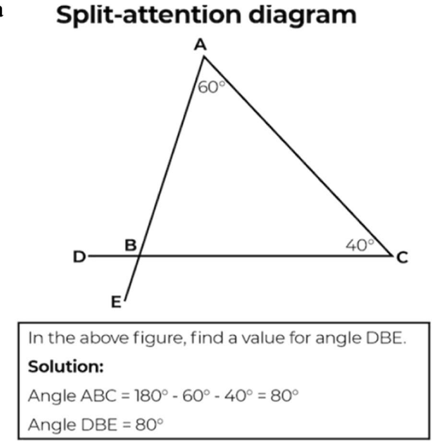
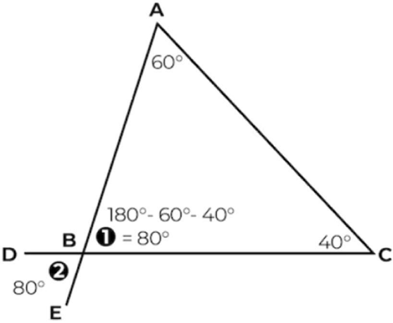
- For extraneous cognitive load, the paper compares instructional formats: one geometry split-attention example is estimated at 8 elements in the split format versus 2 elements in the integrated format.
- The paper argues that expert knowledge can reduce element interactivity, so the same material can be complex for novices but simple for experts; it notes that some effects, such as the worked-example effect, can disappear or reverse with increased expertise.
## Methods
- This is a review article that synthesizes cognitive load theory work on task complexity, element interactivity, intrinsic cognitive load, and extraneous cognitive load.
- It draws on conceptual frameworks of task complexity and on examples from prior cognitive load theory experiments, including mathematics, geometry, algebra, trigonometry, and an expository text example on Kleefstra syndrome.
- The main analysis is theoretical comparison and illustration: the paper contrasts objective vs subjective complexity frameworks and explains how element interactivity can be estimated by counting interacting elements and considering learner expertise.
## Limitations
- The paper states that estimating the number of interacting elements may not always be accurate because learners’ knowledge is difficult to measure precisely.
- The paper states that its examples are drawn primarily from well-structured tasks, such as mathematics, with fewer examples for expository materials.
- Evident from the text: the paper provides a conceptual and illustrative review rather than a new empirical study, so its claims are not based on a single original dataset.
Model-written summary. Check it against the paper before relying on it.
Integrity signals
Registry
Cites
Statistics
Figures
Verification
Claims the paper makes
3 Valid · 14 Not valid · 27 Not checked · 73 Own results and interpretations
At least one cited source doesn’t support this claim or points to a different paper, and none confirmed it — see the verdicts below.
In the paper
“As an example, to memorise the formula of the area of a parallelogram, the base × the height, included 4 interacting elements for a novice - the area, the base, the multiplication relation, and the height.”
What the sources say
- Disputedcites Chen et al. (2015) matched to “The worked example effect, the generation effect, and element interactivity.” (2015) sourceExperimental — accuracy not yet measured
In §8.1.2 Materials (page unavailable), the paper uses memorising the parallelogram area formula as an example but says its five equation elements do not interact. It estimates the interacting-element count for Grade 4 students as one, not four. (LLM, conf=0.93)
Checked by a reasoning model — may be wrong.
plain- Asserted: passes — The authors put it forward as true.
- Checkable: passes — It can be checked against evidence.
- Load-bearing: unclear — It is unclear whether the paper’s conclusions depend on it.
- Based: passes — The paper gives a reason why it holds.
- Disputed
At least one cited source doesn’t support this claim or points to a different paper, and none confirmed it — see the verdicts below.
In the paper
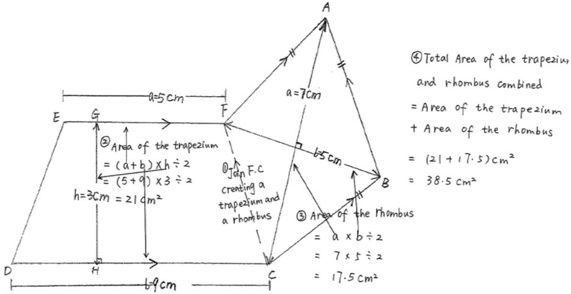
“Finally, the two separate area values added together involved another 3 elements giving, in total, about 25 interactive elements.”
What the sources say
- Disputedcites Chen et al. (2015) matched to “The worked example effect, the generation effect, and element interactivity.” (2015) sourceExperimental — accuracy not yet measured
In §8.1.2 Materials (page unavailable), the source estimates about 20 interacting elements for Grade 4 students calculating the composite shape, not about 25. It counts adding the two area values as one element, not three. (LLM, conf=0.88)
Checked by a reasoning model — may be wrong.
hedged- Asserted: passes — The authors put it forward as true.
- Checkable: passes — It can be checked against evidence.
- Load-bearing: unclear — It is unclear whether the paper’s conclusions depend on it.
- Based: passes — The paper gives a reason why it holds.
- Disputed
Every source the paper cites for this claim was checked and supports it.
In the paper
“However, when novices need to calculate the area of a composite shape, element interactivity is higher compared to memorising formulae.”
What the sources say
- Supportedcites Chen et al. (2015) matched to “The worked example effect, the generation effect, and element interactivity.” (2015) source
Section 8.1.2 (Materials) compares the tasks for Grade 4 students: memorising a formula has an interacting-element count of one, while calculating the area of a composite shape involves an estimated 20 interacting elements. This supports the claim for the novice learners described in the paper. (LLM, conf=0.94)
plainstates an association- Asserted: passes — The authors put it forward as true.
- Checkable: passes — It can be checked against evidence.
- Load-bearing: passes — The paper’s conclusions depend on it.
- Based: passes — The paper gives a reason why it holds.
- Supported
The cited sources support only part of this claim — read each source’s verdict below.
In the paper
“Most cognitive load theory effects disappear or even reverse when students study low element interactivity information, leading to the expertise reversal effect (Chen etal., 2017).”
What the sources say
- Partly supportedcites Chen et al., 2017 matched to “The Expertise Reversal Effect is a Variant of the More General Element Interactivity Effect” (2017) sourceExperimental — accuracy not yet measured
The indexed repository description (no section or page given) says the expertise reversal effect is linked to changes in relative element interactivity. It distinguishes changes caused by the material from those caused by learners’ expertise. The available passages do not support the broader claim that most cognitive load theory effects disappear or reverse with low-interactivity information, or that studying such information alone leads to expertise reversal. (LLM, conf=0.76)
plainstates a cause- Asserted: passes — The authors put it forward as true.
- Checkable: passes — It can be checked against evidence.
- Load-bearing: passes — The paper’s conclusions depend on it.
- Based: passes — The paper gives a reason why it holds.
- Partly supported
In the paper
“Out of 24 categories, only two reference learners' prior knowledge.”
What the sources say
- Not checked — no full text of the sourcecites Liu and Li (2012) matched to “Task complexity: A review and conceptualization framework” (2012) source
plain- Asserted: passes — The authors put it forward as true.
- Checkable: passes — It can be checked against evidence.
- Load-bearing: passes — The paper’s conclusions depend on it.
- Based: passes — The paper gives a reason why it holds.
38 more claims
Create a free account to see all 117 claims and every source verdict.
- Probably not a substantial claim. 60
- It may state two separate claims as one. 31
- The quote only partly states this claim. 1
Claims other papers make about this one
Each is checked against this paper’s own text: does it say what the citing paper says it does?
The cited source says what the claim attributes to it.
In the citing paper
“Similarly, CLT suggests that instructional design should consider the learner’s prior knowledge, with more guidance needed for novices than for experts (Chen et al., 2023).”
From Does difficulty moderate learning? A comparative analysis of the desirable difficulties framework and cognitive load theory (2025) · cites this paper as Chen et al., 2023
In the citing paper
“According to cognitive load theory, task complexity decreases with increased familiarity when (1) the number of interactive elements (i.e., how much information must be simultaneously processed in working memory) are reduced and (2) individuals can extract related elements crucial for problem-solving and ignore irrelevant details (Chen et al., 2023).”
From The Effect of Playback Speed and Distractions on the Comprehension of Audio and Audio-Visual Materials (2024) · cites this paper as Chen et al., 2023
Citations
Cites
The magical number seven, plus or minus two: Some limits on our capacity for processing information.
Miller, G. A. (1956) · Psychological Review · doi:10.1037/h0043158 · Cited by 17,812 · cited 1×
“Irrespective of how it is acquired, information must be processed by a working memory that has very limited capacity (Cowan, 2001; Miller, 1956) and duration (Peterson & Peterson, 1959).”
BackgroundThe magical number 4 in short-term memory: A reconsideration of mental storage capacity
Cowan, N. (2001) · Behavioral and Brain Sciences · doi:10.1017/s0140525x01003922 · Cited by 6,779 · cited 1×
“Irrespective of how it is acquired, information must be processed by a working memory that has very limited capacity (Cowan, 2001; Miller, 1956) and duration (Peterson & Peterson, 1959).”
BackgroundNewell, A. (1972) · Cited by 6,222
Cognitive Architecture and Instructional Design
Sweller, J., van Merrienboer, J. J. G., & Paas, F. G. W. C. (1998) · Educational Psychology Review · doi:10.1023/a:1022193728205 · Cited by 6,023
Self-citationCognitive load theory, learning difficulty, and instructional design
Sweller, J. (1994) · Learning and Instruction · doi:10.1016/0959-4752(94)90003-5 · Cited by 5,426 · cited 4×
“While Sweller and Chandler (1994) occasionally mentioned that differences in extraneous cognitive load also are due to differences in element interactivity, they made no attempt to provide details.”
BackgroundInfluentialSelf-citationEricsson, K. A., & Kintsch, W. (1995) · Psychological Review · doi:10.1037/0033-295x.102.2.211 · Cited by 3,498
Short-term retention of individual verbal items.
Peterson, L., & Peterson, M. J. (1959) · Journal of Experimental Psychology · doi:10.1037/h0049234 · Cited by 2,939 · cited 1×
“Irrespective of how it is acquired, information must be processed by a working memory that has very limited capacity (Cowan, 2001; Miller, 1956) and duration (Peterson & Peterson, 1959).”
BackgroundGoal setting and task performance: 1969–1980.
Locke, E. A., Shaw, K. N., Saari, L. M., & Latham, G. P. (1981) · Psychological Bulletin · doi:10.1037/0033-2909.90.1.125 · Cited by 2,452
Cognitive Architecture and Instructional Design: 20 Years Later
Sweller, J., van Merriënboer, J. J. G., & Paas, F. (2019) · Educational Psychology Review · doi:10.1007/s10648-019-09465-5 · Cited by 2,337
Self-citationElement Interactivity and Intrinsic, Extraneous, and Germane Cognitive Load
Sweller, J. (2010) · Educational Psychology Review · doi:10.1007/s10648-010-9128-5 · Cited by 2,020 · cited 11×
“Similar explanations are 1 3 Educational Psychology Review (2023) 35:63 Page 7 of 18 63 available for other cognitive load effects (Sweller, 2010).”
BackgroundInfluentialSelf-citation
Research works printed but not linked: 1
- Gill, T. G., & Murphy, W. (2011). Task complexity and design science. In 9th International Conference on Education and Information Systems, Technologies and Applications (EISTA 2011) . <!-- image -->
Cited by
Items 101–200 of 214
Li, H., Zhang, W., Pan, W., Chen, H., Hou, Y., & Bu, L. (2025) · Universal Access in the Information Society · doi:10.1007/s10209-025-01259-7 · Cited by 1
Arthur, F., Okyere‐Dankwa, R., Owusu, D., & Nortey, S. A. (2025) · Brain and Behavior · doi:10.1002/brb3.70832 · Cited by 8
“This aligns with CLT’s assertion that when cognitive load is high, individuals may prioritize efficiency and structure over exploratory or creative processes (Chen et al. 2023; Krieglstein et al. 2023).”
Neural mechanisms of visual quality perception and adaptability in the visual pathway
Zhang, Y., Chen, Y., Hu, Y., Han, X., Xie, Z., Wang, X., Zhou, Y., Min, X., & Zhai, G. (2025) · Patterns · doi:10.1016/j.patter.2025.101368 · Cited by 2
“78,79 This study highlights the impact of visual quality on cognitive load, offering insights for designing experiments on human learning processes.”
Exploring multimedia principles and learning from errors in augmented reality and video
Candido, V., Cattaneo, A., & Petko, D. (2025) · Learning and Instruction · doi:10.1016/j.learninstruc.2025.102244 · Cited by 7
Martín, A. S., Hagenow, M., Shah, J., Kildal, J., & Lazkano, E. (2025) · IEEE RO-MAN · doi:10.1109/ro-man63969.2025.11217753 · Cited by 1
“Additionally, the cognitive load of managing complex tasks while seeking help can overwhelm a person’s working memory, reducing efficiency and increasing stress [14], [15], [16].”
Pina, J., Bernal-Berdun, E., Martin, D., Malpica, S., Real, C., Barquero, A., Julián, P. A., Lázaro, J. M., Martín-Yebra, A., Masiá, B., et al. (2025) · Proceedings - International Symposium on Mixed and Augmented Reality, ISMAR · doi:10.1109/ismar67309.2025.00054 · Cited by 5
“The study of cognitive load (CL) has been an active research area [18, 52, 53] since the publication of the seminal work from Sweller [50], which established the basis of the cognitive load theory.”
Ovadiya, T. (2025) · Education Sciences · doi:10.3390/educsci15111538 · Cited by 5
“The theory focuses on the ‘element interactivity effect,’ which becomes critical when learners must simultaneously process multiple interacting elements—a common challenge in mathematical problem solving (Chen et al., 2023; Sweller, 2024).”
Zhang, D., Huang, Y., Li, H., Yao, Y., Hao, M., & Liu, T. (2025) · European Journal of Oncology Nursing · doi:10.1016/j.ejon.2025.103077 · Cited by 1
Bu, L., Cui, B., Chen, H., Pan, W., & Li, H. (2025) · Behaviour and Information Technology · doi:10.1080/0144929x.2025.2604586 · Cited by 2
Gorbunova, A., Adamovich, K. A., Savelyev, A., & Costley, J. (2025) · The Internet and Higher Education · doi:10.1016/j.iheduc.2025.101073 · Cited by 3
Huang, Z., Wei, X., Liu, X., & Yang, Y. (2026) · Frontiers in Psychology · doi:10.3389/fpsyg.2025.1720922 · Cited by 1
Fei, L., Xue, M., & Pang, Q. (2026) · Building and Environment · doi:10.1016/j.buildenv.2026.114352 · Cited by 3
Hussain, A. A. I., Kamari, A., Syamsudin, F. I., Harahap, L. K., Saputro, S., Wiyarsi, A., & Sukkaew, A. (2026) · AMPLITUDO Journal of Science & Technology Innovation · doi:10.56566/amplitudo.v5i1.517 · Cited by 1
Njuguna, G. N., & Min, Q. (2026) · AI & Society · doi:10.1007/s00146-026-02973-3 · Cited by 2
“This fosters user engagement by optimizing LLM use (Chen et al. 2023) and reinforcing human–LLM collaboration.”
The DECADE learning model: Integrating learning theories in mathematics education
Putra, F. G., Sutiarso, S., Nurhanurawati, N., Hariri, H., Caswita, C., & Maulina, D. (2026) · Indonesian Journal of Science and Mathematics Education · doi:10.24042/ijsme.v9i1.30746 · Cited by 3
Wang, P., & Luo, H. (2026) · The Internet and Higher Education · doi:10.1016/j.iheduc.2026.101088 · Cited by 2
When to inquire and when to instruct: Prior knowledge and element interactivity in medical learning
Jimmy Zambrano, R., Narváez-Rivera, C., Sayago-Heredia, G., & León, S. M. J. (2026) · Learning and Instruction · doi:10.1016/j.learninstruc.2026.102392 · Cited by 1
Désiron, J. C., Endres, T., & Schneider, S. (2026) · Frontiers in Psychology · doi:10.3389/fpsyg.2026.1795142 · Cited by 2
“Future experiments should manipulate element interactivity directly (e.g., by altering the number and interdependence of interface elements) and measure both objective structure and subjective appraisals to disentangle these aspects (Chen et al., 2023).”
InfluentialMohammadi, M., Berahmand, K., Sadiq, S. W., & Khosravi, H. (2026) · Computers and Education Artificial Intelligence · doi:10.1016/j.caeai.2026.100616 · Cited by 6
Shahin, M., Maghanaki, M., & Chen, F. F. (2026) · Big Data and Cognitive Computing · doi:10.3390/bdcc10070215 · Cited by 1
“Existing cognitive load theory research [75–77] conceptualizes extraneous load in the context of instructional effectiveness.”
Effects of task complexity and pre-training on problem solving: A cognitive load perspective
Zeitlhofer, I., Zumbach, J., & Schwartz, N. (2026) · European Journal of Psychology of Education · doi:10.1007/s10212-026-01176-0 · Cited by 1
“In contrast, ECL refers to cognitive load imposed by processing learning-irrelevant information, often due to ineffective instructional design, and can be reduced by adjusting instructional methods (Chen et al., 2023; Sweller et al., 2019).”
VIEW: An Assessment of Problem-Solving Style - 20 Years of Progress
Isaksen, S. G., & Hoßbach, C. (2024) · Psychological Reports · doi:10.1177/00332941241249954 · Cited by 2
“…better understand the potential linkages between problem-solving style and cognitive fi xation (e.g., Gauselmann et al., 2023; Wang et al., 2023), cognitive load (e.g., Chen et al., 2023; Paas et al., 2010), and cognitive biases (e.g. Acciarini et al., 2021; Tversky & Kahneman, 1974), among others.”
Instructional design for teaching analytical chemistry in English as a foreign language
Derkach, T. M., & Yaroshenko, O. G. (2025) · Journal of Physics Conference Series · doi:10.1088/1742-6596/3105/1/012013 · Cited by 1
Editorial: (Ir)Relevance in education: individuals as navigators of dynamic information landscapes
Bobrowicz, K., Thibaut, J., Greiff, S., & Pavlova, M. (2025) · Frontiers in Psychology · doi:10.3389/fpsyg.2024.1546881 · Cited by 1
Krieglstein, F., Schmitz, M., Wesenberg, L., Spitzer, M., & Rey, G. D. (2024) · Research Square · doi:10.21203/rs.3.rs-4598970/v1
The MKM: Identify and Assess Complexity and Prior Knowledge in Your Math Didactics
Miró, À., Alier, M., & Serrano, J. M. (2024) · Lecture notes in educational technology · doi:10.1007/978-981-97-1814-6_110
Bartura, K., Gustafsson, H., & Abrahamsen, F. E. (2024) · doi:10.31234/osf.io/svjmc
Lopez, C., Morrison, M., & Deacon, M. (2024) · European Public & Social Innovation Review · doi:10.31637/epsir-2024-760 · Cited by 1
Choi, S., Kim, D., & Song, J. (2024) · Educational Technology Research and Development · doi:10.1007/s11423-024-10421-6 · Cited by 1
“This was because the simplifying conditions sequencing provided in session 1 were clear, concise, and offered explicit instructions, resulting in low levels of element interaction (Chen et al., 2023).”
InfluentialMangubat, J. P. L., & Paglinawan, J. L. (2024) · International Journal of Latest Technology in Engineering Management & Applied Science · doi:10.51583/ijltemas.2024.1311012 · Cited by 2
Khoo, L. J., Yatim, M. H. M., & Seng, W. Y. (2024) · The International journal of Multimedia & Its Applications · doi:10.5121/ijma.2024.16601
Measuring Cognitive Load Through Event Camera Based Human-Pose Estimation
Aitsam, M., Lacroix, D., Goyal, G., Bartolozzi, C., & Nuovo, A. G. D. (2025) · Springer proceedings in advanced robotics · doi:10.1007/978-3-031-81688-8_17 · Cited by 7
Singh, V. K., Sengar, R. S., & Pandey, N. (2025) · International Conference on Intelligent Control, Computing and Communications (IC3) · doi:10.1109/ic363308.2025.10956321
“Cognitive load analysis could provide valuable insights into the relationship between perceived difficulty, actual complexity, and learning outcomes, informing the design of more effective instructional strategies and challenge sequences [21].”
黎, 泳. (2025) · Advances in Psychology · doi:10.12677/ap.2025.154224
Acebedo, D. A., Ang, A. J., Torrecampo, K. E., et al. (2025) · SSRN Electronic Journal · doi:10.2139/ssrn.5261723
Improving Students’ Ability in Reading Descriptive Paragraphs Through Mind Mapping TechniquePreprint
Silalahi, E. (2025) · SSRN Electronic Journal · doi:10.2139/ssrn.5263191
Mental workload recognition from EEG signals via semi-supervised autoencoders
Liu, Q., Jiang, X., Wang, H., et al. (2025) · Computer Methods in Biomechanics & Biomedical Engineering · doi:10.1080/10255842.2025.2523310
Secondary Mathematics Complexity Decomposed and Fitted Through Five Reliable Variables
Miró, À., Alier, M., Serrano, J. M., Benavides, A., & Catasús, P. (2025) · Lecture notes in educational technology · doi:10.1007/978-981-96-5658-5_93
Hendra, O., & Nugraha, W. (2025) · Safety and Reliability · doi:10.1080/09617353.2025.2534932 · Cited by 1
Human capacity strengthening for firefighters: A scoping review
Ojeda, K. V. T., & Trujillo, M. D. L. Á. S. (2025) · Multidisciplinary Reviews · doi:10.31893/multirev.2026028
Wolden, B., Palm, D., & Wolden, M. (2025) · Journal of Physical Therapy Education · doi:10.1097/jte.0000000000000440 · Cited by 4
Lernaufgaben digital dokumentieren, sammeln und veröffentlichen
Ringel, R. (2025) · Perspektiven auf Lehre Journal for Higher Education and Academic Development · doi:10.55310/jfhead.74
Brunstein, J. C., & Heckhausen, H. (2025) · Springer eBooks · doi:10.1007/978-3-662-69368-1_6
Boomers Need New Skills: Teaching Modern Media Literacies for the New Media Landscape
Burke, B. R. (2025) · Advances in computational intelligence and robotics book series · doi:10.4018/979-8-3373-0872-2.ch006
Javier, M., & Nistal, C. (2025) · Psychology and Education A Multidisciplinary Journal · doi:10.70838/pemj.460602
Emotional intelligence: the key to managing cognitive overload and enhancing quality of life
Mohamed, D. A. A., & Shehata, G. M. (2025) · Management & Sustainability An Arab Review · doi:10.1108/msar-02-2025-0049 · Cited by 1
Oktaviyanthi, R., Agus, R. N., & Khotimah (2025) · AIP conference proceedings · doi:10.1063/5.0290059
Rismawati, R., Ranjan, A., & Sharma, K. (2025) · IGI Global eBooks · doi:10.4018/979-8-3373-2292-6.ch008 · Cited by 1
Corpora and AI for inductive learning: Theory and practice
Csomay, E., Jablonkai, R. R., & Sun, H. (2025) · Applied Corpus Linguistics · doi:10.1016/j.acorp.2025.100165 · Cited by 1
“That is to say, for learners who are not good at inferring patterns from observations to learn complex structures, additional support may help avoid cognitive overload which could hamper the learning process (Chen et al., 2023; Gorbunova et al., 2023).”
Li, Y., Fang, W., Miao, C., & Sun, Z. (2026) · International Journal of Industrial Ergonomics · doi:10.1016/j.ergon.2026.104040
Collaborative learning in interpreting: A collaborative cognitive load theory approach
Du, R., & Salaets, H. (2025) · Across Languages and Cultures · doi:10.1556/084.2025.01063 · Cited by 1
Riyanti, L. E., & Gauthama, W. (2025) · Journal of Applied Research in Higher Education · doi:10.1108/jarhe-06-2025-0428
Lin, Y., Wen, Z., Li, Y., Wei, X., Zhang, J., Yan, T., & Bao, Z. (2025) · BMC Medical Education · doi:10.1186/s12909-025-08368-0 · Cited by 1
“Procedures like tooth extraction are inherently complex, imposing a high intrinsic load due to their numerous, interacting steps [8].”
Game-Based Learning Design for Post-Merger Integration Methods: Requirements and Metamodel
Lāce, K. (2025) · Complex Systems Informatics and Modeling Quarterly · doi:10.7250/csimq.2025-45.05
“Recent research in Cognitive Load Theory introduced the concept of element interactivity, which refers to the degree to which individual elements of learning activity interact and must be processed by the learner simultaneously [15].”
de Souza, T. N. S., Prata, E. D. S., de Magalhães, M. V. D., et al. (2025) · Terrae Didatica · doi:10.20396/td.v21i00.8681542
Design of a Multidimensional Virtual Reality User Experience Questionnaire
Bozdemir, Y., & Law, E. L. (2025) · doi:10.14236/ewic/bcshci2025.54 · Cited by 2
Bartura, K., Gustafsson, H., & Abrahamsen, F. E. (2026) · Perceptual and Motor Skills · doi:10.1177/00315125261419408
“First, participants may disengage or lack motivation if they perceive the task is unimportant or overly complex (Chen et al., 2023; Low et al., 2022), potentially leading them to conserve resources — even though task dif fi culty/complexity was not measured in the study.”
Wolfert, C., Neumann, I., & Sommerhoff, D. (2025) · Teaching Mathematics and its Applications An International Journal of the IMA · doi:10.1093/teamat/hraf019
Li, Y., Fang, W., Miao, C., et al. (2026) · SSRN Electronic Journal · doi:10.2139/ssrn.6222894
Zhang, D., Luo, S., Liu, Y., Zhang, X., Hu, Y., Shen, J., Yi, P., Zhao, K., & Liu, W. (2026) · Humanities and Social Sciences Communications · doi:10.1057/s41599-026-06738-7 · Cited by 5
Moshfeghi, Y., Aboshi, S., & Thomas, D. (2026) · SSRN Electronic Journal · doi:10.2139/ssrn.6361106
Guo, S., & Wu, Z. (2026) · Across Languages and Cultures · doi:10.1556/084.2025.01184
Turkish adaptation and psychometric evaluation of cognitive load scale for middle school students
Özcan, Z. Ç., & Öner, A. T. (2026) · Acta Psychologica · doi:10.1016/j.actpsy.2026.106583 · Cited by 1
Socio-ecological problems: How reflective and impulsive students demonstrate mathematical literacy
Fuadah, P. F., & Shodikin, A. (2026) · Indonesian Journal of Science and Mathematics Education · doi:10.24042/ijsme.v9i1.29894
Ngu, B. H., Tay, E. G., Phan, H. P., & Usop, H. H. (2026) · International Journal of Mathematical Education in Science and Technology · doi:10.1080/0020739x.2026.2633245
Effects of physically embodied educational robots on children's learning outcomes: A meta-analysis
Shu, L., Xie, S., & Lin, H. (2026) · Acta Psychologica · doi:10.1016/j.actpsy.2026.106576 · Cited by 2
Wang, Q., Wang, Y., Wei, T., & Fu, S. (2026) · Scientific Reports · doi:10.1038/s41598-026-45101-3 · Cited by 4
“Previous research has shown that improving information structure and enhancing information clarity can significantly reduce extraneous cognitive load, thereby improving information processing efficiency 25,34 .”
Tarng, W., Lee, B.-Y., & Ding, T.-J. (2026) · Electronics · doi:10.3390/electronics15061315 · Cited by 1
Ayat, N. E., Boutalline, M., Tannouche, A., Ouazri, C., & Yahyaoui, M. (2026) · Quality & Quantity · doi:10.1007/s11135-026-02715-z · Cited by 1
“Rules derive from contemporary Cognitive Load Theory research (Sweller et al. 2024; Chen et al. 2023) and evidence-based autism pedagogy (Shahini et al. 2025; Kotsi et al. 2025), empirically calibrated via percentile analysis of pilot data.”
Wang, K., & Zhang, S. (2026) · Tourism Review · doi:10.1108/tr-09-2025-1169 · Cited by 1
Delaney, B., Walsh, J. F., Blankenship, J. C., & Luz, H. P. (2026) · Education Sciences · doi:10.3390/educsci16040598
“Chen et al. (2023) wrote that task difficulty for novices should consider both elemental interactivity and the learner’s prior knowledge.”
Ratniyom, J., Boonphadung, S., Intaraprasit, M., & Chumkaeo, P. (2026) · Chemistry Teacher International · doi:10.1515/cti-2025-0097 · Cited by 2
“29,30 This approach aligns with the sca ff olding process of reduction in degrees of freedom, in which content complexity is deliberately constrained by breaking down complex concepts into smaller, sequential, and more manageable components.”
Han, L., Gu, P., Zhou, H., & Du, Z. (2026) · International Journal of Industrial Ergonomics · doi:10.1016/j.ergon.2026.103965
Fitrohyati, D. J., & Hikmawan, R. (2026) · JKTP Jurnal Kajian Teknologi Pendidikan · doi:10.17977/um038v9i22026p224-232 · Cited by 1
Dou, D., Huang, B., Chen, Q., Zhou, X., & Wang, C. (2026) · Frontiers in Psychology · doi:10.3389/fpsyg.2026.1811374 · Cited by 1
Scholl, D., & Küth, S. (2026) · Teaching and Teacher Education · doi:10.1016/j.tate.2026.105600
Li, H., Lou, W., Chen, H., Pan, W., Wang, Z., & Chen, J. (2026) · International Journal of Human-Computer Interaction · doi:10.1080/10447318.2026.2674831
Novitra, F., Sundari, P. D., Muslim, Suherman, D. S., Anshari, R., Hidayati, & Dwiridal, L. (2026) · Social Sciences & Humanities Open · doi:10.1016/j.ssaho.2026.103032 · Cited by 2
Krogh‐Jensen, O., Damsgaard, L., Rohde, R. A., Nielsen, G., Fosnaes, O., Hauge, J., & Wienecke, J. (2026) · Educational Psychology Review · doi:10.1007/s10648-026-10175-y
“Rather, it supports the notion that motor learning can take place even when cognitive demands are pres-ent, if the tasks are meaningfully integrated (Chen et al., 2023; Paas et al., 2010).”
Santhosh Kumar, S., Khan, A. K., & Shinde, S. (2026) · Education and Information Technologies · doi:10.1007/s10639-026-14046-5 · Cited by 1
“This is considered to be cognitive load, which is reduced by modern technologies (Chen et al., 2023).”
Zeitlhofer, I., & Zumbach, J. (2026) · International Journal of Educational Research · doi:10.1016/j.ijer.2026.103039 · Cited by 2
Kholis, N., Hakim, V. G. A., Heung, Y. M. E., Gumelar, A. S., & Mubarok, H. (2026) · European Journal of Engineering Education · doi:10.1080/03043797.2026.2677543 · Cited by 2
Darmika, I. M. P. (2026) · MIMBAR PGSD Undiksha · doi:10.23887/jjpgsd.v14i1.97130
王莹, Li, Q., & Liu, X. (2026) · Frontiers in Psychology · doi:10.3389/fpsyg.2026.1855051 · Cited by 1
The Universal Tool: A Working Theory of Generative Cognitive Development Across the LifespanPreprint
Mohamed, R. (2026) · OSF Preprints (OSF Preprints) · doi:10.5281/zenodo.20769604
Worked Example–Problem Unit Presentation Formats: The Role of Unit Number and Learner ExpertisePreprint
He, F., Lin, H., Bai, H., Yang, C., & Yang, Y. (2026) · SSRN Electronic Journal · doi:10.2139/ssrn.7049788
Research on Intelligent Automotive HMI Design Based on Cognitive Load Theory
Wang, H., & Long, R. (2026) · Communications in computer and information science · doi:10.1007/978-3-032-30819-1_21
Complexity-Aware and Response Time Enhanced Knowledge Tracing
Li, W., Wu, W., Sun, J., Sun, G., & He, Y. (2026) · Lecture notes in computer science · doi:10.1007/978-981-92-2759-4_5
Bernadine, N. A., Parta, I. N., & Hasanah, D. (2026) · Journal of Physics Conference Series · doi:10.1088/1742-6596/3276/1/012016
“Based on CLT proposed by Sweller [18], Kalyuga [3], Plass [17], and Sternberg [19], the instrument in this study was developed to characterize ICL in mathematical content based on its sources.”
Applying Cognitive Load Theory to Best Practices in Pharmacy Education: A Narrative Review
Islam, M. A., Yang, S., Kim, L., & Talukder, R. M. (2026) · American Journal of Pharmaceutical Education · doi:10.1016/j.ajpe.2026.102060 · Cited by 1
Liu, J., Sun, M., Liu, C., & Yang, H. (2026) · The Electronic Library · doi:10.1108/el-12-2025-0489
Bu, L., Hou, Y., Han, Y., & Cui, B. (2026) · Interactive Learning Environments · doi:10.1080/10494820.2026.2711397
Task Complexity Index for Digital Services
Haas, T., & Rantanen, E. M. (2026) · Proceedings of the Human Factors and Ergonomics Society Annual Meeting · doi:10.1177/10711813261475200
Zhou, J., Lv, Z., Li, Y., & Wang, Y. (2026) · Acta Psychologica · doi:10.1016/j.actpsy.2026.107542
Hussain, M. (2026) · Turkish Journal of Special Education Research and Practice · doi:10.37233/trsped.drr.2004007 · Cited by 1
Embodied guidance fading: When embodiment supports STEM learning by optimizing cognitive load
PAAS, F. G. W. C., Marcus, N., Sigayret, K., Wang, P., Ouwehand, K., & Zou, L. (2026) · Educational Psychologist · doi:10.1080/00461520.2026.2717080 · Cited by 1
Self-citationZhang, J., Zhang, Y., Ye, B., & Guo, Y. (2026) · Decision Support Systems · doi:10.1016/j.dss.2026.114759
Peer instruction in chemistry stratified exercises: Cognitive and metacognitive effects
Zheng, Y., Wang, X., Zhang, Y., & Mei, H. (2026) · Learning and Instruction · doi:10.1016/j.learninstruc.2026.102460
Beyond Problem-Solving: Interactive Worked Examples as Pathways to Dual Teacher Expertise
Ovadiya, T. (2026) · Journal of Intelligence · doi:10.3390/jintelligence14090203 · Cited by 1
“Element interactivity measures the complexity of a concept and is a fundamental part of cognitive load theory, usually applied to biologically secondary information (Chen et al., 2023).”
Metadata
- Authors
- Chen, O., Paas, F., & Sweller, J.
- Affiliations
- Loughborough University (GB)
- University of Wollongong (AU)
- UNSW Sydney (AU)
- Corresponding author
- Chen, Ouhao
- Venue
- Educational Psychology Review
- Published
- 2023-06
- Volume
- 35
- Issue
- 2
- ISSN
- 1040-726X (ISSN-L)
- 1573-336X
- OpenAlex
- W4379233238
- Semantic Scholar
- 3eec95c206a174f3f1cdf61a51843b47131dcd9b
- Cited by
- 224
- References
- 48
- Citations by year
- 2026: 88 · 2025: 78 · 2024: 51 · 2023: 7
- FWCI
- 57.73
- Type
- journal article
- Language
- en
- Open access
- hybrid
- doi.org
- Licence
- cc-by
- creativecommons.org/licenses/by/4.0 (tdm)
- creativecommons.org/licenses/by/4.0 (vor, 1 d)
- Locations
- Educational Psychology Review (publishedVersion, cc-by)
- Figshare (submittedVersion, cc-by)
- Research Online (University of Wollongong) (submittedVersion)
- Topics
- Social Sciences › Psychology › Experimental and Cognitive Psychology › Visual and Cognitive Learning Processes
- Social Sciences › Psychology › Developmental and Educational Psychology › Innovative Teaching and Learning Methods
- Social Sciences › Psychology › Developmental and Educational Psychology › Educational and Psychological Assessments
- Keywords
- task complexity, cognitive load theory, element interactivity, intrinsic cognitive load, extraneous cognitive load, long-term memory, information structure, instructional design
About these checks
Registry, retraction, Cites and statistics results are computed, not judged, with one exception: a printed reference that no index lists is read once by a model before it counts as a citation error. Claims are extracted by a model and kept only when their quote appears verbatim in the text; each cited source is then checked, with a model’s help, for whether it says what the claim relies on. Those verdicts can be wrong — read the claim’s quote and the cited source before relying on one.
The claim verdicts this report counts are experimental: their accuracy is not yet measured.
A language model drew the claims from the paper on 2026-10-10, under version 3 of the claim definition (model deepseek-v4.1-flash, prompt extract-v3).
A second model labelled each claim on 2026-10-10 (model jev-1.13-20260917, definition revision gold-guideline-v0.2).
Cited sources are checked with a language model’s help (gpt-6-sol).
Statistics and arithmetic are recomputed, not judged.
Confidence bands are shown only for fields calibrated on our annotated test set. None is calibrated yet, so no band is shown.
What counts as a claim ›How we measure confidence ›How we check this ›
Are you an author, or do you see a problem with this page? Request a review
Data sources
Bibliographic data: Semantic Scholar, OpenAlex, Crossref.
Contains information from the Semantic Scholar Academic Graph Datasets, made available under the ODC Attribution License (ODC-BY 1.0).
Semantic Scholar’s data is described in: Kinney, R., et al. (2023). The Semantic Scholar Open Data Platform. arXiv:2301.10140.
