

Factor Structure, Reliability and Criterion Validity of the Autism-Spectrum Quotient (AQ): A Study in Dutch Population and Patient Groups
Open accessThe DOI matches its Crossref record; 37 of the 38 references it cites were found in a registry or an index.
Abstract
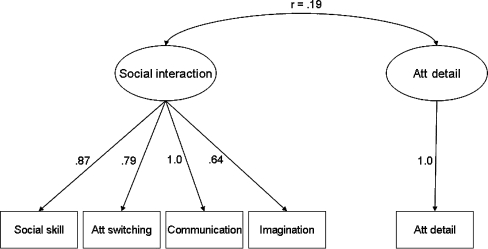
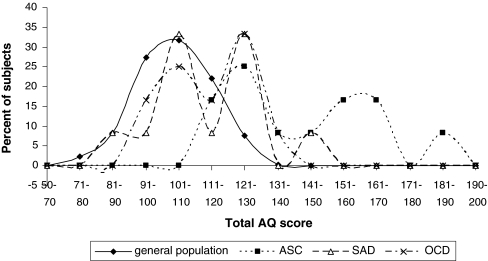
The factor structure of the Dutch translation of the Autism-Spectrum Quotient (AQ; a continuous, quantitative measure of autistic traits) was evaluated with confirmatory factor analyses in a large general population and student sample. The criterion validity of the AQ was examined in three matched patient groups (autism spectrum conditions (ASC), social anxiety disorder, and obsessive-compulsive disorder). A two factor model, consisting of a "Social interaction" factor and "Attention to detail" factor could be identified. The internal consistency and test-retest reliability of the AQ were satisfactory. High total AQ and factor scores were specific to ASC patients. Men scored higher than women and science students higher than non-science students. The Dutch translation of the AQ is a reliable instrument to assess autism spectrum conditions.
Overview
The claims and statistics of this paper haven’t been checked yet.
Free: it reads the open-access text and checks the first 5 claims that cite a source we can check. Create a free account to check every claim.
Integrity signals
Registry
Cites
Statistics
Figures
Verification
Claims the paper makes
The claims and statistics of this paper haven’t been checked yet.
Free: it reads the open-access text and checks the first 5 claims that cite a source we can check. Create a free account to check every claim.
Claims other papers make about this one
Each is checked against this paper’s own text: does it say what the citing paper says it does?
The source backs part of the claim, not all of it — or backs it for a different population, condition or comparison.
In the citing paper
“The test has good internal consistency and test-retest reliability and has been translated into many languages [57, 58].”
From A 'choice', an 'addiction', a way 'out of the lost': Exploring self-injury in autistic people without intellectual disability (2019) · cites this paper as [58]
Experimental — accuracy not yet measuredThe cited source says what the claim attributes to it.
In the citing paper
“High total AQ scores are specific to patients with an ASD and set them apart from both the general population and from patients with SAD [65].”
The check wasn’t confident either way, so it gives no verdict — never disputed.
In the citing paper
“The most widely used measure for adults with ASC is the Adolescent/Adult Sensory Profile (AASP), a 60-item self-report measure that finds differences in sensory processing in more than 90% of adults with ASC [17,19].”
From The Sensory Perception Quotient (SPQ): development and validation of a new sensory questionnaire for adults with and without autism (2014) · cites this paper as [19]
Experimental — accuracy not yet measured
Self-check
Percentages, sums and reported differences re-computed from the paper’s own numbers.
The self-check needs the paper’s full text.
Citations
Cites
Lord, C., Rutter, M., & Le Couteur, A. (1994) · Journal of Autism and Developmental Disorders · doi:10.1007/bf02172145 · Cited by 9,065 · cited 2×
“Keywords Autism Factor analysis Validity Reliability Autism phenotype”
MethodSchermelleh-Engel, K., Moosbrugger, H., & Müller, H. (2003) · Department of Psychology - University of Koblenz-Landau · doi:10.23668/psycharchives.12784 · Cited by 8,975
Lord, C., Risi, S., Lambrecht, L., Cook, E. H., Leventhal, B. L., DiLavore, P. C., Pickles, A., & Rutter, M. (2000) · Journal of Autism and Developmental Disorders · doi:10.1023/a:1005592401947 · Cited by 7,520 · cited 2×
“Keywords Autism Factor analysis Validity Reliability Autism phenotype”
MethodBaron-Cohen, S., Wheelwright, S., Skinner, R., Martin, J., & Clubley, E. (2001) · Journal of Autism and Developmental Disorders · doi:10.1023/a:1005653411471 · Cited by 6,450 · cited 13×
“Both the British (Baron-Cohen et al. 2001) and the Japanese version (Kurita et al. 2005) of the AQ reported good test-retest reliability and moderate internal consistency (Cronbach’s a varying from .63 to .78).”
BackgroundMethodResultInfluentialStructured Clinical Interview for DSM-IV Axis I Disorders
Spitzer, R. L., First, M. B., & Gibbon, M. (1997) · Medical Entomology and Zoology · Cited by 4,096
Autism as a strongly genetic disorder: evidence from a British twin study
Bailey, A., Le Couteur, A., Gottesman, I., Bolton, P., Simonoff, E., Yuzda, E., & Rutter, M. (1995) · Psychological Medicine · doi:10.1017/s0033291700028099 · Cited by 2,461
The extreme male brain theory of autism
Baron-Cohen, S. (2002) · Trends in Cognitive Sciences · doi:10.1016/s1364-6613(02)01904-6 · Cited by 2,007 · cited 2×
“In line with the empathizing–systemizing theory of autism (Baron-Cohen 2002; Baron-Cohen et al. 2005) and findings from previous studies (Baron-Cohen et al. 2001; Hoekstra et al. 2007; Wakabayashi et al. 2006) we expected: (a) AQ scores to be continuously distributed in the general population; (b)…”
ResultThe Extreme Male-Brain Theory of Autism
Baron-Cohen, S. (1999) · Neurodevelopmental Disorders · doi:10.7551/mitpress/4945.003.0023 · Cited by 1,413
Autistic Traits in the General Population: A Twin Study
Constantino, J. N., & Todd, R. D. (2003) · Archives of General Psychiatry · doi:10.1001/archpsyc.60.5.524 · Cited by 1,317 · cited 2×
“continuously distributed in the population (Constantino and Todd 2003; Piven et al. 1997; Spiker et al. 2002).”
BackgroundSex differences in the brain: implications for explaining autism
Baron-Cohen, S., Knickmeyer, R. C., & Belmonte, M. K. (2005) · Science · doi:10.1126/science.1115455 · Cited by 1,145 · cited 2×
“In line with the empathizing–systemizing theory of autism (Baron-Cohen 2002; Baron-Cohen et al. 2005) and findings from previous studies (Baron-Cohen et al. 2001; Hoekstra et al. 2007; Wakabayashi et al. 2006) we expected: (a) AQ scores to be continuously distributed in the general population; (b)…”
Result
Research works printed but not linked: 2
- 1. American Psychiatric Association (2000). Diagnostic and Statistical Manual for Mental Disorders, 4th Ed., Text Revision (DSM-IV-TR). Washington: American Psychiatric Press.
- 26. Neale M. C., Boker S. M., Xie G., Maes H. H. Mx: Statistical modeling. 7. Richmond: VCU; 2006.
Cited by
Items 501–600 of 761
Shabalin, A. P., & Pervushina, O. N. (2020) · Reflexio · doi:10.25205/2658-4506-2020-13-2-118-161 · Cited by 4
Ishizuka, M., Otsuka, S., Miyata, J., Yoshihara, Y., Kubota, M., & Murai, T. (2024) · Schizophrenia Research · doi:10.1016/j.schres.2024.12.007 · Cited by 4
Evidence for a role of synchrony but not common fate in the perception of biological group movements
Cracco, E., Papeo, L., & Wiersema, J. R. (2024) · European Journal of Neuroscience · doi:10.1111/ejn.16356 · Cited by 4
Evidence-Based Practice for Students with Autism Spectrum Disorders
Denniston, L. (2017) · California State University ScholarWorks (system-wide DSpace) · Cited by 4
Cognitive profiles of adults with high functioning autism (HFA) and Asperger syndrome
Spek, A. A. (2010) · Leiden Repository (Leiden University) · Cited by 3
What Makes Us IT People? Autistic Tendency and Intrinsic Interests in IT
Jia, R., & Jia, H. H. (2019) · ACM SIGCPR Conference on Computer Personnel Research (SIGCPR) · doi:10.1145/3322385.3322408 · Cited by 3
Widjaja, E. S., Spackman, E. K., Bainbridge, T. F., Ludeke, S. G., Uljarević, M., Hudry, K., & Smillie, L. D. (2025) · Assessment · doi:10.1177/10731911251326395 · Cited by 3
Neurodiversity, Social Support, and Mental Wellbeing: Pathways to Resilience Among Early Adolescents
Cherewick, M., Reaven, J., Giri, P., Rai, R. P., Cruz, C. M., Leiferman, J. A., & Matergia, M. (2025) · Advances in Neurodevelopmental Disorders · doi:10.1007/s41252-025-00469-7 · Cited by 3
Social Impairment in the Autistic Spectrum: Real-Life Versus Online Perceived Social Skills
Poulain, R., Cappe, C., & Batty, M. (2023) · Advances in Neurodevelopmental Disorders · doi:10.1007/s41252-023-00368-9 · Cited by 3
Fani, O. R., de Jonge, M. V., Janssen, S. M. J., Ahami, A. O. T., & de Vries, M. (2026) · Journal of Autism and Developmental Disorders · doi:10.1007/s10803-026-07242-2 · Cited by 3
ASS en verslaving: Behandelervaringen in een DD-programma
Bosma, M., van Zanten, J., & Sonneborn, C. (2014) · Verslaving · doi:10.1007/s12501-014-0005-7 · Cited by 3
Gracey, C. D. (2011) · Research Explorer (The University of Manchester) · Cited by 3
Visuo-motor updating in individuals with heightened autistic traits
Pomè, A., & Zimmermann, E. (2024) · eLife · doi:10.7554/elife.94946 · Cited by 3
Altered category learning and reduced generalization in autistic adults
Overwalle, J. V., der Donck, S. V., Geusens, B., Boets, B., & Wagemans, J. P. (2024) · Autism Research · doi:10.1002/aur.3286 · Cited by 3
Harris, L. L., & Coolidge, F. L. (2022) · Journal of Clinical Psychology · doi:10.1002/jclp.23373 · Cited by 3
Menstruation and Menopause in autistic adults: Periods of importance?Preprint
Groenman, A. P., Torenvliet, C., Radhoe, T. A., van Rentergem, J. A. A., & Geurts, H. M. (2021) · PsyArXiv (OSF Preprints) · doi:10.31234/osf.io/kn8xe · Cited by 3
ÜNİVERSİTE ÖĞRENCİLERİNDE OTİZM SPEKTRUM ANKETİ TÜRKÇE FORMUNUN GÜVENİRLİĞİNİN DEĞERLENDİRİLMESİ
Aykan, S., & Kalaycıoğlu, C. (2020) · Kırıkkale Üniversitesi Tıp Fakültesi Dergisi · doi:10.24938/kutfd.809869 · Cited by 3
Two validation studies of a performance validity test for autistic adults
Scheeren, A. M., Dubbelink, L. O., Lever, A. G., & Geurts, H. M. (2024) · Applied Neuropsychology Adult · doi:10.1080/23279095.2024.2305206 · Cited by 3
Experience-dependent reshaping of body gender perception
D’Argenio, G., Finisguerra, A., & Urgesi, C. (2021) · Psychological Research · doi:10.1007/s00426-021-01569-4 · Cited by 3
Karmakar, A., Bhattacharya, M., Chatterjee, S., & Dogra, A. K. (2021) · Advances in Autism · doi:10.1108/aia-08-2020-0049 · Cited by 3
Kumari, M., & Sharma, A. (2020) · International Journal of Engineering Trends and Technology · doi:10.14445/22315381/ijett-v68i12p214 · Cited by 3
Vocal emotion recognition: A comparison of singers and instrumentalists, amateurs and professionals
Nussbaum, C., Dethloff, J., Schirmer, A., & Schweinberger, S. R. (2025) · iScience · doi:10.1016/j.isci.2025.114089 · Cited by 3
Yeter, Ö., Kooi, B. P., de Weerd, H., Verbrugge, R., & Hendriks, P. (2024) · University of Groningen research database (University of Groningen / Centre for Information Technology) · Cited by 3
Agile methodology and development of software for users with specific disorders
Fojtík, R. (2010) · Proceedings of the International Multiconference on Computer Science and Information Technology · doi:10.1109/imcsit.2010.5679723 · Cited by 3
Going beyond our means: A proposal for improving psycholinguistic methods
Goldshtein, M. (2021) · Illinois Digital Environment for Access to Learning and Scholarship (University of Illinois at Urbana-Champaign) · Cited by 3
Amador, J. A., Canals, J., Caparrós, B. C., Farriols, N., Ruiz, A. S., Cañete‐Massé, C., Krieger, V., Algado, S. S., Monné, M. R., Pérez-González, A., et al. (2023) · RECERCAT (Consorci de Serveis Universitaris de Catalunya) · Cited by 3
Impact of autistic traits on the anxiety-linked attentional bias to negative information
South, E., Papaelias, S., Grafton, B., MacLeod, C., & Maybery, M. T. (2022) · Research in Autism · doi:10.1016/j.rasd.2022.102036 · Cited by 2
Exploring individual differences in deductive reasoning as a function of 'autistic'-like traits
Fugard, A. J. B. (2009) · ERA · Cited by 2
Tokarek͐, A., Gąsiorowska, A., & Król, M. E. (2025) · Research in Autism · doi:10.1016/j.reia.2025.202590 · Cited by 2
Wagner, J., Bolgan, S., & Rusconi, E. (2022) · Elsevier eBooks · doi:10.1016/b978-0-323-90570-1.00016-4 · Cited by 2
Individuals with high autism traits show top-down attention bias towards threatening stimuli
Zhang, X., Wang, K., Jia, H., He, Q., Zhang, X., & Wang, E. (2024) · Biological Psychology · doi:10.1016/j.biopsycho.2024.108875 · Cited by 2
Keyu, W., Zhou, L.-F., Ruan, Y., Shi, X., Wen, X., & Meng, M. (2023) · Visual Cognition · doi:10.1080/13506285.2024.2358559 · Cited by 2
Individual differences in absolute identification as a function of autistic trait levels
Farahi, S. M. M. M., & Leth‐Steensen, C. (2023) · Cognitive Processing · doi:10.1007/s10339-023-01166-w · Cited by 2
Hennepe, S. J. T., Voorendonk, E. M., & de Jongh, A. (2026) · European Journal of Psychotraumatology · doi:10.1080/20008066.2026.2696633 · Cited by 2
Süt, E., Ayaslan, Z., Çetin, S., Kaya, T. T., Gundogan, N., Halaç, E., & Çıray, R. O. (2025) · Journal of Autism and Developmental Disorders · doi:10.1007/s10803-025-07192-1 · Cited by 2
Visual-Tactile Speech Perception and the Autism Quotient
Derrick, D., Bicevskis, K., & Gick, B. (2019) · Frontiers in Communication · doi:10.3389/fcomm.2018.00061 · Cited by 2
The study of human interaction when playing rock-paper-scissors
Drew, N. (2012) · The Plymouth Student Scientist · doi:10.24382/33b4-k221 · Cited by 2
Nair, K. S., Hedger, N., George, R. L., Chandra, G., Mohanakumar, K. P., Chakrabarti, B., & Rajamma, U. (2025) · Scientific Reports · doi:10.1038/s41598-025-23676-7 · Cited by 2
Autism Spectrum Conditions and Friendship in a Turkish Speaking Sample
Kocabaşoğlu, N. (2015) · Eastern Mediterranean University Institutional Repository (Eastern Mediterranean University) · Cited by 2
Time course of effective connectivity associated with perspective taking in utterance comprehension
Tokimoto, S., & Tokimoto, N. (2023) · Frontiers in Human Neuroscience · doi:10.3389/fnhum.2023.1179230 · Cited by 2
Weaker McGurk Effect for Rubin’s Vase-Type Speech in People With High Autistic Traits
Ujiie, Y., & Takahashi, K. (2021) · Multisensory Research · doi:10.1163/22134808-bja10047 · Cited by 2
Poulain, R., Batty, M., & Cappe, C. (2023) · Multisensory Research · doi:10.1163/22134808-bja10103 · Cited by 2
Crespo-Eguílaz, N., Gambra, L., Laña, B., & Sánchez-Carpintero, R. (2021) · European Journal of Education and Psychology · doi:10.32457/ejep.v14i2.1613 · Cited by 2
Zavlis, O., & Jones, M. (2020) · PsyArXiv (OSF Preprints) · doi:10.31234/osf.io/hqwm8 · Cited by 2
Doğan, M. K., Fusar‐Poli, L., Arias-Magnasco, A., Pries, L.-K., Lin, B. D., Klingenberg, B., Bortoletto, R., Colizzi, M., Menne‐Lothmann, C., Decoster, J., et al. (2025) · Schizophrenia Research · doi:10.1016/j.schres.2025.08.003 · Cited by 2
Postural sway dynamics in adults across the autism spectrum: a multifactor approach
Bloomer, B. F., Bolbecker, A. R., Gildea, E., Kennedy, D. P., Wisner, K., O’Donnell, B. F., & Hetrick, W. P. (2025) · Molecular Autism · doi:10.1186/s13229-025-00676-y · Cited by 2
7-factor model of autism symptoms in 3-6-year-olds: Age-related changes
Nasledov, A., Tkacheva, L. O., & Александрович, М. С. (2024) · Terapia psicológica · doi:10.4067/s0718-48082024000300379 · Cited by 2
Hoogenhout, M. (2017) · Open University of Cape Town (University of Cape Town) · Cited by 2
Individual Differences in Behavioural and Physiological Responses to Affective Touch
Haggarty, C. (2018) · Liverpool John Moores University · doi:10.24377/researchonline.ljmu.ac.uk.00009599 · Cited by 2
Sexuality and the Autism Spectrum: Implications for Individuals with the Broad Autism Phenotype
Qualls, L. R. (2017) · ODU Digital Commons (Old Dominion University) · doi:10.25777/dyfr-1j94 · Cited by 2
English, M. C. W., Gignac, G. E., Visser, T. A. W., Whitehouse, A., Enns, J. T., & Maybery, M. T. (2021) · Molecular Autism · doi:10.1186/s13229-021-00475-1 · Cited by 2
Sizoo, B. B. (2010) · Radboud Repository (Radboud University) · Cited by 2
Distinct Biases Shape Perceptual Inference Dynamics Along the Autism-Psychosis SpectraPreprint
Eckert, A.-L., Blume, J. S., Knopp, B., Schütz, A. C., & Endres, D. (2024) · PsyArXiv (OSF Preprints) · doi:10.31234/osf.io/nwt5u · Cited by 2
Differential Effects of Cerebellar tDCS on Sequential Mentalizing
Catoira, B., Manzo, M., de Gabriac, J., Allaert, J., Guiomar, R. N. R. M., Smet, S. D., Deroost, N., Vanderhasselt, M.-A., Overwalle, F. V., & Baeken, C. (2025) · The Cerebellum · doi:10.1007/s12311-025-01876-1 · Cited by 2
Gender Bias in Autism Research on Young Adults: A Scoping Review
Podesta, L. M., & Bosman, A. M. T. (2026) · Review Journal of Autism and Developmental Disorders · doi:10.1007/s40489-026-00546-0 · Cited by 1
Yamada, K., Kimura, T., Cui, M., Tanaka, E., Kubota, Y., Ikehara, S., & Iso, H. (2023) · Scientific Reports · doi:10.1038/s41598-023-32945-2 · Cited by 1
Beckerson, M. E., Kerr-German, A. N., & Buss, A. T. (2024) · Child Neuropsychology · doi:10.1080/09297049.2024.2386072 · Cited by 1
Parenting a child with autism : Support for early parent-child interaction
Poslawsky, I. E. (2014) · Utrecht University Repository (Utrecht University) · Cited by 1
Masereel, M., Cano, S. C., Tran, T. D., de Jonge, M., Dumont, E. L. M., Elburg, A. A. V., & Mulkens, S. (2026) · PLoS ONE · doi:10.1371/journal.pone.0354232 · Cited by 1
Lin, Y., Pellicano, E., Dickson, C., Trudel, N., Noonan, M. P., Lockwood, P. L., Luo, Y.-J., Fleming, S. M., & Wittmann, M. K. (2026) · bioRxiv (Cold Spring Harbor Laboratory) · doi:10.64898/2026.06.05.728761 · Cited by 1
Bayesian network structure and predictability of autistic traitsPreprint
Briganti, G., Williams, D. R., Mulder, J., & Linkowski, P. (2020) · PsyArXiv (OSF Preprints) · doi:10.31234/osf.io/83epj · Cited by 1
Chen, C., Chien, Y., & Gau, S. S. (2025) · European Child & Adolescent Psychiatry · doi:10.1007/s00787-025-02776-9 · Cited by 1
Special Interests in Autism: Functions, Benefits, and Challenges
Bayer, M., & Dziobek, I. (2026) · Autism · doi:10.1177/13623613261471572 · Cited by 2
Vicarious ratings of social touch, the effect of age and autistic traitsPreprint
Haggarty, C. J., Moore, D., Trotter, P. D., Hagan, R., McGlone, F. P., & Walker, S. C. (2021) · PsyArXiv (OSF Preprints) · doi:10.31234/osf.io/e38hn · Cited by 1
Rombough, A. (2014) · Summit (Simon Fraser University) · Cited by 1
Oudkerk, M., Esselink, R. A. J., Kan, C. C., Tendolkar, I., & Beek, M. H. C. T. V. (2018) · Advances in Neurodevelopmental Disorders · doi:10.1007/s41252-018-0089-x · Cited by 1
An examination of central coherence in eating disorders and its clinical implications
López, C. (2008) · Cited by 1
Groot, K. D., & Smeets, G. (2017) · Advances in Neurodevelopmental Disorders · doi:10.1007/s41252-017-0037-1 · Cited by 1
MYmind for Attention-Deficit Hyperactivity Disorder
Bögels, S. M. (2025) · Springer eBooks · doi:10.1007/978-3-030-90465-4_59-1 · Cited by 1
Binocular rivalry in autistic and socially anxious adults
Kamhout, S., Olivier, J. M., Morris, J., Brimhall, H. R., Black, B. L., Gabrielsen, T. P., South, M., Lundwall, R. A., & Nielsen, J. A. (2023) · Frontiers in Psychiatry · doi:10.3389/fpsyt.2023.1181797 · Cited by 1
Perceptual processing links autism and synesthesia: a twin studyPreprint
van Leeuwen, T. M., Wilsson, L., Norrman, H. N., Dingemanse, M., Bölte, S., & Neufeld, J. (2020) · PsyArXiv (OSF Preprints) · doi:10.31234/osf.io/b2mvg · Cited by 1
Yu, Y., He, L., & Qiu, J. (2020) · Research Square · doi:10.21203/rs.3.rs-111822/v1 · Cited by 1
Visuo-motor updating in individuals with heightened autistic traitsPreprint
Pomè, A., & Zimmermann, E. (2024) · eLife · doi:10.7554/elife.94946.2 · Cited by 1
Sugiyama, M., Fujii, S., & Mori, M. (2023) · Scientific Reports · doi:10.1038/s41598-023-46315-5 · Cited by 1
Association between autistic tendency and mental health for studying abroad
Takeuchi, J., & Sakagami, Y. (2022) · Pediatrics International · doi:10.1111/ped.14724 · Cited by 1
van der Linden, K. F. J. T. (2021) · Research Publications (Maastricht University) · doi:10.26481/dis.20211011kl · Cited by 1
Skorokhodov, I. V., Vergeles, K., Юрьевна, С. Е., Portnova, G. V., Павловна, Ф. С., & Алексеевич, В. А. (2020) · PsyArXiv (OSF Preprints) · doi:10.31234/osf.io/2u6mc · Cited by 1
Why is Autism More Common in Males?
Baron‐Cohen, S., Lombardo, M. V., Auyeung, B., Ashwin, E., Chakrabarti, B., & Knickmeyer, R. C. (2014) · WORLD SCIENTIFIC eBooks · doi:10.1142/9789814602167_0018 · Cited by 1
Ito, H., Atsumi, T., Gushiken, M., Roberts, M., & 慎治, 岡. (2026) · Behavioral Sciences · doi:10.3390/bs16060992 · Cited by 1
Дмитриевич, Н. А., Tkacheva, L., Miroshnikov, S., & Zashchirinskaya, O. (2023) · Russian Foundation for Basic Research Journal Humanities and social sciences · doi:10.22204/2587-8956-2023-113-02-120-134 · Cited by 1
Development of a Chinese Version of the "Autism-Spectrum Quotient (AQ)"
Li, L., & Tamaoka, K. (2019) · The Japan Journal of Logopedics and Phoniatrics · doi:10.5112/jjlp.60.314 · Cited by 1
Müller-Lyer Illusion susceptibility is conditionally predicted by autistic trait expression
Tailor, G., Telles-Langdon, D. M., & Glazebrook, C. M. (2023) · Experimental Brain Research · doi:10.1007/s00221-023-06756-w · Cited by 1
Zovetti, N., Meller, T., Evermann, U., Pfarr, J., Hoffmann, J., Federspiel, A., Walther, S., Grezellschak, S., Jansen, A., Abu-Akel, A. M., et al. (2024) · Psychiatry Research Neuroimaging · doi:10.1016/j.pscychresns.2024.111910 · Cited by 1
The Relation Between the Degree of Synaesthesia, Autistic Traits, and Local/Global Visual PerceptionPreprint
Burghoorn, F., Dingemanse, M., van Lier, R., & van Leeuwen, T. M. (2018) · PsyArXiv (OSF Preprints) · doi:10.31234/osf.io/gyufw · Cited by 1
Reich, J. C., & Pond, R. S. (2023) · Psi Chi Journal of Psychological Research · doi:10.24839/2325-7342.jn28.2.149 · Cited by 1
Cross-cultural differences in autistic traits and the level of psychological distress
Fani, O. (2024) · Nottingham ePrints (University of Nottingham) · Cited by 1
Visual Processing Across Space and Time in Children with Autism Spectrum Disorder
Kopec, J. (2020) · Syracuse University Libraries (Syracuse University) · Cited by 1
Reduced Backward Alpha Propagation at Rest Marks the Autism ContinuumPreprint
Tarasi, L., Alamia, A., & Romei, V. (2026) · bioRxiv (Cold Spring Harbor Laboratory) · doi:10.64898/2026.05.09.723982 · Cited by 1
Almeida, K. F. A. (2023) · LA Referencia (Red Federada de Repositorios Institucionales de Publicaciones Científicas) · Cited by 1
Giulio, P. (2022) · Open Journal of Pediatrics and Child Health · doi:10.17352/ojpch.000041 · Cited by 1
Lever, A. G. (2016) · UvA-DARE (University of Amsterdam) · Cited by 1
Henningsson, S. (2008) · Gothenburg University Publications Electronic Archive (Gothenburg University) · Cited by 1
錯覚を利用した自閉症スペクトラム障害の発話知覚の特異性についての検討 : 健常大学生内の自閉症傾向を用いたアナログ研究
氏家, 悠. (2016) · Institutional Repositories DataBase (IRDB) · Cited by 1
Smith, D. (2018) · Aston Publications Explorer (Aston University) · doi:10.48780/publications.aston.ac.uk.00041140 · Cited by 1
Palumbo, L. (2012) · Repository@Hull (Worktribe) (University of Hull) · Cited by 1
Verkes, R. J., Hummelen, J. W., Boerema, I., & Bousardt, A. M. C. (2015) · Radboud Repository (Radboud University) · Cited by 1
Wojtera, D., & Obrębska, M. (2025) · Psychiatria i Psychologia Kliniczna · doi:10.15557/pipk.2025.0007 · Cited by 1
Metadata
- Authors
- Hoekstra, R. A., Bartels, M., Cath, D. C., & Boomsma, D. I.
- Affiliations
- Vrije Universiteit Amsterdam (NL)
- Corresponding author
- Hoekstra, Rosa A.
- Venue
- Journal of Autism and Developmental Disorders
- Published
- 2008-02-27
- Volume
- 38
- Issue
- 8
- Pages
- 1555-1566
- ISSN
- 0162-3257 (ISSN-L)
- 1573-3432
- PMC
- PMC2516538
- OpenAlex
- W2150214803
- Cited by
- 651
- References
- 38
- Citations by year
- 2026: 32 · 2025: 33 · 2024: 34 · 2023: 43 · 2022: 26 · 2021: 58 · 2020: 46 · 2019: 46 · 2018: 45 · 2017: 43 · 2016: 29 · 2015: 37 · 2014: 44 · 2013: 36 · 2012: 32
- FWCI
- 11.06
- Type
- journal article
- Language
- en
- Open access
- hybrid
- doi.org
- Licence
- cc-by-nc
- Locations
- Journal of Autism and Developmental Disorders (publishedVersion, cc-by-nc)
- Europe PMC (PubMed Central) (publishedVersion, cc-by-nc)
- PubMed Central (publishedVersion, cc-by-nc)
- PubMed (publishedVersion)
- VU Research Portal (publishedVersion, other-oa)
- Open Research Online (The Open University) (acceptedVersion)
- Digital Academic REpository of VU University Amsterdam (Vrije Universiteit Amsterdam) (submittedVersion)
- Research Portal (King's College London) (submittedVersion, cc-by-nc)
- Data Archiving and Networked Services (DANS) (submittedVersion, other-oa)
- Funders
- Nederlandse Organisatie voor Wetenschappelijk Onderzoek (NWO/ SPI 56-464-14192, 56‐464‐14192, 451–04-034, Spi-56-464-14192, 14192, 575-25-006)
- Topics
- Life Sciences › Neuroscience › Cognitive Neuroscience › Autism Spectrum Disorder Research
- Social Sciences › Decision Sciences › Management Science and Operations Research › Psychometric Methodologies and Testing
- Social Sciences › Psychology › Experimental and Cognitive Psychology › Anxiety, Depression, Psychometrics, Treatment, Cognitive Processes
- Keywords
- Autism Spectrum Quotient, autistic traits, factor structure, criterion validity, Dutch translation, autism spectrum disorder, social anxiety disorder, obsessive-compulsive disorder, social interaction, attention to detail, gender differences, science students
- MeSH terms
- Adolescent, Adult, Autistic Disorder, Mental Disorders, Cross-Cultural Comparison, Female, Humans, Interview, Psychological, Male, Middle Aged, Netherlands, Personality Assessment, Psychometrics, Surveys and Questionnaires, Reference Values, Translating, Reproducibility of Results, Early Diagnosis
About these checks
Registry, retraction, Cites and statistics results are computed, not judged, with one exception: a printed reference that no index lists is read once by a model before it counts as a citation error. Claims are extracted by a model and kept only when their quote appears verbatim in the text; each cited source is then checked, with a model’s help, for whether it says what the claim relies on. Those verdicts can be wrong — read the claim’s quote and the cited source before relying on one.
Statistics and arithmetic are recomputed, not judged.
Confidence bands are shown only for fields calibrated on our annotated test set. None is calibrated yet, so no band is shown.
What counts as a claim ›How we measure confidence ›How we check this ›
Are you an author, or do you see a problem with this page? Request a review
Data sources
Bibliographic data: Semantic Scholar, OpenAlex, Crossref.
Contains information from the Semantic Scholar Academic Graph Datasets, made available under the ODC Attribution License (ODC-BY 1.0).
Semantic Scholar’s data is described in: Kinney, R., et al. (2023). The Semantic Scholar Open Data Platform. arXiv:2301.10140.
