

Factor Structure, Reliability and Criterion Validity of the Autism-Spectrum Quotient (AQ): A Study in Dutch Population and Patient Groups
Open accessThe DOI matches its Crossref record; 37 of the 38 references it cites were found in a registry or an index.
Abstract
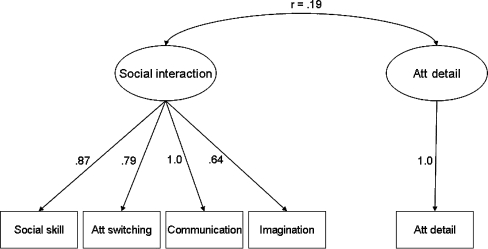
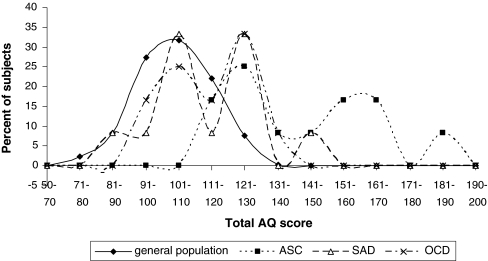
The factor structure of the Dutch translation of the Autism-Spectrum Quotient (AQ; a continuous, quantitative measure of autistic traits) was evaluated with confirmatory factor analyses in a large general population and student sample. The criterion validity of the AQ was examined in three matched patient groups (autism spectrum conditions (ASC), social anxiety disorder, and obsessive-compulsive disorder). A two factor model, consisting of a "Social interaction" factor and "Attention to detail" factor could be identified. The internal consistency and test-retest reliability of the AQ were satisfactory. High total AQ and factor scores were specific to ASC patients. Men scored higher than women and science students higher than non-science students. The Dutch translation of the AQ is a reliable instrument to assess autism spectrum conditions.
Overview
The claims and statistics of this paper haven’t been checked yet.
Free: it reads the open-access text and checks the first 5 claims that cite a source we can check. Create a free account to check every claim.
Integrity signals
Registry
Cites
Statistics
Figures
Verification
Claims the paper makes
The claims and statistics of this paper haven’t been checked yet.
Free: it reads the open-access text and checks the first 5 claims that cite a source we can check. Create a free account to check every claim.
Claims other papers make about this one
Each is checked against this paper’s own text: does it say what the citing paper says it does?
The source backs part of the claim, not all of it — or backs it for a different population, condition or comparison.
In the citing paper
“The test has good internal consistency and test-retest reliability and has been translated into many languages [57, 58].”
From A 'choice', an 'addiction', a way 'out of the lost': Exploring self-injury in autistic people without intellectual disability (2019) · cites this paper as [58]
Experimental — accuracy not yet measuredThe cited source says what the claim attributes to it.
In the citing paper
“High total AQ scores are specific to patients with an ASD and set them apart from both the general population and from patients with SAD [65].”
The check wasn’t confident either way, so it gives no verdict — never disputed.
In the citing paper
“The most widely used measure for adults with ASC is the Adolescent/Adult Sensory Profile (AASP), a 60-item self-report measure that finds differences in sensory processing in more than 90% of adults with ASC [17,19].”
From The Sensory Perception Quotient (SPQ): development and validation of a new sensory questionnaire for adults with and without autism (2014) · cites this paper as [19]
Experimental — accuracy not yet measured
Self-check
Percentages, sums and reported differences re-computed from the paper’s own numbers.
The self-check needs the paper’s full text.
Citations
Cites
Lord, C., Rutter, M., & Le Couteur, A. (1994) · Journal of Autism and Developmental Disorders · doi:10.1007/bf02172145 · Cited by 9,065 · cited 2×
“Keywords Autism Factor analysis Validity Reliability Autism phenotype”
MethodSchermelleh-Engel, K., Moosbrugger, H., & Müller, H. (2003) · Department of Psychology - University of Koblenz-Landau · doi:10.23668/psycharchives.12784 · Cited by 8,975
Lord, C., Risi, S., Lambrecht, L., Cook, E. H., Leventhal, B. L., DiLavore, P. C., Pickles, A., & Rutter, M. (2000) · Journal of Autism and Developmental Disorders · doi:10.1023/a:1005592401947 · Cited by 7,520 · cited 2×
“Keywords Autism Factor analysis Validity Reliability Autism phenotype”
MethodBaron-Cohen, S., Wheelwright, S., Skinner, R., Martin, J., & Clubley, E. (2001) · Journal of Autism and Developmental Disorders · doi:10.1023/a:1005653411471 · Cited by 6,450 · cited 13×
“Both the British (Baron-Cohen et al. 2001) and the Japanese version (Kurita et al. 2005) of the AQ reported good test-retest reliability and moderate internal consistency (Cronbach’s a varying from .63 to .78).”
BackgroundMethodResultInfluentialStructured Clinical Interview for DSM-IV Axis I Disorders
Spitzer, R. L., First, M. B., & Gibbon, M. (1997) · Medical Entomology and Zoology · Cited by 4,096
Autism as a strongly genetic disorder: evidence from a British twin study
Bailey, A., Le Couteur, A., Gottesman, I., Bolton, P., Simonoff, E., Yuzda, E., & Rutter, M. (1995) · Psychological Medicine · doi:10.1017/s0033291700028099 · Cited by 2,461
The extreme male brain theory of autism
Baron-Cohen, S. (2002) · Trends in Cognitive Sciences · doi:10.1016/s1364-6613(02)01904-6 · Cited by 2,007 · cited 2×
“In line with the empathizing–systemizing theory of autism (Baron-Cohen 2002; Baron-Cohen et al. 2005) and findings from previous studies (Baron-Cohen et al. 2001; Hoekstra et al. 2007; Wakabayashi et al. 2006) we expected: (a) AQ scores to be continuously distributed in the general population; (b)…”
ResultThe Extreme Male-Brain Theory of Autism
Baron-Cohen, S. (1999) · Neurodevelopmental Disorders · doi:10.7551/mitpress/4945.003.0023 · Cited by 1,413
Autistic Traits in the General Population: A Twin Study
Constantino, J. N., & Todd, R. D. (2003) · Archives of General Psychiatry · doi:10.1001/archpsyc.60.5.524 · Cited by 1,317 · cited 2×
“continuously distributed in the population (Constantino and Todd 2003; Piven et al. 1997; Spiker et al. 2002).”
BackgroundSex differences in the brain: implications for explaining autism
Baron-Cohen, S., Knickmeyer, R. C., & Belmonte, M. K. (2005) · Science · doi:10.1126/science.1115455 · Cited by 1,145 · cited 2×
“In line with the empathizing–systemizing theory of autism (Baron-Cohen 2002; Baron-Cohen et al. 2005) and findings from previous studies (Baron-Cohen et al. 2001; Hoekstra et al. 2007; Wakabayashi et al. 2006) we expected: (a) AQ scores to be continuously distributed in the general population; (b)…”
Result
Research works printed but not linked: 2
- 1. American Psychiatric Association (2000). Diagnostic and Statistical Manual for Mental Disorders, 4th Ed., Text Revision (DSM-IV-TR). Washington: American Psychiatric Press.
- 26. Neale M. C., Boker S. M., Xie G., Maes H. H. Mx: Statistical modeling. 7. Richmond: VCU; 2006.
Cited by
Items 601–700 of 761
van der Meer, J. M. J. (2014) · Radboud Repository (Radboud University)
Психодиагностика риска расстройств аутистического спектра у детей 3–4 лет
Наследов, А., Александрович, М. С., Tkacheva, L. O., Защиринская, О., & Семета, М. У. (2023) · doi:10.15862/01mnnpm23
Teunisse, J., & de Gruijl, I. P. I. (2016) · Bohn Stafleu van Loghum eBooks · doi:10.1007/978-90-368-1247-4_2
The Architecture of Difference: Theoretical Perspectives on Neurodivergent Cognition
Savickaite, S. (2026) · Springer eBooks · doi:10.1007/978-3-032-19636-1_2
Sönmez, D., & Jordan, T. R. (2025) · Cognitive Processing · doi:10.1007/s10339-025-01321-5
Teunisse, J., & de Gruijl, I. P. I. (2016) · Bohn Stafleu van Loghum eBooks · doi:10.1007/978-90-368-1312-9_15
Teunisse, J., & van Essen, J. (2019) · Bohn Stafleu van Loghum eBooks · doi:10.1007/978-90-368-2374-6_4
Temporal Dynamics of Interference Inhibition in Adults with Autism Spectrum Disorder
Janas, A. J. (2012) · Utrecht University Repository (Utrecht University)
Walker, D. (2017) · Coventry University Open Collections (Coventry university)
Laet, H. D., Nijhof, A. D., & Wiersema, J. R. (2026) · Journal of Autism and Developmental Disorders · doi:10.1007/s10803-026-07466-2
van Berckelaer‐Onnes, I. (2017) · Bohn Stafleu van Loghum eBooks · doi:10.1007/978-90-368-0931-3_29
Grant, S., Norton, S., & Hoekstra, R. A. (2025) · Autism in Adulthood · doi:10.1089/aut.2024.0186
Self-citationIdentification and Assessment of the Broad Autism Phenotype
(2015) · Advances in special education · doi:10.1108/s0270-401320150000029010
Karmakar, A., Bhattacharya, M., Adhya, J., Chatterjee, S., & Dogra, A. K. (2020) · Advances in Autism · doi:10.1108/aia-01-2020-0002
Ma, G., Luo, Q., Li, J., 石慧, Chen, Y., & Song, Y. (2026) · Acta Psychologica · doi:10.1016/j.actpsy.2026.106255
Understanding Differences in Social Learning
Patenaude, J. (2020) · Scholarship@Western (Western University)
Protocol paper Aging & Autism Geurts eaPreprint
Geurts, H. M., van Rentergem, J. A. A., Radhoe, T. A., Torenvliet, C., van der Putten, W., & Groenman, A. P. (2021) · PsyArXiv (OSF Preprints) · doi:10.31234/osf.io/cfkzw
Howlin, P. (2021) · Faculty Opinions – Post-Publication Peer Review of the Biomedical Literature · doi:10.3410/f.739863163.793585597
Drawing the inner world: exploring autistic perception through virtual reality art-making
Savickaite, S., Airlie, R., McDonnell, N., & Simmons, D. (2026) · Frontiers in Psychology · doi:10.3389/fpsyg.2026.1739991
Sörnyei, D., Kovács, F. M., Benedek, T., Őri, D., & Farkas, K. (2026) · medRxiv · doi:10.64898/2026.09.01.26361970
Article 4 Update on Autism Spectrum Disorders for Optometry: A Review of the Literature
Jensen, K. A., Spors, F., & Egan, D. J. (2014)
Raymond, K. E., Butler, B. E., Tremblay, P. F., Bodell, L. P., & Stevenson, R. A. (2025) · Research Square · doi:10.21203/rs.3.rs-7768960/v1
Hirata, R., Oishi, N., Kyuragi, Y., Zakia, H., Aki, M., Yoshimura, S., Shibata, M., Takao, N., Akahori, S., Kobayashi, K., et al. (2026) · NeuroImage · doi:10.1016/j.neuroimage.2026.122125
Nankoo, A. (2020) · UWA Profiles and Research Repository (University of Western Australia) · doi:10.26182/cr5t-xz97
Lu, H., Yi, L., & Zhang, H. (2019) · bioRxiv (Cold Spring Harbor Laboratory) · doi:10.1101/582783
dos Santos, S. P. L., Vaca, D. J. G., Veloz, A. F. V., Navarrete-Veloz, J., Carpio-Arias, T. V., & Veloz, M. F. V. (2026) · Journal of Autism and Developmental Disorders · doi:10.1007/s10803-026-07419-9
Łukasik, A., & Łaba-Hornecka, A. (2026) · Evolutionary Psychology · doi:10.1177/14747049261473640
Wout, F. V. ‘., & Jarrold, C. (2023) · Journal of Autism and Developmental Disorders · doi:10.1007/s10803-022-05843-1
The interplay between the genome and the exposome in psychosis spectrum
Pries, L.-K. (2020) · Research Publications (Maastricht University) · doi:10.26481/dis.20201211lp
Gruner, M., Roessner, V., & Ring, M. (2025) · Autism Research · doi:10.1002/aur.70107
Empathy, autism and the extreme female brain
Dinsdale, N. L. (2012) · Summit (Simon Fraser University)
Boundaries, transitions: Autism Spectrum Disorder in adolescents and adults
Horwitz, E. (2023) · University of Groningen research database (University of Groningen / Centre for Information Technology) · doi:10.33612/diss.593444520
Watanabe, T., Ishii, T., & Akechi, T. (2026) · Frontiers in Psychiatry · doi:10.3389/fpsyt.2026.1858994
van de Kamp, C. B. (2015) · Utrecht University Repository (Utrecht University)
PRISMA: A precision functional imaging dataset of autistic and non-autistic adultsPreprint
Džinalija, N., Geurts, H. M., Scholte, H. S., & Bathelt, J. (2026) · bioRxiv (Cold Spring Harbor Laboratory) · doi:10.64898/2026.01.12.698952
Yu, Y., Wang, X., Ward, J., & Qiu, J. (2019) · Research Square · doi:10.21203/rs.2.18547/v1
The Broad Autism Phenotype, Empathy, and Intimate Relationships
Jamil, R. R. (2016) · Scholarship at UWindsor (University of Windsor)
Hill, S. (2013) · Carleton University's Institutional Repository (MacOdrum Library, Carleton University) · doi:10.22215/etd/2013-10089
Valla, J. M. (2013) · eCommons (Cornell University)
EMERGENT RELATIONSHIPS BETWEEN EMPATHIZING AND SYSTEMIZING SKILLS
Valla, J. M. (2013)
Electrophysiological correlates of visual search in the autism spectrum
Dunn, S. A. (2016) · White Rose eTheses Online (University of Leeds, The University of Sheffield, University of York)
Xia, W., Li, N., Wang, Y., Shangguan, C., & Zhou, H. (2026) · Frontiers in Psychology · doi:10.3389/fpsyg.2026.1778225
South, E. (2020) · UWA Profiles and Research Repository (University of Western Australia) · doi:10.26182/qxyg-j118
(Re-)Conceptualisation in Autism Spectrum Disorders
Burnett, H. G. (2012) · Repository@Hull (Worktribe) (University of Hull)
MYmind for Children and Adolescents with ADHD or Autism and their Parents
Bögels, S. M. (2025) · Springer eBooks · doi:10.1007/978-3-030-90465-4_59-2
Weiher, L., Vermeulen, R., Wessels, H., & Watson, S. J. (2026) · Psychology Crime and Law · doi:10.1080/1068316x.2026.2708706
Maas, I. L., de Jong, J. R., Dijkerman, H. C., & Keizer, A. (2026) · Research in Neurodiversity · doi:10.1016/j.rin.2026.100021
Staff, A. I., Geurts, H. M., Kuin, M., der Oord, S. V., & Boyer, B. E. (2020) · PsyArXiv (OSF Preprints) · doi:10.31234/osf.io/7eka9
ter Heege, F. M., Mijnster, T., van Veen, M., Pijnenborg, G. H. M., de Jong, P. J., Boersma, G. J., & Lancel, M. (2020) · Figshare · doi:10.6084/m9.figshare.12560705
Inferring Thoughts by and of Individuals With and Without Autism: An Empathic Accuracy Study
Laet, H. D., Nijhof, A. D., & Wiersema, J. R. (2026) · Autism · doi:10.1177/13623613261451897
Investigating the continuum of autism : evidence from a non-clinical sample
Paulovic, S. (2012) · Carleton University's Institutional Repository (MacOdrum Library, Carleton University) · doi:10.22215/etd/2012-06767
Behandelervaringen in een DD-programma
Bosma, M., van Zanten, J., & Sonneborn, C. (2014)
Beyond forced choice: hyper-realistic AI faces reveal a four-cluster perceptual geometry of emotionPreprint
Cui, B. H., & Bex, P. J. (2026) · bioRxiv (Cold Spring Harbor Laboratory) · doi:10.64898/2026.06.02.729704
Intact Neural and Behavioral Processing of Vocal Emotional Expressions in Men with Autism
Vos, S., den Broeck, R. V., Callejo, D. R., Collignon, O., & Boets, B. (2026) · Brain Sciences · doi:10.3390/brainsci16080876
Cognitieve flexibiliteit bij kinderen en jong volwassenen met een Autisme Spectrum Stoornis
van Ginkel, I. (2010) · Utrecht University Repository (Utrecht University)
Factor Invariance of Anxiety and Depression Measures in Autism
McKernan, E. P. (2020) · Syracuse University Libraries (Syracuse University)
van den Heuvel, R. M., Geurts, H. M., Wensing, M., & Teunisse, J. (2025) · Frontiers in Psychology · doi:10.3389/fpsyg.2025.1411908
Structural processing of visual narratives in autism
Coderre, E. L., Pellegrino-Wood, J., O'Donnell, E. G., & Cohn, N. (2026) · Discourse Processes · doi:10.1080/0163853x.2026.2627175
Beyond Categories : A Dimensional Approach to Autism and Sensorimotor Differences
Bang, P. (2024) · Linköping University medical dissertations · doi:10.3384/9789180755467
Doğan, M. K., Prachason, T., SCALMATI, S., Lin, B. D., Pries, L.-K., Klingenberg, B., Arias-Magnasco, A., Menne‐Lothmann, C., Decoster, J., van Winkel, R., et al. (2026) · European Archives of Psychiatry and Clinical Neuroscience · doi:10.1007/s00406-026-02404-w
English, M. C. W., Gignac, G. E., Visser, T. A. W., Whitehouse, A., Enns, J. T., & Maybery, M. T. (2021) · Figshare · doi:10.6084/m9.figshare.14608418
Grove, R., Begeer, S., Scheeren, A. M., Weiland, R. F., & Hoekstra, R. A. (2021) · Figshare · doi:10.6084/m9.figshare.14157682
Self-citationDiagnosis and assessment of adults with ASDs
McLeer, S. V., & McNelis, D. N. (2012) · Cambridge University Press eBooks · doi:10.1017/cbo9780511978616.013
A Study of the Relationship between Social Communication Skills and Sensitivity to Paralanguage
YOSHIMOTO, J. (2022) · International Journal of Social Science and Humanity · doi:10.18178/ijssh.2022.v12.1099
Tesche, C. D., & Wilson, J. E. (2026) · NeuroImage · doi:10.1016/j.neuroimage.2026.122194
PRESENCE OF AUTISTIC TRAITS AND SOCIAL SUPPORT AMONG INDIVIDUALS IN STEM AND NON-STEM OCCUPATIONS
Arsić, B. (2025) · Research in Education and Rehabilitation · doi:10.51558/2744-1555.2025.8.2.309
Cyberbullying and autistic traits across STEM and non-STEM professions
Arsić, B. (2025) · Zbornik radova Filozofskog fakulteta u Pristini · doi:10.5937/zrffp55-59924
O’Neill, A., & Kallitsounaki, A. (2026) · Research in Neurodiversity · doi:10.1016/j.rin.2026.100055
Flores-García, E., Wojcik, D. Z., Huelmo, S., & Villoria, E. D. (2026) · Applied Sciences · doi:10.3390/app16199850
Janai, A. (2018) · Digital Access to Scholarship at Harvard (DASH) (Harvard University)
Are We All on the Spectrum? Assessing Autistic Traits in the HEXACO Personality Framework
Stiner, E. (2017) · Digital Collections (Trent University)
Spruijt, A. M. (2012) · Leiden Repository (Leiden University)
Rivera, R. A., & Bennetto, L. (2026) · Appetite Disordered Eating · doi:10.1016/j.appde.2026.100015
Me, myself and others : representations of self and other in children with autism spectrum disorder
Kaddouri, R. E. (2020) · Ghent University Academic Bibliography (Ghent University)
Weel, M. H. M. (2013) · Leiden Repository (Leiden University)
Investigating autistic traits, sensory experiences and personality: a mixed methods approach
Venugopalan, P. (2019) · University of Southern Queensland research data collection · doi:10.26192/nkt9-5t46
Turi, M., Burr, D. C., & Binda, P. (2017) · eLife · doi:10.7554/elife.32399.013
Autistic traits, working memory, and L2 prosodic boundary detection
Kuo, G. (2022) · Concentric Studies in Linguistics · doi:10.1075/consl.21040.kuo
Autistic Traits in the UK BiobankPreprint
Fysh, M. C., Matlock, K. A., Tsompanidis, A., Allison, C. L., Weir, E. M., Radecki, M. A., Matthews, F. E., Warrier, V., Greenberg, D. M., Braschi, S., et al. (2026) · Research Square · doi:10.21203/rs.3.rs-10021244/v1
Zilberberg, A. (2010) · JMU Scholoraly Commons (James Madison University)
Alonso-Esteban, Y., Marín, F. A., Navarro‐Pardo, E., & López-Ramón, M. F. (2026) · Behavioral Psychology/Psicología Conductual · doi:10.31083/bp45494
Autistic traits are associated with suboptimal decision Bias strategies in subsecond timing
Frisoni, M., Tarasi, L., Borgomaneri, S., & Romei, V. (2026) · Consciousness and Cognition · doi:10.1016/j.concog.2026.104123
The Relation Between Autistic Traits and Symbolic Numerical Comparison Effects
Farahi, S. M. M. M., & Leth‐Steensen, C. (2026) · Psychiatry International · doi:10.3390/psychiatryint7050191
Yıldız, F. B. P., Kurtulmuş, A., Çelik, Z., Ereğli, B., & Görmez, A. (2026) · Frontiers in Psychiatry · doi:10.3389/fpsyt.2026.1933974
Kaminski, J., Capitain, S., Kühr, F., Nussbaum, C., & Bräuer, J. (2025) · Scientific Reports · doi:10.1038/s41598-025-25646-5
Factor Structure of the Autism-Spectrum Quotient Japanese Version
金山, 裕., 前田, 由., 佐藤, 寛., Maeda, Y., & Sato, H. (2015) · 関西大学社会学部紀要
The impact of model eyesight and social reward on automatic imitation in virtual reality.
Nevejans, M., Wiersema, J. R., Houwer, J. D., & Cracco, E. (2025) · Journal of Experimental Psychology Human Perception & Performance · doi:10.1037/xhp0001271
Women in Psychiatry 2023: Autism
(2025) · Frontiers research topics · doi:10.3389/978-2-8325-6235-2
自閉スペクトラムの多様性の背景にある感覚処理特性に関する実験心理学的検討
矢口, 彩., 39361, & ヤグチ, ア. (2021) · Institutional Repositories DataBase (IRDB) · doi:10.14992/00020676
The development of multisensory integration in autism spectrum disorders
Greenfield, K. (2017) · Nottingham ePrints (University of Nottingham)
CRISANTI, C. (2017) · Electronic Theses and Dissertations Repository (University of Pisa)
Dimensional approach to the conceptualization and measurement of the broad autism phenotype
Gimenez, M. G. (2021) · Repositorio de Patentes de la Universidad de Almería (Universidad de Almería)
Metadata
- Authors
- Hoekstra, R. A., Bartels, M., Cath, D. C., & Boomsma, D. I.
- Affiliations
- Vrije Universiteit Amsterdam (NL)
- Corresponding author
- Hoekstra, Rosa A.
- Venue
- Journal of Autism and Developmental Disorders
- Published
- 2008-02-27
- Volume
- 38
- Issue
- 8
- Pages
- 1555-1566
- ISSN
- 0162-3257 (ISSN-L)
- 1573-3432
- PMC
- PMC2516538
- OpenAlex
- W2150214803
- Cited by
- 651
- References
- 38
- Citations by year
- 2026: 32 · 2025: 33 · 2024: 34 · 2023: 43 · 2022: 26 · 2021: 58 · 2020: 46 · 2019: 46 · 2018: 45 · 2017: 43 · 2016: 29 · 2015: 37 · 2014: 44 · 2013: 36 · 2012: 32
- FWCI
- 11.06
- Type
- journal article
- Language
- en
- Open access
- hybrid
- doi.org
- Licence
- cc-by-nc
- Locations
- Journal of Autism and Developmental Disorders (publishedVersion, cc-by-nc)
- Europe PMC (PubMed Central) (publishedVersion, cc-by-nc)
- PubMed Central (publishedVersion, cc-by-nc)
- PubMed (publishedVersion)
- VU Research Portal (publishedVersion, other-oa)
- Open Research Online (The Open University) (acceptedVersion)
- Digital Academic REpository of VU University Amsterdam (Vrije Universiteit Amsterdam) (submittedVersion)
- Research Portal (King's College London) (submittedVersion, cc-by-nc)
- Data Archiving and Networked Services (DANS) (submittedVersion, other-oa)
- Funders
- Nederlandse Organisatie voor Wetenschappelijk Onderzoek (NWO/ SPI 56-464-14192, 56‐464‐14192, 451–04-034, Spi-56-464-14192, 14192, 575-25-006)
- Topics
- Life Sciences › Neuroscience › Cognitive Neuroscience › Autism Spectrum Disorder Research
- Social Sciences › Decision Sciences › Management Science and Operations Research › Psychometric Methodologies and Testing
- Social Sciences › Psychology › Experimental and Cognitive Psychology › Anxiety, Depression, Psychometrics, Treatment, Cognitive Processes
- Keywords
- Autism Spectrum Quotient, autistic traits, factor structure, criterion validity, Dutch translation, autism spectrum disorder, social anxiety disorder, obsessive-compulsive disorder, social interaction, attention to detail, gender differences, science students
- MeSH terms
- Adolescent, Adult, Autistic Disorder, Mental Disorders, Cross-Cultural Comparison, Female, Humans, Interview, Psychological, Male, Middle Aged, Netherlands, Personality Assessment, Psychometrics, Surveys and Questionnaires, Reference Values, Translating, Reproducibility of Results, Early Diagnosis
About these checks
Registry, retraction, Cites and statistics results are computed, not judged, with one exception: a printed reference that no index lists is read once by a model before it counts as a citation error. Claims are extracted by a model and kept only when their quote appears verbatim in the text; each cited source is then checked, with a model’s help, for whether it says what the claim relies on. Those verdicts can be wrong — read the claim’s quote and the cited source before relying on one.
Statistics and arithmetic are recomputed, not judged.
Confidence bands are shown only for fields calibrated on our annotated test set. None is calibrated yet, so no band is shown.
What counts as a claim ›How we measure confidence ›How we check this ›
Are you an author, or do you see a problem with this page? Request a review
Data sources
Bibliographic data: Semantic Scholar, OpenAlex, Crossref.
Contains information from the Semantic Scholar Academic Graph Datasets, made available under the ODC Attribution License (ODC-BY 1.0).
Semantic Scholar’s data is described in: Kinney, R., et al. (2023). The Semantic Scholar Open Data Platform. arXiv:2301.10140.
