

A Close Eye on the Eagle-Eyed Visual Acuity Hypothesis of Autism
Open accessThe DOI matches its Crossref record; 58 of the 59 references it cites were found in a registry or an index.
Abstract
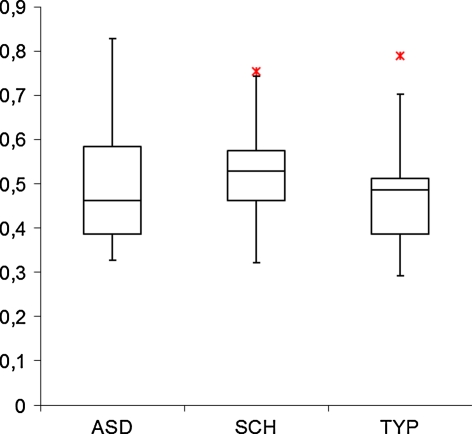
Autism spectrum disorders (ASD) have been associated with sensory hypersensitivity. A recent study reported visual acuity (VA) in ASD in the region reported for birds of prey. The validity of the results was subsequently doubted. This study examined VA in 34 individuals with ASD, 16 with schizophrenia (SCH), and 26 typically developing (TYP). Participants with ASD did not show higher VA than those with SCH and TYP. There were no substantial correlations of VA with clinical severity in ASD or SCH. This study could not confirm the eagle-eyed acuity hypothesis of ASD, or find evidence for a connection of VA and clinical phenotypes. Research needs to further address the origins and circumstances associated with altered sensory or perceptual processing in ASD.
Overview
The claims and statistics of this paper haven’t been checked yet.
Free: it reads the open-access text and checks the first 5 claims that cite a source we can check. Create a free account to check every claim.
Integrity signals
Registry
Cites
Statistics
Figures
Verification
Claims the paper makes
The claims and statistics of this paper haven’t been checked yet.
Free: it reads the open-access text and checks the first 5 claims that cite a source we can check. Create a free account to check every claim.
Claims other papers make about this one
Each is checked against this paper’s own text: does it say what the citing paper says it does?
In the citing paper
“These hypersensitivities cannot be explained as outcomes of abnormally enhanced sensation (29 -31).”
From Autism as a disorder of prediction (2014) · cites this paper as [30]
Self-check
Percentages, sums and reported differences re-computed from the paper’s own numbers.
The self-check needs the paper’s full text.
Citations
Cites
The assessment and analysis of handedness: The Edinburgh inventory
Oldfield, R. C. (1971) · Neuropsychologia · doi:10.1016/0028-3932(71)90067-4 · Cited by 35,900 · cited 1×
“The groups were comparable with regard to sex distribution [v2(2) = 2.7, p = .31], handedness (Edinburgh Handedness Inventory) (Oldfield 1971) [v2(4) = 3.6, p = .50], and nonverbal IQ (Raven’s SPM) (Kratzmeier and Horn 1987) [F(2,75) = 1.3, p = .28, g2 = .03].”
MethodInfluentialThe Positive and Negative Syndrome Scale (PANSS) for schizophrenia.
Kay, S. R., Fiszbein, A., & Opler, L. A. (1987) · Schizophrenia Bulletin · doi:10.1093/schbul/13.2.261 · Cited by 21,378
Philosophical transactions of the Royal Society of London. B
Press, H. (1886) · Cited by 10,081
The weak coherence account: detail-focused cognitive style in autism spectrum disorders
Happé, F., & Frith, U. (2006) · Journal of Autism and Developmental Disorders · doi:10.1007/s10803-005-0039-0 · Cited by 2,884
Enhanced Perceptual Functioning in Autism: An Update, and Eight Principles of Autistic Perception
Mottron, L., Dawson, M., Soulières, I., Hubert, B., & Burack, J. (2006) · Journal of Autism and Developmental Disorders · doi:10.1007/s10803-005-0040-7 · Cited by 1,957 · cited 1×
“…of Turin, Turin, Italy H. Walter Department of Psychiatry, Charité, Berlin, Germany overconnectivity (Belmonte and Yurgelun-Todd 2003; Geschwind and Levitt 2007) and enhanced perceptual functioning and discrimination (Mottron et al. 2006; Plaisted 2001) have been postulated to cause ATD.”
BackgroundTomchek, S. D., & Dunn, W. (2007) · American Journal of Occupational Therapy · doi:10.5014/ajot.61.2.190 · Cited by 1,534
Autism spectrum disorders: developmental disconnection syndromes
Geschwind, D. H., & Levitt, P. (2007) · Current Opinion in Neurobiology · doi:10.1016/j.conb.2007.01.009 · Cited by 1,411 · cited 2×
“On the biological level, neural disconnectivity or S. Bölte (&) Department of Women’s and Children’s Health, Astrid Lindgren Children’s Hospital, Q2:07, Center of Neurodevelopmental Disorders (KIND), Karolinska Institutet, 17176 Stockholm, Sweden e-mail: sven.bolte@ki.se S. Bölte Department of Child and Adolescent P…”
BackgroundThe Freiburg Visual Acuity Test???Automatic Measurement of Visual Acuity
Bach, M. (1996) · Optometry and Vision Science · doi:10.1002/j.1538-9235.1996.tb04409.x · Cited by 984
An islet of ability in autistic children: a research note
Shah, A., & Frith, U. (1983) · Journal of Child Psychology and Psychiatry · doi:10.1111/j.1469-7610.1983.tb00137.x · Cited by 888 · cited 3×
“the Embedded Figures Test (Shah and Frith 1983), or resisting the influence of context in visual illusions (Happé”
BackgroundVision in autism spectrum disorders
Simmons, D. R., Robertson, A. E., McKay, L. S., Toal, E., McAleer, P., & Pollick, F. E. (2009) · Vision Research · doi:10.1016/j.visres.2009.08.005 · Cited by 827
Vagaries of Visual Perception in Autism
Dakin, S., & Frith, U. (2005) · Neuron · doi:10.1016/j.neuron.2005.10.018 · Cited by 765
Talent in autism: hyper-systemizing, hyper-attention to detail and sensory hypersensitivity
Baron-Cohen, S., Ashwin, E., Ashwin, C., Tavassoli, T., & Chakrabarti, B. (2009) · Philosophical Transactions of the Royal Society B: Biological Sciences · doi:10.1098/rstb.2008.0337 · Cited by 669 · cited 11×
“The monitors used [CRT, 1700 (43.1 cm), 1024 9 768 pixels, 85 Hz] yielded a maximum decimal VA of 0.89 (logMAR = -0.06) on the FrACT program, substantially higher than in Ashwin et al. (2009a), but also restricted in assessing high VA thresholds.”
BackgroundMethodResultInfluentialRogers, S. J., & Ozonoff, S. (2005) · Journal of Child Psychology and Psychiatry · doi:10.1111/j.1469-7610.2005.01431.x · Cited by 597 · cited 1×
“Overall, hyporesponsiveness to sensory stimuli has still been more frequently observed in ASD than hypersensitivity (Rogers and Ozonoff 2005).”
BackgroundBertone, A., Mottron, L., Jelenic, P., & Faubert, J. (2005) · Brain · doi:10.1093/brain/awh561 · Cited by 536
Enhanced pitch sensitivity in individuals with autism: a signal detection analysis
Bonnel, A., Mottron, L., Peretz, I., Trudel, M., Gallun, E., & Bonnel, A.-M. (2003) · Journal of Cognitive Neuroscience · doi:10.1162/089892903321208169 · Cited by 527
Happé, F. G. E. (1996) · Journal of Child Psychology and Psychiatry · doi:10.1111/j.1469-7610.1996.tb01483.x · Cited by 489
Studies in the Childhood Psychoses I. Diagnostic Criteria and Classification
Kolvin, I. (1971) · British Journal of Psychiatry · doi:10.1192/bjp.118.545.381 · Cited by 468
Understanding autism: Insights from mind and brain
Hill, E. L., & Frith, U. (2003) · Philosophical Transactions of the Royal Society of London. Series B: Biological Sciences · doi:10.1098/rstb.2002.1209 · Cited by 452 · cited 2×
“Theory of Mind), certain executive malfunctions and attention to detail (ATD), the latter also being known as weak central coherence or local orientation bias (Hill and Frith 2003).”
BackgroundGuilmatre, A., Dubourg, C., Mosca, A.-L., Legallic, S., Goldenberg, A., Drouin-Garraud, V., Layet, V., Rosier, A., Briault, S., Bonnet-Brilhault, F., et al. (2009) · Archives of General Psychiatry · doi:10.1001/archgenpsychiatry.2009.80 · Cited by 429
Jolliffe, T., & Baron-Cohen, S. (1999) · Cognition · doi:10.1016/s0010-0277(99)00022-0 · Cited by 426
Rapoport, J., Chavez, A., Greenstein, D., Addington, A., & Gogtay, N. (2009) · Journal of the American Academy of Child & Adolescent Psychiatry · doi:10.1097/chi.0b013e31818b1c63 · Cited by 400
A Research Note: The Relations Among Social and Task Perceptions in Small Groups
Wheeless, L. R., Wheeless, V. E., & Dickson-Markman, F. (1982) · Small Group Behavior · doi:10.1177/104649648201300307 · Cited by 386
The Development of Autism: Perspectives From Theory and Research
(2001) · Routledge eBooks · doi:10.4324/9781410600196 · Cited by 323
Reduced Generalization in Autism: An Alternative to Weak Central Coherence
Plaisted, K. C. (2001) · Apollo (University of Cambridge) · Cited by 295
Tavassoli (2006) · doi:10.1016/j.bandc.2005.12.013 · Cited by 290
Cognitive mechanisms, specificity and neural underpinnings of visuospatial peaks in autism
Caron, M.-J. (2006) · Brain · doi:10.1093/brain/awl072 · Cited by 282 · cited 3×
“…specific strengths on visual search and spatial tasks exhibited by individuals with ASD, such as superior performance on the Block Design Test (Caron et al. 2006) and the Embedded Figures Test (Shah and Frith 1983), or resisting the influence of context in visual illusions (Happé 1996;…”
BackgroundNeumann, D., Spezio, M. L., Piven, J., & Adolphs, R. (2006) · Social Cognitive and Affective Neuroscience · doi:10.1093/scan/nsl030 · Cited by 281
Functional anatomy of impaired selective attention and compensatory processing in autism
Belmonte, M. K., & Yurgelun-Todd, D. A. (2003) · Cognitive Brain Research · doi:10.1016/s0926-6410(03)00189-7 · Cited by 266 · cited 1×
“…for Cognitive Science, University of Turin, Turin, Italy H. Walter Department of Psychiatry, Charité, Berlin, Germany overconnectivity (Belmonte and Yurgelun-Todd 2003; Geschwind and Levitt 2007) and enhanced perceptual functioning and discrimination (Mottron et al. 2006; Plaisted 2001)…”
BackgroundPervasive Developmental Disorders
(2011) · Encyclopedia of Child Behavior and Development · doi:10.1007/978-0-387-79061-9_4496 · Cited by 247
Couture, S. M., Penn, D. L., Losh, M., Adolphs, R., Hurley, R., & Piven, J. (2010) · Psychological Medicine · doi:10.1017/s003329170999078x · Cited by 231
Sporn, A. L., Addington, A. M., Gogtay, N., Ordóñez, A. E., Gornick, M. C., CLASEN, L. S., GREENSTEIN, D. K., Tossell, J. W., Gochman, P., Lenane, M., et al. (2004) · Biological Psychiatry · doi:10.1016/j.biopsych.2004.01.019 · Cited by 186
Gestalt perception and local–global processing in high-functioning autism
Bölte, S., Holtmann, M., Poustka, F., Scheurich, A., & Schmidt, L. (2007) · Journal of Autism and Developmental Disorders · doi:10.1007/s10803-006-0231-x · Cited by 185 · cited 1×
“…strengths on visual search and spatial tasks exhibited by individuals with ASD, such as superior performance on the Block Design Test (Caron et al. 2006) and the Embedded Figures Test (Shah and Frith 1983), or resisting the influence of context in visual illusions (Happé 1996; Bölte et al. 2007).”
Self-citationEagle-Eyed Visual Acuity: An Experimental Investigation of Enhanced Perception in Autism
Ashwin, E., Ashwin, C., Rhydderch, D., Howells, J., & Baron-Cohen, S. (2009) · Biological Psychiatry · doi:10.1016/j.biopsych.2008.06.012 · Cited by 154
Minshew, N. J., & Hobson, J. A. (2008) · Journal of Autism and Developmental Disorders · doi:10.1007/s10803-007-0528-4 · Cited by 154
Bölte, S., & Poustka, F. (2004) · Zeitschrift für Kinder- und Jugendpsychiatrie und Psychotherapie · doi:10.1024/1422-4917.32.1.45 · Cited by 143
Self-citationYeap, S., Kelly, S. P., Sehatpour, P., Magno, E., Javitt, D. C., Garavan, H., Thakore, J. H., & Foxe, J. J. (2006) · Archives of General Psychiatry · doi:10.1001/archpsyc.63.11.1180 · Cited by 143
Sutherland, A., & Crewther, D. P. (2010) · Brain · doi:10.1093/brain/awq122 · Cited by 133
Chen, Y., Levy, D. L., Sheremata, S., Nakayama, K., Matthysse, S., & Holzman, P. S. (2003) · American Journal of Psychiatry · doi:10.1176/appi.ajp.160.10.1795 · Cited by 115
Research note: Exceptional absolute pitch perception for spoken words in an able adult with autism
Heaton, P. F., Davis, R. E., & Happe, F. G. E. (2008) · Neuropsychologia · doi:10.1016/j.neuropsychologia.2008.02.006 · Cited by 112
Comparison Groups in Autism Family Research: Down Syndrome, Fragile X Syndrome, and Schizophrenia
Seltzer, M. M., Abbeduto, L., Krauss, M. W., Greenberg, J. S., & Swe, A. (2004) · Journal of Autism and Developmental Disorders · doi:10.1023/b:jadd.0000018073.92982.64 · Cited by 109
Global–Local Visual Processing in Schizophrenia: Evidence for an Early Visual Processing Deficit
Johnson, S. C., Lowery, N., Kohler, C. G., & Turetsky, B. I. (2005) · Biological Psychiatry · doi:10.1016/j.biopsych.2005.04.053 · Cited by 107
High functioning children with autism spectrum disorder: A novel test of multitasking
Mackinlay, R., Charman, T., & Karmiloff-Smith, A. (2006) · Brain and Cognition · doi:10.1016/j.bandc.2005.12.006 · Cited by 106 · cited 1×
“…connectivity or overconnectivity could be associated with multitasking problems, missing the whole picture in complex situations, and problems in language comprehension (Jolliffe and Baron-Cohen 1999; Mackinlay et al. 2006) Enhanced perceptual function could be related to sensory abnormalities.”
BackgroundThe Development of Autism: Perspectives from Theory and Research
Levy, S. E. (2002) · Journal of Developmental & Behavioral Pediatrics · doi:10.1097/00004703-200206000-00015 · Cited by 89
Subjective Perceptual Distortions and Visual Dysfunction in Children with Autism
Davis, R. A. O., Bockbrader, M. A., Murphy, R. R., Hetrick, W. P., & O’Donnell, B. F. (2006) · Journal of Autism and Developmental Disorders · doi:10.1007/s10803-005-0055-0 · Cited by 88
Top-Down Attentional Modulation in Autistic Spectrum Disorders Is Stimulus-Specific
Greenaway, R., & Plaisted, K. (2005) · Psychological Science · doi:10.1111/j.1467-9280.2005.01648.x · Cited by 81
Pring, L. (2007) · Developmental Medicine & Child Neurology · doi:10.1111/j.1469-8749.2005.tb01180.x · Cited by 72
Abnormal brain lateralization and connectivity in Schizophrenia
Ribolsi, M., Koch, G., Magni, V., Di Lorenzo, G., Rubino, I. A., Siracusano, A., & Centonze, D. (2009) · Reviews in the Neurosciences · doi:10.1515/revneuro.2009.20.1.61 · Cited by 70
Magnée, M. J. C. M., Oranje, B., van Engeland, H., Kahn, R. S., & Kemner, C. (2009) · Neuropsychologia · doi:10.1016/j.neuropsychologia.2009.02.012 · Cited by 65
Keedy, S. K., Rosen, C., Khine, T., Rajarethinam, R., Janicak, P. G., & Sweeney, J. A. (2009) · Psychiatry Research: Neuroimaging · doi:10.1016/j.pscychresns.2008.06.003 · Cited by 64
Segregation by onset asynchrony
Hancock, P., Walton, L., Mitchell, G., Plenderleith, Y., & Phillips, W. A. (2008) · Journal of Vision · doi:10.1167/8.7.21 · Cited by 58
Far visual acuity is unremarkable in autism: Do we need to focus on crowding?
Kéïta, L., Mottron, L., & Bertone, A. (2010) · Autism Research · doi:10.1002/aur.164 · Cited by 57
Pring, L. (2005) · Developmental Medicine & Child Neurology · doi:10.1017/s0012162205000976 · Cited by 38
Background and history of autism in relation to vision care
Trachtman, J. N. (2008) · Optometry · doi:10.1016/j.optm.2007.10.015 · Cited by 32
Regarding “Eagle-Eyed Visual Acuity: An Experimental Investigation of Enhanced Perception in Autism”
Bach, M., & Dakin, S. C. (2009) · Biological Psychiatry · doi:10.1016/j.biopsych.2009.02.035 · Cited by 32
Delayed Visual Maturation And Autism
Goodman, R., & Ashby, L. (1990) · Developmental Medicine & Child Neurology · doi:10.1111/j.1469-8749.1990.tb08487.x · Cited by 24
Crewther, D. P., & Sutherland, A. (2009) · Biological Psychiatry · doi:10.1016/j.biopsych.2009.02.036 · Cited by 18
Eagle-eyed Visual Acuity in Autism
Ashwin, E., Ashwin, C., Tavassoli, T., Chakrabarti, B., & Baron‐Cohen, S. (2009) · Biological Psychiatry · doi:10.1016/j.biopsych.2009.05.015 · Cited by 8
(2001) · Medical Entomology and Zoology
Research works printed but not linked: 7
- Achenbach TM Rescorla LA Manual for ASEBA adult forms & profiles 2003 Burlington, VT University of Vermont, Research Center for Children, Youth & Families
- Bölte S Rühl D Schmötzer G Poustka F Diagnostisches Interview für Autismus–Revidiert (ADI-R) 2006 Bern Huber
- Bulheller S Häcker H Peadbody picture vocabulary test (PPVT) 2004 Frankfurt/M Harcourt
- Kratzmeier H Horn R Raven-matrizen-test (SPM) 1987 Göttingen Beltz
- Rassow B Cavazos H Wesemann W Normgerechte Sehschärfenbestimmung mit Buchstaben Augenärztliche Fortbildung 1990 13 105 114
- Rühl D Bölte S Feineis-Matthews S Poustka F Diagnostische Beobachtungsskala für Autistische Störungen (ADOS) 2004 Bern Huber 14992047
- Tavassoli, T., Latham, K., & Baron-Cohen, S. (2010). Visual processing in autism spectrum conditions. Poster presented at the 3rd conference of the Scientific Society Autism Spectrum (WTAS), 18th–19th February, Frankfurt/M., Germany.
Cited by
Precise minds in uncertain worlds: Predictive coding in autism.
Van de Cruys, S., Evers, K., Van der Hallen, R., Van Eylen, L., Boets, B., de-Wit, L., & Wagemans, J. (2014) · Psychological Review · doi:10.1037/a0037665 · Cited by 885
“Bach & Dakin, 2009), and replication attempts have failed (Bölte et al., 2012; Kéïta, Mottron, & Bertone, 2010).”
BackgroundAutism as a disorder of prediction
Sinha, P., Kjelgaard, M. M., Gandhi, T. K., Tsourides, K., Cardinaux, A. L., Pantazis, D., Diamond, S. P., & Held, R. M. (2014) · Proceedings of the National Academy of Sciences · doi:10.1073/pnas.1416797111 · Cited by 563
The Sensory Experiences of Adults with Autism Spectrum Disorder: A Qualitative Analysis
Robertson, A. E., & Simmons, D. R. (2015) · Perception · doi:10.1068/p7833 · Cited by 293
Autismo infantil: impacto do diagnóstico e repercussões nas relações familiares
Pinto, R. N. M., Torquato, I. M. B., Collet, N., Reichert, A. P. D. S., Souza Neto, V. L. D., & Saraiva, A. M. (2016) · Revista Gaúcha de Enfermagem · doi:10.1590/1983-1447.2016.03.61572 · Cited by 162
The Mechanisms Underlying the ASD Advantage in Visual Search
Káldy, Z., Giserman, I., Carter, A. S., & Blaser, E. (2013) · Journal of Autism and Developmental Disorders · doi:10.1007/s10803-013-1957-x · Cited by 160
Metadata
- Authors
- Bölte, S., Schlitt, S., Gapp, V., Hainz, D., Schirman, S., Poustka, F., Weber, B., Freitag, C., Ciaramidaro, A., & Walter, H.
- Affiliations
- Karolinska Institutet (SE)
- Goethe University Frankfurt (DE)
- University of Turin (IT)
- Stiftung Charité (DE)
- Corresponding author
- Bölte, Sven
- Venue
- Journal of Autism and Developmental Disorders
- Published
- 2011-06-10
- Volume
- 42
- Issue
- 5
- Pages
- 726-733
- ISSN
- 0162-3257 (ISSN-L)
- 1573-3432
- PMC
- PMC3324676
- OpenAlex
- W2048667767
- Cited by
- 44
- References
- 59
- Citations by year
- 2024: 1 · 2023: 3 · 2022: 1 · 2021: 1 · 2020: 4 · 2019: 2 · 2018: 3 · 2017: 3 · 2016: 4 · 2015: 6 · 2014: 6 · 2013: 5 · 2012: 3
- FWCI
- 2.43
- Type
- journal article
- Language
- en
- Open access
- hybrid
- doi.org
- Licence
- cc-by-nc
- Locations
- Journal of Autism and Developmental Disorders (publishedVersion, cc-by-nc)
- Europe PMC (PubMed Central) (publishedVersion, cc-by-nc)
- PubMed Central (publishedVersion, cc-by-nc)
- PubMed (publishedVersion)
- IRIS UNIMORE (University of Modena and Reggio Emilia) (submittedVersion, cc-by-nc)
- eSpace (Curtin University) (submittedVersion)
- IRIS Research product catalog (Sapienza University of Rome) (submittedVersion)
- Publication Server of Goethe University Frankfurt am Main (Goethe University Frankfurt) (submittedVersion, cc-by-nc)
- Topics
- Life Sciences › Neuroscience › Cognitive Neuroscience › Autism Spectrum Disorder Research
- Life Sciences › Neuroscience › Cognitive Neuroscience › Visual perception and processing mechanisms
- Health Sciences › Medicine › Psychiatry and Mental health › Schizophrenia research and treatment
- Keywords
- autism spectrum disorder, visual acuity, sensory hypersensitivity, schizophrenia, clinical severity, perceptual processing, raptors
- MeSH terms
- Adolescent, Adult, Attention, Autistic Disorder, Female, Humans, Male, Schizophrenia, Vision, Ocular, Visual Acuity, Visual Perception
About these checks
Registry, retraction, Cites and statistics results are computed, not judged, with one exception: a printed reference that no index lists is read once by a model before it counts as a citation error. Claims are extracted by a model and kept only when their quote appears verbatim in the text; each cited source is then checked, with a model’s help, for whether it says what the claim relies on. Those verdicts can be wrong — read the claim’s quote and the cited source before relying on one.
Statistics and arithmetic are recomputed, not judged.
Confidence bands are shown only for fields calibrated on our annotated test set. None is calibrated yet, so no band is shown.
What counts as a claim ›How we measure confidence ›How we check this ›
Are you an author, or do you see a problem with this page? Request a review
Data sources
Bibliographic data: Semantic Scholar, OpenAlex, Crossref.
Contains information from the Semantic Scholar Academic Graph Datasets, made available under the ODC Attribution License (ODC-BY 1.0).
Semantic Scholar’s data is described in: Kinney, R., et al. (2023). The Semantic Scholar Open Data Platform. arXiv:2301.10140.
