

The DOI matches its Crossref record; 22 of the 23 references it cites were found in a registry or an index.
MIStore: a Blockchain-Based Medical Insurance Storage System
Open accessAbstract
Currently, blockchain technology, which is decentralized and may provide tamper-resistance to recorded data, is experiencing exponential growth in industry and research. In this paper, we propose the MIStore, a blockchain-based medical insurance storage system. Due to blockchain's the property of tamper-resistance, MIStore may provide a high-credibility to users. In a basic instance of the system, there are a hospital, patient, insurance company and n servers. Specifically, the hospital performs a (t, n)-threshold MIStore protocol among the n servers. For the protocol, any node of the blockchain may join the protocol to be a server if the node and the hospital wish. Patient's spending data is stored by the hospital in the blockchain and is protected by the n servers. Any t servers may help the insurance company to obtain a sum of a part of the patient's spending data, which servers can perform homomorphic computations on. However, the n servers cannot learn anything from the patient's spending data, which recorded in the blockchain, forever as long as more than n - t servers are honest. Besides, because most of verifications are performed by record-nodes and all related data is stored at the blockchain, thus the insurance company, servers and the hospital only need small memory and CPU. Finally, we deploy the MIStore on the Ethererum blockchain and give the corresponding performance evaluation.
Overview
The claims and statistics of this paper haven’t been checked yet.
Run the check — free, no account needed. It reads the open-access text and checks the sources it cites.
Integrity signals
Registry
Cites
Statistics
Figures
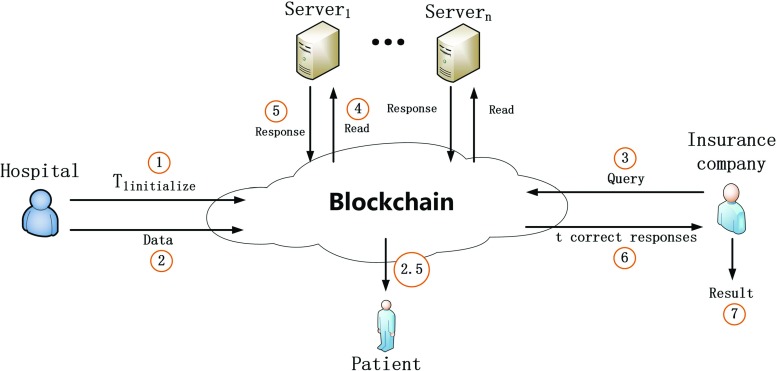
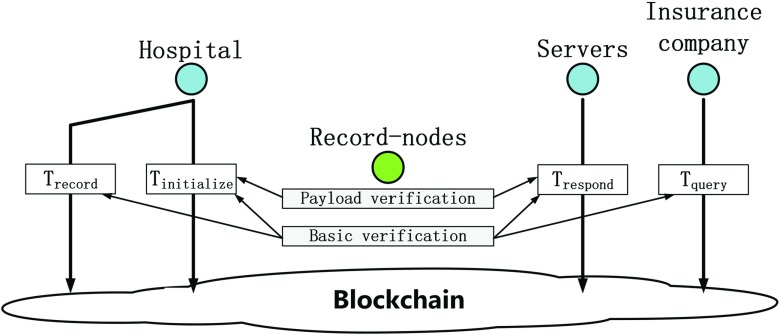
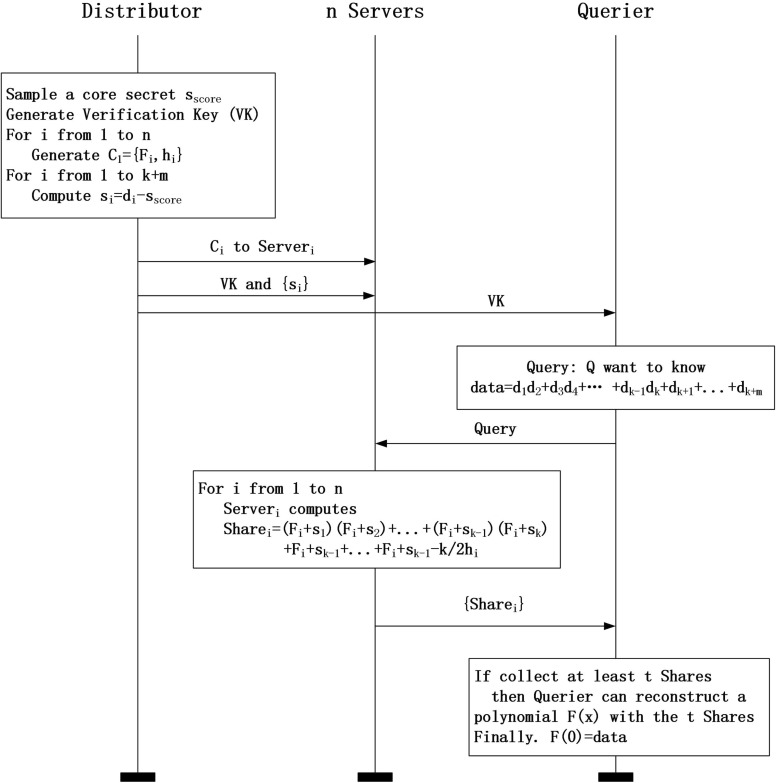
Verification
Claims the paper makes
The claims and statistics of this paper haven’t been checked yet.
Run the check — free, no account needed. It reads the open-access text and checks the sources it cites.
Claims other papers make about this one
Each is checked against this paper’s own text: does it say what the citing paper says it does?
The source backs part of the claim, not all of it — or backs it for a different population, condition or comparison.
In the citing paper
“Prior literature has suggested various recommendations for future research, including extending (e.g.Zhou et al., 2018) or replicating current frameworks (e.g.Quaini et al., 2018), and developing targeted treatment solutions (e.g.Mamoshina et al., 2018), to name a few.”
From Blockchain in healthcare: A systematic literature review, synthesizing framework and future research agenda (2020) · cites this paper as Zhou et al., 2018
Experimental — accuracy not yet measuredThe cited source says what the claim attributes to it.
In the citing paper
“Furthermore, prior studies have also attended to the need for improvements in data processing (e.g.Zhou et al., 2018).”
From Blockchain in healthcare: A systematic literature review, synthesizing framework and future research agenda (2020) · cites this paper as Zhou et al., 2018
The cited source says what the claim attributes to it.
In the citing paper
“For instance, prior studies have addressed issues pertaining to authentic data mobilization (Brogan et al., 2018), avoidance of data leakage (Zhang et al., 2016;Zhou et al., 2018) or double spending on storage (Rahmadika & Rhee, 2019), and perpetual data preservation (H.Li et al., 2018).”
From Blockchain in healthcare: A systematic literature review, synthesizing framework and future research agenda (2020) · cites this paper as Zhou et al., 2018
The cited source says what the claim attributes to it.
In the citing paper
“With the increasing inter-institutional adoption of blockchain, scholars have also focused on the issue of storage and preservation of sensitive data (Al Omar et al., 2019) from different sources such as medical devices (Firdaus et al., 2018), and medical insurance (Zhou et al., 2018).”
From Blockchain in healthcare: A systematic literature review, synthesizing framework and future research agenda (2020) · cites this paper as Zhou et al., 2018
The cited source says what the claim attributes to it.
In the citing paper
“For example, utilization of permissioned consortium blockchain (Zhang et al., 2018) or platforms other than Ethereum (Zhou et al., 2018;Rahmadika & Rhee, 2018) may improve current architectures being used to deploy blockchain in healthcare ecosystem.”
From Blockchain in healthcare: A systematic literature review, synthesizing framework and future research agenda (2020) · cites this paper as Zhou et al., 2018
In the citing paper
“Three papers addressed the sharing of clinical data for use in non-clinical contexts [29,32,47].”
From Blockchain in healthcare and health sciences—A scoping review (2020) · cites this paper as [32]
In the citing paper
“Five of the publications addressed the m-health domain and patientcontrolled collection, storage and sharing of sensor data [23,27,35,39,32].”
From Blockchain in healthcare and health sciences—A scoping review (2020) · cites this paper as [32]
Self-check
Percentages, sums and reported differences re-computed from the paper’s own numbers.
The self-check needs the paper’s full text.
Citations
Cites
Shamir, A. (1979) · Communications of the ACM · doi:10.1145/359168.359176 · Cited by 13,756
(2013) · Cited by 5,372
Bellare, M., & Rogaway, P. (1993) · ACM SIGSAC Conference on Computer and Communications Security (CCS) · doi:10.1145/168588.168596 · Cited by 4,695
Practical Byzantine fault tolerance
Castro, M., & Liskov, B. H. (1999) · Operating Systems Design and Implementation · doi:10.5555/296806.296824 · Cited by 4,026
The Elliptic Curve Digital Signature Algorithm (ECDSA)
Johnson, D. B., Menezes, A., & Vanstone, S. A. (2001) · International Journal of Information Security · doi:10.1007/s102070100002 · Cited by 2,350
Pricing via processing or combatting junk mail
Dwork, C., & Naor, M. (2007) · Lecture Notes in Computer Science · doi:10.1007/3-540-48071-4_10 · Cited by 1,282
Yue, X., Wang, H., Jin, D., Li, M., & Jiang, W. (2016) · Journal of Medical Systems · doi:10.1007/s10916-016-0574-6 · Cited by 1,240
MeDShare: Trust-Less Medical Data Sharing Among Cloud Service Providers via Blockchain
Xia, Q., Sifah, E. B., Asamoah, K. O., Gao, J., Du, X., & Guizani, M. (2017) · IEEE Access · doi:10.1109/access.2017.2730843 · Cited by 1,148
PPCoin: Peer-to-Peer Crypto-Currency with Proof-of-Stake
King, S., & Nadal, S. (2012) · Cited by 984
Pairing-Friendly Elliptic Curves of Prime Order
Barreto, P. S. L. M., & Naehrig, M. (2006) · Lecture notes in computer science · doi:10.1007/11693383_22 · Cited by 880
Pinocchio: Nearly Practical Verifiable Computation
Parno, B., Howell, J., Gentry, C., & Raykova, M. (2013) · 2013 IEEE Symposium on Security and Privacy · doi:10.1109/sp.2013.47 · Cited by 864
Proof of activity: Extending bitcoin’s proof of work via proof of stake [extended abstract] y
Bentov, I., Lee, C., Mizrahi, A., & Rosenfeld, M. (2014) · ACM SIGMETRICS Performance Evaluation Review · doi:10.1145/2695533.2695545 · Cited by 592
The Ripple Protocol Consensus Algorithm
Schwartz, D., Youngs, N., & Britto, A. (2014) · Cited by 576
A One Round Protocol for Tripartite Diffie–Hellman
Joux, A. (2004) · Journal of Cryptology · doi:10.1007/s00145-004-0312-y · Cited by 452
Dziembowski, S., Faust, S., Kolmogorov, V., & Pietrzak, K. (2015) · Lecture Notes in Computer Science · doi:10.1007/978-3-662-48000-7_29 · Cited by 294
Separating Decision Diffie–Hellman from Computational Diffie–Hellman in Cryptographic Groups
Joux, A., & Nguyen, K. T. (2003) · Journal of Cryptology · doi:10.1007/s00145-003-0052-4 · Cited by 239
Service Pricing Decision in Cyber-Physical Systems: Insights from Game Theory
Liu, X., Dong, M., Ota, K., Hung, P. C. K., & Liu, A. (2015) · IEEE Transactions on Services Computing · doi:10.1109/tsc.2015.2449314 · Cited by 92
The Exact Security of ECIES in the Generic Group Model
Smart, N. P. (2001) · Lecture notes in computer science · doi:10.1007/3-540-45325-3_8 · Cited by 56
Designing Proof of Human-Work Puzzles for Cryptocurrency and Beyond
Blocki, J., & Zhou, H.-S. (2016) · Lecture notes in computer science · doi:10.1007/978-3-662-53644-5_20 · Cited by 44
Peer-to-Peer Law, Built on BitcoinPreprint
Abramowicz, M. B. (2015) · SSRN Electronic Journal · doi:10.2139/ssrn.2573788 · Cited by 30
Private and Flexible Urban Message Delivery
Chang, S., Zhu, H., Dong, M., Ota, K., Liu, X., & Shen, X. (2015) · IEEE Transactions on Vehicular Technology · doi:10.1109/tvt.2015.2466651 · Cited by 19
Identity‐based signcryption from lattices
Yan, J., Wang, L., Dong, M., Yang, Y., & Yao, W. (2015) · Security and Communication Networks · doi:10.1002/sec.1297 · Cited by 9
Self-citation
Research works printed but not linked: 6
- Bentov, I., Lee, C., Mizrahi, A., and Rosenfeld, M.: Proof of activity Extending bitcoin’s proof of work via proof of stake. In: Proceedings of the ACM SIGMETRICS 2014 Workshop on Economics of Networked Systems, NetEcon. 2, 2014.
- Dwork, C., and Naor, M.: Pricing via processing or combatting junk mail. In: CRYPTO’92, pp. 139–147, 1992.
- Abramaowicz, M., Cryptocurrency-based Law[J]. Ariz. L. Rev. 58:359, 2016.
- Ferrer, E. C.: The blockchain: A new framework for robotic swarm systems. arXiv: 1608.00695 , 2016 · arXiv
- Brambilla, G., Amoretti, M., and Zanichelli, F.: Using block chain for peer-to-peer proof-of-location. arXiv: 1607.00174 , 2016 · arXiv
- Ekblaw, A., Azaria, A., Halamka, J. D., et al.: A Case Study for Blockchain in Healthcare: “MedRec” prototype for electronic health records and medical research data[C]. In: Proceedings of IEEE Open and Big Data Conference, Vol. 13, p. 13, 2016.
Cited by
Sorted by citations
Blockchain technology in healthcare: a systematic review
Agbo, C. C., Mahmoud, Q. H., & Eklund, J. M. (2019) · Healthcare · doi:10.3390/healthcare7020056 · Cited by 1,131
Blockchain in healthcare and health sciences—A scoping review
Hasselgren, A., Kralevska, K., Gligoroski, D., Pedersen, S. A., & Faxvaag, A. (2020) · International Journal of Medical Informatics · doi:10.1016/j.ijmedinf.2019.104040 · Cited by 676
“Access control, data integrity, interoperability 12 [30] Electronic health records Sharing healthcare data between health institutions Data integrity 13 [31] Electronic health records Sharing healthcare data between health institutions Data integrity, access control 14 [32] Administrative systems Sharing healthcare in…”
BackgroundInfluentialBlockchain technology in healthcare: Challenges and opportunities
Attaran, M. (2022) · International Journal of Healthcare Management · doi:10.1080/20479700.2020.1843887 · Cited by 468
Tandon, A., Dhir, A., Islam, A. K. M. N., & Mäntymäki, M. (2020) · Computers in Industry · doi:10.1016/j.compind.2020.103290 · Cited by 439
“, 2016), memory and CPU requirements (Zhou et al., 2018), temperature (Zhang et al.”
InfluentialBlockchain and Artificial Intelligence Technology in E-Health
Tagde, P., Tagde, S., Bhattacharya, T., Tagde, P., Chopra, H., Akter, R., Kaushik, D., & Rahman, M. H. (2021) · Environmental Science and Pollution Research · doi:10.1007/s11356-021-16223-0 · Cited by 281
Metadata
- Authors
- Zhou, L., Wang, L., & Sun, Y.
- Affiliations
- Beijing University of Posts and Telecommunications (CN)
- Corresponding author
- Wang, Licheng
- Venue
- Journal of Medical Systems
- Published
- 2018-07-02
- Volume
- 42
- Issue
- 8
- Pages
- 149-149
- ISSN
- 0148-5598 (ISSN-L)
- 1573-689X
- PMC
- PMC6028902
- OpenAlex
- W2810711254
- Cited by
- 217
- References
- 23
- Citations by year
- 2026: 11 · 2025: 12 · 2024: 25 · 2023: 36 · 2022: 48 · 2021: 43 · 2020: 18 · 2019: 21 · 2018: 3
- FWCI
- 34.29
- Type
- journal article
- Language
- en
- Open access
- hybrid
- doi.org
- Licence
- Locations
- Journal of Medical Systems (publishedVersion, cc-by)
- Europe PMC (PubMed Central) (publishedVersion, other-oa)
- PubMed Central (publishedVersion, cc-by)
- PubMed (publishedVersion)
- Funders
- National Natural Science Foundation of China (61502048)
- Topics
- Physical Sciences › Computer Science › Information Systems › Blockchain Technology Applications and Security
- Physical Sciences › Computer Science › Information Systems › Blockchain Technology in Education and Learning
- Physical Sciences › Computer Science › Computer Networks and Communications › Cryptography and Data Security
- Keywords
- blockchain, health insurance, data storage, threshold secret sharing, privacy preservation, tamper resistance, Ethereum, secure multi-party computation
- MeSH terms
- Humans, Insurance, Health, Research, Technology, Information Storage and Retrieval, Computer Security
About these checks
Registry, retraction, Cites and statistics results are computed, not judged, with one exception: a printed reference that no index lists is read once by a model before it counts as a citation error. Claims are extracted by a model and kept only when their quote appears verbatim in the text; each cited source is then checked, with a model’s help, for whether it says what the claim relies on. Those verdicts can be wrong — read the claim’s quote and the cited source before relying on one.
Statistics and arithmetic are recomputed, not judged.
Confidence bands are shown only for fields calibrated on our annotated test set. None is calibrated yet, so no band is shown.
What counts as a claim ›How we measure confidence ›How we check this ›
Are you an author, or do you see a problem with this page? Request a review
