

Risk Factors for School Absenteeism and Dropout: A Meta-Analytic Review
Open accessThe DOI matches its Crossref record; 119 of the 123 references it cites were found in a registry or an index; 3 of the 46 sources its claims cite were checked for support.
Abstract
School absenteeism and dropout are associated with many different life-course problems. To reduce the risk for these problems it is important to gain insight into risk factors for both school absenteeism and permanent school dropout. Until now, no quantitative overview of these risk factors and their effects was available. Therefore, this study was aimed at synthesizing the available evidence on risk factors for school absenteeism and dropout. In total, 75 studies were included that reported on 781 potential risk factors for school absenteeism and 635 potential risk factors for dropout. The risk factors were classified into 44 risk domains for school absenteeism and 42 risk domains for dropout. The results of a series of three-level meta-analyses yielded a significant mean effect for 28 school absenteeism risk domains and 23 dropout risk domains. For school absenteeism, 12 risk domains were found with large effects, including having a negative attitude towards school, substance abuse, externalizing and internalizing problems of the juvenile, and a low parent-school involvement. For dropout, the risk domains having a history of grade retention, having a low IQ or experiencing learning difficulties, and a low academic achievement showed large effects. The findings of the current study contribute to the fundamental knowledge of the etiology of school absenteeism and dropout which in turn contributes to a better understanding of the problematic development of adolescents. Further, more insight into the strength of effects of risk factors on school absenteeism and dropout is important for the development and improvement of both assessment, prevention and intervention strategies.
Overview
CoChat Summary
TL;DR
This meta-analytic review synthesized 75 studies and found that many child, family, school, and peer risk domains are significantly associated with school absenteeism and dropout. For absenteeism, negative school attitude and substance abuse showed large effects; for dropout, grade retention, low IQ/learning difficulties, and low academic achievement showed large effects.
Key findings
- Across 75 studies, 28 of 44 absenteeism risk domains and 23 of 42 dropout risk domains had significant positive mean effects. For absenteeism, large effects included negative school attitude (r = 0.553), anti-social behavior/cognitions (r = 0.428), smoking (r = 0.336), drug abuse (r = 0.327), alcohol abuse (r = 0.311), poor pupil-teacher relationship (r = 0.286), and low parental school involvement (r = 0.272).
- For dropout, large effects were found for history of grade retention (r = 0.348), low IQ/learning difficulties (r = 0.326), and low academic achievement (r = 0.316). Medium effects included psychiatric symptoms/disorders (r = 0.269), drug abuse (r = 0.247), anti-social behavior/cognitions (r = 0.236), involvement with truant/deviant peers (r = 0.228), and low family SES (r = 0.222).
- Gender moderation was found only for drug abuse in absenteeism and negative school attitude in dropout; both effects were stronger as the percentage of boys in samples decreased, meaning they were stronger in girls. Most risk domains were not moderated by gender.
- Bias assessment found no indication of bias in 13 absenteeism and 14 dropout domain effects, some indication in 22 and 20, and moderate to strong indication in 9 and 8, respectively. Trim-and-fill analyses suggested underestimation rather than overestimation in several domains.
Methods
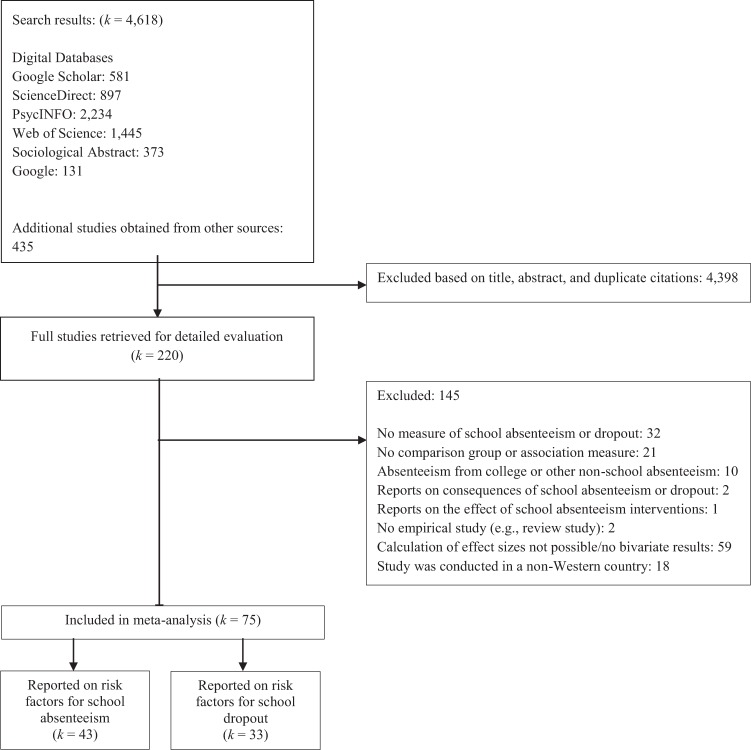
- Systematic searches until May 2019 in multiple databases and reference lists; inclusion required Western-country samples, Dutch or English language, peer-reviewed journals or dissertations, primary/secondary school samples, risk factors preceding absenteeism/dropout, and bivariate association data.
- Included 75 studies: 43 absenteeism studies (41 non-overlapping samples, N = 243,296; 781 effect sizes) and 33 dropout studies (31 non-overlapping samples, N = 136,392; 635 effect sizes). Risk factors were classified into 44 absenteeism and 42 dropout mutually exclusive risk domains.
- Three-level random-effects meta-analyses in R using metafor, with Fisher’s z transformed correlations; intercept-only models estimated mean domain effects, percentage of boys was tested as a moderator where heterogeneity was present and at least five studies were available, and bias was assessed with trim-and-fill, three-level funnel plot, and Egger’s regression tests.
Limitations
- Stated: the authors cannot assure the included studies are representative of all studies; primary studies may have been missed; restricting to published studies and dissertations risks publication bias; bias tests indicated bias in many domains, though trim-and-fill suggested underestimation; non-experimental designs preclude causal conclusions; retrospective studies mean some factors may not be true antecedents; mutually exclusive risk domains prevent examining combinations of risk factors; only percentage of boys was tested as a moderator, and only for domains based on at least five studies.
- Evident: the text reports 75 included studies in the results but refers to “a total of 69 studies and 1384 effect sizes” in the limitations; many risk domains are based on few studies or effect sizes and show high heterogeneity, limiting precision and moderator analyses.
Model-written summary. Check it against the paper before relying on it.
Integrity signals
Registry
Cites
Statistics
Figures
Verification
Claims the paper makes
3 Valid · 0 Not valid · 24 Not checked · 94 Own results and interpretations
A result the paper reports from its own data — it cites no other source for it, so there is none to check. The quote shows it is in the paper.
In the paper
“trim-and-fill analyses showed that an underestimation rather than an overestimation of risk domain effects was a problem (see Tables 4 and 5).”
§ Risk Factors for School Absenteeism and Dropout: A Meta-Analytic Review > Discussion > Limitations
plain- Asserted: passes — The authors put it forward as true.
- Checkable: passes — It can be checked against evidence.
- Load-bearing: passes — The paper’s conclusions depend on it.
- Based: passes — The paper gives a reason why it holds.
A result the paper reports from its own data — it cites no other source for it, so there is none to check. The quote shows it is in the paper.
In the paper
“Significant level-2 and/or level-3 variance was found in 32 risk domains.”
§ Risk Factors for School Absenteeism and Dropout: A Meta-Analytic Review > Results > The Moderating Effect of Gender
plain- Asserted: passes — The authors put it forward as true.
- Checkable: passes — It can be checked against evidence.
- Load-bearing: unclear — It is unclear whether the paper’s conclusions depend on it.
- Based: passes — The paper gives a reason why it holds.
A result the paper reports from its own data — it cites no other source for it, so there is none to check. The quote shows it is in the paper.
In the paper
“The three tests for bias assessment indicated that bias may have been present in multiple estimated effects of risk domains.”
§ Risk Factors for School Absenteeism and Dropout: A Meta-Analytic Review > Discussion > Limitations
hedged- Asserted: passes — The authors put it forward as true.
- Checkable: passes — It can be checked against evidence.
- Load-bearing: unclear — It is unclear whether the paper’s conclusions depend on it.
- Based: passes — The paper gives a reason why it holds.
A result the paper reports from its own data — it cites no other source for it, so there is none to check. The quote shows it is in the paper.
In the paper
“For school absenteeism, 12 risk domains were found with large effects, including having a negative attitude towards school, substance abuse, externalizing and internalizing problems of the juvenile, and a low parent-school involvement.”
§ Risk Factors for School Absenteeism and Dropout: A Meta-Analytic Review > Abstract
plainstates an association- Asserted: passes — The authors put it forward as true.
- Checkable: passes — It can be checked against evidence.
- Load-bearing: passes — The paper’s conclusions depend on it.
- Based: passes — The paper gives a reason why it holds.
A result the paper reports from its own data — it cites no other source for it, so there is none to check. The quote shows it is in the paper.
In the paper
“For school absenteeism, 12 risk domains were found with large effects, including having a negative attitude towards school, substance abuse, externalizing and internalizing problems of the juvenile, and a low parent-school involvement.”
§ Risk Factors for School Absenteeism and Dropout: A Meta-Analytic Review > Abstract
plainstates an association- Asserted: passes — The authors put it forward as true.
- Checkable: passes — It can be checked against evidence.
- Load-bearing: passes — The paper’s conclusions depend on it.
- Based: passes — The paper gives a reason why it holds.
70 more claims
Create a free account to see all 121 claims and to verify the 1 reference still open.
- It may state two separate claims as one. 25
- Probably not a substantial claim. 29
Claims other papers make about this one
Each is checked against this paper’s own text: does it say what the citing paper says it does?
The source backs part of the claim, not all of it — or backs it for a different population, condition or comparison.
In the citing paper
“Researchers commonly group risk or contextual (and, conversely, protective) factors for SA/A into various categories that include child-, parent-, family-, peer-, school-, and community-based variables (Kearney, 2008; Zaff et al., 2017; Gubbels et al., 2019).”
From Reconciling Contemporary Approaches to School Attendance and School Absenteeism: Toward Promotion and Nimble Response, Global Policy Review and Implementation, and Future Adaptability (Part 1) (2019) · cites this paper as Gubbels et al., 2019
Experimental — accuracy not yet measuredThe cited source says what the claim attributes to it.
In the citing paper
“While the link between mental health issues and school attendance during adolescence has been documented”
From “So That You Can Feel Well”: Perspectives of Students with Social, Emotional and Behavioral Difficulties on Factors that Support School Attendance (2025) · cites this paper as Gubbels et al., 2019
The cited source says what the claim attributes to it.
In the citing paper
“A large amount of quantitative research demonstrates the complex associations with student-level risk factors and SAPs, particularly internalizing and/or externalizing behaviors among other variables”
From “So That You Can Feel Well”: Perspectives of Students with Social, Emotional and Behavioral Difficulties on Factors that Support School Attendance (2025) · cites this paper as Gubbels et al., 2019
Self-check
Percentages, sums and reported differences re-computed from the paper’s own numbers.
Each contradiction between two passages listed here was confirmed by an independent check.
Rated major: it would touch a result — a value a result rests on, reported and recomputed p-values on opposite sides of the significance level, two passages that conflict with no sign which is right, or a cited work retracted before this paper was published.
In the paper
§ Risk Factors for School Absenteeism and Dropout: A Meta-Analytic Review > Results > Overall Effects of Risk Domains for Dropout
“| Large classes/schools | 1 | 1 | 0.145 (0.080) | (−0.011, 0.292) | 0.035* | 100.0 | – | – | – | – | 0.144c |”
§ Risk Factors for School Absenteeism and Dropout: A Meta-Analytic Review > Calculation of Effect Sizes and Statistical Analyses
“The log-likelihood-ratio-tests were performed one-tailed and all other tests were performed two-tailed. A p-value < 0.05 was considered as statistically significant.”
Rated minor: it would not touch a result — a value no result rests on, a p-value that stays on the same side of the significance level, or a conflict that is clerical, resolved elsewhere in the paper, or outside its own findings.
In the paper
“Table 4 presents the results of the three analyses that were conducted to assess bias in the estimated mean effect of each of the 43 risk domains for school absenteeism.”
§ Risk Factors for School Absenteeism and Dropout: A Meta-Analytic Review > Results > Assessment of Bias
Reported 43 · recomputed 44
Rated minor: it would not touch a result — a value no result rests on, a p-value that stays on the same side of the significance level, or a conflict that is clerical, resolved elsewhere in the paper, or outside its own findings.
In the paper
“| Battin-Pearson et al. 2002 | Dropout | 770 | 88 | 682 | 50.99 | 34 | 12 | 6 | 12 | 6 |”
§ Risk Factors for School Absenteeism and Dropout: A Meta-Analytic Review > Method > Search Strategy
Reported 34 · recomputed 36
Rated minor: it would not touch a result — a value no result rests on, a p-value that stays on the same side of the significance level, or a conflict that is clerical, resolved elsewhere in the paper, or outside its own findings.
In the paper
“| Hancock et al. 2018 | Absenteeism | 5231 | 544 | 4687 | 61.00 | 23 | 6 | 13 | 0 | 0 |”
§ Risk Factors for School Absenteeism and Dropout: A Meta-Analytic Review > Method > Search Strategy
Reported 23 · recomputed 19
Rated minor: it would not touch a result — a value no result rests on, a p-value that stays on the same side of the significance level, or a conflict that is clerical, resolved elsewhere in the paper, or outside its own findings.
In the paper
“| Ingul et al. 2012 | Absenteeism | 308–610 | 101–103 | 207–507 | 47.70 | 46 | 29 | 10 | 6 | 2 |”
§ Risk Factors for School Absenteeism and Dropout: A Meta-Analytic Review > Method > Search Strategy
Reported 46 · recomputed 47
7 more findings
Create a free account to see every finding of this check.
Citations
Cites
R: A Language and Environment for Statistical Computing
R Core Team (2025) · doi:10.32614/r.manuals · Cited by 352,181
Tabachnick, B. G., & Fidell, L. S. (1983) · Cited by 80,042
The Ecology of Human Development: Experiments by Nature and Design
Bronfenbrenner, U. (1979) · Harvard University Press eBooks · doi:10.4159/9780674028845 · Cited by 26,084
Conducting Meta-Analyses in R with the metafor Package
Viechtbauer, W. (2010) · Journal of Statistical Software · doi:10.18637/jss.v036.i03 · Cited by 20,464 · cited 2×
“In the statistical environment R (version 3.5.1; R Core Team 2015), the function “rma.mv” of the metafor-package (Viechtbauer 2010) was used to conduct the statistical analyses.”
MethodInfluentialDuval, S., & Tweedie, R. (2000) · Biometrics · doi:10.1111/j.0006-341x.2000.00455.x · Cited by 14,099 · cited 1×
“First, a funnel-plot-based trim and fill method was conducted (Duval and Tweedie 2000a, 2000b).”
MethodThe ecology of human development : experiments by nature and design
Bronfenbrenner, U. (1979) · Cited by 12,580
Toward an experimental ecology of human development.
Bronfenbrenner, U. (1977) · American Psychologist · doi:10.1037/0003-066x.32.7.513 · Cited by 10,853 · cited 1×
“This view on how school absenteeism and dropout evolve is in line with the ecological perspective on child development of Bronfenbrenner (1979, 1986).”
Result(2000) · Cited by 9,198
A Nonparametric “Trim and Fill” Method of Accounting for Publication Bias in Meta-Analysis
Duval, S., & Tweedie, R. (2000) · Journal of the American Statistical Association · doi:10.1080/01621459.2000.10473905 · Cited by 2,955
The Psychology of Criminal Conduct
Hart, S. D., Andrews, D. A., & Bonta, J. (1995) · Political Psychology · doi:10.2307/3792235 · Cited by 2,900
Research works printed but not linked: 4
- Andrews DA Dowden C A meta-analytic investigation into effective correctional intervention for female offenders Forum on Corrections Research 1999 11 18 21
- *Mullvain, P. (2017). Examining the relationship between bullying, attendance, and achievement in schools (Doctoral dissertation). http://scholarworks.waldenu.edu/cgi/viewcontent.cgi?article=3717&context=dissertations.
- National Center for Education Statistics. 2015 and 2017 Mathematics and Reading Assessments 2018 Washington, DC US Department of Education
- *Taylor, R. G. (2009). School facilities in the nation’s capital: an analysis of student achievement, attendance, and truancy (Doctoral dissertation). http://citeseerx.ist.psu.edu/viewdoc/download?doi=10.1.1.620.4220&rep=rep1&type=pdf.
Cited by
Items 101–200 of 585
Fredriksson, U., Rasmusson, M., Backlund, Å., Isaksson, J., & Kreitz-Sandberg, S. (2024) · PLoS ONE · doi:10.1371/journal.pone.0300537 · Cited by 26
“Also, Gubbels et al. [28] note that most of the risk domains they had identified in their literature review were not moderated by gender.”
BackgroundRamsdal, G. H., & Wynn, R. (2022) · International Journal of Environmental Research and Public Health · doi:10.3390/ijerph19073938 · Cited by 27
“A meta-analytic review including 75 studies and 635 risk factors for school dropout found that grade retention, low IQ, learning difficulties, and low academic achievement have large effects [10]; however, the risk domains with the largest effects for school absenteeism included negative attitudes towards school, subs…”
BackgroundAzeredo, C. M., Marques, E. S., Okada, L. M., & Peres, M. F. T. (2022) · Journal of Interpersonal Violence · doi:10.1177/08862605221101201 · Cited by 17
“Victims and perpetrators of bullying are more likely to miss classes and drop out of school (Gubbels et al., 2019).”
BackgroundMitigating Academic Institution Dropout Rates with Predictive Analytics Algorithms
Lainjo, B. (2023) · International Journal of Education Teaching and Social Sciences · doi:10.47747/ijets.v3i1.866 · Cited by 17
Enderle, C., Kreitz-Sandberg, S., Backlund, Å., Isaksson, J., Fredriksson, U., & Ricking, H. (2024) · Frontiers in Education · doi:10.3389/feduc.2024.1405395 · Cited by 14
“…development of school refusal and chronic absenteeism reported in quantitative and qualitative literature (Baker and Bishop, 2015; Finning et al., 2019; Gubbels et al., 2019; Malika et al., 2021; McKay-Brown and Birioukov, 2021; Leduc et al., 2022; Corcoran and Kelly, 2023; Benoit et al., 2024).”
BackgroundInfluentialSchool refusal: mapping the literature by bibliometric analysis
Ulaş, S., Gonzálvez, C., & Seçer, İ. (2024) · Frontiers in Psychology · doi:10.3389/fpsyg.2024.1265781 · Cited by 21
“In view of the large number of articles published annually on SAPs, theoretical reviews, bibliometric studies, and meta-analysis are useful to report greater knowledge about the impact and visibility of scientific production (Gubbels et al., 2019; Eklund et al., 2022).”
BackgroundSorrenti, L., Caparello, C., Meduri, C. F., & Filippello, P. (2024) · European Journal of Investigation in Health Psychology and Education · doi:10.3390/ejihpe15010001 · Cited by 18
“This makes it difficult for students to stay in a class where they feel unwanted and disliked, and therefore, they are more likely to have high rates of absenteeism (Gubbels et al., 2019), which can often be responsible for unsatisfactory academic achievements (Chere & Hlalele, 2014).”
Dalforno, R. W., Wengert, H. I., Kim, L. P., & Jacobsen, K. H. (2022) · Dialogues in Health · doi:10.1016/j.dialog.2022.100046 · Cited by 20
Risk and resilience factors for primary school dropout in Côte d'Ivoire
Wortsman, B., Brice, H., Capani, A., Ball, M., Zinszer, B. D., Tanoh, F., Hermann, A. K. P. E., Ogan, A., Wolf, S., & Jasińska, K. K. (2024) · Journal of Applied Developmental Psychology · doi:10.1016/j.appdev.2024.101654 · Cited by 28
Caridade, S., Azevedo, V., Dinis, M. A. P., Sani, A. I., & Nunes, L. M. (2020) · Education and Urban Society · doi:10.1177/0013124520950335 · Cited by 25
“…the need to consider intervention measures in school absenteeism, given that school absence is associated with many different life-course problems (Gubbels et al., 2019), such as the development of internalization and externalization behavioral problems and the probability of engaging in risky…”
BackgroundInfluentialLópez, V., Cárdenas, K., & González, L. (2021) · Frontiers in Psychology · doi:10.3389/fpsyg.2021.639089 · Cited by 16
“External and internal aspects of the school intervene in this process, which constitute mechanisms of exclusion (Román, 2013; Robison et al., 2017; Gubbels et al., 2019), in the sense that the students don’t drop out, but instead are pushed out due to internal school factors or pulled out due to external community and…”
BackgroundInfluentialVeen, E. J., Pijpker, R., & Hassink, J. (2021) · Journal of Adventure Education & Outdoor Learning · doi:10.1080/14729679.2021.2011340 · Cited by 20
Wellbeing and School Improvement: A Scoping Review
McNeven, S., Main, K., & McKay, L. (2023) · Leadership and Policy in Schools · doi:10.1080/15700763.2023.2183512 · Cited by 19
“…settings points to strong correlations between the intentional promotion of wellbeing and positive school outcomes, such as high attendance rates (Gubbels, van der Put, & Assink, 2019), positive classroom behaviors (Aldridge & McChesney, 2018), and strong academic outcomes (Adler & Seligman,…”
Classifying Students With School Refusal Behavior and Their Relationship to Learning Strategies
Giménez-Miralles, M., Gonzálvez, C., Sanmartín, R., Vicent, M., Flores, M. D. P. A., & García-Fernández, J. M. (2021) · Frontiers in Education · doi:10.3389/feduc.2021.752199 · Cited by 14
Carrello, J., Lung, T. W.-C., Killedar, A., Baur, L. A., & Hayes, A. (2021) · Obesity Research & Clinical Practice · doi:10.1016/j.orcp.2021.09.006 · Cited by 17
Student absenteeism and ecological agency
Kipp, A. L., & Clark, J. S. (2021) · Improving Schools · doi:10.1177/1365480221992884 · Cited by 19
“Iterational (factors related to student beliefs and past experiences) Negative students’ experiences and beliefs toward school and academics (Balkis et al., 2016; Dunn et al., 2004; Gubbels et al., 2019; Parr & Bonitz, 2015; Suldo et al., 2008) Beliefs about self-based on past traumatic experiences in school and home…”
BackgroundGårdvik, K. S., Torgersen, T., Rygg, M., Lydersen, S., & Indredavik, M. S. (2021) · BMC Psychiatry · doi:10.1186/s12888-021-03100-w · Cited by 15
“[41] described 23 risk domains with significant overall effect on school dropout, where mental health problems of the child and adverse childhood experiences were two of these domains.”
BackgroundJimenez, A. L., Banaag, C. G., Arcenas, A. M. A., & Hugo, L. V. (2023) · Springer eBooks · doi:10.1007/978-3-030-42825-9_106-1 · Cited by 27
Associations Between School Absence and School Violence by Sexual Identity
Lowry, R., Kennedy, K. S., Johns, M. M., Harper, C. R., & Wilkins, N. J. (2022) · American Journal of Preventive Medicine · doi:10.1016/j.amepre.2022.03.026 · Cited by 13
Dräger, J., Klein, M., & Sosu, E. (2024) · PLoS ONE · doi:10.1371/journal.pone.0306716 · Cited by 33
Melander, K., Kortteisto, T., Hermanson, E., Kaltiala, R., Mäki-Kokkila, K., Kaila, M., & Kosola, S. (2022) · PLOS ONE · doi:10.1371/journal.pone.0264259 · Cited by 11
“on students aged from 13 to 15 years, because this is the time when absenteeism often increases [29, 30], and absenteeism during this time period predicts the future academic success of the student [31–33].”
BackgroundKeppens, G. (2022) · Journal of School Psychology · doi:10.1016/j.jsp.2022.07.003 · Cited by 16
Pisinger, V. S. C., Møller, S. P., Andersen, S., & Tolstrup, J. S. (2023) · Drug and Alcohol Review · doi:10.1111/dar.13617 · Cited by 17
Tvedt, M. S., & Bru, E. (2023) · Learning and Instruction · doi:10.1016/j.learninstruc.2023.101824 · Cited by 21
Liu, K., Zhao, Y., Li, M., Li, W., & Yang, Y. (2022) · Frontiers in Psychology · doi:10.3389/fpsyg.2022.977678 · Cited by 23
“, 2013), a higher level of parental control (Nunez et al., 2015; Erdem and Kaya, 2020), and having a parent who checked homework (Desimone, 1999) are related to a lower level”
BackgroundFadiji, A. W., & Reddy, V. (2023) · Frontiers in Psychology · doi:10.3389/fpsyg.2022.1044261 · Cited by 18
“Education researchers have always expressed interest in the relationship between parental involvement and academic achievement (Fan and Chen, 2001).”
BackgroundAnxiety during transition from primary to secondary schools in neurodivergent children
Sideropoulos, V., Palikara, O., Burchell, E., Ashworth, M., & Herwegen, J. V. (2024) · JCPP Advances · doi:10.1002/jcv2.12262 · Cited by 19
“Whilst in the neurotypical literature it has been found that issues related to bullying and belonging can lead to high school absence (Gubbels et al., 2019), there was no difference between groups on school refusal despite the bullying problems experienced by the neurodivergent children.”
Adverse Childhood Experiences and Student-Athlete Mental Health: A Social Work in Sports Perspective
Bennett, M. (2022) · Sport Social Work Journal · doi:10.33043/sswj.2.1.77-85 · Cited by 14
Wu, Z., Brown, L. E., Kim, H. Y., Yoshikawa, H., & Aber, J. L. (2023) · Frontiers in Psychology · doi:10.3389/fpsyg.2022.973184 · Cited by 16
“1 The direct and indirect outcomes of the brief SEL activities implemented in Learn Safe in Bo are associated negatively with several known risk factors for school absenteeism, such as anxiety and depression, negative school attitude and low academic self-concept (Gubbels et al., 2019), consistent with the mounting ev…”
ResultSchool Refusal in Adolescence: Personality Traits and Their Influence on Treatment Outcome
de Groot, C. M. C. E., Heyne, D. A., & Boon, A. E. (2023) · Journal of Emotional and Behavioral Disorders · doi:10.1177/10634266231151903 · Cited by 11
“The first comprises studies of the relationship between the persistence of SR and: (a) personality factors, and (b) treatment outcome.”
Glaesser, D., Holl, C., Malinka, J., McCullagh, L., Meissner, L., Harth, N. S., Machunsky, M., & Mitte, K. (2023) · Social Psychology of Education · doi:10.1007/s11218-023-09829-4 · Cited by 19
Brunner, M., Stallasch, S. E., & Lüdtke, O. (2023) · Journal of Research on Educational Effectiveness · doi:10.1080/19345747.2023.2175753 · Cited by 22
“The average level of achievement of students who drop out of school is lower than that of students who continue their school career (Gubbels et al., 2019).”
BackgroundEnderle, C. (2025) · School Mental Health · doi:10.1007/s12310-025-09764-z · Cited by 12
“A large amount of quantitative research demonstrates the complex associations with student-level risk factors and SAPs, particularly internalizing and/or externalizing behaviors among other variables (Gubbels et al., 2019).”
Stromberg, M. H., Rubtsova, A., Sales, J. M., & McGee, R. E. (2022) · Journal of School Health · doi:10.1111/josh.13168 · Cited by 21
From entertainment to extortion: Tunisian children's online experiences
Martin, A. P., Keskes, H., Heni, W., Burton, P., Deliege, A., Rabhi, C., & Ayari, R. (2023) · Child Abuse & Neglect · doi:10.1016/j.chiabu.2023.106405 · Cited by 14
Villadsen, A., Cameron, C., Evans, J., Herwegen, J. V., Hill, V., Hurry, J., Roberts, A., Wyse, D., & Johansen, T. (2023) · Child and Adolescent Mental Health · doi:10.1111/camh.12681 · Cited by 20
Song, S., Martin, M. J., & Wang, Z. (2024) · Journal of School Psychology · doi:10.1016/j.jsp.2024.101330 · Cited by 15
Franco, M. P., Bottiani, J. H., Debnam, K. J., Bonifay, W. E., Pandey, T., Gilles, J. K.-J., & Bradshaw, C. P. (2024) · Journal of School Psychology · doi:10.1016/j.jsp.2024.101381 · Cited by 11
Nwosu, K. C., Wahl, W. P., Nwikpo, M. N., Hickman, G. P., Ezeonwumelu, V. U., & Akuneme, C. C. (2022) · Current Psychology · doi:10.1007/s12144-022-03890-6 · Cited by 17
“This perspective aligns with the ecological systems theory of child development (Gubbels et al., 2019) implying that multiple factors could be responsible for SBRs among adolescents (Deven-ney & O’Toole, 2021; Heyne et al., 2021).”
BackgroundSantos, F. P. S. T., Ferreira, G. A., de Paula, J. J., et al. (2023) · Revista Brasileira de Reumatologia · doi:10.1186/s42358-023-00300-8 · Cited by 9
“However, experiencing learning difficulties is a known cause of school dropout [32].”
BackgroundSchool Absenteeism in Germany: A Shift from Punishment to Support?
Enderle, C., Ricking, H., & Schulze, G. C. (2023) · European Education · doi:10.1080/10564934.2023.2257195 · Cited by 9
“This understanding acknowledges that causes for absences from school can be found in different categories, including the individual, family, peer, or school (Gubbels et al., 2019; Kearney, 2016).”
BackgroundGan, Y., & Guo, J. (2022) · Journal of Child and Family Studies · doi:10.1007/s10826-022-02245-w · Cited by 11
“This is consistent with the meta-analysis by Gubbels et al. (2019), suggesting that individuals who drop out of school exhibit antisocial behavior/cognition, often suffer from “psychiatric symptoms or disorders,” and run “a high risk of adjusting poorly to school”.”
ResultArbour, M., Soto, C., Alée, Y., Atwood, S., Muñoz, P., & Marzolo, M. (2023) · Frontiers in Education · doi:10.3389/feduc.2022.975092 · Cited by 16
“Positive attitudes toward school are positively associated with school attendance (Gubbels et al., 2019), and Chilean parents reported that children oversleeping contributed to problematic absenteeism, which suggests this factor was relevant to the study context (Arbour et al.”
BackgroundParental separation and school dropout in adolescence
Karhina, K., Bøe, T., Hysing, M., Askeland, K. G., & Nilsen, S. A. (2023) · Scandinavian Journal of Public Health · doi:10.1177/14034948231164692 · Cited by 23
“…recent meta-analysis identified several risk factors for school dropout, including physical and mental health problems, adverse childhood experiences, family and parenting problems, and problems at or with school such as peer problems, learning difficulties or negative attitudes toward school [38].”
BackgroundKearney, C. A., Fensken, M., & Dupont, R. (2024) · Frontiers in Education · doi:10.3389/feduc.2024.1272297 · Cited by 13
Gee, K. A., Gottfried, M. A., Freeman, J. A., & Kim, P. K. (2024) · Early Childhood Research Quarterly · doi:10.1016/j.ecresq.2024.01.002 · Cited by 10
The Evolution of Research on School Attendance: A Bibliometric Review of Scholarly Output
Martínez-Torres, J., Gonzálvez, C., Fernández‐Sogorb, A., & García-Fernández, J. M. (2024) · European Journal of Educational Research · doi:10.12973/eu-jer.13.2.851 · Cited by 12
Kosola, S. K., Kullberg, M., Melander, K., Engblom, J., Ranta, K., & Alanko, K. (2024) · Archives of Disease in Childhood · doi:10.1136/archdischild-2023-326331 · Cited by 13
Exploring determinants of school dropout across regions in India: a comprehensive meta-analysis
Venkatesan, R. G., Karmegam, D., & Mappillairaju, B. (2024) · Journal of Computational Social Science · doi:10.1007/s42001-024-00285-4 · Cited by 13
“A meta-analytic review by Gubbels et al. [2] highlights the consistently identified challenges such as low intelligence quotient, learning difficulties, and academic underachievement as significant predictors of school dropout, alongside issues like grade retention and negative attitudes towards…”
InfluentialNordmo, M., Kleppestø, T. H., Reme, B., Sunde, H. F., von Soest, T., & Torvik, F. A. (2024) · JCPP Advances · doi:10.1002/jcv2.12239 · Cited by 11
“Because educational performance is linked to a wide range of important life outcomes, the potential negative effects of adolescent mental health problems could be far reaching (Davies et al., 2018; Gubbels et al., 2019).”
BackgroundKlan, A., Whitley, J., Krause, A., McBrearty, N., Rogers, M. A., & Smith, J. D. (2024) · Educational and Child Psychology · doi:10.53841/bpsecp.2024.41.1.73 · Cited by 8
Exploring patterns of school absenteeism: Links to school climate in adolescents
Pérez‐Marco, M., Fuster‐Rico, A., Gonzálvez, C., Hamadi, S. E., & Havik, T. (2025) · International Journal of Educational Research · doi:10.1016/j.ijer.2025.102674 · Cited by 17
Salgado, J. F., Cuadrado, D., & Moscoso, S. (2022) · Frontiers in Psychology · doi:10.3389/fpsyg.2022.893775 · Cited by 14
“As stated above, absenteeism is the only facet whose relationship with AP has been previously meta-analyzed (see Credé et al., 2010; Gubbels et al., 2019).”
MethodJochim, J., Meinck, F., Roberts, K. J. S., Wittesaele, C., Langwenya, N., Toska, E., & Cluver, L. D. (2022) · Psychology Health & Medicine · doi:10.1080/13548506.2022.2108085 · Cited by 10
“, 2019), which was the case for about 5% of participants, and high rates of grade delay that leads to a greater risk to discontinue school over time (Gubbels et al., 2019).”
BackgroundOpportunities, challenges, and contextual supports to promote enacting maturing during adolescence
Ballard, P. J., Hoyt, L. T., & Johnson, J. B. (2022) · Frontiers in Psychology · doi:10.3389/fpsyg.2022.954860 · Cited by 13
“Although the literature suggests that there may be some positive implications of strict parental control, such as educational success (Fan and Chen, 2001), many immigrant girls face clear barriers to enacting maturity.”
BackgroundMaternal homework approach and adolescents’ academic skills: The mediating role of task values
Šilinskas, G., Viljaranta, J., Poikkeus, A., & Lerkkanen, M. (2022) · Frontiers in Education · doi:10.3389/feduc.2022.999128 · Cited by 13
“A plausible explanation for the conflicting findings on the efficacy of parental homework approach is the different types of such approach (see Patall et al., 2008; Castro et al., 2015; Barger et al., 2019).”
BackgroundNishimura, T., Wakuta, M., Osuka, Y., Tsukui, N., Hirata, I., Takahashi, M., Adachi, M., Katayama, T., Aizaki, K., Sumiya, M., et al. (2024) · Frontiers in Public Health · doi:10.3389/fpubh.2024.1430011 · Cited by 11
“While maintaining stable mental health can positively impact a child’s overall development, challenges in social interactions and academic performance can exacerbate mental health issues, potentially leading to serious consequences such as school attendance problems (9, 10).”
BackgroundAssociation Between Dietary Patterns and Bullying Among Adolescents in Sao Paulo—Brazil
Okada, L. M., Marques, E. S., Levy, R. B., Peres, M. F. T., & Azeredo, C. M. (2022) · International Journal of Offender Therapy and Comparative Criminology · doi:10.1177/0306624x221095017 · Cited by 9
“In addition, the survey SP-PROSO does not account for adolescents not enrolled in regular education and perpetrators of bullying are more likely to miss classes and drop out of school (Gubbels et al., 2019); thus, some of them may not have been included in the analysis.”
BackgroundCunha, K. S., Okada, L. M., Rinaldi, A. E. M., Marques, E. S., Paro, H. B. M. D. S., & Azeredo, C. M. (2022) · Sexuality Research and Social Policy · doi:10.1007/s13178-022-00715-w · Cited by 9
Language disorder and internalizing mental health problems in youth offenders: A systematic review
Zupan, B., Hutchings, S. M., Everitt, L. E., & Gupta, C. C. (2022) · International Journal of Language & Communication Disorders · doi:10.1111/1460-6984.12759 · Cited by 13
“However, language disorder puts Dubois et al.’s youth at risk for poorer academic experiences and outcomes which can lead to leaving school prematurely (Dubois et al., 2020; Gubbels et al., 2019; McGregor, 2020); this risk is increased when intervention is delayed (Thomas et al., 2019).”
BackgroundCarioti, D., Stefanelli, S., Giorgi, A., Masia, M. F., Pivo, G. D., Monte, M. D., Travellini, S., Marcelli, A., Guasti, M. T., Vernice, M., et al. (2024) · Ampersand · doi:10.1016/j.amper.2024.100166 · Cited by 14
Brunner, M., Stallasch, S. E., & Lüdtke, O. (2022) · doi:10.35542/osf.io/39gbq · Cited by 8
Repo, J., Reimer, D., & Kilpi‐Jakonen, E. (2025) · Large-scale Assessments in Education · doi:10.1186/s40536-025-00251-0 · Cited by 13
“Prior research has robustly shown a link between children’s socioeconomic background and school attendance (Gubbels et al., 2019; Klein et al., 2020).”
Krause, A., Rogers, M., Jiang, Y., Climie, E. A., Corkum, P. V., Mah, J. W. T., McBrearty, N., Smith, J. D., & Whitley, J. (2025) · Frontiers in Child and Adolescent Psychiatry · doi:10.3389/frcha.2025.1604431 · Cited by 13
Kearney, C. A., Blanco, A. M., & Dugan, R. B. (2025) · The Family Journal · doi:10.1177/10664807251360787 · Cited by 12
School, family, and peer predictors of adolescent alcohol and marijuana use
Novak, M., Maglica, T., & Radetić-Paić, M. (2022) · Drugs Education Prevention and Policy · doi:10.1080/09687637.2022.2073869 · Cited by 15
Heradstveit, O., Hysing, M., Bøe, T., Nilsen, S. A., Sivertsen, B., Bretteville‐Jensen, A. L., & Askeland, K. G. (2023) · Nordic Studies on Alcohol and Drugs · doi:10.1177/14550725231188568 · Cited by 12
“…problem with school dropout, it is important to gain better insight into the risk factors for dropout, as these may be targeted to promote completion of upper secondary school, and thus contribute to better prospects for adolescents at-risk for negative educational outcomes (Gubbels et al., 2019).”
BackgroundDadi, A. F., He, V. Y., Guenther, J., et al. (2023) · The Australian Educational Researcher · doi:10.1007/s13384-023-00655-3 · Cited by 7
“This finding could be related to students’ academic skills, experience of different school environments and emotional and psychological maturity (Gubbels et al., 2019).”
Determinants of school dropouts and the impact on youth unemployment: Evidence from Ethiopia
Sileshi, M., Jemal, K., & Feyisa, B. W. (2024) · Economic Systems · doi:10.1016/j.ecosys.2024.101228 · Cited by 16
Andreas, J. B., Torvik, F. A., & Lund, I. O. (2021) · Drug and Alcohol Dependence · doi:10.1016/j.drugalcdep.2021.109189 · Cited by 9
Berghe, L. V. D., Vandevelde, S., & Pauw, S. S. W. D. (2022) · Teachers and Teaching · doi:10.1080/13540602.2022.2062748 · Cited by 21
“On the other hand, society experiences missed tax income, increased welfare expenditure, and reduced political and civil participation (Gubbels et al., 2019; Hindriks & De Witte, 2017).”
BackgroundInfluentialSantos, A. C., Simões, C., Branquinho, C., & Arriaga, P. (2022) · Child Abuse & Neglect · doi:10.1016/j.chiabu.2022.105819 · Cited by 16
Duckworth, J. C., Graupensperger, S. A., Schultz, N. R., Gilson, M. S., Fairlie, A. M., Patrick, M. E., & Lee, C. M. (2023) · Addictive Behaviors · doi:10.1016/j.addbeh.2023.107670 · Cited by 10
Factors associated with family function in school children: Case-control study
Carvajal, A. B., Urrego, Á. M. J., Gutierrez-Posso, A. G., Mario, C.-F., & Hernández-Carrillo, M. (2023) · Heliyon · doi:10.1016/j.heliyon.2023.e14595 · Cited by 7
Sharpe, J., Bunting, B. P., & Heary, C. (2023) · School Mental Health · doi:10.1007/s12310-023-09610-0 · Cited by 13
“…report of bullying, attitude to school, relationship with teacher, parents reporting of parent depression, parental conflict and teacher report of problems at home that affect school participation (Egger et al., 2003; Gubbels et al., 2019; Hallinan, (2008); Havik et al., 2014; Ingul et al., 2019).”
BackgroundResultThe role of adolescent social inclusion in educational attainment among vulnerable youth
Renner, H. M., Rowland, B., Hutchinson, D. M., & Toumbourou, J. W. (2024) · Child and Adolescent Mental Health · doi:10.1111/camh.12709 · Cited by 12
Humberstone, E. (2019) · Network Science · doi:10.1017/nws.2019.25 · Cited by 7
“and engagement are also thought tomitigate dropout risk (Gubbels et al., 2019;Marcus & SandersReio, 2001; Rumberger, 2011), a particular concern for pregnant teens who are at greater risk for dropout than their nonpregnant peers (Perper et al.”
BackgroundAnna Vannucii Receives Emerging Scholar Best Article Award, 2020
Levesque, R. J. R. (2020) · Journal of Youth and Adolescence · doi:10.1007/s10964-020-01327-6 · Cited by 8
Appollis, T. M., Mathews, C., Lombard, C. J., & Jonas, K. (2024) · AIDS and Behavior · doi:10.1007/s10461-024-04448-2 · Cited by 10
“…ranging from illness [7], lack of sanitary supplies during menstruation [12], mental health conditions [13], low IQ or learning difficulties [14] to bullying [13, 15], perceived lack of safety [13], exposure to violence [16], parenting problems [13], poor school climate [17], substance use…”
BackgroundScaini, S., Forresi, B., Torres, D., Piron, R., & Giani, L. (2024) · Journal of Cognitive Psychotherapy · doi:10.1891/jcp-2023-0050 · Cited by 9
Countering Racialized Logics About Black Students and School Attendance
Graham, J., Grooms, A. A., & Childs, J. (2025) · Educational Researcher · doi:10.3102/0013189x251321448 · Cited by 8
“Moreover, there has been an abundance of risk/protective factors research in the context of absenteeism, and many authors have framed race as a “risk factor” based on estimates suggesting that Black students are more likely to miss school than their White peers (Gubbels et al., 2019).”
Onslow, J., & Cartmell, H. (2025) · Educational Psychology in Practice · doi:10.1080/02667363.2025.2475041 · Cited by 14
“Rather than there being a single causal factor, EBSA is usually the result of complex, reciprocal interactions between a number of factors relating to the child and their environment which includes their family, peers and school (Gregory & Purcell, 2014; Gubbels et al., 2019).”
Bayrakçeken, E., Çinici, M., & Alkan, Ö. (2025) · BMC Pediatrics · doi:10.1186/s12887-025-06034-4 · Cited by 11
Kyere, E., Hong, S., & Gentle-Genitty, C. S. (2023) · Education Sciences · doi:10.3390/educsci13040387 · Cited by 15
“In this regard, given that race and income are strongly linked [2,66], applying an intersectional framework to examine their combined effect on potential discrimination in the context of teacher–student interaction is important to support African American students.”
Haque, U. M., Kabir, E., & Khanam, R. (2024) · Scientific Reports · doi:10.1038/s41598-024-51230-4 · Cited by 10
Pipa, J., Daniel, J. R., & Peixoto, F. (2024) · Psychology in the Schools · doi:10.1002/pits.23145 · Cited by 12
Discrimination, Psychological Isolation, and Flight from School
Nakhaie, R. (2021) · Journal of International Migration and Integration / Revue de l integration et de la migration internationale · doi:10.1007/s12134-021-00901-6 · Cited by 8
Waterman, E. A., Edwards, K. M., & Banyard, V. L. (2021) · Journal of School Violence · doi:10.1080/15388220.2021.1984934 · Cited by 8
Ampofo, E. T., Opoku, K., & Opoku-Manu, M. (2022) · European Journal of Education and Pedagogy · doi:10.24018/ejedu.2022.3.2.164 · Cited by 11
“According to Heyne et al. (2019), students who are absent from school spend their time away from home and conceal their absences from their parents.”
BackgroundEmery, C. R., Abdullah, A., & Jordan, L. P. (2023) · Journal of Interpersonal Violence · doi:10.1177/08862605231156418 · Cited by 6
“…substance abuse (Halpern et al., 2018), posttraumatic stress disorder and other forms of psychopathology (Adams et al., 2018), behavior problems (Emery, Trung, et al., 2015), school dropout and other academic problems (Gubbels et al., 2019), and ultimately early mortality (Grummitt et al., 2021).”
BackgroundModeling Adolescent Social Inclusion to Improve School Completion
Renner, H. M., Rowland, B., Hutchinson, D. M., & Toumbourou, J. W. (2023) · Journal of Youth and Adolescence · doi:10.1007/s10964-023-01792-9 · Cited by 12
“…antisocial behavior, (e) childhood emotional and behavioral problems, (f) parenting problems, and (g) mental health problems (Goldfeld et al., 2018; Gubbels et al., 2019; Weber et al., 2018) were included in the analysis to control for potential confounding effects (see Appendix D for specifics on…”
BackgroundResultInfluentialCoyle, S., Rueger, S. Y., Chen, Z. J., Case, S., Chen, P., & Eveleigh, E. (2023) · Journal of Child and Family Studies · doi:10.1007/s10826-023-02590-4 · Cited by 11
“This finding is consistent with research emphasizing lack of parent involvement as a risk factor for greater school absenteeism (Gubbels et al., 2019; Kearney, 2008).”
BackgroundResultInfluentialFinkenauer, C., Boer, M., Spitzer, J. E., Weinberg, D., Visser, K., Jonker, M., & Stevens, G. W. J. M. (2023) · npj Science of Learning · doi:10.1038/s41539-023-00189-4 · Cited by 9
Nwafor, C. E., Ugwu, P. C., Okoye, C. F. A., Obi–Nwosu, H., & Ofonedu, M. E. (2024) · Journal of Research on Adolescence · doi:10.1111/jora.12967 · Cited by 14
Inoue, A., & Tanaka, R. (2024) · Economics of Education Review · doi:10.1016/j.econedurev.2024.102545 · Cited by 10
The development of a risk and needs assessment instrument for truancy
van der Put, C. E. (2019) · Children and Youth Services Review · doi:10.1016/j.childyouth.2019.104721 · Cited by 7
Self-citationvan den Toren, S. J., Franse, C. B., Vanneste, Y. T. M., Bannink, R., Lugtenberg, M., Mulder, W. C., de Kroon, M. L. A., van Grieken, A., & Raat, H. (2020) · BMC Public Health · doi:10.1186/s12889-020-09809-9 · Cited by 8
Ações executadas no Programa Saúde na Escola e seus fatores associados
de Medeiros, E. R., Soares, M. F. D. S., Rebouças, D. G. D. C., et al. (2021) · Avances en Enfermería · doi:10.15446/av.enferm.v39n2.86271 · Cited by 6
Papavasileiou, C., Kourou, A., Mavrakis, A., & Luca, S. (2022) · International Journal of Disaster Risk Reduction · doi:10.1016/j.ijdrr.2022.103134 · Cited by 7
Enderle, C., Kotschy, L., Ricking, H., & Kreitz-Sandberg, S. (2025) · Frontiers in Education · doi:10.3389/feduc.2025.1627098 · Cited by 5
Metadata
- Authors
- Gubbels, J., van der Put, C. E., & Assink, M.
- Affiliations
- University of Amsterdam (NL)
- Corresponding author
- Gubbels, Jeanne
- Venue
- Journal of Youth and Adolescence
- Published
- 2019-07-15
- Volume
- 48
- Issue
- 9
- Pages
- 1637-1667
- ISSN
- 0047-2891 (ISSN-L)
- 1573-6601
- PMC
- PMC6732159
- OpenAlex
- W2960437645
- Cited by
- 596
- References
- 123
- Citations by year
- 2026: 98 · 2025: 110 · 2024: 113 · 2023: 92 · 2022: 99 · 2021: 49 · 2020: 29 · 2019: 6
- FWCI
- 13.05
- Type
- journal article
- Language
- en
- Open access
- hybrid
- doi.org
- Licence
- cc-by
- creativecommons.org/licenses/by/4.0 (tdm)
- creativecommons.org/licenses/by/4.0 (vor)
- Locations
- Journal of Youth and Adolescence (publishedVersion, cc-by)
- Europe PMC (PubMed Central) (publishedVersion, cc-by)
- PubMed Central (publishedVersion, cc-by)
- PubMed (publishedVersion)
- UvA-DARE (University of Amsterdam) (publishedVersion, cc-by)
- Data Archiving and Networked Services (DANS) (submittedVersion, other-oa)
- Topics
- Social Sciences › Education › Youth Substance Use and School Attendance
- Social Sciences › Education › Educational Outcomes and Influences
- Social Sciences › Sociology and Political Science › Youth Education and Societal Dynamics
- Keywords
- school absenteeism, school dropout, risk factors, adolescent development, substance abuse, externalizing problems, internalizing problems, school retention, low IQ, learning difficulties, academic performance, attitudes toward school, prevention and intervention
- MeSH terms
- Absenteeism, Adolescent, Adolescent Behavior, Female, Humans, Male, Risk Factors, Student Dropouts, Students, Substance-Related Disorders
About these checks
Registry, retraction, Cites and statistics results are computed, not judged, with one exception: a printed reference that no index lists is read once by a model before it counts as a citation error. Claims are extracted by a model and kept only when their quote appears verbatim in the text; each cited source is then checked, with a model’s help, for whether it says what the claim relies on. Those verdicts can be wrong — read the claim’s quote and the cited source before relying on one.
The claim verdicts this report counts are experimental: their accuracy is not yet measured.
A language model drew the claims from the paper on 2026-10-10, under version 3 of the claim definition (model deepseek-v4.1-flash, prompt extract-v3).
A second model labelled each claim on 2026-10-10 (model jev-1.13-20260917, definition revision gold-guideline-v0.2).
Statistics and arithmetic are recomputed, not judged.
Confidence bands are shown only for fields calibrated on our annotated test set. None is calibrated yet, so no band is shown.
What counts as a claim ›How we measure confidence ›How we check this ›
Are you an author, or do you see a problem with this page? Request a review
Data sources
Bibliographic data: Semantic Scholar, OpenAlex, Crossref.
Contains information from the Semantic Scholar Academic Graph Datasets, made available under the ODC Attribution License (ODC-BY 1.0).
Semantic Scholar’s data is described in: Kinney, R., et al. (2023). The Semantic Scholar Open Data Platform. arXiv:2301.10140.
