

Risk Factors for School Absenteeism and Dropout: A Meta-Analytic Review
Open accessThe DOI matches its Crossref record; 119 of the 123 references it cites were found in a registry or an index; 3 of the 46 sources its claims cite were checked for support.
Abstract
School absenteeism and dropout are associated with many different life-course problems. To reduce the risk for these problems it is important to gain insight into risk factors for both school absenteeism and permanent school dropout. Until now, no quantitative overview of these risk factors and their effects was available. Therefore, this study was aimed at synthesizing the available evidence on risk factors for school absenteeism and dropout. In total, 75 studies were included that reported on 781 potential risk factors for school absenteeism and 635 potential risk factors for dropout. The risk factors were classified into 44 risk domains for school absenteeism and 42 risk domains for dropout. The results of a series of three-level meta-analyses yielded a significant mean effect for 28 school absenteeism risk domains and 23 dropout risk domains. For school absenteeism, 12 risk domains were found with large effects, including having a negative attitude towards school, substance abuse, externalizing and internalizing problems of the juvenile, and a low parent-school involvement. For dropout, the risk domains having a history of grade retention, having a low IQ or experiencing learning difficulties, and a low academic achievement showed large effects. The findings of the current study contribute to the fundamental knowledge of the etiology of school absenteeism and dropout which in turn contributes to a better understanding of the problematic development of adolescents. Further, more insight into the strength of effects of risk factors on school absenteeism and dropout is important for the development and improvement of both assessment, prevention and intervention strategies.
Overview
CoChat Summary
TL;DR
This meta-analytic review synthesized 75 studies and found that many child, family, school, and peer risk domains are significantly associated with school absenteeism and dropout. For absenteeism, negative school attitude and substance abuse showed large effects; for dropout, grade retention, low IQ/learning difficulties, and low academic achievement showed large effects.
Key findings
- Across 75 studies, 28 of 44 absenteeism risk domains and 23 of 42 dropout risk domains had significant positive mean effects. For absenteeism, large effects included negative school attitude (r = 0.553), anti-social behavior/cognitions (r = 0.428), smoking (r = 0.336), drug abuse (r = 0.327), alcohol abuse (r = 0.311), poor pupil-teacher relationship (r = 0.286), and low parental school involvement (r = 0.272).
- For dropout, large effects were found for history of grade retention (r = 0.348), low IQ/learning difficulties (r = 0.326), and low academic achievement (r = 0.316). Medium effects included psychiatric symptoms/disorders (r = 0.269), drug abuse (r = 0.247), anti-social behavior/cognitions (r = 0.236), involvement with truant/deviant peers (r = 0.228), and low family SES (r = 0.222).
- Gender moderation was found only for drug abuse in absenteeism and negative school attitude in dropout; both effects were stronger as the percentage of boys in samples decreased, meaning they were stronger in girls. Most risk domains were not moderated by gender.
- Bias assessment found no indication of bias in 13 absenteeism and 14 dropout domain effects, some indication in 22 and 20, and moderate to strong indication in 9 and 8, respectively. Trim-and-fill analyses suggested underestimation rather than overestimation in several domains.
Methods
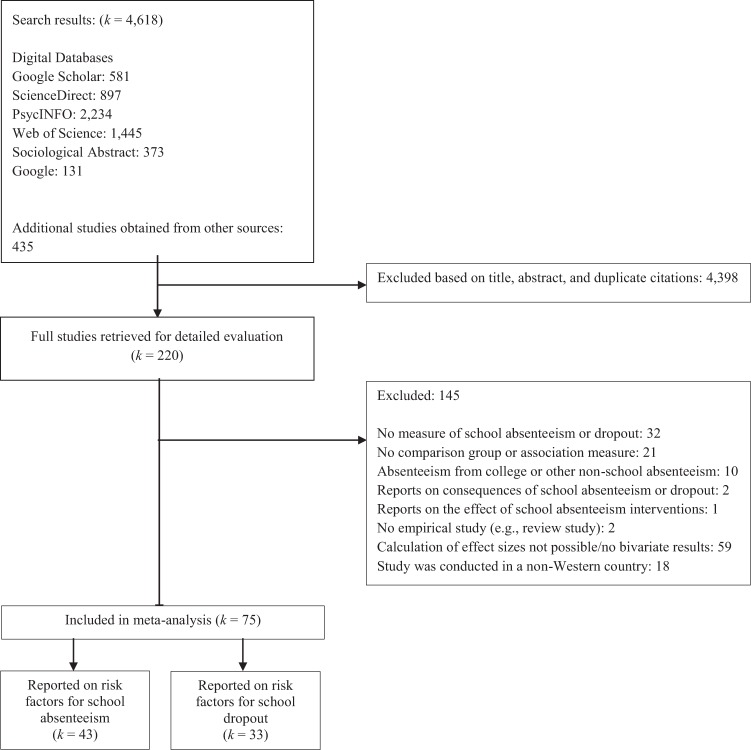
- Systematic searches until May 2019 in multiple databases and reference lists; inclusion required Western-country samples, Dutch or English language, peer-reviewed journals or dissertations, primary/secondary school samples, risk factors preceding absenteeism/dropout, and bivariate association data.
- Included 75 studies: 43 absenteeism studies (41 non-overlapping samples, N = 243,296; 781 effect sizes) and 33 dropout studies (31 non-overlapping samples, N = 136,392; 635 effect sizes). Risk factors were classified into 44 absenteeism and 42 dropout mutually exclusive risk domains.
- Three-level random-effects meta-analyses in R using metafor, with Fisher’s z transformed correlations; intercept-only models estimated mean domain effects, percentage of boys was tested as a moderator where heterogeneity was present and at least five studies were available, and bias was assessed with trim-and-fill, three-level funnel plot, and Egger’s regression tests.
Limitations
- Stated: the authors cannot assure the included studies are representative of all studies; primary studies may have been missed; restricting to published studies and dissertations risks publication bias; bias tests indicated bias in many domains, though trim-and-fill suggested underestimation; non-experimental designs preclude causal conclusions; retrospective studies mean some factors may not be true antecedents; mutually exclusive risk domains prevent examining combinations of risk factors; only percentage of boys was tested as a moderator, and only for domains based on at least five studies.
- Evident: the text reports 75 included studies in the results but refers to “a total of 69 studies and 1384 effect sizes” in the limitations; many risk domains are based on few studies or effect sizes and show high heterogeneity, limiting precision and moderator analyses.
Model-written summary. Check it against the paper before relying on it.
Integrity signals
Registry
Cites
Statistics
Figures
Verification
Claims the paper makes
3 Valid · 0 Not valid · 24 Not checked · 94 Own results and interpretations
A result the paper reports from its own data — it cites no other source for it, so there is none to check. The quote shows it is in the paper.
In the paper
“trim-and-fill analyses showed that an underestimation rather than an overestimation of risk domain effects was a problem (see Tables 4 and 5).”
§ Risk Factors for School Absenteeism and Dropout: A Meta-Analytic Review > Discussion > Limitations
plain- Asserted: passes — The authors put it forward as true.
- Checkable: passes — It can be checked against evidence.
- Load-bearing: passes — The paper’s conclusions depend on it.
- Based: passes — The paper gives a reason why it holds.
A result the paper reports from its own data — it cites no other source for it, so there is none to check. The quote shows it is in the paper.
In the paper
“Significant level-2 and/or level-3 variance was found in 32 risk domains.”
§ Risk Factors for School Absenteeism and Dropout: A Meta-Analytic Review > Results > The Moderating Effect of Gender
plain- Asserted: passes — The authors put it forward as true.
- Checkable: passes — It can be checked against evidence.
- Load-bearing: unclear — It is unclear whether the paper’s conclusions depend on it.
- Based: passes — The paper gives a reason why it holds.
A result the paper reports from its own data — it cites no other source for it, so there is none to check. The quote shows it is in the paper.
In the paper
“The three tests for bias assessment indicated that bias may have been present in multiple estimated effects of risk domains.”
§ Risk Factors for School Absenteeism and Dropout: A Meta-Analytic Review > Discussion > Limitations
hedged- Asserted: passes — The authors put it forward as true.
- Checkable: passes — It can be checked against evidence.
- Load-bearing: unclear — It is unclear whether the paper’s conclusions depend on it.
- Based: passes — The paper gives a reason why it holds.
A result the paper reports from its own data — it cites no other source for it, so there is none to check. The quote shows it is in the paper.
In the paper
“For school absenteeism, 12 risk domains were found with large effects, including having a negative attitude towards school, substance abuse, externalizing and internalizing problems of the juvenile, and a low parent-school involvement.”
§ Risk Factors for School Absenteeism and Dropout: A Meta-Analytic Review > Abstract
plainstates an association- Asserted: passes — The authors put it forward as true.
- Checkable: passes — It can be checked against evidence.
- Load-bearing: passes — The paper’s conclusions depend on it.
- Based: passes — The paper gives a reason why it holds.
A result the paper reports from its own data — it cites no other source for it, so there is none to check. The quote shows it is in the paper.
In the paper
“For school absenteeism, 12 risk domains were found with large effects, including having a negative attitude towards school, substance abuse, externalizing and internalizing problems of the juvenile, and a low parent-school involvement.”
§ Risk Factors for School Absenteeism and Dropout: A Meta-Analytic Review > Abstract
plainstates an association- Asserted: passes — The authors put it forward as true.
- Checkable: passes — It can be checked against evidence.
- Load-bearing: passes — The paper’s conclusions depend on it.
- Based: passes — The paper gives a reason why it holds.
70 more claims
Create a free account to see all 121 claims and to verify the 1 reference still open.
- It may state two separate claims as one. 25
- Probably not a substantial claim. 29
Claims other papers make about this one
Each is checked against this paper’s own text: does it say what the citing paper says it does?
The source backs part of the claim, not all of it — or backs it for a different population, condition or comparison.
In the citing paper
“Researchers commonly group risk or contextual (and, conversely, protective) factors for SA/A into various categories that include child-, parent-, family-, peer-, school-, and community-based variables (Kearney, 2008; Zaff et al., 2017; Gubbels et al., 2019).”
From Reconciling Contemporary Approaches to School Attendance and School Absenteeism: Toward Promotion and Nimble Response, Global Policy Review and Implementation, and Future Adaptability (Part 1) (2019) · cites this paper as Gubbels et al., 2019
Experimental — accuracy not yet measuredThe cited source says what the claim attributes to it.
In the citing paper
“While the link between mental health issues and school attendance during adolescence has been documented”
From “So That You Can Feel Well”: Perspectives of Students with Social, Emotional and Behavioral Difficulties on Factors that Support School Attendance (2025) · cites this paper as Gubbels et al., 2019
The cited source says what the claim attributes to it.
In the citing paper
“A large amount of quantitative research demonstrates the complex associations with student-level risk factors and SAPs, particularly internalizing and/or externalizing behaviors among other variables”
From “So That You Can Feel Well”: Perspectives of Students with Social, Emotional and Behavioral Difficulties on Factors that Support School Attendance (2025) · cites this paper as Gubbels et al., 2019
Self-check
Percentages, sums and reported differences re-computed from the paper’s own numbers.
Each contradiction between two passages listed here was confirmed by an independent check.
Rated major: it would touch a result — a value a result rests on, reported and recomputed p-values on opposite sides of the significance level, two passages that conflict with no sign which is right, or a cited work retracted before this paper was published.
In the paper
§ Risk Factors for School Absenteeism and Dropout: A Meta-Analytic Review > Results > Overall Effects of Risk Domains for Dropout
“| Large classes/schools | 1 | 1 | 0.145 (0.080) | (−0.011, 0.292) | 0.035* | 100.0 | – | – | – | – | 0.144c |”
§ Risk Factors for School Absenteeism and Dropout: A Meta-Analytic Review > Calculation of Effect Sizes and Statistical Analyses
“The log-likelihood-ratio-tests were performed one-tailed and all other tests were performed two-tailed. A p-value < 0.05 was considered as statistically significant.”
Rated minor: it would not touch a result — a value no result rests on, a p-value that stays on the same side of the significance level, or a conflict that is clerical, resolved elsewhere in the paper, or outside its own findings.
In the paper
“Table 4 presents the results of the three analyses that were conducted to assess bias in the estimated mean effect of each of the 43 risk domains for school absenteeism.”
§ Risk Factors for School Absenteeism and Dropout: A Meta-Analytic Review > Results > Assessment of Bias
Reported 43 · recomputed 44
Rated minor: it would not touch a result — a value no result rests on, a p-value that stays on the same side of the significance level, or a conflict that is clerical, resolved elsewhere in the paper, or outside its own findings.
In the paper
“| Battin-Pearson et al. 2002 | Dropout | 770 | 88 | 682 | 50.99 | 34 | 12 | 6 | 12 | 6 |”
§ Risk Factors for School Absenteeism and Dropout: A Meta-Analytic Review > Method > Search Strategy
Reported 34 · recomputed 36
Rated minor: it would not touch a result — a value no result rests on, a p-value that stays on the same side of the significance level, or a conflict that is clerical, resolved elsewhere in the paper, or outside its own findings.
In the paper
“| Hancock et al. 2018 | Absenteeism | 5231 | 544 | 4687 | 61.00 | 23 | 6 | 13 | 0 | 0 |”
§ Risk Factors for School Absenteeism and Dropout: A Meta-Analytic Review > Method > Search Strategy
Reported 23 · recomputed 19
Rated minor: it would not touch a result — a value no result rests on, a p-value that stays on the same side of the significance level, or a conflict that is clerical, resolved elsewhere in the paper, or outside its own findings.
In the paper
“| Ingul et al. 2012 | Absenteeism | 308–610 | 101–103 | 207–507 | 47.70 | 46 | 29 | 10 | 6 | 2 |”
§ Risk Factors for School Absenteeism and Dropout: A Meta-Analytic Review > Method > Search Strategy
Reported 46 · recomputed 47
7 more findings
Create a free account to see every finding of this check.
Citations
Cites
R: A Language and Environment for Statistical Computing
R Core Team (2025) · doi:10.32614/r.manuals · Cited by 352,181
Tabachnick, B. G., & Fidell, L. S. (1983) · Cited by 80,042
The Ecology of Human Development: Experiments by Nature and Design
Bronfenbrenner, U. (1979) · Harvard University Press eBooks · doi:10.4159/9780674028845 · Cited by 26,084
Conducting Meta-Analyses in R with the metafor Package
Viechtbauer, W. (2010) · Journal of Statistical Software · doi:10.18637/jss.v036.i03 · Cited by 20,464 · cited 2×
“In the statistical environment R (version 3.5.1; R Core Team 2015), the function “rma.mv” of the metafor-package (Viechtbauer 2010) was used to conduct the statistical analyses.”
MethodInfluentialDuval, S., & Tweedie, R. (2000) · Biometrics · doi:10.1111/j.0006-341x.2000.00455.x · Cited by 14,099 · cited 1×
“First, a funnel-plot-based trim and fill method was conducted (Duval and Tweedie 2000a, 2000b).”
MethodThe ecology of human development : experiments by nature and design
Bronfenbrenner, U. (1979) · Cited by 12,580
Toward an experimental ecology of human development.
Bronfenbrenner, U. (1977) · American Psychologist · doi:10.1037/0003-066x.32.7.513 · Cited by 10,853 · cited 1×
“This view on how school absenteeism and dropout evolve is in line with the ecological perspective on child development of Bronfenbrenner (1979, 1986).”
Result(2000) · Cited by 9,198
A Nonparametric “Trim and Fill” Method of Accounting for Publication Bias in Meta-Analysis
Duval, S., & Tweedie, R. (2000) · Journal of the American Statistical Association · doi:10.1080/01621459.2000.10473905 · Cited by 2,955
The Psychology of Criminal Conduct
Hart, S. D., Andrews, D. A., & Bonta, J. (1995) · Political Psychology · doi:10.2307/3792235 · Cited by 2,900
Research works printed but not linked: 4
- Andrews DA Dowden C A meta-analytic investigation into effective correctional intervention for female offenders Forum on Corrections Research 1999 11 18 21
- *Mullvain, P. (2017). Examining the relationship between bullying, attendance, and achievement in schools (Doctoral dissertation). http://scholarworks.waldenu.edu/cgi/viewcontent.cgi?article=3717&context=dissertations.
- National Center for Education Statistics. 2015 and 2017 Mathematics and Reading Assessments 2018 Washington, DC US Department of Education
- *Taylor, R. G. (2009). School facilities in the nation’s capital: an analysis of student achievement, attendance, and truancy (Doctoral dissertation). http://citeseerx.ist.psu.edu/viewdoc/download?doi=10.1.1.620.4220&rep=rep1&type=pdf.
Cited by
Items 401–500 of 585
Socioeconomic status and mental health
Bradley, R. H. (2022) · Elsevier eBooks · doi:10.1016/b978-0-323-91497-0.00131-4 · Cited by 1
Proposal for an action plan to reduce early school leaving in Spain
OECD (2023) · Education policy pointers · doi:10.1787/0c249e7a-en · Cited by 8
Does the impact of pupil absences on achievement depend on their timing?Preprint
Dräger, J., Klein, M., & Sosu, E. (2024) · doi:10.35542/osf.io/nwzqh · Cited by 1
Korpelshoek, L., van der Lans, R. M., & Crone, M. R. (2024) · Research Square · doi:10.21203/rs.3.rs-4243252/v1 · Cited by 1
Behind the empty desks: Teachers' insights into student absenteeism in IndiaPreprint
Kundu, A., & Bej, T. (2025) · SSRN Electronic Journal · doi:10.2139/ssrn.5239196 · Cited by 1
Editorial: Addressing emotionally based school avoidance: causes, consequences, and interventions
Anderson, J., Havik, T., & Gonzálvez, C. (2026) · Frontiers in Child and Adolescent Psychiatry · doi:10.3389/frcha.2026.1802875 · Cited by 2
“Therefore, bioecological frameworks are particularly relevant, as they conceptualise development as the product of ongoing interactions between individuals and the systems in which they are embedded (8).”
A Socio-Psychological Study of Dropout Incidence
Bhat, N. A. (2020) · Shanlax International Journal of Education · doi:10.34293/education.v8i2.1879
Collingwood, P. (2020) · The University of Queensland · doi:10.14264/uql.2020.791 · Cited by 1
Gottfried, M. A., Kirksey, J. J., & Hutt, E. L. (2020) · Children and Youth Services Review · doi:10.1016/j.childyouth.2020.105618 · Cited by 4
Jerkunkova, A., Katane, I., & Baltušīte, R. (2020) · Research for Rural Development/Research for Rural Development (Online) · doi:10.22616/rrd.26.2020.041
Putrik, P., Kant, I., Hoofs, H., Reijs, R. P., & Jansen, M. W. J. (2021) · SSRN Electronic Journal · doi:10.2139/ssrn.3745832 · Cited by 4
De belangrijkste risicofactoren voor spijbelen en schooluitval: Resultaten van een meta-analyse
Gubbels, J., van der Put, C. E., & Assink, M. (2021) · JGZ Tijdschrift voor jeugdgezondheidszorg · doi:10.1007/s12452-021-00239-6
Self-citationSally A. Nuamah: How Girls Achieve
Sullivan, M. (2021) · Journal of Youth and Adolescence · doi:10.1007/s10964-021-01428-w
Het aanpakken van ziekteverzuim bij mbo-leerlingen: Een evaluatie van de M@ZL-methodiek
van den Toren, S. J., Franse, C. B., Vanneste, Y. T. M., Bannink, R., Lugtenberg, M., Mulder, W. C., de Kroon, M. L. A., van Grieken, A., & Raat, H. (2021) · JGZ Tijdschrift voor jeugdgezondheidszorg · doi:10.1007/s12452-021-00243-w
“taties, sterk samen te hangen met voortijdig schoolverlaten [6].”
BackgroundIdentifying and supporting young carers in Sweden : School social worker’s perspectives
Mengqi, C. (2021) · Gothenburg University Publications Electronic Archive (Gothenburg University)
putra, R. C. T., & Kristina, A. (2021) · Jurnal Ilmiah Ekonomi Dan Bisnis · doi:10.31849/jieb.v18i1.4579 · Cited by 2
Jaemwimol, K., Punyapas, S., Pornnoppadol, C., & Chantaratin, S. (2021) · Chiang Mai Medical Journal - เชียงใหม่เวชสาร · doi:10.12982/cmumedj.2021.23
“การปรับตัว สามารถแก้ไขความขัดแย้งได้ดีกว่า โดยเฉพาะผู้เป็นพี่ที่มักจะได้ฝึกทักษะทางสังคมเมื อ่ ต้องมีน้อง ในขณะที่ผู้เป็นน้องก็มีโอกาสได้เรียนรู้ และเลียนแบบจากพี่ (15 ) ปัจจัยสถานภาพของบิดามารดาที่อยู่ด้วยกัน ที่ สัมพันธ์กับโอกาสในการกลับไปเรียนมากกว่านั้น สอดคล้องกับการศึกษาของ Sewell (16) ซึ่งอาจ อธิบายได้จากครอบคร…”
Association of Class Attendance and Test with Grades Attained in BDS Final Professional
Sohail, A., Zaman, S., Din, N., et al. (2021) · Journal of Gandhara Medical and Dental Science · doi:10.37762/jgmds.8-4.251
Familiendiagnostik in der Kinder- und Jugendpsychiatrie und -psychotherapie
Schmid, M. (2022) · Springer Reference Medizin · doi:10.1007/978-3-662-49289-5_61-1
The profile of amphetamine users in a substance abuse treatment center in Mexico
Murillo, J. D. T., Bueno-Antonio, R., Calderón‐Garcidueñas, A. L., et al. (2022) · Revista Internacional de Investigación en Adicciones · doi:10.28931/riiad.2022.1.03
Resch, F., & Parzer, P. (2021) · Springer eBooks · doi:10.1007/978-3-030-69955-0_2
Preventing School Absenteeism: The Case for Relationships
Pounders, R. (2021) · Louisiana State University · doi:10.31390/gradschool_theses.5279 · Cited by 1
Σαμαράς, Χ., Tsoni, R., Paxinou, E., Kotsiantis, S. B., & Verykios, V. S. (2022) · Applied Sciences · doi:10.3390/app12146946 · Cited by 1
“Another more recent study [28] makes a distinction between risk factors for absenteeism and ESL.”
BackgroundChoosing Not to Participate: Cyber Truancy and Special Education
Popielarcheck, E. A. (2022) · The Research Repository @ WVU (West Virginia University) · doi:10.33915/etd.11421
Predicting change in high school motivation profiles: the role of parenting practices
Petit, M.-P., Véronneau, M., & Mathys, C. (2022) · Current Psychology · doi:10.1007/s12144-022-03933-y · Cited by 1
“By taking action to keep track of their children’s whereabouts, parental monitoring contributes to lowering adolescents’ maladaptive behaviors (e.g., substance use, delinquency; Villarreal & Nelson, 2018), known to undermine school motivation, engagement, and persistence (Gubbels et al., 2019).”
BackgroundPrimjenjivost tehnike mindfulnessa u obrazovnom kontekstu
Prijatelj, K., Bagarić, E. S., & Kukulj, I. (2022) · Nastavnička revija · doi:10.52444/nr.3.2.1 · Cited by 1
Dogus, Y., & Özdoğru, M. (2022) · Dinamika Ilmu · doi:10.21093/di.v22i2.4911
“(Gubbels et al., 2019; Demirci & Toptas, 2021), it can be said that one of the most devastating consequences of students' negative perceptions of school is their absence from school and eventually drop-out.”
BackgroundSato, R., & Kumagai, K. (2023) · The Japanese Journal of Special Education · doi:10.6033/tokkyou.22a008
Gonzalez, H. (2023) · Journal of Latinos and Education · doi:10.1080/15348431.2023.2253283
An Analysis of Students Dropout in Sociology at Dhawalagiri Multiple Campus, Baglung
Panta, S. R. (2023) · Dhaulagiri Journal of Contemporary Issues · doi:10.3126/djci.v1i1.58623
Mousavi, F., Fereidoni, J., & Cheraghian, S. (2023) · Journal of Studies in Applied Language · doi:10.61186/jsal.6.3.115
Prévention de la pauvreté et de l’exclusion sociale
Richter, D. (2023) · à jour! Psychotherapie-Berufsentwicklung · doi:10.30820/2504-5199-2023-2-71
Verhinderung von Armut und sozialer Exklusion
Richter, D. (2023) · à jour! Psychotherapie-Berufsentwicklung · doi:10.30820/2504-5199-2023-2-31
Emogamification to Enhance Emotional Competency among Primary School Children
Perveen, A., Husin, W. N. I. W., Rosli, A. N., Mottan, K., & Aroyewun, T. F. (2023) · Journal of Learning and Educational Policy · doi:10.55529/jlep.41.1.7
“By introducing emotional intelligence early in different environment, either at home or in school, we may help these children achieve better outcomes not just in the present, but also in the future[14].”
BackgroundBest Practices for Supporting Transgender Youth in SchoolsPreprint
Mulkern, P. J., Wei, A. X., & Price, M. A. (2023) · doi:10.31219/osf.io/j39fh
Pijl, E. K. (2024) · Research Publications (Maastricht University) · doi:10.26481/dis.20240226ep
Tømmerås, T., Backer‐Grøndahl, A., Høstmælingen, A., Laland, H., Gomez, M. B., Apeland, A., Karlsson, L. R. A., Grønlie, A. A., Torsvik, S., Bringedal, G. E., et al. (2024) · Research Square · doi:10.21203/rs.3.rs-3916963/v1
School characteristics and pupils’ thoughts of leaving upper secondary school: The INSchool project
Torland, E. A., Karlstad, C., Thørrisen, M. M., Bonsaksen, T., Haslerud, S., & Aas, R. W. (2024) · Frontiers in Psychology · doi:10.3389/fpsyg.2024.1270139 · Cited by 1
“Gubbels et al. (2019) identified 635 risk factors for dropping out in 33 studies, and a meta-analysis showed that having to repeat a year, low academic performance, and low IQ/learning difficulties were the most important risk factors.”
BackgroundFactors Associated with Absenteeism in Secondary School Students of Namobuddha Municipality
Dhakal, K., Ghimire, S., Shrestha, K. P., et al. (2023) · Panauti Journal · doi:10.3126/panauti.v1i1.63547
“Similarly a study by Gubbels et. al (2019) shows that school absenteeism, 12 risk domains were found with large effects, including having a negative attitude towards school, substance abuse, externalizing and internalizing problems of the juvenile, and a low parent-school involvement.”
BackgroundSoma, Y., Ogasawara, Y., & Kobayashi, H. (2024) · Research Square · doi:10.21203/rs.3.rs-4005726/v1
Salama, H. A., Ragheb, M. A., Wahba, M., & Hemeida, F. A. (2024) · المجلة العربیة للإدارة · doi:10.21608/aja.2024.271477.1590
de León, D., Suárez, G., Rosich, L. I., Muñiz, C. L., González, I., & Sánchez, I. (2024) · Revista Argentina de Ciencias del Comportamiento ( RACC ) · doi:10.32348/1852.4206.v16.n1.44597 · Cited by 3
A Systematic Review of Intervention Programs for School Attendance ProblemsPreprint
Pérez‐Marco, M., Gonzálvez, C., Fuster‐Rico, A., & Vicent, M. (2024) · SSRN Electronic Journal · doi:10.2139/ssrn.4804316
Ivern, J. (2024) · Revista de Psicología Clínica con Niños y Adolescentes · doi:10.21134/rpcna.2024.11.2.5 · Cited by 1
“Este hallazgo parece indicar que el cambio de escenario tuvo un mayor impacto en los estudian-tes, y corrobora la adherencia al sistema educativo como un factor protector clave para los adolescentes ante el consumo de drogas (Gubbels et al., 2019; Ripamonti, 2018).”
BackgroundJuan, R. N. J. S., Arca, J. A. C., Fontanilla, J. S., et al. (2024) · International Journal of Research Publications · doi:10.47119/ijrp1001501620246751
“A study by Gubbels, van der Put, and Assink (2019) highlights that chronic absenteeism is a significant predictor of academic underachievement and future educational disengagement.”
Logistic regression analysis of school anxiety as a predictor of school refusal
Giménez-Miralles, M., Galán, M. M., Sandoval, V. N. O., & Teruel, J. D. Á. (2024) · International Journal of Developmental and Educational Psychology Revista INFAD de psicología · doi:10.17060/ijodaep.2024.n1.v1.2632 · Cited by 2
Professionelle Beziehungen im Kontext von Schulabsentismus
Ricking, H., & Bolz, T. (2024) · PiD - Psychotherapie im Dialog · doi:10.1055/a-2192-0926
Moon, H., Park, T., & Park, Y. (2024) · International Journal of Systemic Therapy · doi:10.1080/2692398x.2024.2395657 · Cited by 1
“Studies have shown that the causes of truancy are explained by the interrelated risks pertaining to individuals, families, societies, and communities (Gubbels et al., 2019; Sahin et al., 2016; Suleman et al., 2017).”
Familiendiagnostik in der Kinder- und Jugendpsychiatrie und -psychotherapie
Schmid, M. (2024) · Springer Reference Medizin · doi:10.1007/978-3-662-66744-6_61
Letting Go: Parenting Teens and Young Adults in a Time of Uncertainty
Kurz, D. (2024) · doi:10.1093/9780190222482.001.0001 · Cited by 1
Kurz, D. (2024) · Oxford University Press eBooks · doi:10.1093/9780190222482.003.0001
Becoming Adolescents and Pulling Away
Kurz, D. (2024) · Oxford University Press eBooks · doi:10.1093/9780190222482.003.0002
Kurz, D. (2024) · Oxford University Press eBooks · doi:10.1093/9780190222482.003.0006
Kurz, D. (2024) · Oxford University Press eBooks · doi:10.1093/9780190222482.005.0001
Kurz, D. (2024) · Oxford University Press eBooks · doi:10.1093/9780190222482.002.0004
Promoting School Success and Preparing for Postsecondary Education
Kurz, D. (2024) · Oxford University Press eBooks · doi:10.1093/9780190222482.003.0004
Parenting Young Adults and Letting Go
Kurz, D. (2024) · Oxford University Press eBooks · doi:10.1093/9780190222482.003.0005
Keeping Teens Safe at a Time of Risk
Kurz, D. (2024) · Oxford University Press eBooks · doi:10.1093/9780190222482.003.0003
Geographic Differences in School Success Among Children and Adolescents in the United States
Crouch, E. L., Figas, K., Benavidez, G. A., Bennett, K. J., & Hung, P. (2024) · The Journal of School Nursing · doi:10.1177/10598405241277115 · Cited by 1
“Research has illuminated numerous risk factors for disengagement, chronic absenteeism, and academic failure, spanning individual (e.g., student, teacher), familial, and school characteristics (Gubbels et al., 2019; Martins et al., 2022).”
Childhood conduct problems, potential snares in adolescence and problematic substance use in BrazilPreprint
Stocker, F., Heron, J., Hickman, M., et al. (2024) · medRxiv · doi:10.1101/2024.09.18.24313884
Han, Y., Park, J., Song, J., & Kang, D. M. (2024) · International Journal of Social Welfare · doi:10.1111/ijsw.12699 · Cited by 3
Shafei, A. (2024) · Carleton University's Institutional Repository (MacOdrum Library, Carleton University) · doi:10.22215/etd/2024-16327 · Cited by 1
Habib, F. A. B., & Hamid, M. K. (2024) · International Journal of Educational Reform · doi:10.1177/10567879241302832
Kitiashvili, A. (2024) · Problems of Psychology in the 21st Century · doi:10.33225/24.18.26
Schulabsentismus und psychische Erkrankungen bei Kindern und Jugendlichen
Reißner, V., Fabis, L., Bowi, U., Asceric, S., & Knollmann, M. (2025) · Kinder- und Jugendmedizin · doi:10.1055/a-2494-2843
PROTOCOL: School Absenteeism Among Children and Young People With Disabilities: A Systematic Review
Stauvermann, L., Rau, M., Meyer, V., Sasso, I., Feldhaus, M., & Speck, K. (2025) · Campbell Systematic Reviews · doi:10.1002/cl2.70033
“In contrast to Gubbels et al. (2019), the focus in the current review lies on SWD.”
InfluentialShubhashree, L., Pranjal, R. S., Prashant, N., Shankar, K., & Shoyaib, K. M. (2025) · Journal of Psychiatry Spectrum · doi:10.4103/jopsys.jopsys_49_23 · Cited by 1
Zaffran, J., Berjot, S., Badré, S., Popiolek, A., & Huyghebaert‐Zouaghi, T. (2025) · L’Orientation scolaire et professionnelle · doi:10.4000/13j6c
Lorant, S., Claudepierre, L., Sperduto, C., Fenouillet, F., & Lefèvre, L. (2025) · L’Orientation scolaire et professionnelle · doi:10.4000/13j6a
Fu, W., Deng, F., & Zhao, W. (2025) · Psychology in the Schools · doi:10.1002/pits.23480
“Currently, there is a large body of research that confirms the impact of risk factors on educational aspirations (Chen et al. 2023; Gubbels et al. 2019).”
Ljungberg, M., & Yllner, V. (2025) · Nordisk socialrättslig tidskrift · doi:10.53292/2a255290.88ef3d86
Enderle, C., & Ricking, H. (2025) · Absentismus und Dropout · doi:10.1007/978-3-658-46233-8_12
Hong, L., Zhao, W., Wang, H., Wang, L., Li, Y., Liu, G., Wang, P., Jiang, J., Zhao, K., & Zhang, G. (2025) · Social Psychology of Education · doi:10.1007/s11218-025-10069-x · Cited by 3
“At the family level, parenting problems and family factors have been found to be important risk factors for school burnout, absenteeism, dropout and refusal (Gubbels et al., 2019; He et al., 2023; Leduc et al., 2022; Qi et al., 2023 ).”
InfluentialRelationship Between School Avoidance Motivation and Absentee Behavior in the Transition to Futoko
Hou, Y., Ota, M., Murai, F., Kinoshita, K., & Kato, H. (2025) · Japanese Psychological Research · doi:10.1111/jpr.12595
Educational Dropout in Iran: A Sociological Meta-Synthesis of Contributing Factors
Sirizi, P. E., Ruhani, A., Afrasiabi, H., & Farahmand, M. (2025) · Nāmah-ʼi mikānīk-i Sharīf. · doi:10.61186/jspi.16.1.83
Roșioară, A.-I., Năsui, B. A., Ciuciuc, N., Sîrbu, D. M., Curşeu, D., Vesa, Ș. C., Popescu, C. A., & Popa, M. (2025) · Medicina · doi:10.3390/medicina61061031
“…adolescents regarding nutritional status [38], as well as other behaviors, such as school absenteeism; a study in the USA on 23,459 adolescents of the same age range [39]; a study from Benin using the same methodology [40]; and a meta-analysis regarding the risk factors for school absenteeism [41].”
Apoyo docente y rechazo escolar: diferencias y capacidad predictiva en adolescentes
Pérez‐Marco, M., Fuster‐Rico, A., & Sorrenti, L. (2025) · International Journal of Developmental and Educational Psychology Revista INFAD de psicología · doi:10.17060/ijodaep.2025.n1.v1.2836
(2025) · Journal of Research Innovation and Implications in Education · doi:10.59765/jriie.9.3.2
Potia, A. H., Wheeler, K., Woodroffe, T., & Thorpe, K. J. (2025) · Australian Journal of Social Issues · doi:10.1002/ajs4.70041
Broschinski, S., Feldhaus, M., Ricking, H., & Sälzer, C. (2025) · KZfSS Kölner Zeitschrift für Soziologie und Sozialpsychologie · doi:10.1007/s11577-025-01008-x
“Studien belegen ferner, dass die Trennung oder Scheidung der Eltern ebenfalls mit einem höheren Schulabsentismus korreliert ist (z. B. Wagner et al. 2004; Dunkake 2010; Pflug und Schneider 2016; Baier 2018; Gubbels et al. 2019; Melvin et al. 2019; Lomholt et al. 2021).”
InfluentialCalculating the Hidden Costs of University Absenteeism Through Internal Efficiency and Loss
Jafari, B., & Yousfi, A. (2025) · Arabic Journal for Translation Studies · doi:10.63939/ajts.tsnj0e17
Vaughn, M. G., Chen, J., Maynard, B. R., et al. (2025) · SSRN Electronic Journal · doi:10.2139/ssrn.5350850
Greig, A., Ledsom, C., Munro, A., & Myburgh, L. (2025) · Educational and Child Psychology · doi:10.53841/bpsecp.2025.42.2.47
Alabbad, H. (2025) · International Journal for Scientific Research · doi:10.59992/ijsr.2025.v4n7p17
Ekornes, S. M., Holen, S., Ingul, J. M., Neumer, S., Adolfsen, F., & Bania, E. V. (2025) · Frontiers in Psychology · doi:10.3389/fpsyg.2025.1601780
“Internalizing difficulties are found to be a true risk domain for school attendance problems and should be considered when assessing school functioning (Finning et al., 2019a; Finning et al., 2019b; Gubbels et al., 2019; Ingul et al., 2019).”
Furneaux-Bate, A., Birrell, L., Berle, D., Newton, N. C., Chapman, C., Slade, T. N., Mewton, L. R., Smout, S., & Teesson, M. (2025) · Mental Health & Prevention · doi:10.1016/j.mhp.2025.200445
Exploring the impact of caregiving on the children of military caregivers
Hernandez, B., Peskin, M. F., Thormaehlen, L. C., Addy, R. C., Peacock, K. S., & Delgado, R. E. (2025) · International Journal of Care and Caring · doi:10.1332/23978821y2025d000000141
Mori, H., Takahashi, M., Adachi, M., Nishimura, T., Shinkawa, H., Osada, M., Adachi, M., & Nakamura, K. (2025) · Child and Adolescent Psychiatry and Mental Health · doi:10.1186/s13034-025-00953-x · Cited by 1
“Many studies have found risk factors related to school absenteeism, such as internalizing and externalizing problems [9], family factors [10], neighborhood or community factors [11], and school factors [9].”
Soma, Y., Ogasawara, Y., & Kobayashi, H. (2025) · Children · doi:10.3390/children12091265 · Cited by 4
Glock, S., Dickert, J., Shevchuk, A., & Schlag, S. (2025) · Zeitschrift für Erziehungswissenschaft · doi:10.1007/s11618-025-01350-y
“Dennoch scheint es Unterschiede in den Gründen für das Fernbleiben zwischen Jungen und Mädchen zu geben (Donat et al. 2018; Gubbels et al. 2019; Hancock et al. 2018”
School Absenteeism, School Refusal, and Truancy
Marino, R. V., & Guillen-Santana, R. (2025) · American Academy of PediatricsItasca, IL eBooks · doi:10.1542/9781610028219-66
Outcomes of developmental trajectories of school absences among adolescents
Tunkkari, M., Virtanen, T. E., Kiuru, N. H., & Vasalampi, K. (2025) · International Journal of Behavioral Development · doi:10.1177/01650254251382284 · Cited by 1
“Regarding educational paths, truancy is related to a higher risk for dropping out of school (Cabus & De Witte, 2015; Gubbels et al., 2019) and not completing upper secondary education in normative time (Virtanen, Vasalampi, et al., 2022).”
Jordal, M. M. (2025) · Human Arenas · doi:10.1007/s42087-025-00529-3
“For example, in their meta-analysis, Gubbels et al. (2019 ) identified as many as 781 “risk factors” associated with school absence.”
Leveling Socoeconomic Disparities: The Role of Service Availability in School Dropout Rates
Kim, J., Hsu, J. H., Sohn, G., Lee, G. M., & Lee, M. A. (2025) · Research on Social Work Practice · doi:10.1177/10497315251377009 · Cited by 2
“First, academic practices and related psychological factors have been studied as potential risk factors for school dropout (e.g., Gubbels et al., 2019).”
InfluentialAddressing Dropout and Out-of-School Children in Europe: A Systematic Review
Nasreen, K., & Afzal, M. T. (2025) · IGI Global eBooks · doi:10.4018/979-8-3693-9082-5.ch008
Learning deficits and early school leaving: Evidence from a longitudinal study in India
Santhya, K. G., Haberland, N. A., & Zavier, A. J. F. (2025) · PLoS ONE · doi:10.1371/journal.pone.0336850 · Cited by 4
Childhood conduct problems, potential snares in adolescence, and problematic substance use in Brazil
Stocker, F., Heron, J. E., Hickman, M., Wehrmeister, F. C., Gonçalves, H., Menezes, A. M. B., Murray, J., & Hammerton, G. (2025) · Journal of Research on Adolescence · doi:10.1111/jora.70099
“…mediators given evidence that they can be consequences of conduct problems using data from both HIC (Colman et al., 2009; Erskine et al., 2016; Gubbels et al., 2019; Howell & Egley, 2005; Kulkarni et al., 2021; Lau et al., 2023; Peterson & Morgan, 2014) and Brazil (Hammerton et al., 2019;…”
InfluentialProblematische Schullaufbahnen: Schulabsentismus, Schulentfremdung und Schulabbruch
Mori, J., & Hascher, T. (2025) · Springer eBooks · doi:10.1007/978-3-662-71375-4_25
Paré-Beauchemin, R., Lavigne, R., Tougas, A., Gauthier, M., & Martin‐Storey, A. (2025) · Emotional and Behavioural Difficulties · doi:10.1080/13632752.2025.2592515
“…(Polanczyk et al. 2015) that can lead to several negative repercussions such as school absenteeism and dropout, social isolation, criminal behaviour, and suicidal thoughts or behaviours (Bilsen 2018; Fazel, Doll, and Långström 2008; Gubbels, van der Put, and Assink 2019; Hards et al. 2022).”
Hopson, L. M., Carlson, C., Berryhill, M. B., Casper, D. M., Rincón, K., Crang, M., Webster, K., Abura-Meerdink, G., Jones, L., McGee, A., et al. (2025) · Journal of Evidence-Based Social Work · doi:10.1080/26408066.2025.2593475
Metadata
- Authors
- Gubbels, J., van der Put, C. E., & Assink, M.
- Affiliations
- University of Amsterdam (NL)
- Corresponding author
- Gubbels, Jeanne
- Venue
- Journal of Youth and Adolescence
- Published
- 2019-07-15
- Volume
- 48
- Issue
- 9
- Pages
- 1637-1667
- ISSN
- 0047-2891 (ISSN-L)
- 1573-6601
- PMC
- PMC6732159
- OpenAlex
- W2960437645
- Cited by
- 596
- References
- 123
- Citations by year
- 2026: 98 · 2025: 110 · 2024: 113 · 2023: 92 · 2022: 99 · 2021: 49 · 2020: 29 · 2019: 6
- FWCI
- 13.05
- Type
- journal article
- Language
- en
- Open access
- hybrid
- doi.org
- Licence
- cc-by
- creativecommons.org/licenses/by/4.0 (tdm)
- creativecommons.org/licenses/by/4.0 (vor)
- Locations
- Journal of Youth and Adolescence (publishedVersion, cc-by)
- Europe PMC (PubMed Central) (publishedVersion, cc-by)
- PubMed Central (publishedVersion, cc-by)
- PubMed (publishedVersion)
- UvA-DARE (University of Amsterdam) (publishedVersion, cc-by)
- Data Archiving and Networked Services (DANS) (submittedVersion, other-oa)
- Topics
- Social Sciences › Education › Youth Substance Use and School Attendance
- Social Sciences › Education › Educational Outcomes and Influences
- Social Sciences › Sociology and Political Science › Youth Education and Societal Dynamics
- Keywords
- school absenteeism, school dropout, risk factors, adolescent development, substance abuse, externalizing problems, internalizing problems, school retention, low IQ, learning difficulties, academic performance, attitudes toward school, prevention and intervention
- MeSH terms
- Absenteeism, Adolescent, Adolescent Behavior, Female, Humans, Male, Risk Factors, Student Dropouts, Students, Substance-Related Disorders
About these checks
Registry, retraction, Cites and statistics results are computed, not judged, with one exception: a printed reference that no index lists is read once by a model before it counts as a citation error. Claims are extracted by a model and kept only when their quote appears verbatim in the text; each cited source is then checked, with a model’s help, for whether it says what the claim relies on. Those verdicts can be wrong — read the claim’s quote and the cited source before relying on one.
The claim verdicts this report counts are experimental: their accuracy is not yet measured.
A language model drew the claims from the paper on 2026-10-10, under version 3 of the claim definition (model deepseek-v4.1-flash, prompt extract-v3).
A second model labelled each claim on 2026-10-10 (model jev-1.13-20260917, definition revision gold-guideline-v0.2).
Statistics and arithmetic are recomputed, not judged.
Confidence bands are shown only for fields calibrated on our annotated test set. None is calibrated yet, so no band is shown.
What counts as a claim ›How we measure confidence ›How we check this ›
Are you an author, or do you see a problem with this page? Request a review
Data sources
Bibliographic data: Semantic Scholar, OpenAlex, Crossref.
Contains information from the Semantic Scholar Academic Graph Datasets, made available under the ODC Attribution License (ODC-BY 1.0).
Semantic Scholar’s data is described in: Kinney, R., et al. (2023). The Semantic Scholar Open Data Platform. arXiv:2301.10140.
