

Risk Factors for School Absenteeism and Dropout: A Meta-Analytic Review
Open accessThe DOI matches its Crossref record; 119 of the 123 references it cites were found in a registry or an index; 3 of the 46 sources its claims cite were checked for support.
Abstract
School absenteeism and dropout are associated with many different life-course problems. To reduce the risk for these problems it is important to gain insight into risk factors for both school absenteeism and permanent school dropout. Until now, no quantitative overview of these risk factors and their effects was available. Therefore, this study was aimed at synthesizing the available evidence on risk factors for school absenteeism and dropout. In total, 75 studies were included that reported on 781 potential risk factors for school absenteeism and 635 potential risk factors for dropout. The risk factors were classified into 44 risk domains for school absenteeism and 42 risk domains for dropout. The results of a series of three-level meta-analyses yielded a significant mean effect for 28 school absenteeism risk domains and 23 dropout risk domains. For school absenteeism, 12 risk domains were found with large effects, including having a negative attitude towards school, substance abuse, externalizing and internalizing problems of the juvenile, and a low parent-school involvement. For dropout, the risk domains having a history of grade retention, having a low IQ or experiencing learning difficulties, and a low academic achievement showed large effects. The findings of the current study contribute to the fundamental knowledge of the etiology of school absenteeism and dropout which in turn contributes to a better understanding of the problematic development of adolescents. Further, more insight into the strength of effects of risk factors on school absenteeism and dropout is important for the development and improvement of both assessment, prevention and intervention strategies.
Overview
CoChat Summary
TL;DR
This meta-analytic review synthesized 75 studies and found that many child, family, school, and peer risk domains are significantly associated with school absenteeism and dropout. For absenteeism, negative school attitude and substance abuse showed large effects; for dropout, grade retention, low IQ/learning difficulties, and low academic achievement showed large effects.
Key findings
- Across 75 studies, 28 of 44 absenteeism risk domains and 23 of 42 dropout risk domains had significant positive mean effects. For absenteeism, large effects included negative school attitude (r = 0.553), anti-social behavior/cognitions (r = 0.428), smoking (r = 0.336), drug abuse (r = 0.327), alcohol abuse (r = 0.311), poor pupil-teacher relationship (r = 0.286), and low parental school involvement (r = 0.272).
- For dropout, large effects were found for history of grade retention (r = 0.348), low IQ/learning difficulties (r = 0.326), and low academic achievement (r = 0.316). Medium effects included psychiatric symptoms/disorders (r = 0.269), drug abuse (r = 0.247), anti-social behavior/cognitions (r = 0.236), involvement with truant/deviant peers (r = 0.228), and low family SES (r = 0.222).
- Gender moderation was found only for drug abuse in absenteeism and negative school attitude in dropout; both effects were stronger as the percentage of boys in samples decreased, meaning they were stronger in girls. Most risk domains were not moderated by gender.
- Bias assessment found no indication of bias in 13 absenteeism and 14 dropout domain effects, some indication in 22 and 20, and moderate to strong indication in 9 and 8, respectively. Trim-and-fill analyses suggested underestimation rather than overestimation in several domains.
Methods
- Systematic searches until May 2019 in multiple databases and reference lists; inclusion required Western-country samples, Dutch or English language, peer-reviewed journals or dissertations, primary/secondary school samples, risk factors preceding absenteeism/dropout, and bivariate association data.
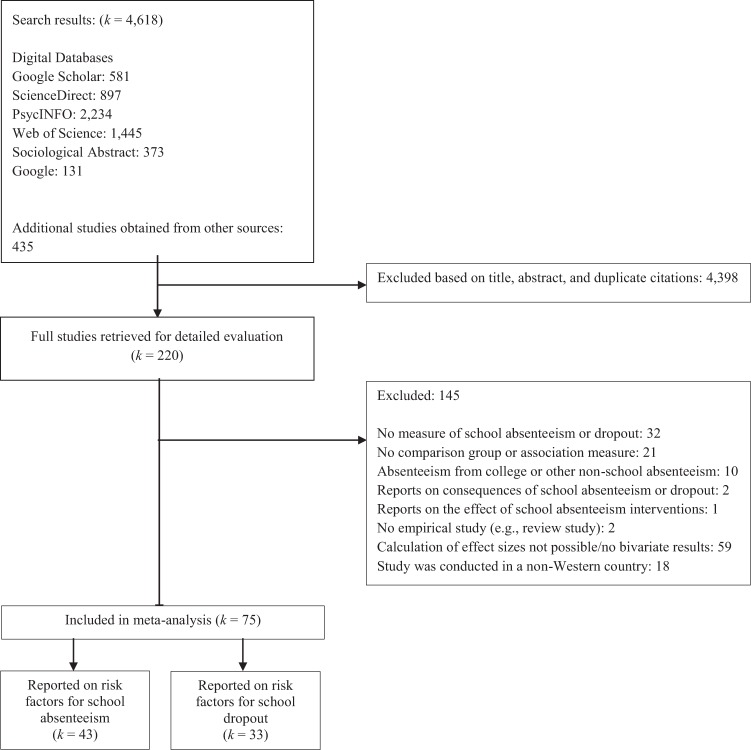
- Included 75 studies: 43 absenteeism studies (41 non-overlapping samples, N = 243,296; 781 effect sizes) and 33 dropout studies (31 non-overlapping samples, N = 136,392; 635 effect sizes). Risk factors were classified into 44 absenteeism and 42 dropout mutually exclusive risk domains.
- Three-level random-effects meta-analyses in R using metafor, with Fisher’s z transformed correlations; intercept-only models estimated mean domain effects, percentage of boys was tested as a moderator where heterogeneity was present and at least five studies were available, and bias was assessed with trim-and-fill, three-level funnel plot, and Egger’s regression tests.
Limitations
- Stated: the authors cannot assure the included studies are representative of all studies; primary studies may have been missed; restricting to published studies and dissertations risks publication bias; bias tests indicated bias in many domains, though trim-and-fill suggested underestimation; non-experimental designs preclude causal conclusions; retrospective studies mean some factors may not be true antecedents; mutually exclusive risk domains prevent examining combinations of risk factors; only percentage of boys was tested as a moderator, and only for domains based on at least five studies.
- Evident: the text reports 75 included studies in the results but refers to “a total of 69 studies and 1384 effect sizes” in the limitations; many risk domains are based on few studies or effect sizes and show high heterogeneity, limiting precision and moderator analyses.
Model-written summary. Check it against the paper before relying on it.
Integrity signals
Registry
Cites
Statistics
Figures
Verification
Claims the paper makes
3 Valid · 0 Not valid · 24 Not checked · 94 Own results and interpretations
A result the paper reports from its own data — it cites no other source for it, so there is none to check. The quote shows it is in the paper.
In the paper
“trim-and-fill analyses showed that an underestimation rather than an overestimation of risk domain effects was a problem (see Tables 4 and 5).”
§ Risk Factors for School Absenteeism and Dropout: A Meta-Analytic Review > Discussion > Limitations
plain- Asserted: passes — The authors put it forward as true.
- Checkable: passes — It can be checked against evidence.
- Load-bearing: passes — The paper’s conclusions depend on it.
- Based: passes — The paper gives a reason why it holds.
A result the paper reports from its own data — it cites no other source for it, so there is none to check. The quote shows it is in the paper.
In the paper
“Significant level-2 and/or level-3 variance was found in 32 risk domains.”
§ Risk Factors for School Absenteeism and Dropout: A Meta-Analytic Review > Results > The Moderating Effect of Gender
plain- Asserted: passes — The authors put it forward as true.
- Checkable: passes — It can be checked against evidence.
- Load-bearing: unclear — It is unclear whether the paper’s conclusions depend on it.
- Based: passes — The paper gives a reason why it holds.
A result the paper reports from its own data — it cites no other source for it, so there is none to check. The quote shows it is in the paper.
In the paper
“The three tests for bias assessment indicated that bias may have been present in multiple estimated effects of risk domains.”
§ Risk Factors for School Absenteeism and Dropout: A Meta-Analytic Review > Discussion > Limitations
hedged- Asserted: passes — The authors put it forward as true.
- Checkable: passes — It can be checked against evidence.
- Load-bearing: unclear — It is unclear whether the paper’s conclusions depend on it.
- Based: passes — The paper gives a reason why it holds.
A result the paper reports from its own data — it cites no other source for it, so there is none to check. The quote shows it is in the paper.
In the paper
“For school absenteeism, 12 risk domains were found with large effects, including having a negative attitude towards school, substance abuse, externalizing and internalizing problems of the juvenile, and a low parent-school involvement.”
§ Risk Factors for School Absenteeism and Dropout: A Meta-Analytic Review > Abstract
plainstates an association- Asserted: passes — The authors put it forward as true.
- Checkable: passes — It can be checked against evidence.
- Load-bearing: passes — The paper’s conclusions depend on it.
- Based: passes — The paper gives a reason why it holds.
A result the paper reports from its own data — it cites no other source for it, so there is none to check. The quote shows it is in the paper.
In the paper
“For school absenteeism, 12 risk domains were found with large effects, including having a negative attitude towards school, substance abuse, externalizing and internalizing problems of the juvenile, and a low parent-school involvement.”
§ Risk Factors for School Absenteeism and Dropout: A Meta-Analytic Review > Abstract
plainstates an association- Asserted: passes — The authors put it forward as true.
- Checkable: passes — It can be checked against evidence.
- Load-bearing: passes — The paper’s conclusions depend on it.
- Based: passes — The paper gives a reason why it holds.
70 more claims
Create a free account to see all 121 claims and to verify the 1 reference still open.
- It may state two separate claims as one. 25
- Probably not a substantial claim. 29
Claims other papers make about this one
Each is checked against this paper’s own text: does it say what the citing paper says it does?
The source backs part of the claim, not all of it — or backs it for a different population, condition or comparison.
In the citing paper
“Researchers commonly group risk or contextual (and, conversely, protective) factors for SA/A into various categories that include child-, parent-, family-, peer-, school-, and community-based variables (Kearney, 2008; Zaff et al., 2017; Gubbels et al., 2019).”
From Reconciling Contemporary Approaches to School Attendance and School Absenteeism: Toward Promotion and Nimble Response, Global Policy Review and Implementation, and Future Adaptability (Part 1) (2019) · cites this paper as Gubbels et al., 2019
Experimental — accuracy not yet measuredThe cited source says what the claim attributes to it.
In the citing paper
“While the link between mental health issues and school attendance during adolescence has been documented”
From “So That You Can Feel Well”: Perspectives of Students with Social, Emotional and Behavioral Difficulties on Factors that Support School Attendance (2025) · cites this paper as Gubbels et al., 2019
The cited source says what the claim attributes to it.
In the citing paper
“A large amount of quantitative research demonstrates the complex associations with student-level risk factors and SAPs, particularly internalizing and/or externalizing behaviors among other variables”
From “So That You Can Feel Well”: Perspectives of Students with Social, Emotional and Behavioral Difficulties on Factors that Support School Attendance (2025) · cites this paper as Gubbels et al., 2019
Self-check
Percentages, sums and reported differences re-computed from the paper’s own numbers.
Each contradiction between two passages listed here was confirmed by an independent check.
Rated major: it would touch a result — a value a result rests on, reported and recomputed p-values on opposite sides of the significance level, two passages that conflict with no sign which is right, or a cited work retracted before this paper was published.
In the paper
§ Risk Factors for School Absenteeism and Dropout: A Meta-Analytic Review > Results > Overall Effects of Risk Domains for Dropout
“| Large classes/schools | 1 | 1 | 0.145 (0.080) | (−0.011, 0.292) | 0.035* | 100.0 | – | – | – | – | 0.144c |”
§ Risk Factors for School Absenteeism and Dropout: A Meta-Analytic Review > Calculation of Effect Sizes and Statistical Analyses
“The log-likelihood-ratio-tests were performed one-tailed and all other tests were performed two-tailed. A p-value < 0.05 was considered as statistically significant.”
Rated minor: it would not touch a result — a value no result rests on, a p-value that stays on the same side of the significance level, or a conflict that is clerical, resolved elsewhere in the paper, or outside its own findings.
In the paper
“Table 4 presents the results of the three analyses that were conducted to assess bias in the estimated mean effect of each of the 43 risk domains for school absenteeism.”
§ Risk Factors for School Absenteeism and Dropout: A Meta-Analytic Review > Results > Assessment of Bias
Reported 43 · recomputed 44
Rated minor: it would not touch a result — a value no result rests on, a p-value that stays on the same side of the significance level, or a conflict that is clerical, resolved elsewhere in the paper, or outside its own findings.
In the paper
“| Battin-Pearson et al. 2002 | Dropout | 770 | 88 | 682 | 50.99 | 34 | 12 | 6 | 12 | 6 |”
§ Risk Factors for School Absenteeism and Dropout: A Meta-Analytic Review > Method > Search Strategy
Reported 34 · recomputed 36
Rated minor: it would not touch a result — a value no result rests on, a p-value that stays on the same side of the significance level, or a conflict that is clerical, resolved elsewhere in the paper, or outside its own findings.
In the paper
“| Hancock et al. 2018 | Absenteeism | 5231 | 544 | 4687 | 61.00 | 23 | 6 | 13 | 0 | 0 |”
§ Risk Factors for School Absenteeism and Dropout: A Meta-Analytic Review > Method > Search Strategy
Reported 23 · recomputed 19
Rated minor: it would not touch a result — a value no result rests on, a p-value that stays on the same side of the significance level, or a conflict that is clerical, resolved elsewhere in the paper, or outside its own findings.
In the paper
“| Ingul et al. 2012 | Absenteeism | 308–610 | 101–103 | 207–507 | 47.70 | 46 | 29 | 10 | 6 | 2 |”
§ Risk Factors for School Absenteeism and Dropout: A Meta-Analytic Review > Method > Search Strategy
Reported 46 · recomputed 47
7 more findings
Create a free account to see every finding of this check.
Citations
Cites
R: A Language and Environment for Statistical Computing
R Core Team (2025) · doi:10.32614/r.manuals · Cited by 352,181
Tabachnick, B. G., & Fidell, L. S. (1983) · Cited by 80,042
The Ecology of Human Development: Experiments by Nature and Design
Bronfenbrenner, U. (1979) · Harvard University Press eBooks · doi:10.4159/9780674028845 · Cited by 26,084
Conducting Meta-Analyses in R with the metafor Package
Viechtbauer, W. (2010) · Journal of Statistical Software · doi:10.18637/jss.v036.i03 · Cited by 20,464 · cited 2×
“In the statistical environment R (version 3.5.1; R Core Team 2015), the function “rma.mv” of the metafor-package (Viechtbauer 2010) was used to conduct the statistical analyses.”
MethodInfluentialDuval, S., & Tweedie, R. (2000) · Biometrics · doi:10.1111/j.0006-341x.2000.00455.x · Cited by 14,099 · cited 1×
“First, a funnel-plot-based trim and fill method was conducted (Duval and Tweedie 2000a, 2000b).”
MethodThe ecology of human development : experiments by nature and design
Bronfenbrenner, U. (1979) · Cited by 12,580
Toward an experimental ecology of human development.
Bronfenbrenner, U. (1977) · American Psychologist · doi:10.1037/0003-066x.32.7.513 · Cited by 10,853 · cited 1×
“This view on how school absenteeism and dropout evolve is in line with the ecological perspective on child development of Bronfenbrenner (1979, 1986).”
Result(2000) · Cited by 9,198
A Nonparametric “Trim and Fill” Method of Accounting for Publication Bias in Meta-Analysis
Duval, S., & Tweedie, R. (2000) · Journal of the American Statistical Association · doi:10.1080/01621459.2000.10473905 · Cited by 2,955
The Psychology of Criminal Conduct
Hart, S. D., Andrews, D. A., & Bonta, J. (1995) · Political Psychology · doi:10.2307/3792235 · Cited by 2,900
Research works printed but not linked: 4
- Andrews DA Dowden C A meta-analytic investigation into effective correctional intervention for female offenders Forum on Corrections Research 1999 11 18 21
- *Mullvain, P. (2017). Examining the relationship between bullying, attendance, and achievement in schools (Doctoral dissertation). http://scholarworks.waldenu.edu/cgi/viewcontent.cgi?article=3717&context=dissertations.
- National Center for Education Statistics. 2015 and 2017 Mathematics and Reading Assessments 2018 Washington, DC US Department of Education
- *Taylor, R. G. (2009). School facilities in the nation’s capital: an analysis of student achievement, attendance, and truancy (Doctoral dissertation). http://citeseerx.ist.psu.edu/viewdoc/download?doi=10.1.1.620.4220&rep=rep1&type=pdf.
Cited by
Items 501–585 of 585
Berghe, L. V. D., Pauw, S. S. W. D., & Vandevelde, S. (2025) · Frontiers in Psychology · doi:10.3389/fpsyg.2025.1620330
Jeder Schultag zählt – Schulabsentismus bei psychischen Erkrankungen
Reißner, V., Bowi, U., & Knollmann, M. (2025) · Pädiatrie up2date · doi:10.1055/a-2701-7925
dos Santos, N., Santos, P. S., Moro, J. D. S., Vitali, F. C., Santana, C. M., Bolan, M., & Cardoso, M. (2025) · Research Square · doi:10.21203/rs.3.rs-8254244/v1
The Impact of Home‐School Cooperation on Academic Burnout Among Chinese High School Students
Zhang, Y., & Liang, W. (2025) · Psychology in the Schools · doi:10.1002/pits.70135
“Persistent academic strain not only impairs attention and problem‐solving but also increases the risk of anxiety, depression, and disengagement from learning (Gubbels et al. 2019).”
Ansari, A., Woods, S. C., & Gottfried, M. A. (2026) · Educational Policy · doi:10.1177/08959048251401903
“Beyond academics, absenteeism has been linked to long-term social and economic disadvantages, including lower lifetime earnings, reduced employment opportunities, and an increased likelihood of involvement in the criminal justice system (Ansari et al., 2020; Grubbels et al., 2019).”
Dahlqvist, H. Z. (2026) · European Journal of Educational Research · doi:10.12973/eu-jer.15.2.497
Nyaga, S. M., Gacohi, J. N., & Kariuki, R. G. (2025) · African Multidisciplinary Journal of Research · doi:10.71064/spu.amjr.2.3.2025.459
“This can be helpful in addressing individual and school factors that often cause learning difficulties and distress among students, resulting in dropping out of school (Gubbels et al., 2019).”
Psychometric Properties of the Spanish Adaptation of the School Failure Coping Scale
Elizalde, P. D. Z., Álvarez-Montero, F. J., & Reyes-Sosa, H. (2026) · Psychology in the Schools · doi:10.1002/pits.70140 · Cited by 1
“During this time, students must manage heavier workloads, complex peer relationships, and high‐stakes evaluations, all of which heighten the likelihood of academic setbacks and perceived failure (Gubbels et al. 2019; Steare et al. 2023).”
Requiem for Many Dreams? Comorbid Substance Use and Disruptive Behaviour Disorders in Adolescents
Ameen, S. (2026) · Indian Journal of Psychological Medicine · doi:10.1177/02537176251414011
Kiss, L., Leal, M., Portella, A. P., et al. (2026) · medRxiv · doi:10.64898/2026.01.21.26344579
Abandonos educativos en las transiciones post obligatorias
Gràcia, M. G., Pareja, R. M., & Guerrero, L. S. (2026) · Revista de Investigación Educativa · doi:10.6018/rie.637771
Partio, J., Virtanen, T. E., Aunola, K., & Vasalampi, K. (2026) · Scandinavian Journal of Educational Research · doi:10.1080/00313831.2026.2623290 · Cited by 2
Cultural Heritage Education as a Tool for Preventing and Combating Early School Leaving
Nuzzaci, A. (2026) · Heritage · doi:10.3390/heritage9030086 · Cited by 3
“…is a multifactorial and multidimensional phenomenon, determined by the interaction of individual, family, school, and socioeconomic variables [30,31], with a greater impact on the most vulnerable students, often struggling with personal difficulties, economic disadvantages, or unstimulating…”
Wathne, K. O. (2026) · Children and Youth Services Review · doi:10.1016/j.childyouth.2026.108854
Dinesen, T. A. (2026) · European Journal of Psychology of Education · doi:10.1007/s10212-026-01082-5 · Cited by 2
Fabes, R. A., Shen, Z., McDonald, A. R., & Catherine, E. (2026) · Frontiers in Developmental Psychology · doi:10.3389/fdpys.2026.1773644
Psychosomatic complaints and school failure: A prospective Swedish national cohort studyPreprint
Wahlström, J., Östberg, V., & Låftman, S. B. (2026) · Research Square · doi:10.21203/rs.3.rs-7999037/v1
Pelkonen, J., Virtanen, T. E., & Kiuru, N. H. (2026) · Scandinavian Journal of Educational Research · doi:10.1080/00313831.2026.2642602 · Cited by 2
The White Working Class. How Engaged are Their Children During Secondary School?
Jerrim, J. (2026) · British Journal of Educational Studies · doi:10.1080/00071005.2026.2641026 · Cited by 2
“Research has suggested that stronger relationships with others plays an important role in supporting pupil attendance and potentially their achievement (Gubbels et al ., 2019).”
Drug Use Among Teens: A Test of Agnew’s Integrated Theory of Crime and Delinquency
Zavala, E., & Vito, A. G. (2026) · Deviant Behavior · doi:10.1080/01639625.2026.2644437 · Cited by 1
Social Determinants of Health and Substance Use Disorders
Etudor-Eyo, E., & Morelli, V. (2026) · Springer eBooks · doi:10.1007/978-3-031-57159-6_35-1
Is There a Mediating Factor Between Specific Learning Disabilities and School Dropouts?
Caraballo-Cueto, J. G. (2026) · Journal of Disability Policy Studies · doi:10.1177/10442073261433241
Developmental differences in psychiatric diagnoses among youth with school refusal behavior
Hung, S., Hung, M.-L., & Kuo, F.-J. (2026) · Asian Journal of Psychiatry · doi:10.1016/j.ajp.2026.104966
Xuan, R. P., & Krein, U. (2026) · Springer international handbooks of education · doi:10.1007/978-3-031-56275-4_203-1
Yarkin, A. K., & DeCoito, I. (2026) · School Science and Mathematics · doi:10.1111/ssm.70023 · Cited by 1
Advancing socially just and anti-racist approaches for school attendance problems
Kearney, C. A., Ellis, K., & Arcaina, V. J. (2026) · Social Sciences & Humanities Open · doi:10.1016/j.ssaho.2026.102779
Asceric, S., Knollmann, M., & Reißner, V. (2026) · Praxis der Kinderpsychologie und Kinderpsychiatrie · doi:10.13109/prkk.2026.75.3.184
Bukhari, O. M. (2026) · Journal of Umm Al-Qura University for Medical Sciences · doi:10.1007/s44361-026-00032-6
“Multiple factors shape patterns of dental attendance, such as sociodemographic characteristics, health behaviors, perceived need for care, and family-level influences [9–15].”
Hiltunen, V., Kiuru, N. H., Tolvanen, A. J., Koskenvuo, K., Lerkkanen, M., & Vasalampi, K. (2026) · Learning and Individual Differences · doi:10.1016/j.lindif.2026.102923 · Cited by 1
Will attendance-based grading improve school absenteeism?
Whitley, J., Rogers, M., McBrearty, N., & Smith, D. (2026) · The Conversation · doi:10.64628/aam.skdwchrp6
Graham, P., Carrick, A., Littlefair, D., Melo, D., Mulholland, K., Graham, P., Bradley, G., Davies, C., Speyer, R., & Cordier, R. (2026) · Educational Research Review · doi:10.1016/j.edurev.2026.100791
Gazmuri, C., & Siddiqui, N. (2026) · International Journal of Educational Development · doi:10.1016/j.ijedudev.2026.103585 · Cited by 3
Enhancing adaptation and learning in educational environments (SENSE project): a case series study
Maggio, R., Pino, C., Catalfamo, L., Gregorio, M. A., Martina, A., Rao, G., Cara, M. D., Quattrocchi, G. L. J. E., & Cucinotta, F. (2026) · Frontiers in Psychiatry · doi:10.3389/fpsyt.2026.1810785
Pan, X., & Gu, B. (2026) · Acta Psychologica · doi:10.1016/j.actpsy.2026.106896
Bahar, O. S., Byansi, W., IBRAHIM, D. A., Boateng, A., Kumbelim, K., Amissah, F. G., Childress, S., Ssewamala, F. M., & Mckay, M. M. (2026) · Families in Society The Journal of Contemporary Social Services · doi:10.1177/10443894261434644
Yang, Q., Hu, E. H., Oh, Y., Park, J., & Morgan, P. L. (2026) · Journal of Applied Developmental Psychology · doi:10.1016/j.appdev.2026.101960
Conceptualising school dropout in developed and developing contexts: a systematic review
Sumap, S. N. A., Alias, B. S., & Amat, S. (2026) · Educational Review · doi:10.21203/rs.3.rs-9681939/v1
School Attendance Problem Surveys in Japan Through the Lens of Publisher Type: A Scoping ReviewPreprint
Hitsuwari, J., Nakao, H., Hayashi, T., Fukutome, T., KUBOTA, N., Hashimoto, K., & Noguchi, H. (2026) · Research Square · doi:10.21203/rs.3.rs-9800171/v1
Almost 20% of Australian students don’t finish school – these 3 things can help them stay
Collie, R. J., & Martin, A. (2026) · The Conversation · doi:10.64628/aa.pt7fr9kgf
Lim, J., Ostry, A. M., Elshabrawy, Y., Brogno, S., ANICET, N. N., Hermann, A. K. P. E., Tanoh, F., Brice, H., Ogan, A., & Jasińska, K. K. (2026) · Research in Comparative and International Education · doi:10.1177/17454999261453153
“Children who are older for their grade are more likely to do poorly in school, dropout, and participate in child labor (Gubbels et al., 2019; Kuepie et al., 2015; Oruko et al., 2015; Rosati and Rossi, 2003; Whitehead et al., 2024; Wortsman et al., 2024b).”
AI-Driven Psychoeducational Analytics for Early Detection of Academic Risk in Colombian Schools
Torres, R. Y. Z., Salcedo, D., Ramirez-Velarde, R. V., & López-Pérez, P. J. (2026) · IEEE World Engineering Education Conference (EDUNINE) · doi:10.1109/edunine62390.2026.11547119
“A recent meta-analysis [6]identified a broad range of risk factors grouped into individual, family, and school domains.”
Counsellors’ Perspectives on Psychosocial Risk Factors Contributing to Adolescent Delinquency
Ibharim, N. S., Kari, D. N. P. M., Harun, M. M., & Pei, A. K. Y. (2025) · Pertanika Journal of Counsellor Educator and Counselling Psychology · doi:10.47836/pjocecp.1.1.05
Torres, R. Y. Z., López-Pérez, P. J., & Salcedo, D. (2026) · Communications in computer and information science · doi:10.1007/978-3-032-22211-4_14
Pelkonen, J., Virtanen, T. E., & Kiuru, N. H. (2026) · European Journal of Psychology of Education · doi:10.1007/s10212-026-01144-8
“SA tend to increase with age (Gubbels et al., 2019), and previous SA predict later SA (Ansari & Pianta, 2019; Balkıs et al., 2016).”
Huang, G., & Hai, L. (2026) · Behavioral Sciences · doi:10.3390/bs16061023 · Cited by 2
“This expectation follows from empirical evidence that multi-tiered collaborative interventions can effectively interrupt the accumulation of risk across school, family, and motivational domains, thereby enhancing school retention (Gubbels et al., 2019; Tanner-Smith & Wilson, 2013).”
Gonzálvez, C., Pérez‐Marco, M., Fuster‐Rico, A., Sanmartín, R., Sunay, C., Caparello, C., Çimen, F., Filippello, P., Meduri, C. F., Seçer, İ., et al. (2026) · Continuity in Education · doi:10.5334/cie.238
Xu, H., Wang, Y., Wang, Y., Li, J. J., Xu, J., & Tan, S. (2026) · Asian Journal of Psychiatry · doi:10.1016/j.ajp.2026.105056
Allende, C., López, V., & Vandecandelaere, M. (2026) · International Journal of Educational Development · doi:10.1016/j.ijedudev.2026.103621 · Cited by 1
A Machine Learning Approach to Classifying School Absenteeism Patterns in Youth with ADHD
Goh, P. K., Rogers, M., Wong, A. W. W. A., Mellor, G. S., Whitley, J., Smith, D., McBrearty, N., Tatartcheff-Quesnel, N., & DuPaul, G. J. (2026) · School Mental Health · doi:10.1007/s12310-026-09893-z
“For instance, absenteeism risk tends to increase with age, and the rele - vance of specific risk factors may differ between boys and girls (Gubbels et al., 2019 ).”
InfluentialSocially problematic juveniles find social norms as more obligating than moral norms
Białek, M., Urbanek, A., Kamiński, A., Zagrobelny, J., & Ackermann-Szulgit, D. (2026) · Judgment and Decision Making · doi:10.1017/jdm.2026.10039
Yalçın, S., Kazak, E., & Er, O. (2026) · Boğaziçi Üniversitesi Eğitim Dergisi · doi:10.52597/buje.1883210
Patterns of University Withdrawal: Do Former Students’ Accounts Raise Social Justice Concerns?
Alonso, J. J. S., Aguilar, D. L., Pérez, P. R. Á., & González‐Morales, O. (2026) · Research in Higher Education · doi:10.1007/s11162-026-09917-2 · Cited by 1
“A substantial proportion of studies rely on students’ intentions to drop out as a proxy for actual withdrawal, whereas fewer investigations focus directly on students who have effectively discontinued their studies (Gubbels et al., 2019; Habicht et al., 2026).”
Matsumoto, R., Ito, Y., Oka, T., Motomura, E., & Okada, M. (2026) · Psychiatry International · doi:10.3390/psychiatryint7040143 · Cited by 1
Razeto, A. (2026) · Perfiles Educativos · doi:10.22201/iisue.24486167e.2026.48.61975
“En las trayectorias de muchos estudiantes se van configurando diversos factores de riesgo que hacen posible la ocurrencia de procesos de ruptura, tales como una actitud negativa hacia la escuela, el abuso de sustancias y un bajo nivel de participación de los padres (Gubbels et al ., 2019).”
What school communities say—and what it predicts: A discourse-based model of dropout risk
Sava, A., Apostu, A., Iliescu, D., CRISTESCU, B., & Zanfirescu, A. Ș. (2026) · International Journal of Educational Development · doi:10.1016/j.ijedudev.2026.103633
Amani, J., Mkumbo, K. A. K., & Pesambili, J. C. (2026) · Social Sciences & Humanities Open · doi:10.1016/j.ssaho.2026.103185
Redl, S., & Weber, C. (2026) · International Journal of Educational Research Open · doi:10.1016/j.ijedro.2026.100576 · Cited by 1
Familiäre Dynamiken und Herausforderungen bei Schulabsentismus: Perspektiven aus der Sozialen Arbeit
Rau, M. (2026) · Absentismus und Dropout · doi:10.1007/978-3-658-51711-3_9
Epstein, S., Ching, B. C. F., Wickersham, A., Dutta, R., Morgan, C., Ford, T. J., Hayes, R. D., & Downs, J. M. (2026) · Child and Adolescent Mental Health · doi:10.1111/camh.70113 · Cited by 4
Pérez‐Marco, M., Gonzálvez, C., Fuster‐Rico, A., Amat, Á., Lorenzo-Rumbo, A., & Arráez-Vera, G. (2026) · Behavioral Sciences · doi:10.3390/bs16071225
“Theoretical models suggest that adolescents with low belongingness experience heightened anxiety, interpersonal discomfort and withdrawal, core risk factors for school refusal (Gubbels et al., 2019; Hamilton, 2024; Leduc et al., 2024).”
Stefanovici, A., Herron, A., & Herbers, J. E. (2026) · Journal of Applied Developmental Psychology · doi:10.1016/j.appdev.2026.101990
Olsen, M., Bore, P., Werner, M., & Claesdotter‐Knutsson, E. (2026) · Canadian Journal of School Psychology · doi:10.1177/08295735261473704
Kiss, L., Leal, M., Portella, A. P., Paiva, H., Iuliano, A., Pires, M., Shipman, H., Anderson, E., Lo, Y., Kerr, L., et al. (2026) · PLoS ONE · doi:10.1371/journal.pone.0342274
Boutin, S., Larrivée, É., & Déry, M. (2026) · Aggressive Behavior · doi:10.1002/ab.70079
“Associations involving control variables were generally consistent with previous literature (e.g., Barbot and Hunter 2012; Chen and Jacobson 2012; Goldbeck et al. 2007; Gubbels et al. 2019; Martin 2019; McFarland et al. 2019; Salk et al. 2017).”
Ay, B., Ay, A., & Balatacı, U. (2026) · The Bulletin of Legal Medicine · doi:10.17986/blm.1760
de Souza, R. S., Cabral, P. M., Caravieri, C. K., Neder, M. C. S., SANTOS, A. P., Montiel‐Nava, C., & Teixeira, M. C. T. V. (2026) · Estudos de Psicologia (Campinas) · doi:10.1590/1982-0275202643e12643
Sumac, N. M., & Gallardo, E. N. (2026) · Journal of Social Knowledge Education (JSKE) · doi:10.37251/jske.v7i3.2218
School‐Based Interventions That Address Students' Unmet Material Needs: A Scoping Review*
Sokol, R. L., Toro, V., Sewall, G., Swirsky, A., Esposti, M. D., Victor, B. G., Kernsmith, P. D., Heinze, J. E., & Smith, J. (2026) · Journal of School Health · doi:10.1111/josh.70207 · Cited by 1
“At the student level, unmet material needs can create barriers to regular school attendance [ 5, 6], limit learning and academic performance [ 4], become risk factors for social and behavioral problems [ 7, 8], and ultimately contribute to school dropout [ 19].”
Becoming a school refuser: A sociological study of long-term school absence in Sweden
Laurin, E. (2026) · Sociology · doi:10.1177/00380385261455236
Bahar, O. S., Addo-Lartey, A. A., IBRAHIM, D. A., Ssewamala, F. M., Neilands, T. B., Tozan, Y., Boateng, A., Byansi, W., Dahlen, A., & Mckay, M. M. (2026) · BMC Public Health · doi:10.1186/s12889-026-28823-x
“It has been documented that unexcused absences put children at a higher academic risk compared to excused absences (i.e., absences related to medical illness or injury) [72, 73].”
Giménez, G., Cefai, C., Chen, C., & Barrado, B. (2026) · Journal of Interpersonal Violence · doi:10.1177/08862605261473572
Fernández‐Sogorb, A., Pérez‐Marco, M., Gonzálvez, C., & Kearney, C. A. (2026) · Child & Youth Care Forum · doi:10.1007/s10566-026-09972-x
Strauss, J., Coley, R. L., & Teixeira, S. N. (2026) · Children & Schools · doi:10.1093/cs/cdag015
Ketidaksesuaian Distribusi Poisson dalam Pemodelan Jumlah Kehadiran Siswa Sekolah Menengah Kejuruan
Pranata, A., Pranata, M., Sibuea, M., Sumiran, S., Joni, J., & Wijaya, R. F. (2026) · Indonesian Journal of Education And Computer Science · doi:10.60076/indotech.v4i2.2083
Xue, B., & Luo, H. (2026) · Frontiers in Psychology · doi:10.3389/fpsyg.2026.1915779
“Inattention, avoidance, procrastination, reduced participation, or school refusal may have multiple causes, including mental health difficulties, family circumstances, prior learning experiences, and educational conditions (Gubbels et al., 2019).”
Turner, J., Kyobutungi, V., Ayozu, H., D’Sa, N., & Jordans, M. J. D. (2026) · PLoS ONE · doi:10.1371/journal.pone.0357215
“At the household level, poverty is one of the strongest drivers of school absenteeism and dropout [9,11,16].”
Gossner, M., Dittman, C. K., Lole, L., & Miller-Lewis, L. R. (2026) · International Journal of Adolescence and Youth · doi:10.1080/02673843.2026.2731698
Secondary School Absenteeism in the Gulf Countries: Narrative Review
Abdelrahim, A. (2026) · ORBIS SCHOLAE · doi:10.14712/23363177.2026.3
The mediating role of school absenteeism in the socioeconomic achievement gap
Dräger, J., Klein, M., & Sosu, E. (2026) · Research in Social Stratification and Mobility · doi:10.1016/j.rssm.2026.101202 · Cited by 1
Meduri, C. F., Caparello, C., Imbesi, M., Gonzálvez, C., & Sorrenti, L. (2026) · Behavioral Sciences · doi:10.3390/bs16091664
“Numerous studies have highlighted the negative short-and long-term impact of absenteeism problems (Bianchi et al., 2022; Gubbels et al., 2019).”
Xuan, R. P., & Krein, U. (2026) · Springer international handbooks of education · doi:10.1007/978-3-032-21359-4_203
Masuku, A. S., Adam, J. K., & Nkosi, P. B. (2025) · African Journal of Inter/Multidisciplinary Studies · doi:10.51415/ajims.v7i2.2882
Volunteering, Crime and Secondary School Attendance: Evidence From Queensland
Kubler, M., Corbett, B. J., Carroll, A., Mills, M., Lynch, D., & Tomaszewski, W. (2026) · Australian Journal of Social Issues · doi:10.1002/ajs4.70141
Razeto, A. (2026) · Revista Brasileira de Educação · doi:10.1590/s1413-24782026310112
School-Level Pathways to Truancy in Dili Through Secondary Qualitative Analysis
Tomé, A. O., Ximenes, M. D. S., & Costa, A. D. (2026) · Tadris Jurnal Keguruan dan Ilmu Tarbiyah · doi:10.24042/tadris.v11i3.31062
Metadata
- Authors
- Gubbels, J., van der Put, C. E., & Assink, M.
- Affiliations
- University of Amsterdam (NL)
- Corresponding author
- Gubbels, Jeanne
- Venue
- Journal of Youth and Adolescence
- Published
- 2019-07-15
- Volume
- 48
- Issue
- 9
- Pages
- 1637-1667
- ISSN
- 0047-2891 (ISSN-L)
- 1573-6601
- PMC
- PMC6732159
- OpenAlex
- W2960437645
- Cited by
- 596
- References
- 123
- Citations by year
- 2026: 98 · 2025: 110 · 2024: 113 · 2023: 92 · 2022: 99 · 2021: 49 · 2020: 29 · 2019: 6
- FWCI
- 13.05
- Type
- journal article
- Language
- en
- Open access
- hybrid
- doi.org
- Licence
- cc-by
- creativecommons.org/licenses/by/4.0 (tdm)
- creativecommons.org/licenses/by/4.0 (vor)
- Locations
- Journal of Youth and Adolescence (publishedVersion, cc-by)
- Europe PMC (PubMed Central) (publishedVersion, cc-by)
- PubMed Central (publishedVersion, cc-by)
- PubMed (publishedVersion)
- UvA-DARE (University of Amsterdam) (publishedVersion, cc-by)
- Data Archiving and Networked Services (DANS) (submittedVersion, other-oa)
- Topics
- Social Sciences › Education › Youth Substance Use and School Attendance
- Social Sciences › Education › Educational Outcomes and Influences
- Social Sciences › Sociology and Political Science › Youth Education and Societal Dynamics
- Keywords
- school absenteeism, school dropout, risk factors, adolescent development, substance abuse, externalizing problems, internalizing problems, school retention, low IQ, learning difficulties, academic performance, attitudes toward school, prevention and intervention
- MeSH terms
- Absenteeism, Adolescent, Adolescent Behavior, Female, Humans, Male, Risk Factors, Student Dropouts, Students, Substance-Related Disorders
About these checks
Registry, retraction, Cites and statistics results are computed, not judged, with one exception: a printed reference that no index lists is read once by a model before it counts as a citation error. Claims are extracted by a model and kept only when their quote appears verbatim in the text; each cited source is then checked, with a model’s help, for whether it says what the claim relies on. Those verdicts can be wrong — read the claim’s quote and the cited source before relying on one.
The claim verdicts this report counts are experimental: their accuracy is not yet measured.
A language model drew the claims from the paper on 2026-10-10, under version 3 of the claim definition (model deepseek-v4.1-flash, prompt extract-v3).
A second model labelled each claim on 2026-10-10 (model jev-1.13-20260917, definition revision gold-guideline-v0.2).
Statistics and arithmetic are recomputed, not judged.
Confidence bands are shown only for fields calibrated on our annotated test set. None is calibrated yet, so no band is shown.
What counts as a claim ›How we measure confidence ›How we check this ›
Are you an author, or do you see a problem with this page? Request a review
Data sources
Bibliographic data: Semantic Scholar, OpenAlex, Crossref.
Contains information from the Semantic Scholar Academic Graph Datasets, made available under the ODC Attribution License (ODC-BY 1.0).
Semantic Scholar’s data is described in: Kinney, R., et al. (2023). The Semantic Scholar Open Data Platform. arXiv:2301.10140.
