

Risk Factors for School Absenteeism and Dropout: A Meta-Analytic Review
Open accessThe DOI matches its Crossref record; 119 of the 123 references it cites were found in a registry or an index; 3 of the 46 sources its claims cite were checked for support.
Abstract
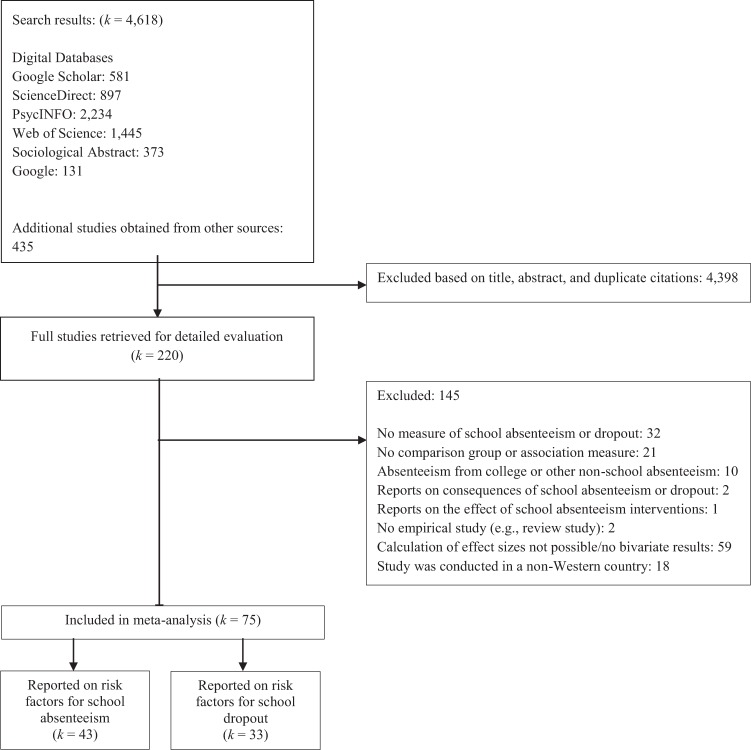
School absenteeism and dropout are associated with many different life-course problems. To reduce the risk for these problems it is important to gain insight into risk factors for both school absenteeism and permanent school dropout. Until now, no quantitative overview of these risk factors and their effects was available. Therefore, this study was aimed at synthesizing the available evidence on risk factors for school absenteeism and dropout. In total, 75 studies were included that reported on 781 potential risk factors for school absenteeism and 635 potential risk factors for dropout. The risk factors were classified into 44 risk domains for school absenteeism and 42 risk domains for dropout. The results of a series of three-level meta-analyses yielded a significant mean effect for 28 school absenteeism risk domains and 23 dropout risk domains. For school absenteeism, 12 risk domains were found with large effects, including having a negative attitude towards school, substance abuse, externalizing and internalizing problems of the juvenile, and a low parent-school involvement. For dropout, the risk domains having a history of grade retention, having a low IQ or experiencing learning difficulties, and a low academic achievement showed large effects. The findings of the current study contribute to the fundamental knowledge of the etiology of school absenteeism and dropout which in turn contributes to a better understanding of the problematic development of adolescents. Further, more insight into the strength of effects of risk factors on school absenteeism and dropout is important for the development and improvement of both assessment, prevention and intervention strategies.
Overview
CoChat Summary
TL;DR
This meta-analytic review synthesized 75 studies and found that many child, family, school, and peer risk domains are significantly associated with school absenteeism and dropout. For absenteeism, negative school attitude and substance abuse showed large effects; for dropout, grade retention, low IQ/learning difficulties, and low academic achievement showed large effects.
Key findings
- Across 75 studies, 28 of 44 absenteeism risk domains and 23 of 42 dropout risk domains had significant positive mean effects. For absenteeism, large effects included negative school attitude (r = 0.553), anti-social behavior/cognitions (r = 0.428), smoking (r = 0.336), drug abuse (r = 0.327), alcohol abuse (r = 0.311), poor pupil-teacher relationship (r = 0.286), and low parental school involvement (r = 0.272).
- For dropout, large effects were found for history of grade retention (r = 0.348), low IQ/learning difficulties (r = 0.326), and low academic achievement (r = 0.316). Medium effects included psychiatric symptoms/disorders (r = 0.269), drug abuse (r = 0.247), anti-social behavior/cognitions (r = 0.236), involvement with truant/deviant peers (r = 0.228), and low family SES (r = 0.222).
- Gender moderation was found only for drug abuse in absenteeism and negative school attitude in dropout; both effects were stronger as the percentage of boys in samples decreased, meaning they were stronger in girls. Most risk domains were not moderated by gender.
- Bias assessment found no indication of bias in 13 absenteeism and 14 dropout domain effects, some indication in 22 and 20, and moderate to strong indication in 9 and 8, respectively. Trim-and-fill analyses suggested underestimation rather than overestimation in several domains.
Methods
- Systematic searches until May 2019 in multiple databases and reference lists; inclusion required Western-country samples, Dutch or English language, peer-reviewed journals or dissertations, primary/secondary school samples, risk factors preceding absenteeism/dropout, and bivariate association data.
- Included 75 studies: 43 absenteeism studies (41 non-overlapping samples, N = 243,296; 781 effect sizes) and 33 dropout studies (31 non-overlapping samples, N = 136,392; 635 effect sizes). Risk factors were classified into 44 absenteeism and 42 dropout mutually exclusive risk domains.
- Three-level random-effects meta-analyses in R using metafor, with Fisher’s z transformed correlations; intercept-only models estimated mean domain effects, percentage of boys was tested as a moderator where heterogeneity was present and at least five studies were available, and bias was assessed with trim-and-fill, three-level funnel plot, and Egger’s regression tests.
Limitations
- Stated: the authors cannot assure the included studies are representative of all studies; primary studies may have been missed; restricting to published studies and dissertations risks publication bias; bias tests indicated bias in many domains, though trim-and-fill suggested underestimation; non-experimental designs preclude causal conclusions; retrospective studies mean some factors may not be true antecedents; mutually exclusive risk domains prevent examining combinations of risk factors; only percentage of boys was tested as a moderator, and only for domains based on at least five studies.
- Evident: the text reports 75 included studies in the results but refers to “a total of 69 studies and 1384 effect sizes” in the limitations; many risk domains are based on few studies or effect sizes and show high heterogeneity, limiting precision and moderator analyses.
Model-written summary. Check it against the paper before relying on it.
Integrity signals
Registry
Cites
Statistics
Figures
Verification
Claims the paper makes
3 Valid · 0 Not valid · 24 Not checked · 94 Own results and interpretations
A result the paper reports from its own data — it cites no other source for it, so there is none to check. The quote shows it is in the paper.
In the paper
“trim-and-fill analyses showed that an underestimation rather than an overestimation of risk domain effects was a problem (see Tables 4 and 5).”
§ Risk Factors for School Absenteeism and Dropout: A Meta-Analytic Review > Discussion > Limitations
plain- Asserted: passes — The authors put it forward as true.
- Checkable: passes — It can be checked against evidence.
- Load-bearing: passes — The paper’s conclusions depend on it.
- Based: passes — The paper gives a reason why it holds.
A result the paper reports from its own data — it cites no other source for it, so there is none to check. The quote shows it is in the paper.
In the paper
“Significant level-2 and/or level-3 variance was found in 32 risk domains.”
§ Risk Factors for School Absenteeism and Dropout: A Meta-Analytic Review > Results > The Moderating Effect of Gender
plain- Asserted: passes — The authors put it forward as true.
- Checkable: passes — It can be checked against evidence.
- Load-bearing: unclear — It is unclear whether the paper’s conclusions depend on it.
- Based: passes — The paper gives a reason why it holds.
A result the paper reports from its own data — it cites no other source for it, so there is none to check. The quote shows it is in the paper.
In the paper
“The three tests for bias assessment indicated that bias may have been present in multiple estimated effects of risk domains.”
§ Risk Factors for School Absenteeism and Dropout: A Meta-Analytic Review > Discussion > Limitations
hedged- Asserted: passes — The authors put it forward as true.
- Checkable: passes — It can be checked against evidence.
- Load-bearing: unclear — It is unclear whether the paper’s conclusions depend on it.
- Based: passes — The paper gives a reason why it holds.
A result the paper reports from its own data — it cites no other source for it, so there is none to check. The quote shows it is in the paper.
In the paper
“For school absenteeism, 12 risk domains were found with large effects, including having a negative attitude towards school, substance abuse, externalizing and internalizing problems of the juvenile, and a low parent-school involvement.”
§ Risk Factors for School Absenteeism and Dropout: A Meta-Analytic Review > Abstract
plainstates an association- Asserted: passes — The authors put it forward as true.
- Checkable: passes — It can be checked against evidence.
- Load-bearing: passes — The paper’s conclusions depend on it.
- Based: passes — The paper gives a reason why it holds.
A result the paper reports from its own data — it cites no other source for it, so there is none to check. The quote shows it is in the paper.
In the paper
“For school absenteeism, 12 risk domains were found with large effects, including having a negative attitude towards school, substance abuse, externalizing and internalizing problems of the juvenile, and a low parent-school involvement.”
§ Risk Factors for School Absenteeism and Dropout: A Meta-Analytic Review > Abstract
plainstates an association- Asserted: passes — The authors put it forward as true.
- Checkable: passes — It can be checked against evidence.
- Load-bearing: passes — The paper’s conclusions depend on it.
- Based: passes — The paper gives a reason why it holds.
70 more claims
Create a free account to see all 121 claims and to verify the 1 reference still open.
- It may state two separate claims as one. 25
- Probably not a substantial claim. 29
Claims other papers make about this one
Each is checked against this paper’s own text: does it say what the citing paper says it does?
The source backs part of the claim, not all of it — or backs it for a different population, condition or comparison.
In the citing paper
“Researchers commonly group risk or contextual (and, conversely, protective) factors for SA/A into various categories that include child-, parent-, family-, peer-, school-, and community-based variables (Kearney, 2008; Zaff et al., 2017; Gubbels et al., 2019).”
From Reconciling Contemporary Approaches to School Attendance and School Absenteeism: Toward Promotion and Nimble Response, Global Policy Review and Implementation, and Future Adaptability (Part 1) (2019) · cites this paper as Gubbels et al., 2019
Experimental — accuracy not yet measuredThe cited source says what the claim attributes to it.
In the citing paper
“While the link between mental health issues and school attendance during adolescence has been documented”
From “So That You Can Feel Well”: Perspectives of Students with Social, Emotional and Behavioral Difficulties on Factors that Support School Attendance (2025) · cites this paper as Gubbels et al., 2019
The cited source says what the claim attributes to it.
In the citing paper
“A large amount of quantitative research demonstrates the complex associations with student-level risk factors and SAPs, particularly internalizing and/or externalizing behaviors among other variables”
From “So That You Can Feel Well”: Perspectives of Students with Social, Emotional and Behavioral Difficulties on Factors that Support School Attendance (2025) · cites this paper as Gubbels et al., 2019
Self-check
Percentages, sums and reported differences re-computed from the paper’s own numbers.
Each contradiction between two passages listed here was confirmed by an independent check.
Rated major: it would touch a result — a value a result rests on, reported and recomputed p-values on opposite sides of the significance level, two passages that conflict with no sign which is right, or a cited work retracted before this paper was published.
In the paper
§ Risk Factors for School Absenteeism and Dropout: A Meta-Analytic Review > Results > Overall Effects of Risk Domains for Dropout
“| Large classes/schools | 1 | 1 | 0.145 (0.080) | (−0.011, 0.292) | 0.035* | 100.0 | – | – | – | – | 0.144c |”
§ Risk Factors for School Absenteeism and Dropout: A Meta-Analytic Review > Calculation of Effect Sizes and Statistical Analyses
“The log-likelihood-ratio-tests were performed one-tailed and all other tests were performed two-tailed. A p-value < 0.05 was considered as statistically significant.”
Rated minor: it would not touch a result — a value no result rests on, a p-value that stays on the same side of the significance level, or a conflict that is clerical, resolved elsewhere in the paper, or outside its own findings.
In the paper
“Table 4 presents the results of the three analyses that were conducted to assess bias in the estimated mean effect of each of the 43 risk domains for school absenteeism.”
§ Risk Factors for School Absenteeism and Dropout: A Meta-Analytic Review > Results > Assessment of Bias
Reported 43 · recomputed 44
Rated minor: it would not touch a result — a value no result rests on, a p-value that stays on the same side of the significance level, or a conflict that is clerical, resolved elsewhere in the paper, or outside its own findings.
In the paper
“| Battin-Pearson et al. 2002 | Dropout | 770 | 88 | 682 | 50.99 | 34 | 12 | 6 | 12 | 6 |”
§ Risk Factors for School Absenteeism and Dropout: A Meta-Analytic Review > Method > Search Strategy
Reported 34 · recomputed 36
Rated minor: it would not touch a result — a value no result rests on, a p-value that stays on the same side of the significance level, or a conflict that is clerical, resolved elsewhere in the paper, or outside its own findings.
In the paper
“| Hancock et al. 2018 | Absenteeism | 5231 | 544 | 4687 | 61.00 | 23 | 6 | 13 | 0 | 0 |”
§ Risk Factors for School Absenteeism and Dropout: A Meta-Analytic Review > Method > Search Strategy
Reported 23 · recomputed 19
Rated minor: it would not touch a result — a value no result rests on, a p-value that stays on the same side of the significance level, or a conflict that is clerical, resolved elsewhere in the paper, or outside its own findings.
In the paper
“| Ingul et al. 2012 | Absenteeism | 308–610 | 101–103 | 207–507 | 47.70 | 46 | 29 | 10 | 6 | 2 |”
§ Risk Factors for School Absenteeism and Dropout: A Meta-Analytic Review > Method > Search Strategy
Reported 46 · recomputed 47
7 more findings
Create a free account to see every finding of this check.
Citations
Cites
R: A Language and Environment for Statistical Computing
R Core Team (2025) · doi:10.32614/r.manuals · Cited by 352,181
Tabachnick, B. G., & Fidell, L. S. (1983) · Cited by 80,042
The Ecology of Human Development: Experiments by Nature and Design
Bronfenbrenner, U. (1979) · Harvard University Press eBooks · doi:10.4159/9780674028845 · Cited by 26,084
Conducting Meta-Analyses in R with the metafor Package
Viechtbauer, W. (2010) · Journal of Statistical Software · doi:10.18637/jss.v036.i03 · Cited by 20,464 · cited 2×
“In the statistical environment R (version 3.5.1; R Core Team 2015), the function “rma.mv” of the metafor-package (Viechtbauer 2010) was used to conduct the statistical analyses.”
MethodInfluentialDuval, S., & Tweedie, R. (2000) · Biometrics · doi:10.1111/j.0006-341x.2000.00455.x · Cited by 14,099 · cited 1×
“First, a funnel-plot-based trim and fill method was conducted (Duval and Tweedie 2000a, 2000b).”
MethodThe ecology of human development : experiments by nature and design
Bronfenbrenner, U. (1979) · Cited by 12,580
Toward an experimental ecology of human development.
Bronfenbrenner, U. (1977) · American Psychologist · doi:10.1037/0003-066x.32.7.513 · Cited by 10,853 · cited 1×
“This view on how school absenteeism and dropout evolve is in line with the ecological perspective on child development of Bronfenbrenner (1979, 1986).”
Result(2000) · Cited by 9,198
A Nonparametric “Trim and Fill” Method of Accounting for Publication Bias in Meta-Analysis
Duval, S., & Tweedie, R. (2000) · Journal of the American Statistical Association · doi:10.1080/01621459.2000.10473905 · Cited by 2,955
The Psychology of Criminal Conduct
Hart, S. D., Andrews, D. A., & Bonta, J. (1995) · Political Psychology · doi:10.2307/3792235 · Cited by 2,900
Research works printed but not linked: 4
- Andrews DA Dowden C A meta-analytic investigation into effective correctional intervention for female offenders Forum on Corrections Research 1999 11 18 21
- *Mullvain, P. (2017). Examining the relationship between bullying, attendance, and achievement in schools (Doctoral dissertation). http://scholarworks.waldenu.edu/cgi/viewcontent.cgi?article=3717&context=dissertations.
- National Center for Education Statistics. 2015 and 2017 Mathematics and Reading Assessments 2018 Washington, DC US Department of Education
- *Taylor, R. G. (2009). School facilities in the nation’s capital: an analysis of student achievement, attendance, and truancy (Doctoral dissertation). http://citeseerx.ist.psu.edu/viewdoc/download?doi=10.1.1.620.4220&rep=rep1&type=pdf.
Cited by
Items 301–400 of 585
Jackson, H. M., Farrer, L. M., Werner‐Seidler, A., Perry, Y., Christensen, H. M., Ohan, J. L., Calear, A. L., & Batterham, P. J. (2023) · Journal of Mood and Anxiety Disorders · doi:10.1016/j.xjmad.2023.100027 · Cited by 6
“Students with past depression have higher rates of school nonattendance than their peers [42], which may suggest that they had fewer opportunities to use the program during class time.”
‘Voices’ of early school leavers in Greek educational system: A Bourdieusian approach
Giavrimis, P. E. (2023) · Equity in Education & Society · doi:10.1177/27526461231215082 · Cited by 4
“…performance dif fi culties (Azzam, 2007; Ensminger and Slusarcick, 1992; Rumberger, 2011), school grade repetition (Yang et al., 2018), absenteeism (Gubbels et al., 2019; Piscitello et al., 2022), demographic variables such as gender, age, parental educational level (Mishra, 2020; Piscitello et…”
Kang, D. W., Kim, S. H., Kyung, Y., & Lee, H. J. (2023) · Children · doi:10.3390/children10121918 · Cited by 3
“In particular, the causes of the increasing prevalence of AD but decreasing proportions of ADSA could not be explained, as mentioned earlier, and the aforementioned well-known risk factors for school absenteeism could not be assessed [19,20].”
BackgroundTEARS OF HOPE: THE PLIGHT OF WORKING STUDENTS UNDER TVL-LATE AFTERNOON PROGRAM
Baja, R. A. C. (2024) · European Journal of Education Studies · doi:10.46827/ejes.v11i5.5291 · Cited by 6
“Student absenteeism, which refers to missing school without valid reasons or excuses, is also known as playing truant or cutting classes (Gubbels et al. , 2019).”
BackgroundMejías-Leiva, M., & Mínguez, A. M. (2024) · Genus · doi:10.1186/s41118-024-00214-3 · Cited by 9
“These results corroborate our Hypothesis 1 and confirm previous research findings showing that children raised in single-parent families are at higher risk of not attending school regularly (Astone & McLanahan, 1991; Gubbels et al., 2019).”
BackgroundResultInfluentialAssociation between ultra-processed dietary pattern and bullying: the role of deviant behaviors
Okada, L. M., Marques, E. S., Levy, R. B., Gonçalves, V. S. S., Peres, M. F. T., & Azeredo, C. M. (2024) · Frontiers in Nutrition · doi:10.3389/fnut.2024.1352258 · Cited by 5
“Second, considering that SP-PROSO is a school-based survey, only adolescents attending school and present in class on during data collection moments were included, which means that our results may not apply to perpetrators of bullying who miss classes or are not enrolled in regular education (82).”
ResultLiao, Z., Francis, N. R., & Brooks, K. (2024) · PLoS ONE · doi:10.1371/journal.pone.0306451 · Cited by 3
Jimenez, A. L., Banaag, C. G., Arcenas, A. M. A., & Hugo, L. V. (2024) · Springer eBooks · doi:10.1007/978-3-030-51366-5_106 · Cited by 7
Investing in education: The impact of scholarships on school attendance in India
Devi, T., Sengupta, R., Rooj, D., & Gopathi, M. (2025) · International Journal of Educational Development · doi:10.1016/j.ijedudev.2025.103309 · Cited by 3
Educational Performance of Extremely Preterm Infants in Primary School
Legge, N., Schneuer, F. J., Shand, A., Fitzgerald, D. A., Popat, H. P., & Nassar, N. (2025) · PEDIATRICS · doi:10.1542/peds.2024-069425 · Cited by 2
Thinking About Emotions in Education: Integrating the Transformation of Learning at School
Celume, M.-P., Cognard, L., & Chamot, Z. (2022) · Integrated science · doi:10.1007/978-3-031-15963-3_12 · Cited by 4
Dropout prevention in vocational education: Evidence from Finnish register data
Vehkasalo, V. (2020) · Nordic Journal of Vocational Education and Training · doi:10.3384/njvet.2242-458x.2010281 · Cited by 5
“However, if subjects are missing from the post-test survey in a non-random fashion, attrition rates of 20%–30% cause seriously biased estimates (Kristman et al., 2004, p. 757). As pointed out by the authors, the literature suggests that missing not at random is the most likely mechanism for loss to followup because mi…”
BackgroundEconomic Cost of Absentee and Dropout Students in Public Schools of Nepal
Roy, R. R., & Sharma, B. P. (2019) · Economic Journal of Nepal · doi:10.3126/ejon.v42i3-4.36029 · Cited by 2
“Student dropout is an extreme case with permanent absenteeism (Gubbels et al., 2019).”
BackgroundDeltour, C., Dachet, D., Monseur, C., & Baye, A. (2022) · Science Insights Education Frontiers · doi:10.15354/sief.22.or057 · Cited by 3
“A positive school climate is associated with lower rates of absenteeism (Gubbels et al., 2019; Hendron & Kearney, 2016).”
BackgroundCreating radio podcasts as pedagogy that promotes learning skills
Ben-Atar, E. (2022) · Journal of Education in Black Sea Region · doi:10.31578/jebs.v8i1.276 · Cited by 2
“Learning difficulties, attention deficit disorders Of the diverse range of learning difficulties, attention and concentration difficulties have the greatest impact on knowledge acquisition and academic achievements, and subsequently on dropout risks (Gubbels et al., 2019).”
BackgroundFACTORS AFFECTING TRUANCY PROBLEMS AMONG SCHOOL STUDENTS IN MALAYSIA
Yusuf, B. N. M., Rahim, R. T. A., & Yusof, S. Y. M. (2023) · International Journal of Education Psychology and Counseling · doi:10.35631/ijepc.849011 · Cited by 8
Putrik, P., Kant, I., Hoofs, H., Reijs, R. P., & Jansen, M. W. J. (2023) · Child & Youth Care Forum · doi:10.1007/s10566-023-09757-6 · Cited by 5
“…model, namely male gender, low parental education and reliance on state welfare subsidies as main source of family income, as well as living in a single-parent household, have been also identified as predictors of dropout by other studies (Bowers et al., 2012 ; Gubbels et al., 2019; Traag, 2012 ).”
Lira, M. M., & Acevedo, E. B. (2023) · Actualidades Investigativas en Educación · doi:10.15517/aie.v23i3.54644 · Cited by 3
“…social e individual, que producen las trayectorias educativas interrumpidas, dentro de los que sobresalen una menor calidad de vida, empleos de baja cualificación, privación económica, delincuencia y problemas de salud mental, etc. (Gubbels et al., 2019; Hawkins et al., 2013; Zorbaz y Özer, 2020).”
Investigating the Performance of the Tourism Industry in the Kabarole District of Uganda
Thomas, L., Enock, O. N., & Sherifah, N. K. (2024) · IDOSR JOURNAL OF CURRENT ISSUES IN ARTS AND HUMANITIES · doi:10.59298/idosrjciah/2024/101.1016004 · Cited by 2
Gender Differences in Academic Grades versus Absenteeism for Medical Sciences StudentsPreprint
Hakami, A. R. (2020) · doi:10.21203/rs.3.rs-33225/v1 · Cited by 2
“, 2019 summed up the risk factors for school absenteeism [17].”
BackgroundTømmerås, T., Backer‐Grøndahl, A., Arnesen, A., Apeland, A., Laland, H., Askeland, E., Kjøbli, J., Idsøe, T., Grønlie, A. A., Gomez, M. B., et al. (2022) · medRxiv · doi:10.1101/2022.08.16.22278822 · Cited by 3
Inoue, A., & Tanaka, R. (2024) · SSRN Electronic Journal · doi:10.2139/ssrn.4820815 · Cited by 2
“Noteworthy among these studies are the works of Ready (2010), Morrissey et al. (2014), Gottfried and Gee (2017), Gennetian et al. (2018), and Gubbels et al. (2019).”
Plata, M. G., Laghi, F., Pastorelli, C., Barbosa, C. P., Tirado, L. M. U., Kanacri, B. P. L., Zuffianò, A., Cirimele, F., García, M. R., Giraldo, G. T., et al. (2022) · Frontiers in Education · doi:10.3389/feduc.2022.897277 · Cited by 5
Mushonga, D. R., Uretsky, M. C., Rose, B. A., & Henneberger, A. K. (2022) · Applied Developmental Science · doi:10.1080/10888691.2022.2156343 · Cited by 1
“Additionally, homeless students are more likely to struggle with academic problems, such as absentee-ism, underperformance, and grade retention, which are associated with future high school dropout (Gubbels et al., 2019; Kennelly & Monrad, 2007; Rumberger, 2020).”
BackgroundResultPronk, S., van den Berg, G., Mulder, E. A., Kuiper, C. H. Z., Stams, G. J. J. M., & Popma, A. (2023) · Children and Youth Services Review · doi:10.1016/j.childyouth.2023.106809 · Cited by 3
Giraldo-Huertas, J. J. (2023) · PLoS ONE · doi:10.1371/journal.pone.0287186 · Cited by 6
Mohamed, R. A. (2023) · European Journal of Education Studies · doi:10.46827/ejes.v10i10.5040 · Cited by 1
“Gubbels et al. (2019) conducted a meta-analysis of 75 papers that looked at 781 variables related to school attendance and 635 factors related to dropout.”
The Effect of a School Registered Nurse Intervention Program on Student Absenteeism
Stone, E., Hampton, D. C., & Hager, K. K. (2023) · International Journal of Educational Reform · doi:10.1177/10567879231198212 · Cited by 1
“School absenteeism is a signi fi cant risk factor for poor school performance (Balfanz & Byrnes, 2012; Gubbels et al., 2019) and eventual school dropout (Robert Wood Johnson Foundation, 2016).”
Oportunidades educativas desiguales en un espacio urbano fragmentado
Krüger, N., & Formichella, M. M. (2024) · Problemas del Desarrollo Revista Latinoamericana de Economía · doi:10.22201/iiec.20078951e.2024.217.70103 · Cited by 1
“Au-tores como Katzman (2011) y Gubbels et al .”
BackgroundSøfteland, M. O., Thørrisen, M. M., & Aas, R. W. (2024) · Nordisk tidsskrift for helseforskning · doi:10.7557/14.6821 · Cited by 1
“Manglande deltaking har vorte framheva som ein viktig konsekvens av å ikkje ha god helse, både generelt (Fugelli & Ingstad, 2014) og meir spesifikt med omsyn til skuledeltaking (Gubbels et al., 2019).”
BackgroundOrtaokul Öğrencilerinde Okul Terk Riskinin İncelenmesi
AVŞAR, D. Ş., & ARSLANTAŞ, H. İ. (2024) · Ulusal Eğitim Akademisi Dergisi · doi:10.32960/uead.1435067 · Cited by 1
The Influence of School History on Early School Dropout
Ovejas, I. S. (2024) · European Public & Social Innovation Review · doi:10.31637/epsir-2025-286 · Cited by 1
The Influence of a Compulsory Attendance Policy on Students’ Sustainable Education
Radhwan, M. G. (2024) · Springer eBooks · doi:10.1007/978-3-031-65215-8_9 · Cited by 2
Hofmann, A. B., Dörner, M., Machetanz, L., & Kirchebner, J. (2024) · Healthcare · doi:10.3390/healthcare12171699 · Cited by 2
“The Swedish-based population study previously mentioned found higher rates of violent crimes in male schizophrenic patients with low intelligence quotient [50], which is a risk factor for dropping out of school [59].”
BackgroundAbsenteeism and Achievement in Early Elementary Grades: A Multilevel Organizational Analysis
May, H., Bailes, L. P., & Riser, D. (2024) · Journal of Education for Students Placed at Risk (JESPAR) · doi:10.1080/10824669.2024.2413483 · Cited by 4
“Weak attendance is a well-documented predictor of lower test scores on state standardized exams, and it also predicts a student’s increased likelihood of stopout or dropout (Gubbels et al., 2019).”
Vandelannote, I., & Demanet, J. (2024) · British Educational Research Journal · doi:10.1002/berj.4077 · Cited by 2
Impact Factors of Student's Abandon Learning Activities: Case Study in Dili
Tomé, A. O., Ximenes, M. D. S., da COSTA, A., & Brito, M. (2024) · KnE Social Sciences · doi:10.18502/kss.v9i31.17546 · Cited by 3
“…is an unproductive act [6], it will imply the students’ academic success [7], especially weakening the ability to acquire knowledge, innovation, and ability to achieve personal and professional goal [8], causing school failure and school dropout [9], and mainly, causing failure in the study [10].”
UNRAVELING THE CRUCIAL REASONS FOR PRIMARY SCHOOL ABSENTEEISM: PARENTAL INSIGHTS
Habib, F. A. B. (2024) · International Online Journal of Primary Education · doi:10.55020/iojpe.1514912 · Cited by 1
Bowe, A. K., Urban, M., Staines, A. S., & Murray, D. M. (2025) · Frontiers in Public Health · doi:10.3389/fpubh.2025.1341797 · Cited by 1
Larsen, L., Tveit, O. B., & Holt, T. (2025) · Scandinavian Journal of Educational Research · doi:10.1080/00313831.2025.2492055 · Cited by 3
“Further, much of the former research on risk factors for school absenteeism and dropout has focused on proximal processes (Gubbels et al., 2019).”
Feldhaus, M., & Rau, M. (2025) · Absentismus und Dropout · doi:10.1007/978-3-658-46233-8_5 · Cited by 2
Mizuno, T., Nawa, N., Isumi, A., Doi, S. K., Morio, T., & Fujiwara, T. (2025) · Frontiers in Public Health · doi:10.3389/fpubh.2025.1466209 · Cited by 1
“In their meta-analysis, Gubbles et al. (9) identified significant and substantial effects for the following risks related to school refusal: a child’s physical and mental problems (e.g., psychiatric symptoms, depression, and anxiety), substance abuse, antisocial or risky behavior, problems at school, school characteristi…”
InfluentialRosenberg, S., Vu, K., Riggs, D. W., & Dunk‐West, P. (2025) · School Mental Health · doi:10.1007/s12310-025-09749-y · Cited by 1
“These issues can often result in students leaving the education system entirely (Gubbels et al., 2019), which affects their future career prospects as well as their overall well-being (Raghupathi & Raghupathi, 2020).”
Kına, D., & Özdemir, N. K. (2025) · Journal of Education · doi:10.1177/00220574251349829 · Cited by 4
“School engagement has also been identi fi ed as an effective strategy to reduce early school leaving (Gubbels et al., 2019; Manzuoli et al., 2019).”
Jeder Schultag zählt – Schulabsentismus bei psychischen Erkrankungen
Reißner, V., Bowi, U., & Knollmann, M. (2025) · Nervenheilkunde · doi:10.1055/a-2578-0268 · Cited by 1
Concurrent and Longitudinal Predictors of School Non-attendance in Autistic Adolescents
Adams, D., Gray, K. M., den Houting, J., Paynter, J. M., Melvin, G. A., & Simpson, K. (2025) · Journal of Autism and Developmental Disorders · doi:10.1007/s10803-025-06976-9 · Cited by 9
Profiling Vulnerability in Youth and Predicting Educational Attainment in Young Adulthood
Renner, H., Rowland, B., Hutchinson, D., & Toumbourou, J. (2025) · Journal des adolescens · doi:10.1002/jad.70042 · Cited by 1
“…these risks occur (political and economic, school and system, and student context), may enable a more comprehensive understanding of the modifiable influences on educational attainment and early school leaving (Bronfenbrenner and Morris 2006; Lamb 2011; Gubbels et al. 2019; Schoon and Melis 2019).”
InfluentialSidik, F. (2025) · Educational Review · doi:10.1080/00131911.2025.2537678 · Cited by 3
“For example, school dropouts may be influenced by negative attitudes and substance abuse in the school climate; low parent-school involvement, low IQ, and learning difficulties in their personal lives; and grade retention and low academic achievement (Bilige & Gan, 2020; Gubbels et al., 2019).”
Lise Öğrencilerinin Okul Terki Risklerinin Çeşitli Değişkenlere Göre İncelenmesi
Kavak, M., & Bülbül, T. (2025) · Mersin Üniversitesi Eğitim Fakültesi Dergisi · doi:10.17860/mersinefd.1573848 · Cited by 1
Risk Factors for Academic Underachievement and Young Students’ Self-Regulated Learning
van Berk, B., & Dignath, C. (2025) · Edition ZfE · doi:10.1007/978-3-658-48674-7_2 · Cited by 1
Does the Truth Set You Free? Lying and Incarceration Among Emerging Adults
Mowen, T. J., Heitkamp, A., & Bares, K. J. (2025) · Deviant Behavior · doi:10.1080/01639625.2025.2558221 · Cited by 1
Dinesen, T. A. (2025) · Journal of Education for Students Placed at Risk (JESPAR) · doi:10.1080/10824669.2025.2563526 · Cited by 2
“Several factors influence dropout rates, including low academic performance, absenteeism, lack of motivation, limited parental involvement, family background, and mental and physical health challenges (Anvik & Waldahl, 2016; Askeland et al., 2020; Gubbels et al., 2019).”
Both/And: Students’ Academic Benefits of Sharing Race/Ethnicity and Language With Their Teachers
Gottfried, M. A., Freeman, J., & Egalite, A. J. (2025) · Educational Evaluation and Policy Analysis · doi:10.3102/01623737251365236 · Cited by 1
“…outcomes for all Hispanic students (López, 2016; Matthews & López, 2019), but also support students by developing positive school expectations and a sense of school belonging, both of which are critical in influencing whether students attend school (Gubbels et al., 2019; Sugrue et al., 2016).”
MUTLU, Ş., & KOŞAN, Y. (2025) · School Mental Health · doi:10.1007/s12310-025-09821-7 · Cited by 1
“In contrast, school avoidance is distinct in that it typically reflects unexcused absences without parental knowledge without parental knowledge (Gubbels et al., 2019; Ingul et al., 2019).”
Santos, A. S., Rodrigues, M. J., Rodrigues, M., et al. (2025) · European Journal of Investigation in Health Psychology and Education · doi:10.3390/ejihpe15100213 · Cited by 1
“…of previous studies, which show that retention is associated with a small increase in absenteeism and a substantial increase in school dropout rates (Gubbels et al., 2019), the decreased engagement with school of retained students might be one plausible explanation that needs further investigation.”
Paat, Y., Hope, T. L., Wagovich, S. A., Cheon, H., Cruz, E. M., & Orezzoli, M. C. E. (2025) · Discover Public Health · doi:10.1186/s12982-025-00922-x · Cited by 4
“Empirical evidence suggests that students who engage in truancy have poorer grades and, therefore, may feel disconnected from school [33].”
Otsuka, Y., Tokiya, M., Saitoh, I., Itani, O., & Kaneita, Y. (2025) · Environmental Health and Preventive Medicine · doi:10.1265/ehpm.25-00290 · Cited by 1
“A recent meta-analytic review identi fi ed physical and mental health problems, substance abuse, antisocial behavior, school-related issues, low parental involvement, and ine ff ective family systems as important contributors to school absenteeism [19].”
InfluentialCarrick, A., Chen, R., Littlefair, D., Friedman, S., Mulholland, K., Hudson, K., Graham, P., Graham, P., Davies, C., Barker, L., et al. (2025) · International Journal of Educational Research · doi:10.1016/j.ijer.2025.102901 · Cited by 2
Ozturk, G. N., Yuksel, P., & Yazıcı, H. (2025) · International Journal of Educational Development · doi:10.1016/j.ijedudev.2025.103455 · Cited by 4
Pérez‐Marco, M., Fuster‐Rico, A., Caparello, C., Filippello, P., Seçer, İ., Sorrenti, L., Sunay, C., Tatlı, E., Ulaş, S., Vicent, M., et al. (2026) · Preventing School Failure Alternative Education for Children and Youth · doi:10.1080/1045988x.2025.2596653 · Cited by 1
Hirata, I., Nishimura, T., Osuka, Y., Wakuta, M., & Taniike, M. (2026) · Children · doi:10.3390/children13010080 · Cited by 1
“Protective factors and risk factors contributing to school non-attendance are diverse, with intricately intertwined factors related to school, home, and the child’s own circumstances [2,3].”
Dropping out of school: early identification of risk factors
Etzion, D., & Romi, S. (2026) · Educational Assessment Evaluation and Accountability · doi:10.1007/s11092-026-09478-z · Cited by 2
“Gubbels et al. (2019) and Samuel and Burger (2020) list stress, pessimism, low intrinsic motivation, feeling of not belonging, and low social status as predictors of dropping out.”
Understanding academic achievement gap in Cambodia: why boys lag behind in upper secondary schools?
Chea, P., Nhem, D., & Chea, S. (2026) · Educational Studies · doi:10.1080/03055698.2026.2668494 · Cited by 1
Perfectionism and School Non‐Attendance Reasons in Adolescents: A Latent Profile Analysis
Fuster‐Rico, A., Vicent, M., Pérez‐Marco, M., & Gonzálvez, C. (2026) · Journal of Adolescence · doi:10.1002/jad.70173 · Cited by 3
“…variables have been shown to have a negative impact on educational opportunities and academic achievement (Filippello et al. 2019; Gottfried and Ansari 2022), as well as the mental health of the adolescent (Askeland et al. 2020; Finning et al. 2019; Gonzálvez et al. 2022; Gubbels et al. 2019).”
Nilsen, T. S., Kyrrestad, H., Walmsness, K., Rye, M., Askeland, K. G., Havik, T., Thastum, M., Adolfsen, F., Bania, E. V., & Haugland, B. S. M. (2026) · School Mental Health · doi:10.1007/s12310-026-09885-z · Cited by 1
Vulnerable Decision Points in School Discipline for Teachers of Latino/a/e Students
Austin, S. C., Santiago‐Rosario, M. R., & McIntosh, K. (2026) · Journal of Positive Behavior Interventions · doi:10.1177/10983007261435185 · Cited by 1
George, G., Beckett, S., Gwala, N., Bergh, K., Mathews, C., & Jonas, K. (2026) · AIDS and Behavior · doi:10.1007/s10461-026-05232-0 · Cited by 1
Informed Student – Guaranteed Success
Spunei, E., Tanase, A., & Tanase, D. (2020) · International Conference and Exposition on Electrical and Power Engineering (EPE) · doi:10.1109/epe50722.2020.9305666 · Cited by 1
“However, a classical educational system, which does not take into account the adaptation of teaching to the student, the current technical development, a system that does not use modern teaching methods, combined with the use of web technologies and effective counselling determines a low attractiveness of activities a…”
Vulnerabilities and academic outcomes among students in Puerto Rico
Sánchez‐Cardona, I., Pérez-Pedrogo, C., López-Torres, S., & Sánchez-Cesáreo, M. (2021) · Preventing School Failure Alternative Education for Children and Youth · doi:10.1080/1045988x.2021.1972920 · Cited by 7
“Grade retention is a noticeable indicator of future dropout risk (Gubbels et al., 2019); nevertheless, little to no attention has been given Table 3.”
BackgroundMethodInfluentialLaundal, Ø., & Solberg, S. (2022) · Nordic Journal of Comparative and International Education (NJCIE) · doi:10.7577/njcie.4839 · Cited by 1
García, S., Maldonado, D., Ritterbusch, A. E., Llanes, L. M., Simbaqueba, M. A., & Cuartas, J. A. (2022) · Children & Society · doi:10.1111/chso.12681 · Cited by 1
Dept., I. M. F. A. (2022) · IMF Staff Country Reports · doi:10.5089/9798400225048.002 · Cited by 1
Resch, F., & Parzer, P. (2022) · Springer eBooks · doi:10.1007/978-3-031-15455-3_2 · Cited by 2
Trascuratezza educativa, abbandono scolastico e disagio adolescenziale
Occhini, L. (2022) · RIVISTA SPERIMENTALE DI FRENIATRIA · doi:10.3280/rsf2022-003002 · Cited by 2
Dillon, C., & Newman, D. (2023) · Perspectives on early childhood psychology and education /Perspectives on early childhood psychology and education · doi:10.58948/2834-8257.1029 · Cited by 1
Beyond Education Dollars: Does Social Safety Net Spending Affect High School Graduation Rates?
Kukla-Acevedo, S., & Acevedo-Polakovich, I. D. (2023) · Journal of Adolescent Health · doi:10.1016/j.jadohealth.2023.08.050 · Cited by 3
Programa de prevenção de evasão universitária na ótica de coordenadores de graduação em saúde
Romero, J. R., Puggina, A. C., & Pina-Oliveira, A. A. (2023) · Revista de Gestão e Avaliação Educacional · doi:10.5902/2318133884590 · Cited by 3
d’Angelo, M. J., Café, M. V., & Rocha, R. G. (2023) · International Journal of Educational Management · doi:10.1108/ijem-08-2022-0331 · Cited by 12
Généralisation des expériences sociales vécues dans les activités parascolaires au contexte scolaire
Bouchard, M., Denault, A., Guay, F., Ratelle, C. F., & Poulin, F. (2023) · Revue de psychoéducation · doi:10.7202/1107454ar · Cited by 2
Sosialisasi dan Pelatihan Penggunaan Absensi Berbasis Mobile di SMA Negeri 21 Bandung
Murnawan, M., Sapanji, R. A. E. V. T., Lestari, S., et al. (2023) · Yumary Jurnal Pengabdian Kepada Masyarakat · doi:10.35912/yumary.v4i2.2586 · Cited by 1
“Menurut Gubbels (2019), kehadiran yang buruk berkorelasi kuat dengan tingginya angka putus sekolah dan rendahnya keberhasilan siswa.”
BackgroundGoll, C. B., Sørlie, T., Friborg, O., Ottosen, K. O., & Sæle, R. G. (2024) · Frontiers in Psychology · doi:10.3389/fpsyg.2024.1304314 · Cited by 5
“Students experiencing learning problems tend to have lower educational attainment and aspirations than their non-afflicted peers (Wagner et al., 2005; Kortering et al., 2010; Irvin et al., 2011), which contribute to the dropout problem (Korhonen et al., 2014; Gubbels et al., 2019).”
BackgroundCécillon, F.-X., Shankland, R., Damay, C., & Hallez, Q. (2024) · Journal of Epidemiology and Population Health · doi:10.1016/j.jeph.2024.202202 · Cited by 5
Kiadarbandsari, A., & Fa’alau, F. (2024) · Journal of the Royal Society of New Zealand · doi:10.1080/03036758.2024.2363438 · Cited by 2
“According to the fi ndings and in agreement with the prior studies (e.g. Tresidder et al. 1997; Manlove 1998; Esch et al. 2014; Hjorth et al. 2016; Gubbels et al. 2019), adolescents who were not attending schools reported higher prevalence of risk behaviours and lower developmental assets than their…”
Chen, X. D., Su, Z., Chen, H., & Ding, R. (2024) · Chinese Political Science Review · doi:10.1007/s41111-024-00256-0 · Cited by 4
“However, it’s important to note that Gubbels et al. (2019) did not distinguish between primary and secondary school students in their analysis.”
InfluentialVenkatesan, R. G., & Mappillairaju, B. (2024) · Journal of Computational Social Science · doi:10.1007/s42001-024-00309-z · Cited by 1
“The primary causes behind students abandoning their studies are diverse, ranging from factors related to the child, family, society, and the school environment [ 8 , 9 ].”
The Studentification of Low-Wage Service Work in Sweden: Who Participates?
Kallos, A. (2024) · Nordic Journal of Working Life Studies · doi:10.18291/njwls.148051 · Cited by 3
“Grades from the final year of compulsory school are used as a proxy to control for educational achievements, as they correlate with academic success in upper secondary school (Gubbels et al. 2019; Plenty et al., 2018).”
MethodPositive Behavioral Interventions and Supports and Substance Misuse in Secondary Schools
Austin, S. C., Hammond, M. A., & Seeley, J. R. (2024) · Journal of Positive Behavior Interventions · doi:10.1177/10983007241276528 · Cited by 1
“Protective factors such as parental monitoring (Rusby et al., 2018), positive relationships with teachers, supportive classroom environments, and positive peer relationships are strongly associated with reduced undesired behaviors (Gubbels et al., 2019; Rimm-Kaufman et al., 2005).”
Jeder Schultag zählt – Schulabsentismus bei psychischen Erkrankungen
Reißner, V., Bowi, U., & Knollmann, M. (2025) · KJP up2date · doi:10.1055/a-2339-1942 · Cited by 3
Help-Seeking for Australian Youth who experience Disadvantage: A Systematic Review
Clark, J. C., Bartik, W. J., Davies, R. L., & Rice, K. (2025) · Child & Youth Care Forum · doi:10.1007/s10566-025-09864-6 · Cited by 1
“Further, Gubbels et al. (2019) meta-analytic review found mental health problems to be a dominant risk factor for school disengagement.”
Speck, K., & Stauvermann, L. (2025) · Absentismus und Dropout · doi:10.1007/978-3-658-46233-8_6 · Cited by 1
Monitoring School-Absenteeism: Cross-National Learning and Policy Challenges
Sälzer, C. (2025) · Education and human development · doi:10.5772/intechopen.1011313 · Cited by 1
Mahyuddin, M. J., Sulaiman, F., Sura, H., Suryani, A., Muliyadi, M., Yasdar, M., & Wahyudi, A. (2021) · Budapest International Research and Critics Institute (BIRCI-Journal): Humanities and Social Sciences · doi:10.33258/birci.v4i1.1703 · Cited by 1
“From this point of view, it can be concluded that student truancy behavior is influenced by internal and external factors (Gottfried & Gee, 2017; Gubbels et al., 2019; Shapira-Lishchinsky & Raftar-Ozery, 2018).”
BackgroundCheah, Y. K., Kee, C. C., Lim, K. H., & Omar, M. A. (2021) · Journal of Affective Disorders Reports · doi:10.1016/j.jadr.2021.100285 · Cited by 3
Okwanga, A. R., & Mwesigwa, D. (2022) · Journal of Gender Related Studies · doi:10.47941/jgrs.1124 · Cited by 1
Okwanga, A. R., & Mwesigwa, D. (2022) · International Journal of Sociological Research · doi:10.58425/ijsr.v1i1.92 · Cited by 1
The Interplay between Dyslexia, Anxiety, and Educational Attainment among Young Adults in Iceland
Arnalds, Á. A., & Harðardóttir, S. (2023) · Education and human development · doi:10.5772/intechopen.113750 · Cited by 1
Brain Morphology and Physical Symptoms: A Population-Neuroimaging Study in 13,250 Pre-AdolescentsPreprint
Estévez‐López, F., Kim, H. H., López-Vicente, M., Legerstee, J. S., Hillegers, M. H. J., Tiemeier, H. W., & Muetzel, R. L. (2021) · Preprints.org · doi:10.20944/preprints202105.0324.v1 · Cited by 1
“For instance, persistent physical symptoms in young are related to increased health care costs (Groenewald et al., 2014) and school absences (Gubbels et al., 2019).”
BackgroundWoldehanna, T., Endale, K., Hicks, J. H., & Baird, S. (2021) · European Journal of Development Research · doi:10.1057/s41287-021-00477-y · Cited by 1
HAPPEN: The Health and Attainment of Pupils in a Primary Education Network
Marchant, E. (2020) · Cronfa (Swansea University) · doi:10.23889/suthesis.56490 · Cited by 2
Anxiety during Transition from Primary to Secondary Schools in Neurodivergent ChildrenPreprint
Sideropoulos, V., Palikara, O., Burchell, E., Ashworth, M., & Herwegen, J. V. (2022) · doi:10.31219/osf.io/vzjrc · Cited by 1
Metadata
- Authors
- Gubbels, J., van der Put, C. E., & Assink, M.
- Affiliations
- University of Amsterdam (NL)
- Corresponding author
- Gubbels, Jeanne
- Venue
- Journal of Youth and Adolescence
- Published
- 2019-07-15
- Volume
- 48
- Issue
- 9
- Pages
- 1637-1667
- ISSN
- 0047-2891 (ISSN-L)
- 1573-6601
- PMC
- PMC6732159
- OpenAlex
- W2960437645
- Cited by
- 596
- References
- 123
- Citations by year
- 2026: 98 · 2025: 110 · 2024: 113 · 2023: 92 · 2022: 99 · 2021: 49 · 2020: 29 · 2019: 6
- FWCI
- 13.05
- Type
- journal article
- Language
- en
- Open access
- hybrid
- doi.org
- Licence
- cc-by
- creativecommons.org/licenses/by/4.0 (tdm)
- creativecommons.org/licenses/by/4.0 (vor)
- Locations
- Journal of Youth and Adolescence (publishedVersion, cc-by)
- Europe PMC (PubMed Central) (publishedVersion, cc-by)
- PubMed Central (publishedVersion, cc-by)
- PubMed (publishedVersion)
- UvA-DARE (University of Amsterdam) (publishedVersion, cc-by)
- Data Archiving and Networked Services (DANS) (submittedVersion, other-oa)
- Topics
- Social Sciences › Education › Youth Substance Use and School Attendance
- Social Sciences › Education › Educational Outcomes and Influences
- Social Sciences › Sociology and Political Science › Youth Education and Societal Dynamics
- Keywords
- school absenteeism, school dropout, risk factors, adolescent development, substance abuse, externalizing problems, internalizing problems, school retention, low IQ, learning difficulties, academic performance, attitudes toward school, prevention and intervention
- MeSH terms
- Absenteeism, Adolescent, Adolescent Behavior, Female, Humans, Male, Risk Factors, Student Dropouts, Students, Substance-Related Disorders
About these checks
Registry, retraction, Cites and statistics results are computed, not judged, with one exception: a printed reference that no index lists is read once by a model before it counts as a citation error. Claims are extracted by a model and kept only when their quote appears verbatim in the text; each cited source is then checked, with a model’s help, for whether it says what the claim relies on. Those verdicts can be wrong — read the claim’s quote and the cited source before relying on one.
The claim verdicts this report counts are experimental: their accuracy is not yet measured.
A language model drew the claims from the paper on 2026-10-10, under version 3 of the claim definition (model deepseek-v4.1-flash, prompt extract-v3).
A second model labelled each claim on 2026-10-10 (model jev-1.13-20260917, definition revision gold-guideline-v0.2).
Statistics and arithmetic are recomputed, not judged.
Confidence bands are shown only for fields calibrated on our annotated test set. None is calibrated yet, so no band is shown.
What counts as a claim ›How we measure confidence ›How we check this ›
Are you an author, or do you see a problem with this page? Request a review
Data sources
Bibliographic data: Semantic Scholar, OpenAlex, Crossref.
Contains information from the Semantic Scholar Academic Graph Datasets, made available under the ODC Attribution License (ODC-BY 1.0).
Semantic Scholar’s data is described in: Kinney, R., et al. (2023). The Semantic Scholar Open Data Platform. arXiv:2301.10140.
