

Risk Factors for School Absenteeism and Dropout: A Meta-Analytic Review
Open accessThe DOI matches its Crossref record; 119 of the 123 references it cites were found in a registry or an index; 3 of the 46 sources its claims cite were checked for support.
Abstract
School absenteeism and dropout are associated with many different life-course problems. To reduce the risk for these problems it is important to gain insight into risk factors for both school absenteeism and permanent school dropout. Until now, no quantitative overview of these risk factors and their effects was available. Therefore, this study was aimed at synthesizing the available evidence on risk factors for school absenteeism and dropout. In total, 75 studies were included that reported on 781 potential risk factors for school absenteeism and 635 potential risk factors for dropout. The risk factors were classified into 44 risk domains for school absenteeism and 42 risk domains for dropout. The results of a series of three-level meta-analyses yielded a significant mean effect for 28 school absenteeism risk domains and 23 dropout risk domains. For school absenteeism, 12 risk domains were found with large effects, including having a negative attitude towards school, substance abuse, externalizing and internalizing problems of the juvenile, and a low parent-school involvement. For dropout, the risk domains having a history of grade retention, having a low IQ or experiencing learning difficulties, and a low academic achievement showed large effects. The findings of the current study contribute to the fundamental knowledge of the etiology of school absenteeism and dropout which in turn contributes to a better understanding of the problematic development of adolescents. Further, more insight into the strength of effects of risk factors on school absenteeism and dropout is important for the development and improvement of both assessment, prevention and intervention strategies.
Overview
CoChat Summary
TL;DR
This meta-analytic review synthesized 75 studies and found that many child, family, school, and peer risk domains are significantly associated with school absenteeism and dropout. For absenteeism, negative school attitude and substance abuse showed large effects; for dropout, grade retention, low IQ/learning difficulties, and low academic achievement showed large effects.
Key findings
- Across 75 studies, 28 of 44 absenteeism risk domains and 23 of 42 dropout risk domains had significant positive mean effects. For absenteeism, large effects included negative school attitude (r = 0.553), anti-social behavior/cognitions (r = 0.428), smoking (r = 0.336), drug abuse (r = 0.327), alcohol abuse (r = 0.311), poor pupil-teacher relationship (r = 0.286), and low parental school involvement (r = 0.272).
- For dropout, large effects were found for history of grade retention (r = 0.348), low IQ/learning difficulties (r = 0.326), and low academic achievement (r = 0.316). Medium effects included psychiatric symptoms/disorders (r = 0.269), drug abuse (r = 0.247), anti-social behavior/cognitions (r = 0.236), involvement with truant/deviant peers (r = 0.228), and low family SES (r = 0.222).
- Gender moderation was found only for drug abuse in absenteeism and negative school attitude in dropout; both effects were stronger as the percentage of boys in samples decreased, meaning they were stronger in girls. Most risk domains were not moderated by gender.
- Bias assessment found no indication of bias in 13 absenteeism and 14 dropout domain effects, some indication in 22 and 20, and moderate to strong indication in 9 and 8, respectively. Trim-and-fill analyses suggested underestimation rather than overestimation in several domains.
Methods
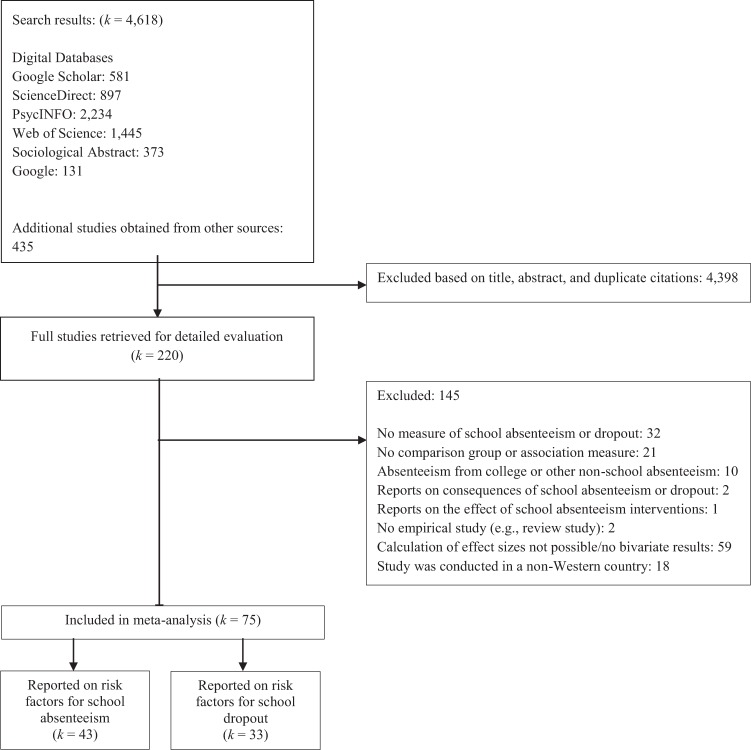
- Systematic searches until May 2019 in multiple databases and reference lists; inclusion required Western-country samples, Dutch or English language, peer-reviewed journals or dissertations, primary/secondary school samples, risk factors preceding absenteeism/dropout, and bivariate association data.
- Included 75 studies: 43 absenteeism studies (41 non-overlapping samples, N = 243,296; 781 effect sizes) and 33 dropout studies (31 non-overlapping samples, N = 136,392; 635 effect sizes). Risk factors were classified into 44 absenteeism and 42 dropout mutually exclusive risk domains.
- Three-level random-effects meta-analyses in R using metafor, with Fisher’s z transformed correlations; intercept-only models estimated mean domain effects, percentage of boys was tested as a moderator where heterogeneity was present and at least five studies were available, and bias was assessed with trim-and-fill, three-level funnel plot, and Egger’s regression tests.
Limitations
- Stated: the authors cannot assure the included studies are representative of all studies; primary studies may have been missed; restricting to published studies and dissertations risks publication bias; bias tests indicated bias in many domains, though trim-and-fill suggested underestimation; non-experimental designs preclude causal conclusions; retrospective studies mean some factors may not be true antecedents; mutually exclusive risk domains prevent examining combinations of risk factors; only percentage of boys was tested as a moderator, and only for domains based on at least five studies.
- Evident: the text reports 75 included studies in the results but refers to “a total of 69 studies and 1384 effect sizes” in the limitations; many risk domains are based on few studies or effect sizes and show high heterogeneity, limiting precision and moderator analyses.
Model-written summary. Check it against the paper before relying on it.
Integrity signals
Registry
Cites
Statistics
Figures
Verification
Claims the paper makes
3 Valid · 0 Not valid · 24 Not checked · 94 Own results and interpretations
A result the paper reports from its own data — it cites no other source for it, so there is none to check. The quote shows it is in the paper.
In the paper
“trim-and-fill analyses showed that an underestimation rather than an overestimation of risk domain effects was a problem (see Tables 4 and 5).”
§ Risk Factors for School Absenteeism and Dropout: A Meta-Analytic Review > Discussion > Limitations
plain- Asserted: passes — The authors put it forward as true.
- Checkable: passes — It can be checked against evidence.
- Load-bearing: passes — The paper’s conclusions depend on it.
- Based: passes — The paper gives a reason why it holds.
A result the paper reports from its own data — it cites no other source for it, so there is none to check. The quote shows it is in the paper.
In the paper
“Significant level-2 and/or level-3 variance was found in 32 risk domains.”
§ Risk Factors for School Absenteeism and Dropout: A Meta-Analytic Review > Results > The Moderating Effect of Gender
plain- Asserted: passes — The authors put it forward as true.
- Checkable: passes — It can be checked against evidence.
- Load-bearing: unclear — It is unclear whether the paper’s conclusions depend on it.
- Based: passes — The paper gives a reason why it holds.
A result the paper reports from its own data — it cites no other source for it, so there is none to check. The quote shows it is in the paper.
In the paper
“The three tests for bias assessment indicated that bias may have been present in multiple estimated effects of risk domains.”
§ Risk Factors for School Absenteeism and Dropout: A Meta-Analytic Review > Discussion > Limitations
hedged- Asserted: passes — The authors put it forward as true.
- Checkable: passes — It can be checked against evidence.
- Load-bearing: unclear — It is unclear whether the paper’s conclusions depend on it.
- Based: passes — The paper gives a reason why it holds.
A result the paper reports from its own data — it cites no other source for it, so there is none to check. The quote shows it is in the paper.
In the paper
“For school absenteeism, 12 risk domains were found with large effects, including having a negative attitude towards school, substance abuse, externalizing and internalizing problems of the juvenile, and a low parent-school involvement.”
§ Risk Factors for School Absenteeism and Dropout: A Meta-Analytic Review > Abstract
plainstates an association- Asserted: passes — The authors put it forward as true.
- Checkable: passes — It can be checked against evidence.
- Load-bearing: passes — The paper’s conclusions depend on it.
- Based: passes — The paper gives a reason why it holds.
A result the paper reports from its own data — it cites no other source for it, so there is none to check. The quote shows it is in the paper.
In the paper
“For school absenteeism, 12 risk domains were found with large effects, including having a negative attitude towards school, substance abuse, externalizing and internalizing problems of the juvenile, and a low parent-school involvement.”
§ Risk Factors for School Absenteeism and Dropout: A Meta-Analytic Review > Abstract
plainstates an association- Asserted: passes — The authors put it forward as true.
- Checkable: passes — It can be checked against evidence.
- Load-bearing: passes — The paper’s conclusions depend on it.
- Based: passes — The paper gives a reason why it holds.
70 more claims
Create a free account to see all 121 claims and to verify the 1 reference still open.
- It may state two separate claims as one. 25
- Probably not a substantial claim. 29
Claims other papers make about this one
Each is checked against this paper’s own text: does it say what the citing paper says it does?
The source backs part of the claim, not all of it — or backs it for a different population, condition or comparison.
In the citing paper
“Researchers commonly group risk or contextual (and, conversely, protective) factors for SA/A into various categories that include child-, parent-, family-, peer-, school-, and community-based variables (Kearney, 2008; Zaff et al., 2017; Gubbels et al., 2019).”
From Reconciling Contemporary Approaches to School Attendance and School Absenteeism: Toward Promotion and Nimble Response, Global Policy Review and Implementation, and Future Adaptability (Part 1) (2019) · cites this paper as Gubbels et al., 2019
Experimental — accuracy not yet measuredThe cited source says what the claim attributes to it.
In the citing paper
“While the link between mental health issues and school attendance during adolescence has been documented”
From “So That You Can Feel Well”: Perspectives of Students with Social, Emotional and Behavioral Difficulties on Factors that Support School Attendance (2025) · cites this paper as Gubbels et al., 2019
The cited source says what the claim attributes to it.
In the citing paper
“A large amount of quantitative research demonstrates the complex associations with student-level risk factors and SAPs, particularly internalizing and/or externalizing behaviors among other variables”
From “So That You Can Feel Well”: Perspectives of Students with Social, Emotional and Behavioral Difficulties on Factors that Support School Attendance (2025) · cites this paper as Gubbels et al., 2019
Self-check
Percentages, sums and reported differences re-computed from the paper’s own numbers.
Each contradiction between two passages listed here was confirmed by an independent check.
Rated major: it would touch a result — a value a result rests on, reported and recomputed p-values on opposite sides of the significance level, two passages that conflict with no sign which is right, or a cited work retracted before this paper was published.
In the paper
§ Risk Factors for School Absenteeism and Dropout: A Meta-Analytic Review > Results > Overall Effects of Risk Domains for Dropout
“| Large classes/schools | 1 | 1 | 0.145 (0.080) | (−0.011, 0.292) | 0.035* | 100.0 | – | – | – | – | 0.144c |”
§ Risk Factors for School Absenteeism and Dropout: A Meta-Analytic Review > Calculation of Effect Sizes and Statistical Analyses
“The log-likelihood-ratio-tests were performed one-tailed and all other tests were performed two-tailed. A p-value < 0.05 was considered as statistically significant.”
Rated minor: it would not touch a result — a value no result rests on, a p-value that stays on the same side of the significance level, or a conflict that is clerical, resolved elsewhere in the paper, or outside its own findings.
In the paper
“Table 4 presents the results of the three analyses that were conducted to assess bias in the estimated mean effect of each of the 43 risk domains for school absenteeism.”
§ Risk Factors for School Absenteeism and Dropout: A Meta-Analytic Review > Results > Assessment of Bias
Reported 43 · recomputed 44
Rated minor: it would not touch a result — a value no result rests on, a p-value that stays on the same side of the significance level, or a conflict that is clerical, resolved elsewhere in the paper, or outside its own findings.
In the paper
“| Battin-Pearson et al. 2002 | Dropout | 770 | 88 | 682 | 50.99 | 34 | 12 | 6 | 12 | 6 |”
§ Risk Factors for School Absenteeism and Dropout: A Meta-Analytic Review > Method > Search Strategy
Reported 34 · recomputed 36
Rated minor: it would not touch a result — a value no result rests on, a p-value that stays on the same side of the significance level, or a conflict that is clerical, resolved elsewhere in the paper, or outside its own findings.
In the paper
“| Hancock et al. 2018 | Absenteeism | 5231 | 544 | 4687 | 61.00 | 23 | 6 | 13 | 0 | 0 |”
§ Risk Factors for School Absenteeism and Dropout: A Meta-Analytic Review > Method > Search Strategy
Reported 23 · recomputed 19
Rated minor: it would not touch a result — a value no result rests on, a p-value that stays on the same side of the significance level, or a conflict that is clerical, resolved elsewhere in the paper, or outside its own findings.
In the paper
“| Ingul et al. 2012 | Absenteeism | 308–610 | 101–103 | 207–507 | 47.70 | 46 | 29 | 10 | 6 | 2 |”
§ Risk Factors for School Absenteeism and Dropout: A Meta-Analytic Review > Method > Search Strategy
Reported 46 · recomputed 47
7 more findings
Create a free account to see every finding of this check.
Citations
Cites
R: A Language and Environment for Statistical Computing
R Core Team (2025) · doi:10.32614/r.manuals · Cited by 352,181
Tabachnick, B. G., & Fidell, L. S. (1983) · Cited by 80,042
The Ecology of Human Development: Experiments by Nature and Design
Bronfenbrenner, U. (1979) · Harvard University Press eBooks · doi:10.4159/9780674028845 · Cited by 26,084
Conducting Meta-Analyses in R with the metafor Package
Viechtbauer, W. (2010) · Journal of Statistical Software · doi:10.18637/jss.v036.i03 · Cited by 20,464 · cited 2×
“In the statistical environment R (version 3.5.1; R Core Team 2015), the function “rma.mv” of the metafor-package (Viechtbauer 2010) was used to conduct the statistical analyses.”
MethodInfluentialDuval, S., & Tweedie, R. (2000) · Biometrics · doi:10.1111/j.0006-341x.2000.00455.x · Cited by 14,099 · cited 1×
“First, a funnel-plot-based trim and fill method was conducted (Duval and Tweedie 2000a, 2000b).”
MethodThe ecology of human development : experiments by nature and design
Bronfenbrenner, U. (1979) · Cited by 12,580
Toward an experimental ecology of human development.
Bronfenbrenner, U. (1977) · American Psychologist · doi:10.1037/0003-066x.32.7.513 · Cited by 10,853 · cited 1×
“This view on how school absenteeism and dropout evolve is in line with the ecological perspective on child development of Bronfenbrenner (1979, 1986).”
Result(2000) · Cited by 9,198
A Nonparametric “Trim and Fill” Method of Accounting for Publication Bias in Meta-Analysis
Duval, S., & Tweedie, R. (2000) · Journal of the American Statistical Association · doi:10.1080/01621459.2000.10473905 · Cited by 2,955
The Psychology of Criminal Conduct
Hart, S. D., Andrews, D. A., & Bonta, J. (1995) · Political Psychology · doi:10.2307/3792235 · Cited by 2,900
Research works printed but not linked: 4
- Andrews DA Dowden C A meta-analytic investigation into effective correctional intervention for female offenders Forum on Corrections Research 1999 11 18 21
- *Mullvain, P. (2017). Examining the relationship between bullying, attendance, and achievement in schools (Doctoral dissertation). http://scholarworks.waldenu.edu/cgi/viewcontent.cgi?article=3717&context=dissertations.
- National Center for Education Statistics. 2015 and 2017 Mathematics and Reading Assessments 2018 Washington, DC US Department of Education
- *Taylor, R. G. (2009). School facilities in the nation’s capital: an analysis of student achievement, attendance, and truancy (Doctoral dissertation). http://citeseerx.ist.psu.edu/viewdoc/download?doi=10.1.1.620.4220&rep=rep1&type=pdf.
Cited by
Items 201–300 of 585
Lindholdt, L., Svendsen, K., Rothausen, K. W., & Bech, B. H. (2023) · Scandinavian Journal of Public Health · doi:10.1177/14034948231173176 · Cited by 15
“Moreover, a meta-analytic review found a higher risk of school absence and drop-out in children with physical and mental problems, such as poor general well-being, psychiatric problems and poor physical health [26], which supports the findings of this study.”
Behind the empty desks: Teachers’ insights into student absenteeism in India
Kundu, A., & Bej, T. (2025) · Power and Education · doi:10.1177/17577438251331931 · Cited by 7
Does the impact of pupil absences on achievement depend on their timing?
Dräger, J., Klein, M., & Sosu, E. (2025) · American Educational Research Journal · doi:10.3102/00028312251347666 · Cited by 10
“The MCS allows us to account for risk factors of school absenteeism identified in the literature (Gubbels et al., 2019; Mireles-Rios et al., 2020; Pyne et al., 2021; Singer et al., 2021) that may also influence children’s academic achievement.”
Framing chronic absenteeism and emotionally-based school absenteeism as public health problems
Kearney, C. A. (2025) · Frontiers in Child and Adolescent Psychiatry · doi:10.3389/frcha.2025.1662093 · Cited by 12
“…factors for CSA/EBSA, for example, are commonly arranged across microsystem (e.g., child anxiety), mesosystem (e.g., child-parent/peer con fl ict), exosystem (e.g., school support), macrosystem (e.g., transportation vulnerability), and chronosystem (e.g., primary vs. secondary school) levels (23).”
Anders, J., Jerrim, J., Rodríguez, M. L. D. G., & Gutiérrez, Ó. D. M. (2025) · Educational Assessment Evaluation and Accountability · doi:10.1007/s11092-025-09470-z · Cited by 6
School dropout: The role of childhood conduct problems and depressive symptoms
Lau, M. A., Temcheff, C. E., Poirier, M., Bégin, V., Commisso, M., & Déry, M. (2021) · Psychology in the Schools · doi:10.1002/pits.22594 · Cited by 8
Liu, H., Hou, W. K., Lau, E. Y. Y., Birk, J. L., & Bonanno, G. A. (2023) · Development and Psychopathology · doi:10.1017/s0954579423000755 · Cited by 7
“Involvement with deviant peers was identified as a significant risk factor for school dropout in a recent meta-analysis (Gubbels et al., 2019).”
BackgroundThe Effectiveness of Dropout Intervention Programs Among K-12 Students: A Meta-Analysis
Wang, Q., Hsiao, Y., Hushman, C. J., & Armstrong, J. (2024) · Journal of Education for Students Placed at Risk (JESPAR) · doi:10.1080/10824669.2024.2342779 · Cited by 8
“High school dropout is also associated with many life-course problems, such as psychiatric disorders, teenage pregnancy, delinquency, and substance abuse (Chou et al., 2006; Gubbels et al., 2019; Nik Jaafar et al., 2013).”
Hirata, I., Nishimura, T., Osuka, Y., Wakuta, M., Tsukui, N., Tsuchiya, K. J., & Senju, A. (2024) · Frontiers in Education · doi:10.3389/feduc.2024.1411503 · Cited by 23
Schlesier, J., Obermeier, R., & Gläser‐Zikuda, M. (2025) · British Journal of Educational Psychology · doi:10.1111/bjep.70028 · Cited by 8
“…the absence of social conflicts rather than positive social relationships with the whole class or single students, but we did not measure severe negative aspects of peer relationships (such as bullying) (Gubbels et al., 2019; Schlesier, Vierbuchen, & Matzner, 2023; Stearns & Glennie, 2006).”
The Significance of Parental Involvements in Reducing K-12 Students Absenteeism
Islam, K., & Shapla, T. J. (2021) · European Journal of Educational Research · doi:10.12973/eu-jer.10.3.1215 · Cited by 10
“…certain parental involvement factors are statistically significant in relation to the K-12 students’ absenteeism—supporting the significance of the overall family involvement in prior research in relation to absenteeism (Gubbels et al., 2019; Rasasingham, 2015; Shafer, 2017; Woullard-Wilder, 2020).”
BackgroundResultInfluentialCapacidad predictiva del rechazo escolar sobre la alta ansiedad social en adolescentes chilenos
Giménez-Miralles, M., Martín, N. L. S., & Gonzálvez, C. (2022) · European Journal of Education and Psychology · doi:10.32457/ejep.v15i2.1967 · Cited by 8
Frawley, C., Babb, K., & Lambie, G. W. (2023) · Journal of Child & Adolescent Trauma · doi:10.1007/s40653-023-00522-4 · Cited by 8
“In addition, higher levels of externalizing behaviors correlate with increased school absenteeism (Gubbels et al., 2019).”
BackgroundSikdar, P., Hamid, F., & Chowdhury, S. (2023) · Khulna University Studies · doi:10.53808/kus.2023.20.02.1000-ss · Cited by 5
Jovčić, N., & Simić, N. (2024) · School Mental Health · doi:10.1007/s12310-024-09654-w · Cited by 8
“From previous studies that showed correlations between internalizing behavior and higher risk of disengagement and dropping out (Gubbels et al., 2019; Olivier et al., 2020), one might assume that this facet of burnout can be a warning sign to teachers.”
The relationship between ‘school readiness’ and later persistent absenteeism
Wood, M. L., Gunning, L., & Mon-Williams, M. A. (2024) · Royal Society Open Science · doi:10.1098/rsos.240272 · Cited by 12
“Good school attendance is key for both academic and later life success, but schools across the world—including the UK, the USA, Australia and Canada—are facing an attendance crisis following the pandemic [1–5].”
BackgroundInfluentialStrömbeck, J., Heyne, D. A., Ferrer‐Wreder, L., & Alanko, K. (2024) · European Child & Adolescent Psychiatry · doi:10.1007/s00787-024-02618-0 · Cited by 13
Phillippi, S. W., Thomas, C. L., & Lentini, K. (2020) · American Journal of Criminal Justice · doi:10.1007/s12103-020-09563-z · Cited by 5
“The risk of abuse is greater among vulnerable youth populations, such as homeless youth, school dropouts, or those with behavioral health conditions (Gewirtz O’Brien et al., 2020; Gubbels et al., 2019).”
BackgroundExploring gender differences in the vulnerability towards drug abuse among adolescents in Malaysia
Sulaiman, W. S. W., Kamaluddin, M. R., Zakaria, E. B., Ibrahim, F. B., Hassan, N., Manap, J., Nen, S. B., Zamani, Z. A., & Yusooff, F. (2021) · Psikohumaniora Jurnal Penelitian Psikologi · doi:10.21580/pjpp.v6i1.6679 · Cited by 9
“, 2016); and a decline in academic achievement, dropouts and school absence (Gubbels et al., 2019) also been reported to be related to drug addiction. N.I.D.A. (2014) also identifies other risk factors, such as aggressive behavior during childhood, lack of monitoring by parents, low social skills, experimenting with d…”
BackgroundYıldırım, M., & Sarı, T. (2022) · Türk Psikolojik Danışma ve Rehberlik Dergisi · doi:10.17066/tpdrd.1096012 · Cited by 13
Gulzar, S. A., Saeed, S., Kirmani, S. T., & Karmaliani, R. (2022) · PLOS Global Public Health · doi:10.1371/journal.pgph.0000500 · Cited by 9
“Several studies have proven internationally that effective primary care and healthy communication with parents result in improved attendance and engagement at school [14].”
BackgroundEXPLORING THE UNDERLYING FACTORS OF DROPPING OUT AT SECONDARY-LEVEL SCHOOLS IN KHULNA, BANGLADESH
Sheikh, M. S., Rashid, M., Nibir, M. M.-A.-M., & Rabbi, M. F. (2022) · Khulna University Studies · doi:10.53808/kus.2022.19.01.2119-edu · Cited by 8
“Beyond the effect mediated by low academic success, there is a very significant link since general deviation is a substantial forecaster of dropout (Gubbels et al., 2019).”
BackgroundOutcome Findings and Issues in Psychotherapy With Children and Adolescents: Externalizing Disorders
Andrade, B. F., Sawrikar, V., Aitken, M., & Henry, S. (2021) · Elsevier eBooks · doi:10.1016/b978-0-12-818697-8.00063-7 · Cited by 6
van den Toren, S. J., van Grieken, A., de Kroon, M. L. A., Mulder, W. C., Vanneste, Y. T. M., & Raat, H. (2020) · BMC Psychology · doi:10.1186/s40359-020-00434-0 · Cited by 8
Tümen, S., Vlassopoulos, M., & Wahba, J. (2025) · SSRN Electronic Journal · doi:10.2139/ssrn.5085146 · Cited by 8
School absenteeism for children exposed to maternal incarceration and other adversities
Bell, M. F., Spittal, M. J., Segal, L., Dennison, S. M., Kinner, S. A., Dawe, S., & Preen, D. B. (2024) · Children and Youth Services Review · doi:10.1016/j.childyouth.2024.108007 · Cited by 7
Association between procrastination and academic dropout intention in university students
García, M. D., Prieto, F. J. G., Aguilar, D. L., & Sanz, C. C. (2025) · Social Sciences & Humanities Open · doi:10.1016/j.ssaho.2025.101506 · Cited by 16
Tsevat, R. K., Nkansah, M., Shankar, M., Choi, K. R., JACKSON, N. J., Thyne, S. M., Gordon, B., & Dudovitz, R. (2025) · Academic Pediatrics · doi:10.1016/j.acap.2025.102864 · Cited by 7
Conflict Dynamics in Education
Călınescu, A. (2025) · EIKI Journal of Effective Teaching Methods · doi:10.59652/jetm.v3i3.662 · Cited by 9
“If left unresolved, conflicts often trigger serious consequences, such as diminished motivation, chronic absenteeism, declining performance, strained relationships, and in some cases, withdrawal from school altogether (Gubbels et al., 2019).”
Data Mining to Identify University Student Dropout Factors
Marín, Y. R., Huatangari, L. Q., Caro, O. C., Guevara, J. L. M., Tuesta, J. N. A., Bardales, E. S., & Santos, R. C. (2025) · Applied Sciences · doi:10.3390/app152211911 · Cited by 5
Dinesen, T. A., Blix, B. H., & Gramstad, A. (2023) · International Journal of Circumpolar Health · doi:10.1080/22423982.2023.2198112 · Cited by 4
“Concerns attached to non-completion of education are that it may lead to economic deprivation and various mental, social, occupational, and marital problems in adulthood [9].”
BackgroundPeeters, M., Braakhekke, E., Kesselring, M., Wijsbroek, S. A. M., Schramel, I., de Putter, I., Klaassen, E., Groenendijk, J., Sieffers, N., de Wildt, S., et al. (2024) · Mental Health & Prevention · doi:10.1016/j.mhp.2024.200388 · Cited by 13
When do prevocational programs ease the transition to vocational education and training?
Busse, R., & Maué, E. (2025) · Vocations and Learning · doi:10.1007/s12186-025-09357-6 · Cited by 9
“Several studies found higher rates of VET dropout for trainees with lower school certificates as school certificates may be a proxy of whether trainees can meet cognitive training requirements (Aarkrog et al., 2018; Gubbels et al., 2019; Holtmann & Solga, 2023).”
Antecedents of developmental trajectories of school absences among adolescents
Tunkkari, M., Kiuru, N. H., Virtanen, T. E., & Vasalampi, K. (2025) · Scandinavian Journal of Educational Research · doi:10.1080/00313831.2025.2506380 · Cited by 8
“These results correspond to previous research showing that high levels of emotional symptoms, and outward-directed problem behaviors increase the risk of school absences (Gubbels et al., 2019; Nik Jaafar et al., 2013).”
School non-attendance and learned helplessness: latent profiles and ROC curves
Pérez‐Marco, M., Fuster‐Rico, A., & Gonzálvez, C. (2025) · Frontiers in Psychology · doi:10.3389/fpsyg.2025.1557915 · Cited by 8
Teacher justice and (A)motivation: a longitudinal study in secondary school
Grazia, V. (2025) · Social Psychology of Education · doi:10.1007/s11218-025-10105-w · Cited by 9
“In this direction, consistently with the SDT framework, a meta-analysis (Gubbels et al., 2019) found that a poor student-teacher relationship was one the most significant risk factors for school dropout, after accounting for three factors in the area of individual student characteristics, related…”
Sleep and dropout from upper secondary school: A register-linked study
Hysing, M., Sivertsen, B., Nilsen, S. A., Heradstveit, O., Bøe, T., & Askeland, K. G. (2023) · Sleep Health · doi:10.1016/j.sleh.2023.05.004 · Cited by 4
“Despite the wide range of individual, familial, academic, and school-related risk factors that have been investigated in relation to school dropout,(4) no studies have investigated the importance of sleep problems as exemplified by the lack of sleep problems in the mentioned meta-analysis.(3) Since sleep problems and…”
BackgroundSuccess Through Leadership Resilience: Qualitative Exploration of a Selected Rural High School
Uleanya, C. (2023) · Research in Educational Administration & Leadership · doi:10.30828/real.1264412 · Cited by 7
“578 Mohlouoa, 2014), teenage pregnancy (Hartnack, 2017), school and community factors (Mokgosi, 2016), transport and accommodation challenges (Strumpher, 2018). This is in congruence with the work of (Deleted for the integrity of the review) which shows that distance and by extension transportation is a challenge for…”
ResultNorthfield, K., Saliba, A. J., & Harris, K. M. (2023) · Children and Youth Services Review · doi:10.1016/j.childyouth.2023.107343 · Cited by 4
Emery, C. R., Abdullah, A., Thapa, S., Chan, K. L., CHUI, C. H.-K., Lai, A. H. Y., Lau, B. H. P., & Wekerle, C. (2023) · Child Abuse & Neglect · doi:10.1016/j.chiabu.2023.106588 · Cited by 5
Statistical identification of predictors of dropout in secondary education: evidence from Malaysia
Hashim, R. A., Lim, H. E., Jafar, M. F., Shanmugam, S. K. S., & Bukhari, N. (2024) · Journal of the Asia Pacific Economy · doi:10.1080/13547860.2024.2306673 · Cited by 4
“Gubbels et al. (2019) performed a meta-analysis on the findings of previous studies and synthesized 23 dropout risk predictors.”
Brustad, I. J., Haugan, T., Bjerkeset, O. A., Sund, E. R., Aune, T. K., Nordahl, H. M., & Vaag, J. R. (2024) · BMC Public Health · doi:10.1186/s12889-024-18271-w · Cited by 9
Schulabsentismus aus einer humanökologischen Perspektive – aktuelle Analysen mit PISA 2022
Feldhaus, M., Rau, M., Ricking, H., & Sälzer, C. (2025) · Zeitschrift für Erziehungswissenschaft · doi:10.1007/s11618-025-01292-5 · Cited by 5
“Darüber hinaus sollten gute Schulleistungen bzw. die Ansicht darüber, dass einem das Lernen leicht fällt, einen negativen Effekt auf Absentismus haben, da Schüler:innen weniger Angst vor schulischem Versa-gen haben (Gubbels et al. 2019; Sälzer 2010; Wagner et al. 2004).”
InfluentialMera-Lemp, M. J., Pizarro, J. J., & Guglielmetti-Serrano, F. (2025) · Frontiers in Psychology · doi:10.3389/fpsyg.2025.1561863 · Cited by 14
Child obesity moderates the association between poverty and academic achievement
Kranjac, A. W., & Kranjac, D. (2021) · Psychology in the Schools · doi:10.1002/pits.22497 · Cited by 7
“Teachers, administrators, coaches, and other practicing educators are aware that child poverty influences academic achievement and is a risk factor for academic failure, school absenteeism, and permanent school dropout (Gubbels et al., 2019; Sirin, 2005).”
BackgroundBerghe, L. V. D., Pauw, S. S. W. D., & Vandevelde, S. (2022) · The Journal of Educational Research · doi:10.1080/00220671.2022.2042169 · Cited by 10
“Longitudinal research consistently shows that truancy, school absenteeism, and school refusal, alongside school dropout, are risk factors for a myriad of life-course problems (Gubbels et al., 2019; Heyne et al., 2020).”
BackgroundGender Differences for Health Indicators in a Sample of School Dropout Adolescents: A Pilot Study
Mastorci, F., Lazzeri, M. F. L., Piaggi, P., Doveri, C., Casu, A., Trivellini, G., Marinaro, I., Bardelli, A., & Pingitore, A. (2022) · International Journal of Environmental Research and Public Health · doi:10.3390/ijerph19137852 · Cited by 11
“Additionally, the emotional dimension and social settings, regarding family or peers, are strictly interconnected and facilitate adaptive behavior [29].”
BackgroundSarğın, Y. C., Onat, M. B., Yilmaz, G., Yılmaz, B. N. K., & Akgür, S. A. (2022) · Journal of Ethnicity in Substance Abuse · doi:10.1080/15332640.2022.2149655 · Cited by 4
“Low parental education is a significant risk factor in youth’ substance use and problems related to substance use (Gubbels et al., 2019).”
Tehupeiory, A., Septiariva, I. Y., & Suryawan, I. W. K. (2023) · AIMS environmental science · doi:10.3934/environsci.2023044 · Cited by 5
“The underpinnings of behavior change theories suggest that informed individuals are more likely to engage in proactive behavior [59,60], such as waste segregation or support for Waste-to-Energy (WtE) initiatives.”
Ogunyemi, A. O., Abiola, A., Olufunlayo, T., et al. (2022) · Annals of Health Research (The Journal of the Medical and Dental Consultants Association of Nigeria OOUTH Sagamu Nigeria) · doi:10.30442/ahr.0802-01-160 · Cited by 3
“[11] Many youths of this age range are at their most impressionistic stage, and they tend to imitate.”
BackgroundPerception of School Social Bonding (PSSB) Instrument: Structural and Concurrent Validity
Gentle-Genitty, C. S., Keppens, G., & Kearney, C. A. (2024) · Contemporary School Psychology · doi:10.1007/s40688-024-00512-9 · Cited by 7
“These col - lective approaches emphasize not only the importance of youth and family relationships but also peer, school, and even community factors that impact student achievement and attendance (Gubbels et al., 2019 ; Singer et al., 2021 ).”
Reynolds, E. C., Nsiah-Asamoah, C. N. A., Okronipa, H., Arnold, C. D., & Stewart, C. P. (2025) · Maternal and Child Nutrition · doi:10.1111/mcn.70066 · Cited by 7
“Adolescents are at a critical period in their education and many students, as a result of FI, often drop out or are lost from the educational system during this time (Gubbels et al. 2019; UNESCO Institute for Statistics (UIS) 2015; Fixing the Broken Promise of Education for All 2015).”
Poor child oral health and school absences: a population-wide data linkage study
Goulart, M. D. A., Sherriff, A., Conway, D. I., & McMahon, A. D. (2025) · Journal of Epidemiology & Community Health · doi:10.1136/jech-2025-223754 · Cited by 5
Kreitz-Sandberg, S., Enderle, C., Isaksson, J., Fredriksson, U., & Backlund, Å. (2025) · Scandinavian Journal of Educational Research · doi:10.1080/00313831.2025.2558721 · Cited by 4
“…influenced not only by various individual factors such as mental health problems, anxiety disorders, low socio-economic status and low levels of academic achievement, but also by family and peer factors and organisational dimensions of the education (Gubbels et al., 2019; Havik et al., 2015).”
Keogh, A. J., & McGillicuddy, D. (2026) · British Educational Research Journal · doi:10.1002/berj.70134 · Cited by 5
Brittain, H. L., & Vaillancourt, T. (2026) · Frontiers in Child and Adolescent Psychiatry · doi:10.3389/frcha.2026.1729744 · Cited by 5
Howard, J., Spooner, C., Sherab, K., Pant, S. B., Upadhyaya, S., & Bista, B. (2021) · Journal of Public Health · doi:10.1007/s10389-021-01514-0 · Cited by 3
Turgumbayev, M., Rima, D., Murat, D., Baisalov, A. D., & Beaver, K. M. (2022) · International Journal of Offender Therapy and Comparative Criminology · doi:10.1177/0306624x221110802 · Cited by 5
The Effect of the Primary Project Program on School Attendance in Early Childhood
Lotyczewski, B. S., Whittington, R. A., Smith, L., Sanyshyn, S. M., Duprey, E. B., Allan, M. J., McFall, J. P., & White, A. M. (2023) · Journal of Applied School Psychology · doi:10.1080/15377903.2023.2236982 · Cited by 5
“Excessive absences throughout primary and secondary school have also been associated with later substance use, inter-nalizing and externalizing issues for the child, school dropout, and delin-quency (Gubbels et al., 2019; Robinson & Courtney, 2018).”
BackgroundTømmerås, T., Backer‐Grøndahl, A., Høstmælingen, A., Laland, H., Gomez, M. B., Apeland, A., Karlsson, L. R. A., Grønlie, A. A., Torsvik, S., Bringedal, G., et al. (2024) · BMC Psychology · doi:10.1186/s40359-024-01765-y · Cited by 3
Age-related variations in school satisfaction: The mediating role of school engagement
Bălţătescu, S., & Cernea-Radu, A. E. (2024) · The Hungarian Educational Research Journal · doi:10.1556/063.2024.00302 · Cited by 10
“Disengagement from school is one of the main sources of absenteeism and dropout, because it can cause students to feel dissatis fi ed and discouraged (Gubbels, Van Der Put, & Assink, 2019).”
BackgroundNorozi, S. A., & Moen, T. (2022) · Frontiers in Education · doi:10.3389/feduc.2022.963460 · Cited by 3
“, 2015; Sibley and Brabeck, 2017), with increased thriving, wellbeing, and decreased behavioral problems (Fan and Chen, 2001; Faugstad and Jenssen, 2019).”
BackgroundDoes anti-poverty intervention impact school absenteeism of children? Evidence from India
Kumar, A., & Singh, R. (2022) · Development in Practice · doi:10.1080/09614524.2022.2153801 · Cited by 3
“Exiting the school system due to dropouts is associated with school absenteeism (Gubbels, van der Put, and Assink 2019).”
BackgroundSchool Attendance Problems in Scotland and Spain: Variations in Recording, Reporting, and Using Data
Giménez-Miralles, M., Gonzálvez, C., Klein, M., et al. (2023) · ORBIS SCHOLAE · doi:10.14712/23363177.2023.11 · Cited by 3
Saadia, Z., Nasralla, K., Alzuwaydi, A. I., & Hamid, H. O. (2024) · Acta Informatica Medica · doi:10.5455/aim.2024.32.47-53 · Cited by 7
“The published literature concentrates on the overall student performance like Khan et al. (1), Gubbel’s et al. (6), while none has looked at the different individual components of the examinations.”
BackgroundCelestin, M., & Mugiraneza, F. (2024) · Journal of Education · doi:10.53819/81018102t5318 · Cited by 3
Kanungo, P., Mohanty, S., & Thamminaina, A. (2024) · Cambridge Journal of Education · doi:10.1080/0305764x.2024.2358812 · Cited by 3
“For developed nations, it is less of a challenge because their policies already identify an association of PI with truancy control (Antony-Newman, 2019; Gubbels et al., 2019).”
BackgroundWho is allowed to stay at home during school hours? An analysis of school withdrawal
Kruithof, E. H., & Keppens, G. (2024) · Educational Studies · doi:10.1080/03055698.2024.2369859 · Cited by 6
“Low parental involvement in school is a common risk factor of school absenteeism (Gubbels, van der Put, and Assink 2019).”
Exploring Entrepreneurial Intention and Student Engagement of Youth Living in Poverty
Khodor, R. M., Valero, O., & Álvarez, I. (2024) · Behavioral Sciences · doi:10.3390/bs14110995 · Cited by 7
Nese, R. N. T., Nese, J. F. T., Santiago‐Rosario, M. R., Izzard, S., Newson, A., Mannan, I. A., Lissman, D. C., Daza, T., Triplett, D., & Malose, S. (2024) · Journal of Education · doi:10.1177/00220574241309893 · Cited by 3
“…factors such as positive relationships with teachers, supportive classroom environments, and positive peer relationships are strongly associated with students ’ overall health and wellbeing as well as academic engagement and fewer disciplinary outcomes (Di Pietro, 2018; Gubbels et al., 2019).”
Katane, I., & Jerkunkova, A. (2020) · SOCIETY INTEGRATION EDUCATION Proceedings of the International Scientific Conference · doi:10.17770/sie2020vol1.5151 · Cited by 5
Yee, E., Jung, C., Cheriberi, D., Choi, M., & Park, W. (2022) · International Journal of Environmental Research and Public Health · doi:10.3390/ijerph191710847 · Cited by 4
Klein, M., Sosu, E., & Dare, S. (2020) · SocArXiv (OSF Preprints) · doi:10.31235/osf.io/9jrqx · Cited by 4
O’Toole, C., & Ćirić, T. (2024) · Frontiers in Education · doi:10.3389/feduc.2024.1456388 · Cited by 3
Ye, Q., Devarshi, P. P., Grant, R. W., Higgins, K., & Mitmesser, S. H. (2023) · Nutrients · doi:10.3390/nu15204356 · Cited by 5
Predictors of non-completion of upper secondary education in Finland based on register data
Raisamo, S. U., Pasanen, T., Hilli, P., & Ståhl, T. (2024) · Scandinavian Journal of Public Health · doi:10.1177/14034948241257564 · Cited by 6
Bahar, O. S., Byansi, W., Ibrahim, A., et al. (2025) · Children and Youth Services Review · doi:10.1016/j.childyouth.2025.108205 · Cited by 2
Substance Use Disorders in Adolescents: A Qualitative Systematic Review
Kara, H., & Karakaya, D. (2025) · Journal of Advanced Nursing · doi:10.1111/jan.16967 · Cited by 4
“…studies, it has been found that substance use causes physical (Devoe et al. 2021; Kwon et al. 2019), mental (Esmaeelzadeh et al. 2018; Rioux et al. 2021), legal (Tharshini and Ibrahim 2023) and social (Gubbels et al. 2019; Ingram et al. 2020; Kilian et al. 2021; Magnan et al. 2024) problems.”
Bania, E. V., Nilsen, T. S., Thastum, M., Ingul, J. M., & Havik, T. (2025) · Frontiers in Psychology · doi:10.3389/fpsyg.2025.1608184 · Cited by 2
“However, a meta-analytic review by Gubbels et al. (2019) identified potential risk factors for school absenteeism, where the following had large effects: negative attitude towards school, substance abuse, externalizing and internalizing problems, and low parent-school involvement.”
InfluentialFactors at the household and university level that influence student dropout at UNAM
Maquera, H. R. M., Zela, M. A. C., & Mamani, R. P. P. (2025) · Frontiers in Education · doi:10.3389/feduc.2025.1598687 · Cited by 4
Longitudinal associations between gaming and academic motivation during middle childhood
Tiraboschi, G. A., Garon‐Carrier, G., Madigan, S. L., Smith, J., Surprenant, R., & Fitzpatrick, C. (2025) · Psychological Medicine · doi:10.1017/s0033291725101153 · Cited by 5
“Our observational design prevents us from discarding some potential time-varying confounders, such as child or parent mental health (Gubbels et al., 2019).”
Neumann, U., Just, V., Henke, L., Knollmann, M., Zellmer, S., Andzinski, M., Schmidtendorf, S., Noack, M., Föcker, M., Seitz, J., et al. (2025) · Frontiers in Child and Adolescent Psychiatry · doi:10.3389/frcha.2025.1629877 · Cited by 3
“Previous research shows, that school absenteeism has complex interacting causes in family environment, personality, school and peer context (12, 21).”
Russell, L., & Thompson, R. A. (2025) · European Educational Research Journal · doi:10.1177/14749041251378585 · Cited by 3
The contested causes of school absence: Longitudinal findings from the UK
van Poortvliet, M. (2025) · Children and Youth Services Review · doi:10.1016/j.childyouth.2025.108634 · Cited by 7
Finding myself in 10 weeks: An SEL-based art therapy program for out-of-school youth
Lee, Y., Jung, H.-M., Kim, S.-B., & Park, Y.-M. (2025) · The Arts in Psychotherapy · doi:10.1016/j.aip.2025.102380 · Cited by 3
Lambie, I., Allen, R., Reil, J., & McLay, J. (2025) · Children and Youth Services Review · doi:10.1016/j.childyouth.2025.108679 · Cited by 3
Vaughn, M. G., Chen, J., Maynard, B. R., Bandaru, Y. S., & Schweiger, A. (2025) · Children and Youth Services Review · doi:10.1016/j.childyouth.2025.108735 · Cited by 3
Pérez‐Marco, M., Fuster‐Rico, A., Fernández‐Sogorb, A., & Gonzálvez, C. (2026) · Current Psychology · doi:10.1007/s12144-025-08993-4 · Cited by 3
Cavicchiolo, E., Manganelli, S., Lucidi, F., & Alivernini, F. (2026) · Learning and Individual Differences · doi:10.1016/j.lindif.2026.102887 · Cited by 2
Brittain, H. L., & Vaillancourt, T. (2026) · Scientific Reports · doi:10.1038/s41598-026-45784-8 · Cited by 4
“…is also inconsistency in meta-analytic findings between bullying victimization and school engagement, with some yielding non-significant effects 42 and others showing associations between being bullied and higher risk of school absence and dropout and lower likelihood of school graduation and…”
Cheng, Q., Thornton, E., Knowles, C., & Humphrey, N. (2026) · Journal of the American Academy of Child & Adolescent Psychiatry · doi:10.1016/j.jaac.2026.04.001 · Cited by 5
The effects of educational robotics on students’ learning outcomes: A three-level meta-analysis
Lu, Y., & Geng, S. (2026) · Educational Research Review · doi:10.1016/j.edurev.2026.100790 · Cited by 5
Nhlenyama, L. S., & Adewumi, S. A. (2026) · Social Sciences · doi:10.3390/socsci15050283 · Cited by 2
Sorrenti, L., Caparello, C., Meduri, C. F., & Filippello, P. (2026) · Education Sciences · doi:10.3390/educsci16071074 · Cited by 2
Reasons for absenteeism in rural primary schools in two Colombian municipalities
Vargas, S. L. (2020) · Revista Salud Bosque · doi:10.18270/rsb.v10i1.3030 · Cited by 2
“A taxa geral de absentismo foi de 5,7 episódios por criança-ano, IC95% (5,5-5,8) e 8,6 dias por criança-ano, IC95% (8,4-8,9).”
BackgroundInfluentialOur Professional and Ethical Responsibilities to Support Student Mental Health
Etscheidt, S. L., Skaar, N. R., Clopton, K. L., & Schmitz, S. L. (2022) · Teaching Exceptional Children · doi:10.1177/00400599221108469 · Cited by 4
“Mental health issues negatively impact school attendance (Egger et al., 2003; Finning et al., 2019; Gubbels et al., 2019), school completion (Gubbels et al., 2019), and academic performance (Deighton et al., 2018; Masten et al., 2005; Wickersham et al., 2021).”
BackgroundA Comparison of High School Graduation Predictors Between Two Ontario Student Cohorts
Robson, K., Malette, N., Anisef, P., Maier, R., & Brown, R. (2022) · Canadian Journal of Education / Revue canadienne de l éducation · doi:10.53967/cje-rce.5181 · Cited by 9
“However, by the early 1960s, not completing high school was reconstructed as a social problem (Anisef & Andres, 1996; Gubbels et al., 2019).”
BackgroundHu, P., Du, S., & Tian, G. (2023) · Sustainability · doi:10.3390/su15054434 · Cited by 2
Identifying the Key Hazards behind Website Drop-Offs by Solving a Survival Problem
Soobramoney, J., Chifurira, R., Chinhamu, K., & Zewotir, T. T. (2023) · Applied Sciences · doi:10.3390/app13148248 · Cited by 3
Welfare conditionality and policy contingencies of school‐allowance retractions in Sweden
Sandberg, J., & Fredholm, A. (2023) · Social Policy and Administration · doi:10.1111/spol.12957 · Cited by 2
Metadata
- Authors
- Gubbels, J., van der Put, C. E., & Assink, M.
- Affiliations
- University of Amsterdam (NL)
- Corresponding author
- Gubbels, Jeanne
- Venue
- Journal of Youth and Adolescence
- Published
- 2019-07-15
- Volume
- 48
- Issue
- 9
- Pages
- 1637-1667
- ISSN
- 0047-2891 (ISSN-L)
- 1573-6601
- PMC
- PMC6732159
- OpenAlex
- W2960437645
- Cited by
- 596
- References
- 123
- Citations by year
- 2026: 98 · 2025: 110 · 2024: 113 · 2023: 92 · 2022: 99 · 2021: 49 · 2020: 29 · 2019: 6
- FWCI
- 13.05
- Type
- journal article
- Language
- en
- Open access
- hybrid
- doi.org
- Licence
- cc-by
- creativecommons.org/licenses/by/4.0 (tdm)
- creativecommons.org/licenses/by/4.0 (vor)
- Locations
- Journal of Youth and Adolescence (publishedVersion, cc-by)
- Europe PMC (PubMed Central) (publishedVersion, cc-by)
- PubMed Central (publishedVersion, cc-by)
- PubMed (publishedVersion)
- UvA-DARE (University of Amsterdam) (publishedVersion, cc-by)
- Data Archiving and Networked Services (DANS) (submittedVersion, other-oa)
- Topics
- Social Sciences › Education › Youth Substance Use and School Attendance
- Social Sciences › Education › Educational Outcomes and Influences
- Social Sciences › Sociology and Political Science › Youth Education and Societal Dynamics
- Keywords
- school absenteeism, school dropout, risk factors, adolescent development, substance abuse, externalizing problems, internalizing problems, school retention, low IQ, learning difficulties, academic performance, attitudes toward school, prevention and intervention
- MeSH terms
- Absenteeism, Adolescent, Adolescent Behavior, Female, Humans, Male, Risk Factors, Student Dropouts, Students, Substance-Related Disorders
About these checks
Registry, retraction, Cites and statistics results are computed, not judged, with one exception: a printed reference that no index lists is read once by a model before it counts as a citation error. Claims are extracted by a model and kept only when their quote appears verbatim in the text; each cited source is then checked, with a model’s help, for whether it says what the claim relies on. Those verdicts can be wrong — read the claim’s quote and the cited source before relying on one.
The claim verdicts this report counts are experimental: their accuracy is not yet measured.
A language model drew the claims from the paper on 2026-10-10, under version 3 of the claim definition (model deepseek-v4.1-flash, prompt extract-v3).
A second model labelled each claim on 2026-10-10 (model jev-1.13-20260917, definition revision gold-guideline-v0.2).
Statistics and arithmetic are recomputed, not judged.
Confidence bands are shown only for fields calibrated on our annotated test set. None is calibrated yet, so no band is shown.
What counts as a claim ›How we measure confidence ›How we check this ›
Are you an author, or do you see a problem with this page? Request a review
Data sources
Bibliographic data: Semantic Scholar, OpenAlex, Crossref.
Contains information from the Semantic Scholar Academic Graph Datasets, made available under the ODC Attribution License (ODC-BY 1.0).
Semantic Scholar’s data is described in: Kinney, R., et al. (2023). The Semantic Scholar Open Data Platform. arXiv:2301.10140.
