

Risk Factors for School Absenteeism and Dropout: A Meta-Analytic Review
Open accessThe DOI matches its Crossref record; 119 of the 123 references it cites were found in a registry or an index; 3 of the 46 sources its claims cite were checked for support.
Abstract
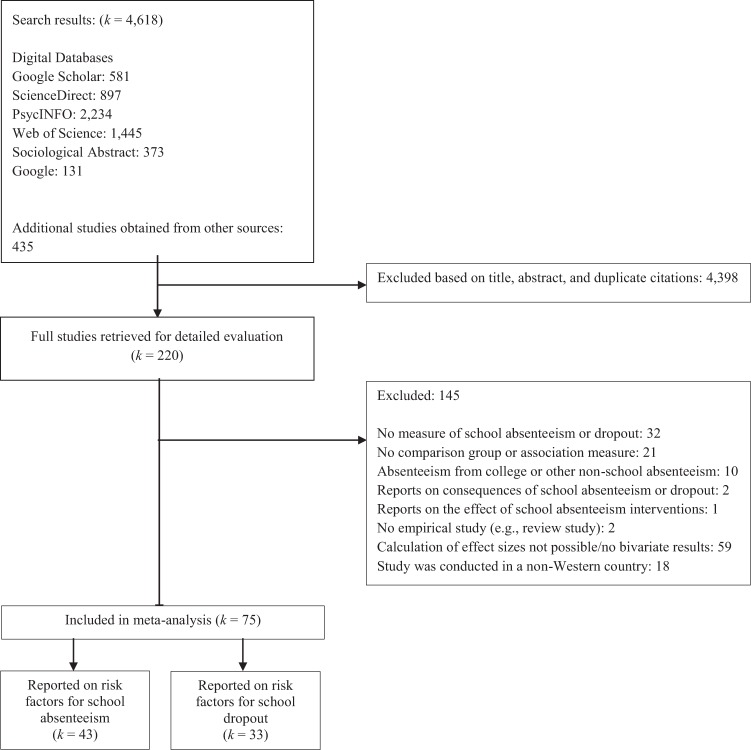
School absenteeism and dropout are associated with many different life-course problems. To reduce the risk for these problems it is important to gain insight into risk factors for both school absenteeism and permanent school dropout. Until now, no quantitative overview of these risk factors and their effects was available. Therefore, this study was aimed at synthesizing the available evidence on risk factors for school absenteeism and dropout. In total, 75 studies were included that reported on 781 potential risk factors for school absenteeism and 635 potential risk factors for dropout. The risk factors were classified into 44 risk domains for school absenteeism and 42 risk domains for dropout. The results of a series of three-level meta-analyses yielded a significant mean effect for 28 school absenteeism risk domains and 23 dropout risk domains. For school absenteeism, 12 risk domains were found with large effects, including having a negative attitude towards school, substance abuse, externalizing and internalizing problems of the juvenile, and a low parent-school involvement. For dropout, the risk domains having a history of grade retention, having a low IQ or experiencing learning difficulties, and a low academic achievement showed large effects. The findings of the current study contribute to the fundamental knowledge of the etiology of school absenteeism and dropout which in turn contributes to a better understanding of the problematic development of adolescents. Further, more insight into the strength of effects of risk factors on school absenteeism and dropout is important for the development and improvement of both assessment, prevention and intervention strategies.
Overview
CoChat Summary
TL;DR
This meta-analytic review synthesized 75 studies and found that many child, family, school, and peer risk domains are significantly associated with school absenteeism and dropout. For absenteeism, negative school attitude and substance abuse showed large effects; for dropout, grade retention, low IQ/learning difficulties, and low academic achievement showed large effects.
Key findings
- Across 75 studies, 28 of 44 absenteeism risk domains and 23 of 42 dropout risk domains had significant positive mean effects. For absenteeism, large effects included negative school attitude (r = 0.553), anti-social behavior/cognitions (r = 0.428), smoking (r = 0.336), drug abuse (r = 0.327), alcohol abuse (r = 0.311), poor pupil-teacher relationship (r = 0.286), and low parental school involvement (r = 0.272).
- For dropout, large effects were found for history of grade retention (r = 0.348), low IQ/learning difficulties (r = 0.326), and low academic achievement (r = 0.316). Medium effects included psychiatric symptoms/disorders (r = 0.269), drug abuse (r = 0.247), anti-social behavior/cognitions (r = 0.236), involvement with truant/deviant peers (r = 0.228), and low family SES (r = 0.222).
- Gender moderation was found only for drug abuse in absenteeism and negative school attitude in dropout; both effects were stronger as the percentage of boys in samples decreased, meaning they were stronger in girls. Most risk domains were not moderated by gender.
- Bias assessment found no indication of bias in 13 absenteeism and 14 dropout domain effects, some indication in 22 and 20, and moderate to strong indication in 9 and 8, respectively. Trim-and-fill analyses suggested underestimation rather than overestimation in several domains.
Methods
- Systematic searches until May 2019 in multiple databases and reference lists; inclusion required Western-country samples, Dutch or English language, peer-reviewed journals or dissertations, primary/secondary school samples, risk factors preceding absenteeism/dropout, and bivariate association data.
- Included 75 studies: 43 absenteeism studies (41 non-overlapping samples, N = 243,296; 781 effect sizes) and 33 dropout studies (31 non-overlapping samples, N = 136,392; 635 effect sizes). Risk factors were classified into 44 absenteeism and 42 dropout mutually exclusive risk domains.
- Three-level random-effects meta-analyses in R using metafor, with Fisher’s z transformed correlations; intercept-only models estimated mean domain effects, percentage of boys was tested as a moderator where heterogeneity was present and at least five studies were available, and bias was assessed with trim-and-fill, three-level funnel plot, and Egger’s regression tests.
Limitations
- Stated: the authors cannot assure the included studies are representative of all studies; primary studies may have been missed; restricting to published studies and dissertations risks publication bias; bias tests indicated bias in many domains, though trim-and-fill suggested underestimation; non-experimental designs preclude causal conclusions; retrospective studies mean some factors may not be true antecedents; mutually exclusive risk domains prevent examining combinations of risk factors; only percentage of boys was tested as a moderator, and only for domains based on at least five studies.
- Evident: the text reports 75 included studies in the results but refers to “a total of 69 studies and 1384 effect sizes” in the limitations; many risk domains are based on few studies or effect sizes and show high heterogeneity, limiting precision and moderator analyses.
Model-written summary. Check it against the paper before relying on it.
Integrity signals
Registry
Cites
Statistics
Figures
Verification
Claims the paper makes
3 Valid · 0 Not valid · 24 Not checked · 94 Own results and interpretations
A result the paper reports from its own data — it cites no other source for it, so there is none to check. The quote shows it is in the paper.
In the paper
“trim-and-fill analyses showed that an underestimation rather than an overestimation of risk domain effects was a problem (see Tables 4 and 5).”
§ Risk Factors for School Absenteeism and Dropout: A Meta-Analytic Review > Discussion > Limitations
plain- Asserted: passes — The authors put it forward as true.
- Checkable: passes — It can be checked against evidence.
- Load-bearing: passes — The paper’s conclusions depend on it.
- Based: passes — The paper gives a reason why it holds.
A result the paper reports from its own data — it cites no other source for it, so there is none to check. The quote shows it is in the paper.
In the paper
“Significant level-2 and/or level-3 variance was found in 32 risk domains.”
§ Risk Factors for School Absenteeism and Dropout: A Meta-Analytic Review > Results > The Moderating Effect of Gender
plain- Asserted: passes — The authors put it forward as true.
- Checkable: passes — It can be checked against evidence.
- Load-bearing: unclear — It is unclear whether the paper’s conclusions depend on it.
- Based: passes — The paper gives a reason why it holds.
A result the paper reports from its own data — it cites no other source for it, so there is none to check. The quote shows it is in the paper.
In the paper
“The three tests for bias assessment indicated that bias may have been present in multiple estimated effects of risk domains.”
§ Risk Factors for School Absenteeism and Dropout: A Meta-Analytic Review > Discussion > Limitations
hedged- Asserted: passes — The authors put it forward as true.
- Checkable: passes — It can be checked against evidence.
- Load-bearing: unclear — It is unclear whether the paper’s conclusions depend on it.
- Based: passes — The paper gives a reason why it holds.
A result the paper reports from its own data — it cites no other source for it, so there is none to check. The quote shows it is in the paper.
In the paper
“For school absenteeism, 12 risk domains were found with large effects, including having a negative attitude towards school, substance abuse, externalizing and internalizing problems of the juvenile, and a low parent-school involvement.”
§ Risk Factors for School Absenteeism and Dropout: A Meta-Analytic Review > Abstract
plainstates an association- Asserted: passes — The authors put it forward as true.
- Checkable: passes — It can be checked against evidence.
- Load-bearing: passes — The paper’s conclusions depend on it.
- Based: passes — The paper gives a reason why it holds.
A result the paper reports from its own data — it cites no other source for it, so there is none to check. The quote shows it is in the paper.
In the paper
“For school absenteeism, 12 risk domains were found with large effects, including having a negative attitude towards school, substance abuse, externalizing and internalizing problems of the juvenile, and a low parent-school involvement.”
§ Risk Factors for School Absenteeism and Dropout: A Meta-Analytic Review > Abstract
plainstates an association- Asserted: passes — The authors put it forward as true.
- Checkable: passes — It can be checked against evidence.
- Load-bearing: passes — The paper’s conclusions depend on it.
- Based: passes — The paper gives a reason why it holds.
70 more claims
Create a free account to see all 121 claims and to verify the 1 reference still open.
- It may state two separate claims as one. 25
- Probably not a substantial claim. 29
Claims other papers make about this one
Each is checked against this paper’s own text: does it say what the citing paper says it does?
The source backs part of the claim, not all of it — or backs it for a different population, condition or comparison.
In the citing paper
“Researchers commonly group risk or contextual (and, conversely, protective) factors for SA/A into various categories that include child-, parent-, family-, peer-, school-, and community-based variables (Kearney, 2008; Zaff et al., 2017; Gubbels et al., 2019).”
From Reconciling Contemporary Approaches to School Attendance and School Absenteeism: Toward Promotion and Nimble Response, Global Policy Review and Implementation, and Future Adaptability (Part 1) (2019) · cites this paper as Gubbels et al., 2019
Experimental — accuracy not yet measuredThe cited source says what the claim attributes to it.
In the citing paper
“While the link between mental health issues and school attendance during adolescence has been documented”
From “So That You Can Feel Well”: Perspectives of Students with Social, Emotional and Behavioral Difficulties on Factors that Support School Attendance (2025) · cites this paper as Gubbels et al., 2019
The cited source says what the claim attributes to it.
In the citing paper
“A large amount of quantitative research demonstrates the complex associations with student-level risk factors and SAPs, particularly internalizing and/or externalizing behaviors among other variables”
From “So That You Can Feel Well”: Perspectives of Students with Social, Emotional and Behavioral Difficulties on Factors that Support School Attendance (2025) · cites this paper as Gubbels et al., 2019
Self-check
Percentages, sums and reported differences re-computed from the paper’s own numbers.
Each contradiction between two passages listed here was confirmed by an independent check.
Rated major: it would touch a result — a value a result rests on, reported and recomputed p-values on opposite sides of the significance level, two passages that conflict with no sign which is right, or a cited work retracted before this paper was published.
In the paper
§ Risk Factors for School Absenteeism and Dropout: A Meta-Analytic Review > Results > Overall Effects of Risk Domains for Dropout
“| Large classes/schools | 1 | 1 | 0.145 (0.080) | (−0.011, 0.292) | 0.035* | 100.0 | – | – | – | – | 0.144c |”
§ Risk Factors for School Absenteeism and Dropout: A Meta-Analytic Review > Calculation of Effect Sizes and Statistical Analyses
“The log-likelihood-ratio-tests were performed one-tailed and all other tests were performed two-tailed. A p-value < 0.05 was considered as statistically significant.”
Rated minor: it would not touch a result — a value no result rests on, a p-value that stays on the same side of the significance level, or a conflict that is clerical, resolved elsewhere in the paper, or outside its own findings.
In the paper
“Table 4 presents the results of the three analyses that were conducted to assess bias in the estimated mean effect of each of the 43 risk domains for school absenteeism.”
§ Risk Factors for School Absenteeism and Dropout: A Meta-Analytic Review > Results > Assessment of Bias
Reported 43 · recomputed 44
Rated minor: it would not touch a result — a value no result rests on, a p-value that stays on the same side of the significance level, or a conflict that is clerical, resolved elsewhere in the paper, or outside its own findings.
In the paper
“| Battin-Pearson et al. 2002 | Dropout | 770 | 88 | 682 | 50.99 | 34 | 12 | 6 | 12 | 6 |”
§ Risk Factors for School Absenteeism and Dropout: A Meta-Analytic Review > Method > Search Strategy
Reported 34 · recomputed 36
Rated minor: it would not touch a result — a value no result rests on, a p-value that stays on the same side of the significance level, or a conflict that is clerical, resolved elsewhere in the paper, or outside its own findings.
In the paper
“| Hancock et al. 2018 | Absenteeism | 5231 | 544 | 4687 | 61.00 | 23 | 6 | 13 | 0 | 0 |”
§ Risk Factors for School Absenteeism and Dropout: A Meta-Analytic Review > Method > Search Strategy
Reported 23 · recomputed 19
Rated minor: it would not touch a result — a value no result rests on, a p-value that stays on the same side of the significance level, or a conflict that is clerical, resolved elsewhere in the paper, or outside its own findings.
In the paper
“| Ingul et al. 2012 | Absenteeism | 308–610 | 101–103 | 207–507 | 47.70 | 46 | 29 | 10 | 6 | 2 |”
§ Risk Factors for School Absenteeism and Dropout: A Meta-Analytic Review > Method > Search Strategy
Reported 46 · recomputed 47
7 more findings
Create a free account to see every finding of this check.
Citations
Cites
R: A Language and Environment for Statistical Computing
R Core Team (2025) · doi:10.32614/r.manuals · Cited by 352,181
Tabachnick, B. G., & Fidell, L. S. (1983) · Cited by 80,042
The Ecology of Human Development: Experiments by Nature and Design
Bronfenbrenner, U. (1979) · Harvard University Press eBooks · doi:10.4159/9780674028845 · Cited by 26,084
Conducting Meta-Analyses in R with the metafor Package
Viechtbauer, W. (2010) · Journal of Statistical Software · doi:10.18637/jss.v036.i03 · Cited by 20,464 · cited 2×
“In the statistical environment R (version 3.5.1; R Core Team 2015), the function “rma.mv” of the metafor-package (Viechtbauer 2010) was used to conduct the statistical analyses.”
MethodInfluentialDuval, S., & Tweedie, R. (2000) · Biometrics · doi:10.1111/j.0006-341x.2000.00455.x · Cited by 14,099 · cited 1×
“First, a funnel-plot-based trim and fill method was conducted (Duval and Tweedie 2000a, 2000b).”
MethodThe ecology of human development : experiments by nature and design
Bronfenbrenner, U. (1979) · Cited by 12,580
Toward an experimental ecology of human development.
Bronfenbrenner, U. (1977) · American Psychologist · doi:10.1037/0003-066x.32.7.513 · Cited by 10,853 · cited 1×
“This view on how school absenteeism and dropout evolve is in line with the ecological perspective on child development of Bronfenbrenner (1979, 1986).”
Result(2000) · Cited by 9,198
A Nonparametric “Trim and Fill” Method of Accounting for Publication Bias in Meta-Analysis
Duval, S., & Tweedie, R. (2000) · Journal of the American Statistical Association · doi:10.1080/01621459.2000.10473905 · Cited by 2,955
The Psychology of Criminal Conduct
Hart, S. D., Andrews, D. A., & Bonta, J. (1995) · Political Psychology · doi:10.2307/3792235 · Cited by 2,900
Research works printed but not linked: 4
- Andrews DA Dowden C A meta-analytic investigation into effective correctional intervention for female offenders Forum on Corrections Research 1999 11 18 21
- *Mullvain, P. (2017). Examining the relationship between bullying, attendance, and achievement in schools (Doctoral dissertation). http://scholarworks.waldenu.edu/cgi/viewcontent.cgi?article=3717&context=dissertations.
- National Center for Education Statistics. 2015 and 2017 Mathematics and Reading Assessments 2018 Washington, DC US Department of Education
- *Taylor, R. G. (2009). School facilities in the nation’s capital: an analysis of student achievement, attendance, and truancy (Doctoral dissertation). http://citeseerx.ist.psu.edu/viewdoc/download?doi=10.1.1.620.4220&rep=rep1&type=pdf.
Cited by
Kearney, C. A., Gonzálvez, C., Graczyk, P. A., & Fornander, M. J. (2019) · Frontiers in Psychology · doi:10.3389/fpsyg.2019.02222 · Cited by 130
Socioeconomic status and school absenteeism: A systematic review and narrative synthesis
Sosu, E., Dare, S., Goodfellow, C., & Klein, M. (2021) · Review of Education · doi:10.1002/rev3.3291 · Cited by 176
School Absenteeism and Academic Achievement: Does the Reason for Absence Matter?
Klein, M., Sosu, E. M., & Dare, S. (2022) · AERA Open · doi:10.1177/23328584211071115 · Cited by 108
“For instance, a recent meta-analytical review of risk factors of school absenteeism did not include studies on excused school absences (Gubbels et al., 2019).”
BackgroundRichardson, R., Connell, T., Foster, M., Blamires, J., Keshoor, S., Moir, C., & Zeng, I. S. (2024) · Journal of Youth and Adolescence · doi:10.1007/s10964-024-01969-w · Cited by 105
“Prevalence rates of school absenteeism were obtained from a meta-analysis of global studies (Gubbels et al., 2019) and New Zealand ’ s latest government registry of school attendance (EducationCounts, 2023).”
MethodDevelopmental predictors of offending and persistence in crime: A systematic review of meta-analyses
Basto-Pereira, M., & Farrington, D. P. (2022) · Aggression and Violent Behavior · doi:10.1016/j.avb.2022.101761 · Cited by 126
Klein, M., Sosu, E., & Dare, S. (2020) · Children and Youth Services Review · doi:10.1016/j.childyouth.2020.105432 · Cited by 106
Brumariu, L. E., Waslin, S. M., Gastelle, M., Kochendorfer, L. B., & Kerns, K. A. (2022) · Development and Psychopathology · doi:10.1017/s0954579422000323 · Cited by 134
Kearney, C. A., Benoit, L., Gonzálvez, C., & Keppens, G. (2022) · Frontiers in Education · doi:10.3389/feduc.2022.1044608 · Cited by 71
“Less attention is paid to broader factors outside a family’s control such as structural barriers to school attendance or school and community factors (Gubbels et al., 2019).”
BackgroundKearney, C. A., Dupont, R., Fensken, M., & Gonzálvez, C. (2023) · Frontiers in Education · doi:10.3389/feduc.2023.1253595 · Cited by 71
Gonzálvez, C., Díaz-Herrero, Á., Sanmartín, R., Vicent, M., Sánchez, A. M. P., & García-Fernández, J. M. (2019) · International Journal of Environmental Research and Public Health · doi:10.3390/ijerph16193731 · Cited by 87
“Several research studies have noted that families of youth with school attendance problems are less likely to be well functioning [53].”
BackgroundAdams, D. (2021) · Journal of Autism and Developmental Disorders · doi:10.1007/s10803-021-05211-5 · Cited by 103
McDonald, B., Lester, K. J., & Michelson, D. (2023) · British Journal of Educational Psychology · doi:10.1111/bjep.12562 · Cited by 63
Piscitello, J., Kim, Y. K., Orooji, M., & Robison, S. B. (2021) · Children and Youth Services Review · doi:10.1016/j.childyouth.2021.106347 · Cited by 70
Student Engagement and School Dropout: Theories, Evidence, and Future Directions
Archambault, I., Janosz, M., Olivier, É., & Dupéré, V. (2022) · Springer eBooks · doi:10.1007/978-3-031-07853-8_16 · Cited by 86
Kearney, C. A. (2021) · Child & Youth Care Forum · doi:10.1007/s10566-020-09591-0 · Cited by 51
School absenteeism in autistic children and adolescents: A scoping review
Nordin, V., Palmgren, M., Lindbladh, A., Bölte, S., & Jonsson, U. (2023) · Autism · doi:10.1177/13623613231217409 · Cited by 86
“…in previous research, including mental and physical health problems, adverse childhood experiences, low parent-school involvement, and socioeconomic factors (Crouch et al., 2019; Finning et al., 2019; Gubbels et al., 2019; Hancock et al., 2021; John et al., 2022; Kearney, 2008; Sosu et al., 2021).”
BackgroundThe New Zealand drug harms ranking study: A multi-criteria decision analysis
Crossin, R., Cleland, L., Wilkins, C., Rychert, M., Adamson, S. J., Potiki, T., Pomerleau, A. C., MacDonald, B., Faletanoai, D., Hutton, F., et al. (2023) · Journal of Psychopharmacology · doi:10.1177/02698811231182012 · Cited by 61
“The profile of drug harm is also likely to differ for adolescents due to factors such as potential interference with education and employment, social norms relating to drug use, and typical traits such as curiosity and sensation seeking (Ball et al., 2022a; Brumback et al., 2021; Gubbels et al., 2019; Nodora et al., 2…”
BackgroundRahman, M. A., Renzaho, A. M. N., Kundu, S., Awal, M. A., Ashikuzzaman, M., Fan, L., Ahinkorah, B. O., Okyere, J., Kamara, J. K., & Mahumud, R. A. (2023) · PLoS ONE · doi:10.1371/journal.pone.0283046 · Cited by 59
“We found physical fighting, peer conflict, and serious injury among adolescents strongly linked to the proliferation of CSA, which is consistent with previous research [6, 42].”
Does religion make people more self-controlled? A review of research from the lab and life
Marcus, Z. J., & McCullough, M. E. (2020) · Current Opinion in Psychology · doi:10.1016/j.copsyc.2020.12.001 · Cited by 40
Kearney, C. A., & Gonzálvez, C. (2022) · Frontiers in Education · doi:10.3389/feduc.2022.977672 · Cited by 41
“Risk and protective factors have been historically examined in categorical and circumscribed fashion, often with a separate focus on child, parent, family, peer, school, community/neighborhood, or macroeconomic and other broader factors (Gubbels et al., 2019).”
BackgroundAskeland, K. G., Bøe, T., Lundervold, A. J., Stormark, K. M., & Hysing, M. (2020) · Frontiers in Psychology · doi:10.3389/fpsyg.2020.01268 · Cited by 41
“, 2019), and a recent meta-analysis found larger effect sizes for the association between school absence and externalizing problems than depression (Gubbels et al., 2019).”
BackgroundResultInfluentialThe relationship between family processes and school absenteeism and dropout: a meta-analysis
Marlow, S. A., & Rehman, N. (2021) · The Educational and Developmental Psychologist · doi:10.1080/20590776.2020.1834842 · Cited by 68
Protective Factors for Antisocial Behavior in Youth: What is the Meta-Analytic Evidence?
Gubbels, J., Assink, M., & van der Put, C. E. (2023) · Journal of Youth and Adolescence · doi:10.1007/s10964-023-01878-4 · Cited by 85
“This study has a number of important limitations, which were also identi fi ed in previous meta-analytic reviews on risk factors for various outcomes (e.g., Assink et al., 2019; Gubbels et al., 2019).”
BackgroundMethodResultInfluentialSelf-citationFornander, M. J., & Kearney, C. A. (2020) · Frontiers in Psychology · doi:10.3389/fpsyg.2019.03079 · Cited by 37
Contreras, D., González, L., Láscar, S., & López, V. (2022) · International Journal of Educational Development · doi:10.1016/j.ijedudev.2022.102576 · Cited by 63
Social Forces, Social Justice, and School Attendance Problems in Youth
Kearney, C. A., Childs, J., & Burke, S. (2022) · Contemporary School Psychology · doi:10.1007/s40688-022-00425-5 · Cited by 60
“With respect to contextual factors for absenteeism, researchers often concentrate on child, parent, family, and peer domains at the expense of broader policy and community factors (Gubbels et al., 2019).”
BackgroundMuris, P., & Ollendick, T. H. (2023) · Clinical Child and Family Psychology Review · doi:10.1007/s10567-023-00425-8 · Cited by 59
“It is important to note that growing up in an individualized, competitive, and complex world should only be seen as a potential prerequisite for such a scenario: these strenuous features of society are especially taxing for young people who already face adverse personal circumstances, such as the presence of a psychia…”
BackgroundAdolescence dropout risk predictors: Family structure, mental health, and self‐esteem
Lawrence, K. C., & Adebowale, T. A. (2022) · Journal of Community Psychology · doi:10.1002/jcop.22884 · Cited by 55
Fornander, M. J., & Kearney, C. A. (2019) · Frontiers in Psychology · doi:10.3389/fpsyg.2019.02381 · Cited by 33
Holtmann, A. C., & Solga, H. (2023) · Zeitschrift für Erziehungswissenschaft · doi:10.1007/s11618-023-01151-1 · Cited by 40
“Here, school/class climate and student-teacher relationships are found to be the most influential factors (Gubbels et al. 2019).”
BackgroundMachine learning predicts upper secondary education dropout as early as the end of primary school
Psyridou, M., Prezja, F., Torppa, M., Lerkkanen, M., Poikkeus, A., & Vasalampi, K. (2024) · Scientific Reports · doi:10.1038/s41598-024-63629-0 · Cited by 64
“An increase in school drop-out rates in many European countries 11 is leading to growing pockets of marginalized young people.”
BackgroundKlein, M., & Sosu, E. (2023) · Sociology of Education · doi:10.1177/00380407231191541 · Cited by 56
“This is significant given that unexcused absences have been the primary focus of research and policy (e.g., Conry and Richards 2018; Gubbels, van der Put, and Assink 2019).”
BackgroundA systematic review of intervention programs for school attendance problems.
Pérez-Marco, M., Gonzálvez, C., Fuster, A., & Vicent, M. (2025) · Children and Youth Services Review · doi:10.1016/j.childyouth.2024.108091 · Cited by 32
Kearney, C. A., & Childs, J. (2022) · Preventing School Failure Alternative Education for Children and Youth · doi:10.1080/1045988x.2022.2124222 · Cited by 46
“Risk factors for school absenteeism are multilayered and include student, caregiver, family, peer, school, community, and macro level variables (Gubbels et al., 2019).”
BackgroundLereya, S. T., Cattan, S., Yoon, Y., Gilbert, R. E., & Deighton, J. (2022) · European Journal of Special Needs Education · doi:10.1080/08856257.2022.2059631 · Cited by 44
“…sexual behaviour, teenage pregnancy, psychiatric disorders, suicide attempt, delinquency, and alcohol, tobacco, marijuana, and other substance abuse (e.g. Chou et al. 2006; Egger, Costello, and Angold 2003; Henry 2007; Mounteney, Haugland, and Skutle 2010; Gubbels, van der Put, and Assink 2019).”
BackgroundTan, C. Y., Pan, Q., Zhang, Y., Lan, M., & Law, N. W. Y. (2022) · Frontiers in Psychology · doi:10.3389/fpsyg.2022.916338 · Cited by 39
Rogers, M. A., Klan, A., Oram, R., Krause, A., Whitley, J., Smith, D. J., & McBrearty, N. (2024) · School Mental Health · doi:10.1007/s12310-024-09640-2 · Cited by 29
“These results are supported by recent meta-analytic research which found large effect sizes for the associations between both internalizing and externalizing problems and absenteeism (Gubbels et al., 2019).”
Risio, L. D., Pettorruso, M., Collevecchio, R., Collacchi, B., Boffa, M., Santorelli, M., Clerici, M., Martinotti, G., Zoratto, F., & Borgi, M. (2023) · Journal of Affective Disorders · doi:10.1016/j.jad.2023.10.112 · Cited by 42
Dräger, J., Klein, M., & Sosu, E. (2024) · British Educational Research Journal · doi:10.1002/berj.3992 · Cited by 59
“Drawing on existing literature (e.g. Gubbels et al., 2019), we controlled for many significant risk factors of school absences that may also affect educational attainment and labour market outcomes and would, therefore confound, their association.”
MethodPanayiotou, M., Finning, K., Hennessey, A., Ford, T., & Humphrey, N. (2023) · Development and Psychopathology · doi:10.1017/s095457942100122x · Cited by 29
“Gubbels et al. (2019) conducted a systematic review of risk factors for school absenteeism, and thus only included longitudinal studies in which emotional difficulties were measured prior to the absence.”
Heyne, D. A. (2022) · Zeitschrift für Kinder- und Jugendpsychiatrie und Psychotherapie · doi:10.1024/1422-4917/a000881 · Cited by 41
“…addressing absenteeism sug gest that adolescents might be more susceptible to SR, for example, when they feel unheard by school personnel (Bryant et al., 2013), have a negative attitude toward school (Gubbels et al., 2019), and their schoolwork is not career focused (Plasman et al., 2021).”
BackgroundXia, X., & Qi, W. (2023) · International Journal of Educational Technology in Higher Education · doi:10.1186/s41239-023-00400-x · Cited by 29
“…data related to learning behavior, explore the key factors that lead to the dropout trend by machine learning methods (such as random forest), count and test the learning behavior differences between dropouts and non-dropouts, and explore the key time nodes or intervals (Gubbels et al., 2019).”
BackgroundAndersen, S., Davidsen, M., Nielsen, L., & Tolstrup, J. (2021) · BMC Psychology · doi:10.1186/s40359-021-00621-7 · Cited by 27
“However, adverse childhood experiences and learning difficulties are possible confounding factors that are likely play a role in achieving a high school diploma [42] and affects mental health as well.”
BackgroundSattar, T., Ullah, M. I., & Ahmad, B. (2022) · Frontiers in Psychology · doi:10.3389/fpsyg.2022.875174 · Cited by 45
Pham, M. D., Wulan, N. R., Sawyer, S. M., Agius, P. A., Fisher, J., Tran, T. D., Medise, B. E., Devaera, Y., Riyanti, A., Ansariadi, A., et al. (2024) · Journal of Adolescent Health · doi:10.1016/j.jadohealth.2024.07.016 · Cited by 86
Bacon, V. R., & Kearney, C. A. (2020) · Children and Youth Services Review · doi:10.1016/j.childyouth.2020.105452 · Cited by 38
On predicting school dropouts in Egypt: A machine learning approach
Selim, K. S., & Rezk, S. S. (2023) · Education and Information Technologies · doi:10.1007/s10639-022-11571-x · Cited by 30
“As a result, it is crucial to determine the causes of dropout to provide policymakers with guidance so as to eradicate this social behavior over time and to address the issue of unifying basic education that is required of all students (Gubbels et al., 2019; Raha-man & Das, 2018).”
BackgroundKearney, C. A., & Graczyk, P. A. (2022) · Frontiers in Education · doi:10.3389/feduc.2022.1020150 · Cited by 26
“The complexity of attendance problems is manifested by multiple risk factors at student, caregiver, family, peer, school, community, and macro levels (Gubbels et al., 2019).”
BackgroundDeep learning-based school attendance prediction for autistic students
Jarbou, M., Won, D., Mattson, J. G., & Romanczyk, R. G. (2022) · Scientific Reports · doi:10.1038/s41598-022-05258-z · Cited by 34
Montero‐Sieburth, M., & Turcatti, D. (2022) · Intercultural Education · doi:10.1080/14675986.2021.2018404 · Cited by 25
Johnsen, D. B., Lomholt, J. J., Heyne, D. A., Jensen, M. B., Jeppesen, P., Silverman, W. K., & Thastum, M. (2024) · Research on Child and Adolescent Psychopathology · doi:10.1007/s10802-024-01196-8 · Cited by 39
“Rates of SAPs typically increase with age and are more prevalent among older youths (Gubbels et al., 2019; Heyne, 2022).”
BackgroundWoldehanna, T., Endale, K., Hicks, J. H., & Baird, S. (2021) · European Journal of Development Research · doi:10.1057/s41287-021-00454-5 · Cited by 26
Choe, D. (2020) · Child Abuse & Neglect · doi:10.1016/j.chiabu.2020.104891 · Cited by 32
Chen, H.-H., Hung, C., Kao, A.-W., & Hsieh, H. (2021) · International Journal of Environmental Research and Public Health · doi:10.3390/ijerph18083888 · Cited by 34
“reasons for students to be absent [36], such as stress, quality of teachers, social life, part time job, exams, and life events [37].”
BackgroundAnttila, S., Lindfors, H., Hirvonen, R., Määttä, S., & Kiuru, N. H. (2022) · Journal of Adolescence · doi:10.1002/jad.12110 · Cited by 39
Liu, L., Gu, H., Zhao, X., & Wang, Y. (2021) · Frontiers in Psychiatry · doi:10.3389/fpsyt.2021.782605 · Cited by 32
Schlesier, J., Vierbuchen, M., & Matzner, M. (2023) · Frontiers in Education · doi:10.3389/feduc.2023.951216 · Cited by 36
“Additionally, anticipated outcomes might be that being bullied and anxious are risk factors for school absenteeism (Gubbels et al., 2019); high levels of anxiety are expected to be correlated with high rates of school absenteeism (Richards and Hadwin, 2011); and anxious students with regular school attendance behavior…”
BackgroundMethodInfluentialHarvey, E., Lemelin, J., & Déry, M. (2022) · Journal of School Psychology · doi:10.1016/j.jsp.2022.01.007 · Cited by 32
Escario, J., Giménez-Nadal, J. I., & Wilkinson, A. V. (2022) · Children and Youth Services Review · doi:10.1016/j.childyouth.2022.106692 · Cited by 29
The Moderating Role of Family Functionality in Prosocial Behaviour and School Climate in Adolescence
Moreno, A. G., & Jurado, M. D. M. M. (2022) · International Journal of Environmental Research and Public Health · doi:10.3390/ijerph20010590 · Cited by 37
“Regarding family functioning and school climate in adolescents, it is worth noting that several studies point out that young people from dysfunctional families have greater problems with school attendance and school refusal [34].”
BackgroundDevelopment of Participation in and Identification With School: Associations With Truancy
Virtanen, T. E., Räikkönen, E., Lerkkanen, M., Määttä, S., & Vasalampi, K. (2020) · The Journal of Early Adolescence · doi:10.1177/0272431620919155 · Cited by 38
Prevalence and correlates of truancy among school-going adolescents in three West African countries
Onyeaka, H., Kugbey, N., Ayanore, M. A., & Asante, K. O. (2020) · Journal of Human Behavior in the Social Environment · doi:10.1080/10911359.2020.1774459 · Cited by 24
Children with School Absenteeism: Comparing Risk Factors Individually and in Domains
Lomholt, J. J., Arendt, J. N., Bolvig, I., & Thastum, M. (2021) · Scandinavian Journal of Educational Research · doi:10.1080/00313831.2020.1869085 · Cited by 38
“In a recent systematic review (Gubbels et al., 2019), 781 potential risk factors for school absenteeism among 243,296 students from primary and secondary school were investigated in a metaanalysis.”
BackgroundMethodInfluentialThe prevalence of sickness absence among primary school pupils – reason to be worried?
Pijl, E. K., Vanneste, Y. T. M., de Rijk, A. E., FERON, F. J. M., & Mathijssen, J. J. P. (2021) · BMC Public Health · doi:10.1186/s12889-021-10193-1 · Cited by 31
“The relationship found between a lower parental educational score and extensive sickness absence is in line with other studies that also found parental education and lower socio-economic status were associated with more absence from school [10, 18, 25].”
BackgroundResultLan, X. (2022) · Personality and Individual Differences · doi:10.1016/j.paid.2022.112012 · Cited by 28
Porta, T., & Todd, N. A. (2023) · Journal of Research in Special Educational Needs · doi:10.1111/1471-3802.12619 · Cited by 43
Melin, J., Jansson‐Fröjmark, M., & Olsson, N. C. (2022) · BMC Psychiatry · doi:10.1186/s12888-022-03861-y · Cited by 35
“A review identified 781 risk factors for SAPs [17] indicating the need for early identification to prevent major mental health problems [18].”
BackgroundPsychological Strategies and Protocols for Promoting School Well-Being: A Systematic Review
Limone, P., & Toto, G. A. (2022) · Frontiers in Psychology · doi:10.3389/fpsyg.2022.914063 · Cited by 37
“Nevertheless, the uniqueness of these factors necessitates a multifactorial approach for risk and needs assessment to promote the creation of interventions aimed at mitigating school dropout (Gubbels et al., 2019).”
BackgroundBoonstra, A., van Mastrigt, G. A. P. G., Evers, S. M. A. A., van Amelsvoort, T. A. M. J., Leijdesdorff, S. M. J., & @ease consortium (2023) · Early Intervention in Psychiatry · doi:10.1111/eip.13443 · Cited by 18
Johnsen, D. B., Lomholt, J. J., Heyne, D. A., Jeppesen, P., Jensen, M. B., Silverman, W. K., & Thastum, M. (2022) · PLoS ONE · doi:10.1371/journal.pone.0261449 · Cited by 26
“These findings were in line with previous studies showing that older youths have higher levels of school absence and that higher age is a significant risk factor for developing SAPs and later dropout [23,54].”
BackgroundResultVirtanen, T. E., Vasalampi, K., Lerkkanen, M., Pelkonen, J., & Poikkeus, A. (2022) · Learning and Instruction · doi:10.1016/j.learninstruc.2022.101663 · Cited by 36
Opara, I., Thorpe, D., & Lardier, D. T. (2022) · Urban Education · doi:10.1177/00420859221125704 · Cited by 21
“Speci fi cally, absenteeism has been associated with higher dropout and lower graduation rates (Garase, 2017; Mireles-Rios et al., 2020), and other dif fi culties transitioning to adulthood (Broadhurst et al., 2005; Gubbels et al., 2019).”
Preliminary validation of the dropout risk inventory for middle and high school students
Vaughn, M. G., Roberts, G., Fall, A., Kremer, K. P., & Martinez, L. R. (2020) · Children and Youth Services Review · doi:10.1016/j.childyouth.2020.104855 · Cited by 21
Associations Between State Laws Governing Recess Policy with Children's Physical Activity and Health
Clevenger, K. A., Perna, F. M., Moser, R. P., & Berrigan, D. (2022) · Journal of School Health · doi:10.1111/josh.13157 · Cited by 18
Coughenour, C., Kleven, B. C., Gakh, M., Stephen, H., Chien, L.-C., Labus, B., & Whaley, R. (2021) · Public Health Nutrition · doi:10.1017/s136898002100063x · Cited by 27
“short- and long-term negative outcomes in youth, including conduct disorders, mental health issues(11), poor school performance and test scores(12,13) and school dropout(14).”
BackgroundTest-to-Stay After Exposure to SARS-CoV-2 in K–12 Schools
Campbell, M. M., Benjamin, D. K., Mann, T. K., Fist, A., Kim, H., Edwards, L., Rak, Z., Brookhart, M. A., Anstrom, K. J., Moore, Z., et al. (2022) · PEDIATRICS · doi:10.1542/peds.2021-056045 · Cited by 16
“over the 2020 and 2021 school years.(15) CONCLUSIONS”
Kearney, C. A., & Childs, J. (2023) · Improving Schools · doi:10.1177/13654802231174986 · Cited by 17
“For example, Gubbels et al. (2019) used a three-level random effects model approach to meta-analysis to account for sampling variance of observed effect sizes, variance between effect sizes from the same study, and variance between studies with respect to identified risk factors for school…”
BackgroundMethodResultInfluentialContrasting school dropout: The protective role of perceived teacher justice
Grazia, V., Molinari, L., & Mameli, C. (2023) · Learning and Instruction · doi:10.1016/j.learninstruc.2023.101826 · Cited by 22
Characteristics of Global Data on Adolescent’s Dietary Intake: A Systematic Scoping Review
Demmler, K., Beal, T., Ghadirian, M. Z., & Neufeld, L. M. (2023) · Current Developments in Nutrition · doi:10.1016/j.cdnut.2023.102054 · Cited by 21
“A study in HICs identi fi ed signi fi cant positive effects on school dropouts related to multiple child, parent, family, peer, and school factors, e.g., low IQ and learning dif fi culties [31].”
BackgroundEarly termination of vocational training: dropout or stopout?
Wydra‐Somaggio, G. (2021) · Empirical research in vocational education and training · doi:10.1186/s40461-021-00109-z · Cited by 22
Mapping out-of-school adolescents and youths in low- and middle-income countries
Alegana, V. A., Pezzulo, C., Tatem, A. J., Omar, B., & Christensen, A. (2021) · Humanities and Social Sciences Communications · doi:10.1057/s41599-021-00892-w · Cited by 22
Çol, B. K., Başaran, A. G., & Köse, B. G. (2024) · Frontiers in Psychology · doi:10.3389/fpsyg.2024.1407233 · Cited by 33
“Similar to the literature, our results indicate that antisocial behavior is associated with suicidal behavior (McCloskey and Ammerman, 2018) and school dropout (Vadivel et al., 2023; Gubbels et al., 2019) and revealed a relationship between antisocial behavior and smoking (Weiss et al., 2019).”
Al‐Beltagi, M., Saeed, N. K., Bediwy, A. S., & Elbeltagi, R. M. (2025) · World Journal of Clinical Pediatrics · doi:10.5409/wjcp.v14.i2.103323 · Cited by 39
Virtanen, T. E., Pelkonen, J., & Kiuru, N. H. (2022) · Scandinavian Journal of Educational Research · doi:10.1080/00313831.2022.2042731 · Cited by 28
“A recent meta-analysis (Gubbels et al., 2019) showed a positive correlation (r = .18) between unexcused absences from school and negative school or classroom climate.”
BackgroundInfluentialBerghe, L. V. D., Pouille, A., Vandevelde, S., & Pauw, S. S. W. D. (2022) · Journal of Ethnic & Cultural Diversity in Social Work · doi:10.1080/15313204.2022.2094519 · Cited by 22
“Results of this study enhance the understanding of the difficulties students are confronted with during their school career and the cumulative process of dropping out (Gubbels et al., 2019).”
BackgroundFamily Structure, Unstructured Socializing, and Heavy Substance Use among Adolescents
Hoffmann, J. P. (2022) · International Journal of Environmental Research and Public Health · doi:10.3390/ijerph19148818 · Cited by 25
Detection of hotspots of school dropouts in India: A spatial clustering approach
Venkatesan, R. G., & Mappillairaju, B. (2023) · PLoS ONE · doi:10.1371/journal.pone.0280034 · Cited by 20
Scoping Review of Positive Mental Health Research for Students in Vocational Education and Training
Solberg, S., Laundal, Ø., & Garrels, V. (2023) · International Journal for Research in Vocational Education and Training · doi:10.13152/ijrvet.10.2.6 · Cited by 25
“Since the decision to leave school early may be related to school environmental factors (Gubbels et al., 2019; Haugan et al., 2019; Magen-Nagar & Shachar, 2017; von Simson et al., 2022), it may be particularly important for VET teachers to focus on school conditions that may affect students'…”
BackgroundEffect of absenteeism on the performance of medical sciences students: gender differences
Hakami, A. R. (2021) · Medical Education Online · doi:10.1080/10872981.2021.1875531 · Cited by 16
“In a recent meta-analysis, Gubbels and colleagues reviewed the risk factors for school absenteeism [19].”
BackgroundDarvishi, M., Vahid, M. K. A., Athar, M. E., Trejos‐Castillo, E., & Habibi, M. (2022) · Frontiers in Psychiatry · doi:10.3389/fpsyt.2022.744794 · Cited by 26
“Some of the delinquent behaviors include theft, property damage, physical aggression, selling drugs, burglary, robbery, vandalism, and avoiding school (2), which could lead to poor educational performance, school absenteeism (3), escape from home (4), substance use, depression/anxiety, self-harm (5), and even increase…”
BackgroundPan, B., Wang, Y., Xu, P., Gong, Y., Zhao, C., Miao, J., & Li, Y. (2024) · BMC Psychology · doi:10.1186/s40359-024-02291-7 · Cited by 21
Physical symptoms and brain morphology: a population neuroimaging study in 12,286 pre-adolescents
Estévez‐López, F., Kim, H. H., López-Vicente, M., Legerstee, J. S., Hillegers, M. H. J., Tiemeier, H. W., & Muetzel, R. L. (2023) · Translational Psychiatry · doi:10.1038/s41398-023-02528-w · Cited by 15
“Importantly, persistent physical symptoms in young people are related to increased health care costs [4] and school absences [5].”
BackgroundBogdan, T., Xie, W., Talaat, H., Mir, H., Venkataraman, B., Banfield, L. E., Georgiades, K., & Duncan, L. (2023) · JCPP Advances · doi:10.1002/jcv2.12186 · Cited by 24
“This limitation is also a concern for studies of secondary school children, where school drop‐out occurs more frequently (Gubbels et al., 2019) and respondents tend to be youth, rather than their parents, adding complexities around consent, privacy and respondent motivation (Bonnell et al., 2018).”
BackgroundHölscher, S. I. E., Schachner, M. K., Juang, L. P., & Altoè, G. (2024) · Journal of Youth and Adolescence · doi:10.1007/s10964-024-02017-3 · Cited by 31
“This could possibly be explained as adolescents who are older than the class average, for example due to having repeated a school year, are more likely to be absent at school (Gubbels et al., 2019).”
BackgroundSälzer, C., Ricking, H., & Feldhaus, M. (2024) · Education Sciences · doi:10.3390/educsci14121365 · Cited by 14
Bianchi, D., Cavicchiolo, E., Manganelli, S., Lucidi, F., Chirico, A., Girelli, L., Cozzolino, M., & Alivernini, F. (2022) · Children and Youth Services Review · doi:10.1016/j.childyouth.2022.106446 · Cited by 20
Ergebnisse einer quantitativen Untersuchung an Schulen zu Risikofaktoren bei Schulangst
Fischer, A.-C., Dunkake, I., & Ricking, H. (2022) · Zeitschrift für Kinder- und Jugendpsychiatrie und Psychotherapie · doi:10.1024/1422-4917/a000880 · Cited by 14
Longitudinal relationships between conduct problems, depressive symptoms, and school dropout
Lau, M. A., Temcheff, C. E., Poirier, M., Commisso, M., & Déry, M. (2022) · Journal of School Psychology · doi:10.1016/j.jsp.2022.10.005 · Cited by 18
Alanko, K., Melander, K., Ranta, K., Engblom, J., & Kosola, S. K. (2023) · Child Psychiatry & Human Development · doi:10.1007/s10578-023-01601-1 · Cited by 23
“…is one of the key determinants of healthy development in children and adolescents [1, 2] School absenteeism, in contrast, is associated with poor academic performance, mental health problems such as depression, anxiety, and conduct disorders, as well as increased risk for substance use [2, 3].”
Factors contributing to dropping out of adults’ programming e-learning
Diržytė, A., Perminas, A., Kaminskis, L., Žebrauskas, G., Sederevičiūtė-Pačiauskienė, Ž., Šliogerienė, J., Suchanova, J., Rimasiute-Knabikiene, R., Patapas, A., & Gajdosikienė, I. (2023) · Heliyon · doi:10.1016/j.heliyon.2023.e22113 · Cited by 25
“Furthermore, male dropouts were related to negative learners ’ attitudes [33].”
Background
Metadata
- Authors
- Gubbels, J., van der Put, C. E., & Assink, M.
- Affiliations
- University of Amsterdam (NL)
- Corresponding author
- Gubbels, Jeanne
- Venue
- Journal of Youth and Adolescence
- Published
- 2019-07-15
- Volume
- 48
- Issue
- 9
- Pages
- 1637-1667
- ISSN
- 0047-2891 (ISSN-L)
- 1573-6601
- PMC
- PMC6732159
- OpenAlex
- W2960437645
- Cited by
- 596
- References
- 123
- Citations by year
- 2026: 98 · 2025: 110 · 2024: 113 · 2023: 92 · 2022: 99 · 2021: 49 · 2020: 29 · 2019: 6
- FWCI
- 13.05
- Type
- journal article
- Language
- en
- Open access
- hybrid
- doi.org
- Licence
- cc-by
- creativecommons.org/licenses/by/4.0 (tdm)
- creativecommons.org/licenses/by/4.0 (vor)
- Locations
- Journal of Youth and Adolescence (publishedVersion, cc-by)
- Europe PMC (PubMed Central) (publishedVersion, cc-by)
- PubMed Central (publishedVersion, cc-by)
- PubMed (publishedVersion)
- UvA-DARE (University of Amsterdam) (publishedVersion, cc-by)
- Data Archiving and Networked Services (DANS) (submittedVersion, other-oa)
- Topics
- Social Sciences › Education › Youth Substance Use and School Attendance
- Social Sciences › Education › Educational Outcomes and Influences
- Social Sciences › Sociology and Political Science › Youth Education and Societal Dynamics
- Keywords
- school absenteeism, school dropout, risk factors, adolescent development, substance abuse, externalizing problems, internalizing problems, school retention, low IQ, learning difficulties, academic performance, attitudes toward school, prevention and intervention
- MeSH terms
- Absenteeism, Adolescent, Adolescent Behavior, Female, Humans, Male, Risk Factors, Student Dropouts, Students, Substance-Related Disorders
About these checks
Registry, retraction, Cites and statistics results are computed, not judged, with one exception: a printed reference that no index lists is read once by a model before it counts as a citation error. Claims are extracted by a model and kept only when their quote appears verbatim in the text; each cited source is then checked, with a model’s help, for whether it says what the claim relies on. Those verdicts can be wrong — read the claim’s quote and the cited source before relying on one.
The claim verdicts this report counts are experimental: their accuracy is not yet measured.
A language model drew the claims from the paper on 2026-10-10, under version 3 of the claim definition (model deepseek-v4.1-flash, prompt extract-v3).
A second model labelled each claim on 2026-10-10 (model jev-1.13-20260917, definition revision gold-guideline-v0.2).
Statistics and arithmetic are recomputed, not judged.
Confidence bands are shown only for fields calibrated on our annotated test set. None is calibrated yet, so no band is shown.
What counts as a claim ›How we measure confidence ›How we check this ›
Are you an author, or do you see a problem with this page? Request a review
Data sources
Bibliographic data: Semantic Scholar, OpenAlex, Crossref.
Contains information from the Semantic Scholar Academic Graph Datasets, made available under the ODC Attribution License (ODC-BY 1.0).
Semantic Scholar’s data is described in: Kinney, R., et al. (2023). The Semantic Scholar Open Data Platform. arXiv:2301.10140.
