

Rating the methodological quality in systematic reviews of studies on measurement properties: a scoring system for the COSMIN checklist
Open accessThe DOI matches its Crossref record; 23 of the 23 references it cites were found in a registry or an index.
Abstract
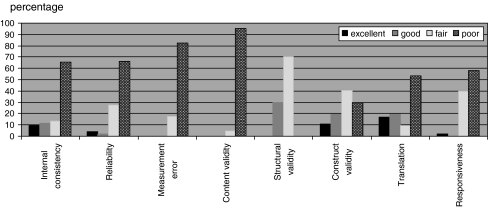
BACKGROUND: The COSMIN checklist is a standardized tool for assessing the methodological quality of studies on measurement properties. It contains 9 boxes, each dealing with one measurement property, with 5-18 items per box about design aspects and statistical methods. Our aim was to develop a scoring system for the COSMIN checklist to calculate quality scores per measurement property when using the checklist in systematic reviews of measurement properties. METHODS: The scoring system was developed based on discussions among experts and testing of the scoring system on 46 articles from a systematic review. Four response options were defined for each COSMIN item (excellent, good, fair, and poor). A quality score per measurement property is obtained by taking the lowest rating of any item in a box ("worst score counts"). RESULTS: Specific criteria for excellent, good, fair, and poor quality for each COSMIN item are described. In defining the criteria, the "worst score counts" algorithm was taken into consideration. This means that only fatal flaws were defined as poor quality. The scores of the 46 articles show how the scoring system can be used to provide an overview of the methodological quality of studies included in a systematic review of measurement properties. CONCLUSIONS: Based on experience in testing this scoring system on 46 articles, the COSMIN checklist with the proposed scoring system seems to be a useful tool for assessing the methodological quality of studies included in systematic reviews of measurement properties.
Overview
The claims and statistics of this paper haven’t been checked yet.
Free: it reads the open-access text and checks the first 5 claims that cite a source we can check. Create a free account to check every claim.
Integrity signals
Registry
Cites
Statistics
Figures
Verification
Claims the paper makes
The claims and statistics of this paper haven’t been checked yet.
Free: it reads the open-access text and checks the first 5 claims that cite a source we can check. Create a free account to check every claim.
Claims other papers make about this one
Each is checked against this paper’s own text: does it say what the citing paper says it does?
The source backs part of the claim, not all of it — or backs it for a different population, condition or comparison.
In the citing paper
“The sample size of this study met a standard for measurement properties (The COSMIN checklist; Terwee et al., 2012).”
From Reliability and validity of the Japanese version of the experiential avoidance in caregiving questionnaire (EACQ) (2023) · cites this paper as Terwee et al., 2012
Experimental — accuracy not yet measuredThe cited source says what the claim attributes to it.
In the citing paper
“The sample size of this study met a standard for measurement properties (The COSMIN checklist; Terwee et al., 2012).”
From Reliability and validity of the Japanese version of the Valued Living Questionnaire Adapted to Caregiving (2023) · cites this paper as Terwee et al., 2012
The cited source says what the claim attributes to it.
In the citing paper
“Third, since this study did not examine the responsiveness (Terwee et al., 2012) of the J-VLQAC, future research should assess this by examining whether the score of the J-VLQAC change through psychological intervention (e.g., ACT) for dementia family caregivers.”
From Reliability and validity of the Japanese version of the Valued Living Questionnaire Adapted to Caregiving (2023) · cites this paper as Terwee et al., 2012
The cited source says what the claim attributes to it.
In the citing paper
“This study examined the PAAQ-J’s reliability and validity according to COSMIN’s framework [27] (see also [28]).”
From Psychometric Properties of the Japanese Version of the Parental Acceptance and Action Questionnaire in Parents with Infants and Toddlers (2023) · cites this paper as [27]
Self-check
Percentages, sums and reported differences re-computed from the paper’s own numbers.
The self-check needs the paper’s full text.
Citations
Cites
GRADE: an emerging consensus on rating quality of evidence and strength of recommendations
Guyatt, G. H., Oxman, A. D., Vist, G. E., Kunz, R., Falck-Ytter, Y., Alonso-Coello, P., & Schünemann, H. J. (2008) · BMJ · doi:10.1136/bmj.39489.470347.ad · Cited by 23,305 · cited 2×
“This distinction is also increasingly being made in systematic reviews of randomized trials and diagnostic studies [13, 19].”
BackgroundMethodQuality criteria were proposed for measurement properties of health status questionnaires
Terwee, C. B., Bot, S. D. M., de Boer, M. R., van der Windt, D. A. W. M., Knol, D. L., Dekker, J., Bouter, L. M., & de Vet, H. C. W. (2007) · Journal of Clinical Epidemiology · doi:10.1016/j.jclinepi.2006.03.012 · Cited by 10,764 · cited 1×
“Other checklists that have been published, such as EMPRO [17], and a checklist we previously designed [18] were developed for rating the quality of an instrument rather than the methodological quality of a study.”
MethodSelf-citationApplied Multivariate Statistics for the Social Sciences
Stevens, J. P. (2012) · Routledge eBooks · doi:10.4324/9780203843130 · Cited by 10,648
Applied multivariate statistics for the social sciences
Stevens, J. P., & Stevens, J. P. (2001) · doi:10.4324/9781410604491 · Cited by 4,993
Mokkink, L. B., Terwee, C. B., Patrick, D. L., Alonso, J., Stratford, P. W., Knol, D. L., Bouter, L. M., & de Vet, H. C. W. (2010) · Quality of Life Research · doi:10.1007/s11136-010-9606-8 · Cited by 4,260 · cited 3×
“However, as we stated in the articles on the development of the COSMIN checklist [7, 8], what is adequate may depend on a number of issues.”
MethodSelf-citationMeasurement in Medicine: A Practical Guide
de Vet, H. C. W., Terwee, C. B., Mokkink, L. B., & Knol, D. L. (2011) · doi:10.1017/cbo9780511996214 · Cited by 2,321
Self-citationAssessing health status and quality-of-life instruments: Attributes and review criteria
Lohr, K. N. (2002) · Quality of Life Research · doi:10.1023/a:1015291021312 · Cited by 2,269
Mokkink, L. B., Terwee, C. B., Knol, D. L., Stratford, P. W., Alonso, J., Patrick, D. L., Bouter, L. M., & de Vet, H. C. (2010) · BMC Medical Research Methodology · doi:10.1186/1471-2288-10-22 · Cited by 1,834
Self-citation2009 updated method guidelines for systematic reviews in the Cochrane Back Review Group
Furlan, A. D., Pennick, V., Bombardier, C., & van Tulder, M. (2009) · Spine · doi:10.1097/brs.0b013e3181b1c99f · Cited by 1,663 · cited 1×
“In this systematic review, levels of evidence were used to rate the quality of the instruments, like is done in reviews of randomized clinical trials [13, 14 ].”
Method(2011) · Amsterdam UMC (VU Amsterdam) - Institutional Repository · Cited by 1,209
Self-citation
Research works printed but not linked: 1
- Higgins, J. P. T. & Green, S. (Eds.). (2009). Cochrane Handbook for Systematic Reviews of Interventions Version 5.0.2 [updated September 2009]. (Available from www.cochrane-handbook.org: Cochrane Collaboration).
Cited by
Items 601–700 of 1,005
Luquiens, A., Whalley, D., Laramée, P., Falissard, B., Kostogianni, N., Rehm, J., Manthey, J., Paille, F., & Aubin, H. J. (2016) · Quality of Life Research · doi:10.1007/s11136-015-1190-5 · Cited by 27
“Methodological quality of reporting of internal consistency, structural validity and hypothesis testing including convergent validity was excellent according to the COSMIN checklist [38].”
MethodNorris, R. N., Morrison, S., Price, A., Pulford, S., Meira, E. P., O’Neill, S., Williams, H., Maddox, T. W., Carter, P. M., & Oldershaw, R. A. (2023) · The Knee · doi:10.1016/j.knee.2023.12.006 · Cited by 27
Aburub, A. S., & Mayo, N. E. (2016) · Quality of Life Research · doi:10.1007/s11136-016-1458-4 · Cited by 27
Mayer, S., Paulus, A. T. G., Łaszewska, A., Simon, J., Drost, R. M. W. A., Ruwaard, D., & Evers, S. (2017) · PharmacoEconomics · doi:10.1007/s40273-017-0522-4 · Cited by 32
“by applying the COSMIN (COnsensusbased Standards for the selection of health Measurement INstruments) checklist [68], as was done by recent research [16, 66, 69].”
MethodGoo, M., Johnston, L. M., Hug, F., & Tucker, K. J. (2020) · Ultrasound in Medicine & Biology · doi:10.1016/j.ultrasmedbio.2020.04.009 · Cited by 27
Ressman, J., Grooten, W. J. A., & Rasmussen-Barr, E. (2021) · BMC Sports Science Medicine and Rehabilitation · doi:10.1186/s13102-021-00289-x · Cited by 31
“For reliability and validity studies a sample size of at least 50 measures is recommended [61, 62].”
BackgroundThe validity and reliability of the Japanese version of RU-SATED
Furihata, R., Tateyama, Y., Nakagami, Y., Akahoshi, T., Itani, O., Kaneita, Y., & Buysse, D. J. (2022) · Sleep Medicine · doi:10.1016/j.sleep.2022.02.014 · Cited by 27
Leahy, E. S., Davidson, M., Benjamin, D. R., & Wajswelner, H. (2015) · Manual Therapy · doi:10.1016/j.math.2015.10.010 · Cited by 27
“Two reviewers (EL, DB) independently assessed and rated each study's methodological quality using the COSMIN checklist (Mokkink et al., 2012; Terwee et al., 2012) which has been recommended for use in systematic reviews of PRO questionnaires (Mokkink et al., 2010b).”
MethodInfluentialVerschuren, O. W., Ketelaar, M., de Groot, J. F., Vila-Nova, F., & Takken, T. (2012) · Developmental Medicine & Child Neurology · doi:10.1111/dmcn.12052 · Cited by 27
Validation of the Dutch version of the critical‐care pain observation tool
Stilma, W., Rijkenberg, S., Feijen, H. M., Maaskant, J. M., & Endeman, H. (2015) · Nursing in Critical Care · doi:10.1111/nicc.12225 · Cited by 27
Holt, N., & Pincus, T. (2016) · BMC Musculoskeletal Disorders · doi:10.1186/s12891-016-1144-2 · Cited by 33
“This requires at least 50 participants to provide two sets of responses to the scale [26].”
BackgroundD'hondt, N. E., Kiers, H., Pool, J. J. M., Hacquebord, S. T., Terwee, C. B., & Veeger, H. E. J. (2016) · Physical Therapy · doi:10.2522/ptj.20160088 · Cited by 30
Self-citationMpundu‐Kaambwa, C., Chen, G., Huynh, E. K., Russo, R. N., & Ratcliffe, J. (2018) · Quality of Life Research · doi:10.1007/s11136-018-1837-0 · Cited by 37
“Quality scores or ranks for each measurement property, defined as excellent, good, fair or poor, were assigned to each measurement property based on the ‘worst score counts’ basis [35].”
MethodTak, I. J. R., Tijssen, M., Schamp, T., Sierevelt, I. N., Thorborg, K., Kerkhoffs, G. M. M. J., Stubbe, J. H., van Beijsterveldt, A.-M., & Haverkamp, D. (2018) · Journal of Orthopaedic and Sports Physical Therapy · doi:10.2519/jospt.2018.7883 · Cited by 27
Measuring outcomes following tibial fracture
Morris, R., Pallister, I., & Trickett, R. W. (2018) · Injury · doi:10.1016/j.injury.2018.11.025 · Cited by 27
Patient-reported outcome measures in subarachnoid hemorrhage: A systematic review
Nobels-Janssen, E., van der Wees, P. J., Verhagen, W. I. M., Westert, G. P., Bartels, R., & Boogaarts, J. H. D. (2019) · Neurology · doi:10.1212/wnl.0000000000007618 · Cited by 30
“The COSMIN criteria were used to assess whether the results of the measurement properties were sufficient, insufficient, or indeterminate (table 2).(13,15,16) We reviewed the measurement properties in duplicate (by E.”
MethodGagnier, J. J., & Johnston, B. C. (2019) · Journal of Clinical Epidemiology · doi:10.1016/j.jclinepi.2019.07.012 · Cited by 27
Education for sustainability and physical education: a systematic scoping review
Royet, T., Vors, O., Cece, V., & Lentillon‐Kaestner, V. (2024) · Sport Education and Society · doi:10.1080/13573322.2024.2440886 · Cited by 27
“…have been used for reviews (Aroma-taris et al., 2015), qualitative studies (Lockwood et al., 2015), quasi-experimental studies (Barker et al., 2024), cross-sectional studies (Moola et al., 2017), expert opinions (McArthur et al., 2020), and questionnaire validation studies (Terwee et al., 2012).”
Barsom, E. Z., van Hees, E., Bemelman, W. A., & Schijven, M. P. (2020) · International Journal of Technology Assessment in Health Care · doi:10.1017/s0266462320000367 · Cited by 28
“For each study, two independent reviewers (EZB and EVH) assessed the methodological quality of items based on a four-point rating scale (inadequate, doubtful, adequate, and very good) (10).”
MethodBraun, T., Thiel, C., Schulz, R. J., & Grüneberg, C. (2021) · Health and Quality of Life Outcomes · doi:10.1186/s12955-021-01690-3 · Cited by 26
“For the follow-up measures, we tried to include as many participants as possible, but targeted at least 100 participants [46].”
MethodThe scale for retropulsion: Internal consistency, reliability and construct validity
Bergmann, J., Krewer, C., Müller, F., & Jahn, K. (2021) · Annals of Physical and Rehabilitation Medicine · doi:10.1016/j.rehab.2021.101537 · Cited by 30
Faria, S. D. O., Hurwitz, G., Kim, J., Liberty, J., Orchard, K., Liu, G., Barbera, L. C., & Howell, D. (2021) · Journal of Clinical Medicine · doi:10.3390/jcm10184162 · Cited by 27
A Systematic Review of Self-Reported Stress Questionnaires in People on the Autism Spectrum
Thoen, A., Steyaert, J. G., Alaerts, K., Evers, K., & Damme, T. V. (2021) · Review Journal of Autism and Developmental Disorders · doi:10.1007/s40489-021-00293-4 · Cited by 28
Evaluation of Psychometric Properties of Hardiness Scales: A Systematic Review
Nia, H. S., Froelicher, E. S., Hosseini, L., & Farahani, M. A. (2022) · Frontiers in Psychology · doi:10.3389/fpsyg.2022.840187 · Cited by 26
Tegegn, H. G., Wark, S., d’Espaignet, E. T., & Spark, M. J. (2022) · Clinical Drug Investigation · doi:10.1007/s40261-022-01199-7 · Cited by 27
“The methodological quality for each measurement property and study, including PROM development studies, was evaluated and an overall rating score given for each PROM using COSMIN scoring [34, 41].”
MethodBraathen, T. N., Brage, S., Tellnes, G., & Eftedal, M. (2012) · Journal of Occupational Rehabilitation · doi:10.1007/s10926-012-9414-9 · Cited by 27
“They can also use the readiness for change model to tailor their interventions [8, 30].”
BackgroundMethodReliability and Validity of the Work Role Functioning Questionnaire (Spanish Version)
Ramada, J. M., Serra, C., Amick, B. C., Abma, F. I., Castaño, J. R., Pidemunt, G., Bültmann, U., & Delclos, G. L. (2014) · Journal of Occupational Rehabilitation · doi:10.1007/s10926-013-9495-0 · Cited by 31
“Before using an adapted instrument it is important to assess its measurement properties [24].”
MethodConijn, A. P., Bipat, S., Reekers, J. A., & Koelemay, M. J. W. (2016) · European Journal of Vascular and Endovascular Surgery · doi:10.1016/j.ejvs.2015.12.012 · Cited by 27
Duncan, R., Essat, M., Jones, G. L., Booth, A., Woods, H. B., Poku, E. N., Kaltenthaler, E., Keetharuth, A. D., Palfreyman, S. J., & Michaels, J. A. (2017) · British journal of surgery · doi:10.1002/bjs.10407 · Cited by 29
Gabel, C. P., Vargas, A. I. C., Qian, M., Vengust, R., Berlemann, U., Aghayev, E., & Melloh, M. (2017) · European Spine Journal · doi:10.1007/s00586-017-5179-3 · Cited by 26
Gridley, N., Blower, S. L., Dunn, A., Bywater, T. J., & Bryant, M. (2019) · Clinical Child and Family Psychology Review · doi:10.1007/s10567-019-00277-1 · Cited by 27
Validation and reliability of a Spanish version of Simple Shoulder Test (SST-Sp)
Membrilla-Mesa, M. D., Tejero-Fernández, V., Vargas, A. I. C., & Arroyo‐Morales, M. (2014) · Quality of Life Research · doi:10.1007/s11136-014-0760-2 · Cited by 25
“Stage 1 involved the initial Spanish translation and cross-cultural adaptation of the SST [16–19].”
BackgroundMethodPeripheral Nerve Blocks for Postdural Puncture Headache: A New Solution for an Old Problem?
Giaccari, L. G., Coppolino, F., Aurilio, C., Esposito, V., Passavanti, M. B., Passavanti, M. B., Pota, V., & Sansone, P. (2021) · In Vivo · doi:10.21873/invivo.12597 · Cited by 29
Developing and validating the nursing presence scale for hospitalized patients
Atashzadeh‐Shoorideh, F., Parvizy, S., Hosseini, M., Raziani, Y., & Mohammadipour, F. (2022) · BMC Nursing · doi:10.1186/s12912-022-00896-0 · Cited by 25
Systematic review of the psychometric properties of balance measures for cerebellar ataxia
Winser, S. J., Smith, C., Hale, L. A., Claydon, L. S., Whitney, S. L., & Mehta, P. (2014) · Clinical Rehabilitation · doi:10.1177/0269215514536412 · Cited by 28
Sathyananda, R. B., de Rijk, A. E., Manjunath, U., Krumeich, A. J. S. M., & van Schayck, O. C. P. (2018) · BMC Health Services Research · doi:10.1186/s12913-018-3423-0 · Cited by 25
“The complete evaluation of methodological characteristics as suggested by COSMIN and Noben and colleagues could not be applied, as methodologies of the articles selected were not advanced enough [27, 28].”
MethodIshaque, S., Johnson, J. A., & Vohra, S. (2018) · Quality of Life Research · doi:10.1007/s11136-018-2046-6 · Cited by 25
Hamzeh, J., Pluye, P., Bush, P. L., Ruchon, C., Vedel, I., & Hudon, C. (2018) · Evaluation and Program Planning · doi:10.1016/j.evalprogplan.2018.12.003 · Cited by 27
Dekkers, K. J. F. M., Janssen‐Potten, Y., Gordon, A. M., Speth, L. A. W. M., Smeets, R., & Rameckers, E. A. A. (2019) · Disability and Rehabilitation · doi:10.1080/09638288.2018.1524522 · Cited by 26
“The purpose of this paper is to investigate the test–retest and inter-rater reliability (including SEM and SDC) of maximum isometric arm strength (IAS) measurements using the HHD and maximum isometric grip and pinch strength (IGPS) measurements using the Biometrics E-Link Evaluation System (digitalized handdynamometer…”
MethodTsang, C. S. L., Chong, D. Y. K., & Pang, M. Y. C. (2019) · Clinical Rehabilitation · doi:10.1177/0269215519828146 · Cited by 27
Gärtner, F. R., Marinus, J., van den Hout, W. B., Vleggeert-Lankamp, C. L. A., & Stiggelbout, A. M. (2019) · Disability and Rehabilitation · doi:10.1080/09638288.2018.1534996 · Cited by 29
“The final questionnaire in Dutch and English is presented as Supplementary Material.”
MethodAnderson, D., Mathieson, S., Eyles, J. P., Maher, C. G., van Gelder, J. M., Tomkins‐Lane, C., Ammendolia, C., Bella, V., & Ferreira, M. L. (2019) · The Spine Journal · doi:10.1016/j.spinee.2019.04.004 · Cited by 25
Dobbs, T. D., Samarendra, H., Hughes, S., Hutchings, H. A., & Whitaker, I. S. (2018) · British Journal of Dermatology · doi:10.1111/bjd.17342 · Cited by 27
Alreni, A. S. E., Harrop, D., Lowe, A. C., Potia, T., Kilner, K., & McLean, S. M. (2017) · Musculoskeletal Science and Practice · doi:10.1016/j.msksp.2017.02.004 · Cited by 28
“(2013, 2014) and the COSMIN checklist (Mokkink et al., 2010; Terwee et al., 2012) was used to capture study specific (population, intervention, and setting) and”
BackgroundMethodInfluentialMeesters, N. J., Dilles, T., Simons, S. H. P., & van Dijk, M. (2018) · Journal of Pain · doi:10.1016/j.jpain.2018.12.005 · Cited by 24
Huang, Y., Lin, G., Lee, S., & Hsieh, C. (2019) · Journal of Geriatric Physical Therapy · doi:10.1519/jpt.0000000000000247 · Cited by 24
Measures Evaluating Patient Satisfaction in Integrated Health Care Settings: A Systematic Review
Black, D., Held, M. L., Skeesick, J., & Peters, T. (2021) · Community Mental Health Journal · doi:10.1007/s10597-020-00760-y · Cited by 25
Carlton, J., Leaviss, J., Pouwer, F., Hendrieckx, C., Broadley, M. M., Clowes, M., McCrimmon, R. J., Heller, S. R., & Speight, J. (2021) · Diabetologia · doi:10.1007/s00125-021-05382-x · Cited by 25
Aljathlani, M. F., Alshammari, M. O., Alsuwaygh, M. A., Al-Mutairi, M. S., Aljassir, F. F., Bindawas, S. M., & Alnahdi, A. H. (2021) · Disability and Rehabilitation · doi:10.1080/09638288.2021.1947396 · Cited by 24
Gerber, C. N., Labruyère, R., & van Hedel, H. J. A. (2015) · Neurorehabilitation and neural repair · doi:10.1177/1545968315583723 · Cited by 26
Measurement properties of instruments assessing self-efficacy in patients with rheumatic diseases
Garratt, A., Løchting, I., Smedslund, G., & Hagen, K. B. (2013) · Rheumatology · doi:10.1093/rheumatology/ket374 · Cited by 31
Satisfaction with Life Scale (SLS-6): First validation study in Parkinson's disease population
Ambrosio, L., Portillo, M. C., Rodríguez‐Blázquez, C., Martínez‐Castrillo, J. C., Rodríguez‐Violante, M., Serrano‐Dueñas, M., Arillo, V. M. C., Garretto, N., Arakaki, T., Álvarez, M., et al. (2016) · Parkinsonism & Related Disorders · doi:10.1016/j.parkreldis.2016.02.012 · Cited by 26
“Therefore, the following minimal sample sizes were stipulated: (1) 50 patients per country, a number necessary to determine a diversity of scale psychometric attributes at a local level [19], and (2) a minimum of 300 patients for the total sample, according to recommendations [18,20].”
BackgroundKaiser, U., Neustadt, K., Kopkow, C., Schmitt, J. M., & Sabatowski, R. (2016) · Healthcare · doi:10.3390/healthcare4030063 · Cited by 25
“The work of the COSMIN group is therefore promising and gratifying [11,12,14].”
BackgroundChiu, A. Y. Y., & Pang, M. Y. C. (2017) · Journal of Orthopaedic and Sports Physical Therapy · doi:10.2519/jospt.2017.7283 · Cited by 24
Validation of French upper limb Erasmus modified Nottingham Sensory Assessment in stroke
Villepinte, C., Catella, E., Martin, M., Hidalgo, S., Téchené, S., Lebely, C., Castel-Lacanal, E., Boissezon, X. D., Chih, H., & Gasq, D. (2018) · Annals of Physical and Rehabilitation Medicine · doi:10.1016/j.rehab.2018.03.004 · Cited by 26
Inter‐ and intra‐rater reliability of ultrasound tissue characterization (UTC) in patellar tendons
van Ark, M., Rabello, L. M., Hoevenaars, D., Meijerink, J., van Gelderen, N., Zwerver, J., & van den Akker‐Scheek, I. (2019) · Scandinavian Journal of Medicine and Science in Sports · doi:10.1111/sms.13439 · Cited by 24
Rencz, F., Szabó, Á., & Brodszky, V. (2021) · Value in Health · doi:10.1016/j.jval.2021.02.006 · Cited by 29
Sultan, P., Ando, K., Sultan, E., Hawkins, J. E., Blake, L., Barwick, F. H., Kawai, M., & Carvalho, B. (2021) · SLEEP · doi:10.1093/sleep/zsab128 · Cited by 24
Brief Autism Mealtime Behavior Inventory (BAMBI): Italian Translation and Validation
Lamboglia, A., Romano, R., Valente, D., Berardi, A., Cavalli, G., Giovannone, F., Sogos, C., Tofani, M., & Galeoto, G. (2023) · Children · doi:10.3390/children10071201 · Cited by 23
“However, test–retest reliability is an important psychometric property for determining the appropriateness of measurement tool [51], and BAMBI was seen as a reliable tool over time.”
MethodAlnahdi, A. H. (2021) · Musculoskeletal Science and Practice · doi:10.1016/j.msksp.2021.102372 · Cited by 23
Digital transformation of accounting practices and behavior during COVID-19: MENA evidence
Feghali, K., Matta, J., & Moussa, S. (2022) · Accounting and Management Information Systems · doi:10.24818/jamis.2022.02005 · Cited by 36
Moral resilience in registered nurses: Cultural adaption and validation study
Tian, X., He, Q., Liu, X., Gan, X., & Herrera, M. (2023) · Nursing Ethics · doi:10.1177/09697330231196229 · Cited by 23
“39 Translation, back-translation, and cultural adaptation of the RMRS We emailed the authors to get permission to use and translate the original RMRS.”
MethodPsychometric validation of the authorized Polish version of the Neck Disability Index
Guzy, G., Vernon, H. T., Polczyk, R., & Szpitalak, M. (2013) · Disability and Rehabilitation · doi:10.3109/09638288.2013.771706 · Cited by 23
“The translation process conducted by the MAPI group described above adhered to the COSMIN group requirements [11] with respect to determining face validity.”
MethodPatient-Reported Mobility: A Systematic Review
Pinto‐Carral, A., Fernández‐Villa, T., & Molina, A. J. (2016) · Archives of Physical Medicine and Rehabilitation · doi:10.1016/j.apmr.2016.01.025 · Cited by 23
van Egmond, M. M. H. T., van Heerbeek, N., Haar, E., & Rovers, M. M. (2017) · Rhinology Journal · doi:10.4193/rhin16.296 · Cited by 28
“Furthermore, analyses were conducted in adequately sized samples according to the COSMIN checklist, in which a sample of 30 patients is considered ‘fair’ and more than 100 patients is regarded as ‘excellent’ (30).”
Methodde Klerk, S., Buchanan, H., & Jerosch‐Herold, C. (2017) · Journal of Hand Therapy · doi:10.1016/j.jht.2017.10.004 · Cited by 24
Duncan, L., Comeau, J., Wang, L., Vitoroulis, I., Boyle, M. H., & BENNETT, K. J. (2018) · Journal of Child Psychology and Psychiatry · doi:10.1111/jcpp.12876 · Cited by 28
Validation of the Danish version of the musculoskeletal tumour society score questionnaire
Sæbye, C., Keller, J. O., & Baad‐Hansen, T. (2019) · World Journal of Orthopedics · doi:10.5312/wjo.v10.i1.23 · Cited by 23
A Systematic Review of the Psychometric Properties of the Geriatric Anxiety Inventory
Champagne, A., Landreville, P., & Gosselin, P. (2020) · Canadian Journal on Aging / La Revue canadienne du vieillissement · doi:10.1017/s0714980820000185 · Cited by 28
“For each measurement property, an overall score is determined by taking the lowest rating of any of the box items (worst score counts method; Terwee et al., 2012).”
Witkamp, F. E., van Zuylen, L., van der Rijt, C. C. D., & van der Heide, A. (2013) · Research in Nursing & Health · doi:10.1002/nur.21551 · Cited by 23
“We performed six psychometric tests on the second to fourth parts of the questionnaire to validate the MOVE2PC, according to the COSMIN checklist, which was originally developed for health-related patient-reported outcomes (Terwee et al., 2012).”
BackgroundMethodVeldman, K., Reijneveld, S. A., Lahr, M. M. H., Uittenbroek, R. J., & Wynia, K. (2016) · Health Expectations · doi:10.1111/hex.12488 · Cited by 23
Mohammed, M. A., Moles, R. J., & Chen, T. F. (2018) · International Journal of Clinical Pharmacy · doi:10.1007/s11096-017-0582-8 · Cited by 23
Beemster, T. T., van Velzen, J. M., van Bennekom, C. A. M., Reneman, M. F., & Frings‐Dresen, M. H. W. (2018) · Journal of Occupational Rehabilitation · doi:10.1007/s10926-018-9767-9 · Cited by 26
“50 to 99 patients are needed to obtain reasonable responsiveness scores [33].”
BackgroundMeasuring trust in one’s physician: A scoping review
Weber, L. R. (2024) · PLoS ONE · doi:10.1371/journal.pone.0303840 · Cited by 24
“Third, a new and noteworthy advancement in psychometric testing of cross-cultural stability or invariance has been the introduction of item-response theory and testing of measurement invariance [26, 27] of the WFTS-SF by Petrocchi et al. [22] and of the SCTPSD by Gopichandran et al. [21].”
BackgroundA Systematic Review of the Reliability and Validity of the Patient Activation Measure Tool
Ng, Q. X., Liau, M. Y. Q., Tan, Y. Y., Tang, A. S. P., Ong, C., Thumboo, J., & Lee, C. E. (2024) · Healthcare · doi:10.3390/healthcare12111079 · Cited by 22
“The included studies were graded according to the COSMIN checklist [13,14] by M.Y.Q.L., A.S.P.T. and Q.X.N.”
MethodFugl-Meyer Assessment for upper extremity in stroke: A pyschometric systematic review
de Blas-Zamorano, P., Montagut‐Martínez, P., Pérez-Cruzado, D., & Merchán-Baeza, J. A. (2025) · Journal of Hand Therapy · doi:10.1016/j.jht.2025.04.004 · Cited by 29
The constructs of health literacy in children: a systematic review
Bakhtiarvand, S. Z., Rahaei, Z., Sadeghian, H. A., Fatehi, F., Soltani, S., Zareiyan, A., & Nutbeam, D. (2025) · BMC Public Health · doi:10.1186/s12889-025-24573-4 · Cited by 26
“…for cohort, case-control, and qualitative studies [45], the Joanna Briggs Institute (JBI) Critical Appraisal Checklist for cross-sectional studies [46], and the Consensus-based Standards for the Selection of Health Measurement Instruments (COSMIN) checklist for tool development studies [47, 48].”
Measuring Physical Activity Using Triaxial Wrist Worn Polar Activity Trackers: A Systematic Review
Henriksen, A., Johansson, J., Hartvigsen, G., Grimsgaard, S., & Hopstock, L. A. (2020) · International journal of exercise science · doi:10.70252/rptd5267 · Cited by 29
“Included studies were assessed for risk of bias using a modified criterion validity subscale (42) from the Consensus-Based Standards for the Selection of Health Status Measurement Instruments (COSMIN) checklist (25).”
MethodTozzo, M. C., Ansanello, W., Martins, J., Zatiti, S. C. A., & de Oliveira, A. S. (2021) · Journal of Manipulative and Physiological Therapeutics · doi:10.1016/j.jmpt.2020.12.001 · Cited by 22
Phillips, S. M., Summerbell, C., Ball, H. L., Hesketh, K. R., Saxena, S. K., & Hillier-Brown, F. C. (2021) · Frontiers in Pediatrics · doi:10.3389/fped.2021.770262 · Cited by 22
“, if one item was scored as “inadequate”, the overall score of the measurement property in that study would be “inadequate”) (44).”
BackgroundA Systematic Review of Mental Health Literacy Measures for Children and Adolescents
Kučera, M., Tomášková, H., Stodola, M., & Kågström, A. (2023) · Adolescent Research Review · doi:10.1007/s40894-022-00202-8 · Cited by 22
“To assess methodological quality of studies included in the systematic review of Patient-Reported Outcome Measures (PROMs), the Consensus-based Standards for the selection of health measurement instruments (COSMIN) guideline for systematic reviews (Terwee et al., 2012) was applied.”
MethodInfluentialHotchkiss, J. T., Cook‐Cottone, C. P., Wong, M. Y. C., Guyker, W. M., & Garcia, A. C. M. (2023) · Mindfulness · doi:10.1007/s12671-023-02196-3 · Cited by 22
Vagnetti, R., Camp, N., Story, M., Belaid, K. A., Mitra, S., Zecca, M., Nuovo, A. G. D., & Magistro, D. (2024) · Journal of Medical Internet Research · doi:10.2196/55597 · Cited by 23
“These reviews are valuable because they consider both the instrument psychometric properties and the methodological quality of the studies conducted to assess them [33].”
BackgroundPeter, W. F., Loos, M.-L. H. J., de Vet, H. C. W., Boers, M., Harlaar, J., Roorda, L. D., Poolman, R. W., Scholtes, V. A., Boogaard, J., Buitelaar, H., et al. (2014) · Arthritis Care & Research · doi:10.1002/acr.22386 · Cited by 25
“According to the COSMIN guidelines, a sample of 100 is considered excellent quality for validation purposes, and a sample of 30 is considered fair quality, which we considered good enough quality for analyzing the first results (35).”
MethodSelf-citationDobson, F., Choi, Y. M., Hall, M., & Hinman, R. S. (2012) · Arthritis Care & Research · doi:10.1002/acr.21707 · Cited by 24
“In the absence of sample size calculations, a sample size of less than 30 receives a poor rating using the COSMIN checklist (24,50).”
MethodInfluentialLee, W. L., Chinna, K., Bulgiba, A. M., Abdullah, K. L., Abidin, I. Z., & Höfer, S. (2015) · Quality of Life Research · doi:10.1007/s11136-015-1097-1 · Cited by 24
“Following unfavorable findings in the systematic reviews [5, 6], a recent call for higher standards of conducting and reporting test–retest study was made [7–9].”
BackgroundInfluentialHughes, S., Rapport, F., Boisvert, I., McMahon, C. M., & Hutchings, H. A. (2017) · BMJ Open · doi:10.1136/bmjopen-2016-014995 · Cited by 28
“Each item will be given a rating using a 4-point rating scale (ie, ‘poor’, ‘fair’, ‘good’ and ‘excellent’).(23) An overall score for each measurement property will be assigned by taking the lowest rating of any item within a box (ie, ‘worst score counts’).”
MethodAiyegbusi, O. L., Kyte, D. G., Cockwell, P., Marshall, T. P., Dutton, M., Slade, A. L., Marklew, N., Price, G. W., Verdi, R., Waters, J., et al. (2017) · BMJ Open · doi:10.1136/bmjopen-2017-016687 · Cited by 23
“Sample size We will recruit up to 30 patients from QEHB for this study based on the recommendations found in literature.(25) The process of improving the usability of any system is an iterative one(22); therefore, a minimum of two testing cycles will be conducted with the patients.”
Silva, A. G., Cerqueira, M., Santos, A. R., Ferreira, C., Alvarelhão, J., & Queirós, A. (2017) · Disability and Rehabilitation · doi:10.1080/09638288.2017.1393112 · Cited by 24
“The COSMIN group suggests a minimum of 100 participants for reliability studies [26].”
BackgroundBarroso, B. I. D. L., Galvão, C. R. C., da Silva, L. B., & Lancman, S. (2018) · Occupational Therapy International · doi:10.1155/2018/4984170 · Cited by 22
“Although the searches were conducted in the most used databases, using all the 27 items of the checklist included in the report of the systematic review and metaanalysis [12, 13, 18], some studies may not have been included in this systematic review.”
BackgroundMethodResultInfluentialMiyamori, T., Nagao, M., Sawa, R., Tumilty, S., Yoshimura, M., Saita, Y., Ikeda, H., & Kaneko, K. (2019) · BMJ Open · doi:10.1136/bmjopen-2018-022864 · Cited by 22
Chávez-Flores, Y. V., Hidalgo-Rasmussen, C. A., & Yanez-Peñúñuri, L. Y. (2019) · Ciência & Saúde Coletiva · doi:10.1590/1413-81232018248.18502017 · Cited by 28
Vrieze, T. D., Gebruers, N., Nevelsteen, I., Tjalma, W. A. A., Thomis, S., Groef, A. D., Dams, L., & Devoogdt, N. (2020) · Lymphatic Research and Biology · doi:10.1089/lrb.2019.0073 · Cited by 26
“32,33 The definition of responsiveness according to the COSMIN initiative is ‘‘the ability of a health-related patient reported outcome instrument to detect change over time in the construct to be measured.’’”
Arensman, R. M., Geelen, R. H. J. G., Koppenaal, T., Veenhof, C., & Pisters, M. F. (2020) · Physiotherapy Theory and Practice · doi:10.1080/09593985.2020.1818337 · Cited by 25
“A priori, a sample size of 50 participants for both the validity and the reliability testing was used in accordance with the recommendations made for a good rating by the COSMIN initiative (Terwee et al., 2012).”
MethodInstruments for measuring nursing research competence: a protocol for a scoping review
Chen, Q., Huang, C., Castro, A. R., & Tang, S. (2021) · BMJ Open · doi:10.1136/bmjopen-2020-042325 · Cited by 22
Participation Measures for Infants and Toddlers Aged Birth to 23 Months: A Systematic Review
Mobbs, C. A., Spittle, A. J., & Johnston, L. M. (2021) · Physical & Occupational Therapy In Pediatrics · doi:10.1080/01942638.2021.1900488 · Cited by 23
A systematic review assessing the quality of patient reported outcomes measures in dry eye diseases
Recchioni, A., Aiyegbusi, O. L., Rivera, S. C., Rauz, S., & Slade, A. L. (2021) · PLoS ONE · doi:10.1371/journal.pone.0253857 · Cited by 25
“This study is the first to undertake a systematic review of PROMs used in DED and OSD, in accordance with the PRISMA [52] and COSMIN guidelines [24].”
MethodRomeo, A., Baccini, M., Carreras, G., Sagripanti, M., Ruggeri, M., Pillastrini, P., & Bari, M. D. (2022) · Physical Therapy · doi:10.1093/ptj/pzac054 · Cited by 24
Romli, M. H., Mackenzie, L. A., Lovarini, M., Tan, M. P., & Clemson, L. M. (2017) · Journal of Evaluation in Clinical Practice · doi:10.1111/jep.12697 · Cited by 24
“Although the interrater reliability study achieved a sample size considered to be adequate for a good quality study, and the test‐retest reliability study was considered to be adequate for a fair quality study, a larger sample size for both studies would have improved the quality of the study results.(20) The proporti…”
MethodResultInfluentialOliveira, A., & Marques, A. S. P. D. D. (2017) · Physical Therapy · doi:10.1093/ptj/pzx122 · Cited by 24
Metadata
- Authors
- Terwee, C. B., Mokkink, L. B., Knol, D. L., Ostelo, R. W. J. G., Bouter, L. M., & de Vet, H. C. W.
- Affiliations
- Amsterdam Public Health (NL)
- Vrije Universiteit Amsterdam (NL)
- Corresponding author
- Terwee, Caroline B.
- Venue
- Quality of Life Research
- Published
- 2011-07-06
- Volume
- 21
- Issue
- 4
- Pages
- 651-657
- ISSN
- 0962-9343 (ISSN-L)
- 1573-2649
- PMC
- PMC3323819
- OpenAlex
- W2151199180
- Semantic Scholar
- 80858ac3671354dc3bf1b226c74eb8fe0513fb26
- Cited by
- 1,978
- References
- 23
- Citations by year
- 2026: 81 · 2025: 118 · 2024: 148 · 2023: 161 · 2022: 164 · 2021: 226 · 2020: 150 · 2019: 172 · 2018: 181 · 2017: 172 · 2016: 142 · 2015: 106 · 2014: 80 · 2013: 45 · 2012: 25
- FWCI
- 12.05
- Type
- journal article
- Language
- en
- Open access
- hybrid
- doi.org
- Licence
- cc-by-nc
- creativecommons.org/licenses/by-nc/2.0 (tdm)
- Locations
- Quality of Life Research (publishedVersion, cc-by-nc)
- Europe PMC (PubMed Central) (publishedVersion, cc-by-nc)
- PubMed Central (publishedVersion, cc-by-nc)
- PubMed (publishedVersion)
- Pure Amsterdam UMC (publishedVersion, other-oa)
- VU Research Portal (publishedVersion, other-oa)
- Amsterdam UMC (VU Amsterdam) - Institutional Repository (acceptedVersion, other-oa)
- Data Archiving and Networked Services (DANS) (submittedVersion, other-oa)
- Digital Academic REpository of VU University Amsterdam (Vrije Universiteit Amsterdam) (submittedVersion)
- Topics
- Social Sciences › Decision Sciences › Statistics, Probability and Uncertainty › Meta-analysis and systematic reviews
- Social Sciences › Sociology and Political Science › Delphi Technique in Research
- Health Sciences › Nursing › Research and Theory › Health Education and Validation
- Keywords
- COSMIN checklist, measurement properties, methodological quality assessment, scoring system, quality scores, systematic reviews, patient-reported outcome measures, quality standards
- MeSH terms
- Humans, Psychometrics, Quality Control, Quality of Life, Surveys and Questionnaires, Review Literature as Topic, Reproducibility of Results, Checklist
About these checks
Registry, retraction, Cites and statistics results are computed, not judged, with one exception: a printed reference that no index lists is read once by a model before it counts as a citation error. Claims are extracted by a model and kept only when their quote appears verbatim in the text; each cited source is then checked, with a model’s help, for whether it says what the claim relies on. Those verdicts can be wrong — read the claim’s quote and the cited source before relying on one.
Statistics and arithmetic are recomputed, not judged.
Confidence bands are shown only for fields calibrated on our annotated test set. None is calibrated yet, so no band is shown.
What counts as a claim ›How we measure confidence ›How we check this ›
Are you an author, or do you see a problem with this page? Request a review
Data sources
Bibliographic data: Semantic Scholar, OpenAlex, Crossref.
Contains information from the Semantic Scholar Academic Graph Datasets, made available under the ODC Attribution License (ODC-BY 1.0).
Semantic Scholar’s data is described in: Kinney, R., et al. (2023). The Semantic Scholar Open Data Platform. arXiv:2301.10140.
