

Rating the methodological quality in systematic reviews of studies on measurement properties: a scoring system for the COSMIN checklist
Open accessThe DOI matches its Crossref record; 23 of the 23 references it cites were found in a registry or an index.
Abstract
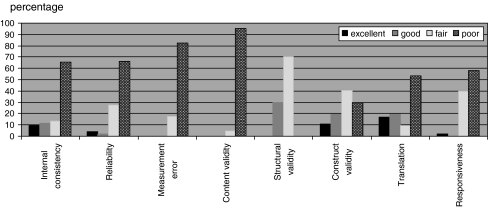
BACKGROUND: The COSMIN checklist is a standardized tool for assessing the methodological quality of studies on measurement properties. It contains 9 boxes, each dealing with one measurement property, with 5-18 items per box about design aspects and statistical methods. Our aim was to develop a scoring system for the COSMIN checklist to calculate quality scores per measurement property when using the checklist in systematic reviews of measurement properties. METHODS: The scoring system was developed based on discussions among experts and testing of the scoring system on 46 articles from a systematic review. Four response options were defined for each COSMIN item (excellent, good, fair, and poor). A quality score per measurement property is obtained by taking the lowest rating of any item in a box ("worst score counts"). RESULTS: Specific criteria for excellent, good, fair, and poor quality for each COSMIN item are described. In defining the criteria, the "worst score counts" algorithm was taken into consideration. This means that only fatal flaws were defined as poor quality. The scores of the 46 articles show how the scoring system can be used to provide an overview of the methodological quality of studies included in a systematic review of measurement properties. CONCLUSIONS: Based on experience in testing this scoring system on 46 articles, the COSMIN checklist with the proposed scoring system seems to be a useful tool for assessing the methodological quality of studies included in systematic reviews of measurement properties.
Overview
The claims and statistics of this paper haven’t been checked yet.
Free: it reads the open-access text and checks the first 5 claims that cite a source we can check. Create a free account to check every claim.
Integrity signals
Registry
Cites
Statistics
Figures
Verification
Claims the paper makes
The claims and statistics of this paper haven’t been checked yet.
Free: it reads the open-access text and checks the first 5 claims that cite a source we can check. Create a free account to check every claim.
Claims other papers make about this one
Each is checked against this paper’s own text: does it say what the citing paper says it does?
The source backs part of the claim, not all of it — or backs it for a different population, condition or comparison.
In the citing paper
“The sample size of this study met a standard for measurement properties (The COSMIN checklist; Terwee et al., 2012).”
From Reliability and validity of the Japanese version of the experiential avoidance in caregiving questionnaire (EACQ) (2023) · cites this paper as Terwee et al., 2012
Experimental — accuracy not yet measuredThe cited source says what the claim attributes to it.
In the citing paper
“The sample size of this study met a standard for measurement properties (The COSMIN checklist; Terwee et al., 2012).”
From Reliability and validity of the Japanese version of the Valued Living Questionnaire Adapted to Caregiving (2023) · cites this paper as Terwee et al., 2012
The cited source says what the claim attributes to it.
In the citing paper
“Third, since this study did not examine the responsiveness (Terwee et al., 2012) of the J-VLQAC, future research should assess this by examining whether the score of the J-VLQAC change through psychological intervention (e.g., ACT) for dementia family caregivers.”
From Reliability and validity of the Japanese version of the Valued Living Questionnaire Adapted to Caregiving (2023) · cites this paper as Terwee et al., 2012
The cited source says what the claim attributes to it.
In the citing paper
“This study examined the PAAQ-J’s reliability and validity according to COSMIN’s framework [27] (see also [28]).”
From Psychometric Properties of the Japanese Version of the Parental Acceptance and Action Questionnaire in Parents with Infants and Toddlers (2023) · cites this paper as [27]
Self-check
Percentages, sums and reported differences re-computed from the paper’s own numbers.
The self-check needs the paper’s full text.
Citations
Cites
GRADE: an emerging consensus on rating quality of evidence and strength of recommendations
Guyatt, G. H., Oxman, A. D., Vist, G. E., Kunz, R., Falck-Ytter, Y., Alonso-Coello, P., & Schünemann, H. J. (2008) · BMJ · doi:10.1136/bmj.39489.470347.ad · Cited by 23,305 · cited 2×
“This distinction is also increasingly being made in systematic reviews of randomized trials and diagnostic studies [13, 19].”
BackgroundMethodQuality criteria were proposed for measurement properties of health status questionnaires
Terwee, C. B., Bot, S. D. M., de Boer, M. R., van der Windt, D. A. W. M., Knol, D. L., Dekker, J., Bouter, L. M., & de Vet, H. C. W. (2007) · Journal of Clinical Epidemiology · doi:10.1016/j.jclinepi.2006.03.012 · Cited by 10,764 · cited 1×
“Other checklists that have been published, such as EMPRO [17], and a checklist we previously designed [18] were developed for rating the quality of an instrument rather than the methodological quality of a study.”
MethodSelf-citationApplied Multivariate Statistics for the Social Sciences
Stevens, J. P. (2012) · Routledge eBooks · doi:10.4324/9780203843130 · Cited by 10,648
Applied multivariate statistics for the social sciences
Stevens, J. P., & Stevens, J. P. (2001) · doi:10.4324/9781410604491 · Cited by 4,993
Mokkink, L. B., Terwee, C. B., Patrick, D. L., Alonso, J., Stratford, P. W., Knol, D. L., Bouter, L. M., & de Vet, H. C. W. (2010) · Quality of Life Research · doi:10.1007/s11136-010-9606-8 · Cited by 4,260 · cited 3×
“However, as we stated in the articles on the development of the COSMIN checklist [7, 8], what is adequate may depend on a number of issues.”
MethodSelf-citationMeasurement in Medicine: A Practical Guide
de Vet, H. C. W., Terwee, C. B., Mokkink, L. B., & Knol, D. L. (2011) · doi:10.1017/cbo9780511996214 · Cited by 2,321
Self-citationAssessing health status and quality-of-life instruments: Attributes and review criteria
Lohr, K. N. (2002) · Quality of Life Research · doi:10.1023/a:1015291021312 · Cited by 2,269
Mokkink, L. B., Terwee, C. B., Knol, D. L., Stratford, P. W., Alonso, J., Patrick, D. L., Bouter, L. M., & de Vet, H. C. (2010) · BMC Medical Research Methodology · doi:10.1186/1471-2288-10-22 · Cited by 1,834
Self-citation2009 updated method guidelines for systematic reviews in the Cochrane Back Review Group
Furlan, A. D., Pennick, V., Bombardier, C., & van Tulder, M. (2009) · Spine · doi:10.1097/brs.0b013e3181b1c99f · Cited by 1,663 · cited 1×
“In this systematic review, levels of evidence were used to rate the quality of the instruments, like is done in reviews of randomized clinical trials [13, 14 ].”
Method(2011) · Amsterdam UMC (VU Amsterdam) - Institutional Repository · Cited by 1,209
Self-citation
Research works printed but not linked: 1
- Higgins, J. P. T. & Green, S. (Eds.). (2009). Cochrane Handbook for Systematic Reviews of Interventions Version 5.0.2 [updated September 2009]. (Available from www.cochrane-handbook.org: Cochrane Collaboration).
Cited by
Items 401–500 of 1,005
Chorna, O. D., Guzzetta, A., & Maitre, N. L. (2017) · Pediatric Neurology · doi:10.1016/j.pediatrneurol.2017.07.011 · Cited by 46
“Assessment publications reporting instruments specifically designed for infants at high risk or with a diagnosis of CP were evaluated with a checklist of Consensus-based Standards for the selection of health Measurement Instruments (COSMIN).(8) It is a 4-point scale that evaluates psychometric properties including rel…”
MethodOhno, S., Takahashi, K., Inoue, A., Takada, K., Ishihara, Y., Tanigawa, M., & Hirao, K. (2017) · Journal of Evaluation in Clinical Practice · doi:10.1111/jep.12795 · Cited by 44
“The strengths of this study include the complete dataset and full participation rates at both time points as well as a sufficient sample size (≥100).(48) In conclusion, we believe that the findings of this research will further elucidate changes in CES‐D, GSES, and GHQ‐12 scores in a young adult population.”
MethodResultPatient-Reported Outcome Measures in Pruritus: A Systematic Review of Measurement Properties
Schoch, D., Sommer, R., Augustin, M., Ständer, S., & Blome, C. (2017) · Journal of Investigative Dermatology · doi:10.1016/j.jid.2017.05.020 · Cited by 47
Spanish version of the Parenting Sense of Competence scale: Evidence of reliability and validity
Oltra‐Benavent, P., Cano‐Climent, A., Oliver‐Roig, A., Cabrero‐García, J., & Richart‐Martínez, M. (2019) · Child & Family Social Work · doi:10.1111/cfs.12693 · Cited by 48
Cross cultural adaptation and validation of a Spanish version of the lower limb functional index
Vargas, A. I. C., Gabel, C. P., & Bennett, P. J. (2014) · Health and Quality of Life Outcomes · doi:10.1186/1477-7525-12-75 · Cited by 44
“The LLFI-Sp baseline and the repeated measures, taken at seven days [47] following a period during which there was no treatment, were both expressed with a 95% CI.”
MethodPaalman, C. H., Terwee, C. B., Jansma, E. P., & Jansen, L. M. C. (2013) · PLoS ONE · doi:10.1371/journal.pone.0063109 · Cited by 47
“The COSMIN checklist includes guidelines for rating of each item [46].”
MethodSelf-citationDoma, K., Speyer, R., Leicht, A. S., & Cordier, R. (2017) · International Journal of Behavioral Nutrition and Physical Activity · doi:10.1186/s12966-017-0470-6 · Cited by 47
“Quality of studies using the COSMIN taxonomy According to the COSMIN taxonomy, the reliability domain consists of internal consistency, reliability testing and measurement error [15].”
MethodInfluentialSystematic review of the psychometric properties of instruments to measure sexual desire
Cartagena-Ramos, D., Fuentealba-Torres, M., Rebustini, F., Leite, A. C. A. B., Alvarenga, W. D. A., Arcêncio, R. A., Dantas, R. A. S., & Nascimento, L. C. (2018) · BMC Medical Research Methodology · doi:10.1186/s12874-018-0570-2 · Cited by 43
Davies, C. F., Macefield, R. C., AVERY, K. N. L., Blazeby, J. M., & Potter, S. (2020) · Annals of Surgical Oncology · doi:10.1245/s10434-020-08736-8 · Cited by 48
Miller, T., Ying, M. T. C., Tsang, C. S. L., Huang, M., & Pang, M. Y. C. (2020) · Physical Therapy · doi:10.1093/ptj/pzaa188 · Cited by 43
Lazor, T., Tigelaar, L., Pole, J. D., De Souza, C., Tomlinson, D., & Sung, L. (2017) · Supportive Care in Cancer · doi:10.1007/s00520-017-3743-3 · Cited by 42
“Each item in each relevant box in the checklist is scored according to four response options: excellent, good, fair, and poor quality [38].”
Anand, E., Devi, J., Ballard, D. H., Joshi, S., Tozer, P. J., Hart, A., Antoniou, A., Deepak, P., Stoker, J., Lung, P. F. C., et al. (2025) · Clinical Gastroenterology and Hepatology · doi:10.1016/j.cgh.2025.02.009 · Cited by 42
Valentim, D. P., Sato, T. D. O., Comper, M. L. C., da Silva, A. M., Bôas, C. C. V., & Padula, R. S. (2017) · Brazilian Journal of Physical Therapy · doi:10.1016/j.bjpt.2017.08.003 · Cited by 42
“The measurement properties were based in studies by Terwee et al.(10,12) and Mokkink et al.”
MethodAn overview & critical review of the Sensory Profile – second edition
Licciardi, L., & Brown, T. (2021) · Scandinavian Journal of Occupational Therapy · doi:10.1080/11038128.2021.1930148 · Cited by 42
“national Delphi consensus-based process [41,42].”
BackgroundMethodInfluentialvan der Linde, J. A., Willems, W. J., van Kampen, D. A., van Beers, L. W. A. H., van Deurzen, D. F. P., & Terwee, C. B. (2014) · BMC Musculoskeletal Disorders · doi:10.1186/1471-2474-15-211 · Cited by 49
“We planned to include at least 100 patients, which is considered excellent for assessing measurement properties [16,22].”
BackgroundSelf-citationPoku, E. N., Duncan, R., Keetharuth, A. D., Essat, M., Phillips, P., Woods, H. B., Palfreyman, S. J., Jones, G. L., Kaltenthaler, E., & Michaels, J. A. (2016) · Health and Quality of Life Outcomes · doi:10.1186/s12955-016-0563-y · Cited by 46
“A 4-point rating scale (excellent, good, fair or poor) was applied with the overall methodological quality scores presented using a “worst score counts method” per box [13].”
MethodDiabetes-related emotional distress instruments: A systematic review of measurement properties
Lee, J., Lee, E., Kim, C., & Moon, S. H. (2015) · International Journal of Nursing Studies · doi:10.1016/j.ijnurstu.2015.07.004 · Cited by 43
Ponce‐Garcia, C., Lagravère, M. O., Cevidanes, L., Ruellas, A. C. D. O., Carey, J. P., & Flores‐Mir, C. (2017) · The Angle Orthodontist · doi:10.2319/071217-468.1 · Cited by 41
“Generalizability box is used to extract data on the characteristics of the study population and sampling procedure, with no scoring system used.(24) COSMIN indicates Consensus-Based Standards for the Selection of Health Measurement Instruments.”
MethodInfluentialCordier, R., Speyer, R., Schindler, A., Michou, E., Heijnen, B. J., Baijens, L. W. J., Karaduman, A. A., Swan, K., Clavé, P., & Joosten, A. V. (2018) · Dysphagia · doi:10.1007/s00455-017-9873-4 · Cited by 40
“Psychometric properties refer to quantifiable data that describe the statistical strengths and weaknesses of an assessment, such as validity and reliability [19].”
BackgroundHawkins, M., Elsworth, G. R., Hoban, E., & Osborne, R. H. (2020) · BMJ Open · doi:10.1136/bmjopen-2019-035974 · Cited by 44
Alkhaffaf, B. H., Glenny, A., Blazeby, J. M., Williamson, P. R., & Bruce, I. A. (2017) · Trials · doi:10.1186/s13063-017-2100-7 · Cited by 42
“Each OMI-related study identified will undergo an evaluation of its methodological quality using the COSMIN Checklist [31].”
BackgroundMethodInfluentialSmith, K. J., Emerson, D. J., Haight, T. D., Mauldin, S., & Wood, B. G. (2019) · Journal of Accounting Education · doi:10.1016/j.jaccedu.2019.01.002 · Cited by 41
Hafner, B. J., Amtmann, D., Morgan, S. J., Abrahamson, D. C., Askew, R. L., Bamer, A. M., Salem, R., GAUNAURD, I. A., GAILEY, R. S., Panel), C. (. A., et al. (2023) · PM&R · doi:10.1002/pmrj.12962 · Cited by 45
Souza, L. A. C., Martins, J., Teixeira‐Salmela, L. F., Lara, E. D. S., Moura, J., Aguiar, L. T., & Faria, C. D. C. D. M. (2014) · Journal of Rehabilitation Medicine · doi:10.2340/16501977-1823 · Cited by 40
“All subjects evaluated in session 2 had no adverse health issues and, therefore, were stable in the interim period between sessions 1 and 2, as previously recommended (6, 25).”
BackgroundBurns, A. S., Lanig, I. S., Grabljevec, K., New, P. W., Bensmaïl, D., Ertzgaard, P., & Nene, A. V. (2016) · Archives of Physical Medicine and Rehabilitation · doi:10.1016/j.apmr.2016.04.025 · Cited by 40
van der Scheer, J. W., Hutchinson, M. J., Paulson, T. A. W., Ginis, K. A. M., & Goosey-Tolfrey, V. L. (2017) · PM&R · doi:10.1016/j.pmrj.2017.08.440 · Cited by 40
“Measurement INstruments (COSMIN) checklist, which has been developed through a transparent and rigorous process [48].”
MethodSimons, M., Kimble, R. M., McPhail, S., & Tyack, Z. F. (2019) · Burns · doi:10.1016/j.burns.2019.07.012 · Cited by 43
Serafin, L. I., Sak‐Dankosky, N., & Czarkowska‐Pączek, B. (2020) · Journal of Advanced Nursing · doi:10.1111/jan.14331 · Cited by 46
Silverberg, J. I., Lai, J., Patel, K. R., Singam, V., Vakharia, P. P., Chopra, R., Sacotte, R. M., Kantor, R. W., Hsu, D. Y., & Cella, D. F. (2020) · British Journal of Dermatology · doi:10.1111/bjd.18978 · Cited by 42
Ghaffari, M., Rakhshanderou, S., Ramezankhani, A., Mehrabi, Y., & Safari‐Moradabadi, A. (2020) · BMC Oral Health · doi:10.1186/s12903-020-01170-y · Cited by 48
“Taking the lowest rating for each item in one box, an overall quality score (poor, fair, good, excellent) is obtained for each measurement property separately [28, 30].”
BackgroundStallwood, E., Monsour, A., Rodrigues, C., Monga, S., Terwee, C. B., Offringa, M., & Butcher, N. J. (2020) · Journal of the American Academy of Child & Adolescent Psychiatry · doi:10.1016/j.jaac.2020.10.009 · Cited by 40
Self-citationCiapponi, A. (2018) · Evidencia actualizacion en la práctica ambulatoria · doi:10.51987/evidencia.v21i1.6834 · Cited by 68
Abma, I. L., Butje, B. J. D., ten Klooster, P. M., & van der Wees, P. J. (2021) · Health and Quality of Life Outcomes · doi:10.1186/s12955-020-01647-y · Cited by 42
Drooling outcome measures in paediatric disability: a systematic review
Sforza, E., Onesimo, R., Leoni, C., Giorgio, V., Proli, F., Notaro, F., Kuczynska, E. M., Cerchiari, A., Selicorni, A., Rigante, D., et al. (2022) · European Journal of Pediatrics · doi:10.1007/s00431-022-04460-5 · Cited by 45
“As the COSMIN checklist does not provide an overall rating score, we used the “worst-score counts principle” [14] to obtain one.”
MethodInfluentialTsang, C. S. L., Shu-ting, W., Miller, T., & Pang, M. Y. C. (2021) · Journal of physiotherapy · doi:10.1016/j.jphys.2021.12.009 · Cited by 44
Baumann, F., Popp, D., Müller, K., Müller, M., Schmitz, P. G., Nerlich, M. L., & Fickert, S. (2016) · Health and Quality of Life Outcomes · doi:10.1186/s12955-016-0407-9 · Cited by 39
“Using the method by Norman is controversial in literature [4, 7, 21, 37, 38].”
MethodSawatzky, R. G., Chan, E. K. H., Zumbo, B. D., Ahmed, S., Bartlett, S. J., Bingham, C. O., Gardner, W. P., Jutai, J. W., Kuspinar, A., Sajobi, T. T., et al. (2016) · Journal of Clinical Epidemiology · doi:10.1016/j.jclinepi.2016.12.002 · Cited by 41
Lee, E., Kim, C., Lee, J., & Moon, S. H. (2017) · Journal of Advanced Nursing · doi:10.1111/jan.13256 · Cited by 40
An Instrument to Measure Maturity of Integrated Care: A First Validation Study
Grooten, L., Borgermans, L. A. D., & Vrijhoef, H. J. (2018) · International Journal of Integrated Care · doi:10.5334/ijic.3063 · Cited by 46
“This assessment was based on the criteria of the COSMIN checklist [28] using the four-point scale in the COSMIN checklist.”
MethodInfluentialAbedi, A., Mokkink, L. B., Zadegan, S. A., Paholpak, P., Tamai, K., Wang, J. C., & Buser, Z. (2018) · Global Spine Journal · doi:10.1177/2192568218806847 · Cited by 39
“Similarly as done in systematic reviews of patient-reported outcome measures that use the COSMIN checklist, the overall quality of each study was determined based on the COSMIN item with the lowest score (ie, worst-score-counts method).(17)”
MethodSelf-citationValidity and reliability of the Mastication Observation and Evaluation (MOE) instrument
Remijn, L., Speyer, R., Groen, B. E., van Limbeek, J., & der Sanden, M. W. G. N. (2014) · Research in Developmental Disabilities · doi:10.1016/j.ridd.2014.03.035 · Cited by 39
Lewis, C. C., Mettert, K., & Lyon, A. R. (2021) · Implementation Research and Practice · doi:10.1177/2633489521994197 · Cited by 38
“Moreover, this approach offers potential users of a measure a single rating capturing the evidence across all previous uses that is less negative than would be produced with the “worst score counts” approach that accounts for only a single study (Terwee et al., 2012).”
BackgroundConnor-Davidson Resilience Scale: a systematic review psychometrics properties using the COSMIN
Nia, H. S., Sánchez‐Teruel, D., Froelicher, E. S., Hejazi, S. S., Hosseini, L., Fomani, F. K., Moshtagh, M., Mollaei, F., Goudarzian, A. H., & Babaei, A. (2024) · Annals of Medicine and Surgery · doi:10.1097/ms9.0000000000001968 · Cited by 41
“The quality criteria of the measured properties were then analyzed using Terwee ’ s study criteria [18,19] .”
Delgado, A., Freire, A. M., Wanderley, E. L. S., & Lemos, A. (2016) · Revista Brasileira Ginecologia e Obstetrícia · doi:10.1055/s-0036-1593894 · Cited by 38
Ferreira, M. V. N., de Moraes, A. C. F., Toazza-Oliveira, P. V., Rendo‐Urteaga, T., Gracia‐Marco, L., Forjaz, C. L. M., Moreno, L. A., & Carvalho, H. B. (2018) · Obesity Reviews · doi:10.1111/obr.12676 · Cited by 43
“The methodological quality score was determined by applying the worse score method, as suggested by the COSMINmanual (31).”
MethodA Systematic Review of the Psychometric Properties of Self-Report Measures of Attitudes to Aging
Faudzi, F. N. M., Armitage, C. J., Bryant, C., & BROWN, L. J. E. (2019) · Research on Aging · doi:10.1177/0164027518825117 · Cited by 39
Measurement properties of family resilience assessment questionnaires: a systematic review
Zhou, J., He, B., He, Y., Huang, W. W., Zhu, H., Zhang, M., & Wang, Y. (2020) · Family Practice · doi:10.1093/fampra/cmaa027 · Cited by 38
The Role of Patient-Reported Outcomes in Sleep Measurements
Pevernagie, D., Bauters, F. A., & Hertegonne, K. B. C. (2021) · Sleep Medicine Clinics · doi:10.1016/j.jsmc.2021.07.001 · Cited by 39
Child-Report Measures of Occupational Performance: A Systematic Review
Cordier, R., Chen, Y.-W. R., Speyer, R., Totino, R., Doma, K., Leicht, A. S., Brown, N., & Cuomo, B. (2016) · PLoS ONE · doi:10.1371/journal.pone.0147751 · Cited by 38
Sánchez‐Balcells, S., Roca, M. C., Zunino, N. R., Llobet, M. P., Lluch‐Canut, T., & Roldán-Merino, J. F. (2018) · Journal of Advanced Nursing · doi:10.1111/jan.13813 · Cited by 39
Banda, S., Nkungula, N., Chiumia, I. K., Rylance, J., & Limbani, F. (2023) · BMC Health Services Research · doi:10.1186/s12913-023-09129-9 · Cited by 48
“For each property, the score is determined by the lowest rating on the related checklist criteria [29].”
BackgroundMethodSystematic review: patient‐reported outcome measures in coeliac disease for regulatory submissions
Canestaro, W. J., Edwards, T. C., & Patrick, D. L. (2016) · Alimentary Pharmacology & Therapeutics · doi:10.1111/apt.13703 · Cited by 39
Hallemans, A., Verbecque, E., Dumas, R., Chèze, L., Hamme, A. V., & Robert, T. (2018) · Gait & Posture · doi:10.1016/j.gaitpost.2018.04.019 · Cited by 38
Martins, J. C., Aguiar, L. T., Nadeau, S. M., Scianni, A. A., Teixeira‐Salmela, L. F., & Faria, C. D. C. D. M. (2019) · Brazilian Journal of Physical Therapy · doi:10.1016/j.bjpt.2019.02.004 · Cited by 38
“, 201230 London/United Kingdom n = 238 Sex: 124(52%) men; Age(y): 69(14) Time post-stroke(mo): 3 Type of stroke: ischemic 205(86%) Criterion”
van der Hout, A., Neijenhuijs, K. I., Jansen, F., van Uden‐Kraan, C. F., Aaronson, N. K., Grøenvold, M., Holzner, B., Terwee, C. B., van de Poll-Franse, L. V., Cuijpers, P. J., et al. (2019) · Supportive Care in Cancer · doi:10.1007/s00520-019-04764-7 · Cited by 41
Self-citationCameron, L. J., Wales, K., Casey, A., Pike, S., Jolliffe, L. J., Schneider, E. J., Christie, L., Ratcliffe, J., & Lannin, N. A. (2021) · Quality of Life Research · doi:10.1007/s11136-021-02944-9 · Cited by 43
Essiet, I. A., Lander, N., Salmon, J., Duncan, M. J., Eyre, E. L. J., Ma, J., & Barnett, L. M. (2021) · International Journal of Behavioral Nutrition and Physical Activity · doi:10.1186/s12966-021-01162-3 · Cited by 39
“[99] has highlighted that results of studies lacking in methodological quality should not be trusted.”
BackgroundPsychometric Properties of the Berger HIV Stigma Scale: A Systematic Review
Wanjala, S. W., Too, E. K., Luchters, S. M. F., & Abubakar, A. A. (2021) · International Journal of Environmental Research and Public Health · doi:10.3390/ijerph182413074 · Cited by 37
“The overall rating of each study’s quality is determined by taking the lowest rating of any standard in a box (“worse score counts” principle) [30].”
BackgroundMethodBaumann, F., Weber, J., Zeman, F., Müller, M., Lahner, M., Nerlich, M. L., & Fickert, S. (2015) · Archives of Orthopaedic and Trauma Surgery · doi:10.1007/s00402-015-2336-1 · Cited by 37
“With an anchor-based method, the patient’s report a current state of health targeting for their personal expectations [4, 37, 38].”
MethodProtopapa, E., van der Meulen, J., Moore, C. M., & Smith, S. C. (2017) · British Journal of Urology · doi:10.1111/bju.13896 · Cited by 37
“they were specifically focused on the criteria for the psychometric properties that an instrument must have, rather than the quality of the paper reporting the instrument development, which the COSMIN guidelines address [24].”
BackgroundJensen, L. C. G., Boie, S., & Axelsen, S. M. (2022) · PLoS ONE · doi:10.1371/journal.pone.0266479 · Cited by 36
“Finally, adopting the relevant design criteria of the COSMIN checklist in the quantitative field test of the ICIQ-UI SF reduced any idiosyncrasies [33, 34].”
MethodBravo-Sanzana, M., Varela, J. J., Terán-Mendoza, O., & Rodríguez‐Rivas, M. E. (2023) · Frontiers in Psychology · doi:10.3389/fpsyg.2023.1190432 · Cited by 37
“TABLE 3 Evaluation of the psychometric properties adapted from COSMIN criteria.”
MethodInfluentialHuang, L., Shu, X., Ge, N., Gao, L., Xu, P., Zhang, Y., Chen, Y., Yue, J., & Wu, C. (2023) · Age and Ageing · doi:10.1093/ageing/afad152 · Cited by 40
Landsverk, N. G., Olsen, N. R., & Brovold, T. (2023) · Implementation Science · doi:10.1186/s13012-023-01301-3 · Cited by 40
“The lowest rating per measurement property was used to determine the risk of bias on that particular property, following the “worst score counts” principle [32].”
MethodMitchell, L. E., Ziviani, J. M., Oftedal, S., & Boyd, R. N. (2013) · Research in Developmental Disabilities · doi:10.1016/j.ridd.2013.04.013 · Cited by 38
“The scoring criteria are described in more detail elsewhere (Terwee et al., 2011).”
BackgroundMethodInfluentialBautista, M., Whittingham, K., Edwards, P., & Boyd, R. N. (2017) · Developmental Medicine & Child Neurology · doi:10.1111/dmcn.13609 · Cited by 40
“From all the papers using the same sleep measure, psychometric properties were extracted and rated on methodological quality using the COnsensus-based Standards for the selection of health Measurement INstruments (COSMIN) checklist with 4-point scale.(17,18) These are classified as excellent, good, fair, or poor based…”
MethodMeasures for social support in raising a child with a disability: A scoping review
Langeveldt, A. M., Dada, S., & Boshoff, K. (2019) · Child Care Health and Development · doi:10.1111/cch.12646 · Cited by 39
“…not perform well if rated against a strict psychometric checklist such as the COSMIN, the consensus‐ based standards for the selection of health measurement instruments checklist, which is widely deemed a useful tool for reviewing measuring instruments (Mokkink et al., 2010; Terwee et al., 2012).”
Jordan, L., Beydon, N., Razanamihaja, N., Garrec, P., Carra, M. C., Fournier, B., Vi‐Fane, B., Kerner, S. P., Felizardo, R., Boy‐Lefèvre, M., et al. (2019) · Sleep Medicine · doi:10.1016/j.sleep.2019.02.021 · Cited by 36
A systematic review of questionnaires assessing the psychological impact of COVID-19
Voitsidis, P., Kerasidou, M. D., Nikopoulou, V. A., Tsalikidis, P., Parlapani, E., Holeva, V., & Diakogiannis, I. (2021) · Psychiatry Research · doi:10.1016/j.psychres.2021.114183 · Cited by 36
Truong, D., Abo, S., Whish‐Wilson, G. A., D’Souza, A. N., Beach, L. J., Mathur, S., Mayer, K. P., Ntoumenopoulos, G., Baldwin, C. E., El‐Ansary, D., et al. (2023) · Critical Care Medicine · doi:10.1097/ccm.0000000000005739 · Cited by 36
“Only studies with at least 50 adult patients were included, in line with COSMIN guidelines reporting that sample sizes less than 50 are considered of “fair” or “poor” methodological quality (13).”
MethodBañas, B. B., & Gorgon, E. J. R. (2014) · Physical & Occupational Therapy In Pediatrics · doi:10.3109/01942638.2014.881952 · Cited by 40
“Using the principle of “worst score counts,” a measurement property is considered poor if a negative answer is given to any of the COSMIN items deemed to be an indicator of major methodological flaw (Terwee et al., 2012).”
BackgroundPain and its clinical associations in individuals with cystic fibrosis: A systematic review
Lee, A. L., Rawlings, S. L., Bennett, K. A., & Armstrong, D. (2016) · Chronic Respiratory Disease · doi:10.1177/1479972316631135 · Cited by 42
“independent reviewers (ALL and KB) evaluated the study quality using the COSMIN checklist.(14) This is a validated tool comprised of 10 sections, each scoring the quality of one measurement property.”
Methodvan Schie, D., Castelein, S., van der Bijl, J., Meijburg, R., Stringer, B., & van Meijel, B. (2016) · Journal of Advanced Nursing · doi:10.1111/jan.13023 · Cited by 38
Austvoll-Dahlgren, A., Nsangi, A., & Semakula, D. (2016) · Systematic Reviews · doi:10.1186/s13643-016-0389-z · Cited by 45
Foldager, F. N., Aslerin, S. L., Kdahl, S. B., Tønning, L. U., & Mechlenburg, I. (2023) · International journal of exercise science · doi:10.70252/isdy8884 · Cited by 52
“should be interpreted with caution, as there is evidence that the strength of evidence of reliability studies is much stronger when the sample includes at least 50 participants (19).”
BackgroundMethodAltin, S. V., Lorrek, K., & Stock, S. (2015) · BMC Family Practice · doi:10.1186/s12875-015-0336-4 · Cited by 37
“To assess the quality of both instruments three researchers independently reviewed the communication items used in both instruments applying the standardized COSMIN checklist developed to assess the methodological quality of studies reporting measurement properties of measurement tools [27].”
MethodA systematic review of patient‐reported measures associated with vestibular dysfunction
Stewart, V., Mendis, M. D., & Choy, N. L. (2017) · The Laryngoscope · doi:10.1002/lary.26641 · Cited by 35
“A four-point rating scale was used to classify each measure as excellent (111), good (11), fair (1), or poor (0) and determined the methodological quality of each study (Table I).(19) A quality rating of “excellent” is given if all relevant COSMIN items are adequately scored.”
MethodWork Addiction Test Questionnaire to Assess Workaholism: Validation of French Version
Ravoux, H., Pereira, B., Brousse, G., Dewavrin, S., Cornet, T., Mermillod, M., Mondillon, L., Vallet, G. T., Moustafa, F., & Dutheil, F. (2018) · JMIR Mental Health · doi:10.2196/mental.8215 · Cited by 37
“Moreover, a number of respondents followed recommendations for the validation of the questionnaires [32-39].”
BackgroundThe quality of dying and death measurement instruments: A systematic psychometric review
Sánchez, D. G., Pérez‐Cruzado, D., & Vargas, A. I. C. (2018) · Journal of Advanced Nursing · doi:10.1111/jan.13687 · Cited by 36
Kwan, Y. H., Png, K., Phang, J. K., Leung, Y. Y., Goh, H., Seah, Y., Thumboo, J., Ng, A. P. S. C., Fong, W. W. S., & Lie, D. (2018) · Journal of Graduate Medical Education · doi:10.4300/jgme-d-18-00086.1 · Cited by 36
Kwan, Y. H., Tan, J. J., Phang, J. K., Fong, W. W. S., Lim, K. K., Koh, H., Lui, N. L., Tan, C. S., Østbye, T., Thumboo, J., et al. (2019) · International Journal of Rheumatic Diseases · doi:10.1111/1756-185x.13735 · Cited by 38
Braaksma, C., Wolterbeek, N., Veen, M. R., Prinsen, C. A. C., & Ostelo, R. (2020) · Osteoarthritis and Cartilage · doi:10.1016/j.joca.2020.08.004 · Cited by 35
Self-citationPontes‐Silva, A., Ávila, M. A., Gomes, C. A. F. D. P., & Dibai‐Filho, A. V. (2021) · European Spine Journal · doi:10.1007/s00586-021-07019-4 · Cited by 35
“95 to indicate good internal consistency [12].”
BackgroundRatti, M. M., Gandaglia, G., Alleva, E., Leardini, L., Sisca, E. S., Derevianko, A., Furnari, F., Ferracini, S. M., Beyer, K., Moss, C. L., et al. (2021) · European Urology Oncology · doi:10.1016/j.euo.2021.10.004 · Cited by 41
Chen, W., Yu, Z., Wang, L., & Gross, D. A. (2022) · Adversity and Resilience Science · doi:10.1007/s42844-022-00076-8 · Cited by 38
“According to the COnsensus-based Standards for the selection of health Measurement INstruments (COSMIN) checklist for assessing methodological quality of studies on measurement properties, sample size of 50–59 for test–retest reliability indicates good quality (Terwee et al., 2012).”
The reliability of WorkWell Systems Functional Capacity Evaluation: a systematic review
Bieniek, S., & Bethge, M. (2014) · BMC Musculoskeletal Disorders · doi:10.1186/1471-2474-15-106 · Cited by 35
“We excluded the other study as the low number of observed performances (1 to 4) per item was considered to be inadequate for a reasonable item-specific analysis [18].”
BackgroundMethodInfluentialCastelino, M., Abbott, J., McElhone, K., & Teh, L. (2012) · Rheumatology · doi:10.1093/rheumatology/kes370 · Cited by 35
Balvardi, S., Pecorelli, N., Castelino, T., Niculiseanu, P., Liberman, A. S., Charlebois, P., Stein, B., Carli, F., Mayo, N. E., Feldman, L. S., et al. (2018) · Diseases of the Colon & Rectum · doi:10.1097/dcr.0000000000001061 · Cited by 35
Chung, H. C., Keiller, D. R., Roberts, J. D., & Gordon, D. A. (2021) · doi:10.1101/2021.03.22.436402 · Cited by 34
Wu, W.-J., Yu, H., Tai, W.-H., Zhang, R., & Hao, W.-Y. (2023) · Sensors · doi:10.3390/s23208545 · Cited by 37
“The primary aim of the checklist is to assist researchers and clinical practitioners in the selection, evaluation, and utilization of appropriate health measurement instruments, thereby guaranteeing the quality and dependability of their findings [21,22].”
BackgroundReimers, A. K., Mess, F., Bucksch, J., Jekauc, D., & Wöll, A. (2013) · BMC Public Health · doi:10.1186/1471-2458-13-461 · Cited by 41
“The four response options in the COSMIN scoring system with the ‘worst score counts’ algorithm [25] did not reveal any differences in the methodological quality between studies.”
Shorter, G. W., Heather, N., Bray, J. W., Giles, E. L., Holloway, A. S., Barbosa, C., Berman, A. H., O'Donnell, A. J., Clarke, M. J., Stockdale, K. J., et al. (2017) · Trials · doi:10.1186/s13063-017-2335-3 · Cited by 35
“The ratings will be based on the COSMIN criteria [47].”
MethodFerreira, M. V. N., de Moraes, A. C. F., Toazza-Oliveira, P. V., Forjaz, C. L. M., Aristizábal, J. C., Santaliesra-Pasías, A. M., Lepera, C., Nascimento‐Junior, W. V., Skapino, E., Delgado, C., et al. (2018) · Obesity · doi:10.1002/oby.22116 · Cited by 39
“6%); however, the final sample size was large enough to test the reliability in children and adolescents and the validity in children, and the final sample size was acceptable to perform validation analysis in adolescents (37).”
BackgroundSpeyer, R., Kim, J., Doma, K., Chen, Y.-W. R., Denman, D., Phyland, D. J., Parsons, L., & Cordier, R. (2018) · Quality of Life Research · doi:10.1007/s11136-018-2001-6 · Cited by 38
Ammann‐Reiffer, C., Bastiaenen, C. H. G., & van Hedel, H. J. A. (2018) · Developmental Medicine & Child Neurology · doi:10.1111/dmcn.14071 · Cited by 34
“Adhering to the criteria provided by the COnsensus-based Standards for the selection of health Measurement INstruments (COSMIN) guidelines, we aimed for a sample size of at least 50.(17) In total, 64 children and adolescents (25 females, 39 males; mean age [SD] 12y 6mo [3y 2mo], range 6–18y 6mo), were recruited.”
MethodChristian, B., Armstrong, R., Calache, H., Carpenter, L. M., Gibbs, L. F., & Gussy, M. G. (2018) · International Journal of Paediatric Dentistry · doi:10.1111/ipd.12446 · Cited by 34
Reliability of mobility measures in older medical patients with cognitive impairment
Braun, T., Thiel, C., Schulz, R. J., & Grüneberg, C. (2019) · BMC Geriatrics · doi:10.1186/s12877-019-1036-z · Cited by 37
de Oliveira, F. C. L., Fredette, A., Echeverría, S. O., Batcho, C. S., & Roy, J. (2019) · Sports Health A Multidisciplinary Approach · doi:10.1177/1941738119844795 · Cited by 37
“This tool uses a 4-point rating scale to assess each item (excellent, good, fair, and poor), to identify whether specific measurement properties reach the standard for adequate methodological quality.(37) As the psychometric properties assessed in this systematic review include reliability measures (inter- and intrare…”
MethodLim, H. H. R., Tang, Z. Y., Hashim, M. A. B. M., Yang, M., Koh, Y. L. E., & Koh, K. H. (2019) · Spine · doi:10.1097/brs.0000000000003325 · Cited by 35
Social constructionist and essentialist beliefs about gender and race
Schudson, Z. C., & Gelman, S. A. (2022) · Group Processes & Intergroup Relations · doi:10.1177/13684302211070792 · Cited by 38
Metadata
- Authors
- Terwee, C. B., Mokkink, L. B., Knol, D. L., Ostelo, R. W. J. G., Bouter, L. M., & de Vet, H. C. W.
- Affiliations
- Amsterdam Public Health (NL)
- Vrije Universiteit Amsterdam (NL)
- Corresponding author
- Terwee, Caroline B.
- Venue
- Quality of Life Research
- Published
- 2011-07-06
- Volume
- 21
- Issue
- 4
- Pages
- 651-657
- ISSN
- 0962-9343 (ISSN-L)
- 1573-2649
- PMC
- PMC3323819
- OpenAlex
- W2151199180
- Semantic Scholar
- 80858ac3671354dc3bf1b226c74eb8fe0513fb26
- Cited by
- 1,978
- References
- 23
- Citations by year
- 2026: 81 · 2025: 118 · 2024: 148 · 2023: 161 · 2022: 164 · 2021: 226 · 2020: 150 · 2019: 172 · 2018: 181 · 2017: 172 · 2016: 142 · 2015: 106 · 2014: 80 · 2013: 45 · 2012: 25
- FWCI
- 12.05
- Type
- journal article
- Language
- en
- Open access
- hybrid
- doi.org
- Licence
- cc-by-nc
- creativecommons.org/licenses/by-nc/2.0 (tdm)
- Locations
- Quality of Life Research (publishedVersion, cc-by-nc)
- Europe PMC (PubMed Central) (publishedVersion, cc-by-nc)
- PubMed Central (publishedVersion, cc-by-nc)
- PubMed (publishedVersion)
- Pure Amsterdam UMC (publishedVersion, other-oa)
- VU Research Portal (publishedVersion, other-oa)
- Amsterdam UMC (VU Amsterdam) - Institutional Repository (acceptedVersion, other-oa)
- Data Archiving and Networked Services (DANS) (submittedVersion, other-oa)
- Digital Academic REpository of VU University Amsterdam (Vrije Universiteit Amsterdam) (submittedVersion)
- Topics
- Social Sciences › Decision Sciences › Statistics, Probability and Uncertainty › Meta-analysis and systematic reviews
- Social Sciences › Sociology and Political Science › Delphi Technique in Research
- Health Sciences › Nursing › Research and Theory › Health Education and Validation
- Keywords
- COSMIN checklist, measurement properties, methodological quality assessment, scoring system, quality scores, systematic reviews, patient-reported outcome measures, quality standards
- MeSH terms
- Humans, Psychometrics, Quality Control, Quality of Life, Surveys and Questionnaires, Review Literature as Topic, Reproducibility of Results, Checklist
About these checks
Registry, retraction, Cites and statistics results are computed, not judged, with one exception: a printed reference that no index lists is read once by a model before it counts as a citation error. Claims are extracted by a model and kept only when their quote appears verbatim in the text; each cited source is then checked, with a model’s help, for whether it says what the claim relies on. Those verdicts can be wrong — read the claim’s quote and the cited source before relying on one.
Statistics and arithmetic are recomputed, not judged.
Confidence bands are shown only for fields calibrated on our annotated test set. None is calibrated yet, so no band is shown.
What counts as a claim ›How we measure confidence ›How we check this ›
Are you an author, or do you see a problem with this page? Request a review
Data sources
Bibliographic data: Semantic Scholar, OpenAlex, Crossref.
Contains information from the Semantic Scholar Academic Graph Datasets, made available under the ODC Attribution License (ODC-BY 1.0).
Semantic Scholar’s data is described in: Kinney, R., et al. (2023). The Semantic Scholar Open Data Platform. arXiv:2301.10140.
