

Rating the methodological quality in systematic reviews of studies on measurement properties: a scoring system for the COSMIN checklist
Open accessThe DOI matches its Crossref record; 23 of the 23 references it cites were found in a registry or an index.
Abstract
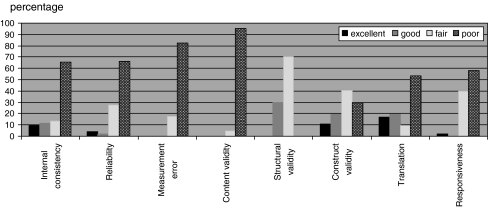
BACKGROUND: The COSMIN checklist is a standardized tool for assessing the methodological quality of studies on measurement properties. It contains 9 boxes, each dealing with one measurement property, with 5-18 items per box about design aspects and statistical methods. Our aim was to develop a scoring system for the COSMIN checklist to calculate quality scores per measurement property when using the checklist in systematic reviews of measurement properties. METHODS: The scoring system was developed based on discussions among experts and testing of the scoring system on 46 articles from a systematic review. Four response options were defined for each COSMIN item (excellent, good, fair, and poor). A quality score per measurement property is obtained by taking the lowest rating of any item in a box ("worst score counts"). RESULTS: Specific criteria for excellent, good, fair, and poor quality for each COSMIN item are described. In defining the criteria, the "worst score counts" algorithm was taken into consideration. This means that only fatal flaws were defined as poor quality. The scores of the 46 articles show how the scoring system can be used to provide an overview of the methodological quality of studies included in a systematic review of measurement properties. CONCLUSIONS: Based on experience in testing this scoring system on 46 articles, the COSMIN checklist with the proposed scoring system seems to be a useful tool for assessing the methodological quality of studies included in systematic reviews of measurement properties.
Overview
The claims and statistics of this paper haven’t been checked yet.
Free: it reads the open-access text and checks the first 5 claims that cite a source we can check. Create a free account to check every claim.
Integrity signals
Registry
Cites
Statistics
Figures
Verification
Claims the paper makes
The claims and statistics of this paper haven’t been checked yet.
Free: it reads the open-access text and checks the first 5 claims that cite a source we can check. Create a free account to check every claim.
Claims other papers make about this one
Each is checked against this paper’s own text: does it say what the citing paper says it does?
The source backs part of the claim, not all of it — or backs it for a different population, condition or comparison.
In the citing paper
“The sample size of this study met a standard for measurement properties (The COSMIN checklist; Terwee et al., 2012).”
From Reliability and validity of the Japanese version of the experiential avoidance in caregiving questionnaire (EACQ) (2023) · cites this paper as Terwee et al., 2012
Experimental — accuracy not yet measuredThe cited source says what the claim attributes to it.
In the citing paper
“The sample size of this study met a standard for measurement properties (The COSMIN checklist; Terwee et al., 2012).”
From Reliability and validity of the Japanese version of the Valued Living Questionnaire Adapted to Caregiving (2023) · cites this paper as Terwee et al., 2012
The cited source says what the claim attributes to it.
In the citing paper
“Third, since this study did not examine the responsiveness (Terwee et al., 2012) of the J-VLQAC, future research should assess this by examining whether the score of the J-VLQAC change through psychological intervention (e.g., ACT) for dementia family caregivers.”
From Reliability and validity of the Japanese version of the Valued Living Questionnaire Adapted to Caregiving (2023) · cites this paper as Terwee et al., 2012
The cited source says what the claim attributes to it.
In the citing paper
“This study examined the PAAQ-J’s reliability and validity according to COSMIN’s framework [27] (see also [28]).”
From Psychometric Properties of the Japanese Version of the Parental Acceptance and Action Questionnaire in Parents with Infants and Toddlers (2023) · cites this paper as [27]
Self-check
Percentages, sums and reported differences re-computed from the paper’s own numbers.
The self-check needs the paper’s full text.
Citations
Cites
GRADE: an emerging consensus on rating quality of evidence and strength of recommendations
Guyatt, G. H., Oxman, A. D., Vist, G. E., Kunz, R., Falck-Ytter, Y., Alonso-Coello, P., & Schünemann, H. J. (2008) · BMJ · doi:10.1136/bmj.39489.470347.ad · Cited by 23,305 · cited 2×
“This distinction is also increasingly being made in systematic reviews of randomized trials and diagnostic studies [13, 19].”
BackgroundMethodQuality criteria were proposed for measurement properties of health status questionnaires
Terwee, C. B., Bot, S. D. M., de Boer, M. R., van der Windt, D. A. W. M., Knol, D. L., Dekker, J., Bouter, L. M., & de Vet, H. C. W. (2007) · Journal of Clinical Epidemiology · doi:10.1016/j.jclinepi.2006.03.012 · Cited by 10,764 · cited 1×
“Other checklists that have been published, such as EMPRO [17], and a checklist we previously designed [18] were developed for rating the quality of an instrument rather than the methodological quality of a study.”
MethodSelf-citationApplied Multivariate Statistics for the Social Sciences
Stevens, J. P. (2012) · Routledge eBooks · doi:10.4324/9780203843130 · Cited by 10,648
Applied multivariate statistics for the social sciences
Stevens, J. P., & Stevens, J. P. (2001) · doi:10.4324/9781410604491 · Cited by 4,993
Mokkink, L. B., Terwee, C. B., Patrick, D. L., Alonso, J., Stratford, P. W., Knol, D. L., Bouter, L. M., & de Vet, H. C. W. (2010) · Quality of Life Research · doi:10.1007/s11136-010-9606-8 · Cited by 4,260 · cited 3×
“However, as we stated in the articles on the development of the COSMIN checklist [7, 8], what is adequate may depend on a number of issues.”
MethodSelf-citationMeasurement in Medicine: A Practical Guide
de Vet, H. C. W., Terwee, C. B., Mokkink, L. B., & Knol, D. L. (2011) · doi:10.1017/cbo9780511996214 · Cited by 2,321
Self-citationAssessing health status and quality-of-life instruments: Attributes and review criteria
Lohr, K. N. (2002) · Quality of Life Research · doi:10.1023/a:1015291021312 · Cited by 2,269
Mokkink, L. B., Terwee, C. B., Knol, D. L., Stratford, P. W., Alonso, J., Patrick, D. L., Bouter, L. M., & de Vet, H. C. (2010) · BMC Medical Research Methodology · doi:10.1186/1471-2288-10-22 · Cited by 1,834
Self-citation2009 updated method guidelines for systematic reviews in the Cochrane Back Review Group
Furlan, A. D., Pennick, V., Bombardier, C., & van Tulder, M. (2009) · Spine · doi:10.1097/brs.0b013e3181b1c99f · Cited by 1,663 · cited 1×
“In this systematic review, levels of evidence were used to rate the quality of the instruments, like is done in reviews of randomized clinical trials [13, 14 ].”
Method(2011) · Amsterdam UMC (VU Amsterdam) - Institutional Repository · Cited by 1,209
Self-citation
Research works printed but not linked: 1
- Higgins, J. P. T. & Green, S. (Eds.). (2009). Cochrane Handbook for Systematic Reviews of Interventions Version 5.0.2 [updated September 2009]. (Available from www.cochrane-handbook.org: Cochrane Collaboration).
Cited by
Items 701–800 of 1,005
Magalhães, H. V., Pernambuco, L. D. A., de Lima, K. C., & Ferreira, M. Â. F. (2018) · Gerodontology · doi:10.1111/ger.12333 · Cited by 22
“23,32 In relation to the transcultural validity, only one work was translated into English from its original publication, 38 but as there was no description of how the methodology was implemented, this property was not able to be evaluated.”
BackgroundMethodInfluentialWatanabe, N., Murakami, S., Uchida, S., Tateishi, S., Ohara, H., Yamamoto, Y., & Kojima, T. (2019) · Journal of Orthopaedic Science · doi:10.1016/j.jos.2018.12.014 · Cited by 22
Rosales, R. S., & Atroshi, I. (2019) · Journal of Hand Surgery (European Volume) · doi:10.1177/1753193419885509 · Cited by 21
Nielsen, A. M., Hartvigsen, J., Kongsted, A., Öberg, B. E., Enthoven, P., Abbott, A. D., & Lauridsen, H. H. (2021) · Health and Quality of Life Outcomes · doi:10.1186/s12955-021-01758-0 · Cited by 21
Assessing involvement with food: A systematic review of measures and tools
Castellini, G., & Graffigna, G. (2021) · Food Quality and Preference · doi:10.1016/j.foodqual.2021.104444 · Cited by 25
Pike, A., McGuckian, T. B., Steenbergen, B., Cole, M. H., & Wilson, P. H. (2022) · Archives of Physical Medicine and Rehabilitation · doi:10.1016/j.apmr.2022.07.014 · Cited by 26
Feasibility of a home-based program to improve handwriting after stroke: a pilot study
Simpson, B., McCluskey, A., Lannin, N. A., & Cordier, R. (2015) · Disability and Rehabilitation · doi:10.3109/09638288.2015.1059495 · Cited by 22
“The presence of ceiling effects are indicative that the measure has limited interpretability for this sample [32].”
BackgroundGovender, R., Lee, M. T., Drinnan, M. J., Davies, T., Twinn, C., & Hilari, K. (2015) · Head & Neck · doi:10.1002/hed.24291 · Cited by 23
A systematic review of the psychometric properties of bronchiolitis assessment tools
Davies, C. J., Waters, D., & Marshall, A. P. (2016) · Journal of Advanced Nursing · doi:10.1111/jan.13098 · Cited by 25
“Table 2 provides information regarding the reported psychometric properties of the tool including reliability, validity and responsiveness and a rating of methodological quality using COSMIN checklist (Terwee et al. 2012).”
MethodInfluentialvan Leeuwen, L. M., Mokkink, L. B., Kamm, C. P., de Groot, V., van den Berg, P., Ostelo, R., & Uitdehaag, B. M. J. (2016) · Disability and Rehabilitation · doi:10.1080/09638288.2016.1213898 · Cited by 21
“According to international guidelines, a minimum of 50 patients is considered adequate for assessing measurement properties.[43] We included 102 patients for validity and 86 patients for reliability analyses and thus largely met this criterion.”
BackgroundSelf-citationPoitras, S., Wood, K. S., Savard, J., Dervin, G. F., & Beaulé, P. E. (2016) · BMC Musculoskeletal Disorders · doi:10.1186/s12891-016-1338-7 · Cited by 21
Martin, G., Gavine, A. J., Inchley, J., & Currie, C. (2017) · SSM - Population Health · doi:10.1016/j.ssmph.2017.03.002 · Cited by 21
“Evaluations of the methodological quality of psychometric measures were assessed using the 4-Point COnsensus-based Standards from the selection of health status Measurement INstruments (COSMIN) checklist (Mokkink et al., 2010; Terwee et al., 2012).”
MethodSeow, K. C., Yusoff, D. M., Koh, Y. L. E., & Tan, N. C. (2017) · BMJ Open · doi:10.1136/bmjopen-2017-016152 · Cited by 21
“sample size calculation The COSMIN checklist recommended a good sample of between 50 to 99 study subjects for assessing their test-retest reliability.(14) In view of a significant drop-out rate for the retest using a web-based approach from an earlier study by the principal investigator, the target recruitment size wa…”
MethodTijssen, M., Tak, I. J. R., Stubbe, J. H., Haverkamp, D., de Visser, E., der Sanden, M. W. G. N., & van Cingel, R. E. H. (2018) · Journal of Orthopaedic and Sports Physical Therapy · doi:10.2519/jospt.2018.7610 · Cited by 23
Barrientos‐Trigo, S., Gil‐García, E., Romero‐Sánchez, J. M., Badanta, B., & Pórcel‐Gálvez, A. M. (2018) · International Nursing Review · doi:10.1111/inr.12495 · Cited by 21
Lazor, T., Pole, J. D., Souza, C. M. D., Schechter, T., Grant, R. M., Davis, H., Duong, N., Stein, E., Cook, S., Tigelaar, L., et al. (2019) · Psycho-Oncology · doi:10.1002/pon.5004 · Cited by 24
Policastro, P. O., Pierobon, A., Pérez, J., Novoa, G. A., Delfino, M. C., Sajfar, M. E., Salzberg, S., Carmody, C., Dorado, J. H., Raguzzi, I. A., et al. (2019) · Musculoskeletal Science and Practice · doi:10.1016/j.msksp.2019.05.010 · Cited by 21
Ziller, C., Braun, T., & Thiel, C. (2020) · Clinical Interventions in Aging · doi:10.2147/cia.s238204 · Cited by 22
Lundby, C., Simonsen, T., Ryg, J., Søndergaard, J., Pottegård, A., & Lauridsen, H. H. (2020) · Research in Social and Administrative Pharmacy · doi:10.1016/j.sapharm.2020.11.001 · Cited by 21
Instruments to assess self-neglect among older adults: A systematic review of measurement properties
Qian, M., Shi, Y., Lv, J., & Yu, M. (2021) · International Journal of Nursing Studies · doi:10.1016/j.ijnurstu.2021.104070 · Cited by 22
Systematic reviews of measurement properties
de Vet, H. C. W., Terwee, C. B., Mokkink, L. B., & Knol, D. L. (2011) · Cambridge University Press eBooks · doi:10.1017/cbo9780511996214.010 · Cited by 29
Self-citationCadorin, L., Bagnasco, A., Tolotti, A., Pagnucci, N., & Sasso, L. (2016) · Journal of Advanced Nursing · doi:10.1111/jan.12926 · Cited by 22
Fitness and Physical Activity in Children and Youth with Disabilities
Fragala-Pinkham, M. A., O’Neil, M. E., Bjornson, K. F., & Boyd, R. N. (2012) · International Journal of Pediatrics · doi:10.1155/2012/162648 · Cited by 23
“” According to the COSMIN a sample size of less than 30 participants is considered “poor,” 30–49 participants is considered “fair,” 50–99 participants is considered “good,” and 100 or more participants is considered “excellent” [19].”
BackgroundMethodInfluentialMathioudakis, A. G., Khaleva, E., Fally, M., Williamson, P. R., Jensen, J. S., Felton, T., Brightling, C. E., Bush, A., Winders, T. A., Linnell, J., et al. (2023) · European Respiratory Journal · doi:10.1183/13993003.02107-2022 · Cited by 21
Perez-Chada, L. M., Salame, N., Ford, A. R., Duffin, K. C., Garg, A., Gottlieb, A. B., Latella, J., Merola, J. F., & Armstrong, A. W. (2020) · American Journal of Clinical Dermatology · doi:10.1007/s40257-019-00496-w · Cited by 20
Sørensen, L., Oestergaard, L. G., van Tulder, M. W., & Petersen, A. K. (2020) · Scandinavian Journal of Medicine and Science in Sports · doi:10.1111/sms.13805 · Cited by 20
Przymuszała, P., Cerbin‐Koczorowska, M., Marciniak-Stępak, P., Zielińska‐Tomczak, Ł., Piszczek, M., Jasiński, J., & Marciniak, R. (2021) · BMC Medical Education · doi:10.1186/s12909-021-02626-7 · Cited by 23
“Although the sample of 71 students can still be considered as “good” [24], a considerable drop is noticeable in comparison with the sample of students who completed the first questionnaire.”
BackgroundResultInterpreting Quality-of-Life Questionnaires in Patients with Long-Standing Facial Palsy
Bruins, T. E., van Veen, M. M., Kleiss, I. J., Broekstra, D. C., Dijkstra, P. U., Ingels, K. J. A. O., & Werker, P. M. N. (2021) · Facial Plastic Surgery & Aesthetic Medicine · doi:10.1089/fpsam.2020.0604 · Cited by 20
“14,15 We considered previously collected test– retest data with a minimum of 37 and a maximum of 52 participants per group, therefore, adequate.”
Adaptation and validation of a culturally adapted HIV stigma scale in Myanmar
Huang, F., Chen, W., Shiu, C. A., Lin, S. H., Tun, M. S., Nwe, T. W., Oo, Y. T. N., & Oo, H. N. (2021) · BMC Public Health · doi:10.1186/s12889-021-11685-w · Cited by 20
“After item reduction, we evaluated the following reliability and validity of the HIVSS-M-3 according to the recommendations in the COSMIN checklist [30].”
MethodInfluentialThe Sensory Processing Measure – Second Edition: A Critical Review and Appraisal
Brown, T., Almiento, L., Yu, M., & Bhopti, A. (2023) · Occupational Therapy In Health Care · doi:10.1080/07380577.2023.2280216 · Cited by 22
“The Checklist was developed based on the original COSMIN Checklist (Mokkink et al., 2010; Terwee et al., 2012) and the COSMIN Risk of Bias Checklist (Mokkink et al., 2018).”
InfluentialTonga, E., Durutürk, N., Gabel, C. P., & Tekindal, M. A. (2014) · Journal of Hand Therapy · doi:10.1016/j.jht.2014.11.001 · Cited by 21
“Power calculations indicated a minimum sample of n>101 for concurrent criterion validity, n>47 for reliability (41) and a sample >100 for factor analysis (50).”
BackgroundGómez-Valero, S., García-Pérez, F., Flórez-García, M. T., & Miangolarra‐Page, J. C. (2017) · Shoulder & Elbow · doi:10.1177/1758573217694340 · Cited by 20
Urpí‐Fernández, A., Zabaleta‐del‐Olmo, E., Montes‐Hidalgo, J., Tomás‐Sábado, J., Roldán-Merino, J. F., & Lluch‐Canut, T. (2017) · Journal of Advanced Nursing · doi:10.1111/jan.13360 · Cited by 21
“The overall methodological quality of each measurement property was rated by considering the lowest rating attributed to the items (Terwee et al., 2012).”
BackgroundMethodInfluentialClark, R., Locke, M., Hill, B. E., Wells, C., & Bialocerkowski, A. (2017) · PLoS ONE · doi:10.1371/journal.pone.0180031 · Cited by 23
“[6,44] Ten of the 13 included papers in this study had greater than 60% of ªyesº items for methodological quality using the Brink and Louw method, [6] compared with the COSMIN checklist grading 12 of 13 papers in this study with a ` poor quality ' due to small sample sizes (less than 30).”
BackgroundMethodHow to Select a Questionnaire with a Good Methodological Quality?
Paiva, S. M., Perazzo, M. F., Ortiz, F. R., Pordeus, I. A., & Martins‐Júnior, P. A. (2017) · Brazilian Dental Journal · doi:10.1590/0103-6440201802008 · Cited by 20
“Another potential application of the COSMIN checklist is to evaluate the methodological quality of systematic reviews of measurement properties, allowing verifying the quality of the studies and the risks of biases (1,17).”
MethodThe Comprehensive Snack Parenting Questionnaire (CSPQ): Development and Test-Retest Reliability
Gevers, D. W. M., Kremers, S., de Vries, N. K., & van Assema, P. (2018) · International Journal of Environmental Research and Public Health · doi:10.3390/ijerph15050862 · Cited by 22
“At least 50 respondents were required to finish the second administration of the questionnaire to adequately calculate reliability coefficients [21].”
BackgroundMcGovern, E. M., Maillart, É., Bourgninaud, M., Manzato, E., Guillonnet, C., Mochel, F., Bourmaleau, J., Lubetzki, C., Baulac, M., & Roze, E. F. (2018) · Journal of the Neurological Sciences · doi:10.1016/j.jns.2018.09.030 · Cited by 20
Schumaher, M. L. N., Milani, D., & Alexandre, N. M. C. (2018) · Journal of Nursing Management · doi:10.1111/jonm.12701 · Cited by 20
Sutton, J. L., Gould, R. L., Coulson, M., Ward, E. V., Butler, A. M., Smith, M., Lavelle, G., Rosa, A., Langridge, M., & Howard, R. J. (2018) · Journal of the American Geriatrics Society · doi:10.1111/jgs.15710 · Cited by 21
“The COSMIN checklist is a standardized tool for evaluating the methodological quality of studies examining measurement properties of health-related instruments.(25,37,38) It assesses measurement properties across the following domains, awarding ratings of “excellent,” “good,” “fair,” or “poor” quality, internal consis…”
BackgroundMethodSilverberg, J. I., Lei, D. K., Yousaf, M., Janmohamed, S. R., Vakharia, P. P., Chopra, R., Chavda, R., Gabriel, S., Patel, K. R., Singam, V., et al. (2020) · Journal of the European Academy of Dermatology and Venereology · doi:10.1111/jdv.16846 · Cited by 20
Marson, B. A., Craxford, S., Deshmukh, S. R., Grindlay, D. J. C., Manning, J. C., & Ollivere, B. J. (2020) · The Bone & Joint Journal · doi:10.1302/0301-620x.102b12.bjj-2020-0732.r2 · Cited by 23
Corti, C., Oprandi, M. C., Chevignard, M., Jansari, A. S., Oldrati, V., Ferrari, E., Martignoni, M., Romaniello, R., Strazzer, S., & Bardoni, A. (2021) · Neuropsychology Review · doi:10.1007/s11065-021-09498-0 · Cited by 21
Reliability and validation of the Dutch Achilles tendon Total Rupture Score
Opdam, K. T. M., Zwiers, R., Wiegerinck, J. I., Kleipool, A. E. B., Haverlag, R., Goslings, J. C., & van Dijk, C. N. (2016) · Knee Surgery Sports Traumatology Arthroscopy · doi:10.1007/s00167-016-4242-7 · Cited by 20
“We used the COnsensusbased Standards for the selection of health Measurement INstruments (COSMIN) checklist for validation of PROMs developed by the COSMIN Initiative [11, 12, 19].”
MethodPsychometric properties of acceptance measures: A systematic review
McAndrews, Z., Richardson, J., & Stopa, L. (2019) · Journal of Contextual Behavioral Science · doi:10.1016/j.jcbs.2018.08.006 · Cited by 19
Zhao, Y.-J., Gui, P.-P., Xu, J., Guo, T., Li, J., Jing, W., Wang, G., & Meng, L. (2025) · Asian Journal of Psychiatry · doi:10.1016/j.ajp.2025.104635 · Cited by 19
Spagnuolo, G., Faria, C. D. C. D. M., da Silva, B. A., Ovando, A. C., Gomes‐Osman, J., & Swarowsky, A. (2018) · Neurorehabilitation · doi:10.3233/nre-172379 · Cited by 19
Fischer‐Tenhagen, C., Meier, J., & Pohl, A. (2022) · Frontiers in Veterinary Science · doi:10.3389/fvets.2022.1002681 · Cited by 19
Yang, C., Chen, H.-T., Luo, K., Watanabe, K., Chuang, H., Wu, C., Dai, C., Kuo, C., & Kawakami, N. (2024) · BMC Public Health · doi:10.1186/s12889-024-18194-6 · Cited by 19
“According to the current literature study [29], the required sample size for factor analysis was five or seven times more than the item numbers, while having a minimum of 100.”
BackgroundMethodResultInfluentialde Vos, R., Silbernagel, K. G., Malliaras, P., Visser, T. S., Alfredson, H., van den Akker‐Scheek, I., van Ark, M., Brorsson, A., Chimenti, R. L., Docking, S., et al. (2024) · British Journal of Sports Medicine · doi:10.1136/bjsports-2024-108263 · Cited by 21
Oftedal, S., Bell, K. L., Mitchell, L. E., Davies, P. S. W., Ware, R. S., & Boyd, R. N. (2012) · International Journal of Pediatrics · doi:10.1155/2012/976425 · Cited by 19
“This study was rated “fair” for study design in the assessment of this construct as an a priori hypothesis of the relationship between the StepWatch and heart rate was not stated, but it was possible to deduce what was expected [19].”
BackgroundMethodInfluentialAlbach, C. A., Wagland, R., & Hunt, K. J. (2017) · Quality of Life Research · doi:10.1007/s11136-017-1703-5 · Cited by 21
“It provides a scoring system for each measurement property that facilitates direct comparisons between studies [18].”
BackgroundMethodAdaptation and validation of the Caregiver Burden Inventory in Spinal Cord Injuries (CBI-SCI)
Conti, A., Clari, M., Garrino, L., Maitan, P., Scivoletto, G., Cavallaro, L., Bandini, B., Mozzone, S., Vellone, E., & Frigerio, S. (2018) · Spinal Cord · doi:10.1038/s41393-018-0179-7 · Cited by 21
Assessment of physical function in children with cancer: A systematic review
Grimshaw, S. L., Taylor, N. F., Mechinaud, F. M., & Shields, N. (2018) · Pediatric Blood & Cancer · doi:10.1002/pbc.27369 · Cited by 20
Motor imagery ability assessments in four disciplines: protocol for a systematic review
Suica, Z., Platteau-Waldmeier, P., Koppel, S., Schmidt‐Trucksäss, A., Ettlin, T. M., & Schuster‐Amft, C. (2018) · BMJ Open · doi:10.1136/bmjopen-2018-023439 · Cited by 19
Puh, U., Hoehlein, B., & Deutsch, J. E. (2019) · Physical Medicine and Rehabilitation Clinics of North America · doi:10.1016/j.pmr.2018.12.006 · Cited by 19
Boucher, V. G., Gemme, C., Dragomir, A. I., Bacon, S., Larue, F., & Lavoie, K. (2020) · Psychosomatic Medicine · doi:10.1097/psy.0000000000000794 · Cited by 22
“3 (range = 2–7) of a maximum of 9, which denotes studies of moderate quality (22,23) (Supplemental Content 3, http://links.”
BackgroundMeasurement properties of the 15-item Arabic lower extremity functional scale
Alnahdi, A. H. (2020) · Disability and Rehabilitation · doi:10.1080/09638288.2020.1754927 · Cited by 19
“For examining the test–retest reliability and measurement error, a sample size of 30 participants was considered to be the minimum required sample (rated as fair sample size) [21].”
BackgroundMethodInfluentialÁvila, C. W., Maria, M. D., Vellone, E., Riegel, B. J., Bernardes, D. D. S., Silveira, L. C. J., & Rabelo, E. R. (2020) · The Journal of Cardiovascular Nursing · doi:10.1097/jcn.0000000000000704 · Cited by 20
Reliability and validity of the Japanese version of the Gratitude at Work Scale (GAWS)
Komase, Y., Watanabe, K., Sasaki, N., & Kawakami, N. (2020) · Journal of Occupational Health · doi:10.1002/1348-9585.12185 · Cited by 20
Gleeson, H., Roesch, C., Hafford‐Letchfield, T., & Ellmers, T. J. (2021) · International Psychogeriatrics · doi:10.1017/s1041610221002659 · Cited by 20
“The COSMIN framework was used to evaluate the included studies for quality of psychometric reporting, with scoring included as recommended by Terwee et al .”
MethodPatient-Reported Outcome Measures in Upper Airway–Related Dyspnea: A Systematic Review
Noud, M., Yancey, K. L., Gelbard, A. H., Sathe, N. A., Penson, D. F., Feurer, I. D., McPheeters, M. L., & Francis, D. O. (2017) · JAMA Otolaryngology–Head & Neck Surgery · doi:10.1001/jamaoto.2017.0348 · Cited by 21
Zanudin, A., Mercer, T. H., Jagadamma, K. C., & van der Linden, M. L. (2017) · Gait & Posture · doi:10.1016/j.gaitpost.2017.07.005 · Cited by 26
Wiitavaara, B., & Heiden, M. (2018) · Disability and Rehabilitation · doi:10.1080/09638288.2018.1495274 · Cited by 19
Png, K., Kwan, Y. H., Leung, Y. Y., Phang, J. K., Lau, J. Q., Lim, K. K., Chew, E., Low, L. L., Tan, C. S., Thumboo, J., et al. (2018) · Seminars in Arthritis and Rheumatism · doi:10.1016/j.semarthrit.2018.02.016 · Cited by 19
Burgess, A., Boyd, R. N., Ziviani, J. M., & Sakzewski, L. (2019) · Australian Occupational Therapy Journal · doi:10.1111/1440-1630.12600 · Cited by 19
Bull, K., Hornsey, S., Kennedy, C., Darlington, A., Grootenhuis, M. A., Hargrave, D. R., Liossi, C., Shepherd, J. P., Walker, D. A., & Morris, C. (2019) · Neuro-Oncology Practice · doi:10.1093/nop/npz064 · Cited by 18
Assas, M. B., Wiriyakijja, P., Fedele, S., Porter, S. R., & Ríordáin, R. N. (2020) · Oral Diseases · doi:10.1111/odi.13416 · Cited by 20
“All rights reserved results showed a lack of rigorous testing for the instruments measuring RIX (Caroline B. Terwee et al., 2011).”
BackgroundReliability and Validity of the Korean version of Short-Form Health Literacy Scale for Adults
Seo, Y. J., Kwak, E.-M., Jo, M., Ko, A.-R., Kim, S. H., & Oh, H. L. (2020) · Research in Community and Public Health Nursing · doi:10.12799/jkachn.2020.31.4.416 · Cited by 19
Test-retest reliability of physical activity questionnaires in Parkinson’s disease
Ånfors, S., Kammerlind, A.-S. C., & Nilsson, M. H. (2021) · BMC Neurology · doi:10.1186/s12883-021-02426-y · Cited by 21
“In order to investigate whether the participants were stable at retest [26], they were given questions on whether they had undergone any changes in medication or deep brain stimulation, answered with yes/no.”
BackgroundPickles, T., Macefield, R. C., Aiyegbusi, O. L., Beecher, C., Horton, M., Christensen, K. B., Phillips, R., Gillespie, D., & Choy, E. (2022) · RMD Open · doi:10.1136/rmdopen-2021-002093 · Cited by 19
Balvardi, S., Semsar‐Kazerooni, K., Kaneva, P. A., Mueller, C., Vassiliou, M. C., Mahroos, M. A., Fiore, J. F., Schwartzman, K., & Feldman, L. S. (2022) · Surgical Endoscopy · doi:10.1007/s00464-022-09466-6 · Cited by 20
Measuring academic satisfaction in nursing students: a systematic review of the instruments
Rossini, S., Mazzotta, R., Kangasniemi, M. K., Badolamenti, S., Macale, L., Sili, A., Vellone, E., Alvaro, R., & Bulfone, G. (2022) · International Journal of Nursing Education Scholarship · doi:10.1515/ijnes-2021-0159 · Cited by 21
Dyer, A., Böhnke, J. R., Curran, D. B., McGrath, K., & Toner, P. (2023) · Drug and Alcohol Review · doi:10.1111/dar.13717 · Cited by 21
Mensch, S. M., Rameckers, E. A. A., Echteld, M. A., & Evenhuis, H. M. (2015) · Research in Developmental Disabilities · doi:10.1016/j.ridd.2015.09.002 · Cited by 18
Fecal microbiota transplantation for Clostridium difficile infection: back to the future
Borgia, G., Maraolo, A. E., Foggia, M., Buonomo, A. R., & Gentile, I. (2015) · Expert Opinion on Biological Therapy · doi:10.1517/14712598.2015.1045872 · Cited by 22
“Only studies with a sample size at least ‘moderate’ (‡ 30 patients) according to the COSMIN checklist [124] are included.”
MethodNae, J. Ä., Creaby, M. W., Cronström, A., & Ageberg, E. (2017) · Physical Therapy in Sport · doi:10.1016/j.ptsp.2017.04.003 · Cited by 18
Hanson, L. C., McBurney, H., & Taylor, N. F. (2017) · European Journal of Cardiovascular Nursing · doi:10.1177/1474515117721129 · Cited by 24
Desmedt, M., Bergs, J., Vertriest, S., Vlayen, A., Schrooten, W., Hellings, J., & Vandijck, D. M. (2017) · Journal of Advanced Nursing · doi:10.1111/jan.13464 · Cited by 22
Morris, C., Dunkley, C., Gibbon, F. M., Currier, J., Roberts, D., Rogers, M., Crudgington, H., Bray, L., Carter, B., Hughes, D. A., et al. (2017) · Trials · doi:10.1186/s13063-017-2323-7 · Cited by 18
“The study researcher will extract evidence of measurement properties from included studies and record a structured appraisal of the methodological quality of the study [38].”
MethodReliability and validity of the de Morton Mobility Index in individuals with sub-acute stroke
Braun, T., Marks, D., Thiel, C., & Grüneberg, C. (2018) · Disability and Rehabilitation · doi:10.1080/09638288.2018.1430176 · Cited by 21
“One strength of this study is the sufficiently large [27,29] sample size of 109 participants for the Rasch, construct validity and internal consistency analyses.”
BackgroundMethodInfluentialFranco, M. R., Pinto, R. Z., Delbaere, K., Eto, B. Y., Faria, M. S., Aoyagi, G. A., Steffens, D., & Pastre, C. M. (2018) · Brazilian Journal of Physical Therapy · doi:10.1016/j.bjpt.2018.01.003 · Cited by 21
“The sample size for the present study was based on COSMIN benchmarks.(19) According to COSMIN, studies assessing internal consistency, reliability and construct validity should include more than 100 participants to be judged as having excellent methodology.”
MethodJayakumar, P., Overbeek, C. L., Vranceanu, A.-M., Williams, M. A., Lamb, S. E., Ring, D., & Gwilym, S. E. (2018) · The Bone & Joint Journal · doi:10.1302/0301-620x.100b6.bjj-2017-1349.r1 · Cited by 18
Perez-Chada, L. M., Cohen, J. M., Gottlieb, A. B., Duffin, K. C., Garg, A., Latella, J., Armstrong, A. W., Ogdie, A., & Merola, J. F. (2018) · Archives of Dermatological Research · doi:10.1007/s00403-018-1855-3 · Cited by 18
Roy, A., Higgins, J., & Nadeau, S. M. (2019) · Physiotherapy Theory and Practice · doi:10.1080/09593985.2019.1622161 · Cited by 21
Silverberg, J. I., Lee, B., Lei, D. K., Yousaf, M., Janmohamed, S. R., Vakharia, P. P., Chopra, R., Chavda, R., Gabriel, S., Patel, K. R., et al. (2021) · Dermatitis · doi:10.1097/der.0000000000000653 · Cited by 19
“However, a sample size of more than 100 participants per analysis has been recommended as sufficient for validation studies.(48)”
Backgroundvan den Broek, A. G., Kloek, C. J. J., Pisters, M. F., & Veenhof, C. (2021) · PLoS ONE · doi:10.1371/journal.pone.0248616 · Cited by 20
Sabah, S. A., Hedge, E. A., Abram, S. G. F., Alvand, A., Price, A. J., & Hopewell, S. (2021) · BMJ Open · doi:10.1136/bmjopen-2020-046169 · Cited by 18
Wiitavaara, B., & Florin, J. (2021) · Disability and Rehabilitation · doi:10.1080/09638288.2021.1979109 · Cited by 19
A systematic review of instruments to measure health literacy of patients in emergency departments
Hesselink, G., Cheng, J. T., & Schoon, Y. (2021) · Academic Emergency Medicine · doi:10.1111/acem.14428 · Cited by 19
Inhulsen, M. M. R., van Stralen, M. M., Terwee, C. B., Ujčič-Voortman, J. K., Seidell, J. C., & Busch, V. (2022) · SLEEP · doi:10.1093/sleep/zsac215 · Cited by 20
“For this study the COnsensus-based Standards for the selection of health Measurement INstruments (COSMIN) guideline for systematic reviews of Patient-Reported Outcome Measures (PROMs), including methodology for assessing content validity, was used [15, 24].”
MethodSelf-citationJin, Y., Brown, R., Bhattarai, M., Kuo, W., & Chen, Y. (2023) · International Journal of Older People Nursing · doi:10.1111/opn.12536 · Cited by 20
Christensen, R., Maxwell, L. J., Jüni, P., Tovey, D. I., Williamson, P. R., Boers, M., Goel, N., Buchbinder, R., MARCH, L. M., Terwee, C. B., et al. (2015) · The Journal of Rheumatology · doi:10.3899/jrheum.141384 · Cited by 19
Self-citationLower Extremity Handheld Dynamometry Strength Measurement in Children With Cerebral Palsy
Mulder-Brouwer, A. N., Rameckers, E. A. A., & Bastiaenen, C. H. G. (2016) · Pediatric Physical Therapy · doi:10.1097/pep.0000000000000228 · Cited by 21
Martins, J. C., Aguiar, L. T., Nadeau, S. M., Scianni, A. A., Teixeira‐Salmela, L. F., & Faria, C. D. C. D. M. (2017) · BMJ Open · doi:10.1136/bmjopen-2016-012655 · Cited by 20
“(‘poor,’ ‘fair,’ ‘good,’ ‘excellent’) is separately obtained for each measurement property.(24) This is essential to prevent the risk of selecting tools, which were developed using designs with poor methodological rigor.”
BackgroundA systematic review of measures of medication adherence in consumers with unipolar depression
Srimongkon, P., Aslani, P., & Chen, T. F. (2018) · Research in Social and Administrative Pharmacy · doi:10.1016/j.sapharm.2018.02.008 · Cited by 20
A critical review of theMotor-Free Visual Perception Test—fourth edition(MVPT-4)
Brown, T., & Peres, L. (2018) · Journal of Occupational Therapy Schools & Early Intervention · doi:10.1080/19411243.2018.1432441 · Cited by 18
“Each measurement property is rated on the COSMIN 4-point scale scoring system as “excellent,” “good,” “fair,” or “poor” quality (Terwee et al., 2012).”
BackgroundCubaka, V. K., Schriver, M., Vedsted, P., Makoul, G. T., & Kallestrup, P. (2018) · Patient Education and Counseling · doi:10.1016/j.pec.2018.04.010 · Cited by 20
Satisfaction of Nigerian patients with health services: a protocol for a systematic review
Akunne, M. O., Okonta, M. J., Ukwe, C. V., Heise, T. L., & Ekwunife, O. I. (2019) · Systematic Reviews · doi:10.1186/s13643-019-1160-z · Cited by 18
Silverberg, J. I., Lei, D. K., Yousaf, M., Janmohamed, S. R., Vakharia, P. P., Chopra, R., Chavda, R., Gabriel, S., Patel, K. R., Singam, V., et al. (2020) · British Journal of Dermatology · doi:10.1111/bjd.19159 · Cited by 19
Kipfer, S., & Pihet, S. (2019) · The JBI Database of Systematic Reviews and Implementation Reports · doi:10.11124/jbisrir-2017-003976 · Cited by 31
“Assessment of methodological quality Publications selected for retrieval were assessed by two independent reviewers for methodological validity prior to inclusion in the review using the COSMIN checklist.(42,45,46) The COSMIN checklist is a standardized tool recommended for use in systematic reviews of measurement pro…”
Method
Metadata
- Authors
- Terwee, C. B., Mokkink, L. B., Knol, D. L., Ostelo, R. W. J. G., Bouter, L. M., & de Vet, H. C. W.
- Affiliations
- Amsterdam Public Health (NL)
- Vrije Universiteit Amsterdam (NL)
- Corresponding author
- Terwee, Caroline B.
- Venue
- Quality of Life Research
- Published
- 2011-07-06
- Volume
- 21
- Issue
- 4
- Pages
- 651-657
- ISSN
- 0962-9343 (ISSN-L)
- 1573-2649
- PMC
- PMC3323819
- OpenAlex
- W2151199180
- Semantic Scholar
- 80858ac3671354dc3bf1b226c74eb8fe0513fb26
- Cited by
- 1,978
- References
- 23
- Citations by year
- 2026: 81 · 2025: 118 · 2024: 148 · 2023: 161 · 2022: 164 · 2021: 226 · 2020: 150 · 2019: 172 · 2018: 181 · 2017: 172 · 2016: 142 · 2015: 106 · 2014: 80 · 2013: 45 · 2012: 25
- FWCI
- 12.05
- Type
- journal article
- Language
- en
- Open access
- hybrid
- doi.org
- Licence
- cc-by-nc
- creativecommons.org/licenses/by-nc/2.0 (tdm)
- Locations
- Quality of Life Research (publishedVersion, cc-by-nc)
- Europe PMC (PubMed Central) (publishedVersion, cc-by-nc)
- PubMed Central (publishedVersion, cc-by-nc)
- PubMed (publishedVersion)
- Pure Amsterdam UMC (publishedVersion, other-oa)
- VU Research Portal (publishedVersion, other-oa)
- Amsterdam UMC (VU Amsterdam) - Institutional Repository (acceptedVersion, other-oa)
- Data Archiving and Networked Services (DANS) (submittedVersion, other-oa)
- Digital Academic REpository of VU University Amsterdam (Vrije Universiteit Amsterdam) (submittedVersion)
- Topics
- Social Sciences › Decision Sciences › Statistics, Probability and Uncertainty › Meta-analysis and systematic reviews
- Social Sciences › Sociology and Political Science › Delphi Technique in Research
- Health Sciences › Nursing › Research and Theory › Health Education and Validation
- Keywords
- COSMIN checklist, measurement properties, methodological quality assessment, scoring system, quality scores, systematic reviews, patient-reported outcome measures, quality standards
- MeSH terms
- Humans, Psychometrics, Quality Control, Quality of Life, Surveys and Questionnaires, Review Literature as Topic, Reproducibility of Results, Checklist
About these checks
Registry, retraction, Cites and statistics results are computed, not judged, with one exception: a printed reference that no index lists is read once by a model before it counts as a citation error. Claims are extracted by a model and kept only when their quote appears verbatim in the text; each cited source is then checked, with a model’s help, for whether it says what the claim relies on. Those verdicts can be wrong — read the claim’s quote and the cited source before relying on one.
Statistics and arithmetic are recomputed, not judged.
Confidence bands are shown only for fields calibrated on our annotated test set. None is calibrated yet, so no band is shown.
What counts as a claim ›How we measure confidence ›How we check this ›
Are you an author, or do you see a problem with this page? Request a review
Data sources
Bibliographic data: Semantic Scholar, OpenAlex, Crossref.
Contains information from the Semantic Scholar Academic Graph Datasets, made available under the ODC Attribution License (ODC-BY 1.0).
Semantic Scholar’s data is described in: Kinney, R., et al. (2023). The Semantic Scholar Open Data Platform. arXiv:2301.10140.
