

Rating the methodological quality in systematic reviews of studies on measurement properties: a scoring system for the COSMIN checklist
Open accessThe DOI matches its Crossref record; 23 of the 23 references it cites were found in a registry or an index.
Abstract
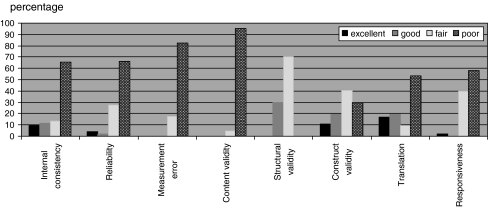
BACKGROUND: The COSMIN checklist is a standardized tool for assessing the methodological quality of studies on measurement properties. It contains 9 boxes, each dealing with one measurement property, with 5-18 items per box about design aspects and statistical methods. Our aim was to develop a scoring system for the COSMIN checklist to calculate quality scores per measurement property when using the checklist in systematic reviews of measurement properties. METHODS: The scoring system was developed based on discussions among experts and testing of the scoring system on 46 articles from a systematic review. Four response options were defined for each COSMIN item (excellent, good, fair, and poor). A quality score per measurement property is obtained by taking the lowest rating of any item in a box ("worst score counts"). RESULTS: Specific criteria for excellent, good, fair, and poor quality for each COSMIN item are described. In defining the criteria, the "worst score counts" algorithm was taken into consideration. This means that only fatal flaws were defined as poor quality. The scores of the 46 articles show how the scoring system can be used to provide an overview of the methodological quality of studies included in a systematic review of measurement properties. CONCLUSIONS: Based on experience in testing this scoring system on 46 articles, the COSMIN checklist with the proposed scoring system seems to be a useful tool for assessing the methodological quality of studies included in systematic reviews of measurement properties.
Overview
The claims and statistics of this paper haven’t been checked yet.
Free: it reads the open-access text and checks the first 5 claims that cite a source we can check. Create a free account to check every claim.
Integrity signals
Registry
Cites
Statistics
Figures
Verification
Claims the paper makes
The claims and statistics of this paper haven’t been checked yet.
Free: it reads the open-access text and checks the first 5 claims that cite a source we can check. Create a free account to check every claim.
Claims other papers make about this one
Each is checked against this paper’s own text: does it say what the citing paper says it does?
The source backs part of the claim, not all of it — or backs it for a different population, condition or comparison.
In the citing paper
“The sample size of this study met a standard for measurement properties (The COSMIN checklist; Terwee et al., 2012).”
From Reliability and validity of the Japanese version of the experiential avoidance in caregiving questionnaire (EACQ) (2023) · cites this paper as Terwee et al., 2012
Experimental — accuracy not yet measuredThe cited source says what the claim attributes to it.
In the citing paper
“The sample size of this study met a standard for measurement properties (The COSMIN checklist; Terwee et al., 2012).”
From Reliability and validity of the Japanese version of the Valued Living Questionnaire Adapted to Caregiving (2023) · cites this paper as Terwee et al., 2012
The cited source says what the claim attributes to it.
In the citing paper
“Third, since this study did not examine the responsiveness (Terwee et al., 2012) of the J-VLQAC, future research should assess this by examining whether the score of the J-VLQAC change through psychological intervention (e.g., ACT) for dementia family caregivers.”
From Reliability and validity of the Japanese version of the Valued Living Questionnaire Adapted to Caregiving (2023) · cites this paper as Terwee et al., 2012
The cited source says what the claim attributes to it.
In the citing paper
“This study examined the PAAQ-J’s reliability and validity according to COSMIN’s framework [27] (see also [28]).”
From Psychometric Properties of the Japanese Version of the Parental Acceptance and Action Questionnaire in Parents with Infants and Toddlers (2023) · cites this paper as [27]
Self-check
Percentages, sums and reported differences re-computed from the paper’s own numbers.
The self-check needs the paper’s full text.
Citations
Cites
GRADE: an emerging consensus on rating quality of evidence and strength of recommendations
Guyatt, G. H., Oxman, A. D., Vist, G. E., Kunz, R., Falck-Ytter, Y., Alonso-Coello, P., & Schünemann, H. J. (2008) · BMJ · doi:10.1136/bmj.39489.470347.ad · Cited by 23,305 · cited 2×
“This distinction is also increasingly being made in systematic reviews of randomized trials and diagnostic studies [13, 19].”
BackgroundMethodQuality criteria were proposed for measurement properties of health status questionnaires
Terwee, C. B., Bot, S. D. M., de Boer, M. R., van der Windt, D. A. W. M., Knol, D. L., Dekker, J., Bouter, L. M., & de Vet, H. C. W. (2007) · Journal of Clinical Epidemiology · doi:10.1016/j.jclinepi.2006.03.012 · Cited by 10,764 · cited 1×
“Other checklists that have been published, such as EMPRO [17], and a checklist we previously designed [18] were developed for rating the quality of an instrument rather than the methodological quality of a study.”
MethodSelf-citationApplied Multivariate Statistics for the Social Sciences
Stevens, J. P. (2012) · Routledge eBooks · doi:10.4324/9780203843130 · Cited by 10,648
Applied multivariate statistics for the social sciences
Stevens, J. P., & Stevens, J. P. (2001) · doi:10.4324/9781410604491 · Cited by 4,993
Mokkink, L. B., Terwee, C. B., Patrick, D. L., Alonso, J., Stratford, P. W., Knol, D. L., Bouter, L. M., & de Vet, H. C. W. (2010) · Quality of Life Research · doi:10.1007/s11136-010-9606-8 · Cited by 4,260 · cited 3×
“However, as we stated in the articles on the development of the COSMIN checklist [7, 8], what is adequate may depend on a number of issues.”
MethodSelf-citationMeasurement in Medicine: A Practical Guide
de Vet, H. C. W., Terwee, C. B., Mokkink, L. B., & Knol, D. L. (2011) · doi:10.1017/cbo9780511996214 · Cited by 2,321
Self-citationAssessing health status and quality-of-life instruments: Attributes and review criteria
Lohr, K. N. (2002) · Quality of Life Research · doi:10.1023/a:1015291021312 · Cited by 2,269
Mokkink, L. B., Terwee, C. B., Knol, D. L., Stratford, P. W., Alonso, J., Patrick, D. L., Bouter, L. M., & de Vet, H. C. (2010) · BMC Medical Research Methodology · doi:10.1186/1471-2288-10-22 · Cited by 1,834
Self-citation2009 updated method guidelines for systematic reviews in the Cochrane Back Review Group
Furlan, A. D., Pennick, V., Bombardier, C., & van Tulder, M. (2009) · Spine · doi:10.1097/brs.0b013e3181b1c99f · Cited by 1,663 · cited 1×
“In this systematic review, levels of evidence were used to rate the quality of the instruments, like is done in reviews of randomized clinical trials [13, 14 ].”
Method(2011) · Amsterdam UMC (VU Amsterdam) - Institutional Repository · Cited by 1,209
Self-citation
Research works printed but not linked: 1
- Higgins, J. P. T. & Green, S. (Eds.). (2009). Cochrane Handbook for Systematic Reviews of Interventions Version 5.0.2 [updated September 2009]. (Available from www.cochrane-handbook.org: Cochrane Collaboration).
Cited by
Items 501–600 of 1,005
Field, D. A., Miller, W. C., Ryan, S. E., Jarus, T., & Abundo, A. (2015) · Archives of Physical Medicine and Rehabilitation · doi:10.1016/j.apmr.2015.08.428 · Cited by 34
Green, A., Liles, C. R., Rushton, A., & Kyte, D. G. (2014) · Manual Therapy · doi:10.1016/j.math.2014.05.013 · Cited by 39
“Papers were rated using a 4-point scale (‘poor’, ‘fair’, ‘good’, ‘excellent’) (Terwee et al., 2012).”
Koopman, F. S., Brehm, M., Heerkens, Y. F., Nollet, F., & Beelen, A. (2014) · Journal of Rehabilitation Medicine · doi:10.2340/16501977-1838 · Cited by 36
“Furthermore, according to the COnsensus-based Standards for the selection of health Measurement INstruments (COSMIN), we used a fair sample size (37).”
MethodTranslation and Adaptation of the Genetic Counselling Outcome Scale (GCOS‐24) for Use in Denmark
Diness, B. R., Overbeck, G., Hjortshøj, T. D., Hammer, T. B., Timshel, S., Sørensen, E., & McAllister, M. (2017) · Journal of Genetic Counseling · doi:10.1007/s10897-017-0086-7 · Cited by 37
“…0.87, mean score 120.8 vs. 104–121, SD 15.1 vs. 8.9– 25.8) (McAllister 2016), and in line with published quality standards for health measurement scales (Terwee et al. 2012), however the sample size was smaller than that recommended for assessment of this property (recommended sample size: greater…”
InfluentialŠuc, A., Einfalt, L., Šarabon, N., & Kastelic, K. (2024) · International Journal of Behavioral Nutrition and Physical Activity · doi:10.1186/s12966-024-01632-4 · Cited by 40
“The quality of the studies for evaluating validity and reliability was assessed using the 4-point scale (i.e., excellent, good, fair, poor) for each of the checklist items, while the final quality score was assessed using the “worst score counts” principle [42].”
MethodEscorpizo, R. S., & Stucki, G. (2013) · Journal of Occupational and Environmental Medicine · doi:10.1097/jom.0b013e318297ae47 · Cited by 33
Haywood, K. L., Collin, S. M., & Crawley, E. M. (2014) · Child Care Health and Development · doi:10.1111/cch.12135 · Cited by 37
Desai, S. S., Peterson, A. C., Wing, K., Younger, A. S. E., Crump, T., Liu, G., Veljkovic, A., Penner, M. J., & Sutherland, J. M. (2019) · Foot & Ankle International · doi:10.1177/1071100719831392 · Cited by 35
Conti, A., Clari, M., Arese, S., Bandini, B., Cavallaro, L., Mozzone, S., Vellone, E., Frigerio, S., & Campagna, S. (2019) · Spinal Cord · doi:10.1038/s41393-019-0384-z · Cited by 33
“A minimum of seven participants for each item were considered sufficient to test scale dimensionality [20].”
BackgroundSalsman, J. M., Danhauer, S. C., Moore, J. B., Canzona, M. R., Victorson, D. E., Zebrack, B., & Reeve, B. B. (2020) · Cancer · doi:10.1002/cncr.33155 · Cited by 34
“COnsensus-based Standards for the selection of health Measurement INstruments (COSMIN).(65-68) By adher-”
MethodHotchkiss, J. T., & Wong, M. Y. C. (2022) · Trends in Psychology · doi:10.1007/s43076-022-00184-5 · Cited by 33
“…4-point rating scale, the COnsensus-based Standards for selecting health status Measurement INstruments (COSMIN) check-list, which was developed to determine whether a study of measurement properties of a self-reported instrument would meet methodological quality standards (Terwee et al., 2012).”
Tomacheuski, R. M., Monteiro, B. P., Evangelista, M. C., Luna, S. P. L., & Steagall, P. V. M. (2023) · PLoS ONE · doi:10.1371/journal.pone.0280830 · Cited by 34
“Its methodology was specifically developed and validated for use in reviews of patient-reported outcome measures [38, 40, 41, 44].”
MethodA systematic review of outcome tools used to measure lower leg conditions.
Shultz, S., Olszewski, A., Ramsey, O., Schmitz, M., Wyatt, V., & Cook, C. E. (2013) · Europe PMC (PubMed Central) · Cited by 33
Stevens, M. J., van den Akker‐Scheek, I., ten Have, B., Adema, M., Giezen, H., & Reininga, I. H. F. (2015) · Journal of Orthopaedic and Sports Physical Therapy · doi:10.2519/jospt.2015.6178 · Cited by 33
Joober, H., Chouinard, M., King, J., Lambert, M., Hudon, É., & Hudon, C. (2018) · International Journal of Integrated Care · doi:10.5334/ijic.4163 · Cited by 33
Responsiveness of the EuroQoL 5-dimension (EQ-5D) in adolescent idiopathic scoliosis
Cheung, P. W. H., Wong, C. K. H., Lau, S. T., & Cheung, J. P. Y. (2017) · European Spine Journal · doi:10.1007/s00586-017-5330-1 · Cited by 32
“We planned for at least 50–100 samples as this was classified as good quality of evaluating responsive property as listed by the COSMIN checklist [12].”
Instruments to assess patient comfort during hospitalization: A psychometric review
Lorente, S., Losilla, J.-M., & Vives, J. (2017) · Journal of Advanced Nursing · doi:10.1111/jan.13495 · Cited by 32
“According to the protocol of this review (Lorente, Vives & Losilla, 2017), we conducted a psychometric review, applying the COnsensus-based Standards for the selection of health status Measurement INstruments (COSMIN) to assess the methodological quality of studies on measurement properties (Mokkink et al., 2012; Terw…”
BackgroundMethodDaliya, P., Gemmill, E. H., Lobo, D. N., & Parsons, S. L. (2019) · HepatoBiliary Surgery and Nutrition · doi:10.21037/hbsn.2019.03.16 · Cited by 32
“HepatoBiliary Surg Nutr 2019;8(3):228-245 | http://dx.doi.org/10.21037/hbsn.2019.03.16 Table 1 Summary of study characteristics (characteristics of each of the 51 non-validation studies) Characteristics n % Year of publication 1991–2000 6 11.8 2001–2010 13 25.5 2011–2017 32 62.7 Origin of study Europe 31 60.8 Africa 1…”
BackgroundMethodInfluentialCollaborators OVAMA consensus group, Horbach, S. E. R., Rongen, A. P. M., Elbers, R. G., van der Horst, C. M. A. M., Prinsen, C. A. C., & Spuls, P. I. (2019) · Quality of Life Research · doi:10.1007/s11136-019-02301-x · Cited by 33
Measures of Motor and Functional Skills for Children With Cerebral Palsy: A Systematic Review
Ferre-Fernández, M., Murcia-González, M. A., Espinosa, M. D. B., & Díaz, J. R. (2019) · Pediatric Physical Therapy · doi:10.1097/pep.0000000000000661 · Cited by 37
The Stay Independent Brochure as a Screening Evaluation for Fall Risk in an Elderly Thai Population
Loonlawong, S., Limroongreungrat, W., & Jiamjarasrangsi, W. (2019) · Clinical Interventions in Aging · doi:10.2147/cia.s233414 · Cited by 32
“In addition, the sample sizes were large enough to ensure appropriate statistical power and precision of the results.(23,24) Importantly, the participants were representative of the broader elderly population in terms of age range, gender and urban-rural areas.”
MethodHawkins, A. T., Rothman, R. L., Geiger, T. M., Canedo, J., Edwards‐Hollingsworth, K., LaNeve, D. C., & Penson, D. F. (2020) · Diseases of the Colon & Rectum · doi:10.1097/dcr.0000000000001717 · Cited by 32
“However, their testing, quality, and intended use can vary widely.(6) This creates a problem, because both researchers and clinicians traditionally lack training in the methodology used to create and validate PROMs and may be unable to assess the quality of tools available for use in both the clinical and research set…”
BackgroundKhac, A. D., Jourdan, C., Fazilleau, S., Palayer, C., Laffont, I., Dupeyron, A., Verdun, S., & Gélis, A. (2021) · JMIR mhealth and uhealth · doi:10.2196/26443 · Cited by 32
“Thus, it is important to also evaluate the so-called agreement reproducibility, reflecting the similarities between 2 measurements and thus related to measurement error [21,27].”
BackgroundMethodInfluentialHow to Assess Shoulder Functionality: A Systematic Review of Existing Validated Outcome Measures
Aldon-Villegas, R., Ridao-Fernández, C., Enamorado, D. T., & Chamorro-Moriana, G. (2021) · Diagnostics · doi:10.3390/diagnostics11050845 · Cited by 32
Rothmund, M., Meryk, A., Rumpold, G., Crazzolara, R., Sodergren, S. C., Darlington, A., Riedl, D., & the EORTC Quality of Life Group (2023) · Journal of Patient-Reported Outcomes · doi:10.1186/s41687-023-00540-8 · Cited by 37
Calder, A., & Mulligan, H. F. (2013) · Disability and health journal · doi:10.1016/j.dhjo.2013.06.003 · Cited by 32
Turci, A. M., Bevilaqua‐Grossi, D., Pinheiro, C. F., Bragatto, M. M., & Chaves, T. C. (2015) · BMC Musculoskeletal Disorders · doi:10.1186/s12891-015-0497-2 · Cited by 32
“The sample size used followed the recommendation of the COSMIN manual [20,26], which states that the sample size should be 5–7 times the number of items with a minimum of 100 individuals.”
BackgroundMethodInfluentialLazzarini, P. A., Ng, V., Kinnear, E. M., Kamp, M. C., Kuys, S. S., Hurst, C. P., & Reed, L. F. (2014) · Journal of Foot and Ankle Research · doi:10.1186/1757-1146-7-7 · Cited by 32
“It was intended that the new multi-item tool would align with best practice principles for clinical tools including being easily interpreted, practical to use and possessing high face, content and criterion validity, and inter- and intrarater reliability [31-33].”
Validation of the Evidence-Based Practice Confidence (EPIC) Scale With Occupational Therapists
Clyde, J. H., Brooks, D., Cameron, J. I., & Salbach, N. M. (2016) · American Journal of Occupational Therapy · doi:10.5014/ajot.2016.017061 · Cited by 32
van Kooij, Y. E., Fink, A., der Sanden, M. W. G. N., & Speksnijder, C. M. (2017) · Journal of Hand Therapy · doi:10.1016/j.jht.2017.02.012 · Cited by 36
Horne, J. C., Lincoln, N. B., & Logan, P. (2017) · Clinical Rehabilitation · doi:10.1177/0269215517705424 · Cited by 35
Translation and Cross‐Cultural Adaptation with Preliminary Validation of GCOS‐24 for Use in Spain
Muñoz‐Cabello, P., García‐Miñáur, S., Vallejo, M. E., Fernández-Franco, L., Stephens, A., Santos‐Simarro, F., Lapunzina, P. D., & McAllister, M. (2017) · Journal of Genetic Counseling · doi:10.1007/s10897-017-0154-z · Cited by 34
“…cross-cultural adaptation of health questionnaires and PROMs (Beaton et al. 2000; Wild et al. 2005), and by published standards for the methodological quality of studies on the measurement properties of health measurement instruments (Mokkink et al. 2010; Terwee et al. 2012;Mokkink et al. 2009).”
BackgroundMethodInfluentialA Systematic Review of Outcome Measures Assessing Disability Following Upper Extremity Trauma
Jayakumar, P., Williams, M. A., Ring, D., Lamb, S. E., & Gwilym, S. E. (2017) · JAAOS Global Research and Reviews · doi:10.5435/jaaosglobal-d-17-00021 · Cited by 32
Lami, F., Egberts, K. J., Ure, A. M., Conroy, R., & Williams, K. J. (2017) · Developmental Medicine & Child Neurology · doi:10.1111/dmcn.13631 · Cited by 37
“The reviewers used the 4-point-rating checklist recommended by the COSMIN group.(34) This checklist allows the classification of each study investigating the measurement property of a health-related, patient-reported outcome measure as poor, fair, good, or excellent quality.”
MethodThe association of affective disorders and facial scarring: Systematic review and meta-analysis
Gibson, J. A. G., Ackling, E., Bisson, J. I., Dobbs, T. D., & Whitaker, I. S. (2018) · Journal of Affective Disorders · doi:10.1016/j.jad.2018.06.013 · Cited by 33
Blower, S. L., Gridley, N., Dunn, A., Bywater, T. J., Hindson, Z., & Bryant, M. (2019) · Clinical Child and Family Psychology Review · doi:10.1007/s10567-019-00276-2 · Cited by 32
Ortega‐Ávila, A. B., Cervera‐Garvi, P., Ramos‐Petersen, L., Chicharro‐Luna, E., & Gijón-Noguerón, G. (2019) · Journal of Clinical Medicine · doi:10.3390/jcm8020146 · Cited by 35
“The “worst score counts” approach was applied to derive a final rating for the PROM [23].”
MethodReliability and validity of on-road driving tests in vulnerable adults: a systematic review
Sawada, T., Tomori, K., Hamana, H., Ohno, K., Seike, Y., Igari, Y., & Fujita, Y. (2019) · International Journal of Rehabilitation Research · doi:10.1097/mrr.0000000000000374 · Cited by 31
“no scoring system in this box, it was recommended by the previous study to use this box for extracting data on the characteristics of the study (Terwee et al., 2012).”
MethodO'Grady, M. G., & Dusing, S. C. (2014) · Physical Therapy · doi:10.2522/ptj.20140111 · Cited by 31
Christiansen, D. H., Møller, A. D., Vestergaard, J. M., Mose, S., & Maribo, T. (2017) · Journal of Hand Therapy · doi:10.1016/j.jht.2017.04.002 · Cited by 34
Khadjesari, Z., Vitoratou, S., Sevdalis, N., & Hull, L. (2017) · BMJ Open · doi:10.1136/bmjopen-2017-017972 · Cited by 32
“Methodological quality of psychometric studies Systematic reviews that investigate the measurement properties of instruments should assess: (1) the methodological quality of the psychometric studies and (2) the psychometric quality of the instrument and the appropriateness of statistical methods of evaluation, where t…”
BackgroundMethodInfluentialGeerinck, A., Bruyère, O., Locquet, M., Reginster, J., & Beaudart, C. (2018) · Advances in Therapy · doi:10.1007/s12325-018-0820-z · Cited by 42
Simons, M., Kimble, R. M., McPhail, S., & Tyack, Z. F. (2019) · Burns · doi:10.1016/j.burns.2019.04.015 · Cited by 31
The Timed Up and Go Test in Children: Does Protocol Choice Matter? A Systematic Review
Verbecque, E., Schepens, K., Theré, J., Schepens, B., Klingels, K., & Hallemans, A. (2018) · Pediatric Physical Therapy · doi:10.1097/pep.0000000000000558 · Cited by 30
Schack, J., Mirtaheri, P., Steen, H., & Gjøvaag, T. F. (2019) · Disability and Rehabilitation · doi:10.1080/09638288.2019.1662495 · Cited by 30
Paramanandam, V. S., Lee, M., Kilbreath, S. L., & Dylke, E. S. (2021) · Acta Oncologica · doi:10.1080/0284186x.2020.1862422 · Cited by 32
“Data extraction Data extraction forms were based on COSMIN Methodology for Systematic Reviews of Patient-Reported Outcome Measures (PROMs) user manual [17].”
MethodField, D. A., & Livingstone, R. (2013) · Clinical Rehabilitation · doi:10.1177/0269215513488122 · Cited by 35
Heinl, D., Prinsen, C. A. C., Drucker, A. M., Ofenloch, R. F., Humphreys, R., Sach, T., Flohr, C., & Apfelbacher, C. (2016) · Systematic Reviews · doi:10.1186/s13643-016-0202-z · Cited by 37
“Taking the lowest rating for each item in one box, an overall quality score (“poor,” “fair,” “good,” “excellent”) is obtained for each measurement property separately [20].”
BackgroundAbram, S. G. F., Middleton, R. M., Beard, D. J., Price, A. J., & Hopewell, S. (2017) · BMJ Open · doi:10.1136/bmjopen-2017-017247 · Cited by 30
“The quality of each included study was assessed by two reviewers (SGFA and RM) using the COSMIN appraisal checklist.(24) When reviewing a study of a PROM, it is necessary to consider a combination of the reported measurement properties, the patient population and the quality of the study methodology.”
MethodInstruments to measure quality of life in institutionalised older adults: Systematic review
Santana‐Berlanga, N. D. R., Pórcel‐Gálvez, A. M., Botello-Hermosa, A., & Barrientos‐Trigo, S. (2020) · Geriatric Nursing · doi:10.1016/j.gerinurse.2020.01.018 · Cited by 31
Silverberg, J. I., Lei, D. K., Yousaf, M., Janmohamed, S. R., Vakharia, P. P., Chopra, R., Chavda, R., Gabriel, S., Patel, K. R., Singam, V., et al. (2020) · Annals of Allergy Asthma & Immunology · doi:10.1016/j.anai.2020.03.006 · Cited by 36
Rahmatpour, P., Sharif Nia, H., & Peyrovi, H. (2019) · Journal of Education and Health Promotion · doi:10.4103/jehp.jehp_466_19 · Cited by 29
“A methodological quality score per box is obtained by taking the lowest rating of any item in a box (“worst score counts”).[28] The quality criteria for measurement properties were analyzed according to the criteria of Terwee study.”
MethodValidity and Reliability of Pain and Behavioral Scales for Preterm Infants: A Systematic Review
Glenzel, L., Oliveira, P. D. N., Marchi, B. S., Ceccon, R. F., & Moran, C. A. (2023) · Pain Management Nursing · doi:10.1016/j.pmn.2023.06.010 · Cited by 35
Verster, J. C., Išerić, E., Ulijn, G. A., Oskam, S. M. P., & Garssen, J. (2024) · Journal of Clinical Medicine · doi:10.3390/jcm13175217 · Cited by 29
Rosales, R. S., García-Gutierrez, R., Reboso-Morales, L., & Atroshi, I. (2017) · Health and Quality of Life Outcomes · doi:10.1186/s12955-017-0745-2 · Cited by 29
“An important issue when we compare MDC is that this absolute reliability index, called smallest real difference (SRD) [34] or smallest detectable change (SDC) [38, 40], depends on several factors including the study population, washout interval, time point during the follow-up when the test-retest analysis was done, a…”
BackgroundCheung, P. W. H., Wong, C. K. H., & Cheung, J. P. Y. (2018) · Spine · doi:10.1097/brs.0000000000002939 · Cited by 29
Barzanji, A., Zareiyan, A., Nezamzadeh, M., & Mazhari, M. S. (2019) · Open Access Macedonian Journal of Medical Sciences · doi:10.3889/oamjms.2019.103 · Cited by 29
“Each reported study was assessed for methodological quality by an author using the COSMIN checklist with 4-point [18].”
MethodInfluentialDanneels, M., Hecke, R. V., Keppler, H., Degeest, S., Cambier, D. C., van de Berg, R., Rompaey, V. V., & Maes, L. (2019) · Ear and Hearing · doi:10.1097/aud.0000000000000748 · Cited by 29
Measurement properties of step tests for exercise capacity in COPD: A systematic review
Vilarinho, R., Caneiras, C. S. G., & Montes, A. M. (2020) · Clinical Rehabilitation · doi:10.1177/0269215520968054 · Cited by 32
Alkhaffaf, B. H., Metryka, A., Blazeby, J. M., Glenny, A., Adeyeye, A. A., Costa, P., del Val, I. D., Gisbertz, S. S., Güner, A., Law, S. Y.-K., et al. (2021) · British journal of surgery · doi:10.1093/bjs/znab192 · Cited by 32
Praveen, S., Parmar, J. S., Chandio, N., & Arora, A. (2021) · International Journal of Environmental Research and Public Health · doi:10.3390/ijerph181910422 · Cited by 31
Validation of the PAM-13 instrument in the Hungarian general population 40 years old and above
Zrubka, Z., Vékás, P., Németh, P., Dobos, Á., Hajdú, O., Kovács, L., Gulàcsi, L., Hibbard, J. H., & Péntek, M. (2022) · The European Journal of Health Economics · doi:10.1007/s10198-022-01434-0 · Cited by 29
Bimanual movements in children with cerebral palsy: a systematic review of instrumented assessments
Cacioppo, M., Loos, A., Lempereur, M., & Brochard, S. (2023) · Journal of NeuroEngineering and Rehabilitation · doi:10.1186/s12984-023-01150-7 · Cited by 29
“Quality of metrological properties (COSMIN score) For studies that specifically evaluated metrological properties, the Consensus based Standards for the selection of health Measurement Instruments (COSMIN) score risk of bias checklist 2017 [21, 22] was used to calculate a quality score for each metrological property.”
MethodTest-retest reliability of single-item assessments of immune fitness, mood, and quality of life
Verster, J. C., Mulder, K. E., Verheul, M. C., van Oostrom, E. C., Hendriksen, P. A., Scholey, A. B., & Garssen, J. (2023) · Heliyon · doi:10.1016/j.heliyon.2023.e15280 · Cited by 29
Lamash, L., Fogel, Y., & Hen‐Herbst, L. (2023) · Journal of Adolescence · doi:10.1002/jad.12244 · Cited by 34
Validation of Treatment Escalation as a Definition of Atopic Eczema Flares
Thomas, K. S., Stuart, B. L., O’Leary, C., Schmitt, J. M., Paul, C. F., Williams, H. C., & Langan, S. (2015) · PLoS ONE · doi:10.1371/journal.pone.0124770 · Cited by 29
“Nevertheless, a sample size of>100 participants per analysis has been recommended as sufficient for validation studies [19].”
BackgroundRienstra, W., Blikman, T., Mensink, F. B., van Raay, J. J. A. M., Dijkstra, B., Bulstra, S. K., Stevens, M. J., & van den Akker‐Scheek, I. (2015) · PLoS ONE · doi:10.1371/journal.pone.0146117 · Cited by 29
“70 is considered good [33].”
Heijnen, B. J., Speyer, R., Bülow, M., & Kuijpers, L. M. F. (2016) · Dysphagia · doi:10.1007/s00455-015-9680-8 · Cited by 34
“[30].”
Liu, Y., Li, H., Ding, N., Wang, N., & Wen, D. (2016) · Medicine · doi:10.1097/md.0000000000003672 · Cited by 34
“Then the methodological quality of included studies was evaluated according to the COSMIN 4point checklist.(32) The COSMIN checklist consists of 9 boxes concerning methodological standards on how each measurement property should be assessed, including 5 to 18 items in each box.”
MethodHimuro, N., Abe, H., Nishibu, H., Seino, T. H., & Mori, M. (2016) · Disability and Rehabilitation · doi:10.1080/09638288.2016.1175036 · Cited by 34
“Each measurement property is allocated a separate rating (excellent, good, fair or poor).[8] The overall score for the measurement property presented in each article is determined by the lowest score for any of the items related to that measurement property (‘‘worse score counts’’).”
BackgroundInfluentialHoen, L. ’., Groen, J., Scheepe, J. R., Reuvers, S. H. M., Castro-Diaz, D. M., Padilla-Fernández, B. Y., POPOLO, G. D., Musco, S., Hamid, R., Ecclestone, H., et al. (2016) · European Urology Focus · doi:10.1016/j.euf.2016.06.009 · Cited by 31
“The total score is obtained by taking the lowest response option of any item per measurement property, with possible scores on a four-point scale of poor, fair, good, or excellent [22].”
MethodWhite, I. D., Sangha, A., Lucas, G., & Wiseman, T. (2016) · Gynecologic Oncology · doi:10.1016/j.ygyno.2016.08.332 · Cited by 31
“org/ instrument development and evaluation in order to identify the most valid and reliable questionnaire for research and clinical use [42].”
BackgroundMethodInfluentialWiitavaara, B., & Heiden, M. (2017) · Disability and Rehabilitation · doi:10.1080/09638288.2017.1334096 · Cited by 30
“The COSMIN checklist [11,13] is a useful contribution in”
MethodCheung, P. W. H., Wong, C. K. H., & Cheung, J. P. Y. (2018) · European Spine Journal · doi:10.1007/s00586-018-5576-2 · Cited by 31
Vermeulen, K., Woestyn, M., Oostra, K. M., Geers, S., Ryngaert, K., de Velde, K. V., Descheemaeker, F., Baets, S. D., & VELDE, D. V. D. (2018) · Journal of Occupational Rehabilitation · doi:10.1007/s10926-018-9812-8 · Cited by 31
Tapp, D., Chenacher, S., Ngangue, P., Bérubé-Mercier, P., Gélinas, C., Douville, F., & Desbiens, J. (2019) · Journal of Palliative Care · doi:10.1177/0825859718816073 · Cited by 29
Yanez-Peñúñuri, L. Y., Hidalgo-Rasmussen, C. A., & Chávez-Flores, Y. V. (2019) · Ciência & Saúde Coletiva · doi:10.1590/1413-81232018246.19612017 · Cited by 34
Fujino, H. (2019) · BMC Research Notes · doi:10.1186/s13104-019-4556-x · Cited by 32
Smith, E. L., Garety, P. A., Harding, H., & Hardy, A. (2019) · Psychology and Psychotherapy Theory Research and Practice · doi:10.1111/papt.12265 · Cited by 32
“Item ratings relating to each psychometric property are then pooled to produce an overall score for each box using the ‘worst score counts’ method (Terwee et al., 2012).”
BackgroundMethodAlDahas, A., Heneghan, N. R., Althobaiti, S., Deane, J. A., Rushton, A., & Falla, D. (2024) · BMC Musculoskeletal Disorders · doi:10.1186/s12891-023-07111-4 · Cited by 28
“Cid et al. [33] investigated the intra-rater reliability of the NHP, it was Table 2 The updated criteria for good measurement properties [13, 18] ICC intraclass correlation coefficient, SDC smallest detectable change, LoA limits of agreement, MIC minimal important change, AUC area under curve”
BackgroundHanson, L. C., Taylor, N. F., & McBurney, H. (2015) · Physiotherapy · doi:10.1016/j.physio.2015.08.004 · Cited by 28
Generic Preference-based Measures for Low Back Pain: Which of Them Should Be Used?
Finch, A. P., Dritsaki, M., & Jommi, C. (2015) · Spine · doi:10.1097/brs.0000000000001247 · Cited by 30
Report of the GRAPPA-OMERACT Psoriatic Arthritis Working Group from the GRAPPA 2015 Annual Meeting
Orbai, A., Mease, P. J., de Wit, M. P. T., Kalyoncu, U., Campbell, W., Tillett, W. L., Eder, L., Elmamoun, M., FitzGerald, O., Gladman, D. D., et al. (2016) · The Journal of Rheumatology · doi:10.3899/jrheum.160116 · Cited by 30
“Focus groups will be held to identify the outcomes important to patients with PsA.”
MethodInfluentialEssner, A., Högberg, H., Zetterberg, L., Hellström, K., Sjöström, R., & Gustås, P. (2020) · Topics in companion animal medicine · doi:10.1016/j.tcam.2020.100407 · Cited by 28
Kara, Ö. K., Türker, D., Kara, K., & Yardımcı-Lokmanoğlu, B. N. (2020) · Child Care Health and Development · doi:10.1111/cch.12801 · Cited by 29
Cañas, M., Ibabe, I., & de Paúl, J. (2020) · Child Abuse & Neglect · doi:10.1016/j.chiabu.2020.104713 · Cited by 30
Kim, M. S., Koh, I. J., Choi, K. Y., Seo, J. Y., & In, Y. (2021) · Journal of Bone and Joint Surgery · doi:10.2106/jbjs.20.02138 · Cited by 29
Castilla, A., Gonzalez, M., Kysh, L., & Sargent, B. A. (2023) · Pediatric Physical Therapy · doi:10.1097/pep.0000000000000993 · Cited by 28
Validity and intrarater reliability of a novel device for assessing Plantar flexor strength
O’Neill, S., Weeks, A., Nørgaard, J. E., & Jørgensen, M. G. (2023) · PLoS ONE · doi:10.1371/journal.pone.0282395 · Cited by 99
Chung, V. C., Ho, R. S. T., Wu, X., & Wu, J. C. Y. (2016) · European Journal of Integrative Medicine · doi:10.1016/j.eujim.2016.08.164 · Cited by 30
Hypertonia Assessment Tool: Reliability and Validity in Children With Neuromotor Disorders
Marsico, P., Frontzek-Weps, V., Balzer, J., & van Hedel, H. J. A. (2016) · Journal of Child Neurology · doi:10.1177/0883073816671681 · Cited by 28
Marsico, P., Mitteregger, E., Balzer, J., & van Hedel, H. J. A. (2017) · Developmental Medicine & Child Neurology · doi:10.1111/dmcn.13425 · Cited by 33
“According to the COSMIN group, a sample size greater than 50 is considered good.(10)”
MethodPoku, E. N., Aber, A., Phillips, P., Essat, M., Woods, H. B., Palfreyman, S. J., Kaltenthaler, E., Jones, G., & Michaels, J. A. (2017) · BJS Open · doi:10.1002/bjs5.25 · Cited by 32
“The psychometric criteria applied in the appraisal of PROMs were based on internationally accepted guidelines 20 , 21 , 23 , 24 .”
A new scale for measuring quality of life in acquired brain injury
Fernández, M., Gómez, L. E., Arias, V. B., Aguayo, V., Amor, A. M., Anđelić, N., & Alonso, M. Á. V. (2018) · Quality of Life Research · doi:10.1007/s11136-018-2047-5 · Cited by 28
Alfaro‐Díaz, C., Esandi, N., Gutiérrez‐Alemán, T., & Canga, A. (2019) · Journal of Advanced Nursing · doi:10.1111/jan.14049 · Cited by 35
Gabes, M., Tischer, C., Apfelbacher, C., & for the quality of life working group of the Harmonising Outcome Measures for Eczema (HOME) initiative (2019) · Pediatric Allergy and Immunology · doi:10.1111/pai.13120 · Cited by 33
Psychometric Properties of the Spanish Version of the Work Ability Index in Working Individuals
Bascour–Sandoval, C., Soto-Rodríguez, F. J., Muñoz-Poblete, C., & Marzuca-Nassr, G. N. (2020) · Journal of Occupational Rehabilitation · doi:10.1007/s10926-019-09871-0 · Cited by 30
Krug, R. C., Cañeiro, J. P., Ribeiro, D. C., Darlow, B. J. S., Silva, M. F., & Loss, J. F. (2020) · Brazilian Journal of Physical Therapy · doi:10.1016/j.bjpt.2020.07.001 · Cited by 28
An overview and critique of the Test of Visual Perception Skills – fourth edition (TVPS-4)
Brown, T., & Peres, L. (2018) · Hong Kong Journal of Occupational Therapy · doi:10.1177/1569186118793847 · Cited by 28
Ahmadi, A., Tohidast, S. A., Mansuri, B., Kamali, M., & Krishnan, G. (2017) · Clinical Rehabilitation · doi:10.1177/0269215517690017 · Cited by 27
Metadata
- Authors
- Terwee, C. B., Mokkink, L. B., Knol, D. L., Ostelo, R. W. J. G., Bouter, L. M., & de Vet, H. C. W.
- Affiliations
- Amsterdam Public Health (NL)
- Vrije Universiteit Amsterdam (NL)
- Corresponding author
- Terwee, Caroline B.
- Venue
- Quality of Life Research
- Published
- 2011-07-06
- Volume
- 21
- Issue
- 4
- Pages
- 651-657
- ISSN
- 0962-9343 (ISSN-L)
- 1573-2649
- PMC
- PMC3323819
- OpenAlex
- W2151199180
- Semantic Scholar
- 80858ac3671354dc3bf1b226c74eb8fe0513fb26
- Cited by
- 1,978
- References
- 23
- Citations by year
- 2026: 81 · 2025: 118 · 2024: 148 · 2023: 161 · 2022: 164 · 2021: 226 · 2020: 150 · 2019: 172 · 2018: 181 · 2017: 172 · 2016: 142 · 2015: 106 · 2014: 80 · 2013: 45 · 2012: 25
- FWCI
- 12.05
- Type
- journal article
- Language
- en
- Open access
- hybrid
- doi.org
- Licence
- cc-by-nc
- creativecommons.org/licenses/by-nc/2.0 (tdm)
- Locations
- Quality of Life Research (publishedVersion, cc-by-nc)
- Europe PMC (PubMed Central) (publishedVersion, cc-by-nc)
- PubMed Central (publishedVersion, cc-by-nc)
- PubMed (publishedVersion)
- Pure Amsterdam UMC (publishedVersion, other-oa)
- VU Research Portal (publishedVersion, other-oa)
- Amsterdam UMC (VU Amsterdam) - Institutional Repository (acceptedVersion, other-oa)
- Data Archiving and Networked Services (DANS) (submittedVersion, other-oa)
- Digital Academic REpository of VU University Amsterdam (Vrije Universiteit Amsterdam) (submittedVersion)
- Topics
- Social Sciences › Decision Sciences › Statistics, Probability and Uncertainty › Meta-analysis and systematic reviews
- Social Sciences › Sociology and Political Science › Delphi Technique in Research
- Health Sciences › Nursing › Research and Theory › Health Education and Validation
- Keywords
- COSMIN checklist, measurement properties, methodological quality assessment, scoring system, quality scores, systematic reviews, patient-reported outcome measures, quality standards
- MeSH terms
- Humans, Psychometrics, Quality Control, Quality of Life, Surveys and Questionnaires, Review Literature as Topic, Reproducibility of Results, Checklist
About these checks
Registry, retraction, Cites and statistics results are computed, not judged, with one exception: a printed reference that no index lists is read once by a model before it counts as a citation error. Claims are extracted by a model and kept only when their quote appears verbatim in the text; each cited source is then checked, with a model’s help, for whether it says what the claim relies on. Those verdicts can be wrong — read the claim’s quote and the cited source before relying on one.
Statistics and arithmetic are recomputed, not judged.
Confidence bands are shown only for fields calibrated on our annotated test set. None is calibrated yet, so no band is shown.
What counts as a claim ›How we measure confidence ›How we check this ›
Are you an author, or do you see a problem with this page? Request a review
Data sources
Bibliographic data: Semantic Scholar, OpenAlex, Crossref.
Contains information from the Semantic Scholar Academic Graph Datasets, made available under the ODC Attribution License (ODC-BY 1.0).
Semantic Scholar’s data is described in: Kinney, R., et al. (2023). The Semantic Scholar Open Data Platform. arXiv:2301.10140.
