

Rating the methodological quality in systematic reviews of studies on measurement properties: a scoring system for the COSMIN checklist
Open accessThe DOI matches its Crossref record; 23 of the 23 references it cites were found in a registry or an index.
Abstract
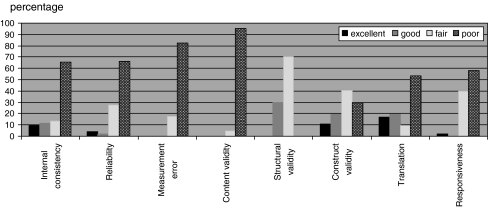
BACKGROUND: The COSMIN checklist is a standardized tool for assessing the methodological quality of studies on measurement properties. It contains 9 boxes, each dealing with one measurement property, with 5-18 items per box about design aspects and statistical methods. Our aim was to develop a scoring system for the COSMIN checklist to calculate quality scores per measurement property when using the checklist in systematic reviews of measurement properties. METHODS: The scoring system was developed based on discussions among experts and testing of the scoring system on 46 articles from a systematic review. Four response options were defined for each COSMIN item (excellent, good, fair, and poor). A quality score per measurement property is obtained by taking the lowest rating of any item in a box ("worst score counts"). RESULTS: Specific criteria for excellent, good, fair, and poor quality for each COSMIN item are described. In defining the criteria, the "worst score counts" algorithm was taken into consideration. This means that only fatal flaws were defined as poor quality. The scores of the 46 articles show how the scoring system can be used to provide an overview of the methodological quality of studies included in a systematic review of measurement properties. CONCLUSIONS: Based on experience in testing this scoring system on 46 articles, the COSMIN checklist with the proposed scoring system seems to be a useful tool for assessing the methodological quality of studies included in systematic reviews of measurement properties.
Overview
The claims and statistics of this paper haven’t been checked yet.
Free: it reads the open-access text and checks the first 5 claims that cite a source we can check. Create a free account to check every claim.
Integrity signals
Registry
Cites
Statistics
Figures
Verification
Claims the paper makes
The claims and statistics of this paper haven’t been checked yet.
Free: it reads the open-access text and checks the first 5 claims that cite a source we can check. Create a free account to check every claim.
Claims other papers make about this one
Each is checked against this paper’s own text: does it say what the citing paper says it does?
The source backs part of the claim, not all of it — or backs it for a different population, condition or comparison.
In the citing paper
“The sample size of this study met a standard for measurement properties (The COSMIN checklist; Terwee et al., 2012).”
From Reliability and validity of the Japanese version of the experiential avoidance in caregiving questionnaire (EACQ) (2023) · cites this paper as Terwee et al., 2012
Experimental — accuracy not yet measuredThe cited source says what the claim attributes to it.
In the citing paper
“The sample size of this study met a standard for measurement properties (The COSMIN checklist; Terwee et al., 2012).”
From Reliability and validity of the Japanese version of the Valued Living Questionnaire Adapted to Caregiving (2023) · cites this paper as Terwee et al., 2012
The cited source says what the claim attributes to it.
In the citing paper
“Third, since this study did not examine the responsiveness (Terwee et al., 2012) of the J-VLQAC, future research should assess this by examining whether the score of the J-VLQAC change through psychological intervention (e.g., ACT) for dementia family caregivers.”
From Reliability and validity of the Japanese version of the Valued Living Questionnaire Adapted to Caregiving (2023) · cites this paper as Terwee et al., 2012
The cited source says what the claim attributes to it.
In the citing paper
“This study examined the PAAQ-J’s reliability and validity according to COSMIN’s framework [27] (see also [28]).”
From Psychometric Properties of the Japanese Version of the Parental Acceptance and Action Questionnaire in Parents with Infants and Toddlers (2023) · cites this paper as [27]
Self-check
Percentages, sums and reported differences re-computed from the paper’s own numbers.
The self-check needs the paper’s full text.
Citations
Cites
GRADE: an emerging consensus on rating quality of evidence and strength of recommendations
Guyatt, G. H., Oxman, A. D., Vist, G. E., Kunz, R., Falck-Ytter, Y., Alonso-Coello, P., & Schünemann, H. J. (2008) · BMJ · doi:10.1136/bmj.39489.470347.ad · Cited by 23,305 · cited 2×
“This distinction is also increasingly being made in systematic reviews of randomized trials and diagnostic studies [13, 19].”
BackgroundMethodQuality criteria were proposed for measurement properties of health status questionnaires
Terwee, C. B., Bot, S. D. M., de Boer, M. R., van der Windt, D. A. W. M., Knol, D. L., Dekker, J., Bouter, L. M., & de Vet, H. C. W. (2007) · Journal of Clinical Epidemiology · doi:10.1016/j.jclinepi.2006.03.012 · Cited by 10,764 · cited 1×
“Other checklists that have been published, such as EMPRO [17], and a checklist we previously designed [18] were developed for rating the quality of an instrument rather than the methodological quality of a study.”
MethodSelf-citationApplied Multivariate Statistics for the Social Sciences
Stevens, J. P. (2012) · Routledge eBooks · doi:10.4324/9780203843130 · Cited by 10,648
Applied multivariate statistics for the social sciences
Stevens, J. P., & Stevens, J. P. (2001) · doi:10.4324/9781410604491 · Cited by 4,993
Mokkink, L. B., Terwee, C. B., Patrick, D. L., Alonso, J., Stratford, P. W., Knol, D. L., Bouter, L. M., & de Vet, H. C. W. (2010) · Quality of Life Research · doi:10.1007/s11136-010-9606-8 · Cited by 4,260 · cited 3×
“However, as we stated in the articles on the development of the COSMIN checklist [7, 8], what is adequate may depend on a number of issues.”
MethodSelf-citationMeasurement in Medicine: A Practical Guide
de Vet, H. C. W., Terwee, C. B., Mokkink, L. B., & Knol, D. L. (2011) · doi:10.1017/cbo9780511996214 · Cited by 2,321
Self-citationAssessing health status and quality-of-life instruments: Attributes and review criteria
Lohr, K. N. (2002) · Quality of Life Research · doi:10.1023/a:1015291021312 · Cited by 2,269
Mokkink, L. B., Terwee, C. B., Knol, D. L., Stratford, P. W., Alonso, J., Patrick, D. L., Bouter, L. M., & de Vet, H. C. (2010) · BMC Medical Research Methodology · doi:10.1186/1471-2288-10-22 · Cited by 1,834
Self-citation2009 updated method guidelines for systematic reviews in the Cochrane Back Review Group
Furlan, A. D., Pennick, V., Bombardier, C., & van Tulder, M. (2009) · Spine · doi:10.1097/brs.0b013e3181b1c99f · Cited by 1,663 · cited 1×
“In this systematic review, levels of evidence were used to rate the quality of the instruments, like is done in reviews of randomized clinical trials [13, 14 ].”
Method(2011) · Amsterdam UMC (VU Amsterdam) - Institutional Repository · Cited by 1,209
Self-citation
Research works printed but not linked: 1
- Higgins, J. P. T. & Green, S. (Eds.). (2009). Cochrane Handbook for Systematic Reviews of Interventions Version 5.0.2 [updated September 2009]. (Available from www.cochrane-handbook.org: Cochrane Collaboration).
Cited by
Items 801–900 of 1,005
Orlandoni, P., & Peladic, N. J. (2016) · Journal of Aging Research and Lifestyle · doi:10.14283/jarcp.2016.87 · Cited by 26
Reply to the concerns raised by McKenna and Heaney about COSMIN
Mokkink, L. B., Terwee, C. B., de Vet, H. C. W., Bouter, L. M., Alonso, J., & Patrick, D. L. (2021) · Journal of Medical Economics · doi:10.1080/13696998.2021.1948231 · Cited by 20
Self-citationChapman, S., Chung, H. C., Rawcliffe, A. J., Izard, R., Smith, L., & Roberts, J. D. (2021) · Nutrients · doi:10.3390/nu13051416 · Cited by 17
“This was done by obtaining a quality score per measurement by taking the lowest rating of any item in a criteria box [49].”
BackgroundMethodInstruments for measuring nursing research competence: a COSMIN-based scoping review
Xia, Y., Huang, H., Halili, X., Tang, S., & Chen, Q. (2023) · BMC Nursing · doi:10.1186/s12912-023-01572-7 · Cited by 17
“These elements are crucial for ensuring content validity, which is crucial for ensuring an instrument’s psychometric properties, and? requires cognitive interviews with the target population [13, 20].”
BackgroundMethodAlnahdi, A. H., Murtada, B. A., Zawawi, A. T., Omar, M. T. A., & Alsobayel, H. (2021) · Disability and Rehabilitation · doi:10.1080/09638288.2021.1880651 · Cited by 17
“A sample size of 30 (fair rating) was considered the minimum required sample for examining the test–retest reliability and measurement error based on COSMIN guidelines [29].”
MethodInfluentialPatient-reported outcome measures for masticatory function in adults: a systematic review
Fan, Y., Shu, X., Leung, K., & Lo, E. C. M. (2021) · BMC Oral Health · doi:10.1186/s12903-021-01949-7 · Cited by 18
Development of the Japanese Version of the Short Scale of Creative Self1, 2
Ishiguro, C., Matsumoto, K., Agata, T., & Okada, T. (2022) · Japanese Psychological Research · doi:10.1111/jpr.12418 · Cited by 21
Mehta, P., Claydon, L. S., Hendrick, P. A., Cook, C. E., & Baxter, D. G. (2015) · Pain Practice · doi:10.1111/papr.12293 · Cited by 17
“As part of this, in reviewing the evidence on available outcome measures, it is important to assess the methodological quality of those studies that investigated psychometric properties.(9) While in clinical practice, adoption of outcome measures will depend on feasibility of use (speed, ease of use, and limited need…”
BackgroundMethodMyer, C. M., Howell, R. J., Cohen, A. P., Willging, J. P., & Ishman, S. L. (2016) · Otolaryngology · doi:10.1177/0194599816630531 · Cited by 17
Lauridsen, H. H., O’Neill, L. D., Kongsted, A., & Hartvigsen, J. (2016) · Pain Practice · doi:10.1111/papr.12477 · Cited by 17
“We determined the percentage of correctly predicted hypotheses as an indicator of the strength of evidence for construct validity.(23,36)”
MethodEdbrooke, L., Denehy, L., Parry, S. M., Astin, R., Jack, S., & Granger, C. L. (2017) · Respirology · doi:10.1111/resp.12975 · Cited by 17
Braun, T., Grüneberg, C., Coppers, A., Tofaute, L., & Thiel, C. (2018) · Journal of Rehabilitation Medicine · doi:10.2340/16501977-2320 · Cited by 17
Systematic Review of the Clinical Disease Severity Indices for Inflammatory Bowel Disease
Alrubaiy, L., Rikaby, I., Sageer, M., Hutchings, H. A., & Williams, J. G. (2015) · Inflammatory Bowel Diseases · doi:10.1097/mib.0000000000000438 · Cited by 17
“Methodological quality assessment: We reported on the methodological quality of the included studies using the COSMIN (COnsensus-based Standards for the selection of health Measurement INstruments) checklist.(16,17) Each measurement property is assessed against certain quality standards and rated on a 4-point scale (p…”
MethodHeiberg, G. A., Pedersen, S. G., Friborg, O., Nielsen, J. F., Stabel, H. H., von Steinbüchel, N., Arntzen, C., & Anke, A. (2018) · BMC Neurology · doi:10.1186/s12883-018-1101-9 · Cited by 18
“preferable) [44] to identify items contributing poorly to the reliability or the ranking of the patients.”
BackgroundResultInfluentialAmano, S., Umeji, A., Takebayashi, T., Takahashi, K., Uchiyama, Y., & Domen, K. (2019) · Topics in Stroke Rehabilitation · doi:10.1080/10749357.2019.1701176 · Cited by 20
“Fourteen items were scored on a 4-point rating scale (poor, fair, good, or excellent) to determine whether the results of the present study could be trusted.(23) Since nine instances of “excellent”, two “good”, one “fair”, two “not applicable”, and no “poor” were identified, the methodological quality aspect of the st…”
Stasi, S., Stamou, M., Papathanasiou, G., Frantzeskaki, P., Kanavas, E., Evaggelou-Sossidis, G., Gouskos, A., Palantzas, A., Poursanidis, K., & Macheras, G. A. (2020) · Journal of Patient-Reported Outcomes · doi:10.1186/s41687-020-00207-8 · Cited by 18
“In the German [15] and Japanese [16] versions, the criterion “minimally important change > smallest detectable change” [39] was used and fully satisfied.”
BackgroundMethodJohn, D., Royal, A., & Bharti, O. K. (2021) · F1000Research · doi:10.12688/f1000research.28454.2 · Cited by 19
Peters, S., Botero, M., Evers, A., Fong, B., Jakab, B., Petter, E., & Eng, J. J. (2021) · Pilot and Feasibility Studies · doi:10.1186/s40814-021-00862-8 · Cited by 17
“To this end, based on published reports [20] and the COSMIN recommendations and checklist [21], 50 or more individuals are needed to determine whether the FM-tele is similar to the FM and will use Kappa methodology to calculate reliability [21].”
MethodHaile, Y. G., Habatmu, K., Derese, A., Gouse, H., Lawrie, S. M., Cella, M., & Alem, A. (2021) · Social Psychiatry and Psychiatric Epidemiology · doi:10.1007/s00127-021-02120-x · Cited by 17
“A summary of quality per measurement property is given for each study by taking the worst result for each criterion (for each measurement property addressed) [36].”
MethodZonjee, V. J., Abma, I. L., de Mooij, M. J., Schaik, S. M. V., van den Berg‐Vos, R. M., Roorda, L. D., & Terwee, C. B. (2022) · Quality of Life Research · doi:10.1007/s11136-022-03151-w · Cited by 18
“For each study and aspect of content validity, following the COSMIN Risk of Bias checklist and using a ‘worst score counts’ principle (Step 1&2) [24], the methodology of the included studies was rated as “very good,” “adequate,” “doubtful,” or “inadequate”.”
MethodSelf-citationA healthier daily diet is associated with greater immune fitness
van Oostrom, E. C., Mulder, K. E., Verheul, M. C., Hendriksen, P. A., Thijssen, S., Kraneveld, A. D., Vlieg‐Boerstra, B., Garssen, J., & Verster, J. C. (2022) · PharmaNutrition · doi:10.1016/j.phanu.2022.100306 · Cited by 18
Systematic review of self-concept measures for primary school aged children with cerebral palsy
Cheong, S. K., & Johnston, L. M. (2013) · Research in Developmental Disabilities · doi:10.1016/j.ridd.2013.07.023 · Cited by 17
Remijn, L., Weijers, G., der Sanden, M. W. G. N., Groen, B. E., & de Korte, C. L. (2015) · Ultrasound in Medicine & Biology · doi:10.1016/j.ultrasmedbio.2015.02.007 · Cited by 17
Rosales, R. S., Martin-Hidalgo, Y., Reboso-Morales, L., & Atroshi, I. (2016) · BMC Musculoskeletal Disorders · doi:10.1186/s12891-016-0963-5 · Cited by 17
“Therefore, it should include the hypothesis that can demonstrate the proposed construct (theory) [15, 16].”
BackgroundMori, B., Norman, K. E., Brooks, D., Herold, J., & Beaton, D. (2016) · Physiotherapy Canada · doi:10.3138/ptc.2014-43e · Cited by 19
Watanabe, K., Kawakami, N., Adachi, H., Inoue, S., & Meyer, M. R. U. (2016) · Journal of Occupational Health · doi:10.1539/joh.16-0143-oa · Cited by 18
Jácome, C. I. O., Flores, I., Martins, F., Castro, C., McPhee, C. C., Shepherd, E., Demain, S. H., de Figueiredo, D. M. P., & Marques, A. S. P. D. D. (2017) · Disability and Rehabilitation · doi:10.1080/09638288.2017.1375034 · Cited by 18
“This study is reported following the COnsensus-based Standards for the selection of health Measurement Instruments [19], the STrengthening the Reporting of OBservational studies in Epidemiology statement [20] and the guidelines for reliability and agreement studies [21].”
Reliability and validity of self-reported sitting and breaks from sitting in the workplace
Sudholz, B., Ridgers, N. D., Mussap, A. J., Bennie, J. A., Timperio, A. F., & Salmon, J. (2017) · Journal of science and medicine in sport · doi:10.1016/j.jsams.2017.10.030 · Cited by 21
Holistic needs assessment in brain cancer patients: A systematic review of available tools
Afseth, J., Neubeck, L., Karatzias, T., & Grant, R. (2018) · European Journal of Cancer Care · doi:10.1111/ecc.12931 · Cited by 21
“, 2010) which are then given a rating of excellent, good, fair, poor or not assessed by taking the lowest rating of any of the items that make up each attribute (Terwee et al., 2012).”
BackgroundMethodInfluentialPotter, K., Bowling, R., Kavanagh, L., Stone, A., Witt, B., & Wooldridge, A. (2019) · Physiotherapy Canada · doi:10.3138/ptc-2018-0071 · Cited by 18
A Systematic Review on Clinimetric Properties of Play Instruments for Occupational Therapy Practice
Romli, M. H., & Yunus, F. W. (2020) · Occupational Therapy International · doi:10.1155/2020/2490519 · Cited by 17
“Although the COnsensus-based Standards for the selection of health status Measurement Instruments (COSMIN; [26]) is considered the gold standard to evaluate the quality of the assessment tool instrument, however, it has several limitations to be used in this systematic review.”
MethodLangan, S. M., Stuart, B., Bradshaw, L., Schmitt, J., Williams, H. C., & Thomas, K. S. (2017) · Journal of Allergy and Clinical Immunology · doi:10.1016/j.jaci.2017.02.043 · Cited by 16
“Predefined categorical bands for POEM scores were used to evaluate clinical interpretability: clear/mild (0-7), moderate (8-16), and severe/very severe (17-28) AD.”
Methodvan Lankveld, W., van Melick, N., Habets, B., Roelofsen, E., Staal, J. B., & van Cingel, R. (2017) · BMC Musculoskeletal Disorders · doi:10.1186/s12891-017-1643-9 · Cited by 16
“For studies into measurement properties of questionnaires, a sample size of >100 is required, and in determining test-retest reliability a sample size of 50 is adequate [34].”
BackgroundReliability of the NEO Five Factor Inventory short form for assessing personality after stroke
Dwan, T., Ownsworth, T., Donovan, C. L., & Lo, A. H. Y. (2017) · International Psychogeriatrics · doi:10.1017/s1041610217000382 · Cited by 20
“For reliability analyses a sample size of 30-49 is considered “fair”, whereas a sample of >50 is considered “good” (Terwee et al., 2012).”
Psychometric Evaluation of the Persian Version of the Childbirth Experience Questionnaire (CEQ)
Kazemi, S., Dencker, A., Pazandeh, F., Montazeri, A., Mobarakabadi, S. S., & Hajian, S. (2020) · BioMed Research International · doi:10.1155/2020/6879283 · Cited by 19
“We also took missing items into consideration [18], and the final sample size was 250.”
MethodGriffin, A. R., Leaver, A. M., Arora, M., Walton, D. M., Peek, A. L., Bandong, A. N., Sterling, M. M., & Rebbeck, T. J. (2021) · Clinical Journal of Pain · doi:10.1097/ajp.0000000000000968 · Cited by 17
Özden, F., Tümtürk, İ., & Sarı, Z. (2022) · Neurological Sciences · doi:10.1007/s10072-022-06066-z · Cited by 16
Psychometric Properties of Instruments Assessing Intrinsic Capacity: A Systematic Review
Chen, Y., Kukreti, S., Yang, H.-L., Liu, C.-C., Yeh, Y., Fung, X. C. C., Liu, C.-H., Liu, L., Griffiths, M. D., Yang, Y., et al. (2023) · Asian Journal of Social Health and Behavior · doi:10.4103/shb.shb_343_23 · Cited by 18
Lin, Y.-T., & Song, C. (2024) · Geriatric Nursing · doi:10.1016/j.gerinurse.2024.04.004 · Cited by 16
Kim, C., Schlenk, E. A., Ahn, J., Kim, M., Park, E., & Park, J. (2016) · The Science of Diabetes Self-Management and Care · doi:10.1177/0145721716655400 · Cited by 17
“The methodological quality of studies reporting on each questionnaire was assessed via the COSMIN checklist.(39,44) It consists of items on internal consistency, reliability, measurement error, content validity, construct validity (including structural validity), hypothesis testing, cross-cultural validity, criterion…”
MethodFox, B., Henwood, T. R., Keogh, J., & Neville, C. C. (2016) · The JBI Database of Systematic Reviews and Implementation Reports · doi:10.11124/jbisrir-2016-003064 · Cited by 18
“Method of the review Assessment of the methodological quality was undertaken with the COSMIN checklist (Appendix II).(35) This is a four-point scoring system developed by COSMIN specifically for use in systematic reviews and was completed by two reviewers independently.”
MethodBiofeedback in Partial Weight Bearing: Validity of 3 Different Devices
van Lieshout, R., Stukstette, M. J. P. M., de Bie, R. A., Vanwanseele, B., & Pisters, M. F. (2016) · Journal of Orthopaedic and Sports Physical Therapy · doi:10.2519/jospt.2016.6625 · Cited by 18
Taylor, J., Boehnke, J. R., Wright, J. M., Kellar, I., Alderson, S. L., Hughes, T. E., Holt, R. I. G., & Siddiqi, N. (2017) · Trials · doi:10.1186/s13063-017-1805-y · Cited by 16
“Key papers for identified outcomes will be assessed against the COnsensus-based Standards for the selection of health Measurement INstruments (COSMIN) Checklist [47] which uses a rating scale to assess the quality of measurement properties 2.”
MethodInfluentialSystematic Review of Clinimetric Instruments to determine the severity of Non‐segmental Vitiligo
Peralta‐Pedrero, M. L., Morales‐Sánchez, M. A., Cruz, F. J., la Torre-García, M. E. D., Cruz‐Peralta, E. S., & Olguín‐García, M. G. (2019) · Australasian Journal of Dermatology · doi:10.1111/ajd.13008 · Cited by 17
“The four-point assessment system was used to measure the quality per study and per property of measurement as excellent, good, deficient or poor.(5,6)”
MethodLeung, Y. Y., Orbai, A., de Wit, M. P. T., Balanescu, A. R., Dernis, E., Soubrier, M., Eder, L., Smolen, J. S., Coates, L. C., Gossec, L., et al. (2020) · Arthritis Care & Research · doi:10.1002/acr.24139 · Cited by 16
“For threshold of remission/LDA/PASS, the cutoff scores of the patientreported outcome measures were established by 2 methods, first using the 25th/75th centile of scores (39); second is the receiver operating characteristic (ROC) curve and the cutoff correspondent to the Youden’s J index (40) for the group identified…”
MethodKhan, M. N. U., Morrison, N. M. V., & Marshall, P. W. (2020) · Journal of Pain Research · doi:10.2147/jpr.s258314 · Cited by 17
Davoli, G. B. D. Q., Cardoso, J. R. D. S., Silva, G. C., Moreira, R. D. F. C., & Mattiello‐Sverzut, A. C. (2021) · Developmental Medicine & Child Neurology · doi:10.1111/dmcn.14887 · Cited by 16
“‘the worst score counts’ principle).(22) The result of each study for a given measurement property was rated against the updated criteria for good measurement properties.”
BackgroundFahsold, A., Fleming, R., Verbeek, H., Holle, B., & Palm, R. (2021) · HERD Health Environments Research & Design Journal · doi:10.1177/19375867211043073 · Cited by 16
“, 2017) using the COnsensus-based Standards for the selection of health Measurement INstruments checklist (Terwee et al., 2012).”
Methoddos Reis, N. F., Biscaro, R. R. M., Figueiredo, F. C. X. S. D., Lunardelli, E. B., & da Silva, R. M. (2021) · Revista Brasileira de Terapia Intensiva · doi:10.5935/0103-507x.20210051 · Cited by 16
Traore, Y., Epstein, J., Spitz, É., MARCH, L. M., Maillefert, J.-F., Rutherford, C., Ricatte, C., Alleyrat, C., Cross, M., King, L. K., et al. (2022) · Osteoarthritis and Cartilage · doi:10.1016/j.joca.2021.12.011 · Cited by 16
Ansari, N. N., Rahimi, M., Naghdi, S., Barzegar-Ganji, Z., Hasson, S., & Moghimi, E. (2022) · Journal of Pediatric Rehabilitation Medicine · doi:10.3233/prm-190648 · Cited by 16
“The COSMIN (COnsensus-based Standards for the selection of health status Measurement INstruments) guideline for evaluating measurement properties suggests sample sizes of at least 30 subjects [28].”
Delage, N., Cantagrel, N., Delorme, J., Pereira, B., Dualé, C., Bertin, C., Chenaf, C., Kerckhove, N., Laporte, C., Picard, P., et al. (2022) · Canadian Journal of Anesthesia/Journal canadien d anesthésie · doi:10.1007/s12630-022-02210-7 · Cited by 16
“Sample size estimation was fixed according to COnsensusbased Standards for the selection of health Measurement INstruments (COSMIN) recommendations.(31,32) Rules-ofthumb for the number of participants needed to ensure internal consistency varied from four to ten participants per variable, with a minimum number of 100…”
MethodBerti, A., Boleto, G., Merkel, P. A., Tómasson, G., Monti, S. M., Quinn, K. A., Hassett, L. C., Carmona, L., & Ramiro, S. (2022) · Rheumatology · doi:10.1093/rheumatology/keac175 · Cited by 16
de Brito, S. A. F., Scianni, A. A., Peniche, P. D. C., & Faria, C. D. C. D. M. (2022) · Clinical Rehabilitation · doi:10.1177/02692155221129834 · Cited by 16
“The lack of evidence of compliance with these requirements, and the use of nonrecommended statistical tests, were the main methodological flaws found.(25,26) Only two studies investigated measurement error, all classified as “doubtful” for methodological quality.”
BackgroundMethodInfluentialKim, S., Kim, M., Kim, J., Park, B., Min, N., Jung, M., Yu, S., Lee, J. Y., Yoo, H. W., Kim, H., et al. (2023) · Allergy Asthma and Immunology Research · doi:10.4168/aair.2023.15.1.43 · Cited by 16
Instruments to Assess Evidence-Based Practice Among Health Care Professionals: A Systematic Review
da Silva, A. M., Valentim, D. P., Martins, A. L., & Padula, R. S. (2023) · Health Education & Behavior · doi:10.1177/10901981231170154 · Cited by 16
“The data regarding the measurement properties were extracted from each study and analyzed according to the COnsensus-based Standards for the selection of health Measurement Instruments (COSMIN) initiative (Mokkink et al., 2010, 2016; Terwee et al., 2012).”
MethodDevelopment and Validation of the Diabetes Management Self-efficacy Scale for Older Adults (DMSES-O)
Song, M., Choi, S., Kim, S.-A., Seo, K., Lee, S. J., & Kim, E. H. (2014) · Journal of muscle and joint health · doi:10.5953/jmjh.2014.21.3.184 · Cited by 18
“요인분석을 이용한 구성타당도 검증을 위해 필요한 최 소 표본크기는 문항수의 5~7배 이상이면서 전체 표본수가 100 명 이상이므로, 본 연구에서 도출된 예비문항이 22개임을 감 안할 때 최소 표본크기를 만족한 것으로 판단하였다(Terwee et al., 2012).”
Lee, J., Kim, S. H., Moon, S. H., & Lee, E. (2014) · Quality of Life Research · doi:10.1007/s11136-014-0716-6 · Cited by 19
Arblaster, K., Mackenzie, L. A., & Willis, K. F. (2015) · The Journal of Mental Health Training Education and Practice · doi:10.1108/jmhtep-04-2015-0016 · Cited by 17
Clari, M., Matarese, M., Alvaro, R., Piredda, M., & Marinis, M. G. D. (2016) · Heart & Lung · doi:10.1016/j.hrtlng.2016.06.006 · Cited by 18
Eyles, J. P., Hunter, D. J., de Meneses, S. R. F., Collins, N. J., Dobson, F., Lucas, B. R., & Mills, K. A. G. (2017) · Osteoarthritis and Cartilage · doi:10.1016/j.joca.2017.02.802 · Cited by 17
Belayneh, T., Worku, A. G., Adefris, M., & Rørtveit, G. (2019) · International Urogynecology Journal · doi:10.1007/s00192-019-03920-1 · Cited by 18
Andersen, C., & Kristensen, M. T. (2019) · Journal of Stroke and Cerebrovascular Diseases · doi:10.1016/j.jstrokecerebrovasdis.2019.06.021 · Cited by 16
Nijmegen Questionnaire: A valid measure for hyperventilation syndrome
Ogilvie, V. L., Kayes, N. M., & Kersten, P. (2019) · New Zealand Journal of Physiotherapy · doi:10.15619/nzjp/47.3.04 · Cited by 19
“The COSMIN checklist identifies several criteria to assess the methodological quality of measurement studies (Mokkink et al., 2010a; Terwee et al., 2012).”
Reliability and validity of a novel Kinect-based software program for measuring a single leg squat
Ressman, J., Rasmussen-Barr, E., & Grooten, W. J. A. (2020) · BMC Sports Science Medicine and Rehabilitation · doi:10.1186/s13102-020-00179-8 · Cited by 18
“For validity and reliability studies, a sample size with at least 50 measures is recommended [47, 71].”
BackgroundMeasurement of Fine-Motor Skills in Young Children with Visual Impairment
Reimer, A. M., Cox, R. F. A., Boonstra, F. N., & der Sanden, M. W. G. N. (2015) · Journal of Developmental and Physical Disabilities · doi:10.1007/s10882-015-9433-5 · Cited by 22
“None of the tests used were investigated for validity and reliability in the specific population, as advised in test development (Terwee et al. 2012).”
MethodDorsey, C. N., Mettert, K. D., Puspitasari, A. J., Damschroder, L. J., & Lewis, C. C. (2021) · Implementation Research and Practice · doi:10.1177/26334895211002474 · Cited by 15
“…approach was adopted to offer a less negative assessment of each property by considering all empirical uses instead of the commonly used “worst score counts” approach (Lewis et al., 2015; Terwee et al., 2012) where only the one lowest performing article was considered in cases of multiple ratings.”
MethodWu, C., Lai, C.-J., Xiao, F., Yang, J.-T., Yang, S., Lai, D., & Tsuang, F.-Y. (2024) · Perioperative Medicine · doi:10.1186/s13741-024-00409-4 · Cited by 15
Developing Patient-Reported and Relevant Outcome Measures
Haywood, K. L., de Wit, M. P. T., Staniszewska, S. H., Morel, T., & Salek, S. (2017) · Springer eBooks · doi:10.1007/978-981-10-4068-9_9 · Cited by 21
Coaching Servant Leadership: Scale Development and Validation
Takamatsu, S. (2022) · Frontiers in Sports and Active Living · doi:10.3389/fspor.2022.871495 · Cited by 15
Hyperacusis and Misophonia: A Systematic Review of Psychometric Measures
Kula, F. B., Cropley, M., & Aazh, H. (2022) · Journal of the American Academy of Audiology · doi:10.1055/a-1896-5032 · Cited by 15
“22,23 The present study aimed to systematically review the psychometric properties of the existing hyperacusis and Conclusion None of the papers reviewed reported all the information required to meet the COSMIN standards.”
Rose, A. E., Cullen, B., Crawford, S., & Evans, J. J. (2022) · Clinical Rehabilitation · doi:10.1177/02692155221139023 · Cited by 16
Quartermaine, J. R., Rose, T., Auld, M. L., & Johnston, L. M. (2023) · Disability and Rehabilitation · doi:10.1080/09638288.2023.2207042 · Cited by 15
“The worst score counts method was utilised, providing a quality score for each measurement property by using the lowest rating of any item [49].”
MethodConcurrent Validity of Two Gait Performance Measures in Children with Neuromotor Disorders
Ammann‐Reiffer, C., Bastiaenen, C. H. G., Klöti, C., & van Hedel, H. J. A. (2018) · Physical & Occupational Therapy In Pediatrics · doi:10.1080/01942638.2017.1420003 · Cited by 15
“Adhering to the criteria provided by the COSMIN guidelines, we aimed for a sample size of at least 50 (Terwee et al., 2012).”
MethodNeijenhuijs, K. I., Jansen, F., Aaronson, N. K., Brédart, A., Grøenvold, M., Holzner, B., Terwee, C. B., Cuijpers, P. J., & Leeuw, I. M. V. (2018) · Supportive Care in Cancer · doi:10.1007/s00520-018-4243-9 · Cited by 15
Self-citationBatting, M., & Barker, K. L. (2018) · Physiotherapy · doi:10.1016/j.physio.2018.07.014 · Cited by 16
Potter, S., Davies, C. F., Holcombe, C., Weiler-Mithoff, E. M., Skillman, J. M., Vidya, R., Masannat, Y., Weber, W. P., Heil, J., Wilson, S. M., et al. (2020) · BMJ Open · doi:10.1136/bmjopen-2019-035505 · Cited by 16
A systematic review of siblings’ psychosocial outcomes following traumatic brain injury
Ownsworth, T., & Karlsson, L. J. E. (2020) · Disability and Rehabilitation · doi:10.1080/09638288.2020.1769206 · Cited by 17
“[27]); (6) Descriptive data: Mean/median and standard deviation/ range or frequency data were reported for psychosocial outcome measures, in the text or a table or graph; and (7) Selection bias: Studies outlined the number of participants who were excluded, or were eligible but did not participate, and the associated…”
BackgroundThe value of core outcome sets in health psychology
Matvienko‐Sikar, K., Terwee, C. B., Gargon, E., Devane, D., Kearney, P. M., & Byrne, M. (2020) · British Journal of Health Psychology · doi:10.1111/bjhp.12447 · Cited by 16
Self-citationStrickland, L. H. H., Murray, D. W., Pandit, H. G., & Jenkinson, C. (2020) · Journal of Patient-Reported Outcomes · doi:10.1186/s41687-020-00262-1 · Cited by 15
Airey, N. D., Taylor, C. D. J., Vikram, A., & Berry, K. (2023) · Psychiatry Research · doi:10.1016/j.psychres.2023.115163 · Cited by 16
“determined using a ‘worse score counts’ method (Terwee et al., 2012).”
MethodBeaton, D., Terwee, C. B., Singh, J. A., HAWKER, G. A., Patrick, D. L., Burke, L. B., Toupin‐April, K., & Tugwell, P. (2015) · The Journal of Rheumatology · doi:10.3899/jrheum.141446 · Cited by 15
Self-citationvan der Meer, S., Trippolini, M. A., van der Palen, J. A. M., Verhoeven, J., & Reneman, M. F. (2013) · Spine · doi:10.1097/01.brs.0000435028.50317.33 · Cited by 19
Lower limb muscle impairment in myotonic dystrophy type 1: The need for better guidelines
Petitclerc, É., Hébert, L. J., Desrosiers, J., & Gagnon, C. (2014) · Muscle & Nerve · doi:10.1002/mus.24521 · Cited by 15
Björklund, M., Wiitavaara, B., & Heiden, M. (2016) · Quality of Life Research · doi:10.1007/s11136-016-1373-8 · Cited by 17
“participants in each sample was most likely adequate for our purpose [62].”
BackgroundKrawcyk, R. S., Vinther, A., Petersen, N., & Kruuse, C. R. (2016) · Journal of Stroke and Cerebrovascular Diseases · doi:10.1016/j.jstrokecerebrovasdis.2016.12.004 · Cited by 15
Oosterhaven, J. A. F., Schuttelaar, M. L. A., Apfelbacher, C., Diepgen, T. L., & Ofenloch, R. F. (2017) · Contact Dermatitis · doi:10.1111/cod.12788 · Cited by 15
Psychometric assessment of a scale to measure bonding workplace social capital
Eguchi, H., Tsutsumi, A., Inoue, A., & Odagiri, Y. (2017) · PLoS ONE · doi:10.1371/journal.pone.0179461 · Cited by 15
Pearson, N. A., Packham, J., Tutton, E., Parsons, H. M., & Haywood, K. L. (2018) · Rheumatology Advances in Practice · doi:10.1093/rap/rky017 · Cited by 16
“Adoption of the COSMIN checklist as per the current review, facilitates the incorporation of study methodological quality in the final judgement of PROM quality (20-22).”
MethodSeager, A., French, H., & Meldrum, D. (2019) · European Journal of Pediatrics · doi:10.1007/s00431-019-03338-3 · Cited by 15
“on sample size) should be used as guidelines and should be at the 132 discretion of the rater [49,50].”
Giaccari, L. G., Coppolino, F., Aurilio, C., Esposito, V., Pace, M. C., Paladini, A., Passavanti, M. B., Pota, V., & Sansone, P. (2020) · Pain and Therapy · doi:10.1007/s40122-020-00166-4 · Cited by 18
Moral distress in nursing students: Cultural adaptation and validation study
Mazzotta, R., Maria, M. D., Bove, D., Badolamenti, S., Bordignon, S. S., Silveira, L. C. J., Vellone, E., Alvaro, R., & Bulfone, G. (2021) · Nursing Ethics · doi:10.1177/09697330211030671 · Cited by 15
“We enrolled 282 participants to support a more stable analysis.(43,44) Data collection procedures The data were collected from May to August 2020 through an electronic questionnaire created with Survio.”
MethodUpdate of the Core Set of Exercise Tests for Children and Adolescents With Cerebral Palsy
Verschuren, O. W., & Balemans, A. C. J. (2015) · Pediatric Physical Therapy · doi:10.1097/pep.0000000000000137 · Cited by 15
Reininga, I. H. F., Brouwer, S., Dijkstra, A., Busse, J. W., Ebrahim, S., Wendt, K. W., & Moumni, M. E. (2014) · Injury · doi:10.1016/j.injury.2014.08.042 · Cited by 15
Şahinoğlu, E., Ergin, G., & Ünver, B. (2019) · Knee Surgery Sports Traumatology Arthroscopy · doi:10.1007/s00167-019-05369-7 · Cited by 15
Thorborg, K., Roos, E. M., Christensen, R., Petersen, J., & Hölmich, P. (2012) · Arthroscopy The Journal of Arthroscopic and Related Surgery · doi:10.1016/j.arthro.2012.07.003 · Cited by 15
Martinko, A., Karuc, J., Jurić, P., Podnar, H., & Sorić, M. (2022) · JMIR mhealth and uhealth · doi:10.2196/37547 · Cited by 15
“Each aspect of methodological quality evaluation was appraised based on a proposed scoring system [22]; it could be either of excellent, good, fair, or poor quality.”
Methodde Klerk, S. (2022) · Hand Therapy · doi:10.1177/17589983221140433 · Cited by 14
“2011 to assess the methodological quality of the crosscultural validity of included studies in their respective SRs.(54) The COSMIN Risk of Bias checklist however, replaced the COSMIN Checklist with 4-point scale as the preferred checklist towards evaluating the methodological quality of studies included in the system…”
Methodda Silva, L. C., Faria, C. D. C. D. M., Peniche, P. D. C., de Brito, S. A. F., & Aguiar, L. T. (2023) · Topics in Stroke Rehabilitation · doi:10.1080/10749357.2023.2217639 · Cited by 14
“24 Therefore, the present study sought to ensure the inclusion of at least 50 individuals.”
BackgroundShufen, C., Jinmin, L., Xiaohui, Z., & Bin, G. (2023) · BMC Musculoskeletal Disorders · doi:10.1186/s12891-023-06926-5 · Cited by 14
“Each standard is answered by the four point rating system (inadequate, doubtful, adequate, or very good) [36], and the final rating is determined by the lowest score given for any of the standards in box 6 (the worst score counts method) [37].”
Background
Metadata
- Authors
- Terwee, C. B., Mokkink, L. B., Knol, D. L., Ostelo, R. W. J. G., Bouter, L. M., & de Vet, H. C. W.
- Affiliations
- Amsterdam Public Health (NL)
- Vrije Universiteit Amsterdam (NL)
- Corresponding author
- Terwee, Caroline B.
- Venue
- Quality of Life Research
- Published
- 2011-07-06
- Volume
- 21
- Issue
- 4
- Pages
- 651-657
- ISSN
- 0962-9343 (ISSN-L)
- 1573-2649
- PMC
- PMC3323819
- OpenAlex
- W2151199180
- Semantic Scholar
- 80858ac3671354dc3bf1b226c74eb8fe0513fb26
- Cited by
- 1,978
- References
- 23
- Citations by year
- 2026: 81 · 2025: 118 · 2024: 148 · 2023: 161 · 2022: 164 · 2021: 226 · 2020: 150 · 2019: 172 · 2018: 181 · 2017: 172 · 2016: 142 · 2015: 106 · 2014: 80 · 2013: 45 · 2012: 25
- FWCI
- 12.05
- Type
- journal article
- Language
- en
- Open access
- hybrid
- doi.org
- Licence
- cc-by-nc
- creativecommons.org/licenses/by-nc/2.0 (tdm)
- Locations
- Quality of Life Research (publishedVersion, cc-by-nc)
- Europe PMC (PubMed Central) (publishedVersion, cc-by-nc)
- PubMed Central (publishedVersion, cc-by-nc)
- PubMed (publishedVersion)
- Pure Amsterdam UMC (publishedVersion, other-oa)
- VU Research Portal (publishedVersion, other-oa)
- Amsterdam UMC (VU Amsterdam) - Institutional Repository (acceptedVersion, other-oa)
- Data Archiving and Networked Services (DANS) (submittedVersion, other-oa)
- Digital Academic REpository of VU University Amsterdam (Vrije Universiteit Amsterdam) (submittedVersion)
- Topics
- Social Sciences › Decision Sciences › Statistics, Probability and Uncertainty › Meta-analysis and systematic reviews
- Social Sciences › Sociology and Political Science › Delphi Technique in Research
- Health Sciences › Nursing › Research and Theory › Health Education and Validation
- Keywords
- COSMIN checklist, measurement properties, methodological quality assessment, scoring system, quality scores, systematic reviews, patient-reported outcome measures, quality standards
- MeSH terms
- Humans, Psychometrics, Quality Control, Quality of Life, Surveys and Questionnaires, Review Literature as Topic, Reproducibility of Results, Checklist
About these checks
Registry, retraction, Cites and statistics results are computed, not judged, with one exception: a printed reference that no index lists is read once by a model before it counts as a citation error. Claims are extracted by a model and kept only when their quote appears verbatim in the text; each cited source is then checked, with a model’s help, for whether it says what the claim relies on. Those verdicts can be wrong — read the claim’s quote and the cited source before relying on one.
Statistics and arithmetic are recomputed, not judged.
Confidence bands are shown only for fields calibrated on our annotated test set. None is calibrated yet, so no band is shown.
What counts as a claim ›How we measure confidence ›How we check this ›
Are you an author, or do you see a problem with this page? Request a review
Data sources
Bibliographic data: Semantic Scholar, OpenAlex, Crossref.
Contains information from the Semantic Scholar Academic Graph Datasets, made available under the ODC Attribution License (ODC-BY 1.0).
Semantic Scholar’s data is described in: Kinney, R., et al. (2023). The Semantic Scholar Open Data Platform. arXiv:2301.10140.
