

Rating the methodological quality in systematic reviews of studies on measurement properties: a scoring system for the COSMIN checklist
Open accessThe DOI matches its Crossref record; 23 of the 23 references it cites were found in a registry or an index.
Abstract
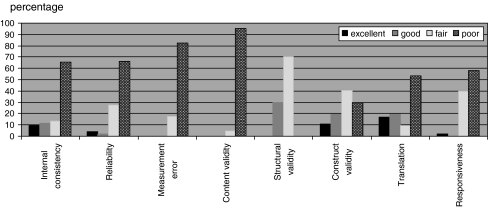
BACKGROUND: The COSMIN checklist is a standardized tool for assessing the methodological quality of studies on measurement properties. It contains 9 boxes, each dealing with one measurement property, with 5-18 items per box about design aspects and statistical methods. Our aim was to develop a scoring system for the COSMIN checklist to calculate quality scores per measurement property when using the checklist in systematic reviews of measurement properties. METHODS: The scoring system was developed based on discussions among experts and testing of the scoring system on 46 articles from a systematic review. Four response options were defined for each COSMIN item (excellent, good, fair, and poor). A quality score per measurement property is obtained by taking the lowest rating of any item in a box ("worst score counts"). RESULTS: Specific criteria for excellent, good, fair, and poor quality for each COSMIN item are described. In defining the criteria, the "worst score counts" algorithm was taken into consideration. This means that only fatal flaws were defined as poor quality. The scores of the 46 articles show how the scoring system can be used to provide an overview of the methodological quality of studies included in a systematic review of measurement properties. CONCLUSIONS: Based on experience in testing this scoring system on 46 articles, the COSMIN checklist with the proposed scoring system seems to be a useful tool for assessing the methodological quality of studies included in systematic reviews of measurement properties.
Overview
The claims and statistics of this paper haven’t been checked yet.
Free: it reads the open-access text and checks the first 5 claims that cite a source we can check. Create a free account to check every claim.
Integrity signals
Registry
Cites
Statistics
Figures
Verification
Claims the paper makes
The claims and statistics of this paper haven’t been checked yet.
Free: it reads the open-access text and checks the first 5 claims that cite a source we can check. Create a free account to check every claim.
Claims other papers make about this one
Each is checked against this paper’s own text: does it say what the citing paper says it does?
The source backs part of the claim, not all of it — or backs it for a different population, condition or comparison.
In the citing paper
“The sample size of this study met a standard for measurement properties (The COSMIN checklist; Terwee et al., 2012).”
From Reliability and validity of the Japanese version of the experiential avoidance in caregiving questionnaire (EACQ) (2023) · cites this paper as Terwee et al., 2012
Experimental — accuracy not yet measuredThe cited source says what the claim attributes to it.
In the citing paper
“The sample size of this study met a standard for measurement properties (The COSMIN checklist; Terwee et al., 2012).”
From Reliability and validity of the Japanese version of the Valued Living Questionnaire Adapted to Caregiving (2023) · cites this paper as Terwee et al., 2012
The cited source says what the claim attributes to it.
In the citing paper
“Third, since this study did not examine the responsiveness (Terwee et al., 2012) of the J-VLQAC, future research should assess this by examining whether the score of the J-VLQAC change through psychological intervention (e.g., ACT) for dementia family caregivers.”
From Reliability and validity of the Japanese version of the Valued Living Questionnaire Adapted to Caregiving (2023) · cites this paper as Terwee et al., 2012
The cited source says what the claim attributes to it.
In the citing paper
“This study examined the PAAQ-J’s reliability and validity according to COSMIN’s framework [27] (see also [28]).”
From Psychometric Properties of the Japanese Version of the Parental Acceptance and Action Questionnaire in Parents with Infants and Toddlers (2023) · cites this paper as [27]
Self-check
Percentages, sums and reported differences re-computed from the paper’s own numbers.
The self-check needs the paper’s full text.
Citations
Cites
GRADE: an emerging consensus on rating quality of evidence and strength of recommendations
Guyatt, G. H., Oxman, A. D., Vist, G. E., Kunz, R., Falck-Ytter, Y., Alonso-Coello, P., & Schünemann, H. J. (2008) · BMJ · doi:10.1136/bmj.39489.470347.ad · Cited by 23,305 · cited 2×
“This distinction is also increasingly being made in systematic reviews of randomized trials and diagnostic studies [13, 19].”
BackgroundMethodQuality criteria were proposed for measurement properties of health status questionnaires
Terwee, C. B., Bot, S. D. M., de Boer, M. R., van der Windt, D. A. W. M., Knol, D. L., Dekker, J., Bouter, L. M., & de Vet, H. C. W. (2007) · Journal of Clinical Epidemiology · doi:10.1016/j.jclinepi.2006.03.012 · Cited by 10,764 · cited 1×
“Other checklists that have been published, such as EMPRO [17], and a checklist we previously designed [18] were developed for rating the quality of an instrument rather than the methodological quality of a study.”
MethodSelf-citationApplied Multivariate Statistics for the Social Sciences
Stevens, J. P. (2012) · Routledge eBooks · doi:10.4324/9780203843130 · Cited by 10,648
Applied multivariate statistics for the social sciences
Stevens, J. P., & Stevens, J. P. (2001) · doi:10.4324/9781410604491 · Cited by 4,993
Mokkink, L. B., Terwee, C. B., Patrick, D. L., Alonso, J., Stratford, P. W., Knol, D. L., Bouter, L. M., & de Vet, H. C. W. (2010) · Quality of Life Research · doi:10.1007/s11136-010-9606-8 · Cited by 4,260 · cited 3×
“However, as we stated in the articles on the development of the COSMIN checklist [7, 8], what is adequate may depend on a number of issues.”
MethodSelf-citationMeasurement in Medicine: A Practical Guide
de Vet, H. C. W., Terwee, C. B., Mokkink, L. B., & Knol, D. L. (2011) · doi:10.1017/cbo9780511996214 · Cited by 2,321
Self-citationAssessing health status and quality-of-life instruments: Attributes and review criteria
Lohr, K. N. (2002) · Quality of Life Research · doi:10.1023/a:1015291021312 · Cited by 2,269
Mokkink, L. B., Terwee, C. B., Knol, D. L., Stratford, P. W., Alonso, J., Patrick, D. L., Bouter, L. M., & de Vet, H. C. (2010) · BMC Medical Research Methodology · doi:10.1186/1471-2288-10-22 · Cited by 1,834
Self-citation2009 updated method guidelines for systematic reviews in the Cochrane Back Review Group
Furlan, A. D., Pennick, V., Bombardier, C., & van Tulder, M. (2009) · Spine · doi:10.1097/brs.0b013e3181b1c99f · Cited by 1,663 · cited 1×
“In this systematic review, levels of evidence were used to rate the quality of the instruments, like is done in reviews of randomized clinical trials [13, 14 ].”
Method(2011) · Amsterdam UMC (VU Amsterdam) - Institutional Repository · Cited by 1,209
Self-citation
Research works printed but not linked: 1
- Higgins, J. P. T. & Green, S. (Eds.). (2009). Cochrane Handbook for Systematic Reviews of Interventions Version 5.0.2 [updated September 2009]. (Available from www.cochrane-handbook.org: Cochrane Collaboration).
Cited by
Items 301–400 of 1,005
Wong, C. K. H., Cheung, P. W. H., Luo, N., & Cheung, J. P. Y. (2019) · The European Journal of Health Economics · doi:10.1007/s10198-018-1026-7 · Cited by 58
Slagers, A. J., Reininga, I. H. F., & van den Akker-Scheek, I. (2017) · Journal of Sports Sciences · doi:10.1080/02640414.2016.1167230 · Cited by 57
“A sample size of at least 100 is considered an adequate sample size for studies regarding measurement properties of questionnaires, and a sample size of 50 is considered adequate for determining test–retest reliability (Terwee et al., 2012).”
BackgroundLevy, T., Laver, K., Killington, M., Lannin, N. A., & Crotty, M. (2018) · Clinical Rehabilitation · doi:10.1177/0269215518811903 · Cited by 59
Bellido‐Pérez, M., Monforte‐Royo, C., Tomás‐Sábado, J., Porta-Sales, J., & Balaguer, A. (2016) · Palliative Medicine · doi:10.1177/0269216316669867 · Cited by 61
Buchanan, H., Siegfried, N., & Jelsma, J. M. (2015) · Occupational Therapy International · doi:10.1002/oti.1398 · Cited by 58
Chow, M. Y. K., Morrow, A., Robbins, S. C. C., & Leask, J. (2013) · Quality of Life Research · doi:10.1007/s11136-012-0343-z · Cited by 63
“We used the ‘‘worst score count’’ method recommended by the authors, in which the final property rating is the lowest rating of any of its corresponding items [38] (Table 4).”
MethodRose, L., Agar, M., Burry, L. D., Campbell, N., Clarke, M., Lee, J., Siddiqi, N., & Page, V. J. (2017) · BMJ Open · doi:10.1136/bmjopen-2017-016371 · Cited by 55
Assessment of patient information needs: A systematic review of measures
Christalle, E., Zill, J. M., Frerichs, W., Härter, M. C., Nestoriuc, Y., Dirmaier, J., & Scholl, I. (2019) · PLoS ONE · doi:10.1371/journal.pone.0209165 · Cited by 61
Xiu, Z., Wang, Y., Zhou, H., Qiu, L., & Pang, R. (2019) · PLoS ONE · doi:10.1371/journal.pone.0215373 · Cited by 63
Haywood, K. L., Brett, J., Tutton, E., & Staniszewska, S. H. (2016) · Quality of Life Research · doi:10.1007/s11136-016-1424-1 · Cited by 60
“The development of the COSMIN guidance—consensusbased standards for the evaluation of study methodological quality—provides essential and timely guidance to support and inform greater transparency and methodological rigour in PROM evaluation [11, 15].”
BackgroundMethodResultInfluentialPålsson, A., Kostogiannis, I., & Ageberg, E. (2020) · Knee Surgery Sports Traumatology Arthroscopy · doi:10.1007/s00167-020-06005-5 · Cited by 55
Bouça‐Machado, R., Fernandes, A. B., Ranzato, C., Beneby, D., Nzwalo, H., & Ferreira, J. J. (2022) · Frontiers in Neuroscience · doi:10.3389/fnins.2022.945398 · Cited by 57
“The search for studies evaluating the clinimetric properties of the included measurement tools was based on previous research (Terwee et al., 2012; Bloem et al., 2016) and the references provided for each measurement tool in the included studies.”
MethodCordier, R., Munro, N., Wilkes‐Gillan, S., Speyer, R., & Pearce, W. M. (2014) · Research in Developmental Disabilities · doi:10.1016/j.ridd.2014.03.050 · Cited by 60
Janssens, A. I. W. A., Rogers, M., Coon, J. T., Allen, K., Green, C., Jenkinson, C., Tennant, A., Logan, S., & Morris, C. (2015) · Value in Health · doi:10.1016/j.jval.2015.01.004 · Cited by 55
“This checklist consists of nine boxes with methodological standards for how each measurement property should be assessed [13].”
BackgroundMethodSpeksnijder, C. M., Koppenaal, T., Knottnerus, J. A., Spigt, M., Staal, J. B., & Terwee, C. B. (2016) · Physical Therapy · doi:10.2522/ptj.20140478 · Cited by 61
Self-citationMason, S. J., Catto, J. W. F., Downing, A., Bottomley, S. E., Glaser, A., & Wright, P. (2018) · British Journal of Urology · doi:10.1111/bju.14368 · Cited by 53
Halim, H. A., Abdul-Razak, S., Yasin, M. M., & Isa, M. R. (2019) · Human Vaccines & Immunotherapeutics · doi:10.1080/21645515.2019.1674112 · Cited by 61
van der Linde, J. A., van Kampen, D. A., van Beers, L. W. A. H., van Deurzen, D. F. P., Terwee, C. B., & Willems, W. J. (2015) · Journal of Orthopaedic Surgery and Research · doi:10.1186/s13018-015-0286-5 · Cited by 57
“We planned to include at least 100 patients, which is considered excellent for assessing measurement properties [15, 16].”
BackgroundSelf-citationGraaf, M. T.-D., Scholten-Peeters, G. G. M., Schellingerhout, J. M., Bourne, A., Buchbinder, R., Sleijser‐Koehorst, M. L. S., Terwee, C. B., & Verhagen, A. P. (2016) · Quality of Life Research · doi:10.1007/s11136-016-1277-7 · Cited by 59
“The appropriate boxes were selected per study and each item within this box scored on a 4-point rating scale: ‘‘poor,’’ ‘‘fair,’’ ‘‘good’’ or ‘‘excellent’’ [25].”
Self-citationKaur, N., Belchior, P. D. C., Gélinas, I., & Bier, N. (2016) · International Psychogeriatrics · doi:10.1017/s104161021600017x · Cited by 56
“To evaluate the methodology of the psychometric studies, the COSMIN checklist (Terwee et al., 2012) was employed.”
MethodPage, T. E., Farina, N., Brown, A., Daley, S., Bowling, A., Basset, T., Livingston, G., Knapp, M. R. J., Murray, J., & Banerjee, S. (2017) · BMJ Open · doi:10.1136/bmjopen-2016-013611 · Cited by 52
van der Linde, J. A., van Kampen, D. A., van Beers, L. W. A. H., van Deurzen, D. F. P., Saris, D. B. F., & Terwee, C. B. (2017) · Journal of Orthopaedic and Sports Physical Therapy · doi:10.2519/jospt.2017.6548 · Cited by 55
Self-citationEhrenbrusthoff, K., Ryan, C. G., Grüneberg, C., & Martin, D. (2018) · Musculoskeletal Science and Practice · doi:10.1016/j.msksp.2018.02.007 · Cited by 58
DeJong, H. M., Abbott, S., Zelesco, M., Kennedy, B. F., Ziman, M. R., & Wood, F. M. (2017) · PubMed Central · Cited by 65
Toward the development of a short multi‐country person‐centered maternity care scale
Afulani, P. A., Feeser, K. R., Sudhinaraset, M., Aborigo, R., Montagu, D., & Chakraborty, N. M. (2019) · International Journal of Gynecology & Obstetrics · doi:10.1002/ijgo.12827 · Cited by 58
Ishøi, L., Hölmich, P., & Thorborg, K. (2019) · International Journal of Sports Physical Therapy · doi:10.26603/ijspt20190715 · Cited by 58
Barber, C. E. H., Zell, J., Yazdany, J., Davis, A. M., Cappelli, L. C., Ehrlich‐Jones, L., Everix, D. K., Thorne, C., Bohm, V., Suter, L. G., et al. (2019) · Arthritis Care & Research · doi:10.1002/acr.24040 · Cited by 52
Systematic review of the measurement properties of indices of prenatal care utilization
Rowe, S., Karkhaneh, Z., MacDonald, I., Chambers, T., Amjad, S., Osornio-Vargas, Á. R., Chari, R. S., Kumar, M., & Ospina, M. B. (2020) · BMC Pregnancy and Childbirth · doi:10.1186/s12884-020-2822-5 · Cited by 52
Boger, E. J., Demain, S. H., & Latter, S. M. (2012) · Disability and Rehabilitation · doi:10.3109/09638288.2012.737080 · Cited by 68
“nl The properties examined in this systematic review are defined by COSMIN [42] and consist of nine items: Internal consistency; Reliability; Measurement error; Content Validity; Structural validity; Hypothesis testing; Cross-cultural validity; Criterion Validity and Responsiveness.”
BackgroundMethodInfluentialWallen, M. A., & Stewart, K. (2014) · Disability and Rehabilitation · doi:10.3109/09638288.2014.963704 · Cited by 54
“[59] to quality rate the measures.”
Proud, E. L., Miller, K. J., Bilney, B., Balachandran, S., McGinley, J. L., & Morris, M. E. (2014) · Archives of Physical Medicine and Rehabilitation · doi:10.1016/j.apmr.2014.09.016 · Cited by 54
Hanratty, J., Livingstone, N., Robalino, S., Terwee, C. B., Glod, M., Oono, I. P., Rodgers, J., Macdonald, G., & McConachie, H. (2015) · PLOS ONE · doi:10.1371/journal.pone.0144649 · Cited by 46
Self-citationRobinson, K. A., Davis, W. E., Dinglas, V. D., Méndez-Téllez, P. A., Rabiee, A., Sukrithan, V., Yalamanchilli, R., Turnbull, A. E., & Needham, D. M. (2016) · Journal of Clinical Epidemiology · doi:10.1016/j.jclinepi.2016.08.014 · Cited by 57
Wouters, M., Evenhuis, H. M., & Hilgenkamp, T. I. M. (2017) · Research in Developmental Disabilities · doi:10.1016/j.ridd.2016.12.016 · Cited by 58
Measurement properties of depression questionnaires in patients with diabetes: a systematic review
van Dijk, S. E. M., Adriaanse, M. C., van der Zwaan, L. G. L., Bosmans, J. E., van Marwijk, H., van Tulder, M. W., & Terwee, C. B. (2018) · Quality of Life Research · doi:10.1007/s11136-018-1782-y · Cited by 54
““poor”, “fair”, “good” or “excellent”) [19].”
Self-citationClinically relevant differences in COPD health status: systematic review and triangulation
Alma, H. J., de Jong, C., Tsiligianni, I., Sanderman, R., Kocks, J. W. H., & van der Molen, T. (2018) · European Respiratory Journal · doi:10.1183/13993003.00412-2018 · Cited by 52
“Included concepts that were selected were from the Cochrane Risk of Bias tool [67], the COSMIN checklist [68], systematic reviews by B OHANNON and colleagues [58, 59] and recommendations in the MCID literature [2, 33, 45, 69].”
MethodAdding meaning to physical fitness test results in individuals with intellectual disabilities
Oppewal, A., & Hilgenkamp, T. I. M. (2019) · Disability and Rehabilitation · doi:10.1080/09638288.2018.1527399 · Cited by 54
“Expanding information on psychometric properties With regard to the tests in the ID-fitscan, further research is needed regarding the psychometric properties that have not been studied yet [22,24].”
BackgroundMethodPedi-IKDC or KOOS-child: which questionnaire should be used in children with knee disorders?
van der Velden, C. A., van der Steen, M. C., Leenders, J. M. P., van Douveren, F. Q. M. P., Janssen, R. P. A., & Reijman, M. (2019) · BMC Musculoskeletal Disorders · doi:10.1186/s12891-019-2600-6 · Cited by 51
Scott, J. L., Étain, B., Manchia, M., Brichant‐Petitjean, C., Geoffroy, P. A., Schulze, T. G., Alda, M., Bellivier, F., & collaborators, C. (2019) · Bipolar Disorders · doi:10.1111/bdi.12829 · Cited by 61
Psychometric Properties of the Barthel Index Used at Intensive Care Unit Discharge
dos Reis, N. F., Figueiredo, F. C. X. S. D., Biscaro, R. R. M., Lunardelli, E. B., & Maurici, R. (2021) · American Journal of Critical Care · doi:10.4037/ajcc2022732 · Cited by 51
Marks, M., Schoones, J. W., Kolling, C., Herren, D. B., Goldhahn, J., & Vlieland, T. P. M. V. (2013) · Journal of Hand Surgery (European Volume) · doi:10.1177/1753193413488301 · Cited by 54
“The resulting rating could be excellent, good, fair, or poor (Terwee et al., 2012).”
BackgroundMethodInfluentialPsychometric properties of dual-task balance assessments for older adults: A systematic review
Yang, L., Liao, L., Lam, F. M. H., He, C. Q., & Pang, M. Y. C. (2015) · Maturitas · doi:10.1016/j.maturitas.2015.01.001 · Cited by 54
Rögener, W., & Wormer, H. (2015) · Public Understanding of Science · doi:10.1177/0963662515597195 · Cited by 52
“This approach is widely employed in the evaluation of scientific research (Neidhardt, 2006); also, methods relying on the consensus of experts are being used for the assessment of quality in medicine and health (Fink et al., 1984; Terwee et al., 2012).”
MethodMatarese, M., Lommi, M., & De Marinis, M. G. (2017) · Journal of Advanced Nursing · doi:10.1111/jan.13204 · Cited by 47
“…of the included studies The methodological quality of the studies was assessed using the four-point rating scale COSMIN checklist, which was developed to determine if a study on measurement properties of a self-reported instrument would meet methodological quality standards (Terwee et al. 2012).”
MethodSpeyer, R., Cordier, R., Parsons, L., Denman, D., & Kim, J. (2017) · Dysphagia · doi:10.1007/s00455-017-9835-x · Cited by 56
“The COSMIN taxonomy includes the following nine measurement properties [17]: internal consistency, reliability, measurement error, content validity, structural validity, hypotheses testing, cross-cultural validity, criterion validity, and responsiveness (Table 2).”
MethodSelf‐criticism self‐report measures: Systematic review
Rose, A., & Rimes, K. A. (2018) · Psychology and Psychotherapy Theory Research and Practice · doi:10.1111/papt.12171 · Cited by 54
“For each study or sample, the methodological quality for a particular measurement property was rated by a series of items on a 4-point nominal rating scale: poor, fair, good, and excellent (Terwee et al., 2012).”
MethodConceptualizing loneliness in health research: Philosophical and psychological ways forward.
McHugh Power, J. E., Dolezal, L., Kee, F., & Lawlor, B. A. (2018) · Journal of Theoretical and Philosophical Psychology · doi:10.1037/teo0000099 · Cited by 42
“Better, more consensus-based measurements of loneliness would positively impact the homogeneity within metaanalyses and would also help to evaluate success of interventions (Terwee et al., 2012).”
BackgroundJakobsson, M., Gutke, A., Mokkink, L. B., Smeets, R., & Lundberg, M. (2018) · Physical Therapy · doi:10.1093/ptj/pzy159 · Cited by 57
“32 To our knowledge, the checklist is the most widely used consensus-based quality assessment tool specifically developed for studies on measurement properties.”
InfluentialSelf-citationObservational Gait Assessment Scales in Patients with Walking Disorders: Systematic Review
Ridao-Fernández, C., Pinto, E. P., & Chamorro-Moriana, G. (2019) · BioMed Research International · doi:10.1155/2019/2085039 · Cited by 50
“selection of health Measurement Instruments [24] (COSMIN checklist).”
BackgroundMethodInfluentialMeasures of workplace inclusion: A systematic review using the COSMIN methodology
Rezai, M., Kolne, K., Bui, S., & Lindsay, S. (2020) · Journal of Occupational Rehabilitation · doi:10.1007/s10926-020-09872-4 · Cited by 49
Item Response Theory Analysis of the Fear of COVID-19 Scale (FCV-19S): A Systematic Review
Alimoradi, Z., Lin, C.-Y., Ullah, I., Griffiths, M. D., & Pakpour, A. H. (2022) · Psychology Research and Behavior Management · doi:10.2147/prbm.s350660 · Cited by 50
“An overall score for the methodological quality of each measurement property for each study is determined by taking the lowest rating of any of the items according to the guideline.(34) The present systematic review specifically focused on the properties of internal consistency, structural validity, cross-cultural val…”
MethodBar‐On, L., Aertbeliën, E., Molenaers, G., Dan, B., & Desloovere, K. (2014) · Developmental Medicine & Child Neurology · doi:10.1111/dmcn.12419 · Cited by 51
“Each of the six domains (and generalizability) were rated by both assessors independently on a four-point scale according to the COSMIN guidelines.(33) ‘Excellent’ quality was assigned if all relevant COSMIN items within a domain were scored as adequate.”
MethodDekkers, K. J. F. M., Rameckers, E. A. A., Smeets, R., & Janssen‐Potten, Y. (2014) · Physical Therapy · doi:10.2522/ptj.20130166 · Cited by 59
Lupi, J. B., de Abreu, D. C. C., Ferreira, M. C., de Oliveira, R. D. R., & Chaves, T. C. (2016) · Disability and Rehabilitation · doi:10.1080/09638288.2016.1207106 · Cited by 57
“Internal consistency is the degree to which the items on a tool correlate, and it is important to standardize the results of a questionnaire by assessing the degree of consistency among the items that make up the tool.[15,20] As recommended by Mokkink et al.”
BackgroundMethodGaasterland, C. M. W., der Weide, M. C. J., Roes, K. C. B., & van der Lee, J. H. (2019) · BMC Medical Research Methodology · doi:10.1186/s12874-019-0866-x · Cited by 51
“The COnsensus-based Standards for the selection of health Measurement Instruments (COSMIN) guidelines, which have been developed to evaluate the methodological quality of studies on measurement properties of HR-PROs and other instruments [23, 24], can be used as a basis for a validation plan.”
MethodShared Decision-Making Measures: A Systematic Review
Ahmad, M. M., Tabar, N. A., Othman, E. H., & Abdelrahim, Z. (2020) · Quality Management in Health Care · doi:10.1097/qmh.0000000000000250 · Cited by 52
Brækken, I. H., Stuge, B., Tveter, A. T., & Bø, K. (2021) · International Urogynecology Journal · doi:10.1007/s00192-021-04881-0 · Cited by 50
Alsharqawi, N., Alhashemi, M., Kaneva, P. A., Baldini, G., Fiore, J. F., Feldman, L. S., & Lee, L. (2019) · Surgical Endoscopy · doi:10.1007/s00464-019-07011-6 · Cited by 48
Putman, S., Dаrtus, J., Migаud, H., Pasquier, G. J. M., Girard, J., Preda, C., & Duhamel, A. (2021) · Orthopaedics & Traumatology Surgery & Research · doi:10.1016/j.otsr.2021.102830 · Cited by 49
Wong, C. K. H., Chen, J., Yu, C. L. Y., Sham, M., & Lam, C. L. K. (2014) · Journal of Clinical Epidemiology · doi:10.1016/j.jclinepi.2014.09.021 · Cited by 50
Elvrum, A.-K. G., Sæther, R., Riphagen, I. I., & Vik, T. (2016) · Developmental Medicine & Child Neurology · doi:10.1111/dmcn.13119 · Cited by 54
“The rating of the methodological quality of the included studies according to the COSMIN was in this regard very useful.(20) There are some potential limitations to this review.”
MethodResultInfluentialA Meta-Analysis of the Reliability of Four Field-Based Trunk Extension Endurance Tests
Martínez-Romero, M. T., Ayala, F., Croix, M. D. S., Vera-García, F. J., de Baranda, P. S., Santonja‐Medina, F., & Sánchez‐Meca, J. (2020) · International Journal of Environmental Research and Public Health · doi:10.3390/ijerph17093088 · Cited by 53
“, “the worst score counts” principle) [45].”
Sæther, R., Helbostad, J. L., Adde, L., Jørgensen, L., & Vik, T. (2013) · Research in Developmental Disabilities · doi:10.1016/j.ridd.2013.03.029 · Cited by 57
Thyroid disease‐specific quality of life questionnaires ‐ A systematic review
Uslar, V., Becker, C., Weyhe, D., & Tabriz, N. (2022) · Endocrinology Diabetes & Metabolism · doi:10.1002/edm2.357 · Cited by 53
Ratter, J., Radlinger, L., & Lucas, C. (2014) · Journal of physiotherapy · doi:10.1016/j.jphys.2014.06.011 · Cited by 52
Hiemstra, L. A., Kerslake, S., Lafave, M. R., & Mohtadi, N. G. H. (2016) · Orthopaedic Journal of Sports Medicine · doi:10.1177/2325967116646085 · Cited by 49
“The COSMIN checklist can be used to guide the design of a health measurement instrument as well as to report on the measurement properties of these tools.(10,20) The Kujala score(5) is a 13-item questionnaire that was developed to evaluate the subjective symptoms and functional limitations in patients with patellofemo…”
MethodYang, L., Lam, F. M. H., Liao, L., Huang, M., He, C. Q., & Pang, M. Y. C. (2016) · Gait & Posture · doi:10.1016/j.gaitpost.2016.11.007 · Cited by 47
“First, of the 23 studies included in this review, very few were rated as good or excellent in terms of methodological quality according to the criteria described in COSMIN (supplementary tables 1-5) [7].”
BackgroundMethodRosenkoetter, U., & Tate, R. L. (2017) · Brain Impairment · doi:10.1017/brimp.2017.29 · Cited by 55
“Terwee et al. (2012) have pointed out that there is an important distinction to be made between the design and statistical outcome standards, in a similar fashion to the quality evaluation of intervention studies.”
BackgroundResultKoçoğlu, D., Dengiz, K. S., & Saçıkara, Z. (2020) · Journal of Advanced Nursing · doi:10.1111/jan.14349 · Cited by 53
Joseph, K. L. H., Dagfinrud, H. S., Christie, A., Hagen, K. B., & Tveter, A. T. (2021) · BMC Musculoskeletal Disorders · doi:10.1186/s12891-021-04069-z · Cited by 47
Gender/sex diversity beliefs: Scale construction, validation, and links to prejudice
Schudson, Z. C., & van Anders, S. M. (2021) · Group Processes & Intergroup Relations · doi:10.1177/1368430220987595 · Cited by 53
“More recent recommendations suggest larger samples to establish test–retest reliability (i.e., N > 100; Terwee et al., 2012); therefore, we also examined GSDB data collected at two time points 4 weeks apart from another sample (Study 3b; N = 500; Schudson et al., 2021).”
BackgroundPsychometric properties of the General Self-Efficacy Scale in Parkinson's disease
Nilsson, M. H., Hagell, P., & Iwarsson, S. (2015) · Acta Neurologica Scandinavica · doi:10.1111/ane.12368 · Cited by 46
“Prerequisites when determining test–retest reliability are that data collection, settings, and participant characteristics are similar at both test conditions (29, 30).”
BackgroundElsman, E. B. M., Mokkink, L. B., Langendoen‐Gort, M., Rutters, F., Beulens, J. W. J., Elders, P. J. M., & Terwee, C. B. (2022) · BMJ Open Diabetes Research & Care · doi:10.1136/bmjdrc-2021-002729 · Cited by 48
“33 Third, criteria for good measurement properties were applied to each result using the quality criteria, resulting in a sufficient (+), insufficient (−), or indeterminate (?) rating (online supplemental appendix 3).”
Self-citationA Systematic Review of the Validity and Reliability of the Patient-Determined Disease Steps Scale
Marrie, R. A., Mcfadyen, C., Yaeger, L., & Salter, A. R. (2022) · International Journal of MS Care · doi:10.7224/1537-2073.2021-102 · Cited by 47
Measurement Properties of Outcome Measures for Vitiligo: A Systematic Review
Vrijman, C., Linthorst Homan, M. W., Limpens, J., van der Veen, W., Wolkerstorfer, A., Terwee, C. B., & Spuls, P. I. (2012) · Archives of Dermatology · doi:10.1001/archdermatol.2012.3065 · Cited by 46
Self-citationHarris‐Hayes, M., McDonough, C. M., Leunig, M., Lee, C. B., Callaghan, J. J., & Roos, E. M. (2013) · Journal of the American Academy of Orthopaedic Surgeons · doi:10.5435/00124635-201300001-00009 · Cited by 47
Abma, F. I., van der Klink, J. J., Terwee, C. B., Amick, B. C., & Bültmann, U. (2011) · Scandinavian Journal of Work Environment & Health · doi:10.5271/sjweh.3190 · Cited by 53
“The COSMIN taxonomy and checklist were chosen for the critical appraisal of the measurement properties (21, 23, 29, 30).”
Self-citationPROMs in paediatric knee ligament injury: use the Pedi-IKDC and avoid using adult PROMs
Dietvorst, M., Reijman, M., van Groningen, B., van der Steen, M. C., & Janssen, R. P. A. (2017) · Knee Surgery Sports Traumatology Arthroscopy · doi:10.1007/s00167-017-4687-3 · Cited by 47
Timmer, M. A., Gouw, S. C., Feldman, B. M., Zwagemaker, A., de Kleijn, P., Pisters, M. F., Schutgens, R. E. G., Blanchette, V. S., Srivastava, A., David, J. A., et al. (2017) · Haemophilia · doi:10.1111/hae.13367 · Cited by 46
“7 For each measurement property the COSMIN includes items that assess design requirements and statistical methods, the actual content of the items is specific for each measurement property.”
Williams, B. A., & Beovich, B. (2019) · Journal of Evaluation in Clinical Practice · doi:10.1111/jep.13293 · Cited by 46
Measurement Properties of the Craniocervical Flexion Test: A Systematic Review
de Araujo, F. X., Ferreira, G. E., Schell, M. S., de Castro, M. P., Ribeiro, D. C., & Silva, M. F. (2020) · Physical Therapy · doi:10.1093/ptj/pzaa072 · Cited by 47
Measurement Properties of Patient-Reported Outcome Measures for Diabetes: Systematic Review
Wee, P. J. L., Kwan, Y. H., Loh, D. H. F., Phang, J. K., Puar, T. H. K., Østbye, T., Thumboo, J., Yoon, S., & Low, L. L. (2021) · Journal of Medical Internet Research · doi:10.2196/25002 · Cited by 52
“The item with the worst rating under each measurement property would determine the overall rating for the specific measurement property [23].”
The Working Alliance Inventory's Measurement Properties: A Systematic Review
Paap, D., Karel, Y., Verhagen, A. P., Dijkstra, P. U., Geertzen, J. H. B., & Pool, G. (2022) · Frontiers in Psychology · doi:10.3389/fpsyg.2022.945294 · Cited by 52
“COSMIN suggests to report the lowest score (Terwee et al., 2012).”
BackgroundMethodInfluentialInternal Structure of the Patient Health Questionnaire-9: A Systematic Review and Meta-analysis
Chae, D., Lee, J., & Lee, E. (2024) · Asian Nursing Research · doi:10.1016/j.anr.2024.12.005 · Cited by 53
Ammann‐Reiffer, C., Bastiaenen, C. H. G., de Bie, R. A., & van Hedel, H. J. A. (2014) · Physical Therapy · doi:10.2522/ptj.20130299 · Cited by 53
Tyson, S. F., & Brown, P. (2014) · Clinical Rehabilitation · doi:10.1177/0269215514521043 · Cited by 44
Validity and reliability of a Dutch version of the Foot and Ankle Ability Measure
Weel, H., Zwiers, R., Azim, D., Sierevelt, I. N., Haverkamp, D., van Dijk, C. N., & Kerkhoffs, G. M. M. J. (2014) · Knee Surgery Sports Traumatology Arthroscopy · doi:10.1007/s00167-014-3480-9 · Cited by 45
Clinical Outcome Measures for Lateropulsion Poststroke: An Updated Systematic Review
Koter, R., Regan, S. E., Clark, C., Huang, V., Mosley, M., Wyant, E., Cook, C. E., & Hoder, J. M. (2017) · Neurology Report · doi:10.1097/npt.0000000000000194 · Cited by 45
Essner, A., Zetterberg, L., Hellström, K., Gustås, P., Högberg, H., & Sjöström, R. (2017) · Acta veterinaria Scandinavica · doi:10.1186/s13028-017-0311-2 · Cited by 47
“The CFA and EFA were repeated in the subgroup of dogs (n = 49).”
BackgroundMethodInfluentialSitnikova, K., Dijkstra-Kersten, S. M. A., Mokkink, L. B., Terluin, B., van Marwijk, H. W. J., Leone, S. S., van der Horst, H. E., & van der Wouden, J. C. (2017) · Journal of Psychosomatic Research · doi:10.1016/j.jpsychores.2017.10.005 · Cited by 42
“Two reviewers (KS and SK) then independently evaluated the quality of the included studies per measurement property, using the COSMIN checklist 4-point rating scale (12, 16) (available from the website www.”
MethodSelf-citationAbou, L., de Freitas, G. R., Palandi, J., & Ilha, J. (2018) · Topics in Spinal Cord Injury Rehabilitation · doi:10.1310/sci17-00027 · Cited by 48
“Quality assessment Two reviewers independently assessed and rated each study’s methodological quality using the scoring system from the COSMIN checklist.(19) Disagreements were settled through discussion, with a third reviewer making the final decision.”
MethodMuscle tone assessments for children aged 0 to 12 years: a systematic review
Goo, M., Tucker, K. J., & Johnston, L. M. (2018) · Developmental Medicine & Child Neurology · doi:10.1111/dmcn.13668 · Cited by 45
“The primary reason was insufficient methodological quality, particularly small sample size (<30) and nonreporting of how missing data were handled.(44) These issues could be overcome by future studies with improved design.”
BackgroundMethodGridley, N., Blower, S. L., Dunn, A., Bywater, T. J., Whittaker, K. A., & Bryant, M. (2019) · Clinical Child and Family Psychology Review · doi:10.1007/s10567-019-00275-3 · Cited by 51
Sastre‐Rus, M., García‐Lorenzo, A., Lluch‐Canut, T., Tomás‐Sábado, J., & Zabaleta‐del‐Olmo, E. (2019) · Journal of Advanced Nursing · doi:10.1111/jan.13960 · Cited by 54
Braun, T., Ehrenbrusthoff, K., Bahns, C., Happe, L., & Kopkow, C. (2019) · BMC Health Services Research · doi:10.1186/s12913-019-4273-0 · Cited by 48
Mehta, A. V., Wilson, C. S., King, T. S., & Gallo, R. A. (2020) · Injury · doi:10.1016/j.injury.2020.10.020 · Cited by 45
Methods for assessment of trunk stabilization, a systematic review
Maaswinkel, E., Griffioen, M., Perez, R. S. G. M., & van Dieën, J. H. (2016) · Journal of Electromyography and Kinesiology · doi:10.1016/j.jelekin.2015.12.010 · Cited by 53
“If the objective of an included article comprised clinimetric assessment of reliability and/or measurement error of methods to assess trunk stabilization, the methodological quality of the study was assessed by the two reviewers using box B and C of an adapted version of the COnsensus-based Standards for the selection…”
MethodValidated assessment tools for screen media use: a systematic review.
Perez, O., Garza, T., Hindera, O., Beltran, A., Musaad, S. M., Dibbs, T., Singh, A., Chug, S., Sisson, A., Kumar Vadathya, A., et al. (2023) · PLoS ONE · doi:10.1371/journal.pone.0283714 · Cited by 44
“According to a COSMIN scoring convention, the quality score per measurement property was obtained by taking the lowest rating of any item, or ‘worst score counts’ [29].”
MethodMonticone, M., Nava, C., Leggero, V., Rocca, B., Salvaderi, S., Ferrante, S., & Ambrosini, E. (2015) · Quality of Life Research · doi:10.1007/s11136-015-0935-5 · Cited by 44
“Each item was scored on a 4-point rating scale (‘‘poor,’’ ‘‘fair,’’ ‘‘good,’’ or ‘‘excellent’’) [10], and the lowest rating of the items in a box was used to define the overall methodological quality of each study.”
Varndell, W., Fry, M., & Elliott, D. (2016) · Journal of Clinical Nursing · doi:10.1111/jocn.13594 · Cited by 47
Metadata
- Authors
- Terwee, C. B., Mokkink, L. B., Knol, D. L., Ostelo, R. W. J. G., Bouter, L. M., & de Vet, H. C. W.
- Affiliations
- Amsterdam Public Health (NL)
- Vrije Universiteit Amsterdam (NL)
- Corresponding author
- Terwee, Caroline B.
- Venue
- Quality of Life Research
- Published
- 2011-07-06
- Volume
- 21
- Issue
- 4
- Pages
- 651-657
- ISSN
- 0962-9343 (ISSN-L)
- 1573-2649
- PMC
- PMC3323819
- OpenAlex
- W2151199180
- Semantic Scholar
- 80858ac3671354dc3bf1b226c74eb8fe0513fb26
- Cited by
- 1,978
- References
- 23
- Citations by year
- 2026: 81 · 2025: 118 · 2024: 148 · 2023: 161 · 2022: 164 · 2021: 226 · 2020: 150 · 2019: 172 · 2018: 181 · 2017: 172 · 2016: 142 · 2015: 106 · 2014: 80 · 2013: 45 · 2012: 25
- FWCI
- 12.05
- Type
- journal article
- Language
- en
- Open access
- hybrid
- doi.org
- Licence
- cc-by-nc
- creativecommons.org/licenses/by-nc/2.0 (tdm)
- Locations
- Quality of Life Research (publishedVersion, cc-by-nc)
- Europe PMC (PubMed Central) (publishedVersion, cc-by-nc)
- PubMed Central (publishedVersion, cc-by-nc)
- PubMed (publishedVersion)
- Pure Amsterdam UMC (publishedVersion, other-oa)
- VU Research Portal (publishedVersion, other-oa)
- Amsterdam UMC (VU Amsterdam) - Institutional Repository (acceptedVersion, other-oa)
- Data Archiving and Networked Services (DANS) (submittedVersion, other-oa)
- Digital Academic REpository of VU University Amsterdam (Vrije Universiteit Amsterdam) (submittedVersion)
- Topics
- Social Sciences › Decision Sciences › Statistics, Probability and Uncertainty › Meta-analysis and systematic reviews
- Social Sciences › Sociology and Political Science › Delphi Technique in Research
- Health Sciences › Nursing › Research and Theory › Health Education and Validation
- Keywords
- COSMIN checklist, measurement properties, methodological quality assessment, scoring system, quality scores, systematic reviews, patient-reported outcome measures, quality standards
- MeSH terms
- Humans, Psychometrics, Quality Control, Quality of Life, Surveys and Questionnaires, Review Literature as Topic, Reproducibility of Results, Checklist
About these checks
Registry, retraction, Cites and statistics results are computed, not judged, with one exception: a printed reference that no index lists is read once by a model before it counts as a citation error. Claims are extracted by a model and kept only when their quote appears verbatim in the text; each cited source is then checked, with a model’s help, for whether it says what the claim relies on. Those verdicts can be wrong — read the claim’s quote and the cited source before relying on one.
Statistics and arithmetic are recomputed, not judged.
Confidence bands are shown only for fields calibrated on our annotated test set. None is calibrated yet, so no band is shown.
What counts as a claim ›How we measure confidence ›How we check this ›
Are you an author, or do you see a problem with this page? Request a review
Data sources
Bibliographic data: Semantic Scholar, OpenAlex, Crossref.
Contains information from the Semantic Scholar Academic Graph Datasets, made available under the ODC Attribution License (ODC-BY 1.0).
Semantic Scholar’s data is described in: Kinney, R., et al. (2023). The Semantic Scholar Open Data Platform. arXiv:2301.10140.
